maintenance GMC SAVANA 2007 User Guide
[x] Cancel search | Manufacturer: GMC, Model Year: 2007, Model line: SAVANA, Model: GMC SAVANA 2007Pages: 452, PDF Size: 2.68 MB
Page 288 of 452
Fuel
If your vehicle has a diesel engine, see “Diesel
Fuel Requirements and Fuel System” in the
DURAMAX
®Diesel Supplement.
For vehicles with gasoline engines, please
read this.
Gasoline
Use of the recommended fuel is an important part
of the proper maintenance of your vehicle. To
help keep your engine clean and maintain optimum
vehicle performance, GM recommends the use
of gasoline advertised as TOP TIER Detergent
Gasoline.
The 8th digit of your Vehicle Identification
Number (VIN) shows the code letter or number
that identifies your engine. You will find the VIN at
the top left of the instrument panel. SeeVehicle
Identication Number (VIN) on page 386.
If your vehicle has the 5.3L V8 engine
(VIN Code Z), you may use either regular
unleaded gasoline or ethanol fuel containing
up to 85% ethanol (E85); also seeFuel E85
(85% Ethanol) on page 290. In all other gasoline
engines, use only regular unleaded gasoline.
Gasoline Octane
Use regular unleaded gasoline with a posted
octane rating of 87 or higher. If the octane rating
is less than 87, you may notice an audible
knocking noise when you drive, commonly referred
to as spark knock. If this occurs, use a gasoline
rated at 87 octane or higher as soon as possible. If
you are using gasoline rated at 87 octane or
higher and you hear heavy knocking, your engine
needs service.
Gasoline Specications
At a minimum, gasoline should meet ASTM
specification D 4814 in the United States or
CAN/CGSB-3.5 in Canada. Some gasolines may
contain an octane-enhancing additive called
methylcyclopentadienyl manganese tricarbonyl
(MMT). General Motors recommends against the
use of gasolines containing MMT. SeeAdditives on
page 289for additional information.
288
Page 302 of 452
Engine Air Cleaner/Filter
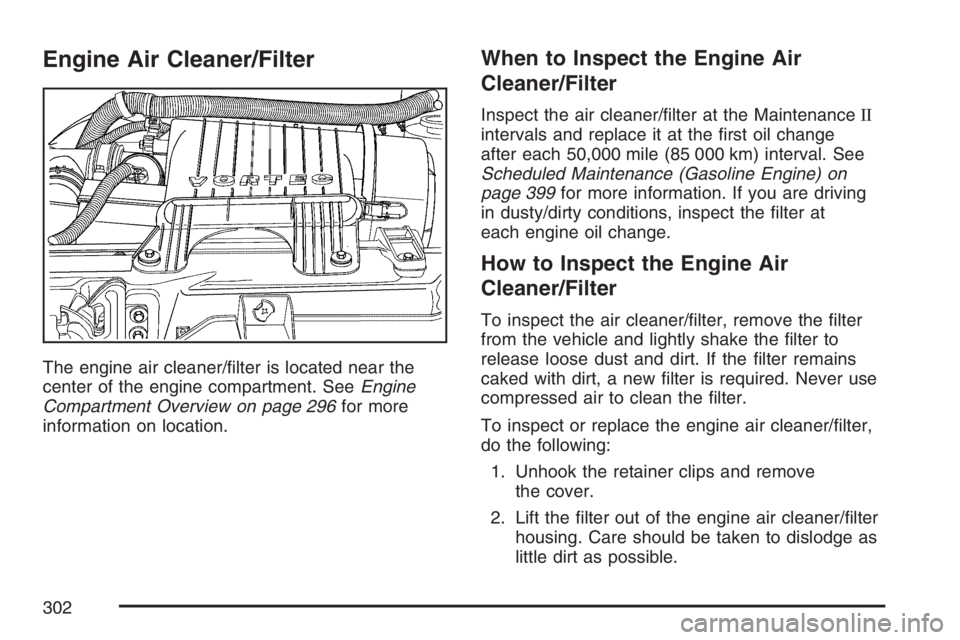
The engine air cleaner/filter is located near the
center of the engine compartment. SeeEngine
Compartment Overview on page 296for more
information on location.
When to Inspect the Engine Air
Cleaner/Filter
Inspect the air cleaner/filter at the MaintenanceII
intervals and replace it at the first oil change
after each 50,000 mile (85 000 km) interval. See
Scheduled Maintenance (Gasoline Engine) on
page 399for more information. If you are driving
in dusty/dirty conditions, inspect the filter at
each engine oil change.
How to Inspect the Engine Air
Cleaner/Filter
To inspect the air cleaner/filter, remove the filter
from the vehicle and lightly shake the filter to
release loose dust and dirt. If the filter remains
caked with dirt, a new filter is required. Never use
compressed air to clean the filter.
To inspect or replace the engine air cleaner/filter,
do the following:
1. Unhook the retainer clips and remove
the cover.
2. Lift the filter out of the engine air cleaner/filter
housing. Care should be taken to dislodge as
little dirt as possible.
302
Page 306 of 452
How to Add Automatic
Transmission Fluid
Refer to the Maintenance Schedule to determine
what kind of transmission fluid to use. See
Recommended Fluids and Lubricants on page 409.
Using a funnel, add fluid down the transmission
dipstick tube only after checking the transmission
fluid while it is hot. A cold check is used only
as a reference. If the fluid level is low, add only
enough of the proper fluid to bring the level up to
the HOT area for a hot check. It does not take
much fluid, generally less than one pint (0.5 L). Do
not overfill.
Notice:Use of the incorrect automatic
transmission uid may damage your vehicle,
and the damages may not be covered by
your warranty. Always use the automatic
transmission uid listed inRecommended
Fluids and Lubricants on page 409.
•After adding fluid, recheck the fluid level as
described under “How to Check Automatic
Transmission Fluid,” earlier in this section.
•When the correct fluid level is obtained, push
the dipstick back in all the way; then flip the
handle down to lock the dipstick in place.
Engine Coolant
The cooling system in your vehicle is filled with
DEX-COOL®engine coolant. This coolant is
designed to remain in your vehicle for five years or
150,000 miles (240 000 km), whichever occurs first,
if you add only DEX-COOL
®extended life coolant.
The following explains your cooling system and
how to add coolant when it is low. If you have a
problem with engine overheating, seeEngine
Overheating on page 309.
A 50/50 mixture of clean, drinkable water and
DEX-COOL
®coolant will:
•Give freezing protection down to
−34°F (−37°C).
•Give boiling protection up to 265°F (129°C).
•Protect against rust and corrosion.
•Help keep the proper engine temperature.
•Let the warning lights and gages work as
they should.
306
Page 320 of 452
So, it is not a good idea to top off your brake fluid.
Adding brake fluid will not correct a leak. If you
add fluid when your linings are worn, then you will
have too much fluid when you get new brake
linings. You should add or remove brake fluid, as
necessary, only when work is done on the
brake hydraulic system.
{CAUTION:
If you have too much brake uid, it can
spill on the engine and/or fuel operated
heater parts, if equipped. If your vehicle
has a diesel engine and a fuel operated
heater, see “Fuel Operated Heater (FOH)”
in the diesel engine supplement. The uid
will burn if the engine is hot enough. You
or others could be burned, and your
vehicle could be damaged. Add brake
uid only when work is done on the brake
hydraulic system. See “Checking Brake
Fluid” in this section.Refer to the Maintenance Schedule to determine
when to check your brake fluid. SeeScheduled
Maintenance (Gasoline Engine) on page 399.
Checking Brake Fluid
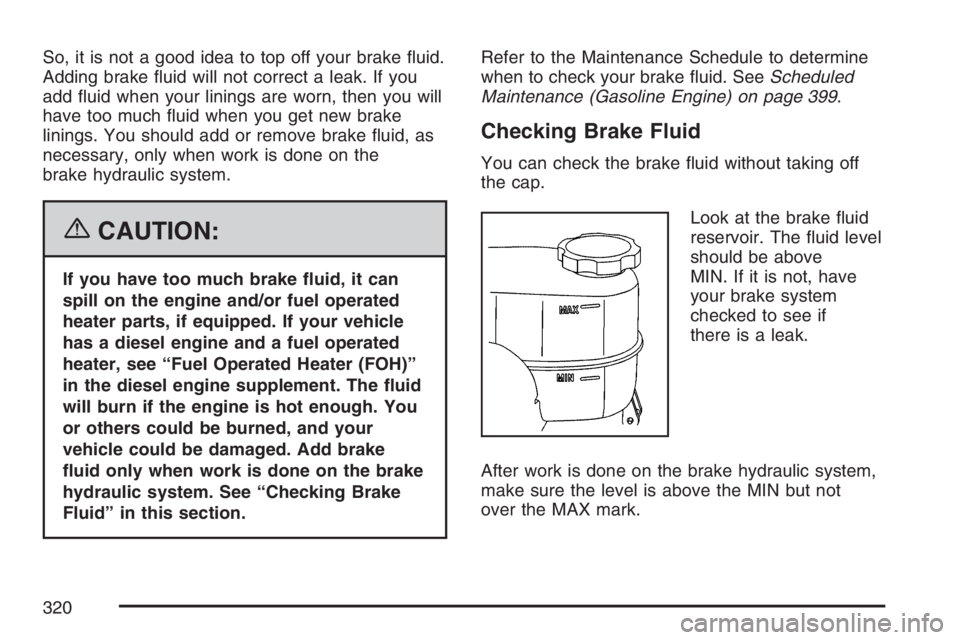
You can check the brake fluid without taking off
the cap.
Look at the brake fluid
reservoir. The fluid level
should be above
MIN. If it is not, have
your brake system
checked to see if
there is a leak.
After work is done on the brake hydraulic system,
make sure the level is above the MIN but not
over the MAX mark.
320
Page 323 of 452
Replacing Brake System Parts
The braking system on a vehicle is complex. Its
many parts have to be of top quality and work well
together if the vehicle is to have really good
braking. Your vehicle was designed and tested with
top-quality GM brake parts. When you replace parts
of your braking system — for example, when your
brake linings wear down and you need new ones
put in — be sure you get new approved GM
replacement parts. If you do not, your brakes may
no longer work properly. For example, if someone
puts in brake linings that are wrong for your vehicle,
the balance between your front and rear brakes can
change — for the worse. The braking performance
you have come to expect can change in many other
ways if someone puts in the wrong replacement
brake parts.
Battery
Your vehicle has a maintenance free battery.
When it is time for a new battery, get one that has
the replacement number shown on the original
battery’s label. We recommend an ACDelco
®
replacement battery. SeeEngine Compartment
Overview on page 296for battery location.
Warning:Battery posts, terminals, and related
accessories contain lead and lead compounds,
chemicals known to the State of California
to cause cancer and reproductive harm. Wash
hands after handling.
323
Page 330 of 452
All-Wheel Drive
Lubricant checks in this section also apply to
these vehicles. However, there are two additional
systems that need lubrication.
Transfer Case
When to Check Lubricant
Refer to the Maintenance Schedule to determine
how often to check the lubricant. SeeScheduled
Maintenance (Gasoline Engine) on page 399.
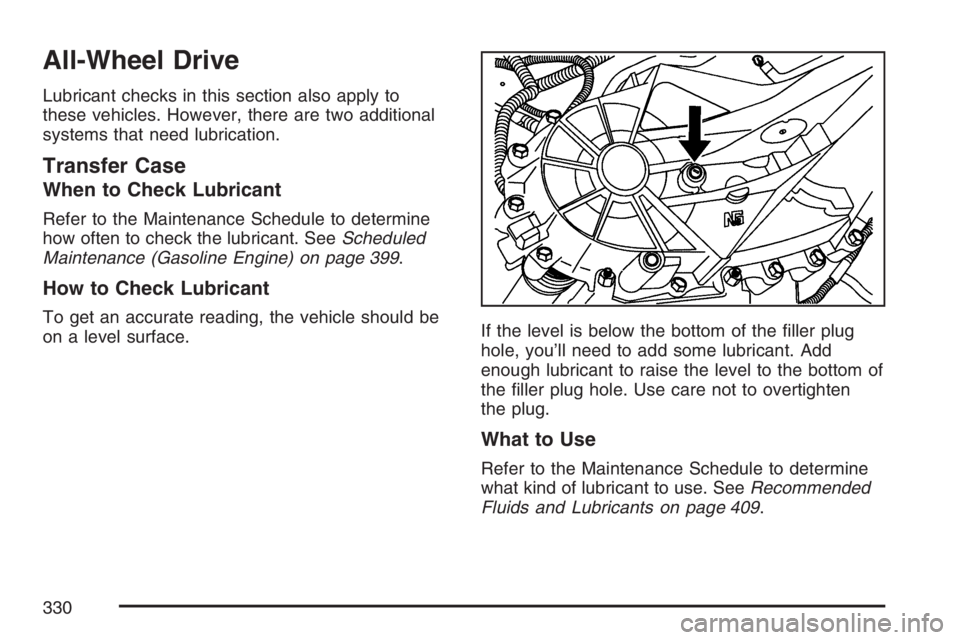
How to Check Lubricant
To get an accurate reading, the vehicle should be
on a level surface.If the level is below the bottom of the filler plug
hole, you’ll need to add some lubricant. Add
enough lubricant to raise the level to the bottom of
the filler plug hole. Use care not to overtighten
the plug.
What to Use
Refer to the Maintenance Schedule to determine
what kind of lubricant to use. SeeRecommended
Fluids and Lubricants on page 409.
330
Page 331 of 452
Rear Axle
When to Check Lubricant
Refer to the Maintenance Schedule to determine
how often to check the lubricant. SeeScheduled
Maintenance (Gasoline Engine) on page 399.
How to Check Lubricant
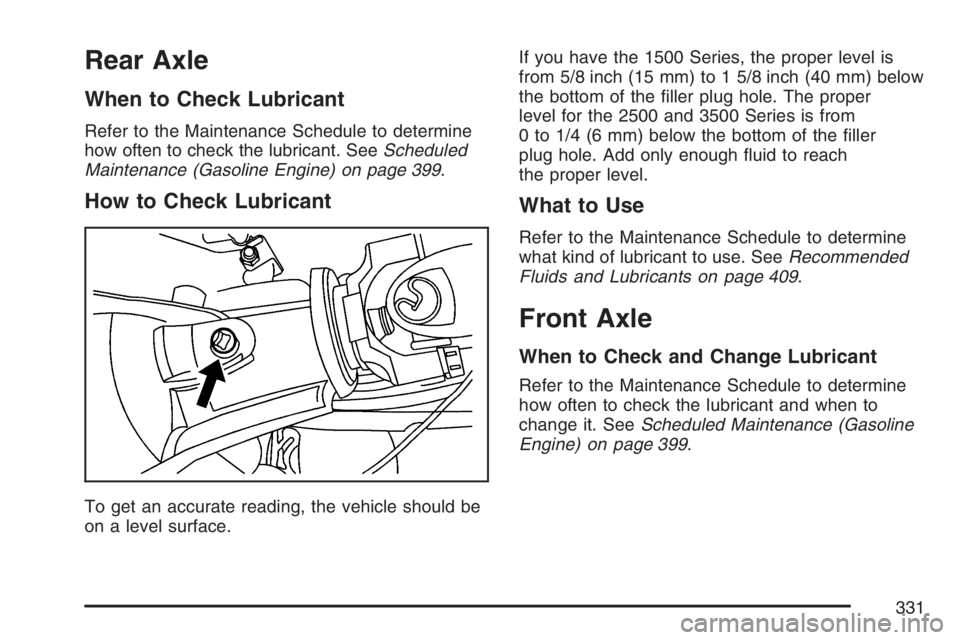
To get an accurate reading, the vehicle should be
on a level surface.If you have the 1500 Series, the proper level is
from 5/8 inch (15 mm) to 1 5/8 inch (40 mm) below
the bottom of the filler plug hole. The proper
level for the 2500 and 3500 Series is from
0 to 1/4 (6 mm) below the bottom of the filler
plug hole. Add only enough fluid to reach
the proper level.
What to Use
Refer to the Maintenance Schedule to determine
what kind of lubricant to use. SeeRecommended
Fluids and Lubricants on page 409.
Front Axle
When to Check and Change Lubricant
Refer to the Maintenance Schedule to determine
how often to check the lubricant and when to
change it. SeeScheduled Maintenance (Gasoline
Engine) on page 399.
331
Page 332 of 452
How to Check Lubricant
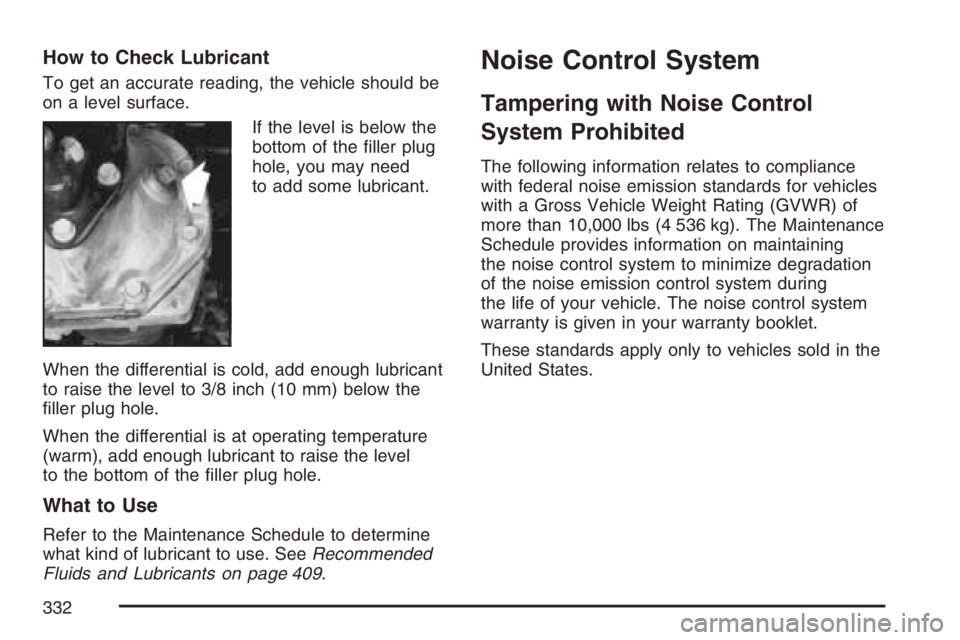
To get an accurate reading, the vehicle should be
on a level surface.
If the level is below the
bottom of the filler plug
hole, you may need
to add some lubricant.
When the differential is cold, add enough lubricant
to raise the level to 3/8 inch (10 mm) below the
filler plug hole.
When the differential is at operating temperature
(warm), add enough lubricant to raise the level
to the bottom of the filler plug hole.
What to Use
Refer to the Maintenance Schedule to determine
what kind of lubricant to use. SeeRecommended
Fluids and Lubricants on page 409.
Noise Control System
Tampering with Noise Control
System Prohibited
The following information relates to compliance
with federal noise emission standards for vehicles
with a Gross Vehicle Weight Rating (GVWR) of
more than 10,000 lbs (4 536 kg). The Maintenance
Schedule provides information on maintaining
the noise control system to minimize degradation
of the noise emission control system during
the life of your vehicle. The noise control system
warranty is given in your warranty booklet.
These standards apply only to vehicles sold in the
United States.
332
Page 333 of 452
Federal law prohibits the following acts or the
causing thereof:
1. The removal or rendering inoperative by any
person, other than for purposes of
maintenance, repair or replacement, of any
device or element of design incorporated into
any new vehicle for the purpose of noise
control, prior to its sale or delivery to
the ultimate purchaser or while it is in use; or
2. The use of the vehicle after such device or
element of design has been removed or
rendered inoperative by any person.
Among those acts presumed to constitute
tampering are the acts listed below.
Insulation:
•
Removal of the noise shields or any
underhood insulation.
Engine:
•
Removal or rendering engine speed governor,
if the vehicle has one, inoperative so as to
allow engine speed to exceed manufacturer
specifications.
Fan and Drive:
•
Removal of fan clutch, if the vehicle has one,
or rendering clutch inoperative.
•Removal of the fan shroud, if the vehicle
has one.
Air Intake:
•
Removal of the air cleaner silencer.
•Modification of the air cleaner.
Exhaust:
•
Removal of the muffler and/or resonator.
•Removal of the exhaust pipes and exhaust
pipe clamps.
Fuel Operated Heater (FOH) — Diesel
Engine:
•
Removal of the muffler.
333
Page 338 of 452
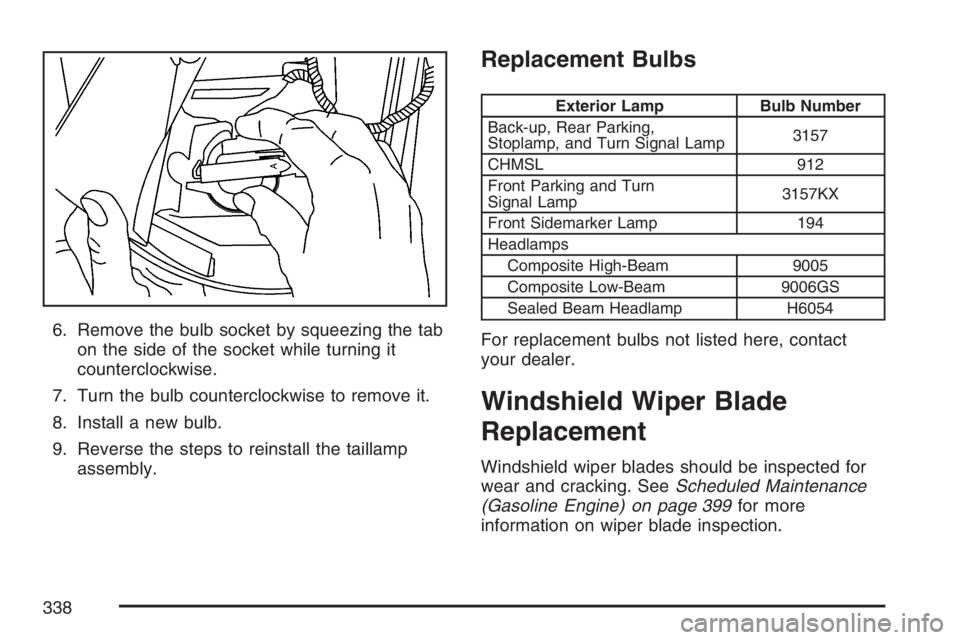
6. Remove the bulb socket by squeezing the tab
on the side of the socket while turning it
counterclockwise.
7. Turn the bulb counterclockwise to remove it.
8. Install a new bulb.
9. Reverse the steps to reinstall the taillamp
assembly.
Replacement Bulbs
Exterior Lamp Bulb Number
Back-up, Rear Parking,
Stoplamp, and Turn Signal Lamp3157
CHMSL 912
Front Parking and Turn
Signal Lamp3157KX
Front Sidemarker Lamp 194
Headlamps
Composite High-Beam 9005
Composite Low-Beam 9006GS
Sealed Beam Headlamp H6054
For replacement bulbs not listed here, contact
your dealer.
Windshield Wiper Blade
Replacement
Windshield wiper blades should be inspected for
wear and cracking. SeeScheduled Maintenance
(Gasoline Engine) on page 399for more
information on wiper blade inspection.
338