oil GMC SAVANA 2007 User Guide
[x] Cancel search | Manufacturer: GMC, Model Year: 2007, Model line: SAVANA, Model: GMC SAVANA 2007Pages: 452, PDF Size: 2.68 MB
Page 226 of 452
Care of Your CDs
Handle CDs carefully. Store them in their original
cases or other protective cases and away from
direct sunlight and dust. The CD player scans the
bottom surface of the disc. If the surface of a
CD is damaged, such as cracked, broken,
or scratched, the CD will not play properly or not
at all. If the surface of a CD is soiled, take a
soft, lint free cloth or dampen a clean, soft cloth in
a mild, neutral detergent solution mixed with
water, and clean it. Make sure the wiping process
starts from the center to the edge.
Do not touch the bottom side of a CD while
handling it; this could damage the surface. Pick up
CDs by grasping the outer edges or the edge of
the hole and the outer edge.
Care of the CD Player
Do not use CD lens cleaners for CD players
because the lens of the CD optics can become
contaminated by lubricants.
Fixed Mast Antenna
The fixed mast antenna can withstand most car
washes without being damaged. If the mast should
ever become slightly bent, straighten it out by
hand. If the mast is badly bent, replace it.
Check occasionally to make sure the mast is
still tightened to the fender. If tightening is
required, tighten by hand, then with a wrench
one quarter turn.
Chime Level Adjustment
The radio is used to adjust the vehicle’s chime
level. To change the volume level of the chime,
press and hold pushbutton 6 with the ignition on
and the radio power off. The volume level will
change from the normal level to loud, and LOUD
will appear on the radio display. To change back to
the default or normal setting, press and hold
pushbutton 6 again. The volume level will change
from the loud level to normal, and NORMAL will
appear on the radio display. Each time the chime
volume is changed, three chimes will sound to
indicate the change. Removing the radio and not
replacing it with a factory radio or chime module will
disable vehicle chimes.
226
Page 250 of 452
Before changing lanes, check your mirrors.
Then use your turn signal.
Just before you leave the lane, glance quickly
over your shoulder to make sure there is not
another vehicle in your blind spot.
Once you are moving on the freeway, make
certain you allow a reasonable following distance.
Expect to move slightly slower at night.
When you want to leave the freeway, move to the
proper lane well in advance. If you miss your
exit, do not, under any circumstances, stop and
back up. Drive on to the next exit.
The exit ramp can be curved, sometimes quite
sharply. The exit speed is usually posted.
Reduce your speed according to your
speedometer, not to your sense of motion.
After driving for any distance at higher speeds,
you may tend to think you are going slower than
you actually are.Before Leaving on a Long Trip
Make sure you are ready. Try to be well rested.
If you must start when you are not fresh — such
as after a day’s work — do not plan to make
too many miles that first part of the journey.
Wear comfortable clothing and shoes you can
easily drive in.
Is your vehicle ready for a long trip? If you keep it
serviced and maintained, it is ready to go. If it
needs service, have it done before starting out.
Of course, you will find experienced and able
service experts in GM dealerships all across
North America. They will be ready and willing to
help if you need it.
Here are some things you can check before a trip:
•Windshield Washer Fluid:Is the reservoir
full? Are all windows clean inside and outside?
•Wiper Blades:Are they in good shape?
•Fuel, Engine Oil, Other Fluids:Have you
checked all levels?
250
Page 280 of 452
Turn Signals When Towing a Trailer
When you tow a trailer, your vehicle has to have
extra wiring and a heavy-duty turn signal
flasher (included in the optional trailering package).
The arrows on your instrument panel will flash
whenever you signal a turn or lane change.
Properly hooked up, the trailer lamps will also flash,
telling other drivers you’re about to turn, change
lanes or stop.
When towing a trailer, the arrows on your
instrument panel will flash for turns even if the bulbs
on the trailer are burned out. Thus, you may think
drivers behind you are seeing your signal when
they are not. It’s important to check occasionally to
be sure the trailer bulbs are still working.
Driving On Grades
Reduce speed and shift to a lower gearbefore
you start down a long or steep downgrade. If you
don’t shift down, you might have to use your
brakes so much that they would get hot and no
longer work well.
You can tow in DRIVE (D). You may want to shift
the transmission to THIRD (3) or a lower gear
under heavy loads and/or hilly conditions.
When towing at high altitude on steep uphill grades,
consider the following: Engine coolant will boil at a
lower temperature than at normal altitudes. If you
turn your engine off immediately after towing at high
altitude on steep uphill grades, your vehicle may
show signs similar to engine overheating. To avoid
this, let the engine run while parked (preferably on
level ground) with the automatic transmission in
PARK (P) for a few minutes before turning the
engine off. If you do get the overheat warning, see
Engine Overheating on page 309.
280
Page 282 of 452
Maintenance When Trailer Towing
Your vehicle will need service more often when
you’re pulling a trailer. See the Maintenance
Schedule for more on this. Things that are
especially important in trailer operation are
automatic transmission fluid (don’t overfill), engine
oil, axle lubricant, belt, cooling system and brake
system. Each of these is covered in this manual,
and the Index will help you find them quickly.
If you’re trailering, it’s a good idea to review these
sections before you start your trip.
Check periodically to see that all hitch nuts and
bolts are tight.
Trailer Wiring Harness
The optional heavy-duty trailer wiring package
includes a seven-wire harness assembly at
the rear of the vehicle and a four-wire
harness assembly under the left hand side
of the instrument panel. The seven-wire
harness assembly is taped together and
located in a frame pocket at the driver side
rear left corner of the frame.The seven-wire harness includes a 30-amp feed
wire. Both harnesses come without connectors and
should be wired by a qualified electrical technician.
The technician can use the following color code
chart when connecting the wiring harness to
your trailer and trailer brake controller.
Seven-Wire Harness
•Light Green: Back-up lamps
•Brown: Parking lamps
•Yellow: Left stoplamp and turn signal
•Dark Green: Right stoplamp and turn signal
•Dark Blue: Use for electric trailer brakes
•Red/Black Stripe: Trailer accessory
•White (heavy gage): Ground wire
Four-Wire Harness (Trailer Brake Controller)
•Black: Ground
•Red/White Stripe: Fused Battery
•Dark Blue: Trailer Brake Feed
•Light Blue: Fused Stoplamp/CHMSL
282
Page 283 of 452
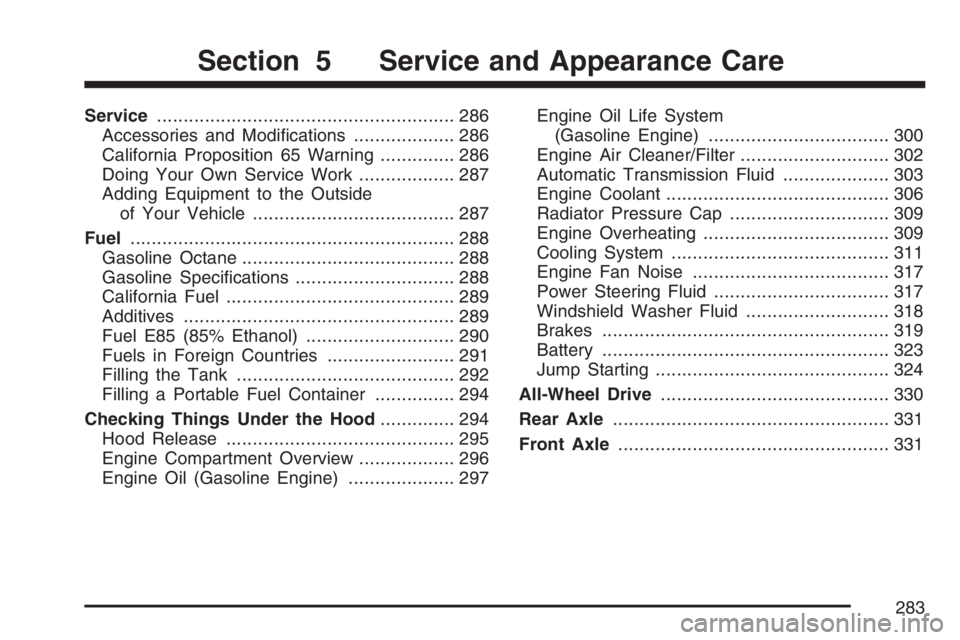
Service........................................................ 286
Accessories and Modifications................... 286
California Proposition 65 Warning.............. 286
Doing Your Own Service Work.................. 287
Adding Equipment to the Outside
of Your Vehicle...................................... 287
Fuel............................................................. 288
Gasoline Octane........................................ 288
Gasoline Specifications.............................. 288
California Fuel........................................... 289
Additives................................................... 289
Fuel E85 (85% Ethanol)............................ 290
Fuels in Foreign Countries........................ 291
Filling the Tank......................................... 292
Filling a Portable Fuel Container............... 294
Checking Things Under the Hood.............. 294
Hood Release........................................... 295
Engine Compartment Overview.................. 296
Engine Oil (Gasoline Engine).................... 297Engine Oil Life System
(Gasoline Engine).................................. 300
Engine Air Cleaner/Filter............................ 302
Automatic Transmission Fluid.................... 303
Engine Coolant.......................................... 306
Radiator Pressure Cap.............................. 309
Engine Overheating................................... 309
Cooling System......................................... 311
Engine Fan Noise..................................... 317
Power Steering Fluid ................................. 317
Windshield Washer Fluid........................... 318
Brakes...................................................... 319
Battery...................................................... 323
Jump Starting............................................ 324
All-Wheel Drive........................................... 330
Rear Axle.................................................... 331
Front Axle................................................... 331
Section 5 Service and Appearance Care
283
Page 291 of 452
To ensure quick starts in the wintertime, the
E85 fuel must be formulated properly for your
climate according to ASTM specification D 5798.
If you have trouble starting on E85, it may be
because your E85 fuel is not properly formulated
for your climate. If this happens, switching to
gasoline or adding gasoline to your fuel tank may
improve starting. For good starting and heater
efficiency below 32°F (0°C), the fuel mix in the fuel
tank should contain no more than 70% ethanol.
It is best not to alternate repeatedly between
gasoline and E85. If you do switch fuels, it
is recommended that you add as much fuel as
possible — do not add less than three gallons
(11 L) when refueling. You should drive the
vehicle immediately after refueling for at least
seven miles (11 km) to allow the vehicle to adapt
to the change in ethanol concentration.
E85 has less energy per gallon than gasoline, so
you will need to refill your fuel tank more often
when using E85 than when you are using gasoline.
SeeFilling the Tank on page 292.Notice:Some additives are not compatible
with E85 fuel and may harm your vehicle’s fuel
system. Damage caused by additives would
not be covered by your new vehicle warranty.
Notice:Your vehicle was not designed for
fuel that contains methanol. Do not use
fuel containing methanol. It can corrode metal
parts in your fuel system and also damage
the plastic and rubber parts. That damage
would not be covered under your warranty.
Fuels in Foreign Countries
If you plan on driving in another country outside
the United States or Canada, the proper fuel may
be hard to find. Never use leaded gasoline or
any other fuel not recommended in the previous
text on fuel. Costly repairs caused by use of
improper fuel would not be covered by your
warranty.
To check the fuel availability, ask an auto club, or
contact a major oil company that does business
in the country where you will be driving.
291
Page 294 of 452
Filling a Portable Fuel Container
{CAUTION:
Never ll a portable fuel container while it
is in your vehicle. Static electricity
discharge from the container can ignite the
gasoline vapor. You can be badly burned
and your vehicle damaged if this occurs.
To help avoid injury to you and others:
Dispense gasoline only into approved
containers.
Do not ll a container while it is inside a
vehicle, in a vehicle’s trunk, pickup
bed, or on any surface other than the
ground.
Bring the ll nozzle in contact with the
inside of the ll opening before
operating the nozzle. Contact should
be maintained until the lling is
complete.
Do not smoke while pumping gasoline.
Checking Things Under
the Hood
{CAUTION:
Things that burn can get on hot engine or
fuel operated heater (FOH) parts and start a
re. These include liquids like fuel, oil,
coolant, brake uid, windshield washer and
other uids, and plastic or rubber. You or
others could be burned. Be careful not to
drop or spill things that will burn onto a hot
engine or fuel operated heater (FOH).
294
Page 297 of 452
A. Battery. SeeBattery on page 323.
B. Radiator Pressure Cap. SeeRadiator Pressure
Cap on page 309.
C. Coolant Recovery Tank. SeeCooling System
on page 311.
D. Automatic Transmission Fluid Dipstick. See
“Checking the Fluid Level” underAutomatic
Transmission Fluid on page 303.
E. Engine Oil Fill Cap. See “When to Add Engine
Oil” underEngine Oil (Gasoline Engine) on
page 297.
F. Engine Oil Dipstick. See “Checking Engine Oil”
underEngine Oil (Gasoline Engine) on
page 297.
G. Engine Air Cleaner/Filter. SeeEngine Air
Cleaner/Filter on page 302.
H. Power Steering Fluid Reservoir. SeePower
Steering Fluid on page 317.
I. Brake Master Cylinder Reservoir. See “Brake
Fluid” underBrakes on page 319.
J. Windshield Washer Fluid Reservoir. See
“Adding Washer Fluid” underWindshield
Washer Fluid on page 318.Engine Oil (Gasoline Engine)
If your vehicle has a diesel engine, see “Engine
Oil” in the DURAMAX®Diesel Engine Supplement.
Checking Engine Oil
It is a good idea to check the engine oil every time
you get fuel. In order to get an accurate reading,
the oil must be warm and the vehicle must be
on level ground.
The engine oil dipstick handle is a yellow loop.
SeeEngine Compartment Overview on page 296
for the location of the engine oil dipstick.
1. Turn off the engine and give the oil several
minutes to drain back into the oil pan. If you
do not do this, the oil dipstick might not
show the actual level.
2. Pull out the dipstick and clean it with a paper
towel or cloth, then push it back in all the
way. Remove it again, keeping the tip down,
and check the level.
297
Page 298 of 452
When to Add Engine Oil
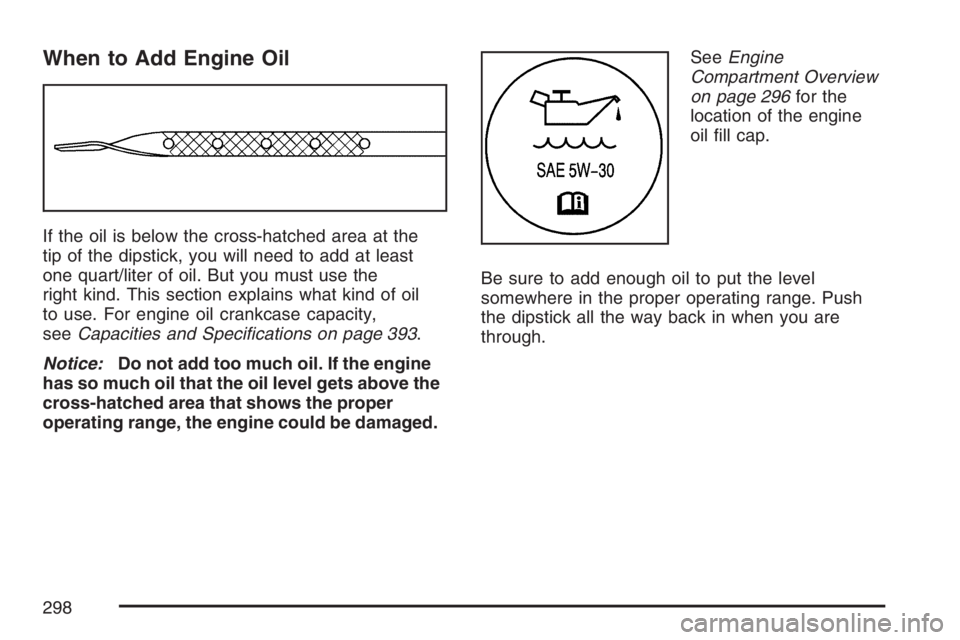
If the oil is below the cross-hatched area at the
tip of the dipstick, you will need to add at least
one quart/liter of oil. But you must use the
right kind. This section explains what kind of oil
to use. For engine oil crankcase capacity,
seeCapacities and Specications on page 393.
Notice:Do not add too much oil. If the engine
has so much oil that the oil level gets above the
cross-hatched area that shows the proper
operating range, the engine could be damaged.SeeEngine
Compartment Overview
on page 296for the
location of the engine
oil fill cap.
Be sure to add enough oil to put the level
somewhere in the proper operating range. Push
the dipstick all the way back in when you are
through.
298
Page 299 of 452
What Kind of Engine Oil to Use
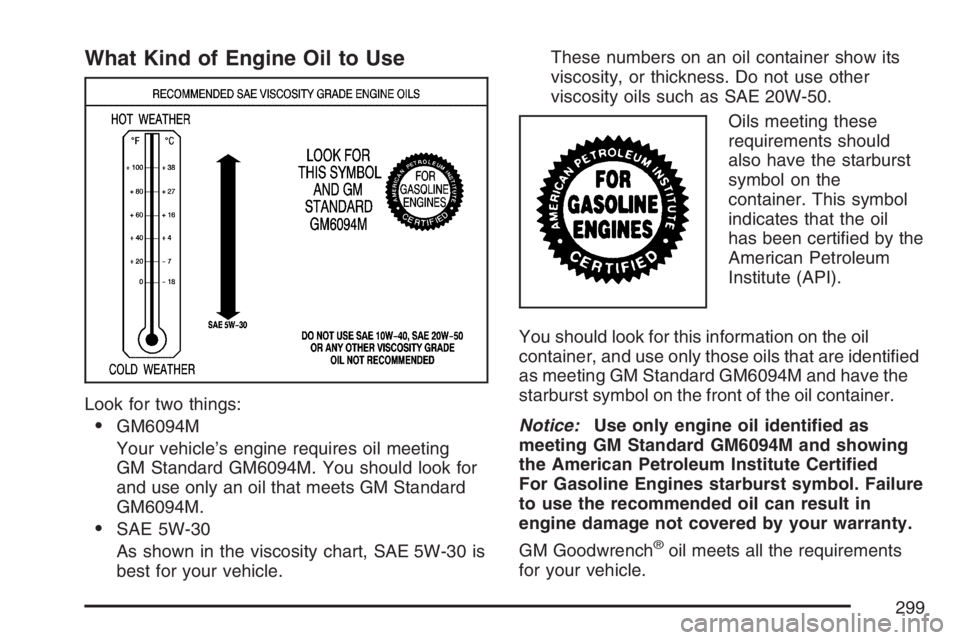
Look for two things:
•GM6094M
Your vehicle’s engine requires oil meeting
GM Standard GM6094M. You should look for
and use only an oil that meets GM Standard
GM6094M.
•SAE 5W-30
As shown in the viscosity chart, SAE 5W-30 is
best for your vehicle.These numbers on an oil container show its
viscosity, or thickness. Do not use other
viscosity oils such as SAE 20W-50.
Oils meeting these
requirements should
also have the starburst
symbol on the
container. This symbol
indicates that the oil
has been certified by the
American Petroleum
Institute (API).
You should look for this information on the oil
container, and use only those oils that are identified
as meeting GM Standard GM6094M and have the
starburst symbol on the front of the oil container.
Notice:Use only engine oil identied as
meeting GM Standard GM6094M and showing
the American Petroleum Institute Certied
For Gasoline Engines starburst symbol. Failure
to use the recommended oil can result in
engine damage not covered by your warranty.
GM Goodwrench®oil meets all the requirements
for your vehicle.
299