tire size GMC SAVANA 2007 User Guide
[x] Cancel search | Manufacturer: GMC, Model Year: 2007, Model line: SAVANA, Model: GMC SAVANA 2007Pages: 452, PDF Size: 2.68 MB
Page 354 of 452
GM’s exclusive TPC Spec system considers over
a dozen critical specifications that impact the
overall performance of your vehicle, including
brake system performance, ride and handling,
traction control, and tire pressure monitoring
performance. GM’s TPC Spec number is molded
onto the tire’s sidewall by the tire manufacturer.
If the tires have an all-season tread design,
the TPC spec number will be followed by a MS,
for mud and snow. SeeTire Sidewall Labeling on
page 341for additional information.
{CAUTION:
Mixing tires could cause you to lose
control while driving. If you mix tires of
different sizes, brands, or types (radial
and bias-belted tires) the vehicle may not
handle properly, and you could have a
crash. Using tires of different sizes,
brands, or types may also cause damage
to your vehicle. Be sure to use the correct
size, brand, and type of tires on your
vehicle’s wheels.
{CAUTION:
If you use bias-ply tires on your vehicle,
the wheel rim anges could develop
cracks after many miles of driving. A tire
and/or wheel could fail suddenly, causing
a crash. Use only radial-ply tires with the
wheels on your vehicle.
If you must replace your vehicle’s tires with those
that do not have a TPC Spec number, make
sure they are the same size, load range, speed
rating, and construction type (radial and
bias-belted tires) as your vehicle’s original tires.
Your vehicle’s original equipment tires are listed on
the Tire and Loading Information label. This label is
attached to the vehicle’s center pillar (B-pillar).
SeeLoading Your Vehicle on page 259, for more
information about the Tire and Loading
Information label.
354
Page 355 of 452
Different Size Tires and Wheels
If you add wheels or tires that are a different size
than your original equipment wheels and tires, this
may affect the way your vehicle performs, including
its braking, ride and handling characteristics,
stability, and resistance to rollover. Additionally,
if your vehicle has electronic systems such as,
anti-lock brakes, traction control, and electronic
stability control, the performance of these systems
can be affected.
{CAUTION:
If you add different sized wheels, your
vehicle may not provide an acceptable
level of performance and safety if tires
not recommended for those wheels are
CAUTION: (Continued)
CAUTION: (Continued)
selected. You may increase the chance
that you will crash and suffer serious
injury. Only use GM specic wheel and
tire systems developed for your vehicle,
and have them properly installed by a
GM certied technician.
SeeBuying New Tires on page 353and
Accessories and Modications on page 286for
additional information.
355
Page 359 of 452
Tire Chains
{CAUTION:
If your vehicle has dual wheels or P245/
75R16 or LT245/75R16 size tires, do not
use tire chains. They can damage your
vehicle because there is not enough
clearance. Tire chains used on a vehicle
without the proper amount of clearance
can cause damage to the brakes,
suspension, or other vehicle parts.
The area damaged by the tire chains
could cause you to lose control of your
vehicle and you or others may be injured
in a crash.
Use another type of traction device only
if its manufacturer recommends it for use
on your vehicle and tire size combination
and road conditions. Follow that
manufacturer’s instructions. To help avoid
CAUTION: (Continued)
CAUTION: (Continued)
damage to your vehicle, drive slowly,
readjust, or remove the device if it is
contacting your vehicle, and do not spin
the vehicle’s wheels.
If you do nd traction devices that will t,
install them on the rear tires.
Notice:If your vehicle does not have dual
wheels and has a tire size other than P245/
75R16 or LT245/75R16, use tire chains only
where legal and only when you must. Use
chains that are the proper size for your tires.
Install them on the tires of the rear axle. Do not
use chains on the tires of the front axle. Tighten
them as tightly as possible with the ends
securely fastened. Drive slowly and follow the
chain manufacturer’s instructions. If you can
hear the chains contacting your vehicle, stop
and retighten them. If the contact continues,
slow down until it stops. Driving too fast or
spinning the wheels with chains on will
damage your vehicle.
359
Page 364 of 452
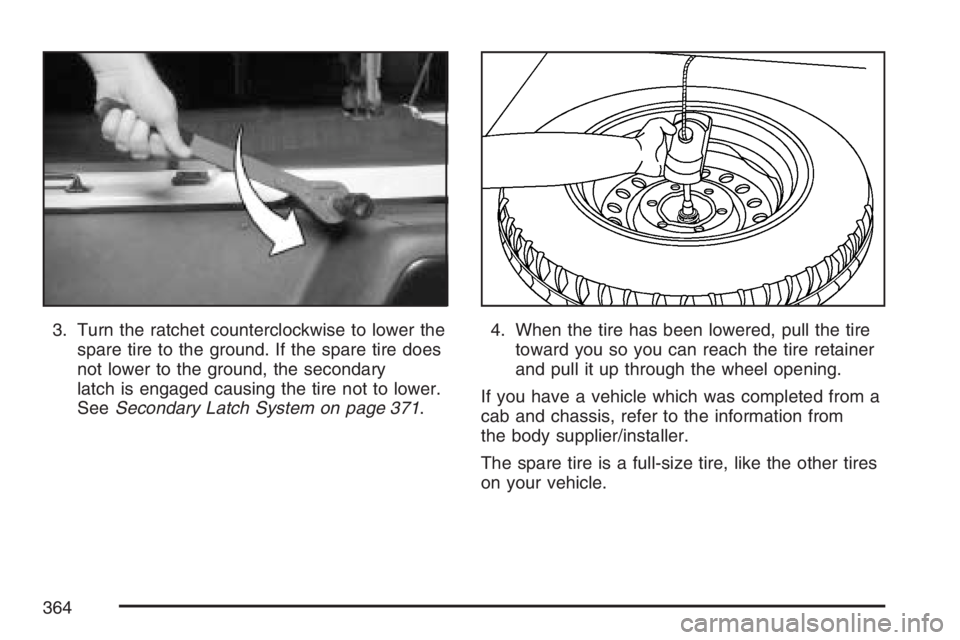
3. Turn the ratchet counterclockwise to lower the
spare tire to the ground. If the spare tire does
not lower to the ground, the secondary
latch is engaged causing the tire not to lower.
SeeSecondary Latch System on page 371.4. When the tire has been lowered, pull the tire
toward you so you can reach the tire retainer
and pull it up through the wheel opening.
If you have a vehicle which was completed from a
cab and chassis, refer to the information from
the body supplier/installer.
The spare tire is a full-size tire, like the other tires
on your vehicle.
364
Page 376 of 452
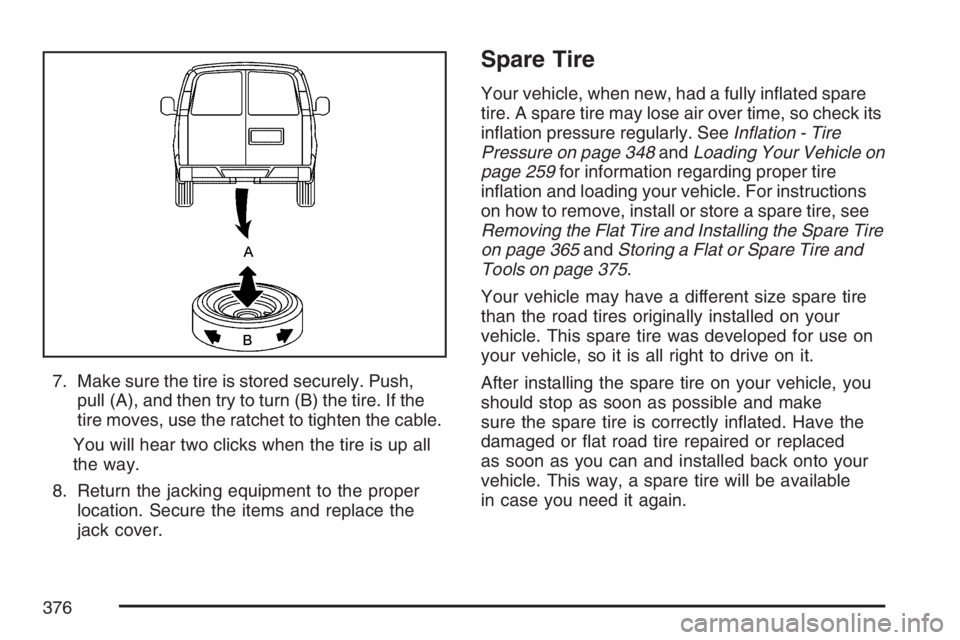
7. Make sure the tire is stored securely. Push,
pull (A), and then try to turn (B) the tire. If the
tire moves, use the ratchet to tighten the cable.
You will hear two clicks when the tire is up all
the way.
8. Return the jacking equipment to the proper
location. Secure the items and replace the
jack cover.
Spare Tire
Your vehicle, when new, had a fully inflated spare
tire. A spare tire may lose air over time, so check its
inflation pressure regularly. SeeInation - Tire
Pressure on page 348andLoading Your Vehicle on
page 259for information regarding proper tire
inflation and loading your vehicle. For instructions
on how to remove, install or store a spare tire, see
Removing the Flat Tire and Installing the Spare Tire
on page 365andStoring a Flat or Spare Tire and
Tools on page 375.
Your vehicle may have a different size spare tire
than the road tires originally installed on your
vehicle. This spare tire was developed for use on
your vehicle, so it is all right to drive on it.
After installing the spare tire on your vehicle, you
should stop as soon as possible and make
sure the spare tire is correctly inflated. Have the
damaged or flat road tire repaired or replaced
as soon as you can and installed back onto your
vehicle. This way, a spare tire will be available
in case you need it again.
376
Page 377 of 452
Do not mix tires and wheels of different sizes,
because they will not fit. Keep your spare tire and
its wheel together. If your vehicle has a spare
tire that does not match your vehicle’s original road
tires and wheels in size and type, do not include
the spare tire in the tire rotation.
Appearance Care
Cleaning the Inside of Your Vehicle
Your vehicle’s interior will continue to look its
best if it is cleaned often. Although not always
visible, dust and dirt can accumulate on your
upholstery. Dirt can damage carpet, fabric, leather,
and plastic surfaces. Regular vacuuming is
recommended to remove particles from your
upholstery. It is important to keep your upholstery
from becoming and remaining heavily soiled.
Soils should be removed as quickly as possible.
Your vehicle’s interior may experience extremes of
heat that could cause stains to set rapidly.
Lighter colored interiors may require more frequent
cleaning. Use care because newspapers and
garments that transfer color to your home
furnishings may also transfer color to your
vehicle’s interior.When cleaning your vehicle’s interior, only use
cleaners specifically designed for the surfaces
being cleaned. Permanent damage may result
from using cleaners on surfaces for which
they were not intended. Use glass cleaner only on
glass. Remove any accidental over-spray from
other surfaces immediately. To prevent over-spray,
apply cleaner directly to the cleaning cloth.
Notice:If you use abrasive cleaners when
cleaning glass surfaces on your vehicle, you
could scratch the glass and/or cause damage
to the rear window defogger. When cleaning
the glass on your vehicle, use only a soft cloth
and glass cleaner.
Many cleaners contain solvents that may become
concentrated in your vehicle’s breathing space.
Before using cleaners, read and adhere to all safety
instructions on the label. While cleaning your
vehicle’s interior, maintain adequate ventilation by
opening your vehicle’s doors and windows.
Dust may be removed from small buttons and
knobs using a small brush with soft bristles.
377
Page 451 of 452
Sun Visors.................................................. 119
Swing-Out Side Door, 60/40........................ 112
Swing-Out Windows.................................... 118
T
Taillamps..................................................... 337
Theft-Deterrent, Radio................................. 223
Theft-Deterrent Systems.............................. 119
Passlock
®................................................ 119
Tilt Wheel.................................................... 147
Tires........................................................... 340
Aluminum Wheels, Cleaning..................... 382
Buying New Tires..................................... 353
Chains..................................................... 359
Changing a Flat Tire................................ 360
Cleaning.................................................. 383
Different Size........................................... 355
Dual Tire Operation.................................. 350
If a Tire Goes Flat................................... 360
Inflation - Tire Pressure............................ 348
Inspection and Rotation............................ 351
Installing the Spare Tire........................... 365
Removing the Flat Tire............................. 365
Removing the Spare Tire and Tools......... 362
Secondary Latch System......................... 371
Spare Tire................................................ 376Tires (cont.)
Storing a Flat or Spare Tire and Tools......... 375
Tire Sidewall Labeling .............................. 341
Tire Terminology and Definitions............... 345
Uniform Tire Quality Grading.................... 356
Wheel Alignment and Tire Balance........... 357
Wheel Replacement................................. 357
When It Is Time for New Tires................. 353
Tow/Haul Mode Light................................... 185
Towing
Recreational Vehicle................................. 264
Towing a Trailer....................................... 266
Your Vehicle............................................. 264
Traction
StabiliTrak
®System................................. 235
Transmission
Fluid, Automatic....................................... 303
Transmission Operation, Automatic.............. 125
Trip Odometer............................................. 168
Turn and Lane-Change Signals................... 148
Turn Signal/Multifunction Lever.................... 147
U
Understanding Radio Reception................... 224
Uniform Tire Quality Grading....................... 356
451
Page 452 of 452
V
Vehicle
Control..................................................... 232
Damage Warnings....................................... 5
Loading.................................................... 259
Symbols...................................................... 5
Vehicle Data Collection and Event
Data Recorders........................................ 430
Vehicle Identification
Number (VIN).......................................... 386
Service Parts Identification Label.............. 386
Ventilation Adjustment.................................. 162
Visors.......................................................... 119
Voltmeter Gage........................................... 175
W
Warning Lights, Gages and Indicators......... 166
Warnings
Hazard Warning Flashers......................... 146
Other Warning Devices............................ 146
Safety and Symbols..................................... 4
Vehicle Damage.......................................... 5Wheels
Alignment and Tire Balance..................... 357
Different Size........................................... 355
Replacement............................................ 357
Where to Put the Restraint............................ 51
Windows..................................................... 116
Manual..................................................... 116
Power...................................................... 117
Swing-Out Windows................................. 118
Windshield
Washer.................................................... 150
Washer Fluid........................................... 318
Wiper Blade Replacement........................ 338
Wiper Blades, Cleaning............................ 382
Wiper Fuses............................................ 387
Wipers..................................................... 149
Winter Driving............................................. 254
Y
Your Vehicle and the Environment............... 396
452