steering GMC SAVANA 2007 Owner's Guide
[x] Cancel search | Manufacturer: GMC, Model Year: 2007, Model line: SAVANA, Model: GMC SAVANA 2007Pages: 452, PDF Size: 2.68 MB
Page 268 of 452
Tow/Haul Mode
Tow/haul is designed to assist while your vehicle
is pulling a large or heavy load or trailer.
Tow/haul is most useful while pulling such a load
in rolling terrain, in stop-and-go traffic, or when
you need improved low-speed control, such
as when parking. The purpose of the tow/haul
mode is to:
•Reduce the frequency and improve the
predictability of transmission shifts,
•provide the same solid shift feel when pulling
a heavy load as when the vehicle is unloaded,
•improve control of vehicle speed while
requiring less throttle pedal activity.
Press this button
located to the right of
the steering wheel
on the instrument panel
to turn tow/haul
mode on and off.While activated, the
indicator light on the
instrument panel
will be on.
Tow/haul mode will turn off automatically when the
ignition is turned off. SeeTow/Haul Mode Light
on page 185.
Tow/haul is most effective when the vehicle and
trailer combined weight is at least 75 percent of the
vehicle’s Gross Combined Weight Rating
(GCWR). See “Weight of the Trailer” later in this
section.
Driving with tow/haul activated without a heavy
load will cause reduced fuel economy and
unpleasant engine and transmission driving
characteristics, but will not cause damage.
268
Page 279 of 452
During your trip, check occasionally to be sure
that the load is secure, and that the lamps and any
trailer brakes are still working.
Following Distance
Stay at least twice as far behind the vehicle ahead
as you would when driving your vehicle without
a trailer. This can help you avoid situations
that require heavy braking and sudden turns.
Passing
You’ll need more passing distance up ahead when
you’re towing a trailer. And, because you’re a
good deal longer, you’ll need to go much farther
beyond the passed vehicle before you can
return to your lane.
Backing Up
Hold the bottom of the steering wheel with
one hand. Then, to move the trailer to the left, just
move that hand to the left. To move the trailer
to the right, move your hand to the right. Always
back up slowly and, if possible, have someone
guide you.
Making Turns
Notice:Making very sharp turns while
trailering could cause the trailer to come in
contact with the vehicle. Your vehicle could be
damaged. Avoid making very sharp turns
while trailering.
When you’re turning with a trailer, make wider
turns than normal. Do this so your trailer
won’t strike soft shoulders, curbs, road signs,
trees or other objects. Avoid jerky or sudden
maneuvers. Signal well in advance.
279
Page 283 of 452
Service........................................................ 286
Accessories and Modifications................... 286
California Proposition 65 Warning.............. 286
Doing Your Own Service Work.................. 287
Adding Equipment to the Outside
of Your Vehicle...................................... 287
Fuel............................................................. 288
Gasoline Octane........................................ 288
Gasoline Specifications.............................. 288
California Fuel........................................... 289
Additives................................................... 289
Fuel E85 (85% Ethanol)............................ 290
Fuels in Foreign Countries........................ 291
Filling the Tank......................................... 292
Filling a Portable Fuel Container............... 294
Checking Things Under the Hood.............. 294
Hood Release........................................... 295
Engine Compartment Overview.................. 296
Engine Oil (Gasoline Engine).................... 297Engine Oil Life System
(Gasoline Engine).................................. 300
Engine Air Cleaner/Filter............................ 302
Automatic Transmission Fluid.................... 303
Engine Coolant.......................................... 306
Radiator Pressure Cap.............................. 309
Engine Overheating................................... 309
Cooling System......................................... 311
Engine Fan Noise..................................... 317
Power Steering Fluid ................................. 317
Windshield Washer Fluid........................... 318
Brakes...................................................... 319
Battery...................................................... 323
Jump Starting............................................ 324
All-Wheel Drive........................................... 330
Rear Axle.................................................... 331
Front Axle................................................... 331
Section 5 Service and Appearance Care
283
Page 297 of 452
A. Battery. SeeBattery on page 323.
B. Radiator Pressure Cap. SeeRadiator Pressure
Cap on page 309.
C. Coolant Recovery Tank. SeeCooling System
on page 311.
D. Automatic Transmission Fluid Dipstick. See
“Checking the Fluid Level” underAutomatic
Transmission Fluid on page 303.
E. Engine Oil Fill Cap. See “When to Add Engine
Oil” underEngine Oil (Gasoline Engine) on
page 297.
F. Engine Oil Dipstick. See “Checking Engine Oil”
underEngine Oil (Gasoline Engine) on
page 297.
G. Engine Air Cleaner/Filter. SeeEngine Air
Cleaner/Filter on page 302.
H. Power Steering Fluid Reservoir. SeePower
Steering Fluid on page 317.
I. Brake Master Cylinder Reservoir. See “Brake
Fluid” underBrakes on page 319.
J. Windshield Washer Fluid Reservoir. See
“Adding Washer Fluid” underWindshield
Washer Fluid on page 318.Engine Oil (Gasoline Engine)
If your vehicle has a diesel engine, see “Engine
Oil” in the DURAMAX®Diesel Engine Supplement.
Checking Engine Oil
It is a good idea to check the engine oil every time
you get fuel. In order to get an accurate reading,
the oil must be warm and the vehicle must be
on level ground.
The engine oil dipstick handle is a yellow loop.
SeeEngine Compartment Overview on page 296
for the location of the engine oil dipstick.
1. Turn off the engine and give the oil several
minutes to drain back into the oil pan. If you
do not do this, the oil dipstick might not
show the actual level.
2. Pull out the dipstick and clean it with a paper
towel or cloth, then push it back in all the
way. Remove it again, keeping the tip down,
and check the level.
297
Page 317 of 452
Engine Fan Noise
Your vehicle has a clutched engine cooling fan.
When the clutch is engaged, the fan spins faster to
provide more air to cool the engine. In most
everyday driving conditions, the fan is spinning
slower and the clutch is not fully engaged.
This improves fuel economy and reduces fan
noise. Under heavy vehicle loading, trailer towing,
and/or high outside temperatures, the fan speed
increases as the clutch more fully engages, so you
may hear an increase in fan noise. This is
normal and should not be mistaken as the
transmission slipping or making extra shifts. It is
merely the cooling system functioning properly.
The fan will slow down when additional cooling is
not required and the clutch partially disengages.
You may also hear this fan noise when you
start the engine. It will go away as the fan clutch
partially disengages.
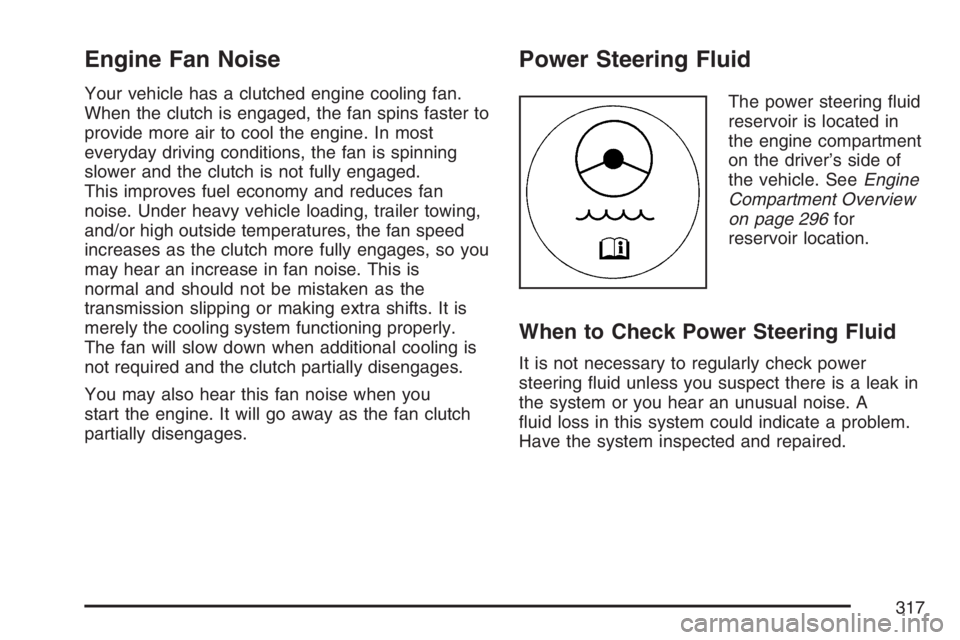
Power Steering Fluid
The power steering fluid
reservoir is located in
the engine compartment
on the driver’s side of
the vehicle. SeeEngine
Compartment Overview
on page 296for
reservoir location.
When to Check Power Steering Fluid
It is not necessary to regularly check power
steering fluid unless you suspect there is a leak in
the system or you hear an unusual noise. A
fluid loss in this system could indicate a problem.
Have the system inspected and repaired.
317
Page 318 of 452
How to Check Power Steering Fluid
To check the power steering fluid, do the following:
1. Turn the key off and let the engine
compartment cool down.
2. Wipe the cap and the top of the
reservoir clean.
3. Unscrew the cap and wipe the dipstick with a
clean rag.
4. Replace the cap and completely tighten it.
5. Then remove the cap again and look at
the fluid level on the dipstick.
The level should be at the COLD FILL mark. If
necessary, add only enough fluid to bring the level
up to the mark.
To prevent contamination of brake fluid, never
check or fill the power steering reservoir with the
brake master cylinder cover off.
What to Use
To determine what kind of fluid to use, see
Recommended Fluids and Lubricants on page 409.
Always use the proper fluid. Failure to use the
proper fluid can cause leaks and damage hoses
and seals.
Windshield Washer Fluid
What to Use
When you need windshield washer fluid, be sure to
read the manufacturer’s instructions before use. If
you will be operating your vehicle in an area where
the temperature may fall below freezing, use a fluid
that has sufficient protection against freezing.
Adding Washer Fluid
Open the cap with the
washer symbol on it.
Add washer fluid
until the tank is full. See
Engine Compartment
Overview on page 296
for reservoir location.
318
Page 345 of 452
Tire Terminology and Denitions
Air Pressure:The amount of air inside the tire
pressing outward on each square inch of the
tire. Air pressure is expressed in pounds
per square inch (psi) or kilopascal (kPa).
Accessory Weight:This means the combined
weight of optional accessories. Some examples of
optional accessories are, automatic
transmission/transaxle, power steering, power
brakes, power windows, power seats, and
air conditioning.
Aspect Ratio:The relationship of a tire’s height
to its width.
Belt:A rubber coated layer of cords that is
located between the plies and the tread. Cords
may be made from steel or other reinforcing
materials.
Bead:The tire bead contains steel wires wrapped
by steel cords that hold the tire onto the rim.Bias Ply Tire:A pneumatic tire in which the plies
are laid at alternate angles less than 90 degrees
to the centerline of the tread.
Cold Tire Pressure:The amount of air pressure in
a tire, measured in pounds per square inch (psi) or
kilopascals (kPa) before a tire has built up heat
from driving. SeeInation - Tire Pressure on
page 348.
Curb Weight:This means the weight of a motor
vehicle with standard and optional equipment
including the maximum capacity of fuel, oil, and
coolant, but without passengers and cargo.
DOT Markings:A code molded into the sidewall
of a tire signifying that the tire is in compliance
with the U.S. Department of Transportation (DOT)
motor vehicle safety standards. The DOT code
includes the Tire Identification Number (TIN),
an alphanumeric designator which can also identify
the tire manufacturer, production plant, brand,
and date of production.
345
Page 360 of 452
If a Tire Goes Flat
It is unusual for a tire to blowout while you are
driving, especially if you maintain your vehicle’s
tires properly. If air goes out of a tire, it is
much more likely to leak out slowly. But if you
should ever have a blowout, here are a few tips
about what to expect and what to do:
If a front tire fails, the flat tire will create a drag
that pulls the vehicle toward that side. Take your
foot off the accelerator pedal and grip the
steering wheel firmly. Steer to maintain lane
position, and then gently brake to a stop well out
of the traffic lane.
A rear blowout, particularly on a curve, acts much
like a skid and may require the same correction
you would use in a skid. In any rear blowout
remove your foot from the accelerator pedal. Get
the vehicle under control by steering the way
you want the vehicle to go. It may be very bumpy
and noisy, but you can still steer. Gently brake
to a stop, well off the road if possible.{CAUTION:
Lifting a vehicle and getting under it to do
maintenance or repairs is dangerous
without the appropriate safety equipment
and training. The jack provided with your
vehicle is designed only for changing a
at tire. If it is used for anything else, you
or others could be badly injured or killed
if the vehicle slips off the jack. Use the
jack provided with your vehicle only for
changing a at tire.
If a tire goes flat, the next part shows how to use the
jacking equipment to change a flat tire safely.
Changing a Flat Tire
If a tire goes flat, avoid further tire and wheel
damage by driving slowly to a level place. Turn on
your vehicle’s hazard warning flashers. SeeHazard
Warning Flashers on page 146for more
information.
360
Page 401 of 452
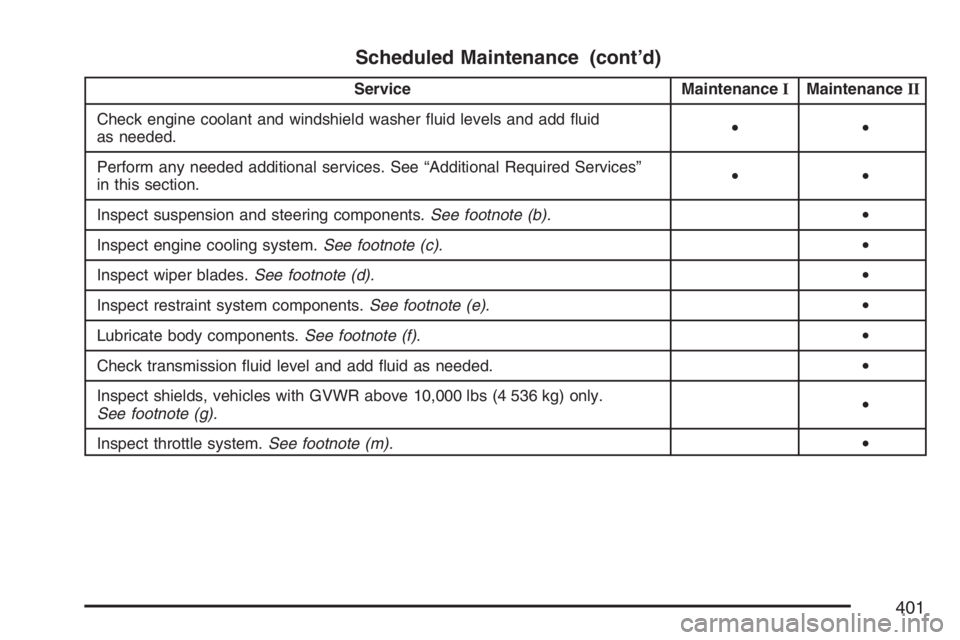
Scheduled Maintenance (cont’d)
Service MaintenanceIMaintenanceII
Check engine coolant and windshield washer fluid levels and add fluid
as needed.••
Perform any needed additional services. See “Additional Required Services”
in this section.••
Inspect suspension and steering components.See footnote (b).•
Inspect engine cooling system.See footnote (c).•
Inspect wiper blades.See footnote (d).•
Inspect restraint system components.See footnote (e).•
Lubricate body components.See footnote (f).•
Check transmission fluid level and add fluid as needed.•
Inspect shields, vehicles with GVWR above 10,000 lbs (4 536 kg) only.
See footnote (g).•
Inspect throttle system.See footnote (m).•
401
Page 403 of 452
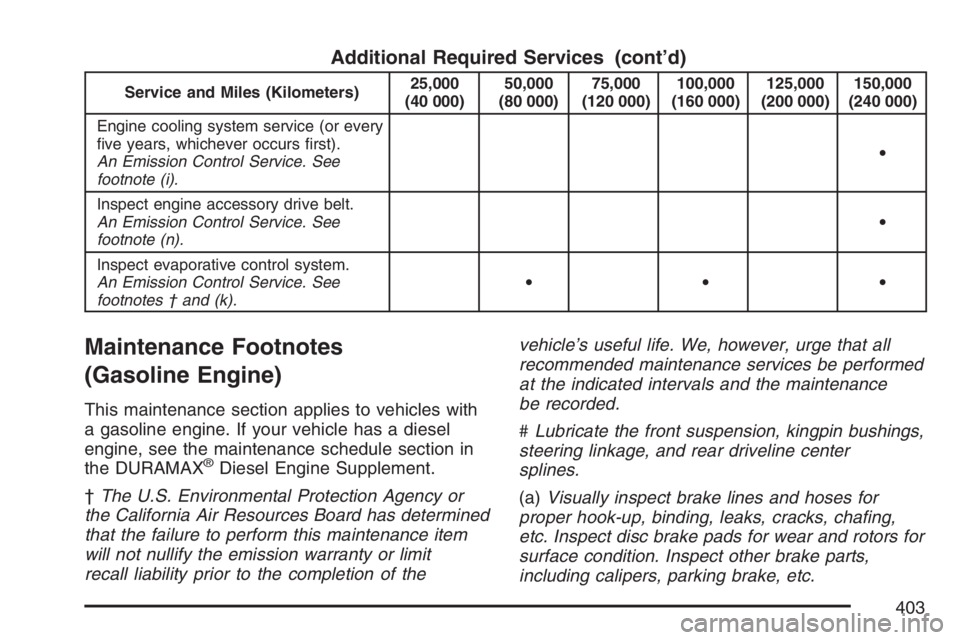
Additional Required Services (cont’d)
Service and Miles (Kilometers)25,000
(40 000)50,000
(80 000)75,000
(120 000)100,000
(160 000)125,000
(200 000)150,000
(240 000)
Engine cooling system service (or every
five years, whichever occurs first).
An Emission Control Service. See
footnote (i).•
Inspect engine accessory drive belt.
An Emission Control Service. See
footnote (n).•
Inspect evaporative control system.
An Emission Control Service. See
footnotes † and (k).•••
Maintenance Footnotes
(Gasoline Engine)
This maintenance section applies to vehicles with
a gasoline engine. If your vehicle has a diesel
engine, see the maintenance schedule section in
the DURAMAX
®Diesel Engine Supplement.
†The U.S. Environmental Protection Agency or
the California Air Resources Board has determined
that the failure to perform this maintenance item
will not nullify the emission warranty or limit
recall liability prior to the completion of thevehicle’s useful life. We, however, urge that all
recommended maintenance services be performed
at the indicated intervals and the maintenance
be recorded.
#Lubricate the front suspension, kingpin bushings,
steering linkage, and rear driveline center
splines.
(a)Visually inspect brake lines and hoses for
proper hook-up, binding, leaks, cracks, chang,
etc. Inspect disc brake pads for wear and rotors for
surface condition. Inspect other brake parts,
including calipers, parking brake, etc.
403