warning GMC SAVANA 2007 Owner's Guide
[x] Cancel search | Manufacturer: GMC, Model Year: 2007, Model line: SAVANA, Model: GMC SAVANA 2007Pages: 452, PDF Size: 2.68 MB
Page 280 of 452
Turn Signals When Towing a Trailer
When you tow a trailer, your vehicle has to have
extra wiring and a heavy-duty turn signal
flasher (included in the optional trailering package).
The arrows on your instrument panel will flash
whenever you signal a turn or lane change.
Properly hooked up, the trailer lamps will also flash,
telling other drivers you’re about to turn, change
lanes or stop.
When towing a trailer, the arrows on your
instrument panel will flash for turns even if the bulbs
on the trailer are burned out. Thus, you may think
drivers behind you are seeing your signal when
they are not. It’s important to check occasionally to
be sure the trailer bulbs are still working.
Driving On Grades
Reduce speed and shift to a lower gearbefore
you start down a long or steep downgrade. If you
don’t shift down, you might have to use your
brakes so much that they would get hot and no
longer work well.
You can tow in DRIVE (D). You may want to shift
the transmission to THIRD (3) or a lower gear
under heavy loads and/or hilly conditions.
When towing at high altitude on steep uphill grades,
consider the following: Engine coolant will boil at a
lower temperature than at normal altitudes. If you
turn your engine off immediately after towing at high
altitude on steep uphill grades, your vehicle may
show signs similar to engine overheating. To avoid
this, let the engine run while parked (preferably on
level ground) with the automatic transmission in
PARK (P) for a few minutes before turning the
engine off. If you do get the overheat warning, see
Engine Overheating on page 309.
280
Page 283 of 452
Service........................................................ 286
Accessories and Modifications................... 286
California Proposition 65 Warning.............. 286
Doing Your Own Service Work.................. 287
Adding Equipment to the Outside
of Your Vehicle...................................... 287
Fuel............................................................. 288
Gasoline Octane........................................ 288
Gasoline Specifications.............................. 288
California Fuel........................................... 289
Additives................................................... 289
Fuel E85 (85% Ethanol)............................ 290
Fuels in Foreign Countries........................ 291
Filling the Tank......................................... 292
Filling a Portable Fuel Container............... 294
Checking Things Under the Hood.............. 294
Hood Release........................................... 295
Engine Compartment Overview.................. 296
Engine Oil (Gasoline Engine).................... 297Engine Oil Life System
(Gasoline Engine).................................. 300
Engine Air Cleaner/Filter............................ 302
Automatic Transmission Fluid.................... 303
Engine Coolant.......................................... 306
Radiator Pressure Cap.............................. 309
Engine Overheating................................... 309
Cooling System......................................... 311
Engine Fan Noise..................................... 317
Power Steering Fluid ................................. 317
Windshield Washer Fluid........................... 318
Brakes...................................................... 319
Battery...................................................... 323
Jump Starting............................................ 324
All-Wheel Drive........................................... 330
Rear Axle.................................................... 331
Front Axle................................................... 331
Section 5 Service and Appearance Care
283
Page 286 of 452
Service
Your dealer knows your vehicle best and wants
you to be happy with it. We hope you will go
to your dealer for all your service needs. You will
get genuine GM parts and GM-trained and
supported service people.
We hope you will want to keep your GM vehicle
all GM. Genuine GM parts have one of these
marks:
Accessories and Modications
When you add non-GM accessories to your vehicle
they can affect your vehicle’s performance and
safety, including such things as, airbags, braking,
stability, ride and handling, emissions systems,
aerodynamics, durability, and electronic systems
like anti-lock brakes, traction control and stability
control. Some of these accessories may even cause
malfunction or damage not covered by warranty.
GM Accessories are designed to complement and
function with other systems on your vehicle. Your
GM dealer can accessorize your vehicle using
genuine GM Accessories. When you go to your
GM dealer and ask for GM Accessories, you will
know that GM-trained and supported service
technicians will perform the work using genuine
GM Accessories.
California Proposition 65 Warning
Most motor vehicles, including this one, contain
and/or emit chemicals known to the State of
California to cause cancer and birth defects or other
reproductive harm. Engine exhaust, many parts and
systems (including some inside the vehicle), many
fluids, and some component wear by-products
contain and/or emit these chemicals.
286
Page 301 of 452
How to Reset the Engine Oil Life
System
The Engine Oil Life System calculates when to
change your engine oil and filter based on vehicle
use. Anytime your oil is changed, reset the
system so it can calculate when the next oil
change is required. If a situation occurs where you
change your oil prior to a change engine oil light
being turned on, reset the system.
To reset the change engine oil light, do
the following:
1. Turn the ignition key to RUN with the
engine off.
2. Fully press and release the accelerator pedal
slowly three times within five seconds.
3. If the Change Engine Oil light flashes for
five seconds, the system is reset.
4. Turn the key to LOCK.
If the change engine oil light comes back on when
you start your vehicle, the engine oil life system
has not reset. Repeat the procedure. If it still does
not reset, see your dealer for service. See
Change Engine Oil Light on page 183.
What to Do with Used Oil
Used engine oil contains certain elements that may
be unhealthy for your skin and could even cause
cancer. Do not let used oil stay on your skin for very
long. Clean your skin and nails with soap and
water, or a good hand cleaner. Wash or properly
dispose of clothing or rags containing used engine
oil. See the manufacturer’s warnings about the use
and disposal of oil products.
Used oil can be a threat to the environment. If you
change your own oil, be sure to drain all the oil from
the filter before disposal. Never dispose of oil by
putting it in the trash, pouring it on the ground, into
sewers, or into streams or bodies of water. Instead,
recycle it by taking it to a place that collects used
oil. If you have a problem properly disposing of your
used oil, ask your dealer, a service station, or a
local recycling center for help.
301
Page 306 of 452
How to Add Automatic
Transmission Fluid
Refer to the Maintenance Schedule to determine
what kind of transmission fluid to use. See
Recommended Fluids and Lubricants on page 409.
Using a funnel, add fluid down the transmission
dipstick tube only after checking the transmission
fluid while it is hot. A cold check is used only
as a reference. If the fluid level is low, add only
enough of the proper fluid to bring the level up to
the HOT area for a hot check. It does not take
much fluid, generally less than one pint (0.5 L). Do
not overfill.
Notice:Use of the incorrect automatic
transmission uid may damage your vehicle,
and the damages may not be covered by
your warranty. Always use the automatic
transmission uid listed inRecommended
Fluids and Lubricants on page 409.
•After adding fluid, recheck the fluid level as
described under “How to Check Automatic
Transmission Fluid,” earlier in this section.
•When the correct fluid level is obtained, push
the dipstick back in all the way; then flip the
handle down to lock the dipstick in place.
Engine Coolant
The cooling system in your vehicle is filled with
DEX-COOL®engine coolant. This coolant is
designed to remain in your vehicle for five years or
150,000 miles (240 000 km), whichever occurs first,
if you add only DEX-COOL
®extended life coolant.
The following explains your cooling system and
how to add coolant when it is low. If you have a
problem with engine overheating, seeEngine
Overheating on page 309.
A 50/50 mixture of clean, drinkable water and
DEX-COOL
®coolant will:
•Give freezing protection down to
−34°F (−37°C).
•Give boiling protection up to 265°F (129°C).
•Protect against rust and corrosion.
•Help keep the proper engine temperature.
•Let the warning lights and gages work as
they should.
306
Page 307 of 452
Notice:Using coolant other than DEX-COOL®
may cause premature engine, heater core,
radiator and fuel operated heater (FOH)
corrosion. In addition, the engine coolant may
require changing sooner, at 30,000 miles
(50 000 km) or 24 months, whichever occurs
rst. Any repairs would not be covered by your
warranty. Always use DEX-COOL
®(silicate-free)
coolant in your vehicle.
What to Use
Use a mixture of one-half clean, drinkable water
and one-half DEX-COOL®coolant which will
not damage aluminum parts. If you use this coolant
mixture, you do not need to add anything else.
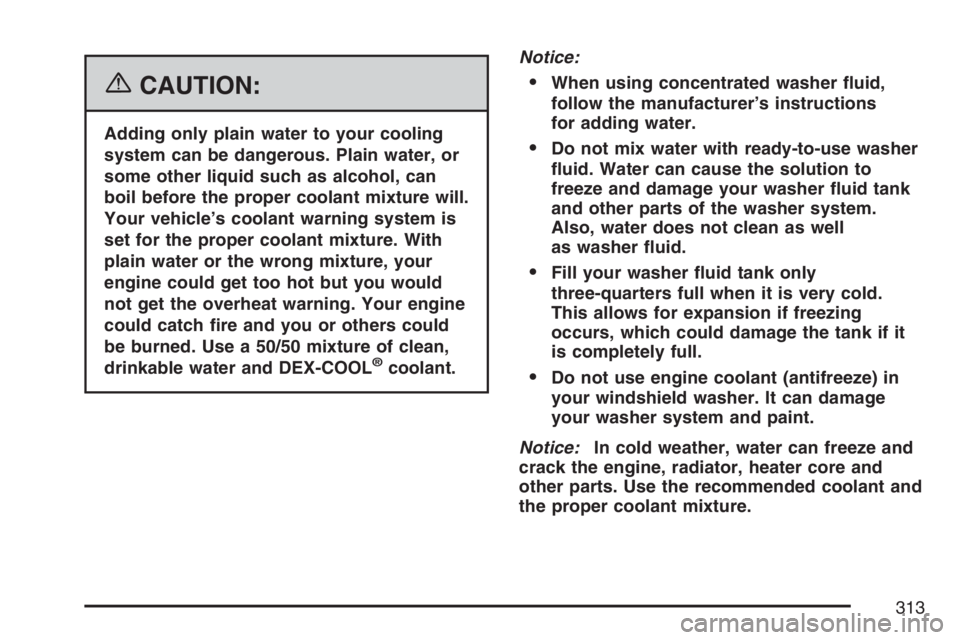
{CAUTION:
Adding only plain water to your cooling
system can be dangerous. Plain water, or
some other liquid such as alcohol, can
boil before the proper coolant mixture will.
Your vehicle’s coolant warning system is
set for the proper coolant mixture.
CAUTION: (Continued)
CAUTION: (Continued)
With plain water or the wrong mixture, your
engine could get too hot but you would not
get the overheat warning. Your engine
could catch re and you or others could be
burned. Use a 50/50 mixture of clean,
drinkable water and the proper coolant.
Notice:If you use an improper coolant
mixture, your engine could overheat and be
badly damaged. The repair cost would not be
covered by your warranty. Too much water
in the mixture can freeze and crack the engine,
radiator, heater core, and other parts.
If you have to add coolant more than four times a
year, have your dealer check your cooling system.
Notice:If you use extra inhibitors and/or
additives in your vehicle’s cooling system, you
could damage your vehicle. Use only the proper
mixture of the engine coolant listed in this
manual for the cooling system. See
Recommended Fluids and Lubricants on
page 409for more information.
307
Page 310 of 452
If Steam Is Coming From Your Engine
{CAUTION:
Steam from an overheated engine can
burn you badly, even if you just open the
hood. Stay away from the engine if you
see or hear steam coming from it. Just
turn it off and get everyone away from the
vehicle until it cools down. Wait until
there is no sign of steam or coolant
before you open the hood.
If you keep driving when your engine is
overheated, the liquids in it can catch re.
You or others could be badly burned.
Stop your engine if it overheats, and get
out of the vehicle until the engine is cool.
Notice:If your engine catches re because
you keep driving with no coolant, your vehicle
can be badly damaged. The costly repairs
would not be covered by your warranty.
If No Steam Is Coming From
Your Engine
If you get an engine overheat warning but see or
hear no steam, the problem may not be too
serious. Sometimes the engine can get a little too
hot when you:
•Climb a long hill on a hot day.
•Stop after high-speed driving.
•Idle for long periods in traffic.
•Tow a trailer. See “Driving on Grades” under
Towing a Trailer on page 266.
If you get the overheat warning with no sign of
steam, try this for a minute or so:
1. In heavy traffic, let the engine idle in
NEUTRAL (N) while stopped. If it is safe to do
so, pull off the road, shift to PARK (P) or
NEUTRAL (N) and let the engine idle.
2. Turn on your heater to full hot at the highest
fan speed and open the windows as
necessary.
310
Page 311 of 452
If you no longer have the overheat warning, you
can drive. Just to be safe, drive slower for
about 10 minutes. If the warning does not come
back on, you can drive normally.
If the warning continues, and you have not
stopped, pull over, stop, and park your vehicle
right away.
If there is still no sign of steam, push down the
accelerator until the engine speed is about
twice as fast as normal idle speed for at least
three minutes while you are parked. If you
still have the warning, turn off the engine and get
everyone out of the vehicle until it cools down.
You may decide not to lift the hood but to
get service help right away.Cooling System
If your vehicle has a diesel engine, see “Van
Models” under “Cooling System” in the
DURAMAX
®Diesel Supplement.
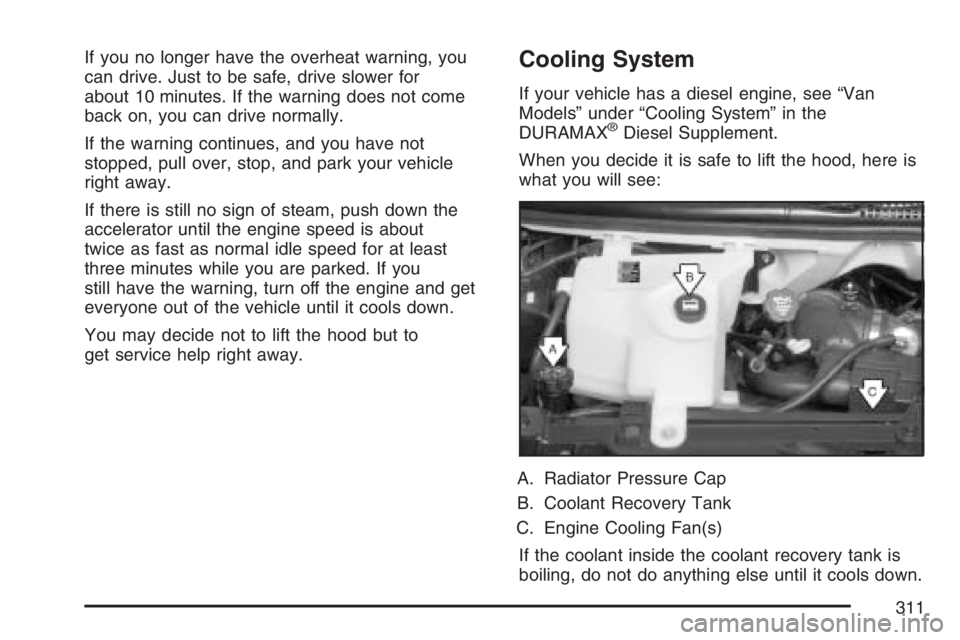
When you decide it is safe to lift the hood, here is
what you will see:
A. Radiator Pressure Cap
B. Coolant Recovery Tank
C. Engine Cooling Fan(s)
If the coolant inside the coolant recovery tank is
boiling, do not do anything else until it cools down.
311
Page 313 of 452
{CAUTION:
Adding only plain water to your cooling
system can be dangerous. Plain water, or
some other liquid such as alcohol, can
boil before the proper coolant mixture will.
Your vehicle’s coolant warning system is
set for the proper coolant mixture. With
plain water or the wrong mixture, your
engine could get too hot but you would
not get the overheat warning. Your engine
could catch re and you or others could
be burned. Use a 50/50 mixture of clean,
drinkable water and DEX-COOL
®coolant.Notice:
When using concentrated washer uid,
follow the manufacturer’s instructions
for adding water.
Do not mix water with ready-to-use washer
uid. Water can cause the solution to
freeze and damage your washer uid tank
and other parts of the washer system.
Also, water does not clean as well
as washer uid.
Fill your washer uid tank only
three-quarters full when it is very cold.
This allows for expansion if freezing
occurs, which could damage the tank if it
is completely full.
Do not use engine coolant (antifreeze) in
your windshield washer. It can damage
your washer system and paint.
Notice:In cold weather, water can freeze and
crack the engine, radiator, heater core and
other parts. Use the recommended coolant and
the proper coolant mixture.
313
Page 314 of 452
{CAUTION:
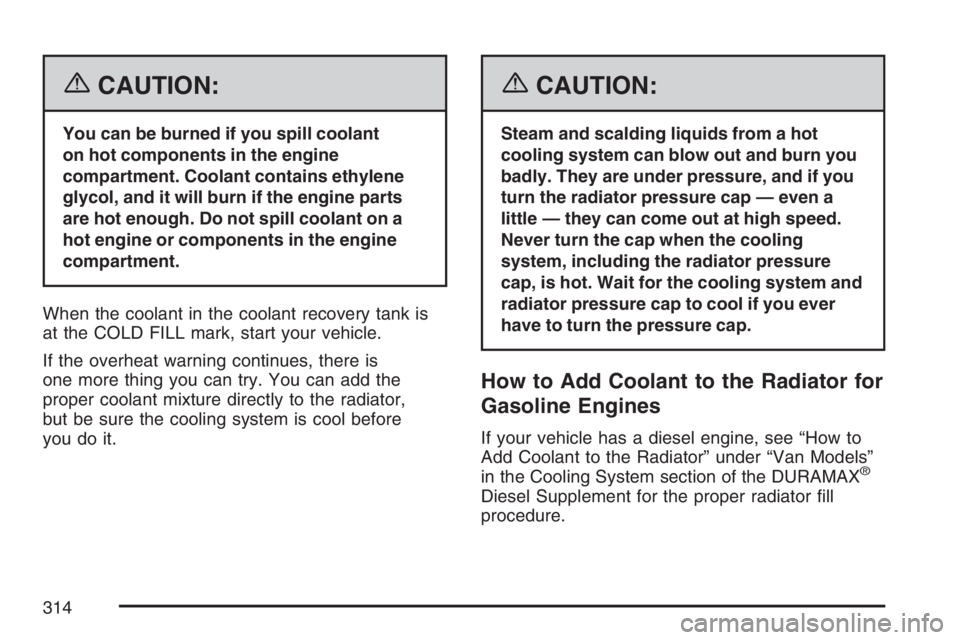
You can be burned if you spill coolant
on hot components in the engine
compartment. Coolant contains ethylene
glycol, and it will burn if the engine parts
are hot enough. Do not spill coolant on a
hot engine or components in the engine
compartment.
When the coolant in the coolant recovery tank is
at the COLD FILL mark, start your vehicle.
If the overheat warning continues, there is
one more thing you can try. You can add the
proper coolant mixture directly to the radiator,
but be sure the cooling system is cool before
you do it.
{CAUTION:
Steam and scalding liquids from a hot
cooling system can blow out and burn you
badly. They are under pressure, and if you
turn the radiator pressure cap — even a
little — they can come out at high speed.
Never turn the cap when the cooling
system, including the radiator pressure
cap, is hot. Wait for the cooling system and
radiator pressure cap to cool if you ever
have to turn the pressure cap.
How to Add Coolant to the Radiator for
Gasoline Engines
If your vehicle has a diesel engine, see “How to
Add Coolant to the Radiator” under “Van Models”
in the Cooling System section of the DURAMAX
®
Diesel Supplement for the proper radiator fill
procedure.
314