ECU GMC SAVANA 2007 Owner's Guide
[x] Cancel search | Manufacturer: GMC, Model Year: 2007, Model line: SAVANA, Model: GMC SAVANA 2007Pages: 452, PDF Size: 2.68 MB
Page 88 of 452
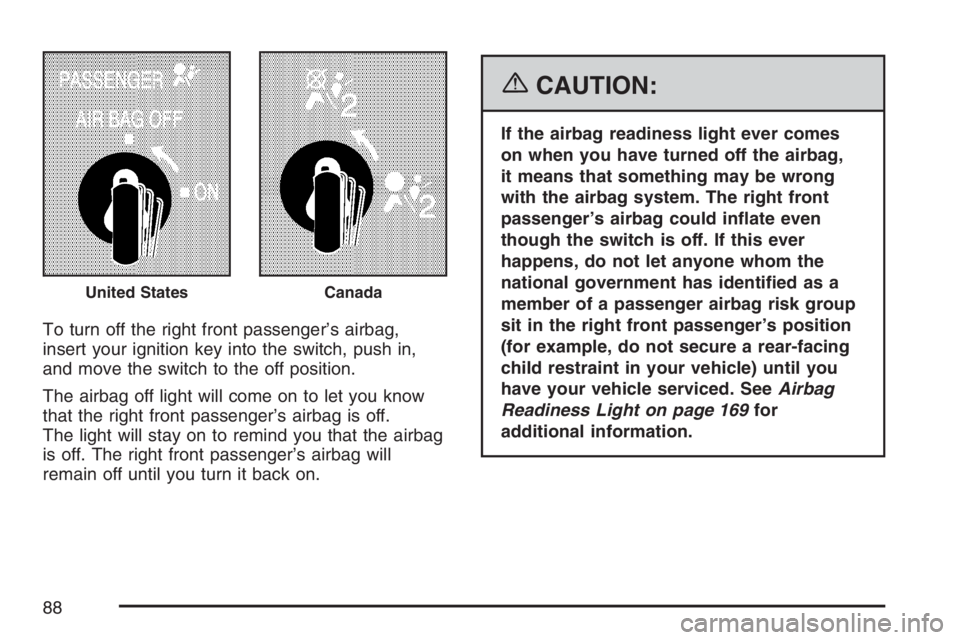
To turn off the right front passenger’s airbag,
insert your ignition key into the switch, push in,
and move the switch to the off position.
The airbag off light will come on to let you know
that the right front passenger’s airbag is off.
The light will stay on to remind you that the airbag
is off. The right front passenger’s airbag will
remain off until you turn it back on.
{CAUTION:
If the airbag readiness light ever comes
on when you have turned off the airbag,
it means that something may be wrong
with the airbag system. The right front
passenger’s airbag could inate even
though the switch is off. If this ever
happens, do not let anyone whom the
national government has identied as a
member of a passenger airbag risk group
sit in the right front passenger’s position
(for example, do not secure a rear-facing
child restraint in your vehicle) until you
have your vehicle serviced. SeeAirbag
Readiness Light on page 169for
additional information.
United StatesCanada
88
Page 90 of 452
The passenger airbag status indicator on the
instrument panel will be visible when you turn your
ignition key to RUN or START. The words ON
and OFF, or the symbol for on and off, will
be visible on the instrument panel during the
system check. When the system check is
complete, either the word ON or the word OFF,
or the symbol for on or the symbol for off, will
be visible. SeePassenger Airbag Status Indicator
on page 172.
The passenger sensing system will turn off the
right front passenger’s frontal airbag under certain
conditions. The driver’s airbag is not part of the
passenger sensing system.
The passenger sensing system works with
sensors that are part of the right front passenger’s
seat. The sensors are designed to detect the
presence of a properly-seated occupant and
determine if the passenger’s frontal airbag should
be enabled (may inflate) or not.Accident statistics show that children are safer if
they are restrained in the rear rather than the front
seat. We recommend that child restraints be
secured in a rear seat, including an infant riding
in a rear-facing infant seat, a child riding in a
forward-facing child seat and an older child riding
in a booster seat.
If your vehicle has a rear seat, it will accommodate
a rear-facing child restraint. A label on your sun
visor says, “Never put a rear-facing child seat
in the front.” This is because the risk to the
rear-facing child is so great, if the airbag deploys.
90
Page 91 of 452
{CAUTION:
A child in a rear-facing child restraint can
be seriously injured or killed if the right
front passenger’s airbag inates. This is
because the back of the rear-facing child
restraint would be very close to the
inating airbag.
Even though the passenger sensing
system is designed to turn off the
passenger’s frontal airbag if the system
detects a rear-facing child restraint,
no system is fail-safe, and no one can
guarantee that an airbag will not deploy
under some unusual circumstance,
even though it is turned off.
CAUTION: (Continued)
CAUTION: (Continued)
We recommend that rear-facing child
restraints be secured in the rear seat,
even if the airbag is off.
If you need to secure a forward-facing
child restraint in the right front seat,
always move the front passenger seat
as far back as it will go. It is better to
secure the child restraint in a rear seat.
91
Page 92 of 452
If your vehicle does not have a rear seat that
will accommodate a rear-facing child restraint,
never put a child in a rear-facing child restraint
in the right front passenger seat unless the
passenger airbag status indicator shows off.
Here is why:
{CAUTION:
A child in a rear-facing child restraint can
be seriously injured or killed if the right
front passenger’s airbag inates. This
is because the back of the rear-facing
child restraint would be very close to the
inating airbag. Be sure the airbag is off
before using a rear-facing child restraint
in the right front seat position.
Even though the passenger sensing
system is designed to turn off the
passenger’s frontal airbag if the system
detects a rear-facing child restraint,
CAUTION: (Continued)
CAUTION: (Continued)
no system is fail-safe, and no one can
guarantee that an airbag will not deploy
under some unusual circumstance, even
though it is turned off. We recommend
that rear-facing child restraints be
transported in vehicles with a rear seat
that will accommodate a rear-facing child
restraint, whenever possible.
If you need to secure a forward-facing
child restraint in the right front seat,
always move the front passenger seat
as far back as it will go. It is better to
secure the child restraint in a rear seat.
92
Page 93 of 452
The passenger sensing system is designed to turn
off the right front passenger’s frontal airbag if:
•The right front passenger seat is unoccupied.
•The system determines that an infant is
present in a rear-facing infant seat.
•The system determines that a small child is
present in a forward-facing child restraint.
•The system determines that a small child is
present in a booster seat.
•A right front passenger takes his/her weight off
of the seat for a period of time.
•The right front passenger seat is occupied by
a smaller person, such as a child who has
outgrown child restraints.
•Or, if there is a critical problem with the airbag
system or the passenger sensing system.
When the passenger sensing system has turned
off the passenger’s frontal airbag, the off indicator
on the instrument panel will light and stay lit to
remind you that the airbag is off.If a child restraint has been installed and the on
indicator is lit, turn the vehicle off. Remove
the child restraint from the vehicle and reinstall the
child restraint following the child restraint
manufacturer’s directions and refer toSecuring a
Child Restraint in the Right Front Seat Position
(With Passenger Sensing System)in the Index.
If, after reinstalling the child restraint and restarting
the vehicle, the on indicator is still lit, check to
make sure that the vehicle’s seatback is not
pressing the child restraint into the seat cushion.
If this happens, slightly recline the vehicle’s
seatback and adjust the seat cushion if possible.
Also make sure the child restraint is not trapped
under the vehicle head restraint. If this happens,
adjust the head restraint.
If the on indicator is still lit, secure the child in
the child restraint in a rear seat position if one
is available and check with your dealer.
93
Page 95 of 452
{CAUTION:
If the airbag readiness light in the
instrument panel cluster ever comes on
and stays on, it means that something
may be wrong with the airbag system.
If this ever happens, have the vehicle
serviced promptly, because an adult-size
person sitting in the right front
passenger’s seat may not have the
protection of the frontal airbag. See
Airbag Readiness Light on page 169for
more on this, including important safety
information.A thick layer of additional material such as a
blanket, or aftermarket equipment such as seat
covers, seat heaters and seat massagers
can affect how well the passenger sensing system
operates. Remove any additional material from
the seat cushion before reinstalling or securing the
child restraint or small occupant. You may want
to consider not using seat covers or other
aftermarket equipment if your vehicle has the
passenger sensing system. SeeAdding Equipment
to Your Airbag-Equipped Vehicle on page 97for
more information about modifications that can
affect how the system operates.
{CAUTION:
Stowing of articles under the passenger’s
seat or between the passenger’s seat
cushion and seatback may interfere with
the proper operation of the passenger
sensing system.
95
Page 97 of 452
Adding Equipment to Your
Airbag-Equipped Vehicle
Q:Is there anything I might add to the front
of the vehicle that could keep the airbags
from working properly?
A:Yes. If you add things that change your
vehicle’s frame, bumper system, height,
front end or side sheet metal, they may keep
the airbag system from working properly.
Also, the airbag system may not work properly
if you relocate any of the airbag sensors.
If you have any questions about this,
you should contact Customer Assistance
before you modify your vehicle. The phone
numbers and addresses for Customer
Assistance are in Step Two of theCustomer
Satisfaction Procedure on page 418.
Q:Because I have a disability, I have to get
my vehicle modied. How can I nd out
whether this will affect my airbag system?
A:Changing or moving any parts of the
front seats, safety belts, the airbag sensing
and diagnostic module, steering wheel,
the instrument panel, or airbag wiring can
affect the operation of the airbag system.
If you have questions, call Customer
Assistance. The phone numbers and
addresses for Customer Assistance are in
Step Two of the Customer Satisfaction
Procedure in this manual. SeeCustomer
Satisfaction Procedure on page 418.
97
Page 101 of 452
Keys............................................................ 102
Remote Keyless Entry (RKE) System........ 104
Remote Keyless Entry (RKE)
System Operation.................................. 105
Doors and Locks........................................ 108
Door Locks................................................ 108
Power Door Locks..................................... 109
Cargo Door Relocking............................... 109
Rear Door Security Locks......................... 110
Lockout Protection..................................... 110
Sliding Side Door...................................... 111
60/40 Swing-Out Side Door....................... 112
Rear Doors............................................... 114
Windows...................................................... 116
Manual Windows....................................... 116
Power Windows........................................ 117
Swing-Out Windows.................................. 118
Sun Visors................................................ 119
Theft-Deterrent Systems............................. 119
Passlock
®.................................................. 119
Starting and Operating Your Vehicle......... 120
New Vehicle Break-In................................ 120
Ignition Positions....................................... 121Retained Accessory Power (RAP)............. 122
Starting the Engine.................................... 122
Fuel Regulator........................................... 124
Engine Coolant Heater.............................. 124
Automatic Transmission Operation............. 125
Parking Brake........................................... 128
Shifting Into Park (P) ................................. 129
Shifting Out of Park (P)............................. 130
Parking Over Things That Burn................. 131
Engine Exhaust......................................... 132
Running the Engine While Parked............. 133
Mirrors......................................................... 134
Manual Rearview Mirror............................. 134
Automatic Dimming Rearview Mirror with
Compass and Temperature Display........ 134
Outside Manual Mirror............................... 136
Outside Camper-Type Mirrors.................... 137
Outside Power Mirrors............................... 138
Outside Convex Mirror............................... 138
Outside Heated Mirrors............................. 139
Storage Areas............................................. 139
Section 2 Features and Controls
101
Page 106 of 452
Resynchronization
Resynchronization may be necessary due to the
security method used by this system. The
transmitter does not send the same signal twice to
the receiver. The receiver will not respond to a
signal that has been sent previously. This prevents
anyone from recording and playing back the
signal from the transmitter.
To resynchronize your transmitter, stand close to
your vehicle and press and hold the lock and
unlock buttons on the transmitter at the same time
for seven seconds. The door locks should cycle
to confirm synchronization. If the locks do not
cycle, see your dealer for service.
Battery Replacement
Under normal use, the battery in your remote
keyless entry transmitter should last about
four years.
You can tell the battery is weak if the transmitter
won’t work at the normal range in any location.
If you have to get close to your vehicle before the
transmitter works, it’s probably time to change
the battery.
Notice:When replacing the battery, use care
not to touch any of the circuitry. Static
from your body transferred to these surfaces
may damage the transmitter.
106
Page 109 of 452
There are several ways to lock and unlock your
vehicle.
If your vehicle is equipped with keyless entry, see
Remote Keyless Entry (RKE) System on
page 104for more information.
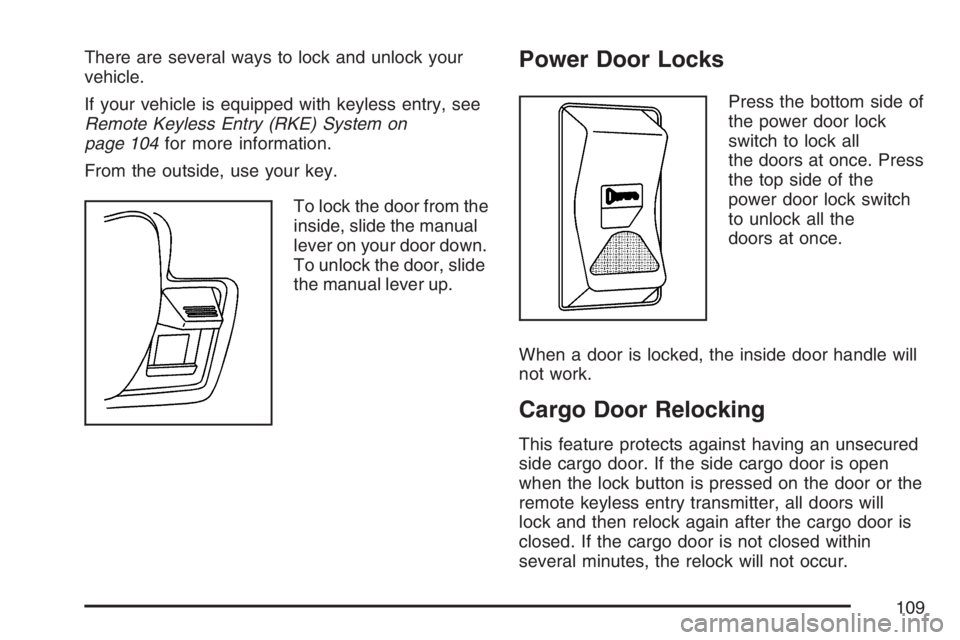
From the outside, use your key.
To lock the door from the
inside, slide the manual
lever on your door down.
To unlock the door, slide
the manual lever up.Power Door Locks
Press the bottom side of
the power door lock
switch to lock all
the doors at once. Press
the top side of the
power door lock switch
to unlock all the
doors at once.
When a door is locked, the inside door handle will
not work.
Cargo Door Relocking
This feature protects against having an unsecured
side cargo door. If the side cargo door is open
when the lock button is pressed on the door or the
remote keyless entry transmitter, all doors will
lock and then relock again after the cargo door is
closed. If the cargo door is not closed within
several minutes, the relock will not occur.
109