tires GMC SAVANA 2007 Service Manual
[x] Cancel search | Manufacturer: GMC, Model Year: 2007, Model line: SAVANA, Model: GMC SAVANA 2007Pages: 452, PDF Size: 2.68 MB
Page 364 of 452
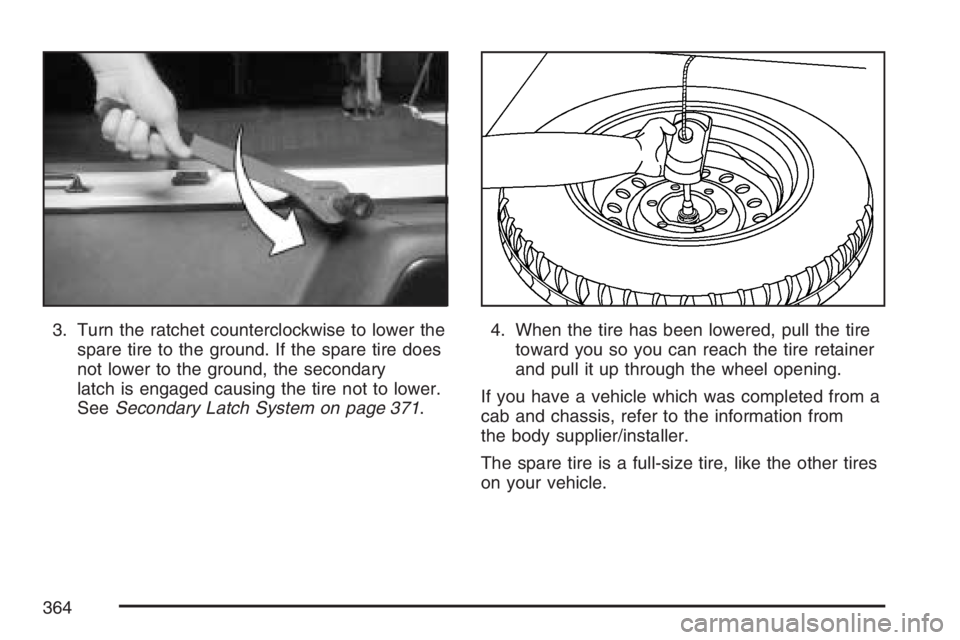
3. Turn the ratchet counterclockwise to lower the
spare tire to the ground. If the spare tire does
not lower to the ground, the secondary
latch is engaged causing the tire not to lower.
SeeSecondary Latch System on page 371.4. When the tire has been lowered, pull the tire
toward you so you can reach the tire retainer
and pull it up through the wheel opening.
If you have a vehicle which was completed from a
cab and chassis, refer to the information from
the body supplier/installer.
The spare tire is a full-size tire, like the other tires
on your vehicle.
364
Page 376 of 452
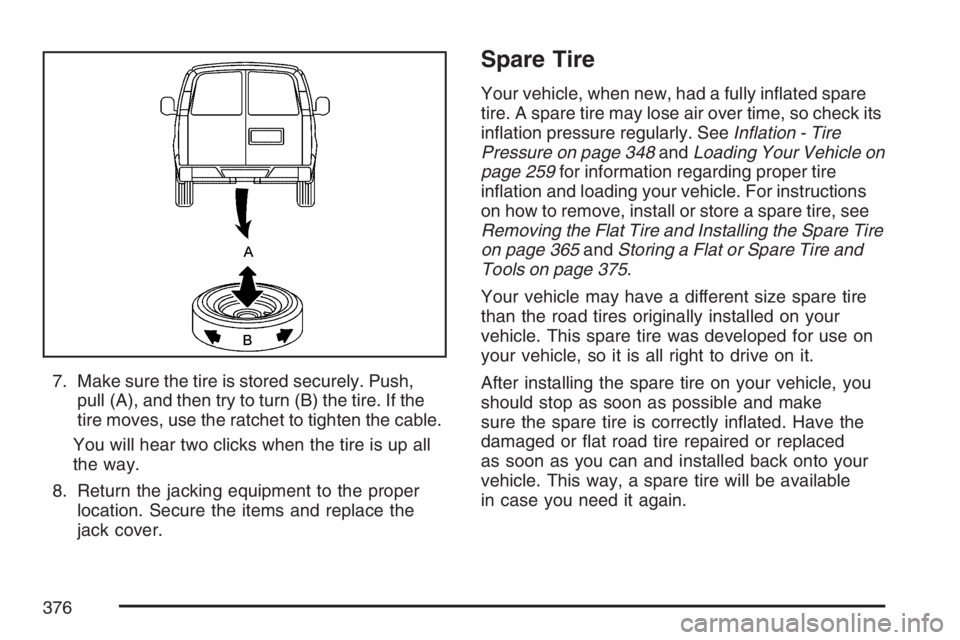
7. Make sure the tire is stored securely. Push,
pull (A), and then try to turn (B) the tire. If the
tire moves, use the ratchet to tighten the cable.
You will hear two clicks when the tire is up all
the way.
8. Return the jacking equipment to the proper
location. Secure the items and replace the
jack cover.
Spare Tire
Your vehicle, when new, had a fully inflated spare
tire. A spare tire may lose air over time, so check its
inflation pressure regularly. SeeInation - Tire
Pressure on page 348andLoading Your Vehicle on
page 259for information regarding proper tire
inflation and loading your vehicle. For instructions
on how to remove, install or store a spare tire, see
Removing the Flat Tire and Installing the Spare Tire
on page 365andStoring a Flat or Spare Tire and
Tools on page 375.
Your vehicle may have a different size spare tire
than the road tires originally installed on your
vehicle. This spare tire was developed for use on
your vehicle, so it is all right to drive on it.
After installing the spare tire on your vehicle, you
should stop as soon as possible and make
sure the spare tire is correctly inflated. Have the
damaged or flat road tire repaired or replaced
as soon as you can and installed back onto your
vehicle. This way, a spare tire will be available
in case you need it again.
376
Page 377 of 452
Do not mix tires and wheels of different sizes,
because they will not fit. Keep your spare tire and
its wheel together. If your vehicle has a spare
tire that does not match your vehicle’s original road
tires and wheels in size and type, do not include
the spare tire in the tire rotation.
Appearance Care
Cleaning the Inside of Your Vehicle
Your vehicle’s interior will continue to look its
best if it is cleaned often. Although not always
visible, dust and dirt can accumulate on your
upholstery. Dirt can damage carpet, fabric, leather,
and plastic surfaces. Regular vacuuming is
recommended to remove particles from your
upholstery. It is important to keep your upholstery
from becoming and remaining heavily soiled.
Soils should be removed as quickly as possible.
Your vehicle’s interior may experience extremes of
heat that could cause stains to set rapidly.
Lighter colored interiors may require more frequent
cleaning. Use care because newspapers and
garments that transfer color to your home
furnishings may also transfer color to your
vehicle’s interior.When cleaning your vehicle’s interior, only use
cleaners specifically designed for the surfaces
being cleaned. Permanent damage may result
from using cleaners on surfaces for which
they were not intended. Use glass cleaner only on
glass. Remove any accidental over-spray from
other surfaces immediately. To prevent over-spray,
apply cleaner directly to the cleaning cloth.
Notice:If you use abrasive cleaners when
cleaning glass surfaces on your vehicle, you
could scratch the glass and/or cause damage
to the rear window defogger. When cleaning
the glass on your vehicle, use only a soft cloth
and glass cleaner.
Many cleaners contain solvents that may become
concentrated in your vehicle’s breathing space.
Before using cleaners, read and adhere to all safety
instructions on the label. While cleaning your
vehicle’s interior, maintain adequate ventilation by
opening your vehicle’s doors and windows.
Dust may be removed from small buttons and
knobs using a small brush with soft bristles.
377
Page 383 of 452
Notice:If you drive your vehicle through an
automatic car wash that has silicone carbide
tire cleaning brushes, you could damage the
aluminum or chrome-plated wheels. The repairs
would not be covered by your warranty. Never
drive a vehicle equipped with aluminum or
chrome-plated wheels through an automatic
car wash that uses silicone carbide tire
cleaning brushes.
Do not take the vehicle through an automatic car
wash that has silicone carbide tire cleaning
brushes. These brushes can also damage the
surface of these wheels.
Tires
To clean the tires, use a stiff brush with tire
cleaner.
Notice:Using petroleum-based tire dressing
products on your vehicle may damage the
paint nish and/or tires. When applying a tire
dressing, always wipe off any overspray
from all painted surfaces on your vehicle.
Sheet Metal Damage
If the vehicle is damaged and requires sheet metal
repair or replacement, make sure the body repair
shop applies anti-corrosion material to parts
repaired or replaced to restore corrosion protection.
Original manufacturer replacement parts will
provide the corrosion protection while maintaining
the warranty.
Finish Damage
Any stone chips, fractures or deep scratches in
the finish should be repaired right away. Bare
metal will corrode quickly and may develop into
major repair expense.
Minor chips and scratches can be repaired with
touch-up materials available from your dealer.
Larger areas of finish damage can be corrected in
your dealer’s body and paint shop.
383
Page 400 of 452
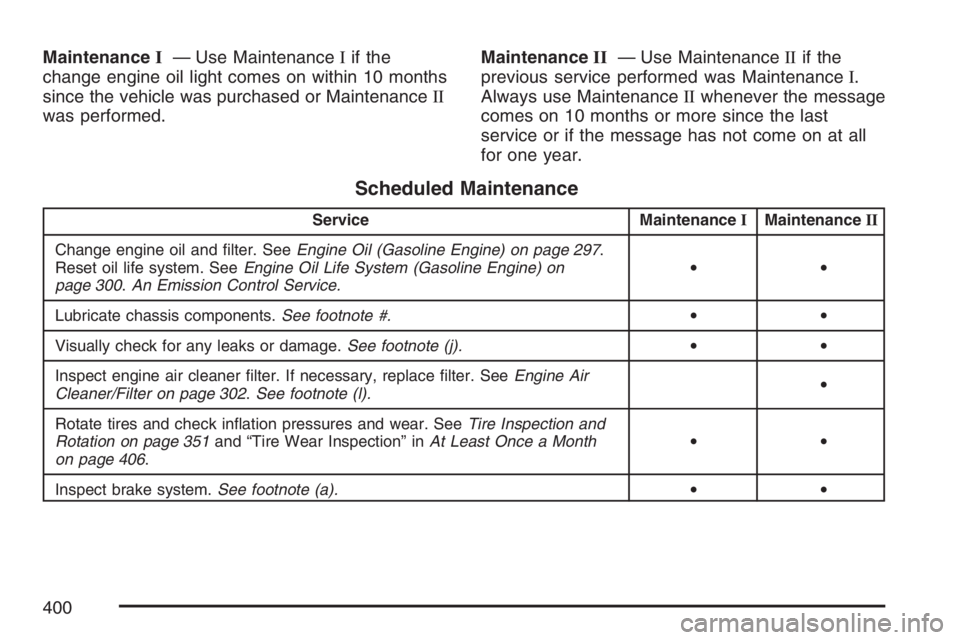
MaintenanceI— Use MaintenanceIif the
change engine oil light comes on within 10 months
since the vehicle was purchased or MaintenanceII
was performed.MaintenanceII— Use MaintenanceIIif the
previous service performed was MaintenanceI.
Always use MaintenanceIIwhenever the message
comes on 10 months or more since the last
service or if the message has not come on at all
for one year.
Scheduled Maintenance
Service MaintenanceIMaintenanceII
Change engine oil and filter. SeeEngine Oil (Gasoline Engine) on page 297.
Reset oil life system. SeeEngine Oil Life System (Gasoline Engine) on
page 300.An Emission Control Service.••
Lubricate chassis components.See footnote #.••
Visually check for any leaks or damage.See footnote (j).••
Inspect engine air cleaner filter. If necessary, replace filter. SeeEngine Air
Cleaner/Filter on page 302.See footnote (l).•
Rotate tires and check inflation pressures and wear. SeeTire Inspection and
Rotation on page 351and “Tire Wear Inspection” inAt Least Once a Month
on page 406.••
Inspect brake system.See footnote (a).••
400
Page 406 of 452
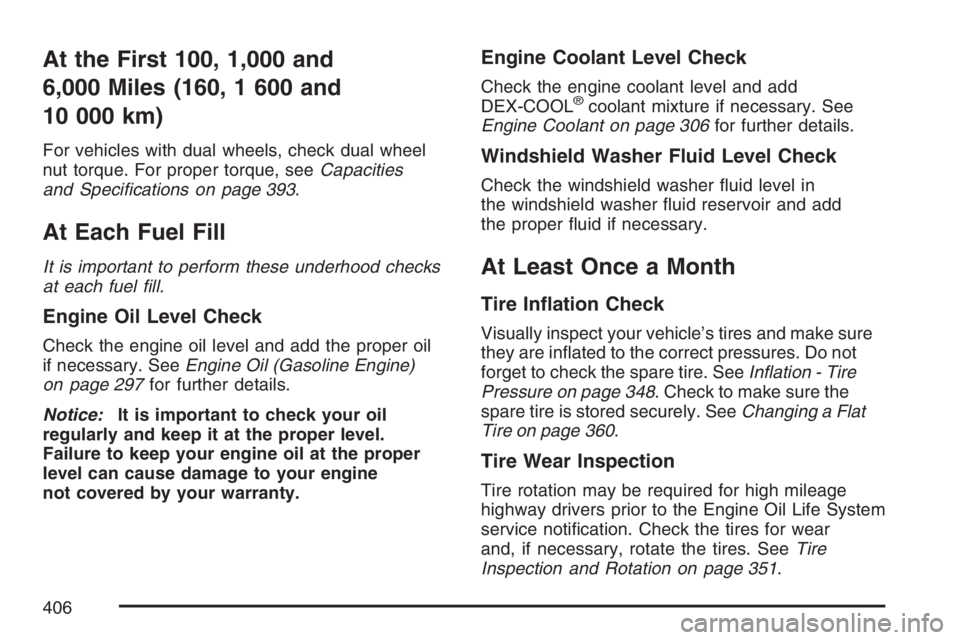
At the First 100, 1,000 and
6,000 Miles (160, 1 600 and
10 000 km)
For vehicles with dual wheels, check dual wheel
nut torque. For proper torque, seeCapacities
and Specications on page 393.
At Each Fuel Fill
It is important to perform these underhood checks
at each fuel ll.
Engine Oil Level Check
Check the engine oil level and add the proper oil
if necessary. SeeEngine Oil (Gasoline Engine)
on page 297for further details.
Notice:It is important to check your oil
regularly and keep it at the proper level.
Failure to keep your engine oil at the proper
level can cause damage to your engine
not covered by your warranty.
Engine Coolant Level Check
Check the engine coolant level and add
DEX-COOL®coolant mixture if necessary. See
Engine Coolant on page 306for further details.
Windshield Washer Fluid Level Check
Check the windshield washer fluid level in
the windshield washer fluid reservoir and add
the proper fluid if necessary.
At Least Once a Month
Tire Ination Check
Visually inspect your vehicle’s tires and make sure
they are inflated to the correct pressures. Do not
forget to check the spare tire. SeeInation - Tire
Pressure on page 348. Check to make sure the
spare tire is stored securely. SeeChanging a Flat
Tire on page 360.
Tire Wear Inspection
Tire rotation may be required for high mileage
highway drivers prior to the Engine Oil Life System
service notification. Check the tires for wear
and, if necessary, rotate the tires. SeeTire
Inspection and Rotation on page 351.
406
Page 427 of 452
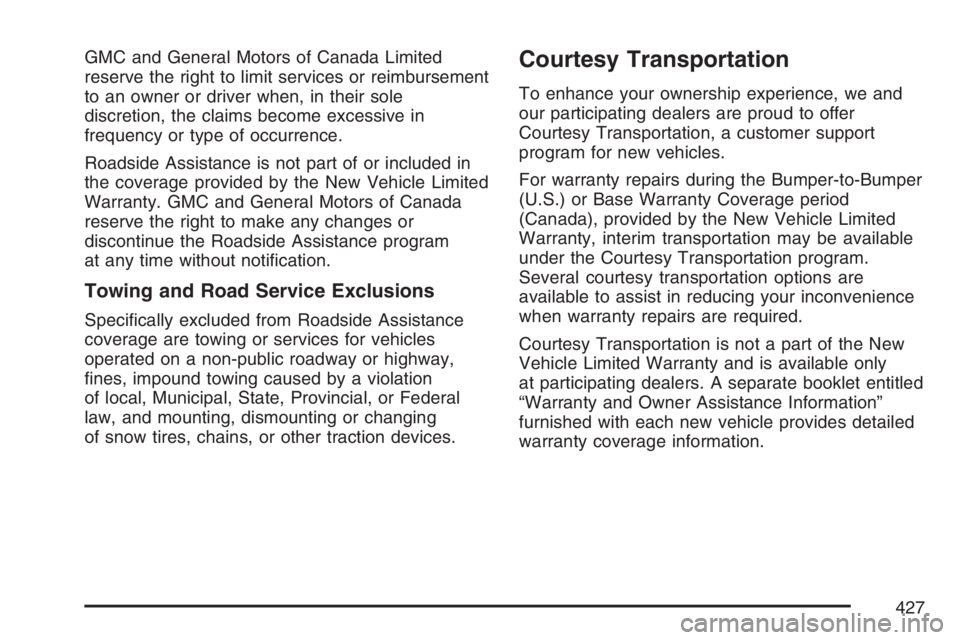
GMC and General Motors of Canada Limited
reserve the right to limit services or reimbursement
to an owner or driver when, in their sole
discretion, the claims become excessive in
frequency or type of occurrence.
Roadside Assistance is not part of or included in
the coverage provided by the New Vehicle Limited
Warranty. GMC and General Motors of Canada
reserve the right to make any changes or
discontinue the Roadside Assistance program
at any time without notification.
Towing and Road Service Exclusions
Specifically excluded from Roadside Assistance
coverage are towing or services for vehicles
operated on a non-public roadway or highway,
fines, impound towing caused by a violation
of local, Municipal, State, Provincial, or Federal
law, and mounting, dismounting or changing
of snow tires, chains, or other traction devices.
Courtesy Transportation
To enhance your ownership experience, we and
our participating dealers are proud to offer
Courtesy Transportation, a customer support
program for new vehicles.
For warranty repairs during the Bumper-to-Bumper
(U.S.) or Base Warranty Coverage period
(Canada), provided by the New Vehicle Limited
Warranty, interim transportation may be available
under the Courtesy Transportation program.
Several courtesy transportation options are
available to assist in reducing your inconvenience
when warranty repairs are required.
Courtesy Transportation is not a part of the New
Vehicle Limited Warranty and is available only
at participating dealers. A separate booklet entitled
“Warranty and Owner Assistance Information”
furnished with each new vehicle provides detailed
warranty coverage information.
427
Page 439 of 452
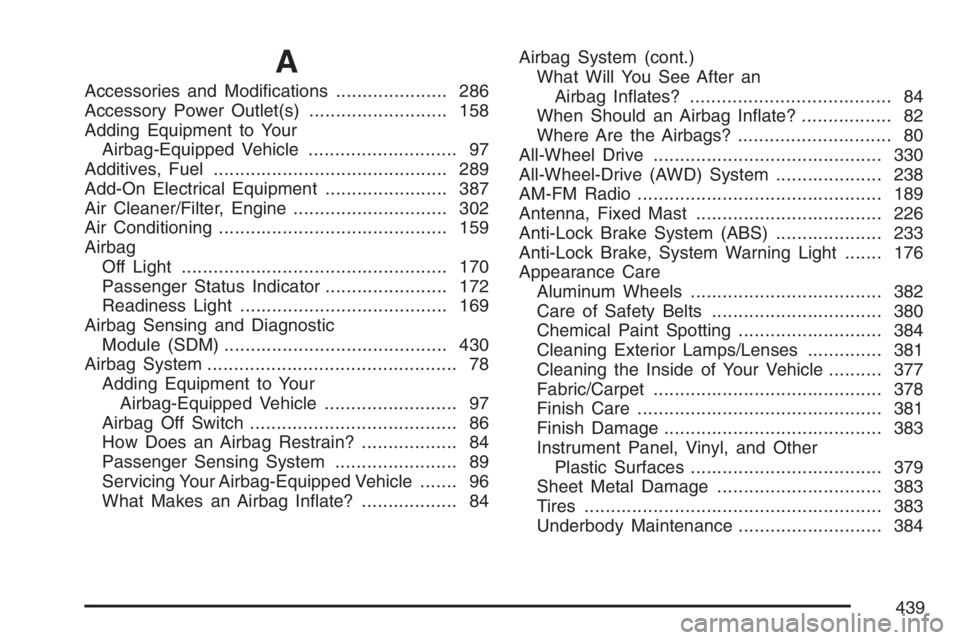
A
Accessories and Modifications..................... 286
Accessory Power Outlet(s).......................... 158
Adding Equipment to Your
Airbag-Equipped Vehicle............................ 97
Additives, Fuel............................................ 289
Add-On Electrical Equipment....................... 387
Air Cleaner/Filter, Engine............................. 302
Air Conditioning........................................... 159
Airbag
Off Light.................................................. 170
Passenger Status Indicator....................... 172
Readiness Light....................................... 169
Airbag Sensing and Diagnostic
Module (SDM).......................................... 430
Airbag System............................................... 78
Adding Equipment to Your
Airbag-Equipped Vehicle......................... 97
Airbag Off Switch....................................... 86
How Does an Airbag Restrain?.................. 84
Passenger Sensing System....................... 89
Servicing Your Airbag-Equipped Vehicle....... 96
What Makes an Airbag Inflate?.................. 84Airbag System (cont.)
What Will You See After an
Airbag Inflates?...................................... 84
When Should an Airbag Inflate?................. 82
Where Are the Airbags?............................. 80
All-Wheel Drive........................................... 330
All-Wheel-Drive (AWD) System.................... 238
AM-FM Radio.............................................. 189
Antenna, Fixed Mast................................... 226
Anti-Lock Brake System (ABS).................... 233
Anti-Lock Brake, System Warning Light....... 176
Appearance Care
Aluminum Wheels.................................... 382
Care of Safety Belts................................ 380
Chemical Paint Spotting........................... 384
Cleaning Exterior Lamps/Lenses.............. 381
Cleaning the Inside of Your Vehicle.......... 377
Fabric/Carpet........................................... 378
Finish Care.............................................. 381
Finish Damage......................................... 383
Instrument Panel, Vinyl, and Other
Plastic Surfaces.................................... 379
Sheet Metal Damage............................... 383
Tires........................................................ 383
Underbody Maintenance........................... 384
439
Page 440 of 452
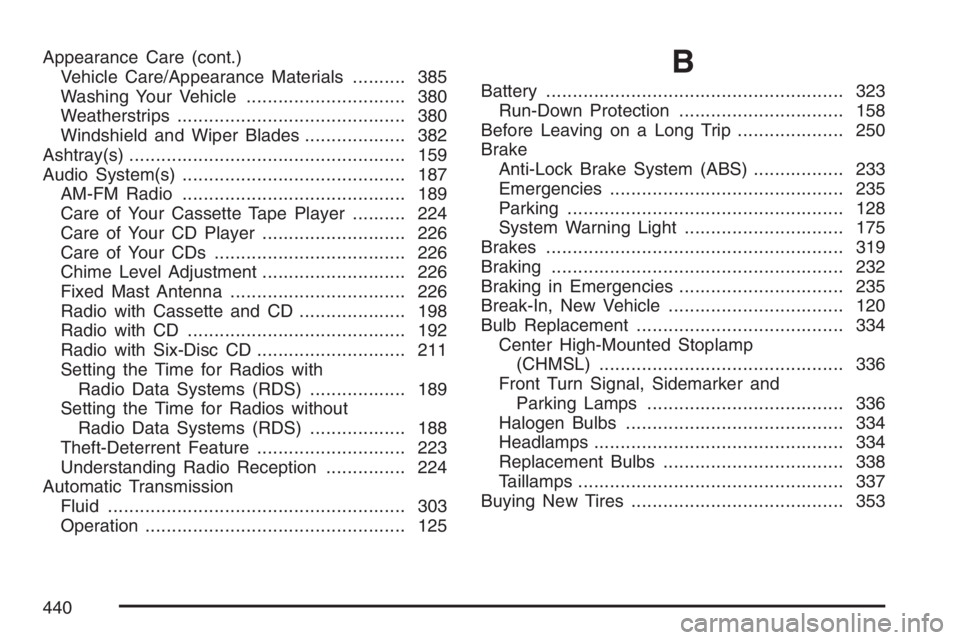
Appearance Care (cont.)
Vehicle Care/Appearance Materials.......... 385
Washing Your Vehicle.............................. 380
Weatherstrips........................................... 380
Windshield and Wiper Blades................... 382
Ashtray(s).................................................... 159
Audio System(s).......................................... 187
AM-FM Radio.......................................... 189
Care of Your Cassette Tape Player.......... 224
Care of Your CD Player........................... 226
Care of Your CDs.................................... 226
Chime Level Adjustment........................... 226
Fixed Mast Antenna................................. 226
Radio with Cassette and CD.................... 198
Radio with CD......................................... 192
Radio with Six-Disc CD............................ 211
Setting the Time for Radios with
Radio Data Systems (RDS).................. 189
Setting the Time for Radios without
Radio Data Systems (RDS).................. 188
Theft-Deterrent Feature............................ 223
Understanding Radio Reception............... 224
Automatic Transmission
Fluid........................................................ 303
Operation................................................. 125B
Battery........................................................ 323
Run-Down Protection............................... 158
Before Leaving on a Long Trip.................... 250
Brake
Anti-Lock Brake System (ABS)................. 233
Emergencies............................................ 235
Parking.................................................... 128
System Warning Light.............................. 175
Brakes........................................................ 319
Braking....................................................... 232
Braking in Emergencies............................... 235
Break-In, New Vehicle................................. 120
Bulb Replacement....................................... 334
Center High-Mounted Stoplamp
(CHMSL).............................................. 336
Front Turn Signal, Sidemarker and
Parking Lamps..................................... 336
Halogen Bulbs......................................... 334
Headlamps............................................... 334
Replacement Bulbs.................................. 338
Taillamps.................................................. 337
Buying New Tires........................................ 353
440
Page 441 of 452
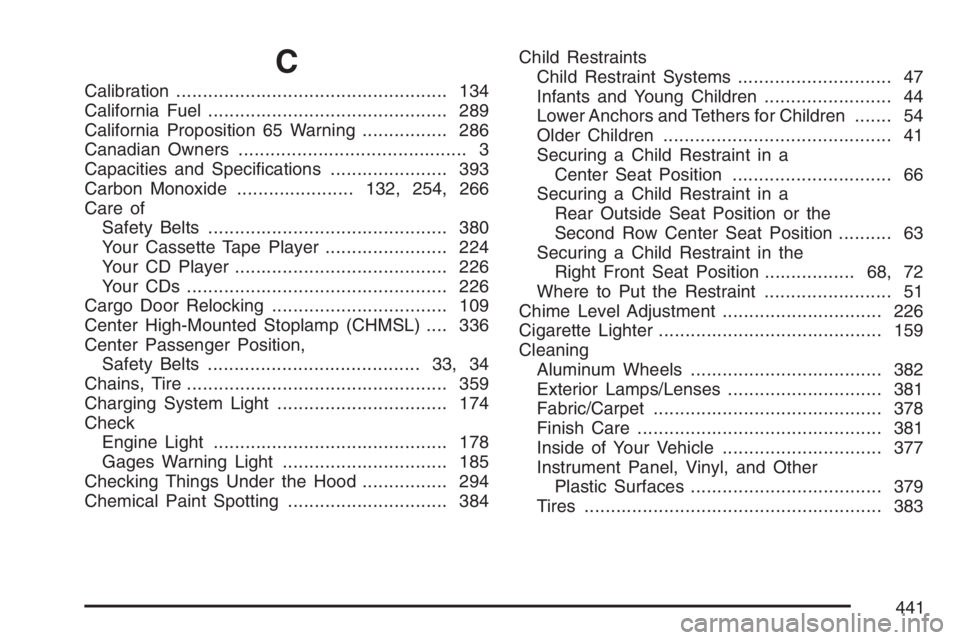
C
Calibration................................................... 134
California Fuel............................................. 289
California Proposition 65 Warning................ 286
Canadian Owners........................................... 3
Capacities and Specifications...................... 393
Carbon Monoxide......................132, 254, 266
Care of
Safety Belts............................................. 380
Your Cassette Tape Player....................... 224
Your CD Player........................................ 226
Your CDs ................................................. 226
Cargo Door Relocking................................. 109
Center High-Mounted Stoplamp (CHMSL).... 336
Center Passenger Position,
Safety Belts........................................ 33, 34
Chains, Tire................................................. 359
Charging System Light................................ 174
Check
Engine Light............................................ 178
Gages Warning Light............................... 185
Checking Things Under the Hood................ 294
Chemical Paint Spotting.............................. 384Child Restraints
Child Restraint Systems............................. 47
Infants and Young Children........................ 44
Lower Anchors and Tethers for Children....... 54
Older Children........................................... 41
Securing a Child Restraint in a
Center Seat Position.............................. 66
Securing a Child Restraint in a
Rear Outside Seat Position or the
Second Row Center Seat Position .......... 63
Securing a Child Restraint in the
Right Front Seat Position................. 68, 72
Where to Put the Restraint........................ 51
Chime Level Adjustment .............................. 226
Cigarette Lighter.......................................... 159
Cleaning
Aluminum Wheels.................................... 382
Exterior Lamps/Lenses............................. 381
Fabric/Carpet........................................... 378
Finish Care.............................................. 381
Inside of Your Vehicle .............................. 377
Instrument Panel, Vinyl, and Other
Plastic Surfaces.................................... 379
Tires........................................................ 383
441