belt GMC SAVANA 2007 Workshop Manual
[x] Cancel search | Manufacturer: GMC, Model Year: 2007, Model line: SAVANA, Model: GMC SAVANA 2007Pages: 452, PDF Size: 2.68 MB
Page 77 of 452
7. If your child restraint manufacturer
recommends using a top tether and the
position you are using has a top tether anchor,
attach and tighten the top tether to the top
tether anchor. Refer to the instructions
that came with the child restraint and toLower
Anchors and Tethers for Children (LATCH)
on page 54.
8. Push and pull the child restraint in different
directions to be sure it is secure.
To remove the child restraint, if the top tether is
attached to the top tether anchor, disconnect
it. Unbuckle the vehicle’s safety belt and let it
go back all the way. The safety belt will move
freely again and be ready to work for an adult or
larger child passenger.
If you had turned the airbag off with the switch,
remember to be sure to use the airbag off switch
to turn on the right front passenger’s airbag
when you remove the child restraint from the
vehicle unless the person who will be sitting there
is a member of a passenger airbag risk group.
SeeAirbag Off Switch on page 86.
{CAUTION:
If the right front passenger’s airbag is
turned off for a person who is not in a
risk group identied by the national
government, that person will not have the
extra protection of an airbag. In a crash,
the airbag will not be able to inate and
help protect the person sitting there.
Do not turn off the passenger’s airbag
unless the person sitting there is in a risk
group. SeeAirbag Off Switch on page 86
for more on this, including important
safety information.
77
Page 78 of 452
Airbag System
Your vehicle has an airbag for the driver in the
middle of the steering wheel. If it says AIR BAG on
the instrument panel in front of the right front
passenger’s seat, your vehicle has an airbag for
the right front passenger.
If there is not a right front passenger’s seat, your
vehicle has an airbag for the driver only.
Airbags are designed to supplement the protection
provided by safety belts. Even though today’s
airbags are also designed to help reduce the risk
of injury from the force of an inflating bag, all
airbags must inflate very quickly to do their job.
Here are the most important things to know about
the airbag system:{CAUTION:
You can be severely injured or killed in a
crash if you are not wearing your safety
belt — even if you have airbags. Wearing
your safety belt during a crash helps
reduce your chance of hitting things
inside the vehicle or being ejected from it.
Airbags are “supplemental restraints” to
the safety belts. All airbags are designed
to work with safety belts, but do not
replace them.
{CAUTION:
Airbags are designed to deploy in moderate
to severe frontal and near frontal crashes.
They are not designed to inate in rollover,
rear crashes, or in many side crashes.
CAUTION: (Continued)
78
Page 79 of 452
CAUTION: (Continued)
And, for some unrestrained occupants,
airbags may provide less protection in
frontal crashes than more forceful airbags
have provided in the past. Everyone in
your vehicle should wear a safety belt
properly — whether or not there is an
airbag for that person.
{CAUTION:
Airbags inate with great force, faster
than the blink of an eye. If you are too
close to an inating airbag, as you would
be if you were leaning forward, it could
seriously injure you. Safety belts help
keep you in position before and during a
crash. Always wear your safety belt, even
with airbags. The driver should sit as far
back as possible while still maintaining
control of the vehicle.If your vehicle has an airbag for the right front
passenger, read the following:
{CAUTION:
Anyone who is up against, or very close
to, any airbag when it inates can be
seriously injured or killed. Airbags plus
lap-shoulder belts offer the best
protection for adults, but not for young
children and infants. Neither the vehicle’s
safety belt system nor its airbag system is
designed for them. Young children and
infants need the protection that a child
restraint system can provide. Always
secure children properly in your vehicle.
To read how, seeOlder Children on
page 41andInfants and Young Children
on page 44.
79
Page 84 of 452
What Makes an Airbag Inate?
In an impact of sufficient severity, the airbag
sensing system detects that the vehicle is in a
crash. The sensing system triggers a release of
gas from the inflator, which inflates the airbag.
The inflator, airbag, and related hardware are all
part of the airbag modules inside the steering
wheel and in the instrument panel in front of the
right front passenger.
How Does an Airbag Restrain?
In moderate to severe frontal or near-frontal
collisions, even belted occupants can contact
the steering wheel or the instrument panel.
The airbag supplements the protection provided
by safety belts. Airbags distribute the force of
the impact more evenly over the occupant’s upper
body, stopping the occupant more gradually.
But airbags would not help you in many types of
collisions, including rollovers, rear impacts,
and many side impacts, primarily because an
occupant’s motion is not toward those airbags.
Airbags should never be regarded as anything
more than a supplement to safety belts, and then
only in moderate to severe frontal or near-frontal
collisions.
What Will You See After an Airbag
Inates?
After an airbag inflates, it quickly deflates, so
quickly that some people may not even realize the
airbag inflated. Some components of the airbag
module — the steering wheel hub for the driver’s
airbag or the instrument panel for the right
front passenger’s bag — may be hot for a short
time. The parts of the airbag that come into contact
with you may be warm, but not too hot to touch.
There may be some smoke and dust coming from
the vents in the deflated airbags. Airbag inflation
does not prevent the driver from seeing out of
the windshield or being able to steer the vehicle,
nor does it prevent people from leaving the vehicle.
84
Page 87 of 452
Child age 1 to 12.A child age 1 to 12 must
ride in the front seat because:
•
My vehicle has no rear seat;
•Although children ages 1 to 12 ride in the rear
seat(s) whenever possible, children ages 1 to
12 sometimes must ride in the front because
no space is available in the rear seat(s) of my
vehicle; or
•The child has a medical condition which,
according to the child’s physician, makes
it necessary for the child to ride in the front
seat so that the driver can constantly monitor
the child’s condition.
Medical Condition.A passenger has a
medical condition which, according to his or
her physician:
•
Causes the passenger airbag to pose a
special risk for the passenger; and
•Makes the potential harm from the passenger
airbag in a crash greater than the potential
harm from turning off the airbag and allowing
the passenger, even if belted, to hit the
dashboard or windshield in a crash.
{CAUTION:
If the right front passenger’s airbag is
turned off for a person who is not in
a risk group identied by the national
government, that person will not have the
extra protection of an airbag. In a crash,
the airbag will not be able to inate and
help protect the person sitting there.
Do not turn off the passenger’s airbag
unless the person sitting there is in a risk
group. SeeAirbag Off Switch on page 86.
87
Page 94 of 452
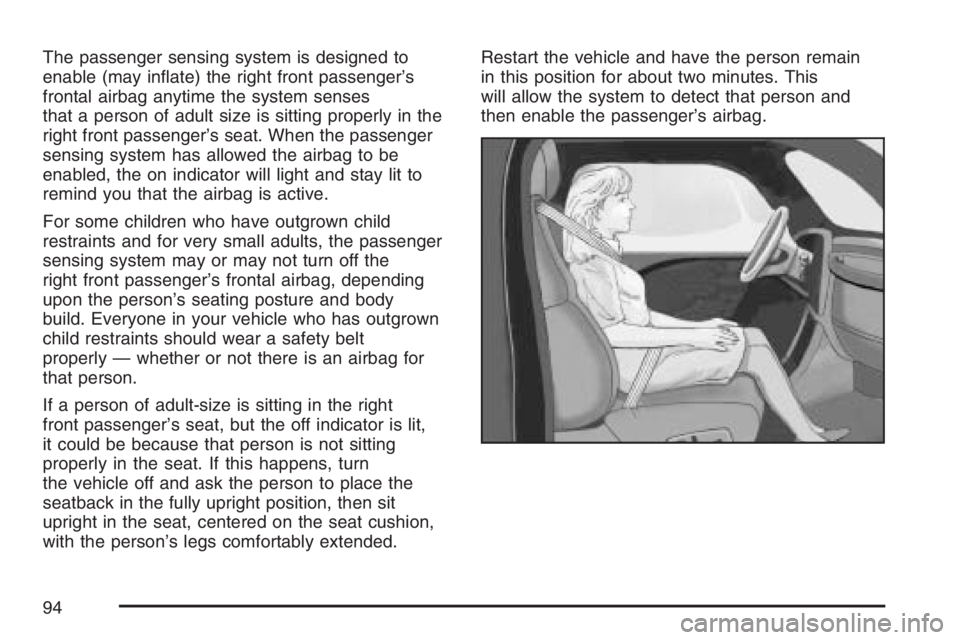
The passenger sensing system is designed to
enable (may inflate) the right front passenger’s
frontal airbag anytime the system senses
that a person of adult size is sitting properly in the
right front passenger’s seat. When the passenger
sensing system has allowed the airbag to be
enabled, the on indicator will light and stay lit to
remind you that the airbag is active.
For some children who have outgrown child
restraints and for very small adults, the passenger
sensing system may or may not turn off the
right front passenger’s frontal airbag, depending
upon the person’s seating posture and body
build. Everyone in your vehicle who has outgrown
child restraints should wear a safety belt
properly — whether or not there is an airbag for
that person.
If a person of adult-size is sitting in the right
front passenger’s seat, but the off indicator is lit,
it could be because that person is not sitting
properly in the seat. If this happens, turn
the vehicle off and ask the person to place the
seatback in the fully upright position, then sit
upright in the seat, centered on the seat cushion,
with the person’s legs comfortably extended.Restart the vehicle and have the person remain
in this position for about two minutes. This
will allow the system to detect that person and
then enable the passenger’s airbag.
94
Page 97 of 452
Adding Equipment to Your
Airbag-Equipped Vehicle
Q:Is there anything I might add to the front
of the vehicle that could keep the airbags
from working properly?
A:Yes. If you add things that change your
vehicle’s frame, bumper system, height,
front end or side sheet metal, they may keep
the airbag system from working properly.
Also, the airbag system may not work properly
if you relocate any of the airbag sensors.
If you have any questions about this,
you should contact Customer Assistance
before you modify your vehicle. The phone
numbers and addresses for Customer
Assistance are in Step Two of theCustomer
Satisfaction Procedure on page 418.
Q:Because I have a disability, I have to get
my vehicle modied. How can I nd out
whether this will affect my airbag system?
A:Changing or moving any parts of the
front seats, safety belts, the airbag sensing
and diagnostic module, steering wheel,
the instrument panel, or airbag wiring can
affect the operation of the airbag system.
If you have questions, call Customer
Assistance. The phone numbers and
addresses for Customer Assistance are in
Step Two of the Customer Satisfaction
Procedure in this manual. SeeCustomer
Satisfaction Procedure on page 418.
97
Page 98 of 452

Restraint System Check
Checking the Restraint Systems
Now and then, make sure the safety belt reminder
light and all your belts, buckles, latch plates,
retractors and anchorages are working properly.
Look for any other loose or damaged safety
belt system parts. If you see anything that might
keep a safety belt system from doing its job, have
it repaired. SeeCare of Safety Belts on page 380
for more information.
Torn or frayed safety belts may not protect you in
a crash. They can rip apart under impact forces.
If a belt is torn or frayed, get a new one right away.
Also look for any opened or broken airbag
covers, and have them repaired or replaced. The
airbag system does not need regular maintenance.Notice:If you damage the covering for the
driver’s or the right front passenger’s airbag,
the airbag may not work properly. You may
have to replace the airbag module in the
steering wheel or both the airbag module
and the instrument panel for the right front
passenger’s airbag. Do not open or break the
airbag coverings.
98
Page 99 of 452
Replacing Restraint System Parts
After a Crash
{CAUTION:
A crash can damage the restraint systems
in your vehicle. A damaged restraint
system may not properly protect the
person using it, resulting in serious injury
or even death in a crash. To help make
sure your restraint systems are working
properly after a crash, have them inspected
and any necessary replacements made
as soon as possible.
If you have had a crash, do you need new safety
belts or LATCH system parts?
After a very minor collision, nothing may be
necessary. But if the belts were stretched, as they
would be if worn during a more severe crash,
then you need new parts.
If the LATCH system was being used during a
more severe crash, you may need new LATCH
system parts.If belts are cut or damaged, replace them.
Collision damage also may mean you will need to
have LATCH system, safety belt or seat parts
repaired or replaced. New parts and repairs may
be necessary even if the belt or LATCH system
was not being used at the time of the collision.
If an airbag inflates, if your vehicle has these, you
will need to replace airbag system parts. See the
part on the airbag system earlier in this section.
If the frontal airbags inflate, you will also need to
replace the driver’s and right front passenger’s
safety belt buckle assembly. Be sure to do
so. Then the new buckle assembly will be there
to help protect you in a collision.
After a crash you may need to replace the
driver and front passenger’s safety belt buckle
assemblies, even if the frontal airbags have
not deployed. On some models, the driver and
front passenger’s safety belt buckle assemblies
contain safety belt pretensioners. If your vehicle
has safety belt pretensioners, have them checked
if your vehicle has been in a collision, or if your
airbag readiness light stays on after you start your
vehicle or while you are driving. SeeAirbag
Readiness Light on page 169.
99
Page 108 of 452
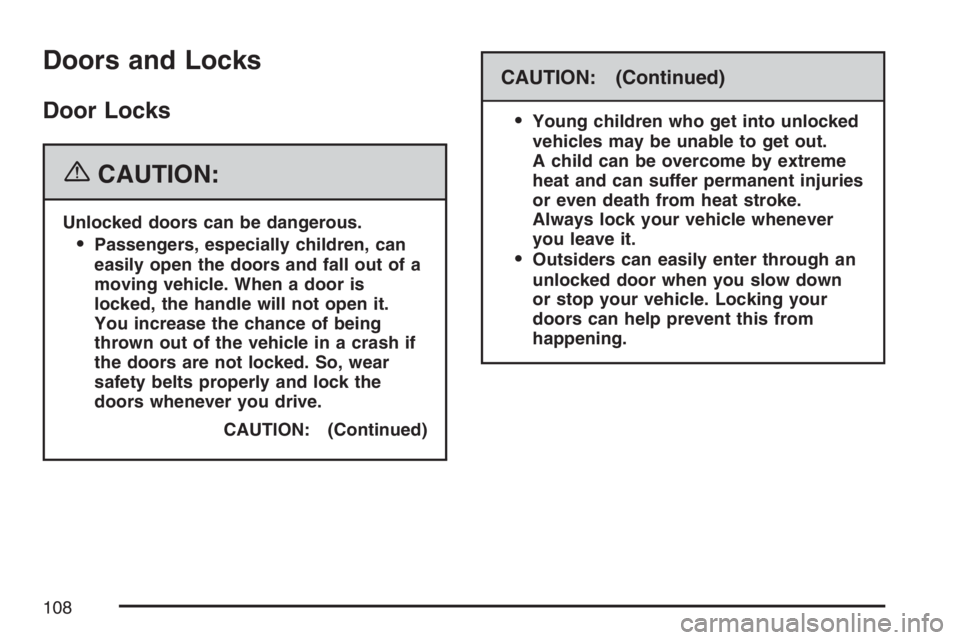
Doors and Locks
Door Locks
{CAUTION:
Unlocked doors can be dangerous.
Passengers, especially children, can
easily open the doors and fall out of a
moving vehicle. When a door is
locked, the handle will not open it.
You increase the chance of being
thrown out of the vehicle in a crash if
the doors are not locked. So, wear
safety belts properly and lock the
doors whenever you drive.
CAUTION: (Continued)
CAUTION: (Continued)
Young children who get into unlocked
vehicles may be unable to get out.
A child can be overcome by extreme
heat and can suffer permanent injuries
or even death from heat stroke.
Always lock your vehicle whenever
you leave it.
Outsiders can easily enter through an
unlocked door when you slow down
or stop your vehicle. Locking your
doors can help prevent this from
happening.
108