tire size GMC SAVANA 2008 User Guide
[x] Cancel search | Manufacturer: GMC, Model Year: 2008, Model line: SAVANA, Model: GMC SAVANA 2008Pages: 402, PDF Size: 2.45 MB
Page 310 of 402
When It Is Time for New Tires
Various factors, such as maintenance, temperatures,
driving speeds, vehicle loading, and road conditions,
influence when you need new tires.
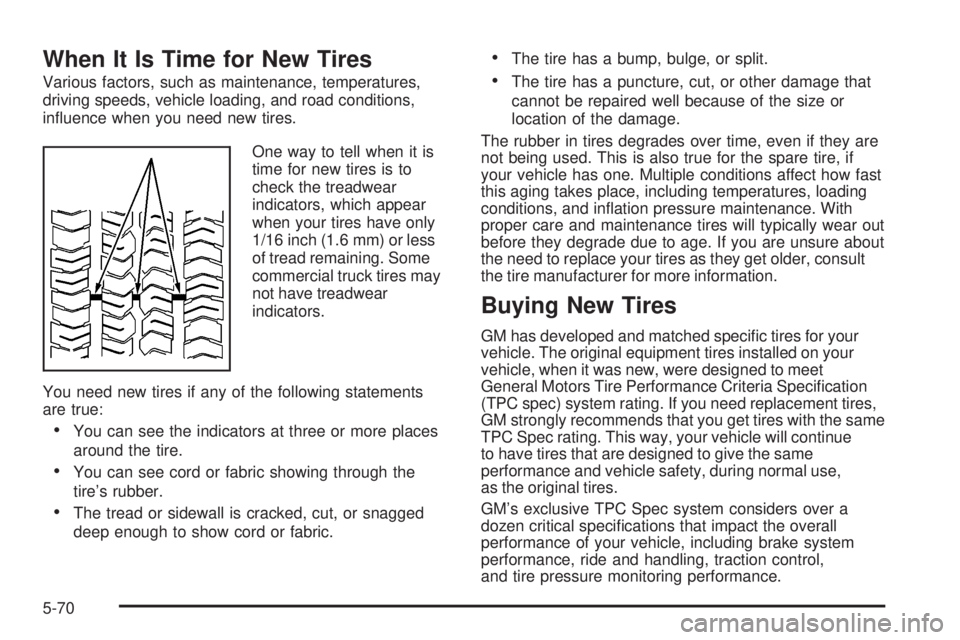
One way to tell when it is
time for new tires is to
check the treadwear
indicators, which appear
when your tires have only
1/16 inch (1.6 mm) or less
of tread remaining. Some
commercial truck tires may
not have treadwear
indicators.
You need new tires if any of the following statements
are true:
•You can see the indicators at three or more places
around the tire.
•You can see cord or fabric showing through the
tire’s rubber.
•The tread or sidewall is cracked, cut, or snagged
deep enough to show cord or fabric.
•The tire has a bump, bulge, or split.
•The tire has a puncture, cut, or other damage that
cannot be repaired well because of the size or
location of the damage.
The rubber in tires degrades over time, even if they are
not being used. This is also true for the spare tire, if
your vehicle has one. Multiple conditions affect how fast
this aging takes place, including temperatures, loading
conditions, and inflation pressure maintenance. With
proper care and maintenance tires will typically wear out
before they degrade due to age. If you are unsure about
the need to replace your tires as they get older, consult
the tire manufacturer for more information.
Buying New Tires
GM has developed and matched specific tires for your
vehicle. The original equipment tires installed on your
vehicle, when it was new, were designed to meet
General Motors Tire Performance Criteria Specification
(TPC spec) system rating. If you need replacement tires,
GM strongly recommends that you get tires with the same
TPC Spec rating. This way, your vehicle will continue
to have tires that are designed to give the same
performance and vehicle safety, during normal use,
as the original tires.
GM’s exclusive TPC Spec system considers over a
dozen critical specifications that impact the overall
performance of your vehicle, including brake system
performance, ride and handling, traction control,
and tire pressure monitoring performance.
5-70
Page 311 of 402
GM’s TPC Spec number is molded onto the tire’s
sidewall near the tire size. If the tires have an all-season
tread design, the TPC spec number will be followed
by a MS, for mud and snow. SeeTire Sidewall Labeling
on page 5-54for additional information.
GM recommends replacing tires in sets of four (or six if
your vehicle has dual rear wheels). This is because
uniform tread depth on all tires will help keep your
vehicle performing most like it did when the tires were
new. Replacing less than a full set of tires can affect the
braking and handling performance of your vehicle. See
Tire Inspection and Rotation on page 5-68for information
on proper tire rotation.
{CAUTION:
Mixing tires could cause you to lose
control while driving. If you mix tires of
different sizes, brands, or types (radial
and bias-belted tires) the vehicle may not
handle properly, and you could have a
crash. Using tires of different sizes,
brands, or types may also cause damage to
your vehicle. Be sure to use the correct
size, brand, and type of tires on your
vehicle’s wheels.
{CAUTION:
If you use bias-ply tires on your vehicle,
the wheel rim anges could develop
cracks after many miles of driving. A tire
and/or wheel could fail suddenly, causing
a crash. Use only radial-ply tires with the
wheels on your vehicle.
If you must replace your vehicle’s tires with those that
do not have a TPC Spec number, make sure they are
the same size, load range, speed rating, and construction
type (radial and bias-belted tires) as your vehicle’s
original tires.
Vehicles that have a tire pressure monitoring system
could give an inaccurate low-pressure warning if
non-TPC Spec rated tires are installed on your vehicle.
Non-TPC Spec rated tires may give a low-pressure
warning that is higher or lower than the proper warning
level you would get with TPC Spec rated tires.
SeeTire Pressure Monitor System on page 5-62.
Your vehicle’s original equipment tires are listed on the
Tire and Loading Information label. SeeLoading Your
Vehicle on page 4-20, for more information about the
Tire and Loading Information label and its location on
your vehicle.
5-71
Page 312 of 402
Different Size Tires and Wheels
If you add wheels or tires that are a different size than
your original equipment wheels and tires, this could
affect the way your vehicle performs, including its
braking, ride and handling characteristics, stability, and
resistance to rollover. Additionally, if your vehicle has
electronic systems such as anti-lock brakes, rollover
airbags, traction control, and electronic stability control,
the performance of these systems can be affected.{CAUTION:
If you add different sized wheels, your vehicle
may not provide an acceptable level of
performance and safety if tires not
recommended for those wheels are selected.
You may increase the chance that you will
crash and suffer serious injury. Only use GM
specic wheel and tire systems developed for
your vehicle, and have them properly installed
by a GM certied technician.
SeeBuying New Tires on page 5-70andAccessories
and Modifications on page 5-3for additional information.
5-72
Page 316 of 402
Tire Chains
{CAUTION:
If your vehicle has dual wheels or P245/75R16
or LT245/75R16 size tires, do not use tire
chains. They can damage your vehicle because
there is not enough clearance. Tire chains
used on a vehicle without the proper amount of
clearance can cause damage to the brakes,
suspension, or other vehicle parts. The area
damaged by the tire chains could cause you to
lose control of your vehicle and you or others
may be injured in a crash.
Use another type of traction device only if its
manufacturer recommends it for use on your
vehicle and tire size combination and road
CAUTION: (Continued)
CAUTION: (Continued)
conditions. Follow that manufacturer’s
instructions. To help avoid damage to your
vehicle, drive slowly, readjust, or remove the
device if it is contacting your vehicle, and do
not spin the vehicle’s wheels.
If you do nd traction devices that will t,
install them on the rear tires.
Notice:If your vehicle does not have dual wheels
and has a tire size other than P245/75R16 or
LT245/75R16, use tire chains only where legal and
only when you must. Use chains that are the proper
size for your tires. Install them on the tires of the
rear axle. Do not use chains on the tires of the front
axle. Tighten them as tightly as possible with the
ends securely fastened. Drive slowly and follow the
chain manufacturer’s instructions. If you can hear
the chains contacting your vehicle, stop and
retighten them. If the contact continues, slow down
until it stops. Driving too fast or spinning the wheels
with chains on will damage your vehicle.
5-76
Page 322 of 402
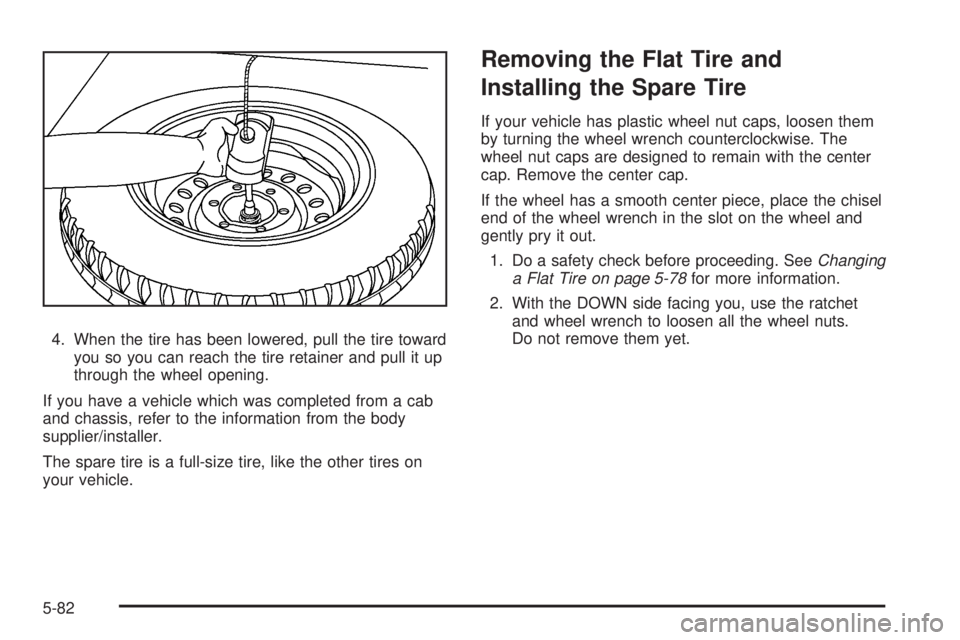
4. When the tire has been lowered, pull the tire toward
you so you can reach the tire retainer and pull it up
through the wheel opening.
If you have a vehicle which was completed from a cab
and chassis, refer to the information from the body
supplier/installer.
The spare tire is a full-size tire, like the other tires on
your vehicle.
Removing the Flat Tire and
Installing the Spare Tire
If your vehicle has plastic wheel nut caps, loosen them
by turning the wheel wrench counterclockwise. The
wheel nut caps are designed to remain with the center
cap. Remove the center cap.
If the wheel has a smooth center piece, place the chisel
end of the wheel wrench in the slot on the wheel and
gently pry it out.
1. Do a safety check before proceeding. SeeChanging
a Flat Tire on page 5-78for more information.
2. With the DOWN side facing you, use the ratchet
and wheel wrench to loosen all the wheel nuts.
Do not remove them yet.
5-82
Page 334 of 402
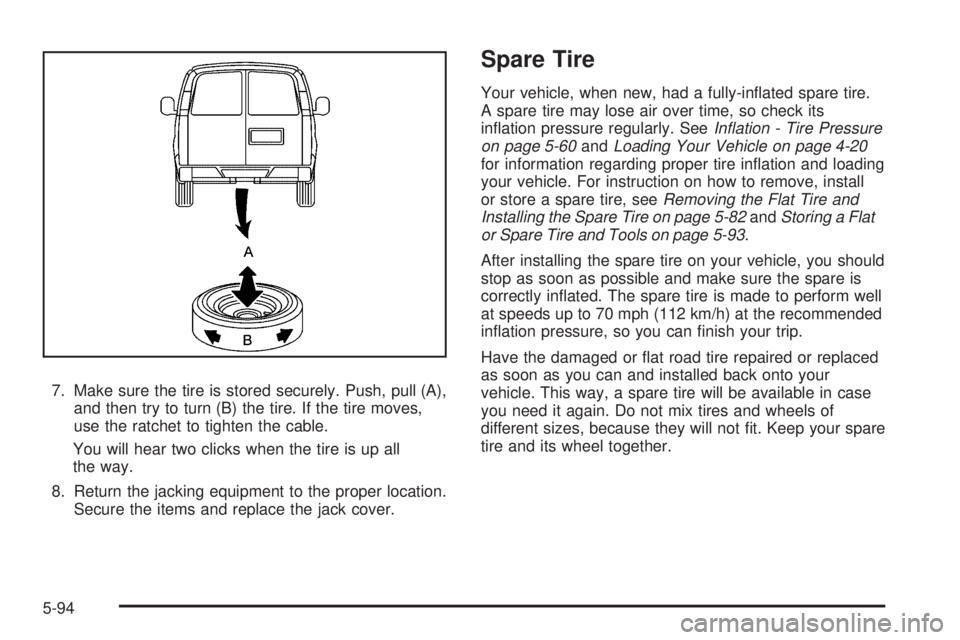
7. Make sure the tire is stored securely. Push, pull (A),
and then try to turn (B) the tire. If the tire moves,
use the ratchet to tighten the cable.
You will hear two clicks when the tire is up all
the way.
8. Return the jacking equipment to the proper location.
Secure the items and replace the jack cover.
Spare Tire
Your vehicle, when new, had a fully-inflated spare tire.
A spare tire may lose air over time, so check its
inflation pressure regularly. SeeInflation - Tire Pressure
on page 5-60andLoading Your Vehicle on page 4-20
for information regarding proper tire inflation and loading
your vehicle. For instruction on how to remove, install
or store a spare tire, seeRemoving the Flat Tire and
Installing the Spare Tire on page 5-82andStoring a Flat
or Spare Tire and Tools on page 5-93.
After installing the spare tire on your vehicle, you should
stop as soon as possible and make sure the spare is
correctly inflated. The spare tire is made to perform well
at speeds up to 70 mph (112 km/h) at the recommended
inflation pressure, so you can finish your trip.
Have the damaged or flat road tire repaired or replaced
as soon as you can and installed back onto your
vehicle. This way, a spare tire will be available in case
you need it again. Do not mix tires and wheels of
different sizes, because they will not fit. Keep your spare
tire and its wheel together.
5-94
Page 401 of 402
Tires (cont.)
Cleaning...................................................5-101
Different Size..............................................5-72
Dual Tire Operation.....................................5-61
If a Tire Goes Flat.......................................5-77
Inflation - Tire Pressure................................5-60
Inspection and Rotation................................5-68
Installing the Spare Tire................................5-82
Pressure Monitor Operation...........................5-64
Pressure Monitor System..............................5-62
Removing the Flat Tire.................................5-82
Removing the Spare Tire and Tools...............5-79
Secondary Latch System..............................5-90
Spare Tire..................................................5-94
Storing a Flat or Spare Tire and Tools............5-93
Tire Sidewall Labeling..................................5-54
Tire Terminology and Definitions....................5-57
Uniform Tire Quality Grading.........................5-73
Wheel Alignment and Tire Balance.................5-74
Wheel Replacement.....................................5-74
When It Is Time for New Tires......................5-70Tow/Haul Mode...............................................2-25
Tow/Haul Mode Light.......................................3-40
Towing
Recreational Vehicle.....................................4-26
Towing a Trailer..........................................4-28
Your Vehicle...............................................4-25
Traction
StabiliTrak
®System....................................... 4-5
Transmission
Fluid, Automatic...........................................5-20
Transmission Operation, Automatic....................2-22
Trip Odometer................................................3-26
Turn and Lane-Change Signals.......................... 3-8
Turn Signal/Multifunction Lever........................... 3-7
U
Uniform Tire Quality Grading............................5-73
Using this Manual............................................... iii
11
Page 402 of 402
V
Vehicle
Control........................................................ 4-3
Damage Warnings........................................... iv
Loading......................................................4-20
Symbols......................................................... iv
Vehicle Customization, DIC..............................3-58
Vehicle Data Recording and Privacy..................7-16
Vehicle Identification
Number (VIN)............................................5-103
Service Parts Identification Label..................5-103
Ventilation Adjustment......................................3-21
Visors...........................................................2-16
Voltmeter Gage..............................................3-32
W
Warning Lights, Gages and Indicators................3-24
Warnings
DIC Warnings and Messages........................3-49
Hazard Warning Flashers............................... 3-6
Other Warning Devices.................................. 3-6
Safety and Symbols......................................... iii
Vehicle Damage.............................................. ivWheels
Alignment and Tire Balance..........................5-74
Different Size..............................................5-72
Replacement...............................................5-74
Where to Put the Restraint...............................1-38
Windows.......................................................2-13
Manual......................................................2-13
Power........................................................2-14
Swing-Out Windows.....................................2-15
Windows, Enhanced Technology Glass...............2-16
Windshield
Washer......................................................3-10
Washer Fluid..............................................5-35
Wiper Blade Replacement.............................5-52
Wiper Blades, Cleaning................................5-99
Wiper Fuses.............................................5-104
Wipers......................................................... 3-9
Winter Driving................................................4-16
Y
Your Vehicle and the Environment....................... 6-2
12