heating GMC SAVANA 2009 User Guide
[x] Cancel search | Manufacturer: GMC, Model Year: 2009, Model line: SAVANA, Model: GMC SAVANA 2009Pages: 404, PDF Size: 2.35 MB
Page 176 of 404
STARTING DISABLED SERVICE
THROTTLE
This message displays if the starting of the engine is
disabled due to the electronic throttle control system.
Have your vehicle serviced by your dealer/retailer
immediately.
This message only appears while the ignition is in
ON/RUN, and will not disappear until the problem is
resolved.
This message cannot be acknowledged.
TIGHTEN GAS CAP
This message may display and a chime may be heard
along with the check engine light on the instrument
panel cluster if the vehicle’s fuel cap is not tightened
properly. SeeMalfunction Indicator Lamp on page 3-36.
Reinstall the fuel cap fully. SeeFilling the Tank on
page 5-10. The diagnostic system can determine if the
fuel cap has been left off or improperly installed. A
loose or missing fuel cap allows fuel to evaporate into
the atmosphere. A few driving trips with the cap properly
installed should turn this light and message off.
TIRE LEARNING ACTIVE
If your vehicle has the Tire Pressure Monitor System
(TPMS), this message displays when the system is
re-learning the tire positions on your vehicle. SeeDIC
Operation and Displays on page 3-43for more
information. The tire positions must be re-learned after
rotating the tires or after replacing a tire or sensor. See
Tire Inspection and Rotation on page 5-69,Tire Pressure
Monitor System on page 5-64, andInflation - Tire
Pressure on page 5-62for more information.
TRACTION CONTROL OFF
If your vehicle has StabiliTrak, this message displays
when the Traction Control System (TCS) is turned
off. Adjust your driving accordingly. SeeStabiliTrak
®
System on page 4-6for more information.
TRANSMISSION HOT IDLE ENGINE
Notice:If you drive your vehicle while the
transmission uid is overheating and the
transmission temperature warning is displayed on
the instrument panel cluster and/or DIC, you
can damage the transmission. This could lead to
costly repairs that would not be covered by
your warranty. Do not drive your vehicle with
overheated transmission uid or while the
transmission temperature warning is displayed.
3-58
Page 240 of 404
Driving On Grades
Reduce speed and shift to a lower gearbeforestarting
down a long or steep downgrade. If the transmission is
not shifted down, the brakes might have to be used so
much that they would get hot and no longer work well.
The vehicle can tow in D (Drive). Shift the transmission to
a lower gear if the transmission shifts too often under
heavy loads and/or hilly conditions.
When towing at high altitude on steep uphill grades,
consider the following: Engine coolant will boil at a lower
temperature than at normal altitudes. If the engine is
turned off immediately after towing at high altitude on
steep uphill grades, the vehicle may show signs similar to
engine overheating. To avoid this, let the engine run while
parked, preferably on level ground, with the automatic
transmission in P (Park) for a few minutes before turning
the engine off. If the overheat warning comes on, see
Engine Overheating on page 5-31.
Parking on Hills
{CAUTION:
Parking the vehicle on a hill with the trailer attached
can be dangerous. If something goes wrong, the rig
could start to move. People can be injured, and
both the vehicle and the trailer can be damaged.
When possible, always park the rig on a flat
surface.
If parking the rig on a hill:
1. Press the brake pedal, but do not shift into P (Park)
yet for vehicles with an automatic transmission, or
into gear for vehicles with a manual transmission.
Turn the wheels into the curb if facing downhill
or into traffic if facing uphill.
2. Have someone place chocks under the trailer
wheels.
4-36
Page 243 of 404
Service............................................................5-3
Accessories and Modifications..........................5-3
California Proposition 65 Warning.....................5-4
California Perchlorate Materials Requirements......5-4
Doing Your Own Service Work.........................5-4
Adding Equipment to the Outside of the
Vehicle......................................................5-5
Fuel................................................................5-5
Gasoline Octane............................................5-6
Gasoline Specifications....................................5-6
California Fuel...............................................5-6
Additives.......................................................5-7
Fuel E85 (85% Ethanol)..................................5-8
Fuels in Foreign Countries...............................5-9
Filling the Tank............................................5-10
Filling a Portable Fuel Container.....................5-12
Checking Things Under the Hood....................5-12
Hood Release..............................................5-13
Engine Compartment Overview.......................5-14
Engine Oil...................................................5-15
Engine Oil Life System..................................5-18
Engine Air Cleaner/Filter................................5-20
Automatic Transmission Fluid.........................5-21
Cooling System............................................5-24
Engine Coolant.............................................5-25Radiator Pressure Cap..................................5-31
Engine Overheating.......................................5-31
Engine Fan Noise.........................................5-33
Power Steering Fluid.....................................5-34
Windshield Washer Fluid................................5-35
Brakes........................................................5-36
Battery........................................................5-39
Jump Starting...............................................5-40
All-Wheel Drive..............................................5-44
Rear Axle
.......................................................5-45
Front Axle......................................................5-46
Noise Control System.....................................5-47
Tampering with Noise Control System
Prohibited.................................................5-47
Bulb Replacement..........................................5-48
Halogen Bulbs..............................................5-48
Headlamps..................................................5-48
Front Turn Signal, Sidemarker and
Parking Lamps..........................................5-50
Center High-Mounted
Stoplamp (CHMSL)....................................5-51
Taillamps.....................................................5-51
Replacement Bulbs.......................................5-52
Windshield Wiper Blade Replacement..............5-53
Section 5 Service and Appearance Care
5-1
Page 267 of 404
{CAUTION:
An electric engine cooling fan under the hood can
start up even when the engine is not running and
can cause injury. Keep hands, clothing, and tools
away from any underhood electric fan.
{CAUTION:
Heater, fuel operated heater (FOH), radiator
hoses, and other engine parts, can be very hot.
Do not touch them. If you do, you can be burned.
Do not run the engine if there is a leak. If you run
the engine, it could lose all coolant. That could
cause an engine fire, and you could be burned.
Get any leak fixed before you drive the vehicle.Notice:Using coolant other than DEX-COOL may
cause premature engine, heater core, radiator and
fuel operated heater (FOH) corrosion. In addition,
the engine coolant may require changing sooner, at
30,000 miles (50 000 km) or 24 months, whichever
occurs rst. Any repairs would not be covered by
your warranty. Always use DEX-COOL (silicate-free)
coolant in your vehicle.
Engine Coolant
The cooling system in the vehicle is filled with
DEX-COOL®engine coolant. This coolant is designed
to remain in the vehicle for five years or 150,000 miles
(240 000 km), whichever occurs first.
The following explains the cooling system and how to
check and add coolant when it is low. If there is a problem
with engine overheating, seeEngine Overheating on
page 5-31.
5-25
Page 273 of 404
Radiator Pressure Cap
The radiator pressure cap is located near the center of
the engine compartment. SeeEngine Compartment
Overview on page 5-14for more information on location.
Notice:If the pressure cap is not tightly installed,
coolant loss and possible engine damage may
occur. Be sure the cap is properly and tightly
secured.
Engine Overheating
If your vehicle has the DURAMAX Diesel engine, see
the DURAMAX Diesel manual for more information.
The vehicle has an indicator to warn of engine
overheating.
You will find an engine coolant temperature gage on
your vehicle’s instrument panel. SeeEngine Coolant
Temperature Gage on page 3-35for more information.You may decide not to lift the hood when this warning
appears, but instead get service help right away.
SeeRoadside Assistance Program on page 7-7.
If you do decide to lift the hood, make sure the vehicle
is parked on a level surface.
Then check to see if the engine cooling fans are
running. If the engine is overheating, both fans should
be running. If they are not, do not continue to run
the engine and have the vehicle serviced.
See if the engine cooling fan speed increases when idle
speed is doubled by pushing the accelerator pedal down.
If it does not, your vehicle needs service. Turn off the
engine.
Notice:Engine damage from running the engine
without coolant is not covered by the warranty.
Notice:If the engine catches re because of being
driven with no coolant, your vehicle can be badly
damaged. The costly repairs would not be covered
by the vehicle warranty.
5-31
Page 296 of 404
Tires
Your new vehicle comes with high-quality tires
made by a leading tire manufacturer. If you ever
have questions about your tire warranty and where
to obtain service, see your vehicle Warranty booklet
for details. For additional information refer to the tire
manufacturer.
{CAUTION:
Poorly maintained and improperly used tires
are dangerous.
•Overloading your vehicle’s tires can
cause overheating as a result of too
much flexing. You could have an air-out
and a serious accident. SeeLoading the
Vehicle on page 4-18.
CAUTION: (Continued)
CAUTION: (Continued)
•
Underinflated tires pose the same danger
as overloaded tires. The resulting accident
could cause serious injury. Check all tires
frequently to maintain the recommended
pressure. Tire pressure should be
checked when your vehicle’s tires are
cold. SeeInflation - Tire Pressure on
page 5-62.
•Overinflated tires are more likely to
be cut, punctured, or broken by a sudden
impact — such as when you hit a pothole.
Keep tires at the recommended pressure.
•Worn, old tires can cause accidents.
If the tire’s tread is badly worn, or if your
vehicle’s tires have been damaged,
replace them.
5-54
Page 395 of 404
Child Restraints (cont.)
Securing a Child Restraint in the
Right Front Seat Position..................1-50, 1-54
Where to Put the Restraint...........................1-39
Cigarette Lighter.............................................3-19
Cleaning
Aluminum Wheels......................................5-101
Exterior Lamps/Lenses.................................5-99
Fabric/Carpet..............................................5-97
Finish Care...............................................5-100
Instrument Panel, Vinyl, and Other
Plastic Surfaces.......................................5-98
Interior.......................................................5-96
Tires........................................................5-101
Underbody Maintenance.............................5-102
Washing Your Vehicle...................................5-99
Weatherstrips..............................................5-98
Windshield and Wiper Blades......................5-100
Climate Control System...................................3-19
Outlet Adjustment........................................3-21
Rear Air Conditioning and Heating System.........3-23
Rear Heating System...................................3-22
Clock, Setting.................................................3-66
Collision Damage Repair..................................7-11
Compass.......................................................3-48
Control of a Vehicle.......................................... 4-3
Coolant
Engine.......................................................5-25
Engine Temperature Gage............................3-35
Cooling System..............................................5-24Cruise Control................................................3-10
Cruise Control Light........................................3-41
Customer Assistance Information
Courtesy Transportation................................7-10
Customer Assistance for Text
Telephone (TTY) Users............................... 7-6
Customer Assistance Offices........................... 7-6
Customer Satisfaction Procedure..................... 7-2
GM Mobility Reimbursement Program............... 7-7
Reporting Safety Defects to
General Motors........................................
7-15
Reporting Safety Defects to the
Canadian Government..............................7-15
Reporting Safety Defects to the
United States Government.........................7-14
Roadside Assistance Program......................... 7-7
Service Publications Ordering Information........7-15
D
Daytime Running Lamp...................................3-15
Defensive Driving............................................. 4-2
Delayed Locking............................................... 2-7
DIC Compass.................................................3-48
Disc, MP3......................................................3-79
Doing Your Own Service Work........................... 5-4
Dome Lamp Override......................................3-16
Dome Lamps .................................................3-16
3
Page 396 of 404
Door
60/40 Swing-Out Side Door...........................2-10
Automatic Door Lock..................................... 2-8
Automatic Door Unlock.................................. 2-8
Cargo Door Relocking.................................... 2-7
Delayed Locking........................................... 2-7
Locks.......................................................... 2-6
Power Door Locks......................................... 2-6
Programmable Automatic Door Locks............... 2-7
Rear Door Security Locks............................... 2-8
Rear Doors.................................................2-12
Sliding Side Door.......................................... 2-9
Driver Information Center (DIC).........................3-43
DIC Operation and Displays..........................3-43
DIC Vehicle Customization............................3-59
DIC Warnings and Messages........................3-50
Driving
At Night.....................................................4-12
Before a Long Trip......................................4-13
Defensive..................................................... 4-2
Drunken....................................................... 4-2
Highway Hypnosis.......................................4-14
Hill and Mountain Roads..............................4-14
In Rain and on Wet Roads...........................4-12
Rocking Your Vehicle to Get it Out.................4-18
Winter........................................................4-15
Dual Tire Operation.........................................5-63E
EDR .............................................................7-16
Electrical System
Add-On Equipment.....................................5-104
Engine Compartment Fuse Block.................5-106
Floor Console Fuse Block...........................5-104
Fuses and Circuit Breakers.........................5-104
Headlamp Wiring.......................................5-104
Windshield Wiper Fuses.............................5-104
Electronic Immobilizer
PASS-Key
®III+...........................................2-17
Electronic Immobilizer Operation
PASS-Key
®III+...........................................2-17
Engine
Air Cleaner/Filter.........................................5-20
Check and Service Engine Soon Lamp...........3-36
Coolant......................................................5-25
Coolant Heater............................................2-22
Coolant Temperature Gage...........................3-35
Drive Belt Routing.......................................6-16
Engine Compartment Overview......................5-14
Exhaust.....................................................2-30
Fan Noise..................................................5-33
Oil .............................................................5-15
Oil Life System...........................................5-18
Overheating................................................5-31
Starting......................................................2-20
4
Page 401 of 404
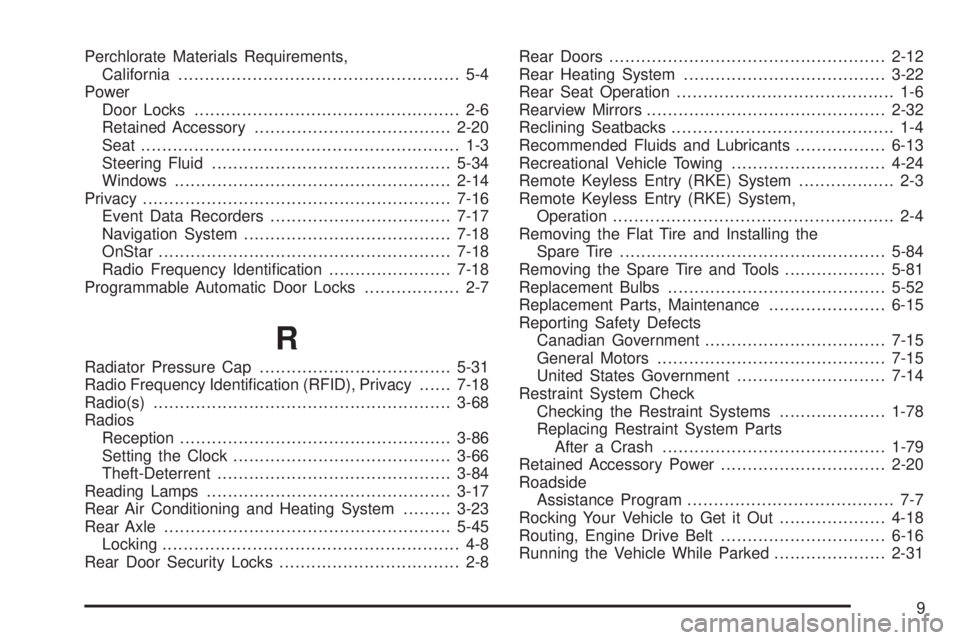
Perchlorate Materials Requirements,
California..................................................... 5-4
Power
Door Locks.................................................. 2-6
Retained Accessory.....................................2-20
Seat ............................................................ 1-3
Steering Fluid.............................................5-34
Windows....................................................2-14
Privacy..........................................................7-16
Event Data Recorders..................................7-17
Navigation System.......................................7-18
OnStar.......................................................7-18
Radio Frequency Identification.......................7-18
Programmable Automatic Door Locks.................. 2-7
R
Radiator Pressure Cap....................................5-31
Radio Frequency Identification (RFID), Privacy......7-18
Radio(s)........................................................3-68
Radios
Reception...................................................3-86
Setting the Clock.........................................3-66
Theft-Deterrent............................................3-84
Reading Lamps..............................................3-17
Rear Air Conditioning and Heating System.........3-23
Rear Axle......................................................5-45
Locking........................................................ 4-8
Rear Door Security Locks.................................. 2-8Rear Doors....................................................2-12
Rear Heating System......................................3-22
Rear Seat Operation......................................... 1-6
Rearview Mirrors.............................................2-32
Reclining Seatbacks.......................................... 1-4
Recommended Fluids and Lubricants.................6-13
Recreational Vehicle Towing.............................4-24
Remote Keyless Entry (RKE) System.................. 2-3
Remote Keyless Entry (RKE) System,
Operation..................................................... 2-4
Removing the Flat Tire and Installing the
Spare Tire..................................................5-84
Removing the Spare Tire and Tools...................5-81
Replacement Bulbs.........................................5-52
Replacement Parts, Maintenance......................6-15
Reporting Safety Defects
Canadian Government..................................7-15
General Motors...........................................7-15
United States Government............................7-14
Restraint System Check
Checking the Restraint Systems....................1-78
Replacing Restraint System Parts
After a Crash..........................................1-79
Retained Accessory Power...............................2-20
Roadside
Assistance Program....................................... 7-7
Rocking Your Vehicle to Get it Out....................4-18
Routing, Engine Drive Belt...............................6-16
Running the Vehicle While Parked.....................
2-31
9