keyless GMC SAVANA 2010 User Guide
[x] Cancel search | Manufacturer: GMC, Model Year: 2010, Model line: SAVANA, Model: GMC SAVANA 2010Pages: 424, PDF Size: 2.4 MB
Page 203 of 424
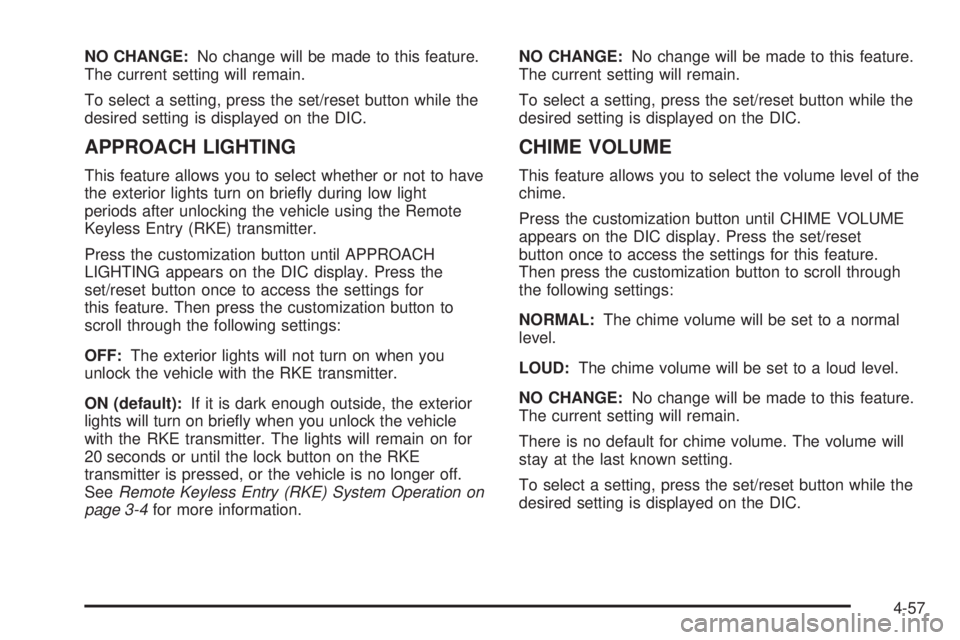
NO CHANGE:No change will be made to this feature.
The current setting will remain.
To select a setting, press the set/reset button while the
desired setting is displayed on the DIC.
APPROACH LIGHTING
This feature allows you to select whether or not to have
the exterior lights turn on briefly during low light
periods after unlocking the vehicle using the Remote
Keyless Entry (RKE) transmitter.
Press the customization button until APPROACH
LIGHTING appears on the DIC display. Press the
set/reset button once to access the settings for
this feature. Then press the customization button to
scroll through the following settings:
OFF:The exterior lights will not turn on when you
unlock the vehicle with the RKE transmitter.
ON (default):If it is dark enough outside, the exterior
lights will turn on briefly when you unlock the vehicle
with the RKE transmitter. The lights will remain on for
20 seconds or until the lock button on the RKE
transmitter is pressed, or the vehicle is no longer off.
SeeRemote Keyless Entry (RKE) System Operation on
page 3-4for more information.NO CHANGE:No change will be made to this feature.
The current setting will remain.
To select a setting, press the set/reset button while the
desired setting is displayed on the DIC.
CHIME VOLUME
This feature allows you to select the volume level of the
chime.
Press the customization button until CHIME VOLUME
appears on the DIC display. Press the set/reset
button once to access the settings for this feature.
Then press the customization button to scroll through
the following settings:
NORMAL:The chime volume will be set to a normal
level.
LOUD:The chime volume will be set to a loud level.
NO CHANGE:No change will be made to this feature.
The current setting will remain.
There is no default for chime volume. The volume will
stay at the last known setting.
To select a setting, press the set/reset button while the
desired setting is displayed on the DIC.
4-57
Page 266 of 424
California Proposition 65 Warning
Most motor vehicles, including this one, contain and/or
emit chemicals known to the State of California to
cause cancer and birth defects or other reproductive
harm. Engine exhaust, many parts and systems, many
fluids, and some component wear by-products
contain and/or emit these chemicals.
California Perchlorate Materials
Requirements
Certain types of automotive applications, such as airbag
initiators, seat belt pretensioners, and lithium batteries
contained in remote keyless transmitters, may
contain perchlorate materials. Special handling may be
necessary. For additional information, see
www.dtsc.ca.gov/hazardouswaste/perchlorate.
Doing Your Own Service Work
{WARNING:
You can be injured and the vehicle could be
damaged if you try to do service work on a vehicle
without knowing enough about it.
•Be sure you have sufficient knowledge,
experience, the proper replacement parts, and
tools before attempting any vehicle
maintenance task.
•Be sure to use the proper nuts, bolts, and
other fasteners. English and metric fasteners
can be easily confused. If the wrong fasteners
are used, parts can later break or fall off. You
could be hurt.
If doing some of your own service work, use the proper
service manual. It tells you much more about how to
service the vehicle than this manual can. To order
the proper service manual, seeService Publications
Ordering Information on page 8-15.
6-4
Page 330 of 424
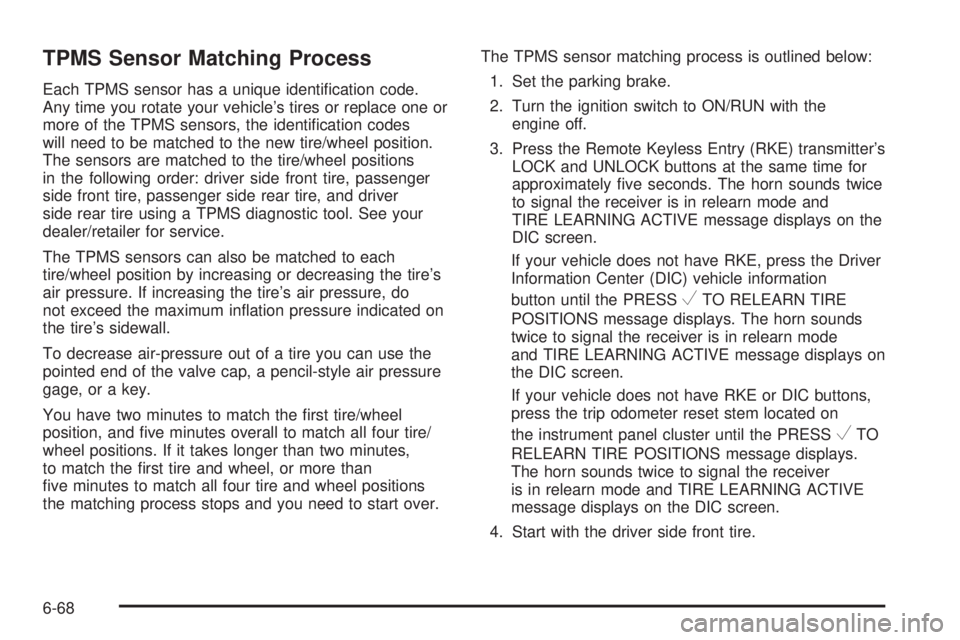
TPMS Sensor Matching Process
Each TPMS sensor has a unique identification code.
Any time you rotate your vehicle’s tires or replace one or
more of the TPMS sensors, the identification codes
will need to be matched to the new tire/wheel position.
The sensors are matched to the tire/wheel positions
in the following order: driver side front tire, passenger
side front tire, passenger side rear tire, and driver
side rear tire using a TPMS diagnostic tool. See your
dealer/retailer for service.
The TPMS sensors can also be matched to each
tire/wheel position by increasing or decreasing the tire’s
air pressure. If increasing the tire’s air pressure, do
not exceed the maximum inflation pressure indicated on
the tire’s sidewall.
To decrease air-pressure out of a tire you can use the
pointed end of the valve cap, a pencil-style air pressure
gage, or a key.
You have two minutes to match the first tire/wheel
position, and five minutes overall to match all four tire/
wheel positions. If it takes longer than two minutes,
to match the first tire and wheel, or more than
five minutes to match all four tire and wheel positions
the matching process stops and you need to start over.The TPMS sensor matching process is outlined below:
1. Set the parking brake.
2. Turn the ignition switch to ON/RUN with the
engine off.
3. Press the Remote Keyless Entry (RKE) transmitter’s
LOCK and UNLOCK buttons at the same time for
approximately five seconds. The horn sounds twice
to signal the receiver is in relearn mode and
TIRE LEARNING ACTIVE message displays on the
DIC screen.
If your vehicle does not have RKE, press the Driver
Information Center (DIC) vehicle information
button until the PRESS
VTO RELEARN TIRE
POSITIONS message displays. The horn sounds
twice to signal the receiver is in relearn mode
and TIRE LEARNING ACTIVE message displays on
the DIC screen.
If your vehicle does not have RKE or DIC buttons,
press the trip odometer reset stem located on
the instrument panel cluster until the PRESS
VTO
RELEARN TIRE POSITIONS message displays.
The horn sounds twice to signal the receiver
is in relearn mode and TIRE LEARNING ACTIVE
message displays on the DIC screen.
4. Start with the driver side front tire.
6-68
Page 417 of 424
Headlamps (cont.)
Front Turn Signal, Sidemarker and Parking
Lamps ....................................................6-51
High/Low Beam Changer................................ 4-5
On Reminder..............................................4-11
Heater...........................................................4-15
Engine Coolant...........................................3-25
Highbeam On Light.........................................4-36
Highway Hypnosis...........................................5-12
Hill and Mountain Roads..................................5-13
Hood
Checking Things Under................................6-12
Release.....................................................6-13
Horn ............................................................... 4-3
How to Wear Safety Belts Properly...................2-15
I
Ignition Positions.............................................3-22
Infants and Young Children, Restraints...............2-33
Inflation - Tire Pressure...................................6-63
Instrument Panel
Brightness..................................................4-12
Cluster.......................................................4-21
Introduction...................................................... 7-2
J
Jump Starting.................................................6-41
K
Keyless Entry
Remote (RKE) System................................... 3-4
Keyless Entry System....................................... 3-4
Keys............................................................... 3-3
L
Labeling, Tire Sidewall.....................................6-56
Lamps
Daytime Running (DRL)................................4-11
Dome ........................................................4-12
Dome Lamp Override...................................4-13
License Plate..............................................6-53
Malfunction Indicator....................................4-31
Reading.....................................................4-13
Taillamps....................................................6-52
Lap-Shoulder Belt...........................................2-24
LATCH System for Child Restraints...................2-42
7
Page 421 of 424
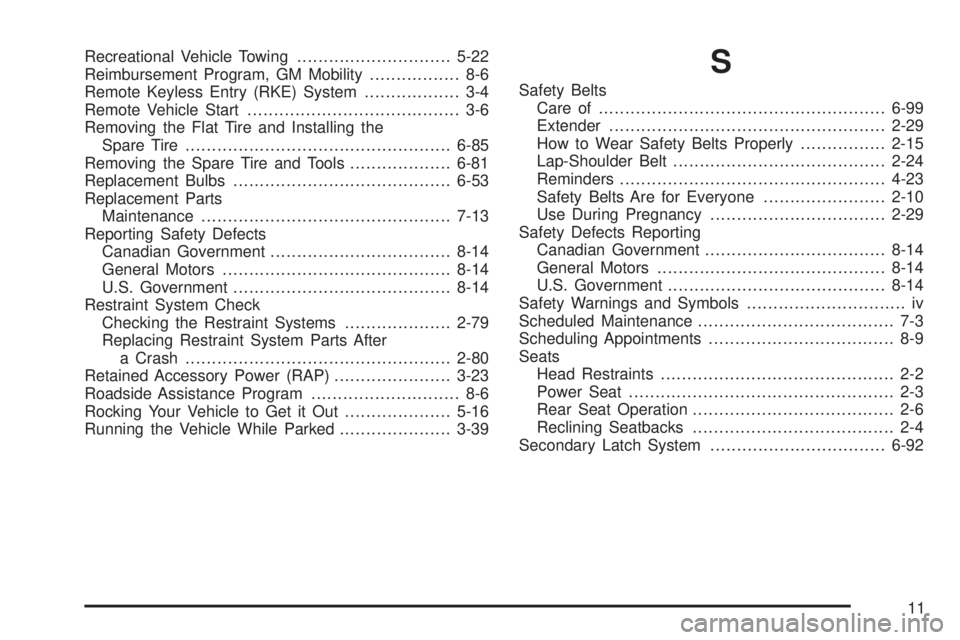
Recreational Vehicle Towing.............................5-22
Reimbursement Program, GM Mobility................. 8-6
Remote Keyless Entry (RKE) System.................. 3-4
Remote Vehicle Start........................................ 3-6
Removing the Flat Tire and Installing the
Spare Tire..................................................6-85
Removing the Spare Tire and Tools...................6-81
Replacement Bulbs.........................................6-53
Replacement Parts
Maintenance...............................................7-13
Reporting Safety Defects
Canadian Government..................................8-14
General Motors...........................................8-14
U.S. Government.........................................8-14
Restraint System Check
Checking the Restraint Systems....................2-79
Replacing Restraint System Parts After
a Crash..................................................2-80
Retained Accessory Power (RAP)......................3-23
Roadside Assistance Program............................ 8-6
Rocking Your Vehicle to Get it Out....................5-16
Running the Vehicle While Parked.....................3-39S
Safety Belts
Care of ......................................................6-99
Extender....................................................2-29
How to Wear Safety Belts Properly................2-15
Lap-Shoulder Belt........................................2-24
Reminders..................................................4-23
Safety Belts Are for Everyone.......................2-10
Use During Pregnancy.................................2-29
Safety Defects Reporting
Canadian Government..................................8-14
General Motors...........................................8-14
U.S. Government.........................................8-14
Safety Warnings and Symbols.............................. iv
Scheduled Maintenance..................................... 7-3
Scheduling Appointments................................... 8-9
Seats
Head Restraints............................................ 2-2
Power Seat.................................................. 2-3
Rear Seat Operation...................................... 2-6
Reclining Seatbacks...................................... 2-4
Secondary Latch System.................................6-92
11