tow GMC SAVANA 2010 User Guide
[x] Cancel search | Manufacturer: GMC, Model Year: 2010, Model line: SAVANA, Model: GMC SAVANA 2010Pages: 424, PDF Size: 2.4 MB
Page 79 of 424
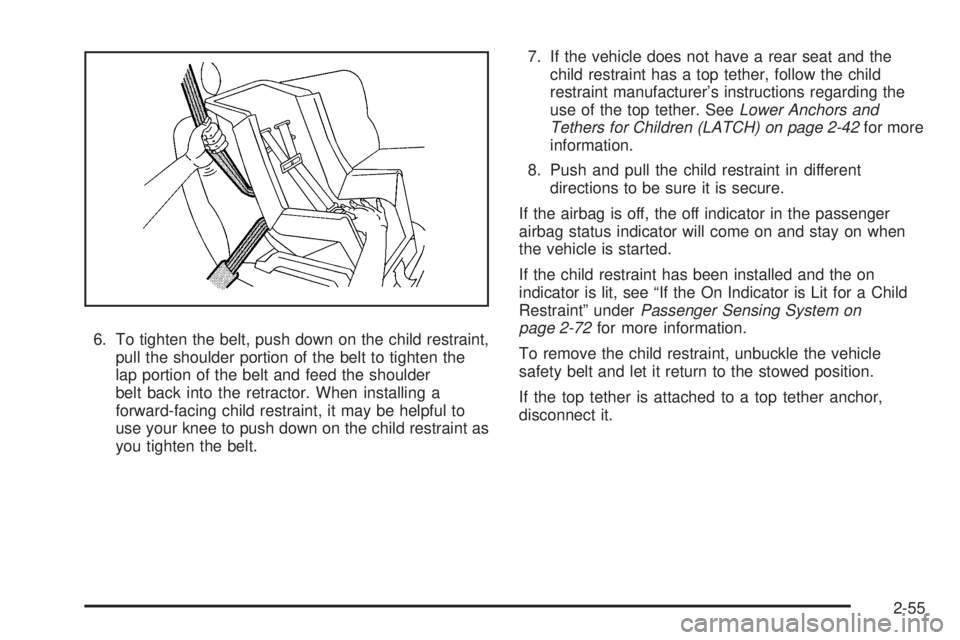
6. To tighten the belt, push down on the child restraint,
pull the shoulder portion of the belt to tighten the
lap portion of the belt and feed the shoulder
belt back into the retractor. When installing a
forward-facing child restraint, it may be helpful to
use your knee to push down on the child restraint as
you tighten the belt.7. If the vehicle does not have a rear seat and the
child restraint has a top tether, follow the child
restraint manufacturer’s instructions regarding the
use of the top tether. SeeLower Anchors and
Tethers for Children (LATCH) on page 2-42for more
information.
8. Push and pull the child restraint in different
directions to be sure it is secure.
If the airbag is off, the off indicator in the passenger
airbag status indicator will come on and stay on when
the vehicle is started.
If the child restraint has been installed and the on
indicator is lit, see “If the On Indicator is Lit for a Child
Restraint” underPassenger Sensing System on
page 2-72for more information.
To remove the child restraint, unbuckle the vehicle
safety belt and let it return to the stowed position.
If the top tether is attached to a top tether anchor,
disconnect it.
2-55
Page 83 of 424
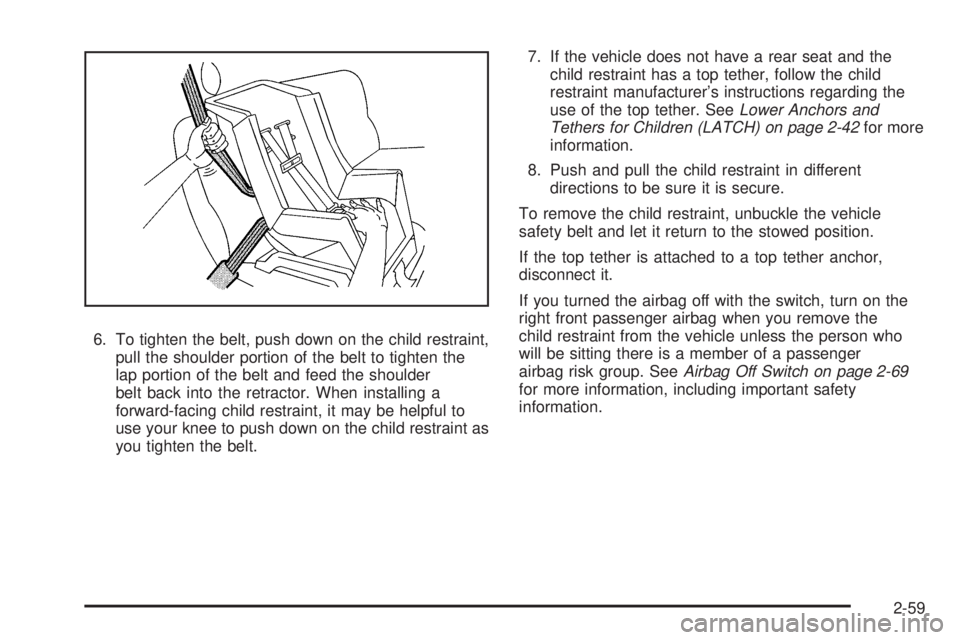
6. To tighten the belt, push down on the child restraint,
pull the shoulder portion of the belt to tighten the
lap portion of the belt and feed the shoulder
belt back into the retractor. When installing a
forward-facing child restraint, it may be helpful to
use your knee to push down on the child restraint as
you tighten the belt.7. If the vehicle does not have a rear seat and the
child restraint has a top tether, follow the child
restraint manufacturer’s instructions regarding the
use of the top tether. SeeLower Anchors and
Tethers for Children (LATCH) on page 2-42for more
information.
8. Push and pull the child restraint in different
directions to be sure it is secure.
To remove the child restraint, unbuckle the vehicle
safety belt and let it return to the stowed position.
If the top tether is attached to a top tether anchor,
disconnect it.
If you turned the airbag off with the switch, turn on the
right front passenger airbag when you remove the
child restraint from the vehicle unless the person who
will be sitting there is a member of a passenger
airbag risk group. SeeAirbag Off Switch on page 2-69
for more information, including important safety
information.
2-59
Page 91 of 424
Rollover capable roof-rail airbags are designed to help
contain the head and chest of occupants in the
outboard seating positions in the first, second, and third
rows, if equipped. The rollover capable roof-rail
airbags are designed to help reduce the risk of full or
partial ejection in rollover events, although no system
can prevent all such ejections.
But airbags would not help in many types of collisions,
primarily because the occupant’s motion is not
toward those airbags. SeeWhen Should an Airbag
Inate? on page 2-65for more information.
Airbags should never be regarded as anything more
than a supplement to safety belts.
What Will You See After an Airbag
Inates?
After the frontal airbags inflate, they quickly deflate, so
quickly that some people may not even realize an
airbag inflated. Roof-rail airbags may still be at least
partially inflated for some time after they deploy. Some
components of the airbag module may be hot for
several minutes. For location of the airbag modules, see
What Makes an Airbag Inate? on page 2-66.
The parts of the airbag that come into contact with you
may be warm, but not too hot to touch. There may
be some smoke and dust coming from the vents in the
deflated airbags. Airbag inflation does not preventthe driver from seeing out of the windshield or being
able to steer the vehicle, nor does it prevent people
from leaving the vehicle.
{WARNING:
When an airbag inflates, there may be dust in the
air. This dust could cause breathing problems for
people with a history of asthma or other breathing
trouble. To avoid this, everyone in the vehicle
should get out as soon as it is safe to do so. If
you have breathing problems but cannot get out of
the vehicle after an airbag inflates, then get fresh
air by opening a window or a door. If you
experience breathing problems following an airbag
deployment, you should seek medical attention.
The vehicle has a feature that may automatically unlock
the doors (if equipped with power door locks), turn on
the interior lamps and hazard warning flashers, and shut
off the fuel system after the airbags inflate. You can
lock the doors, turn off the interior lamps and turn the
hazard warning flashers by using the controls for
those features.
2-67
Page 101 of 424
A thick layer of additional material, such as a blanket or
cushion, or aftermarket equipment such as seat
covers, seat heaters, and seat massagers can affect
how well the passenger sensing system operates.
We recommend that you not use seat covers or other
aftermarket equipment except when approved by GM for
your specific vehicle. SeeAdding Equipment to Your
Airbag-Equipped Vehicle on page 2-78for more
information about modifications that can affect how the
system operates.
The on indicator may be lit if an object, such as a
briefcase, handbag, grocery bag, laptop or other
electronic device, is put on an unoccupied seat. If this is
not desired remove the object from the seat.
{WARNING:
Stowing of articles under the passenger seat or
between the passenger seat cushion and seatback
may interfere with the proper operation of the
passenger sensing system.
Servicing Your Airbag-Equipped
Vehicle
Airbags affect how the vehicle should be serviced.
There are parts of the airbag system in several places
around the vehicle. Your dealer/retailer and the
service manual have information about servicing the
vehicle and the airbag system. To purchase a service
manual, seeService Publications Ordering Information
on page 8-15.
{WARNING:
For up to 10 seconds after the ignition is turned off
and the battery is disconnected, an airbag can still
inflate during improper service. You can be injured
if you are close to an airbag when it inflates. Avoid
yellow connectors. They are probably part of the
airbag system. Be sure to follow proper service
procedures, and make sure the person performing
work for you is qualified to do so.
2-77
Page 105 of 424
Keys...............................................................3-3
Remote Keyless Entry (RKE) System................3-4
Remote Keyless Entry (RKE) System
Operation...................................................3-4
Remote Vehicle Start......................................3-6
Doors and Locks.............................................3-8
Door Locks....................................................3-8
Power Door Locks..........................................3-9
Cargo Door Relocking.....................................3-9
Delayed Locking.............................................3-9
Programmable Automatic Door Locks..............3-10
Automatic Door Lock.....................................3-10
Automatic Door Unlock..................................3-10
Rear Door Security Locks..............................3-11
Lockout Protection........................................3-12
Sliding Side Door..........................................3-12
60/40 Swing-Out Side Door............................3-13
Rear Doors..................................................3-15
Windows........................................................3-16
Manual Windows..........................................3-17
Power Windows............................................3-17
Swing-Out Windows......................................3-18
Enhanced Technology Glass..........................3-19
Sun Visors...................................................3-20Theft-Deterrent Systems..................................3-20
PASS-Key®III+ Electronic Immobilizer.............3-20
PASS-Key®III+ Electronic Immobilizer
Operation.................................................3-20
Starting and Operating Your Vehicle................3-22
New Vehicle Break-In....................................3-22
Ignition Positions..........................................3-22
Retained Accessory Power (RAP)...................3-23
Starting the Engine.......................................3-23
Fast Idle System..........................................3-25
Engine Coolant Heater..................................3-25
Automatic Transmission Operation
(Six Speed Automatic Transmission)............3-26
Automatic Transmission Operation
(Four Speed Automatic Transmission)..........3-31
Tow/Haul Mode............................................3-33
Parking Brake..............................................3-35
Shifting Into Park..........................................3-36
Shifting Out of Park......................................3-37
Parking Over Things That Burn.......................3-38
Engine Exhaust............................................3-38
Running the Vehicle While Parked..................3-39
Section 3 Features and Controls
3-1
Page 106 of 424
Mirrors...........................................................3-40
Manual Rearview Mirror.................................3-40
Outside Manual Mirrors..................................3-40
Outside Towing Mirrors..................................3-40Outside Power Mirrors...................................3-41
Outside Convex Mirror...................................3-41
Outside Heated Mirrors..................................3-42
Storage Areas................................................3-42
Section 3 Features and Controls
3-2
Page 116 of 424
Lockout Protection
This feature protects you from locking the key in the
vehicle when the key is in the ignition and a door
is open.
If the power lock switch is pressed when either the
driver, passenger, or rear door is open, all the doors will
lock and then the driver door will unlock. This feature
does not include the side cargo door.
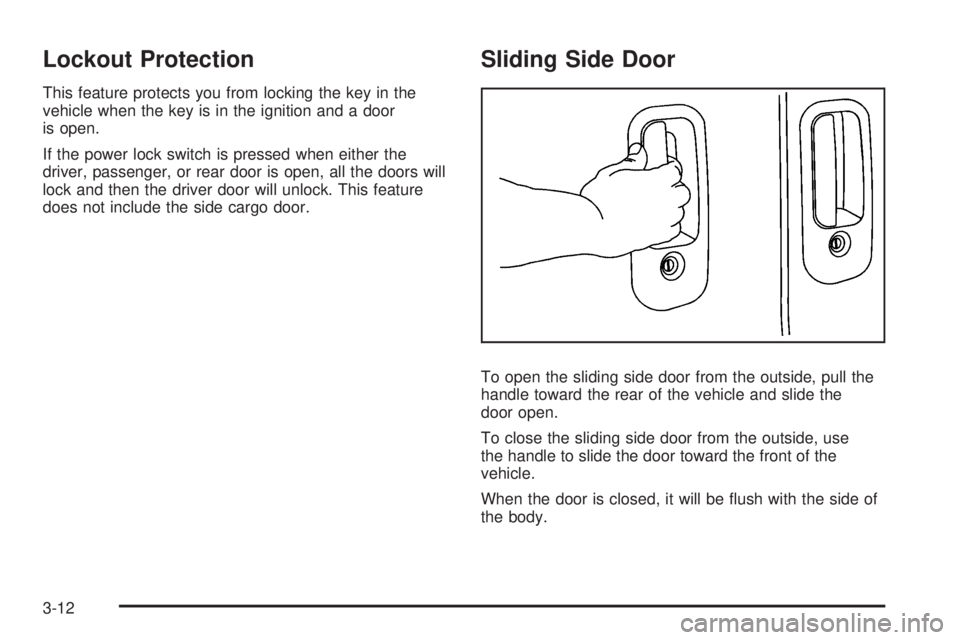
Sliding Side Door
To open the sliding side door from the outside, pull the
handle toward the rear of the vehicle and slide the
door open.
To close the sliding side door from the outside, use
the handle to slide the door toward the front of the
vehicle.
When the door is closed, it will be flush with the side of
the body.
3-12
Page 117 of 424
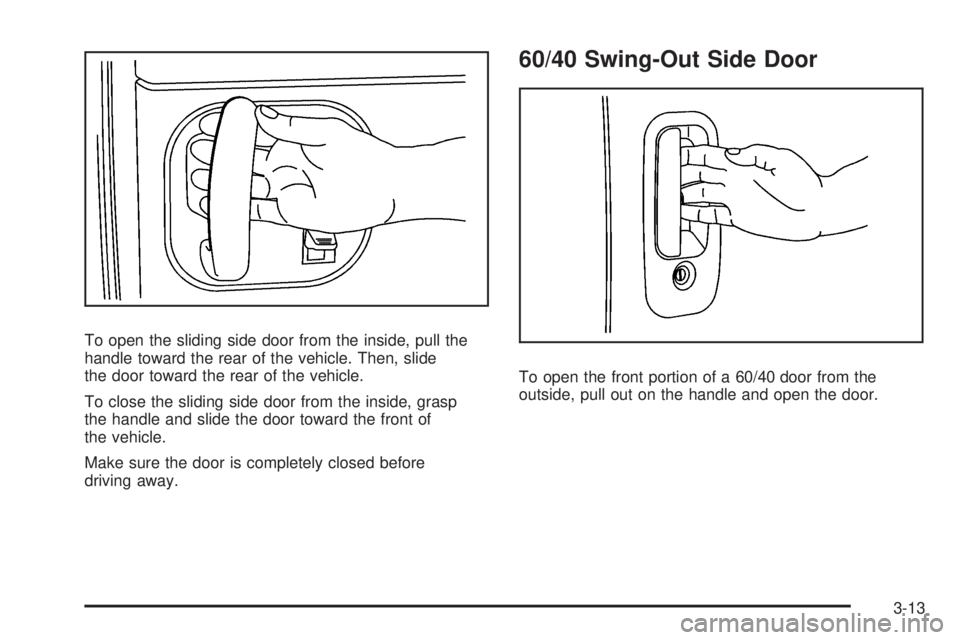
To open the sliding side door from the inside, pull the
handle toward the rear of the vehicle. Then, slide
the door toward the rear of the vehicle.
To close the sliding side door from the inside, grasp
the handle and slide the door toward the front of
the vehicle.
Make sure the door is completely closed before
driving away.
60/40 Swing-Out Side Door
To open the front portion of a 60/40 door from the
outside, pull out on the handle and open the door.
3-13
Page 118 of 424
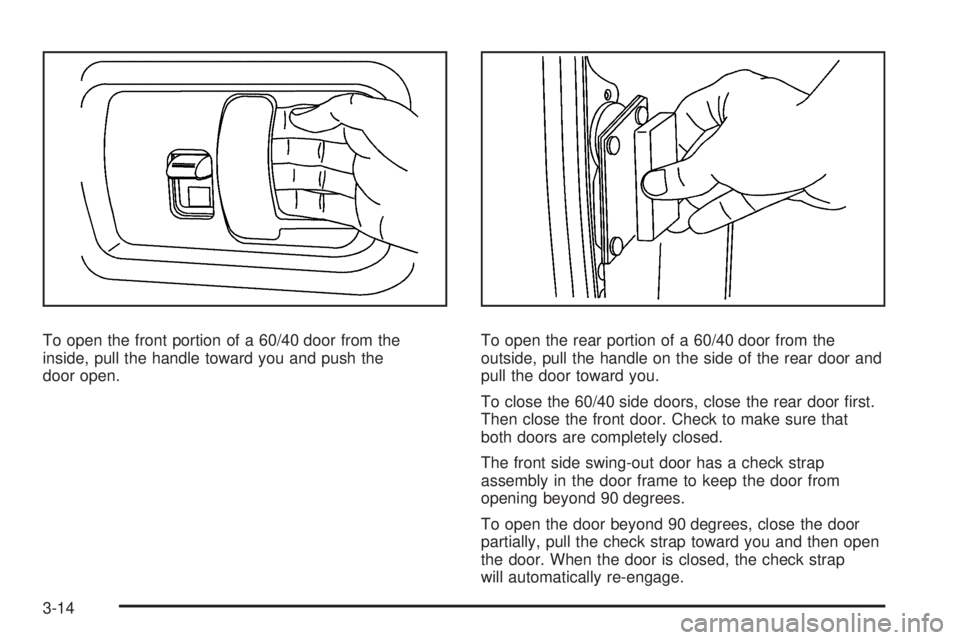
To open the front portion of a 60/40 door from the
inside, pull the handle toward you and push the
door open.To open the rear portion of a 60/40 door from the
outside, pull the handle on the side of the rear door and
pull the door toward you.
To close the 60/40 side doors, close the rear door first.
Then close the front door. Check to make sure that
both doors are completely closed.
The front side swing-out door has a check strap
assembly in the door frame to keep the door from
opening beyond 90 degrees.
To open the door beyond 90 degrees, close the door
partially, pull the check strap toward you and then open
the door. When the door is closed, the check strap
will automatically re-engage.
3-14
Page 119 of 424
Rear Doors
{WARNING:
Unlocked doors can be dangerous.
•Passengers, especially children, can easily
open the doors and fall out of a moving vehicle.
When a door is locked, the handle will not open
it. The chance of being thrown out of the
vehicle in a crash is increased if the doors are
not locked. So, all passengers should wear
safety belts properly and the doors should be
locked whenever the vehicle is driven.
•Young children who get into unlocked vehicles
may be unable to get out. A child can be
overcome by extreme heat and can suffer
permanent injuries or even death from heat
stroke. Always lock the vehicle whenever
leaving it.
•Outsiders can easily enter through an unlocked
door when you slow down or stop your vehicle.
Locking your doors can help prevent this from
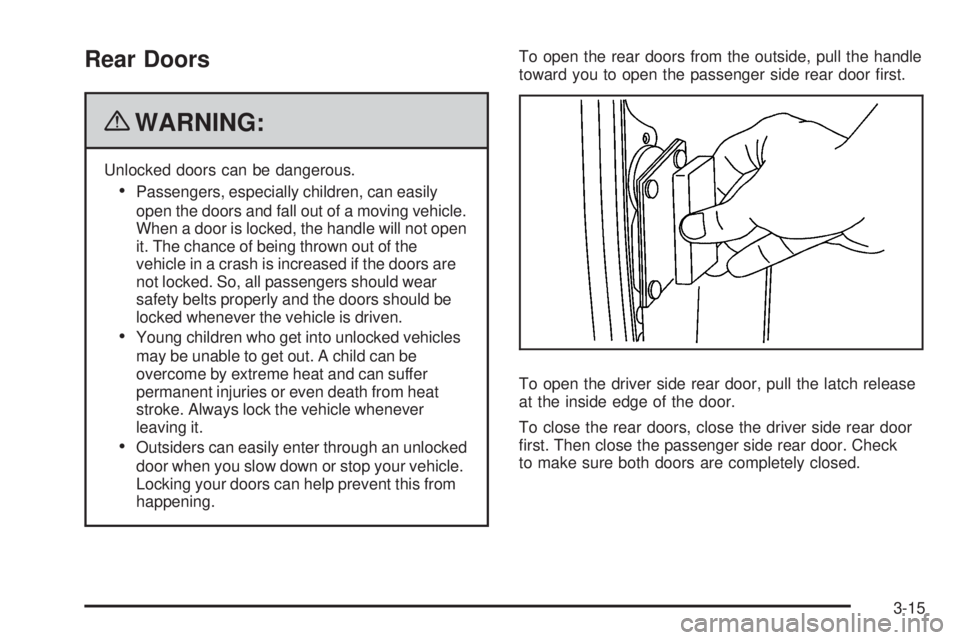
happening.To open the rear doors from the outside, pull the handle
toward you to open the passenger side rear door first.
To open the driver side rear door, pull the latch release
at the inside edge of the door.
To close the rear doors, close the driver side rear door
first. Then close the passenger side rear door. Check
to make sure both doors are completely closed.
3-15