brake GMC SAVANA 2011 Repair Manual
[x] Cancel search | Manufacturer: GMC, Model Year: 2011, Model line: SAVANA, Model: GMC SAVANA 2011Pages: 414, PDF Size: 5.27 MB
Page 338 of 414
Black plate (66,1)GMC Savana Owner Manual - 2011
10-66 Vehicle Care
Buying New Tires
GM has developed and matched
specific tires for the vehicle. The
original equipment tires installed
were designed to meet General
Motors Tire Performance Criteria
Specification (TPC Spec) system
rating. When replacement tires are
needed, GM strongly recommends
buying tires with the same TPC
Spec rating.
GM's exclusive TPC Spec system
considers over a dozen critical
specifications that impact the
overall performance of the
vehicle, including brake system
performance, ride and handling,
traction control, and tire pressure
monitoring performance. GM's TPC
Spec number is molded onto the
tire's sidewall near the tire size.
If the tires have an all‐season tread
design, the TPC Spec number will
be followed by MS for mud and
snow. SeeTire Sidewall Labeling on
page 10‑51 for additional
information. GM recommends replacing all the
tires at the same time. Uniform tread
depth on all tires will help to
maintain the performance of the
vehicle. Braking and handling
performance may be adversely
affected if all the tires are not
replaced at the same time. See
Tire
Inspection on page 10‑63 andTire
Rotation on page 10‑63 for
information on proper tire rotation.
{WARNING
Tires could explode during
improper service. Attempting to
mount or dismount a tire could
cause injury or death. Only your
dealer or authorized tire service
center should mount or dismount
the tires.
{WARNING
Mixing tires of different sizes,
brands, or types may cause loss
of control of the vehicle, resulting
in a crash or other vehicle
damage. Use the correct size,
brand, and type of tires on all
wheels.
This vehicle may have a different
size spare than the road tires
originally installed on the vehicle.
When new, the vehicle included a
spare tire and wheel assembly
with a similar overall diameter as
the road tires and wheels, so it is
all right to drive on it. The spare
tire was developed for use on this
vehicle and will not affect vehicle
handling.
Page 339 of 414
Black plate (67,1)GMC Savana Owner Manual - 2011
Vehicle Care 10-67
{WARNING
Using bias-ply tires on the
vehicle may cause the wheel
rim flanges to develop cracks
after many miles of driving.
A tire and/or wheel could fail
suddenly and cause a crash.
Use only radial-ply tires with
the wheels on the vehicle.
If the vehicle tires must be replaced
with a tire that does not have a TPC
Spec number, make sure they are
the same size, load range, speed
rating, and construction (radial) as
the original tires.
Vehicles that have a tire pressure
monitoring system could give an
inaccurate low‐pressure warning if
non‐TPC Spec rated tires are
installed. See Tire Pressure Monitor
System on page 10‑58. The Tire and Loading Information
label indicates the original
equipment tires on the vehicle. See
Vehicle Load Limits on page 9‑12
for the label location and more
information about the Tire and
Loading Information label.
Different Size Tires and
Wheels
If wheels or tires are installed that
are a different size than the original
equipment wheels and tires, vehicle
performance, including its braking,
ride and handling characteristics,
stability, and resistance to rollover
may be affected. If the vehicle has
electronic systems such as antilock
brakes, rollover airbags, traction
control, and electronic stability
control, the performance of these
systems can also be affected.
{WARNING
If different sized wheels are used,
there may not be an acceptable
level of performance and safety if
tires not recommended for those
wheels are selected. This
increases the chance of a crash
and serious injury. Only use GM
specific wheel and tire systems
developed for the vehicle, and
have them properly installed by a
GM certified technician.
See Buying New Tires on
page 10‑66 andAccessories and
Modifications on page 10‑3 for
additional information.
Page 342 of 414
Black plate (70,1)GMC Savana Owner Manual - 2011
10-70 Vehicle Care
Wheel Replacement
Replace any wheel that is bent,
cracked, or badly rusted or
corroded. If wheel nuts keep coming
loose, the wheel, wheel bolts, and
wheel nuts should be replaced.
If the wheel leaks air, replace it.
Some aluminum wheels can be
repaired. See your dealer if any of
these conditions exist.
Your dealer will know the kind of
wheel that is needed.
Each new wheel should have the
same load-carrying capacity,
diameter, width, offset, and be
mounted the same way as the
one it replaces.
Replace wheels, wheel bolts, wheel
nuts, or Tire Pressure Monitor
System (TPMS) sensors with new
GM original equipment parts.{WARNING
Using the wrong replacement
wheels, wheel bolts, or wheel
nuts can be dangerous. It could
affect the braking and handling of
the vehicle. Tires can lose air,
and cause loss of control, causing
a crash. Always use the correct
wheel, wheel bolts, and wheel
nuts for replacement.
Notice: The wrong wheel can
also cause problems with
bearing life, brake cooling,
speedometer or odometer
calibration, headlamp aim,
bumper height, vehicle ground
clearance, and tire or tire chain
clearance to the body and
chassis.
See If a Tire Goes Flat on
page 10‑71 for more information.
Used Replacement Wheels
{WARNING
Replacing a wheel with a used
one is dangerous. How it has
been used or how far it has been
driven may be unknown. It could
fail suddenly and cause a crash.
When replacing wheels, use a
new GM original equipment
wheel.
Page 343 of 414
Black plate (71,1)GMC Savana Owner Manual - 2011
Vehicle Care 10-71
Tire Chains
{WARNING
Tire chains used on a vehicle
without the proper amount of
clearance can cause damage to
the brakes, suspension, or other
vehicle parts. The area damaged
by the tire chains could cause you
to lose control of the vehicle and
you or others may be injured in a
crash. To help avoid damage to
the vehicle, drive slowly, readjust,
or remove the device if it is
contacting the vehicle. Do not
spin the vehicle's tires. Follow the
manufacturer's instructions.Notice:
Use tire chains only
where legal and only when you
must. Use chains that are the
proper size for the tires. Install
them on the tires of the rear axle.
Do not use chains on the tires of
the front axle. Tighten them as
tightly as possible with the ends
securely fastened. Drive slowly
and follow the chain
manufacturer's instructions.
If you can hear the chains
contacting the vehicle, stop and
retighten them. If the contact
continues, slow down until it
stops. Driving too fast or
spinning the wheels with chains
on will damage the vehicle.
For Cutaway models with LT245/
75R16, LT225/75R16 or LT215/
85R16 size single or dual rear tires,
use Low Profile Z-Chain or SAE
Class S cables. For Cargo or Passenger models
with P245/70R17, LT225/75R16 or
LT245/75R16 size tires, use Low
Profile Z-Chain cables. SAE Class S
chains are not recommended.
If the vehicle has dual rear tires, do
not use individual tire chains. Use
tire chains that fit across both dual
tires.
If a Tire Goes Flat
It is unusual for a tire to blow out
while driving, especially if the tires
are maintained properly. If air goes
out of a tire, it is much more likely to
leak out slowly. But if there ever is a
blowout, here are a few tips about
what to expect and what to do:
If a front tire fails, the flat tire
creates a drag that pulls the vehicle
toward that side. Take your foot off
the accelerator pedal and grip the
steering wheel firmly. Steer to
maintain lane position, and then
gently brake to a stop, well off the
road, if possible.
Page 344 of 414
Black plate (72,1)GMC Savana Owner Manual - 2011
10-72 Vehicle Care
A rear blowout, particularly on a
curve, acts much like a skid and
may require the same correction as
used in a skid. Stop pressing the
accelerator pedal and steer to
straighten the vehicle. It may be
very bumpy and noisy. Gently brake
to a stop, well off the road,
if possible.
{WARNING
Driving on a flat tire will cause
permanent damage to the tire.
Re-inflating a tire after it has
been driven on while severely
underinflated or flat may cause a
blowout and a serious crash.
Never attempt to re-inflate a tire
that has been driven on while
severely underinflated or flat.
Have your dealer or an authorized
tire service center repair or
replace the flat tire as soon as
possible.
{WARNING
Lifting a vehicle and getting
under it to do maintenance or
repairs is dangerous without the
appropriate safety equipment and
training. If a jack is provided with
the vehicle, it is designed only for
changing a flat tire. If it is used for
anything else, you or others could
be badly injured or killed if the
vehicle slips off the jack. If a jack
is provided with the vehicle, only
use it for changing a flat tire.
If a tire goes flat, avoid further tire
and wheel damage by driving slowly
to a level place, well off the road,
if possible. Turn on the hazard
warning flashers. See Hazard
Warning Flashers on page 6‑4.
{WARNING
Changing a tire can be
dangerous. The vehicle can slip
off the jack and roll over or fall
causing injury or death. Find a
level place to change the tire. To
help prevent the vehicle from
moving:
1. Set the parking brake firmly.
2. Put an automatic transmission in P (Park) or a
manual transmission in
1 (First) or R (Reverse).
3. Turn off the engine and do not restart while the vehicle
is raised.
4. Do not allow passengers to remain in the vehicle.
5. Place wheel blocks on both sides of the tire at the
opposite corner of the tire
being changed.
Page 351 of 414
Black plate (79,1)GMC Savana Owner Manual - 2011
Vehicle Care 10-79
{WARNING
Wheel nuts that are improperly or
incorrectly tightened can cause
the wheels to become loose or
come off. The wheel nuts should
be tightened with a torque wrench
to the proper torque specification
after replacing. Follow the torque
specification supplied by the
aftermarket manufacturer when
using accessory locking wheel
nuts. SeeCapacities and
Specifications on page 12‑2 for
original equipment wheel nut
torque specifications.
Notice: Improperly tightened
wheel nuts can lead to brake
pulsation and rotor damage. To
avoid expensive brake repairs,
evenly tighten the wheel nuts in
the proper sequence and to the
proper torque specification. See
Capacities and Specifications on
page 12‑2 for the wheel nut
torque specification.
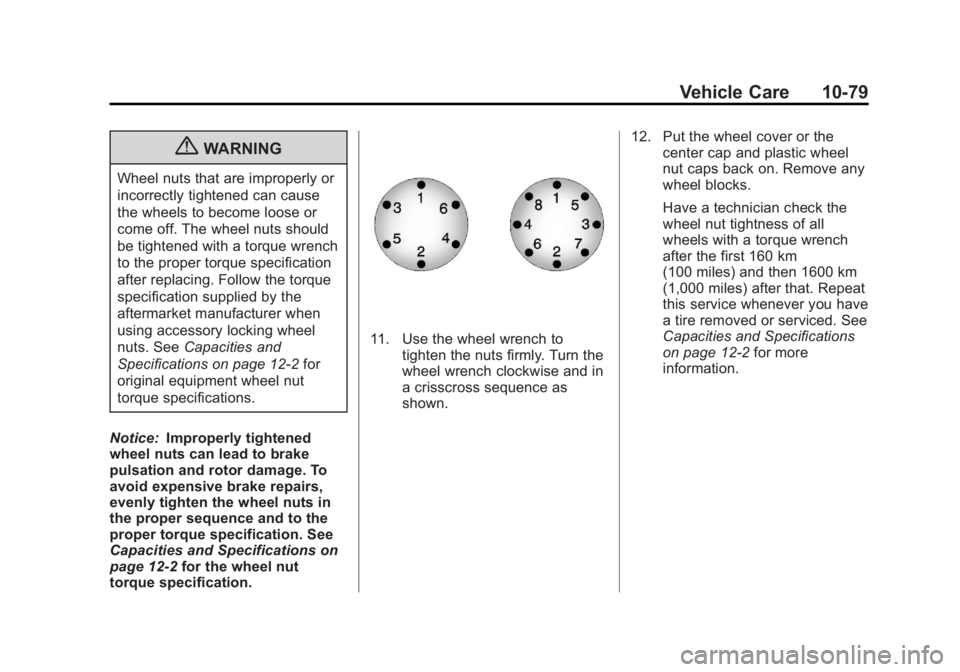
11. Use the wheel wrench to tighten the nuts firmly. Turn the
wheel wrench clockwise and in
a crisscross sequence as
shown. 12. Put the wheel cover or the
center cap and plastic wheel
nut caps back on. Remove any
wheel blocks.
Have a technician check the
wheel nut tightness of all
wheels with a torque wrench
after the first 160 km
(100 miles) and then 1600 km
(1,000 miles) after that. Repeat
this service whenever you have
a tire removed or serviced. See
Capacities and Specifications
on page 12‑2 for more
information.
Page 356 of 414
Black plate (84,1)GMC Savana Owner Manual - 2011
10-84 Vehicle Care
Jump Starting
For more information about the
vehicle battery, seeBattery on
page 10‑31.
If the vehicle battery has run down,
you may want to use another
vehicle and some jumper cables to
start your vehicle. Be sure to use
the following steps to do it safely.
{WARNING
Batteries can hurt you. They can
be dangerous because:
.They contain acid that can
burn you.
.They contain gas that can
explode or ignite.
.They contain enough
electricity to burn you.
If you do not follow these steps
exactly, some or all of these
things can hurt you. Notice:
Ignoring these steps
could result in costly damage to
the vehicle that would not be
covered by the warranty.
Trying to start the vehicle by
pushing or pulling it will not
work, and it could damage the
vehicle.
1. Check the other vehicle. It must
have a 12-volt battery with a
negative ground system.
Notice: Only use a vehicle that
has a 12-volt system with a
negative ground for jump
starting. If the other vehicle does
not have a 12-volt system with a
negative ground, both vehicles
can be damaged.
2. Get the vehicles close enough so the jumper cables can reach,
but be sure the vehicles are not
touching each other. If they
are, it could cause a ground
connection you do not want. You
would not be able to start your vehicle, and the bad grounding
could damage the electrical
systems.
To avoid the possibility of the
vehicles rolling, set the parking
brake firmly on both vehicles
involved in the jump start
procedure. Put an automatic
transmission in P (Park) or a
manual transmission in
N (Neutral) before setting the
parking brake.
Notice: If the radio or other
accessories are left on during the
jump starting procedure, they
could be damaged. The repairs
would not be covered by the
warranty. Always turn off the
radio and other accessories when
jump starting the vehicle.
Page 362 of 414
Black plate (90,1)GMC Savana Owner Manual - 2011
10-90 Vehicle Care
3. Firmly set the parking brake.See Parking Brake on page 9‑36
for more information.
4. Put the transmission in P (Park).
5. Secure the vehicle to the dolly following the manufacturer's
instructions.
6. Use an adequate clamping device designed for towing to
ensure that the front wheels are
locked into the straight position.
7. Turn the ignition to LOCK/OFF. If the tow vehicle will not be
started or driven for six weeks or
more, remove the battery cable
from the negative terminal (post)
of the battery to prevent the
battery from draining while
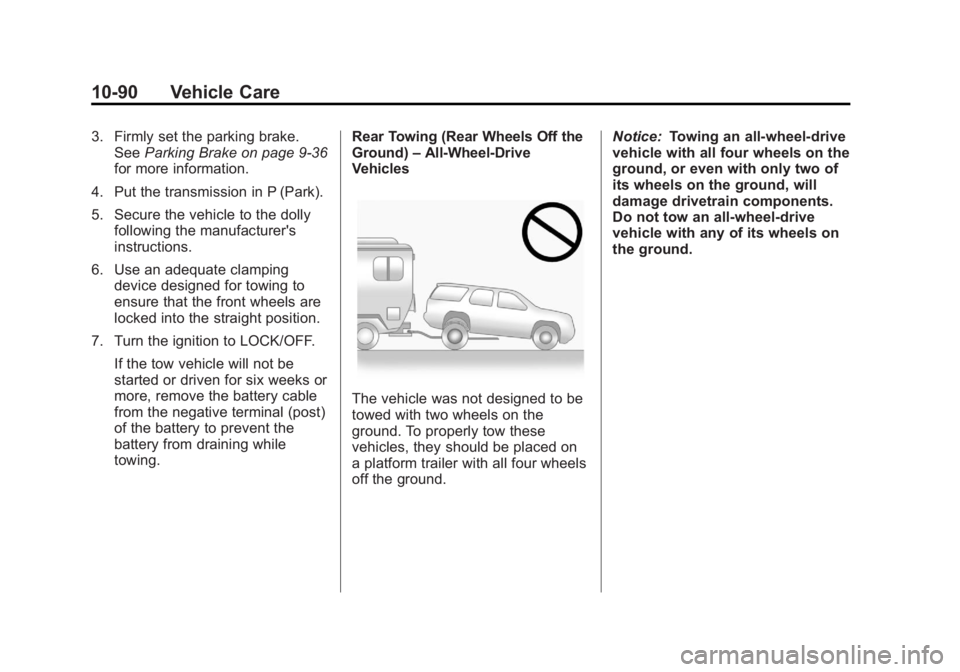
towing. Rear Towing (Rear Wheels Off the
Ground)
–All‐Wheel‐Drive
Vehicles
The vehicle was not designed to be
towed with two wheels on the
ground. To properly tow these
vehicles, they should be placed on
a platform trailer with all four wheels
off the ground. Notice:
Towing an all-wheel-drive
vehicle with all four wheels on the
ground, or even with only two of
its wheels on the ground, will
damage drivetrain components.
Do not tow an all-wheel-drive
vehicle with any of its wheels on
the ground.
Page 370 of 414
Black plate (98,1)GMC Savana Owner Manual - 2011
10-98 Vehicle Care
Floor Mats
{WARNING
If a floor mat is the wrong size or
is not properly installed, it can
interfere with the accelerator
pedal and/or brake pedal.
Interference with the pedals can
cause unintended acceleration
and/or increased stopping
distance which can cause a crash
and injury. Make sure the floor
mat does not interfere with the
accelerator or brake pedal.Use the following guidelines for
proper floor mat usage.
.The original equipment floor
mats were designed for the
vehicle. If the floor mats need
replacing, it is recommended
that GM certified floor mats be
purchased. Non-GM floor mats
may not fit properly and may
interfere with the accelerator or
brake pedal. Always check that
the floor mats do not interfere
with the pedals.
.Use the floor mat with the
correct side up. Do not turn
it over.
.Do not place anything on top of
the driver side floor mat.
.Use only a single floor mat on
the driver side.
.Do not place one floor mat on
top of another.
Page 374 of 414
Black plate (4,1)GMC Savana Owner Manual - 2011
11-4 Service and Maintenance
.Engine air cleaner filter
inspection. SeeEngine Air
Cleaner/Filter on page 10‑18.
.Brake system inspection (or
every 12 months, whichever
occurs first).
.Steering and suspension
inspection. Visual inspection for
damaged, loose, or missing
parts or signs of wear.
.Lubricate the front suspension,
kingpin bushings, steering
linkage, and rear driveline center
splines.
.Body hinges and latches, key
lock cylinders, folding seat
hardware, and rear compartment
hinges, linkage, and handle pivot
points lubrication. See
Recommended Fluids and
Lubricants on page 11‑7. More
frequent lubrication may be
required when the vehicle is
exposed to a corrosive
environment. Applying silicone
grease on weatherstrips with a clean cloth makes them last
longer, seal better, and not stick
or squeak.
.Restraint system component
check. See
Safety System
Check on page 3‑23.
.Fuel system inspection for
damage or leaks.
.Exhaust system and nearby heat
shields inspection for loose or
damaged components.
.Vehicles with diesel engine or
GVWR above 4 536 kg
(10,000 lbs) only: Shields
inspection for damage or
looseness. Adjust or replace as
required. This is a Noise
Emission Control Service.
Applicable to vehicles sold in the
United States and recommended
for vehicles sold in Canada.
Additional Required Services
At the First 160 km/100 Miles,
1 600 km/1,000 Miles, and
10 000 km/6,000 Miles
.For vehicles with dual wheels:
Check dual wheel nut torque.
For proper torque, see
Capacities and Specifications on
page 12‑2.
Every 12 000 km/7,500 Miles
.Rotate tires. Tires should be
rotated every 12 000 km/
7,500 mi. See Tire Rotation on
page 10‑63.
At Each Fuel Stop
.Engine oil level check. See
Engine Oil on page 10‑7.
.Engine coolant level check. See
Engine Coolant on page 10‑20.
.Windshield washer fluid level
check. See Washer Fluid on
page 10‑27.