window GMC SAVANA 2012 Owner's Guide
[x] Cancel search | Manufacturer: GMC, Model Year: 2012, Model line: SAVANA, Model: GMC SAVANA 2012Pages: 424, PDF Size: 5.15 MB
Page 44 of 424

Black plate (16,1)GMC Savana Owner Manual - 2012 - 2nd - 11/11/11
2-16 Keys, Doors, and Windows
Heated Mirrors
For vehicles with heated mirrors:
1(Rear Defogger):Press to heat
the mirrors.
An indicator light in the button lights
when the outside heated mirrors are
activated.
See “Rear Window Defogger” under
Climate Control Systems on
page 8‑1 for more information.
Interior Mirrors
Manual Rearview Mirror
Hold the inside rearview mirror in
the center to move it for a clearer
view behind the vehicle. Adjust the
mirror to avoid glare from the
headlamps behind. Push the tab
forward for daytime use and pull it
for nighttime use.
If you have a cargo van without the
rear door glass, the vehicle may not
have an inside rearview mirror.
Windows
{WARNING
Leaving children, helpless adults,
or pets in a vehicle with the
windows closed is dangerous.
They can be overcome by the
extreme heat and suffer
permanent injuries or even death
from heat stroke. Never leave a
child, a helpless adult, or a pet
alone in a vehicle, especially with
the windows closed in warm or
hot weather.
Page 45 of 424

Black plate (17,1)GMC Savana Owner Manual - 2012 - 2nd - 11/11/11
Keys, Doors, and Windows 2-17
Manual Windows
Operate the manual windows by
turning the hand crank on each door
to raise or lower the side door
windows.
Power Windows
{WARNING
Leaving children in a vehicle with
the keys is dangerous for many
reasons. Children or others could
be badly injured or even killed.
They could operate the power
windows or other controls or even
make the vehicle move. The
windows will function and they
could be seriously injured or killed
if caught in the path of a closing
window. Do not leave keys in a
vehicle with children.
When there are children in the
rear seat use the window lockout
button to prevent unintentional
operation of the windows.
If the vehicle has power windows,
the controls are located on each of
the side doors.
The driver door has a switch for the
passenger window also. The power
windows will work when the ignition
has been turned to ON/RUN or
ACC/ACCESSORY, or when
Retained Accessory Power (RAP) is
active. SeeRetained Accessory
Power (RAP) on page 9‑21.
Press the switch to lower the
window.
Pull up on the front edge of the
switch to raise the window.
Page 46 of 424
Black plate (18,1)GMC Savana Owner Manual - 2012 - 2nd - 11/11/11
2-18 Keys, Doors, and Windows
Express‐Down
The driver window switch also has
an express-down feature that allows
the window to be lowered without
holding the switch. Press fully and
release the window switch marked
AUTO to activate the express-down
mode. This mode can be cancelled
at any time by pulling up on the
switch. To open the window part
way, lightly tap the switch until the
window is at the desired position.
Swing-Out Windows
Side Swing-Out Window
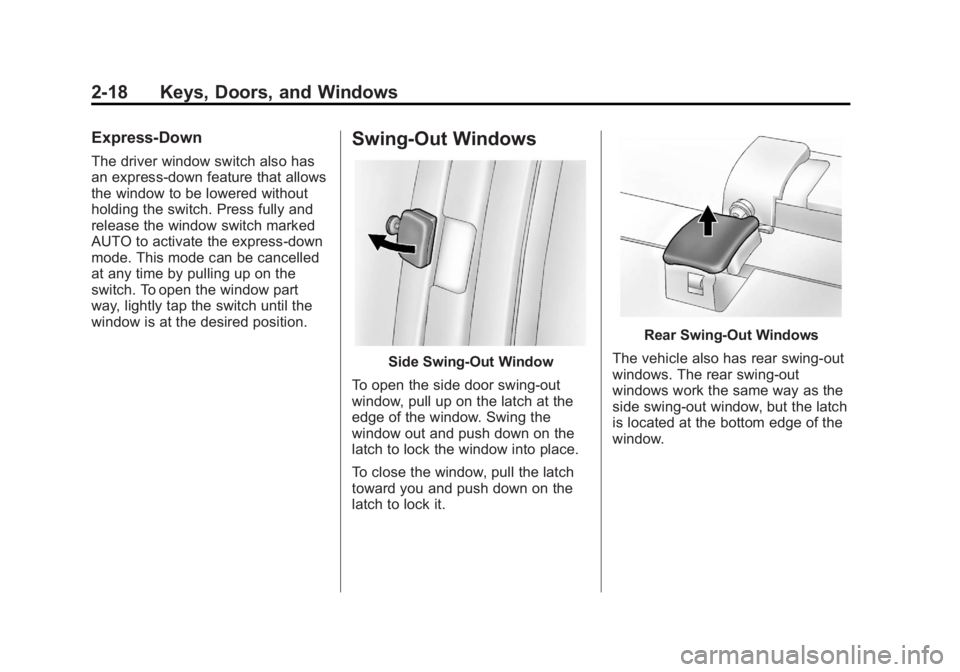
To open the side door swing-out
window, pull up on the latch at the
edge of the window. Swing the
window out and push down on the
latch to lock the window into place.
To close the window, pull the latch
toward you and push down on the
latch to lock it.
Rear Swing‐Out Windows
The vehicle also has rear swing‐out
windows. The rear swing-out
windows work the same way as the
side swing‐out window, but the latch
is located at the bottom edge of the
window.
Page 47 of 424
Black plate (19,1)GMC Savana Owner Manual - 2012 - 2nd - 11/11/11
Keys, Doors, and Windows 2-19
Enhanced Technology
Glass
The vehicle may be equipped with
Enhanced Technology Glass (ETG).
ETG is part of the overall occupant
protection system on passenger
vans. ETG may help to keep
passengers sitting next to these
fixed windows from being ejected
through the glass in some, but not in
all crashes. Even with this glass,
safety belts must still be worn at all
times. For passenger vans, use only
ETG glass approved for the vehicle
for replacement when damaged.The following table shows laminated glass location, based on vehicle model
and options.
Vehicle Configuration ETG Locations
Eight‐Seat Passenger Vans Sliding door forward window
12‐ and 15‐Seat Passenger Vans Sliding door forward window and
rear-most side windows
Long Wheelbase Cargo Vans Rear-most side windows
Sun Visors
To block out glare, swing down the
sun visors. You can also swing them
to the side.
Visor Vanity Mirror
The vehicle may have visor vanity
mirrors, with or without lamps. Lift
the mirror cover to turn the lamps
on, if equipped.
Page 48 of 424

Black plate (20,1)GMC Savana Owner Manual - 2012 - 2nd - 11/11/11
2-20 Keys, Doors, and Windows
2NOTES
Page 54 of 424

Black plate (6,1)GMC Savana Owner Manual - 2012 - 2nd - 11/15/11
3-6 Seats and Restraints
3. Pull the pin handle up todisengage the pin from the
retaining clip, and then pull the
pin out.
4. Repeat this procedure for the other pins.
5. Pull the seat rearward about 5 cm (2 in), and then lift the seat
from the floor rails.
6. Remove the seat from the vehicle.
7. For the second- and third-rowseats, stow the safety belt latch
by attaching the clip on the
safety belt latch to the trim just
inside the side door.For the last row of seats, stow
the safety belt latch plate on the
clip at the window trim. Roll the
mini-latch into the safety belt
webbing and then hook the
safety belt latch plate on the clip.
Page 68 of 424

Black plate (20,1)GMC Savana Owner Manual - 2012 - 2nd - 11/15/11
3-20 Seats and Restraints
{WARNING
Airbags inflate with great force,
faster than the blink of an eye.
Anyone who is up against, or very
close to, any airbag when it
inflates can be seriously injured
or killed. Do not sit unnecessarily
close to the airbag, as you would
be if you were sitting on the edge
of your seat or leaning forward.
Safety belts help keep you in
position before and during a
crash. Always wear your safety
belt, even with airbags. The driver
should sit as far back as possible
while still maintaining control of
the vehicle.
Occupants should not lean on or
sleep against the door or side
windows in seating positions with
roof-rail airbags.
{WARNING
Children who are up against,
or very close to, any airbag
when it inflates can be seriously
injured or killed. Airbags plus
lap-shoulder belts offer protection
for adults and older children, but
not for young children and infants.
Neither the vehicle safety belt
system nor its airbag system is
designed for them. Young
children and infants need the
protection that a child restraint
system can provide. Always
secure children properly in the
vehicle. To read how, seeOlder
Children on page 3‑38 orInfants
and Young Children on
page 3‑40.
There is an airbag readiness light
on the instrument panel, which
shows the airbag symbol.
The system checks the airbag
electrical system for malfunctions.
The light tells you if there is an
electrical problem. See Airbag
Readiness Light on page 5‑16 for
more information.
Page 69 of 424
Black plate (21,1)GMC Savana Owner Manual - 2012 - 2nd - 11/15/11
Seats and Restraints 3-21
Where Are the Airbags?
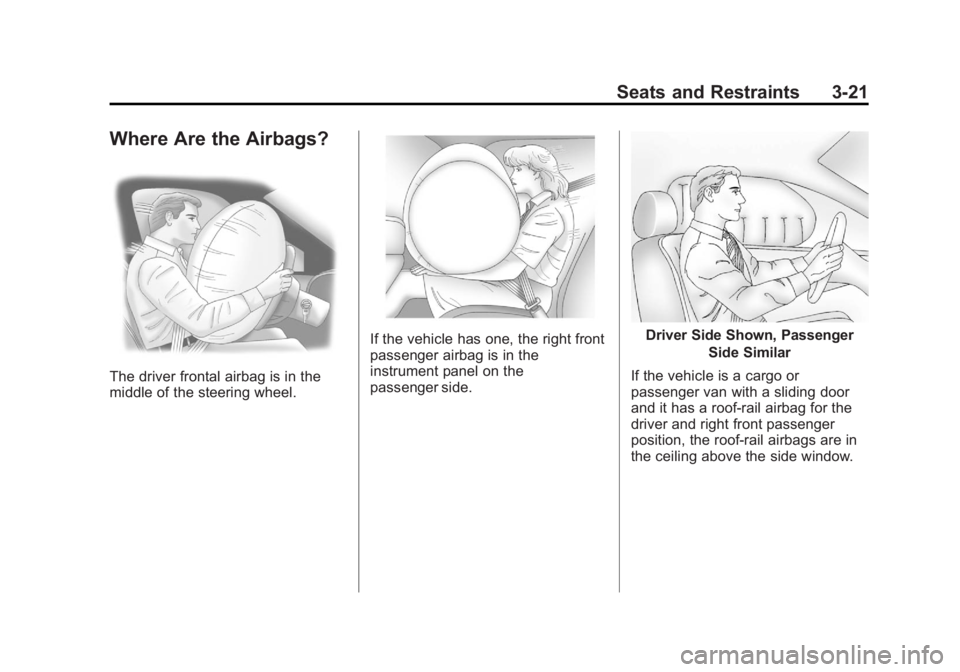
The driver frontal airbag is in the
middle of the steering wheel.
If the vehicle has one, the right front
passenger airbag is in the
instrument panel on the
passenger side.Driver Side Shown, PassengerSide Similar
If the vehicle is a cargo or
passenger van with a sliding door
and it has a roof-rail airbag for the
driver and right front passenger
position, the roof-rail airbags are in
the ceiling above the side window.
Page 70 of 424
Black plate (22,1)GMC Savana Owner Manual - 2012 - 2nd - 11/15/11
3-22 Seats and Restraints
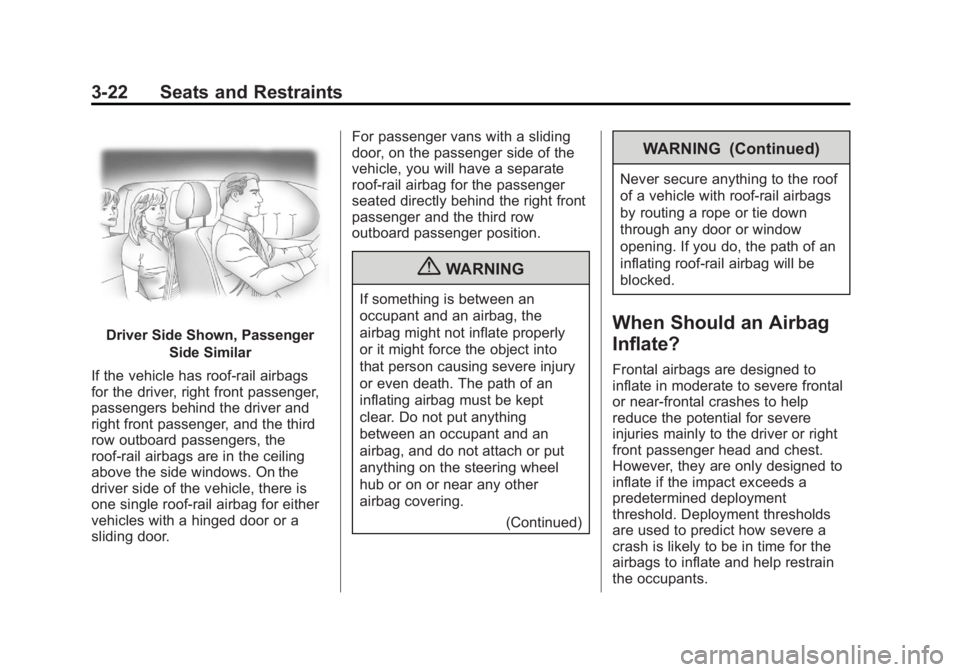
Driver Side Shown, PassengerSide Similar
If the vehicle has roof-rail airbags
for the driver, right front passenger,
passengers behind the driver and
right front passenger, and the third
row outboard passengers, the
roof-rail airbags are in the ceiling
above the side windows. On the
driver side of the vehicle, there is
one single roof-rail airbag for either
vehicles with a hinged door or a
sliding door. For passenger vans with a sliding
door, on the passenger side of the
vehicle, you will have a separate
roof-rail airbag for the passenger
seated directly behind the right front
passenger and the third row
outboard passenger position.
{WARNING
If something is between an
occupant and an airbag, the
airbag might not inflate properly
or it might force the object into
that person causing severe injury
or even death. The path of an
inflating airbag must be kept
clear. Do not put anything
between an occupant and an
airbag, and do not attach or put
anything on the steering wheel
hub or on or near any other
airbag covering.
(Continued)
WARNING (Continued)
Never secure anything to the roof
of a vehicle with roof-rail airbags
by routing a rope or tie down
through any door or window
opening. If you do, the path of an
inflating roof-rail airbag will be
blocked.
When Should an Airbag
Inflate?
Frontal airbags are designed to
inflate in moderate to severe frontal
or near-frontal crashes to help
reduce the potential for severe
injuries mainly to the driver or right
front passenger head and chest.
However, they are only designed to
inflate if the impact exceeds a
predetermined deployment
threshold. Deployment thresholds
are used to predict how severe a
crash is likely to be in time for the
airbags to inflate and help restrain
the occupants.
Page 72 of 424
Black plate (24,1)GMC Savana Owner Manual - 2012 - 2nd - 11/15/11
3-24 Seats and Restraints
Roof-rail airbags are not intended to
inflate in frontal impacts, near-frontal
impacts, or rear impacts. All roof-rail
airbags will deploy when either side
of the vehicle is struck.
In any particular crash, no one can
say whether an airbag should have
inflated simply because of the
damage to a vehicle or because of
what the repair costs were.
For frontal airbags, inflation is
determined by what the vehicle hits,
the angle of the impact, and how
quickly the vehicle slows down.
For roof-rail airbags, deployment is
determined by the location and
severity of the side impact.
In a rollover event, roof‐rail airbag
deployment is determined by the
direction of the roll.What Makes an Airbag
Inflate?
In a deployment event, the sensing
system sends an electrical signal
triggering a release of gas from the
inflator. Gas from the inflator fills the
airbag causing the bag to break out
of the cover and deploy. The inflator,
the airbag, and related hardware are
all part of the airbag module.
Frontal airbag modules are located
inside the steering wheel and
instrument panel. For vehicles with
roof-rail airbags, there are airbag
modules in the ceiling of the vehicle,
near the side windows for the first,
second, and third rows (if equipped).
SeeWhere Are the Airbags? on
page 3‑21 for more information.
How Does an Airbag
Restrain?
In moderate to severe frontal or
near frontal collisions, even belted
occupants can contact the steering
wheel or the instrument panel. In
moderate to severe side collisions,
even belted occupants can contact
the inside of the vehicle.
Airbags supplement the protection
provided by safety belts. Frontal
airbags distribute the force of the
impact more evenly over the
occupant's upper body, stopping the
occupant more gradually. Roof-rail
airbags distribute the force of the
impact more evenly over the
occupant's upper body.