engine oil GMC SAVANA PASSENGER 2008 Owner's Guide
[x] Cancel search | Manufacturer: GMC, Model Year: 2008, Model line: SAVANA PASSENGER, Model: GMC SAVANA PASSENGER 2008Pages: 402, PDF Size: 2.34 MB
Page 356 of 402
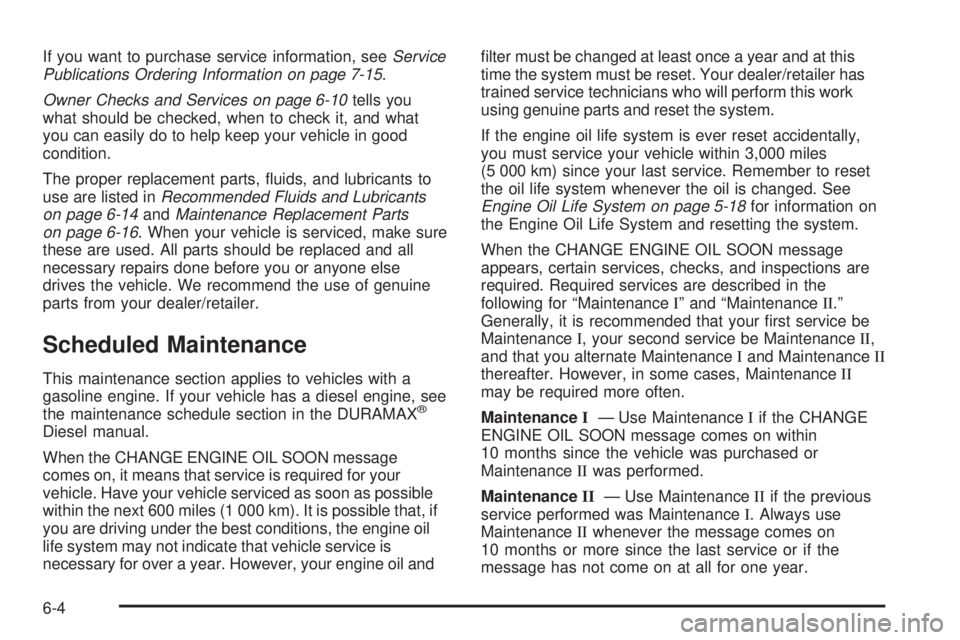
If you want to purchase service information, seeService
Publications Ordering Information on page 7-15.
Owner Checks and Services on page 6-10tells you
what should be checked, when to check it, and what
you can easily do to help keep your vehicle in good
condition.
The proper replacement parts, fluids, and lubricants to
use are listed inRecommended Fluids and Lubricants
on page 6-14andMaintenance Replacement Parts
on page 6-16. When your vehicle is serviced, make sure
these are used. All parts should be replaced and all
necessary repairs done before you or anyone else
drives the vehicle. We recommend the use of genuine
parts from your dealer/retailer.
Scheduled Maintenance
This maintenance section applies to vehicles with a
gasoline engine. If your vehicle has a diesel engine, see
the maintenance schedule section in the DURAMAX
®
Diesel manual.
When the CHANGE ENGINE OIL SOON message
comes on, it means that service is required for your
vehicle. Have your vehicle serviced as soon as possible
within the next 600 miles (1 000 km). It is possible that, if
you are driving under the best conditions, the engine oil
life system may not indicate that vehicle service is
necessary for over a year. However, your engine oil andfilter must be changed at least once a year and at this
time the system must be reset. Your dealer/retailer has
trained service technicians who will perform this work
using genuine parts and reset the system.
If the engine oil life system is ever reset accidentally,
you must service your vehicle within 3,000 miles
(5 000 km) since your last service. Remember to reset
the oil life system whenever the oil is changed. See
Engine Oil Life System on page 5-18for information on
the Engine Oil Life System and resetting the system.
When the CHANGE ENGINE OIL SOON message
appears, certain services, checks, and inspections are
required. Required services are described in the
following for “MaintenanceI” and “MaintenanceII.”
Generally, it is recommended that your first service be
MaintenanceI, your second service be MaintenanceII,
and that you alternate MaintenanceIand MaintenanceII
thereafter. However, in some cases, MaintenanceII
may be required more often.
MaintenanceI— Use MaintenanceIif the CHANGE
ENGINE OIL SOON message comes on within
10 months since the vehicle was purchased or
MaintenanceIIwas performed.
MaintenanceII— Use MaintenanceIIif the previous
service performed was MaintenanceI. Always use
MaintenanceIIwhenever the message comes on
10 months or more since the last service or if the
message has not come on at all for one year.
6-4
Page 357 of 402
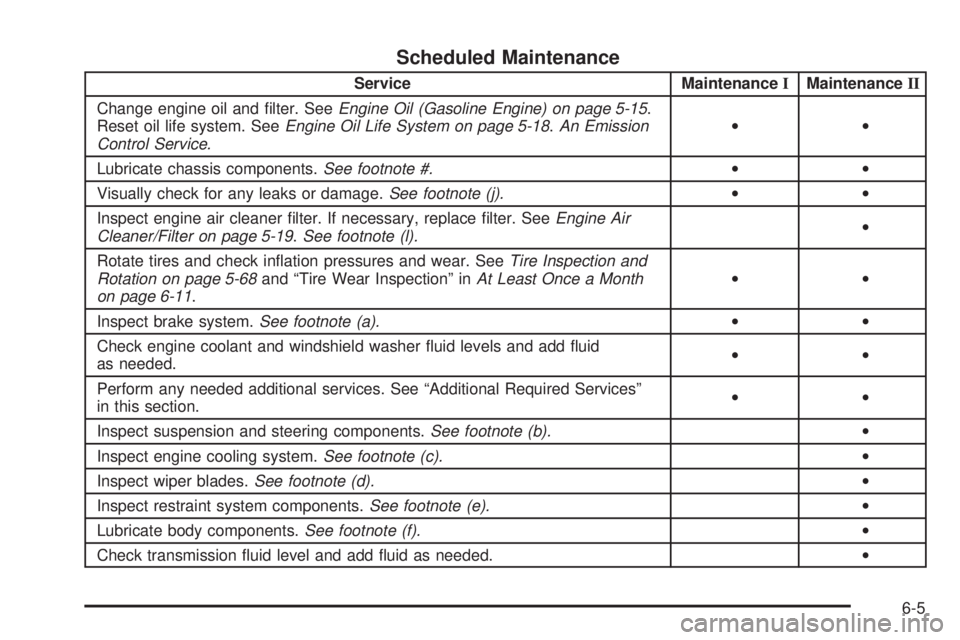
Scheduled Maintenance
Service MaintenanceIMaintenanceII
Change engine oil and filter. SeeEngine Oil (Gasoline Engine) on page 5-15.
Reset oil life system. SeeEngine Oil Life System on page 5-18.An Emission
Control Service.••
Lubricate chassis components.See footnote #.••
Visually check for any leaks or damage.See footnote (j).••
Inspect engine air cleaner filter. If necessary, replace filter. SeeEngine Air
Cleaner/Filter on page 5-19.See footnote (l).•
Rotate tires and check inflation pressures and wear. SeeTire Inspection and
Rotation on page 5-68and “Tire Wear Inspection” inAt Least Once a Month
on page 6-11.••
Inspect brake system.See footnote (a).••
Check engine coolant and windshield washer fluid levels and add fluid
as needed.••
Perform any needed additional services. See “Additional Required Services”
in this section.••
Inspect suspension and steering components.See footnote (b).•
Inspect engine cooling system.See footnote (c).•
Inspect wiper blades.See footnote (d).•
Inspect restraint system components.See footnote (e).•
Lubricate body components.See footnote (f).•
Check transmission fluid level and add fluid as needed.•
6-5
Page 361 of 402
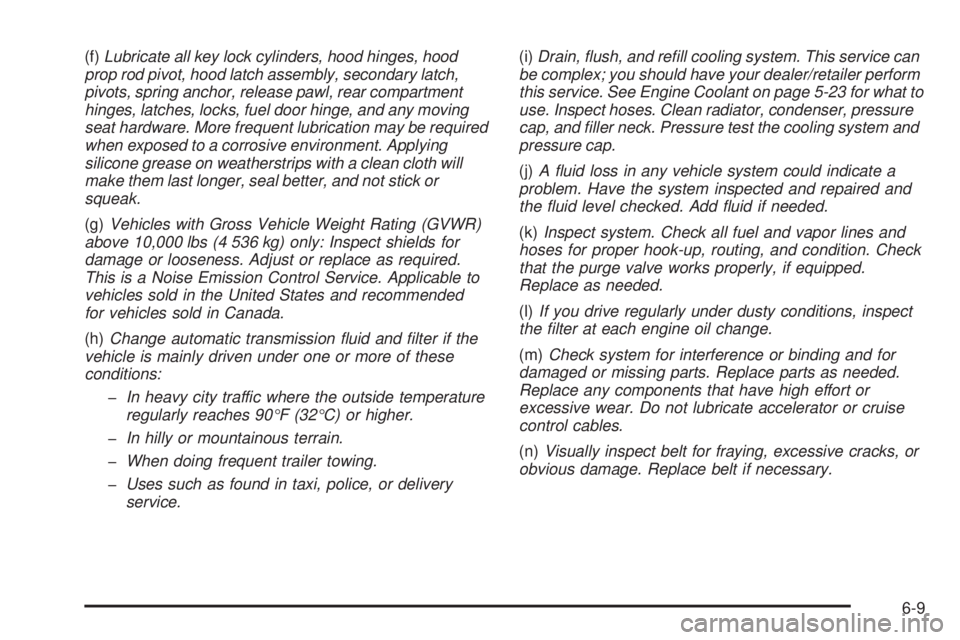
(f)Lubricate all key lock cylinders, hood hinges, hood
prop rod pivot, hood latch assembly, secondary latch,
pivots, spring anchor, release pawl, rear compartment
hinges, latches, locks, fuel door hinge, and any moving
seat hardware. More frequent lubrication may be required
when exposed to a corrosive environment. Applying
silicone grease on weatherstrips with a clean cloth will
make them last longer, seal better, and not stick or
squeak.
(g)Vehicles with Gross Vehicle Weight Rating (GVWR)
above 10,000 lbs (4 536 kg) only: Inspect shields for
damage or looseness. Adjust or replace as required.
This is a Noise Emission Control Service. Applicable to
vehicles sold in the United States and recommended
for vehicles sold in Canada.
(h)Change automatic transmission fluid and filter if the
vehicle is mainly driven under one or more of these
conditions:
-In heavy city traffic where the outside temperature
regularly reaches 90°F (32°C) or higher.
-In hilly or mountainous terrain.
-When doing frequent trailer towing.
-Uses such as found in taxi, police, or delivery
service.(i)Drain, flush, and refill cooling system. This service can
be complex; you should have your dealer/retailer perform
this service. See Engine Coolant on page 5-23 for what to
use. Inspect hoses. Clean radiator, condenser, pressure
cap, and filler neck. Pressure test the cooling system and
pressure cap.
(j)A fluid loss in any vehicle system could indicate a
problem. Have the system inspected and repaired and
the fluid level checked. Add fluid if needed.
(k)Inspect system. Check all fuel and vapor lines and
hoses for proper hook-up, routing, and condition. Check
that the purge valve works properly, if equipped.
Replace as needed.
(l)If you drive regularly under dusty conditions, inspect
the filter at each engine oil change.
(m)Check system for interference or binding and for
damaged or missing parts. Replace parts as needed.
Replace any components that have high effort or
excessive wear. Do not lubricate accelerator or cruise
control cables.
(n)Visually inspect belt for fraying, excessive cracks, or
obvious damage. Replace belt if necessary.
6-9
Page 362 of 402
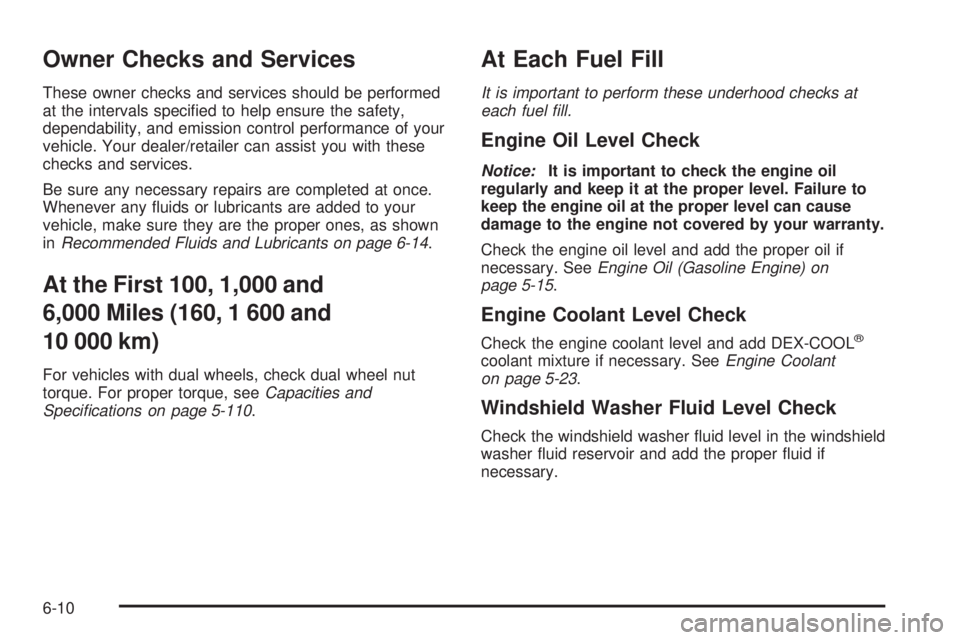
Owner Checks and Services
These owner checks and services should be performed
at the intervals specified to help ensure the safety,
dependability, and emission control performance of your
vehicle. Your dealer/retailer can assist you with these
checks and services.
Be sure any necessary repairs are completed at once.
Whenever any fluids or lubricants are added to your
vehicle, make sure they are the proper ones, as shown
inRecommended Fluids and Lubricants on page 6-14.
At the First 100, 1,000 and
6,000 Miles (160, 1 600 and
10 000 km)
For vehicles with dual wheels, check dual wheel nut
torque. For proper torque, seeCapacities and
Specifications on page 5-110.
At Each Fuel Fill
It is important to perform these underhood checks at
each fuel fill.
Engine Oil Level Check
Notice:It is important to check the engine oil
regularly and keep it at the proper level. Failure to
keep the engine oil at the proper level can cause
damage to the engine not covered by your warranty.
Check the engine oil level and add the proper oil if
necessary. SeeEngine Oil (Gasoline Engine) on
page 5-15.
Engine Coolant Level Check
Check the engine coolant level and add DEX-COOL®
coolant mixture if necessary. SeeEngine Coolant
on page 5-23.
Windshield Washer Fluid Level Check
Check the windshield washer fluid level in the windshield
washer fluid reservoir and add the proper fluid if
necessary.
6-10
Page 363 of 402
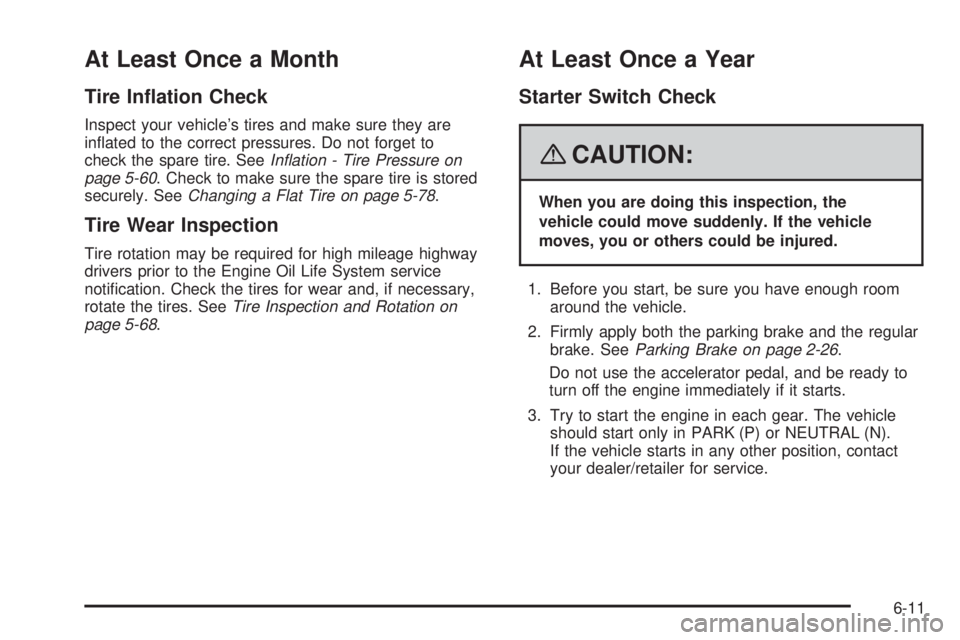
At Least Once a Month
Tire Ination Check
Inspect your vehicle’s tires and make sure they are
inflated to the correct pressures. Do not forget to
check the spare tire. SeeInflation - Tire Pressure on
page 5-60. Check to make sure the spare tire is stored
securely. SeeChanging a Flat Tire on page 5-78.
Tire Wear Inspection
Tire rotation may be required for high mileage highway
drivers prior to the Engine Oil Life System service
notification. Check the tires for wear and, if necessary,
rotate the tires. SeeTire Inspection and Rotation on
page 5-68.
At Least Once a Year
Starter Switch Check
{CAUTION:
When you are doing this inspection, the
vehicle could move suddenly. If the vehicle
moves, you or others could be injured.
1. Before you start, be sure you have enough room
around the vehicle.
2. Firmly apply both the parking brake and the regular
brake. SeeParking Brake on page 2-26.
Do not use the accelerator pedal, and be ready to
turn off the engine immediately if it starts.
3. Try to start the engine in each gear. The vehicle
should start only in PARK (P) or NEUTRAL (N).
If the vehicle starts in any other position, contact
your dealer/retailer for service.
6-11
Page 366 of 402
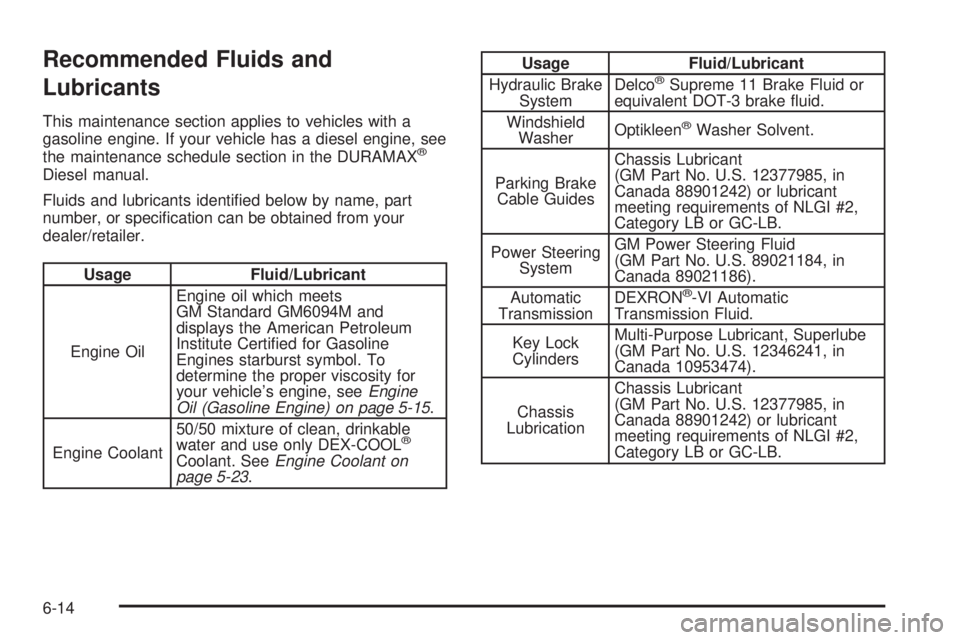
Recommended Fluids and
Lubricants
This maintenance section applies to vehicles with a
gasoline engine. If your vehicle has a diesel engine, see
the maintenance schedule section in the DURAMAX
®
Diesel manual.
Fluids and lubricants identified below by name, part
number, or specification can be obtained from your
dealer/retailer.
Usage Fluid/Lubricant
Engine OilEngine oil which meets
GM Standard GM6094M and
displays the American Petroleum
Institute Certified for Gasoline
Engines starburst symbol. To
determine the proper viscosity for
your vehicle’s engine, seeEngine
Oil (Gasoline Engine) on page 5-15.
Engine Coolant50/50 mixture of clean, drinkable
water and use only DEX-COOL
®
Coolant. SeeEngine Coolant on
page 5-23.
Usage Fluid/Lubricant
Hydraulic Brake
SystemDelco®Supreme 11 Brake Fluid or
equivalent DOT-3 brake fluid.
Windshield
WasherOptikleen
®Washer Solvent.
Parking Brake
Cable GuidesChassis Lubricant
(GM Part No. U.S. 12377985, in
Canada 88901242) or lubricant
meeting requirements of NLGI #2,
Category LB or GC-LB.
Power Steering
SystemGM Power Steering Fluid
(GM Part No. U.S. 89021184, in
Canada 89021186).
Automatic
TransmissionDEXRON
®-VI Automatic
Transmission Fluid.
Key Lock
CylindersMulti-Purpose Lubricant, Superlube
(GM Part No. U.S. 12346241, in
Canada 10953474).
Chassis
LubricationChassis Lubricant
(GM Part No. U.S. 12377985, in
Canada 88901242) or lubricant
meeting requirements of NLGI #2,
Category LB or GC-LB.
6-14
Page 368 of 402
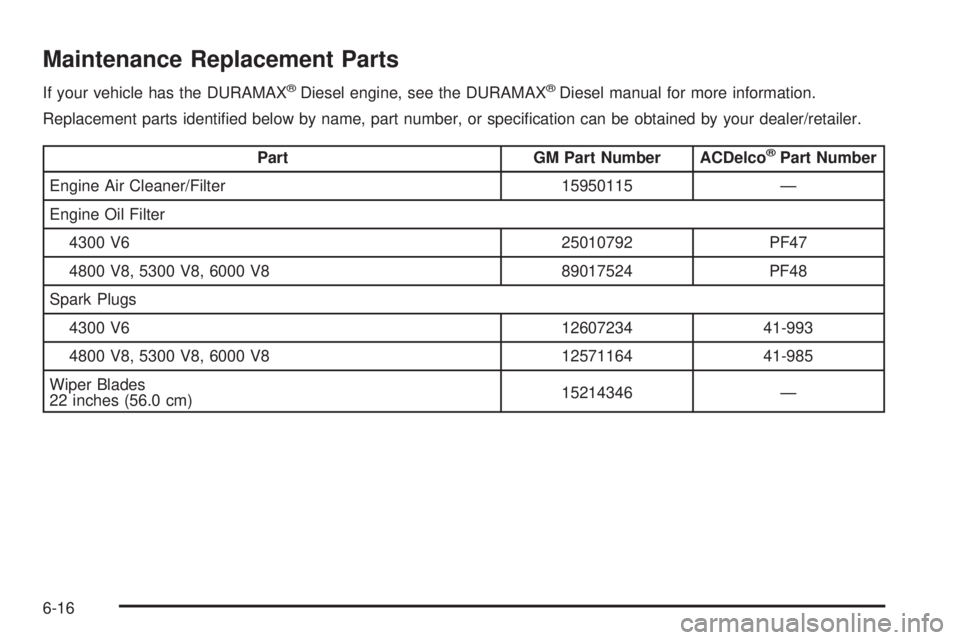
Maintenance Replacement Parts
If your vehicle has the DURAMAX®Diesel engine, see the DURAMAX®Diesel manual for more information.
Replacement parts identified below by name, part number, or specification can be obtained by your dealer/retailer.
Part GM Part Number ACDelco®Part Number
Engine Air Cleaner/Filter 15950115 —
Engine Oil Filter
4300 V6 25010792 PF47
4800 V8, 5300 V8, 6000 V8 89017524 PF48
Spark Plugs
4300 V6 12607234 41-993
4800 V8, 5300 V8, 6000 V8 12571164 41-985
Wiper Blades
22 inches (56.0 cm)15214346 —
6-16
Page 394 of 402
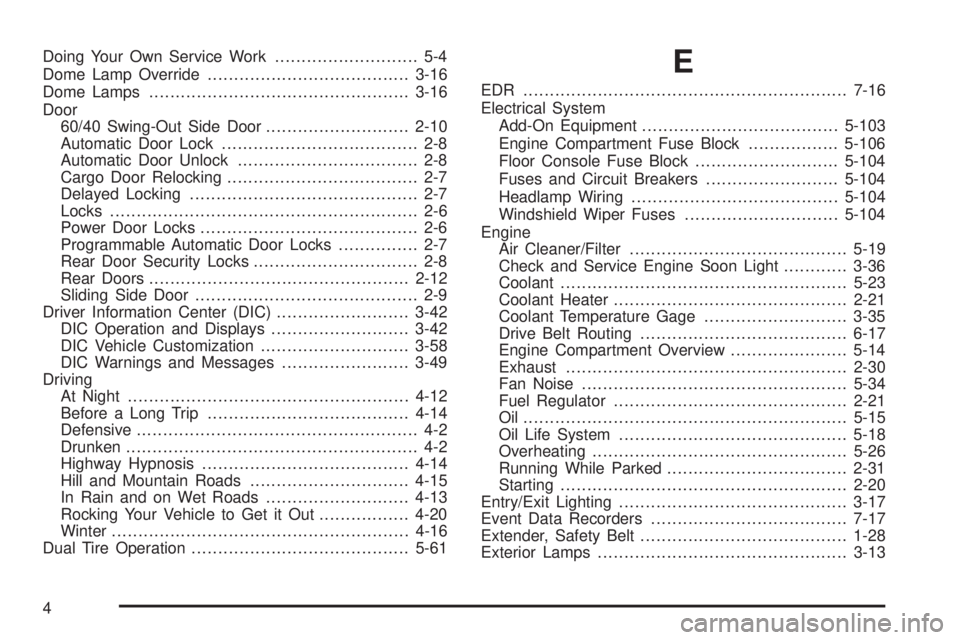
Doing Your Own Service Work........................... 5-4
Dome Lamp Override......................................3-16
Dome Lamps.................................................3-16
Door
60/40 Swing-Out Side Door...........................2-10
Automatic Door Lock..................................... 2-8
Automatic Door Unlock.................................. 2-8
Cargo Door Relocking.................................... 2-7
Delayed Locking........................................... 2-7
Locks.......................................................... 2-6
Power Door Locks......................................... 2-6
Programmable Automatic Door Locks............... 2-7
Rear Door Security Locks............................... 2-8
Rear Doors.................................................2-12
Sliding Side Door.......................................... 2-9
Driver Information Center (DIC).........................3-42
DIC Operation and Displays..........................3-42
DIC Vehicle Customization............................3-58
DIC Warnings and Messages........................3-49
Driving
At Night.....................................................4-12
Before a Long Trip......................................4-14
Defensive..................................................... 4-2
Drunken....................................................... 4-2
Highway Hypnosis.......................................4-14
Hill and Mountain Roads..............................4-15
In Rain and on Wet Roads...........................4-13
Rocking Your Vehicle to Get it Out.................4-20
Winter........................................................4-16
Dual Tire Operation.........................................5-61E
EDR .............................................................7-16
Electrical System
Add-On Equipment.....................................5-103
Engine Compartment Fuse Block.................5-106
Floor Console Fuse Block...........................5-104
Fuses and Circuit Breakers.........................5-104
Headlamp Wiring.......................................5-104
Windshield Wiper Fuses.............................5-104
Engine
Air Cleaner/Filter.........................................5-19
Check and Service Engine Soon Light............3-36
Coolant......................................................5-23
Coolant Heater............................................2-21
Coolant Temperature Gage...........................3-35
Drive Belt Routing.......................................6-17
Engine Compartment Overview......................5-14
Exhaust.....................................................2-30
Fan Noise..................................................5-34
Fuel Regulator............................................2-21
Oil .............................................................5-15
Oil Life System...........................................5-18
Overheating................................................5-26
Running While Parked..................................2-31
Starting......................................................2-20
Entry/Exit Lighting...........................................3-17
Event Data Recorders.....................................7-17
Extender, Safety Belt.......................................1-28
Exterior Lamps...............................................3-13
4
Page 395 of 402
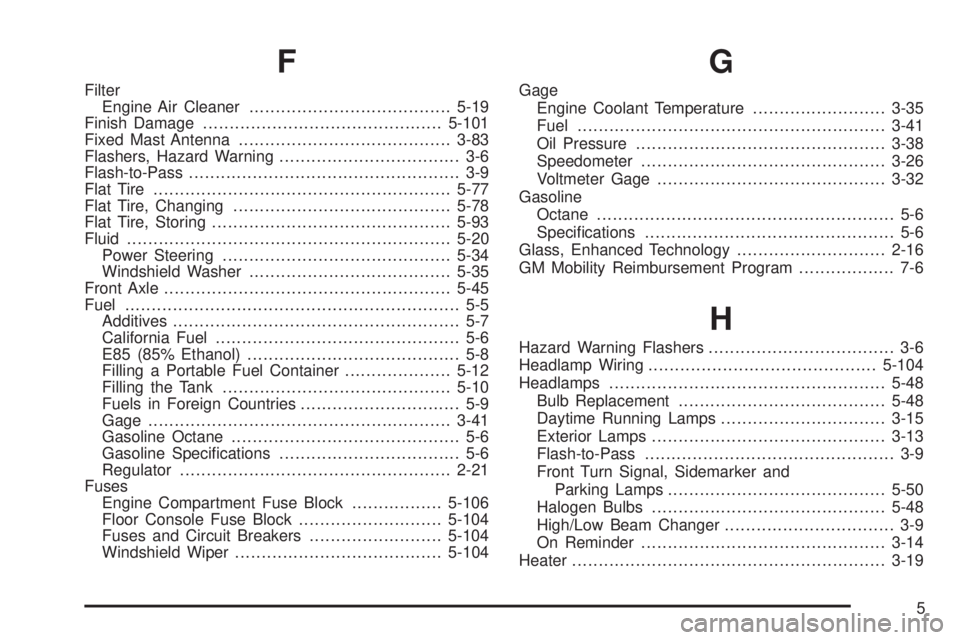
F
Filter
Engine Air Cleaner......................................5-19
Finish Damage.............................................5-101
Fixed Mast Antenna........................................3-83
Flashers, Hazard Warning.................................. 3-6
Flash-to-Pass................................................... 3-9
Flat Tire........................................................5-77
Flat Tire, Changing.........................................5-78
Flat Tire, Storing.............................................5-93
Fluid.............................................................5-20
Power Steering...........................................5-34
Windshield Washer......................................5-35
Front Axle......................................................5-45
Fuel............................................................... 5-5
Additives...................................................... 5-7
California Fuel.............................................. 5-6
E85 (85% Ethanol)........................................ 5-8
Filling a Portable Fuel Container....................5-12
Filling the Tank...........................................5-10
Fuels in Foreign Countries.............................. 5-9
Gage.........................................................3-41
Gasoline Octane........................................... 5-6
Gasoline Specifications.................................. 5-6
Regulator...................................................2-21
Fuses
Engine Compartment Fuse Block.................5-106
Floor Console Fuse Block...........................5-104
Fuses and Circuit Breakers.........................5-104
Windshield Wiper.......................................5-104
G
Gage
Engine Coolant Temperature.........................3-35
Fuel..........................................................3-41
Oil Pressure...............................................3-38
Speedometer..............................................3-26
Voltmeter Gage...........................................3-32
Gasoline
Octane........................................................ 5-6
Specifications............................................... 5-6
Glass, Enhanced Technology............................2-16
GM Mobility Reimbursement Program.................. 7-6
H
Hazard Warning Flashers................................... 3-6
Headlamp Wiring...........................................5-104
Headlamps....................................................5-48
Bulb Replacement.......................................5-48
Daytime Running Lamps...............................3-15
Exterior Lamps............................................3-13
Flash-to-Pass............................................... 3-9
Front Turn Signal, Sidemarker and
Parking Lamps.........................................5-50
Halogen Bulbs............................................5-48
High/Low Beam Changer................................ 3-9
On Reminder..............................................3-14
Heater...........................................................3-19
5
Page 398 of 402
N
Navigation System, Privacy..............................7-18
New Vehicle Break-In......................................2-18
Noise Control System, Tampering......................5-46
O
Odometer......................................................3-26
Odometer, Trip...............................................3-26
Off-Road Recovery..........................................4-10
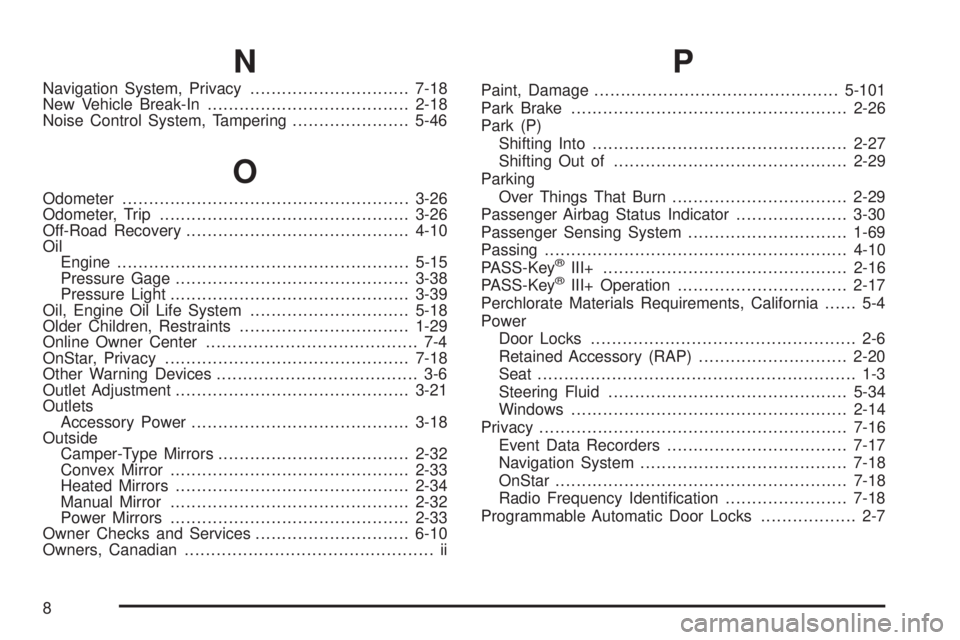
Oil
Engine.......................................................5-15
Pressure Gage............................................3-38
Pressure Light.............................................3-39
Oil, Engine Oil Life System..............................5-18
Older Children, Restraints................................1-29
Online Owner Center........................................ 7-4
OnStar, Privacy..............................................7-18
Other Warning Devices...................................... 3-6
Outlet Adjustment............................................3-21
Outlets
Accessory Power.........................................3-18
Outside
Camper-Type Mirrors....................................2-32
Convex Mirror.............................................2-33
Heated Mirrors............................................2-34
Manual Mirror.............................................2-32
Power Mirrors.............................................2-33
Owner Checks and Services.............................6-10
Owners, Canadian............................................... ii
P
Paint, Damage..............................................5-101
Park Brake....................................................2-26
Park (P)
Shifting Into................................................2-27
Shifting Out of............................................2-29
Parking
Over Things That Burn.................................2-29
Passenger Airbag Status Indicator.....................3-30
Passenger Sensing System..............................1-69
Passing.........................................................4-10
PASS-Key
®III+..............................................2-16
PASS-Key®III+ Operation................................2-17
Perchlorate Materials Requirements, California...... 5-4
Power
Door Locks.................................................. 2-6
Retained Accessory (RAP)............................2-20
Seat............................................................ 1-3
Steering Fluid.............................................5-34
Windows....................................................2-14
Privacy..........................................................7-16
Event Data Recorders..................................7-17
Navigation System.......................................7-18
OnStar.......................................................7-18
Radio Frequency Identification.......................7-18
Programmable Automatic Door Locks.................. 2-7
8