lock GMC SAVANA PASSENGER 2009 Owners Manual
[x] Cancel search | Manufacturer: GMC, Model Year: 2009, Model line: SAVANA PASSENGER, Model: GMC SAVANA PASSENGER 2009Pages: 406, PDF Size: 2.34 MB
Page 325 of 406
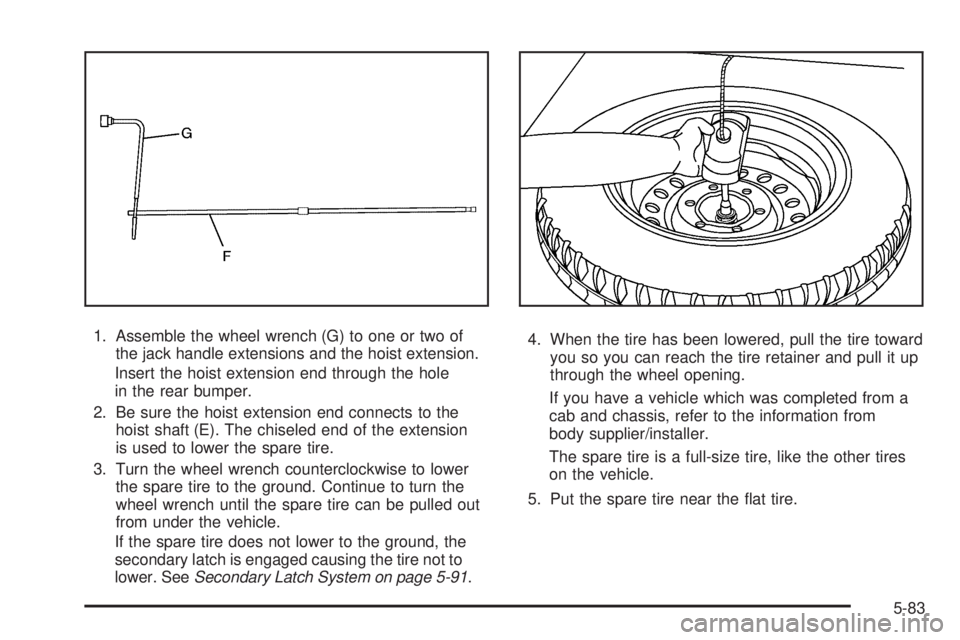
1. Assemble the wheel wrench (G) to one or two of
the jack handle extensions and the hoist extension.
Insert the hoist extension end through the hole
in the rear bumper.
2. Be sure the hoist extension end connects to the
hoist shaft (E). The chiseled end of the extension
is used to lower the spare tire.
3. Turn the wheel wrench counterclockwise to lower
the spare tire to the ground. Continue to turn the
wheel wrench until the spare tire can be pulled out
from under the vehicle.
If the spare tire does not lower to the ground, the
secondary latch is engaged causing the tire not to
lower. SeeSecondary Latch System on page 5-91.4. When the tire has been lowered, pull the tire toward
you so you can reach the tire retainer and pull it up
through the wheel opening.
If you have a vehicle which was completed from a
cab and chassis, refer to the information from
body supplier/installer.
The spare tire is a full-size tire, like the other tires
on the vehicle.
5. Put the spare tire near the flat tire.
5-83
Page 326 of 406
Removing the Flat Tire and
Installing the Spare Tire
If your vehicle has plastic wheel nut caps, loosen
them by turning the wheel wrench counterclockwise.
The wheel nut caps are designed to remain with
the center cap. Remove the center cap.
If the wheel has a smooth center piece, place the chisel
end of the wheel wrench in the slot on the wheel and
gently pry it out.
1. Do a safety check before proceeding. SeeChanging
a Flat Tire on page 5-80for more information.
2. Loosen all the wheel nuts with the wheel wrench.
Do not remove them yet.
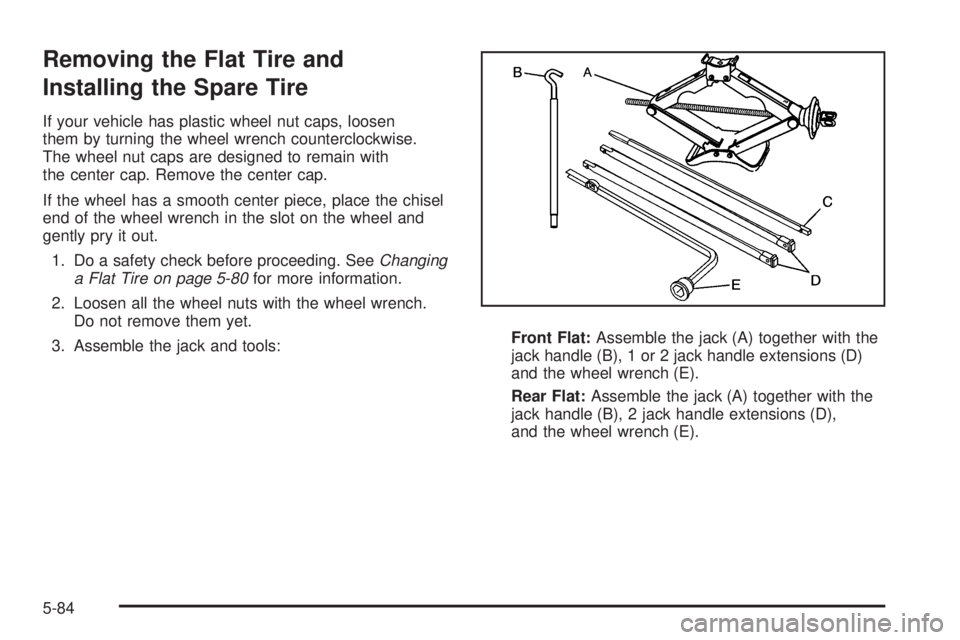
3. Assemble the jack and tools:Front Flat:Assemble the jack (A) together with the
jack handle (B), 1 or 2 jack handle extensions (D)
and the wheel wrench (E).
Rear Flat:Assemble the jack (A) together with the
jack handle (B), 2 jack handle extensions (D),
and the wheel wrench (E).
5-84
Page 329 of 406
{CAUTION:
Getting under a vehicle when it is jacked up is
dangerous. If the vehicle slips off the jack you
could be badly injured or killed. Never get under a
vehicle when it is supported only by a jack.
{CAUTION:
Raising your vehicle with the jack improperly
positioned can damage the vehicle and even
make the vehicle fall. To help avoid personal injury
and vehicle damage, be sure to fit the jack lift
head into the proper location before raising the
vehicle.5. Raise the vehicle by turning the wheel wrench
clockwise. Raise the vehicle far enough off the
ground so there is enough room for the spare
tire to fit.
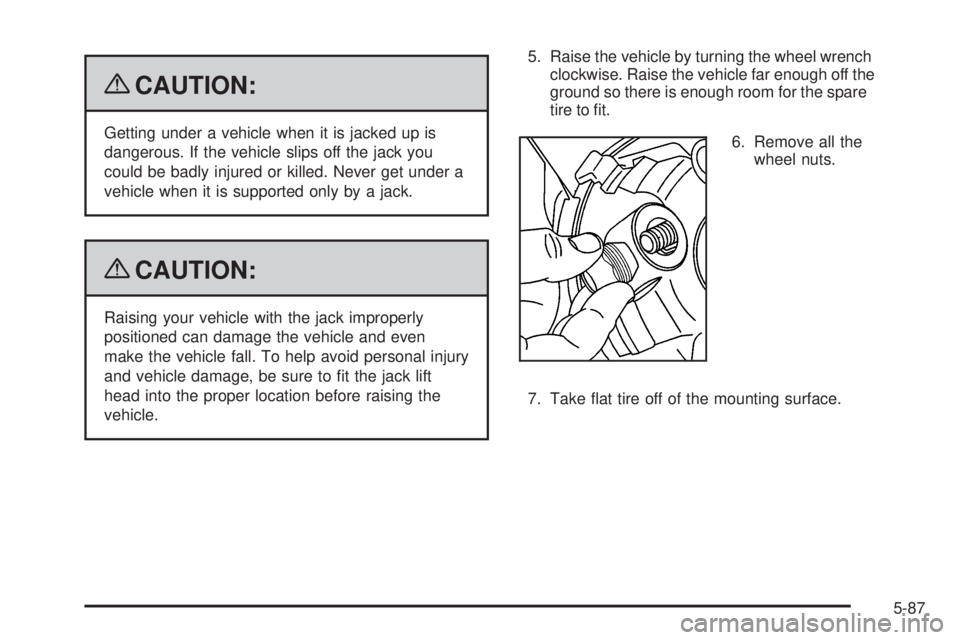
6. Remove all the
wheel nuts.
7. Take flat tire off of the mounting surface.
5-87
Page 331 of 406
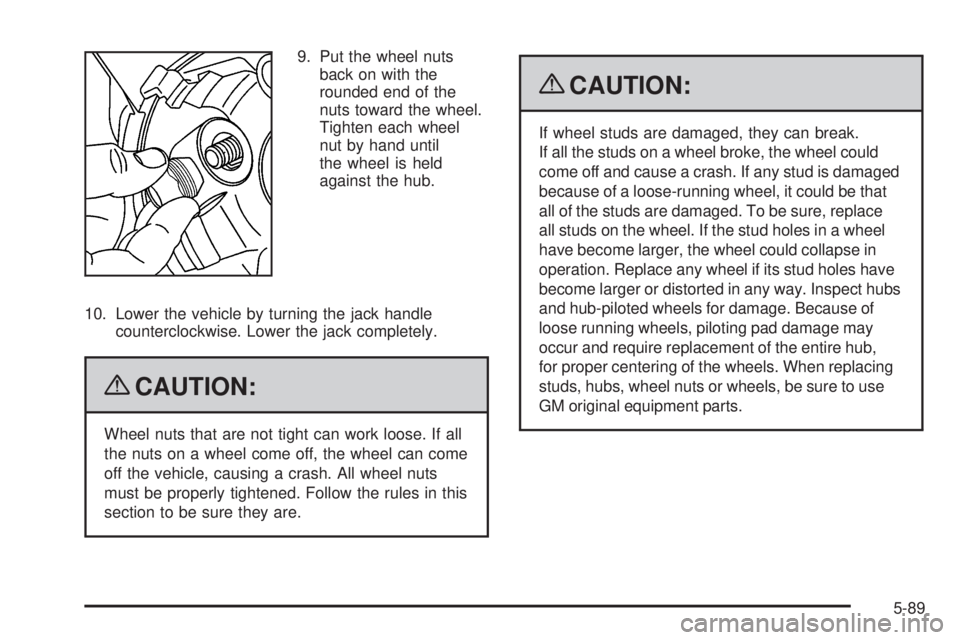
9. Put the wheel nuts
back on with the
rounded end of the
nuts toward the wheel.
Tighten each wheel
nut by hand until
the wheel is held
against the hub.
10. Lower the vehicle by turning the jack handle
counterclockwise. Lower the jack completely.
{CAUTION:
Wheel nuts that are not tight can work loose. If all
the nuts on a wheel come off, the wheel can come
off the vehicle, causing a crash. All wheel nuts
must be properly tightened. Follow the rules in this
section to be sure they are.
{CAUTION:
If wheel studs are damaged, they can break.
If all the studs on a wheel broke, the wheel could
come off and cause a crash. If any stud is damaged
because of a loose-running wheel, it could be that
all of the studs are damaged. To be sure, replace
all studs on the wheel. If the stud holes in a wheel
have become larger, the wheel could collapse in
operation. Replace any wheel if its stud holes have
become larger or distorted in any way. Inspect hubs
and hub-piloted wheels for damage. Because of
loose running wheels, piloting pad damage may
occur and require replacement of the entire hub,
for proper centering of the wheels. When replacing
studs, hubs, wheel nuts or wheels, be sure to use
GM original equipment parts.
5-89
Page 332 of 406
{CAUTION:
Wheel nuts that are improperly or incorrectly
tightened can cause the wheels to become loose or
come off. The wheel nuts should be tightened with a
torque wrench to the proper torque specification
after replacing. Follow the torque specification
supplied by the aftermarket manufacturer when
using accessory locking wheel nuts. SeeCapacities
and Specifications on page 5-110for original
equipment wheel nut torque specifications.
Notice:Improperly tightened wheel nuts can
lead to brake pulsation and rotor damage. To avoid
expensive brake repairs, evenly tighten the wheel
nuts in the proper sequence and to the proper torque
specication. SeeCapacities and Specifications on
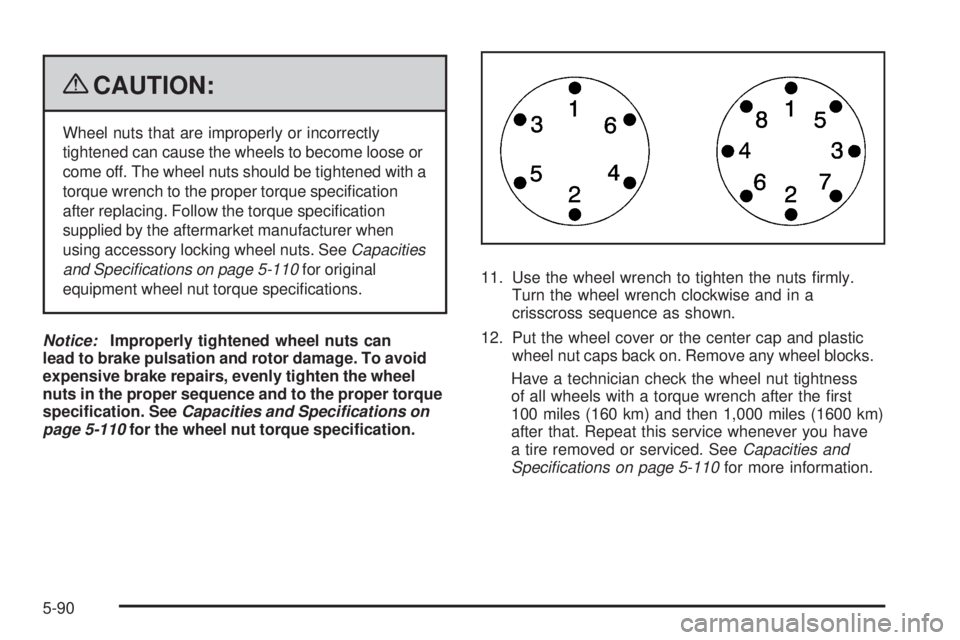
page 5-110for the wheel nut torque specication.11. Use the wheel wrench to tighten the nuts firmly.
Turn the wheel wrench clockwise and in a
crisscross sequence as shown.
12. Put the wheel cover or the center cap and plastic
wheel nut caps back on. Remove any wheel blocks.
Have a technician check the wheel nut tightness
of all wheels with a torque wrench after the first
100 miles (160 km) and then 1,000 miles (1600 km)
after that. Repeat this service whenever you have
a tire removed or serviced. SeeCapacities and
Specifications on page 5-110for more information.
5-90
Page 334 of 406
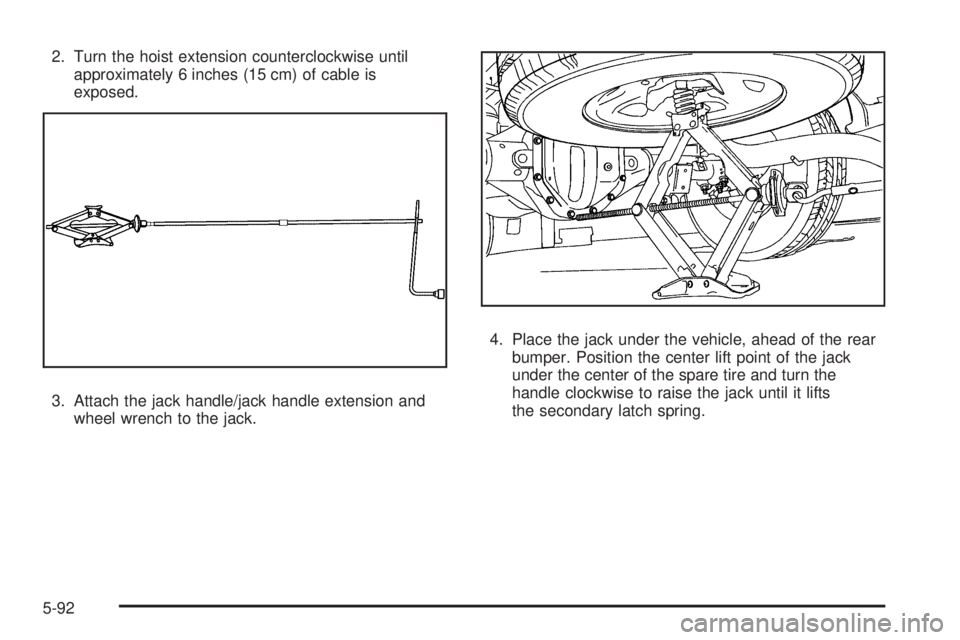
2. Turn the hoist extension counterclockwise until
approximately 6 inches (15 cm) of cable is
exposed.
3. Attach the jack handle/jack handle extension and
wheel wrench to the jack.4. Place the jack under the vehicle, ahead of the rear
bumper. Position the center lift point of the jack
under the center of the spare tire and turn the
handle clockwise to raise the jack until it lifts
the secondary latch spring.
5-92
Page 335 of 406
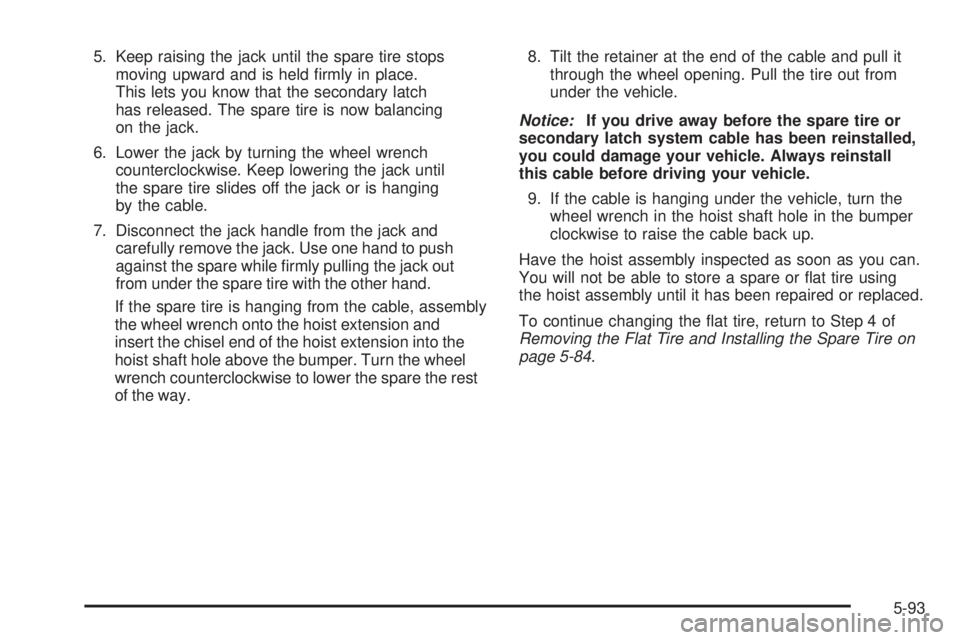
5. Keep raising the jack until the spare tire stops
moving upward and is held firmly in place.
This lets you know that the secondary latch
has released. The spare tire is now balancing
on the jack.
6. Lower the jack by turning the wheel wrench
counterclockwise. Keep lowering the jack until
the spare tire slides off the jack or is hanging
by the cable.
7. Disconnect the jack handle from the jack and
carefully remove the jack. Use one hand to push
against the spare while firmly pulling the jack out
from under the spare tire with the other hand.
If the spare tire is hanging from the cable, assembly
the wheel wrench onto the hoist extension and
insert the chisel end of the hoist extension into the
hoist shaft hole above the bumper. Turn the wheel
wrench counterclockwise to lower the spare the rest
of the way.8. Tilt the retainer at the end of the cable and pull it
through the wheel opening. Pull the tire out from
under the vehicle.
Notice:If you drive away before the spare tire or
secondary latch system cable has been reinstalled,
you could damage your vehicle. Always reinstall
this cable before driving your vehicle.
9. If the cable is hanging under the vehicle, turn the
wheel wrench in the hoist shaft hole in the bumper
clockwise to raise the cable back up.
Have the hoist assembly inspected as soon as you can.
You will not be able to store a spare or flat tire using
the hoist assembly until it has been repaired or replaced.
To continue changing the flat tire, return to Step 4 of
Removing the Flat Tire and Installing the Spare Tire on
page 5-84.
5-93
Page 346 of 406
Headlamp Wiring
The headlamp wiring is protected by fuses in the engine
compartment fuse block. An electrical overload will
cause the lamps to flicker on and off, or in some cases
to remain off. If this happens, have your headlamp
wiring checked right away.
Windshield Wiper Fuses
The windshield wiper motor is protected by a circuit
breaker and a fuse. If the motor overheats due to heavy
snow, etc., the wiper will stop until the motor cools.
Although the circuit is protected from electrical overload,
overload due to heavy snow, etc., may cause wiper
linkage damage. Always clear ice and heavy snow from
the windshield before using the windshield wipers. If the
overload is caused by some electrical problem and not
snow, etc., be sure to get it fixed.
Fuses and Circuit Breakers
The wiring circuits in the vehicle are protected from
short circuits by a combination of fuses and circuit
breakers. This greatly reduces the chance of fires
caused by electrical problems.
Look at the silver-colored band inside the fuse. If the
band is broken or melted, replace the fuse. Be sure
you replace a bad fuse with a new one of the identical
size and rating.
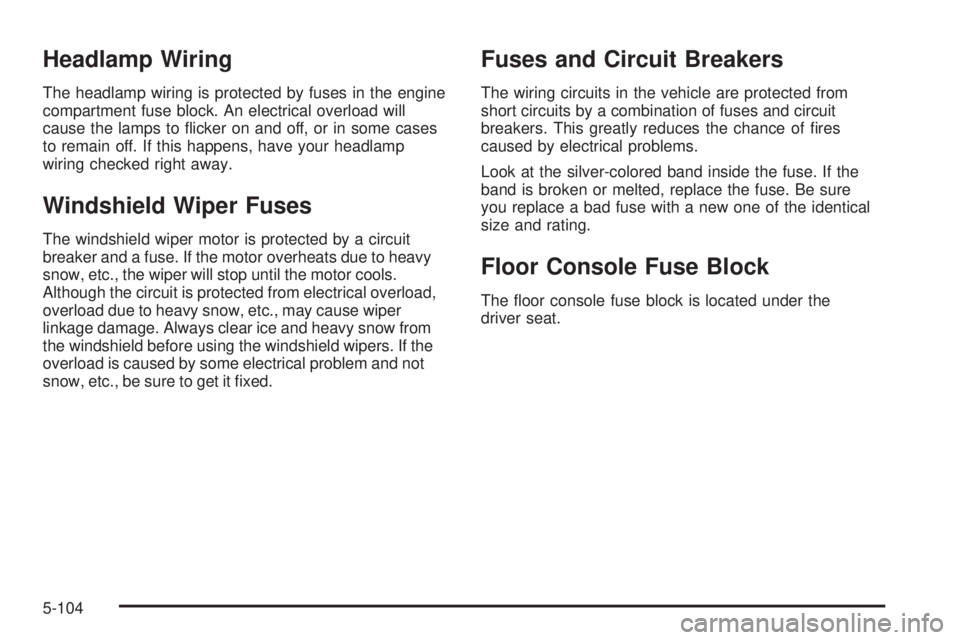
Floor Console Fuse Block
The floor console fuse block is located under the
driver seat.
5-104
Page 348 of 406
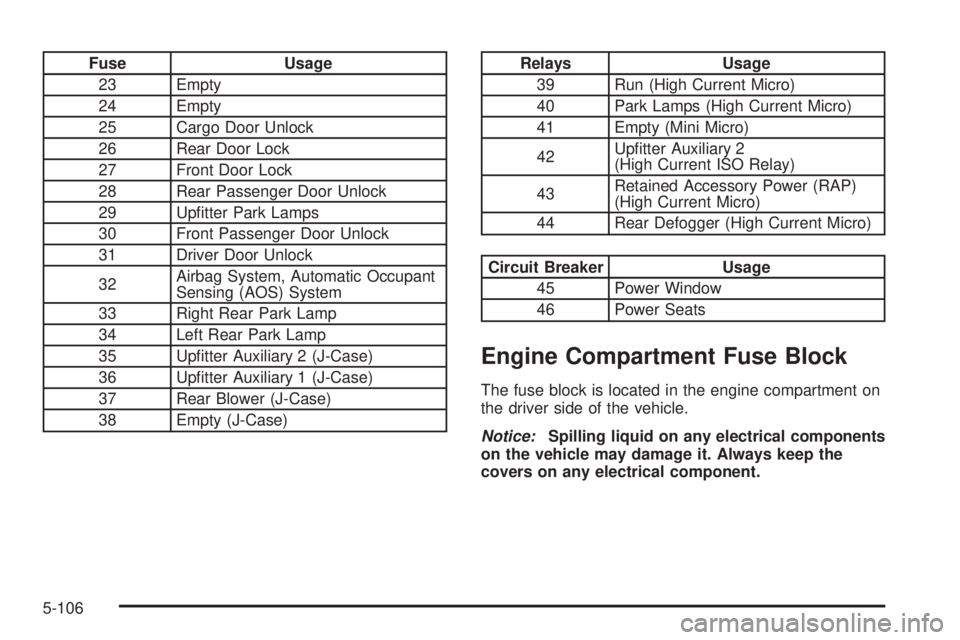
Fuse Usage
23 Empty
24 Empty
25 Cargo Door Unlock
26 Rear Door Lock
27 Front Door Lock
28 Rear Passenger Door Unlock
29 Upfitter Park Lamps
30 Front Passenger Door Unlock
31 Driver Door Unlock
32Airbag System, Automatic Occupant
Sensing (AOS) System
33 Right Rear Park Lamp
34 Left Rear Park Lamp
35 Upfitter Auxiliary 2 (J-Case)
36 Upfitter Auxiliary 1 (J-Case)
37 Rear Blower (J-Case)
38 Empty (J-Case)Relays Usage
39 Run (High Current Micro)
40 Park Lamps (High Current Micro)
41 Empty (Mini Micro)
42Upfitter Auxiliary 2
(High Current ISO Relay)
43Retained Accessory Power (RAP)
(High Current Micro)
44 Rear Defogger (High Current Micro)
Circuit Breaker Usage
45 Power Window
46 Power Seats
Engine Compartment Fuse Block
The fuse block is located in the engine compartment on
the driver side of the vehicle.
Notice:Spilling liquid on any electrical components
on the vehicle may damage it. Always keep the
covers on any electrical component.
5-106
Page 351 of 406
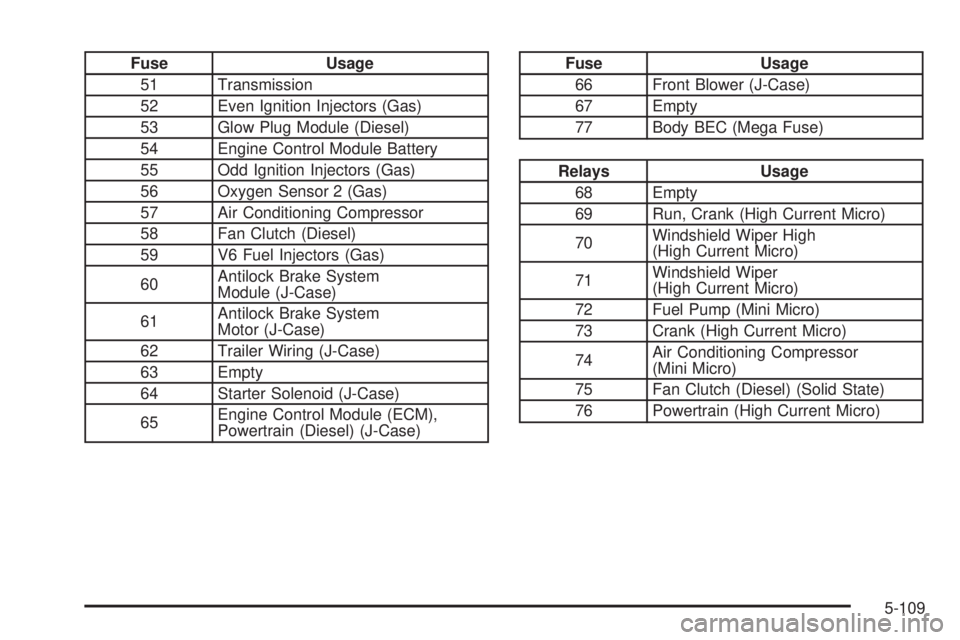
Fuse Usage
51 Transmission
52 Even Ignition Injectors (Gas)
53 Glow Plug Module (Diesel)
54 Engine Control Module Battery
55 Odd Ignition Injectors (Gas)
56 Oxygen Sensor 2 (Gas)
57 Air Conditioning Compressor
58 Fan Clutch (Diesel)
59 V6 Fuel Injectors (Gas)
60Antilock Brake System
Module (J-Case)
61Antilock Brake System
Motor (J-Case)
62 Trailer Wiring (J-Case)
63 Empty
64 Starter Solenoid (J-Case)
65Engine Control Module (ECM),
Powertrain (Diesel) (J-Case)Fuse Usage
66 Front Blower (J-Case)
67 Empty
77 Body BEC (Mega Fuse)
Relays Usage
68 Empty
69 Run, Crank (High Current Micro)
70Windshield Wiper High
(High Current Micro)
71Windshield Wiper
(High Current Micro)
72 Fuel Pump (Mini Micro)
73 Crank (High Current Micro)
74Air Conditioning Compressor
(Mini Micro)
75 Fan Clutch (Diesel) (Solid State)
76 Powertrain (High Current Micro)
5-109