heater GMC SAVANA PASSENGER 2010 User Guide
[x] Cancel search | Manufacturer: GMC, Model Year: 2010, Model line: SAVANA PASSENGER, Model: GMC SAVANA PASSENGER 2010Pages: 424, PDF Size: 2.38 MB
Page 289 of 424
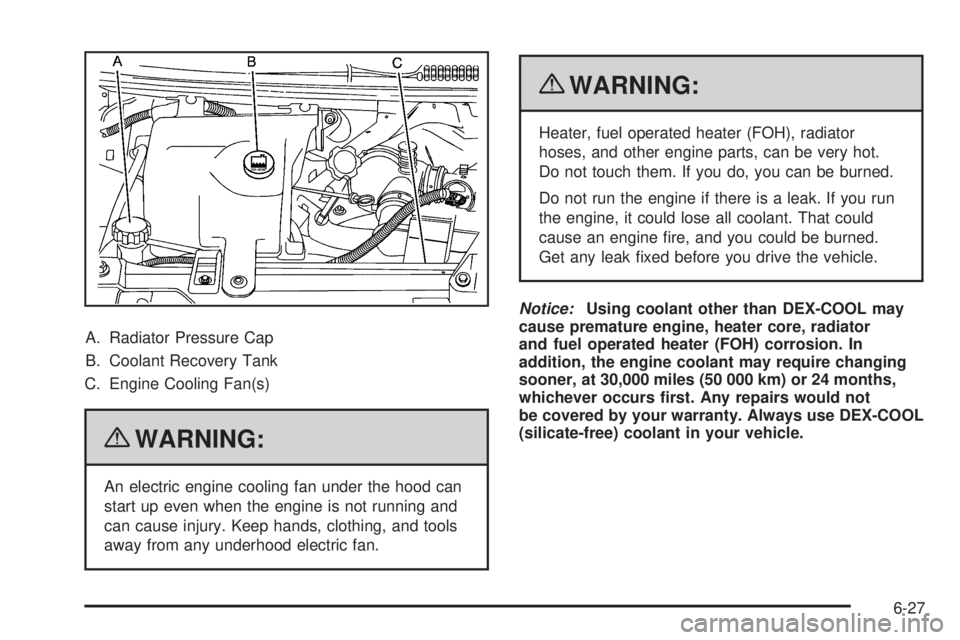
A. Radiator Pressure Cap
B. Coolant Recovery Tank
C. Engine Cooling Fan(s)
{WARNING:
An electric engine cooling fan under the hood can
start up even when the engine is not running and
can cause injury. Keep hands, clothing, and tools
away from any underhood electric fan.
{WARNING:
Heater, fuel operated heater (FOH), radiator
hoses, and other engine parts, can be very hot.
Do not touch them. If you do, you can be burned.
Do not run the engine if there is a leak. If you run
the engine, it could lose all coolant. That could
cause an engine fire, and you could be burned.
Get any leak fixed before you drive the vehicle.
Notice:Using coolant other than DEX-COOL may
cause premature engine, heater core, radiator
and fuel operated heater (FOH) corrosion. In
addition, the engine coolant may require changing
sooner, at 30,000 miles (50 000 km) or 24 months,
whichever occurs rst. Any repairs would not
be covered by your warranty. Always use DEX-COOL
(silicate-free) coolant in your vehicle.
6-27
Page 290 of 424
Engine Coolant
The cooling system in the vehicle is filled with
DEX-COOL®engine coolant. This coolant is designed
to remain in the vehicle for five years or 150,000 miles
(240 000 km), whichever occurs first.
The following explains the cooling system and how to
check and add coolant when it is low. If there is a
problem with engine overheating, seeEngine
Overheating on page 6-33.
What to Use
{WARNING:
Adding only plain water to the cooling system can
be dangerous. Plain water, or some other liquid
such as alcohol, can boil before the proper coolant
mixture will. The vehicle’s coolant warning system
is set for the proper coolant mixture. With plain
water or the wrong mixture, the engine could get
too hot but you would not get the overheat
warning. The engine could catch fire and you or
others could be burned. Use a 50/50 mixture of
clean, drinkable water and DEX-COOL
®coolant.Use a 50/50 mixture of clean, drinkable water and
DEX-COOL
®coolant. If using this mixture, nothing else
needs to be added. This mixture:
•Gives freezing protection down to−34°F (−37°C),
outside temperature.
•Gives boiling protection up to 265°F (129°C),
engine temperature.
•Protects against rust and corrosion.
•Will not damage aluminum parts.
•Helps keep the proper engine temperature.
Notice:If an improper coolant mixture is used, the
engine could overheat and be badly damaged.
The repair cost would not be covered by the vehicle
warranty. Too much water in the mixture can
freeze and crack the engine, radiator, heater core,
and other parts.
Notice:If extra inhibitors and/or additives are used
in the vehicle’s cooling system, the vehicle could
be damaged. Use only the proper mixture of
the engine coolant listed in this manual for the
cooling system. SeeRecommended Fluids and
Lubricants on page 7-11for more information.
6-28
Page 296 of 424
If No Steam Is Coming From The
Engine Compartment
If an engine overheat warning is displayed but no steam
can be seen or heard, the problem may not be too
serious. Sometimes the engine can get a little too hot
when the vehicle:
•Climbs a long hill on a hot day.
•Stops after high-speed driving.
•Idles for long periods in traffic.
•Tows a trailer. See “Driving on Grades” under
Towing a Trailer on page 5-26.
If the overheat warning is displayed with no sign of
steam:
1. Turn the air off.
2. Turn the heater on to the highest temperature and
to the highest fan speed. Open the windows as
necessary.
3. In heavy traffic, let the engine idle in N (Neutral)
while stopped. If it is safe to do so, pull off the
road, shift to P (Park) or N (Neutral) and let
the engine idle.
If the temperature overheat gage is no longer in the
overheat zone or an overheat warning no longer
displays, the vehicle can be driven. Continue to drive
the vehicle slow for about 10 minutes. Keep a safevehicle distance from the car in front of you. If the
warning does not come back on, continue to drive
normally.
If the warning continues, pull over, stop, and park the
vehicle right away.
If there is still no sign of steam, push down the
accelerator until the engine speed is about twice as fast
as normal idle speed for at least three minutes while
you are parked. If you still have the warning, turn off the
engine until it cools down.
You may decide not to lift the hood but to get service
help right away.
Engine Fan Noise
Your vehicle has a clutched engine cooling fan. When
the clutch is engaged, the fan spins faster to provide
more air to cool the engine. In most everyday driving
conditions, the fan is spinning slower and the clutch is
not fully engaged. This improves fuel economy and
reduces fan noise. Under heavy vehicle loading, trailer
towing, and/or high outside temperatures, the fan
speed increases as the clutch more fully engages, so
you may hear an increase in fan noise. This is
normal and should not be mistaken as the transmission
slipping or making extra shifts. It is merely the cooling
system functioning properly. The fan will slow down
when additional cooling is not required and the clutch
partially disengages.
6-34
Page 299 of 424
Brakes
Brake Fluid
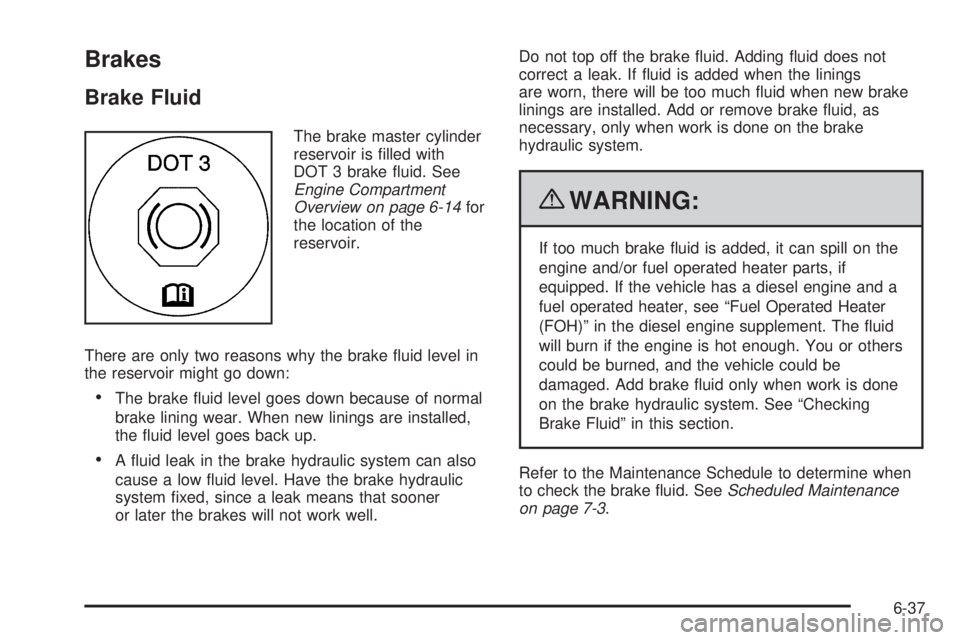
The brake master cylinder
reservoir is filled with
DOT 3 brake fluid. See
Engine Compartment
Overview on page 6-14for
the location of the
reservoir.
There are only two reasons why the brake fluid level in
the reservoir might go down:
•The brake fluid level goes down because of normal
brake lining wear. When new linings are installed,
the fluid level goes back up.
•A fluid leak in the brake hydraulic system can also
cause a low fluid level. Have the brake hydraulic
system fixed, since a leak means that sooner
or later the brakes will not work well.Do not top off the brake fluid. Adding fluid does not
correct a leak. If fluid is added when the linings
are worn, there will be too much fluid when new brake
linings are installed. Add or remove brake fluid, as
necessary, only when work is done on the brake
hydraulic system.
{WARNING:
If too much brake fluid is added, it can spill on the
engine and/or fuel operated heater parts, if
equipped. If the vehicle has a diesel engine and a
fuel operated heater, see “Fuel Operated Heater
(FOH)” in the diesel engine supplement. The fluid
will burn if the engine is hot enough. You or others
could be burned, and the vehicle could be
damaged. Add brake fluid only when work is done
on the brake hydraulic system. See “Checking
Brake Fluid” in this section.
Refer to the Maintenance Schedule to determine when
to check the brake fluid. SeeScheduled Maintenance
on page 7-3.
6-37
Page 310 of 424
2. The use of the vehicle after such device or element
of design has been removed or rendered inoperative
by any person.
Among those acts presumed to constitute tampering are
the acts listed below.
Insulation:
•
Removal of the noise shields or any underhood
insulation.
Engine:
•
Removal or rendering engine speed governor, if the
vehicle has one, inoperative so as to allow engine
speed to exceed manufacturer specifications.
Fan and Drive:
•
Removal of fan clutch, if the vehicle has one, or
rendering clutch inoperative.
•Removal of the fan shroud, if the vehicle has one.
Air Intake:
•
Removal of the air cleaner silencer.
•Modification of the air cleaner.
Exhaust:
•
Removal of the muffler and/or resonator.
•Removal of the exhaust pipes and exhaust pipe
clamps.
Fuel Operated Heater (FOH) — Diesel
Engine:
•
Removal of the muffler.
Bulb Replacement
For the proper type of replacement bulbs, see
Replacement Bulbs on page 6-53.
For any bulb changing procedure not listed in this
section, contact your dealer/retailer.
6-48
Page 367 of 424
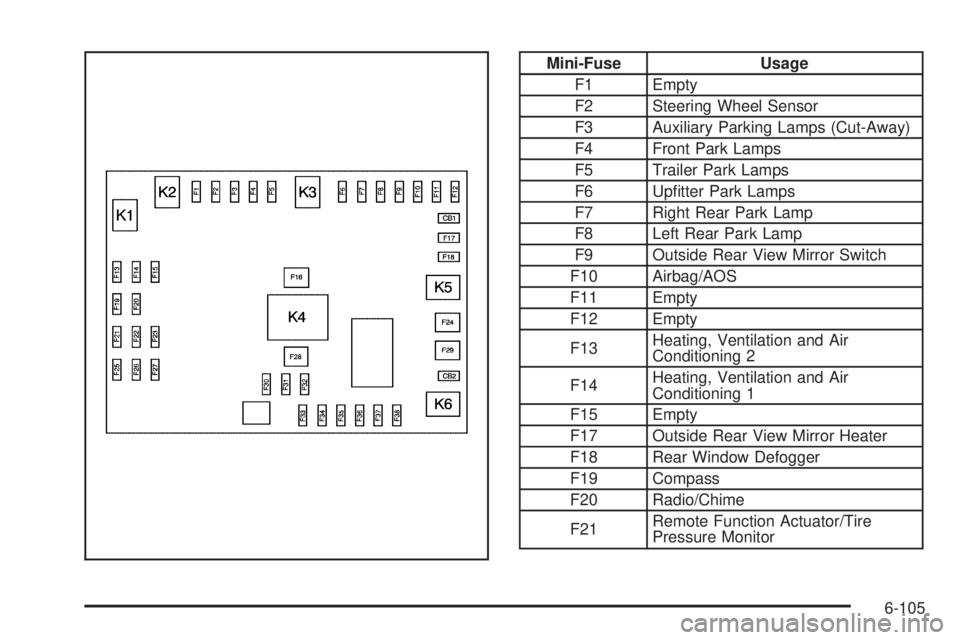
Mini-Fuse Usage
F1 Empty
F2 Steering Wheel Sensor
F3 Auxiliary Parking Lamps (Cut-Away)
F4 Front Park Lamps
F5 Trailer Park Lamps
F6 Upfitter Park Lamps
F7 Right Rear Park Lamp
F8 Left Rear Park Lamp
F9 Outside Rear View Mirror Switch
F10 Airbag/AOS
F11 Empty
F12 Empty
F13Heating, Ventilation and Air
Conditioning 2
F14Heating, Ventilation and Air
Conditioning 1
F15 Empty
F17 Outside Rear View Mirror Heater
F18 Rear Window Defogger
F19 Compass
F20 Radio/Chime
F21Remote Function Actuator/Tire
Pressure Monitor
6-105
Page 370 of 424
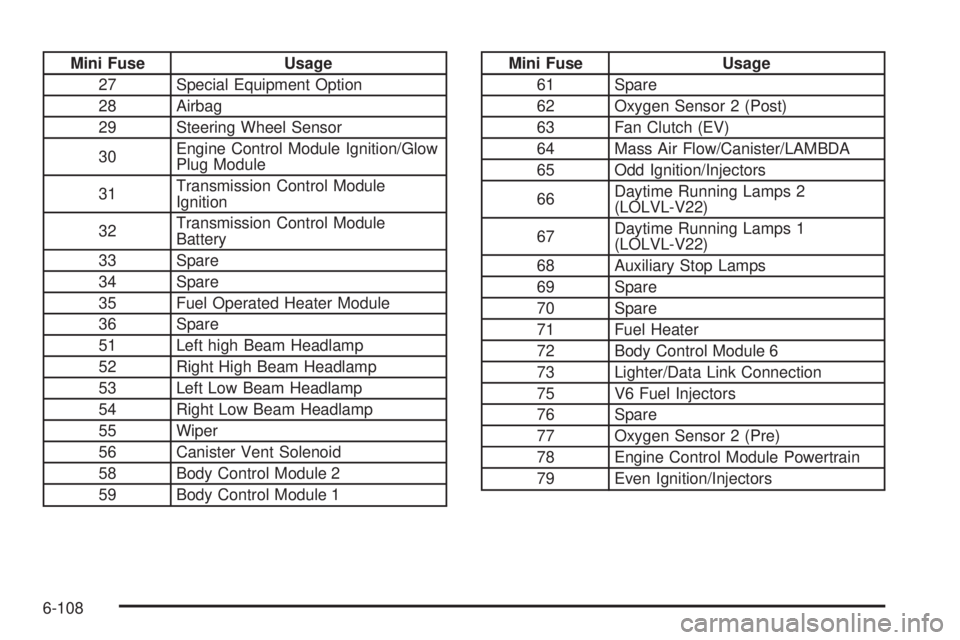
Mini Fuse Usage
27 Special Equipment Option
28 Airbag
29 Steering Wheel Sensor
30Engine Control Module Ignition/Glow
Plug Module
31Transmission Control Module
Ignition
32Transmission Control Module
Battery
33 Spare
34 Spare
35 Fuel Operated Heater Module
36 Spare
51 Left high Beam Headlamp
52 Right High Beam Headlamp
53 Left Low Beam Headlamp
54 Right Low Beam Headlamp
55 Wiper
56 Canister Vent Solenoid
58 Body Control Module 2
59 Body Control Module 1Mini Fuse Usage
61 Spare
62 Oxygen Sensor 2 (Post)
63 Fan Clutch (EV)
64 Mass Air Flow/Canister/LAMBDA
65 Odd Ignition/Injectors
66Daytime Running Lamps 2
(LOLVL-V22)
67Daytime Running Lamps 1
(LOLVL-V22)
68 Auxiliary Stop Lamps
69 Spare
70 Spare
71 Fuel Heater
72 Body Control Module 6
73 Lighter/Data Link Connection
75 V6 Fuel Injectors
76 Spare
77 Oxygen Sensor 2 (Pre)
78 Engine Control Module Powertrain
79 Even Ignition/Injectors
6-108
Page 415 of 424
E
E85 Fuel......................................................... 6-8
EDR .............................................................8-16
Electrical Equipment, Add-On..........................6-104
Electrical System
Engine Compartment Fuse Block.................6-106
Floor Console Fuse Block...........................6-104
Fuses and Circuit Breakers.........................6-104
Headlamp Wiring.......................................6-104
Windshield Wiper Fuses.............................6-104
Electronic Immobilizer
PASS-Key
®III+...........................................3-20
Electronic Immobilizer Operation
PASS-Key
®III+...........................................3-20
Engine
Air Cleaner/Filter.........................................6-19
Check and Service Engine Soon Lamp...........4-31
Compartment Overview................................6-14
Coolant......................................................6-28
Coolant Heater............................................3-25
Coolant Temperature Gage...........................4-30
Cooling System...........................................6-26
Drive Belt Routing.......................................7-14
Exhaust.....................................................3-38Engine (cont.)
Fan Noise..................................................6-34
Fast Idle System.........................................3-25
Oil .............................................................6-15
Overheating................................................6-33
Starting......................................................3-23
Engine Oil
Life System................................................6-18
Enhanced Technology Glass.............................3-19
Entry/Exit Lighting...........................................4-13
Event Data Recorders.....................................8-16
Extender, Safety Belt.......................................2-29
Exterior Lamps................................................. 4-9
F
Fast Idle System............................................3-25
Filter
Engine Air Cleaner......................................6-19
Finish Damage.............................................6-102
Fixed Mast Antenna........................................4-78
Flashers, Hazard Warning.................................. 4-3
Flash-to-Pass................................................... 4-5
Flat Tire........................................................6-79
5
Page 417 of 424
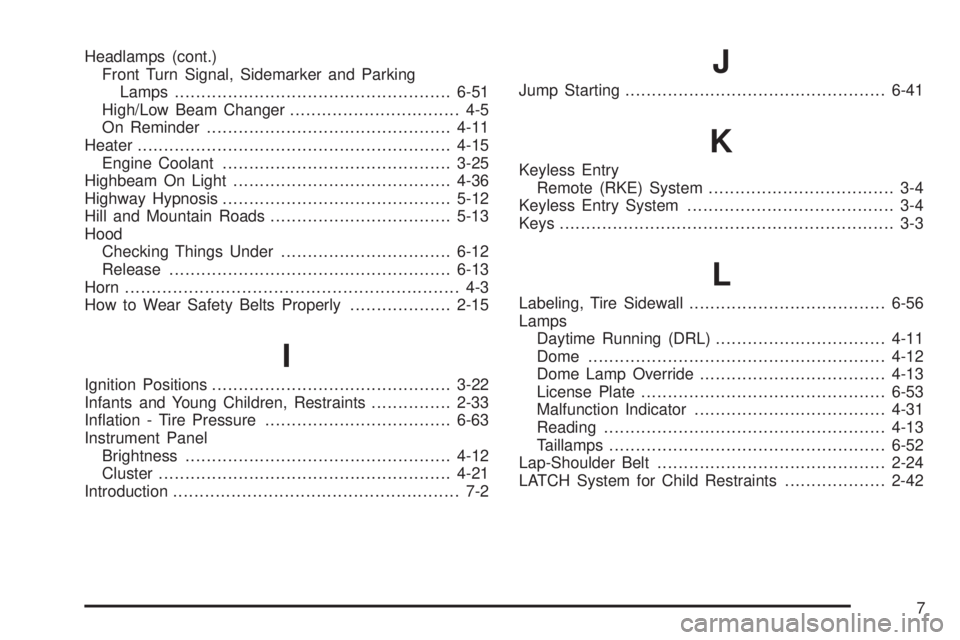
Headlamps (cont.)
Front Turn Signal, Sidemarker and Parking
Lamps ....................................................6-51
High/Low Beam Changer................................ 4-5
On Reminder..............................................4-11
Heater...........................................................4-15
Engine Coolant...........................................3-25
Highbeam On Light.........................................4-36
Highway Hypnosis...........................................5-12
Hill and Mountain Roads..................................5-13
Hood
Checking Things Under................................6-12
Release.....................................................6-13
Horn ............................................................... 4-3
How to Wear Safety Belts Properly...................2-15
I
Ignition Positions.............................................3-22
Infants and Young Children, Restraints...............2-33
Inflation - Tire Pressure...................................6-63
Instrument Panel
Brightness..................................................4-12
Cluster.......................................................4-21
Introduction...................................................... 7-2
J
Jump Starting.................................................6-41
K
Keyless Entry
Remote (RKE) System................................... 3-4
Keyless Entry System....................................... 3-4
Keys............................................................... 3-3
L
Labeling, Tire Sidewall.....................................6-56
Lamps
Daytime Running (DRL)................................4-11
Dome ........................................................4-12
Dome Lamp Override...................................4-13
License Plate..............................................6-53
Malfunction Indicator....................................4-31
Reading.....................................................4-13
Taillamps....................................................6-52
Lap-Shoulder Belt...........................................2-24
LATCH System for Child Restraints...................2-42
7