warning light GMC SAVANA PASSENGER 2010 Service Manual
[x] Cancel search | Manufacturer: GMC, Model Year: 2010, Model line: SAVANA PASSENGER, Model: GMC SAVANA PASSENGER 2010Pages: 424, PDF Size: 2.38 MB
Page 282 of 424
When to Inspect the Engine Air
Cleaner/Filter
Inspect the air cleaner/filter at the MaintenanceII
intervals and replace it at the first oil change after each
50,000 mile (80 000 km) interval. SeeScheduled
Maintenance on page 7-3for more information. If you
are driving in dusty/dirty conditions, inspect the filter
at each engine oil change.
How to Inspect the Engine Air
Cleaner/Filter
To inspect the air cleaner/filter, remove the filter from
the vehicle and lightly shake the filter to release
loose dust and dirt. If the filter remains caked with dirt, a
new filter is required. Never use compressed air to
clean the filter.
To inspect or replace the engine air cleaner/filter, do the
following:
1. Unhook the retainer clips and remove the cover.
2. Lift the filter out of the engine air cleaner/filter
housing. Care should be taken to dislodge as
little dirt as possible.
3. Clean the engine air cleaner/filter housing.
4. Inspect or replace the engine air cleaner/filter. Make
sure that the filter fits properly into the housing.5. Reinstall the cover and fasten the retaining clips.
{WARNING:
Operating the engine with the air cleaner/filter off
can cause you or others to be burned. The air
cleaner not only cleans the air; it helps to stop
flames if the engine backfires. If it is not there and
the engine backfires, you could be burned. Do not
drive with it off, and be careful working on the
engine with the air cleaner/filter off.
Notice:If the air cleaner/lter is off, a backre can
cause a damaging engine re. And, dirt can
easily get into the engine, which will damage it.
Always have the air cleaner/lter in place when you
are driving.
Automatic Transmission Fluid
(4-Speed Transmission)
If your vehicle has the DURAMAX Diesel engine, see
the DURAMAX Diesel manual for more information.
6-20
Page 301 of 424
Brake Wear
This vehicle has disc brakes. Disc brake pads have
built-in wear indicators that make a high-pitched warning
sound when the brake pads are worn and new pads
are needed. The sound can come and go or be heard all
the time the vehicle is moving, except when applying
the brake pedal firmly.
{WARNING:
The brake wear warning sound means that soon
the brakes will not work well. That could lead to an
accident. When the brake wear warning sound is
heard, have the vehicle serviced.
Notice:Continuing to drive with worn-out brake
pads could result in costly brake repair.
Some driving conditions or climates can cause a brake
squeal when the brakes are first applied or lightly
applied. This does not mean something is wrong with
the brakes.
Properly torqued wheel nuts are necessary to help
prevent brake pulsation. When tires are rotated, inspect
brake pads for wear and evenly tighten wheel nuts in
the proper sequence to torque specifications in
Capacities and Specications on page 6-110.Brake linings should always be replaced as complete
axle sets.
Brake Pedal Travel
See your dealer/retailer if the brake pedal does not
return to normal height, or if there is a rapid increase in
pedal travel. This could be a sign that brake service
might be required.
Brake Adjustment
Every brake stop, the brakes adjust for wear.
Replacing Brake System Parts
The braking system on a vehicle is complex. Its many
parts have to be of top quality and work well together if
the vehicle is to have really good braking. The vehicle
was designed and tested with top-quality brake parts.
When parts of the braking system are replaced — for
example, when the brake linings wear down and new
ones are installed — be sure to get new approved
replacement parts. If this is not done, the brakes might
not work properly. For example, if someone puts in brake
linings that are wrong for the vehicle, the balance
between the front and rear brakes can change — for the
worse. The braking performance expected can change in
many other ways if the wrong replacement brake parts
are installed.
6-39
Page 303 of 424
Jump Starting
If the vehicle battery has run down, you may want to
use another vehicle and some jumper cables to
start your vehicle. Be sure to use the following steps to
do it safely.
{WARNING:
Batteries can hurt you. They can be dangerous
because:
•They contain acid that can burn you.
•They contain gas that can explode or ignite.
•They contain enough electricity to burn you.
If you do not follow these steps exactly, some or
all of these things can hurt you.
Notice:Ignoring these steps could result in costly
damage to the vehicle that would not be covered
by the warranty.
Trying to start the vehicle by pushing or pulling it
will not work, and it could damage the vehicle.
1. Check the other vehicle. It must have a 12-volt
battery with a negative ground system.Notice:If the other vehicle’s system is not a 12-volt
system with a negative ground, both vehicles can
be damaged. Only use vehicles with 12-volt systems
with negative grounds to jump start your vehicle.
2. Get the vehicles close enough so the jumper cables
can reach, but be sure the vehicles are not touching
each other. If they are, it could cause a ground
connection you do not want. You would not be able
to start your vehicle, and the bad grounding
could damage the electrical systems.
To avoid the possibility of the vehicles rolling, set
the parking brake firmly on both vehicles involved in
the jump start procedure. Put an automatic
transmission in P (Park) or a manual transmission
in N (Neutral) before setting the parking brake.
Notice:If you leave the radio or other accessories
on during the jump starting procedure, they
could be damaged. The repairs would not be
covered by the warranty. Always turn off the radio
and other accessories when jump starting the
vehicle.
3. Turn off the ignition on both vehicles. Unplug
unnecessary accessories plugged into the cigarette
lighter or the accessory power outlet. Turn off
the radio and all lamps that are not needed. This
will avoid sparks and help save both batteries. And
it could save the radio!
6-41
Page 304 of 424
4. Open the hoods and locate the positive (+) and
negative (−) terminal locations of the other vehicle.
Your vehicle has a remote positive (+) jump
starting terminal and a remote negative (−) jump
starting terminal. You should always use these
remote terminals instead of the terminals on the
battery.
The remote positive (+) terminal is located behind
a red plastic cover near the engine accessory
drive bracket on the driver’s side of the engine
compartment, below the alternator. To uncover the
remote positive (+) terminal, open the red plastic
cover.
The remote negative (−) terminal is located on the
engine drive bracket on all V8 engines and is
marked GND (Ground).
On V6 engines the remote negative (−) terminal is
located on a tab attached to the engine accessory
drive bracket and is marked GND (Ground).
{WARNING:
Using an open flame near a battery can cause
battery gas to explode. People have been hurt
doing this, and some have been blinded. Use a
flashlight if you need more light.
Be sure the battery has enough water. You do not
need to add water to the battery installed in your
new vehicle. But if a battery has filler caps, be
sure the right amount of fluid is there. If it is low,
add water to take care of that first. If you do not,
explosive gas could be present.
Battery fluid contains acid that can burn you. Do
not get it on you. If you accidentally get it in your
eyes or on your skin, flush the place with water
and get medical help immediately.
6-42
Page 328 of 424
Federal Communications Commission
(FCC) and Industry and Science
Canada
SeeRadio Frequency Statement on page 8-18for
information regarding Part 15 of the Federal
Communications Commission (FCC) Rules and
RSS-210/211 of Industry and Science Canada.
Tire Pressure Monitor Operation
This vehicle may have a Tire Pressure Monitor System
(TPMS). The TPMS is designed to warn the driver
when a low tire pressure condition exists. TPMS sensors
are mounted onto each tire and wheel assembly,
excluding the spare tire and wheel assembly. The TPMS
sensors monitor the air pressure in the vehicle’s tires
and transmits the tire pressure readings to a receiver
located in the vehicle.
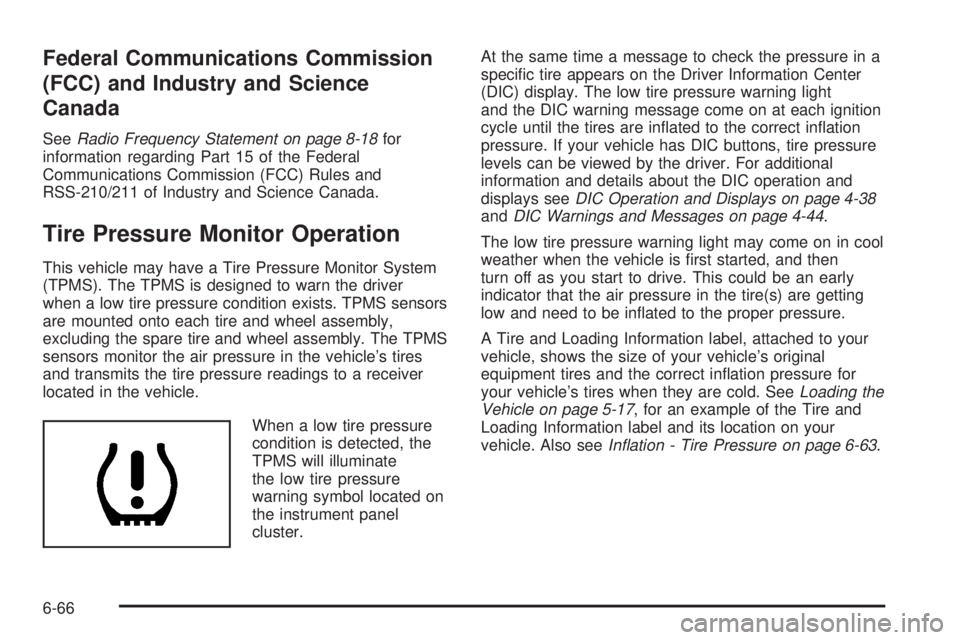
When a low tire pressure
condition is detected, the
TPMS will illuminate
the low tire pressure
warning symbol located on
the instrument panel
cluster.At the same time a message to check the pressure in a
specific tire appears on the Driver Information Center
(DIC) display. The low tire pressure warning light
and the DIC warning message come on at each ignition
cycle until the tires are inflated to the correct inflation
pressure. If your vehicle has DIC buttons, tire pressure
levels can be viewed by the driver. For additional
information and details about the DIC operation and
displays seeDIC Operation and Displays on page 4-38
andDIC Warnings and Messages on page 4-44.
The low tire pressure warning light may come on in cool
weather when the vehicle is first started, and then
turn off as you start to drive. This could be an early
indicator that the air pressure in the tire(s) are getting
low and need to be inflated to the proper pressure.
A Tire and Loading Information label, attached to your
vehicle, shows the size of your vehicle’s original
equipment tires and the correct inflation pressure for
your vehicle’s tires when they are cold. SeeLoading the
Vehicle on page 5-17, for an example of the Tire and
Loading Information label and its location on your
vehicle. Also seeInation - Tire Pressure on page 6-63.
6-66
Page 329 of 424
Your vehicle’s TPMS can warn you about a low tire
pressure condition but it does not replace normal
tire maintenance. SeeTire Inspection and Rotation on
page 6-69andTires on page 6-55.
Notice:Liquid tire sealants could damage the Tire
Pressure Monitor System (TPMS) sensors. Sensor
damage caused by using a tire sealant is not
covered by your warranty. Do not use liquid tire
sealants.
TPMS Malfunction Light and Message
The TPMS will not function properly if one or more of the
TPMS sensors are missing or inoperable. When the
system detects a malfunction, the low tire warning light
flashes for about one minute and then stays on for
the remainder of the ignition cycle. A DIC warning
message is also displayed. The low tire warning light
and DIC warning message come on at each ignition
cycle until the problem is corrected. Some of the
conditions that can cause the malfunction light and DIC
message to come on are:
•One of the road tires has been replaced with the
spare tire. The spare tire does not have a TPMS
sensor. The TPMS malfunction light and DIC
message should go off once you re-install the road
tire containing the TPMS sensor.
•The TPMS sensor matching process was started
but not completed or not completed successfully
after rotating the vehicle’s tires. The DIC message
and TPMS malfunction light should go off once
the TPMS sensor matching process is performed
successfully. See “TPMS Sensor Matching Process”
later in this section.
•One or more TPMS sensors are missing or
damaged. The DIC message and the TPMS
malfunction light should go off when the TPMS
sensors are installed and the sensor matching
process is performed successfully. See your
dealer/retailer for service.
•Replacement tires or wheels do not match your
vehicle’s original equipment tires or wheels.
Tires and wheels other than those recommended
for your vehicle could prevent the TPMS from
functioning properly. SeeBuying New Tires on
page 6-73.
•Operating electronic devices or being near facilities
using radio wave frequencies similar to the TPMS
could cause the TPMS sensors to malfunction.
If the TPMS is not functioning it cannot detect or signal
a low tire condition. See your dealer/retailer for
service if the TPMS malfunction light and DIC message
comes on and stays on.
6-67
Page 361 of 424
Care of Safety Belts
Keep belts clean and dry.
{WARNING:
Do not bleach or dye safety belts. It may severely
weaken them. In a crash, they might not be able
to provide adequate protection. Clean safety belts
only with mild soap and lukewarm water.
Weatherstrips
Silicone grease on weatherstrips will make them last
longer, seal better, and not stick or squeak. Apply
silicone grease with a clean cloth. During very cold,
damp weather frequent application may be required. See
Recommended Fluids and Lubricants on page 7-11.
Washing Your Vehicle
The best way to preserve the vehicle’s finish is to keep
it clean by washing it often.
Notice:Certain cleaners contain chemicals that can
damage the emblems or nameplates on the vehicle.
Check the cleaning product label. If it states that
it should not be used on plastic parts, do not use it
on the vehicle or damage may occur and it would
not be covered by the warranty.
Do not wash the vehicle in direct sunlight. Use a car
washing soap. Do not use cleaning agents that
are petroleum based or that contain acid or abrasives,
as they can damage the paint, metal or plastic on
the vehicle. Approved cleaning products can be obtained
from your dealer/retailer. Follow all manufacturers’
directions regarding correct product usage, necessary
safety precautions and appropriate disposal of any
vehicle care product.
Rinse the vehicle well, before washing and after to
remove all cleaning agents completely. If they are
allowed to dry on the surface, they could stain.
Dry the finish with a soft, clean chamois or an all-cotton
towel to avoid surface scratches and water spotting.
High pressure car washes may cause water to enter the
vehicle. Avoid using high pressure washes closer
than 12 inches (30 cm) to the surface of the vehicle.
Use of power washers exceeding 1,200 psi (8 274 kPa)
can result in damage or removal of paint and decals.
6-99
Page 411 of 424
A
Accessories and Modifications............................ 6-3
Accessory Power............................................3-23
Accessory Power Outlets.................................4-14
Additives, Fuel................................................. 6-7
Add-On Electrical Equipment...........................6-104
Air Cleaner/Filter, Engine.................................6-19
Air Conditioning..............................................4-15
Airbag
Adding Equipment to Your Airbag-Equipped
Vehicle...................................................2-78
Airbag System
Airbag Off Switch........................................2-69
How Does an Airbag Restrain?......................2-66
Passenger Sensing System...........................2-72
Servicing Your Airbag-Equipped Vehicle..........2-77
What Makes an Airbag Inflate?......................2-66
What Will You See After an Airbag Inflates?....2-67
When Should an Airbag Inflate?....................2-65
Where Are the Airbags?...............................2-62
Airbags
Off Light.....................................................4-24
Passenger Status Indicator...........................4-26
Readiness Light..........................................4-23
System Check.............................................2-60
All-Wheel Drive...............................................6-45
All-Wheel-Drive (AWD) System........................... 5-7Antenna
Fixed Mast.................................................4-78
Antilock Brake System (ABS)............................. 5-4
Warning Light.............................................4-29
Appearance Care
Aluminum Wheels......................................6-101
Care of Safety Belts....................................6-99
Chemical Paint Spotting..............................6-102
Cleaning Exterior Lamps/Lenses..................6-100
Fabric/Carpet..............................................6-97
Finish Care...............................................6-100
Finish Damage..........................................6-102
Instrument Panel, Vinyl, and Other Plastic
Surfaces.................................................
6-98
Interior Cleaning..........................................6-96
Sheet Metal Damage..................................6-102
Tires........................................................6-102
Underbody Maintenance.............................6-102
Washing Your Vehicle...................................6-99
Weatherstrips..............................................6-99
Windshield and Wiper Blades......................6-101
Ashtray.........................................................4-15
Assistance Program, Roadside........................... 8-6
Audio System.................................................4-59
Audio Steering Wheel Controls......................4-77
Radio Reception..........................................4-77
Setting the Clock.........................................4-60
Theft-Deterrent Feature................................4-76
1
Page 412 of 424
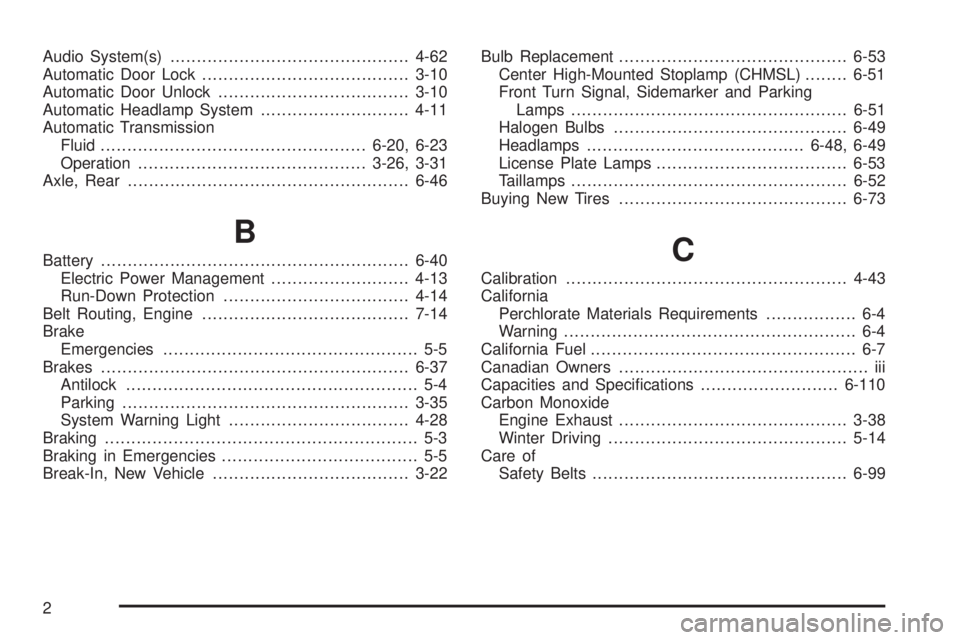
Audio System(s).............................................4-62
Automatic Door Lock.......................................3-10
Automatic Door Unlock....................................3-10
Automatic Headlamp System............................4-11
Automatic Transmission
Fluid..................................................6-20, 6-23
Operation...........................................3-26, 3-31
Axle, Rear.....................................................6-46
B
Battery..........................................................6-40
Electric Power Management..........................4-13
Run-Down Protection...................................4-14
Belt Routing, Engine.......................................7-14
Brake
Emergencies................................................ 5-5
Brakes..........................................................6-37
Antilock....................................................... 5-4
Parking......................................................3-35
System Warning Light..................................4-28
Braking........................................................... 5-3
Braking in Emergencies..................................... 5-5
Break-In, New Vehicle.....................................3-22Bulb Replacement...........................................6-53
Center High-Mounted Stoplamp (CHMSL)........6-51
Front Turn Signal, Sidemarker and Parking
Lamps ....................................................6-51
Halogen Bulbs............................................6-49
Headlamps.........................................6-48, 6-49
License Plate Lamps....................................6-53
Taillamps....................................................6-52
Buying New Tires...........................................6-73C
Calibration.....................................................4-43
California
Perchlorate Materials Requirements................. 6-4
Warning....................................................... 6-4
California Fuel.................................................. 6-7
Canadian Owners............................................... iii
Capacities and Specifications..........................6-110
Carbon Monoxide
Engine Exhaust...........................................3-38
Winter Driving.............................................5-14
Care of
Safety Belts................................................6-99
2
Page 415 of 424
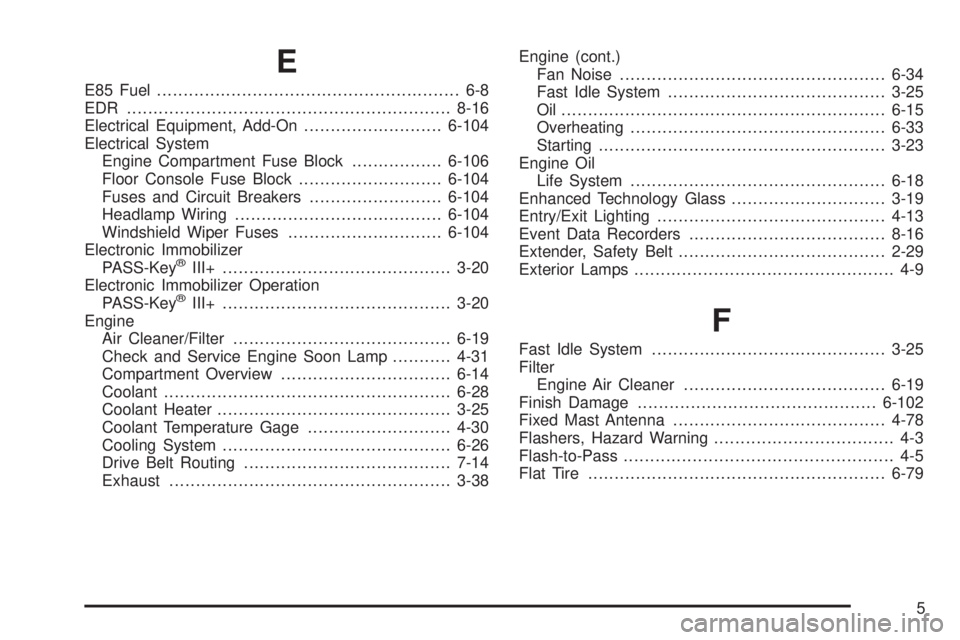
E
E85 Fuel......................................................... 6-8
EDR .............................................................8-16
Electrical Equipment, Add-On..........................6-104
Electrical System
Engine Compartment Fuse Block.................6-106
Floor Console Fuse Block...........................6-104
Fuses and Circuit Breakers.........................6-104
Headlamp Wiring.......................................6-104
Windshield Wiper Fuses.............................6-104
Electronic Immobilizer
PASS-Key
®III+...........................................3-20
Electronic Immobilizer Operation
PASS-Key
®III+...........................................3-20
Engine
Air Cleaner/Filter.........................................6-19
Check and Service Engine Soon Lamp...........4-31
Compartment Overview................................6-14
Coolant......................................................6-28
Coolant Heater............................................3-25
Coolant Temperature Gage...........................4-30
Cooling System...........................................6-26
Drive Belt Routing.......................................7-14
Exhaust.....................................................3-38Engine (cont.)
Fan Noise..................................................6-34
Fast Idle System.........................................3-25
Oil .............................................................6-15
Overheating................................................6-33
Starting......................................................3-23
Engine Oil
Life System................................................6-18
Enhanced Technology Glass.............................3-19
Entry/Exit Lighting...........................................4-13
Event Data Recorders.....................................8-16
Extender, Safety Belt.......................................2-29
Exterior Lamps................................................. 4-9
F
Fast Idle System............................................3-25
Filter
Engine Air Cleaner......................................6-19
Finish Damage.............................................6-102
Fixed Mast Antenna........................................4-78
Flashers, Hazard Warning.................................. 4-3
Flash-to-Pass................................................... 4-5
Flat Tire........................................................6-79
5