ignition GMC SAVANA PASSENGER 2010 Repair Manual
[x] Cancel search | Manufacturer: GMC, Model Year: 2010, Model line: SAVANA PASSENGER, Model: GMC SAVANA PASSENGER 2010Pages: 424, PDF Size: 2.38 MB
Page 369 of 424
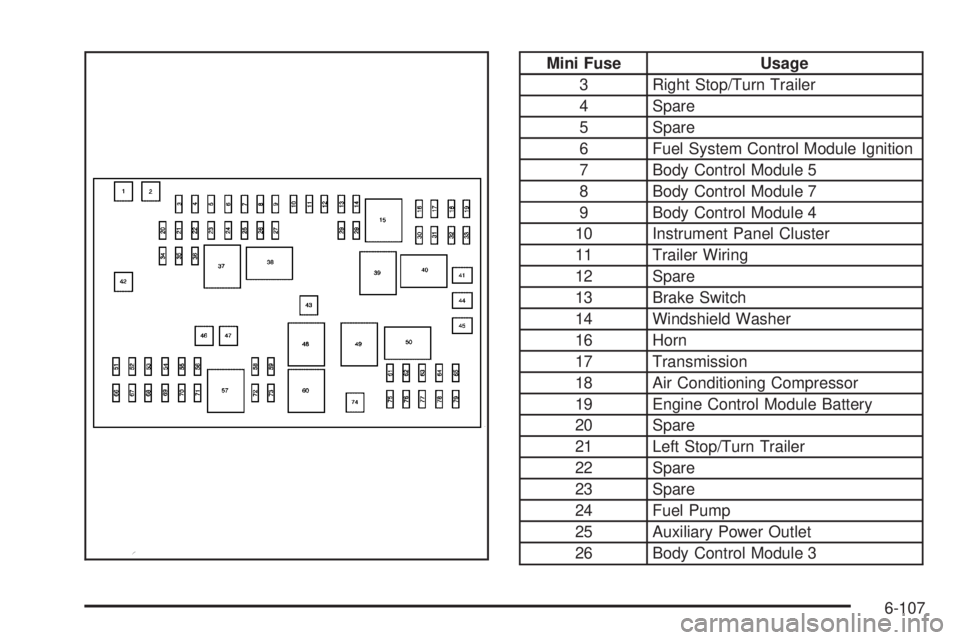
Mini Fuse Usage
3 Right Stop/Turn Trailer
4 Spare
5 Spare
6 Fuel System Control Module Ignition
7 Body Control Module 5
8 Body Control Module 7
9 Body Control Module 4
10 Instrument Panel Cluster
11 Trailer Wiring
12 Spare
13 Brake Switch
14 Windshield Washer
16 Horn
17 Transmission
18 Air Conditioning Compressor
19 Engine Control Module Battery
20 Spare
21 Left Stop/Turn Trailer
22 Spare
23 Spare
24 Fuel Pump
25 Auxiliary Power Outlet
26 Body Control Module 3
6-107
Page 370 of 424
Mini Fuse Usage
27 Special Equipment Option
28 Airbag
29 Steering Wheel Sensor
30Engine Control Module Ignition/Glow
Plug Module
31Transmission Control Module
Ignition
32Transmission Control Module
Battery
33 Spare
34 Spare
35 Fuel Operated Heater Module
36 Spare
51 Left high Beam Headlamp
52 Right High Beam Headlamp
53 Left Low Beam Headlamp
54 Right Low Beam Headlamp
55 Wiper
56 Canister Vent Solenoid
58 Body Control Module 2
59 Body Control Module 1Mini Fuse Usage
61 Spare
62 Oxygen Sensor 2 (Post)
63 Fan Clutch (EV)
64 Mass Air Flow/Canister/LAMBDA
65 Odd Ignition/Injectors
66Daytime Running Lamps 2
(LOLVL-V22)
67Daytime Running Lamps 1
(LOLVL-V22)
68 Auxiliary Stop Lamps
69 Spare
70 Spare
71 Fuel Heater
72 Body Control Module 6
73 Lighter/Data Link Connection
75 V6 Fuel Injectors
76 Spare
77 Oxygen Sensor 2 (Pre)
78 Engine Control Module Powertrain
79 Even Ignition/Injectors
6-108
Page 379 of 424
•Vehicles with diesel engine or GVWR above
4 536 kg (10,000 lbs) only: Shields inspection
for damage or looseness. Adjust or replace as
required. This is a Noise Emission Control Service.
Applicable to vehicles sold in the United States
and recommended for vehicles sold in Canada.
Additional Required Services
At the First 160 km/100 Miles, 1 600 km/
1,000 Miles, and 10 000 km/6,000 Miles
•
For vehicles with dual wheels: Check dual wheel nut
torque. For proper torque, seeCapacities and
Specications on page 6-110.
At Each Fuel Stop
•
Engine oil level check. SeeEngine Oil on
page 6-15.
•Engine coolant level check. SeeEngine Coolant on
page 6-28.
•Windshield washer fluid level check. SeeWindshield
Washer Fluid on page 6-36.
Once a Month
•
Tire inflation check. SeeInation - Tire Pressure on
page 6-63.
•Tire wear inspection. SeeTire Inspection and
Rotation on page 6-69.
Once a Year
•
Starter switch check. SeeOwner Checks and
Services on page 7-9.
•Parking brake and automatic transmission P (Park)
mechanism check. SeeOwner Checks and
Services on page 7-9.
•Automatic transmission shiftlock control system
check. SeeOwner Checks and Services on
page 7-9.
•Ignition transmission lock check. SeeOwner
Checks and Services on page 7-9.
•Engine cooling system and pressure cap pressure
check. Radiator and air conditioning condenser
outside cleaning. SeeCooling System on
page 6-26.
•Exhaust system and nearby heat shields inspection
for loose or damaged components.
•Throttle system inspection for interference, binding
or for damaged or missing parts. Replace parts as
needed. Replace any components that have
high effort or excessive wear. Do not lubricate
accelerator or cruise control cables.
First Engine Oil Change After Every
40 000 km/25,000 Miles
•
Fuel system inspection for damage or leaks.
7-5
Page 383 of 424
Owner Checks and Services
Starter Switch Check
{WARNING:
When you are doing this inspection, the vehicle
could move suddenly. If the vehicle moves, you or
others could be injured.
1. Before starting this check, be sure there is enough
room around the vehicle.
2. Firmly apply both the parking brake and the regular
brake. SeeParking Brake on page 3-35.
Do not use the accelerator pedal, and be ready to
turn off the engine immediately if it starts.
3. Try to start the engine in each gear. The vehicle
should start only in P (Park) or N (Neutral). If the
vehicle starts in any other position, contact
your dealer/retailer for service.
Automatic Transmission Shift Lock
Control System Check
{WARNING:
When you are doing this inspection, the vehicle
could move suddenly. If the vehicle moves, you or
others could be injured.
1. Before starting this check, be sure there is enough
room around the vehicle. It should be parked on a
level surface.
2. Firmly apply the parking brake. SeeParking Brake
on page 3-35.
Be ready to apply the regular brake immediately if
the vehicle begins to move.
3. With the engine off, turn the ignition to ON/RUN,
but do not start the engine. Without applying the
regular brake, try to move the shift lever out
of P (Park) with normal effort. If the shift lever
moves out of P (Park), contact your dealer/retailer
for service.
7-9
Page 384 of 424
Ignition Transmission Lock Check
While parked, and with the parking brake set, try to turn
the ignition to LOCK/OFF in each shift lever position.
•The ignition should turn to LOCK/OFF only
when the shift lever is in P (Park).
•The ignition key should come out only in
LOCK/OFF.
Contact your dealer/retailer if service is required.
Parking Brake and Automatic
Transmission P (Park) Mechanism
Check
{WARNING:
When you are doing this check, the vehicle could
begin to move. You or others could be injured and
property could be damaged. Make sure there is
room in front of the vehicle in case it begins to roll.
Be ready to apply the regular brake at once
should the vehicle begin to move.Park on a fairly steep hill, with the vehicle facing
downhill. Keeping your foot on the regular brake,
set the parking brake.
•To check the parking brake’s holding ability: With
the engine running and the transmission in
N (Neutral), slowly remove foot pressure from the
regular brake pedal. Do this until the vehicle is held
by the parking brake only.
•To check the P (Park) mechanism’s holding
ability: With the engine running, shift to P (Park).
Then release the parking brake followed by
the regular brake.
Contact your dealer/retailer if service is required.
7-10
Page 410 of 424
Radio Frequency
Identication (RFID)
RFID technology is used in some vehicles for functions
such as tire pressure monitoring and ignition system
security, as well as in connection with conveniences
such as key fobs for remote door locking/unlocking and
starting, and in-vehicle transmitters for garage door
openers. RFID technology in GM vehicles does not use
or record personal information or link with any other
GM system containing personal information.
Radio Frequency Statement
This vehicle has systems that operate on a radio
frequency that comply with Part 15 of the Federal
Communications Commission (FCC) Rules and with
RSS-210/211 of Industry and Science Canada.
Operation is subject to the following two conditions:
1. The device may not cause interference.
2. The device must accept any interference received,
including interference that may cause undesired
operation of the device.
Changes or modifications to any of these systems by
other than an authorized service facility could void
authorization to use this equipment.
8-18
Page 417 of 424
Headlamps (cont.)
Front Turn Signal, Sidemarker and Parking
Lamps ....................................................6-51
High/Low Beam Changer................................ 4-5
On Reminder..............................................4-11
Heater...........................................................4-15
Engine Coolant...........................................3-25
Highbeam On Light.........................................4-36
Highway Hypnosis...........................................5-12
Hill and Mountain Roads..................................5-13
Hood
Checking Things Under................................6-12
Release.....................................................6-13
Horn ............................................................... 4-3
How to Wear Safety Belts Properly...................2-15
I
Ignition Positions.............................................3-22
Infants and Young Children, Restraints...............2-33
Inflation - Tire Pressure...................................6-63
Instrument Panel
Brightness..................................................4-12
Cluster.......................................................4-21
Introduction...................................................... 7-2
J
Jump Starting.................................................6-41
K
Keyless Entry
Remote (RKE) System................................... 3-4
Keyless Entry System....................................... 3-4
Keys............................................................... 3-3
L
Labeling, Tire Sidewall.....................................6-56
Lamps
Daytime Running (DRL)................................4-11
Dome ........................................................4-12
Dome Lamp Override...................................4-13
License Plate..............................................6-53
Malfunction Indicator....................................4-31
Reading.....................................................4-13
Taillamps....................................................6-52
Lap-Shoulder Belt...........................................2-24
LATCH System for Child Restraints...................2-42
7