door lock GMC SAVANA PASSENGER 2010 Owners Manual
[x] Cancel search | Manufacturer: GMC, Model Year: 2010, Model line: SAVANA PASSENGER, Model: GMC SAVANA PASSENGER 2010Pages: 424, PDF Size: 2.38 MB
Page 1 of 424
In Brief........................................................... 1-1
Instrument Panel
........................................ 1-2
Initial Drive Information
............................... 1-4
Vehicle Features
......................................1-13
Performance and Maintenance
...................1-16
Seats and Restraint System............................. 2-1
Head Restraints
......................................... 2-2
Front Seats
............................................... 2-2
Rear Seats
............................................... 2-6
Safety Belts
.............................................2-10
Child Restraints
.......................................2-30
Airbag System
.........................................2-60
Restraint System Check
............................2-79
Features and Controls..................................... 3-1
Keys
........................................................ 3-3
Doors and Locks
....................................... 3-8
Windows
.................................................3-16
Theft-Deterrent Systems
............................3-20
Starting and Operating Your Vehicle
...........3-22
Mirrors
....................................................3-40
Storage Areas
.........................................3-42Instrument Panel............................................. 4-1
Instrument Panel Overview
.......................... 4-3
Climate Controls
......................................4-15
Warning Lights, Gages, and Indicators
........4-20
Driver Information Center (DIC)
..................4-37
Audio System(s)
.......................................4-59
Driving Your Vehicle....................................... 5-1
Your Driving, the Road, and the Vehicle
....... 5-2
Towing
...................................................5-22
Service and Appearance Care.......................... 6-1
Service
..................................................... 6-3
Fuel
......................................................... 6-5
Checking Things Under the Hood
...............6-12
All-Wheel Drive
........................................6-45
Rear Axle
...............................................6-46
Front Axle
...............................................6-46
Noise Control System
...............................6-47
Bulb Replacement
....................................6-48
Windshield Wiper Blade Replacement
.........6-54
Tires
......................................................6-55
Appearance Care
.....................................6-96
2010 GMC Savana Owner ManualM
Page 7 of 424
Instrument Panel..............................................1-2
Initial Drive Information....................................1-4
Remote Keyless Entry (RKE) System................1-4
Remote Vehicle Start......................................1-4
Door Locks....................................................1-5
Windows.......................................................1-6
Seat Adjustment.............................................1-6
Safety Belt....................................................1-8
Airbag On-Off Switch......................................1-8
Sensing System for Passenger Airbag...............1-9
Mirror Adjustment...........................................1-9
Steering Wheel Adjustment............................1-10
Interior Lighting............................................1-11
Exterior Lighting...........................................1-11
Windshield Wiper/Washer...............................1-12
Climate Controls...........................................1-12Vehicle Features.............................................1-13
Radio(s)......................................................1-13
Portable Audio Devices..................................1-14
Steering Wheel Controls................................1-15
Cruise Control..............................................1-15
Power Outlets..............................................1-16
Performance and Maintenance.........................1-16
StabiliTrak
®..................................................1-16
Tire Pressure Monitor....................................1-17
Engine Oil Life System..................................1-17
Fuel E85 (85% Ethanol)................................1-18
Driving for Better Fuel Economy.....................1-18
Roadside Assistance Program........................1-18
Section 1 In Brief
1-1
Page 10 of 424
Initial Drive Information
This section provides a brief overview about some of
the important features that may or may not be on your
specific vehicle.
For more detailed information, refer to each of the
features which can be found later in this owner manual.
Remote Keyless Entry (RKE)
System
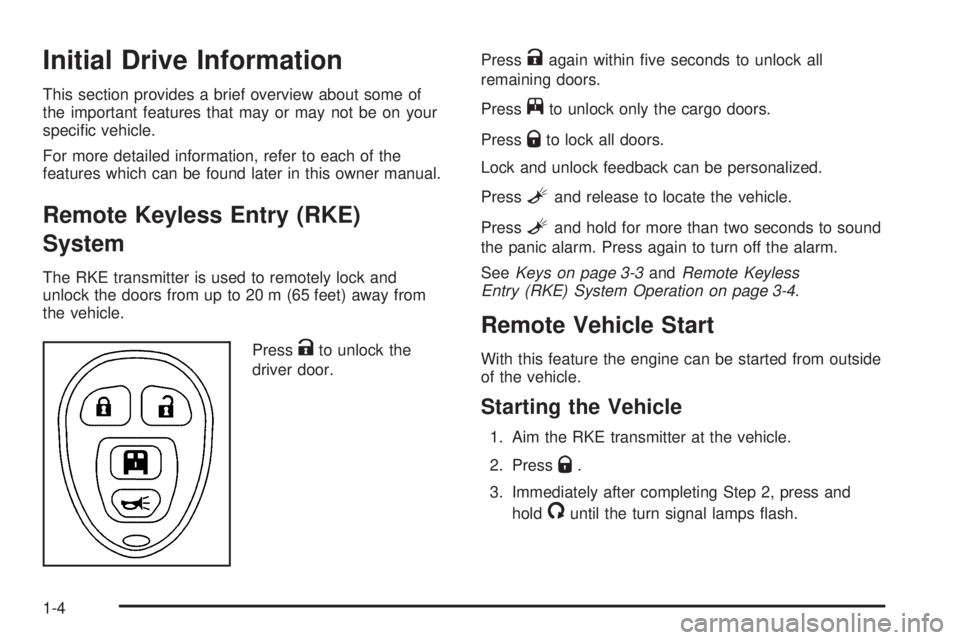
The RKE transmitter is used to remotely lock and
unlock the doors from up to 20 m (65 feet) away from
the vehicle.
Press
Kto unlock the
driver door.Press
Kagain within five seconds to unlock all
remaining doors.
Press
jto unlock only the cargo doors.
Press
Qto lock all doors.
Lock and unlock feedback can be personalized.
Press
Land release to locate the vehicle.
Press
Land hold for more than two seconds to sound
the panic alarm. Press again to turn off the alarm.
SeeKeys on page 3-3andRemote Keyless
Entry (RKE) System Operation on page 3-4.
Remote Vehicle Start
With this feature the engine can be started from outside
of the vehicle.
Starting the Vehicle
1. Aim the RKE transmitter at the vehicle.
2. Press
Q.
3. Immediately after completing Step 2, press and
hold
/until the turn signal lamps flash.
1-4
Page 11 of 424
When the vehicle starts, the parking lamps will turn on
and remain on as long as the engine is running. The
doors will be locked and the climate control system may
come on.
The engine will continue to run for 10 minutes. Repeat
the steps for a 10-minute time extension. Remote
start can be extended only once.
Canceling a Remote Start
To cancel a remote start:
•Aim the RKE transmitter at the vehicle and press
and hold
/until the parking lamps turn off.
•Turn on the hazard warning flashers.
•Turn the ignition switch to ON/RUN and then back
to LOCK/OFF.
SeeRemote Vehicle Start on page 3-6.
Door Locks
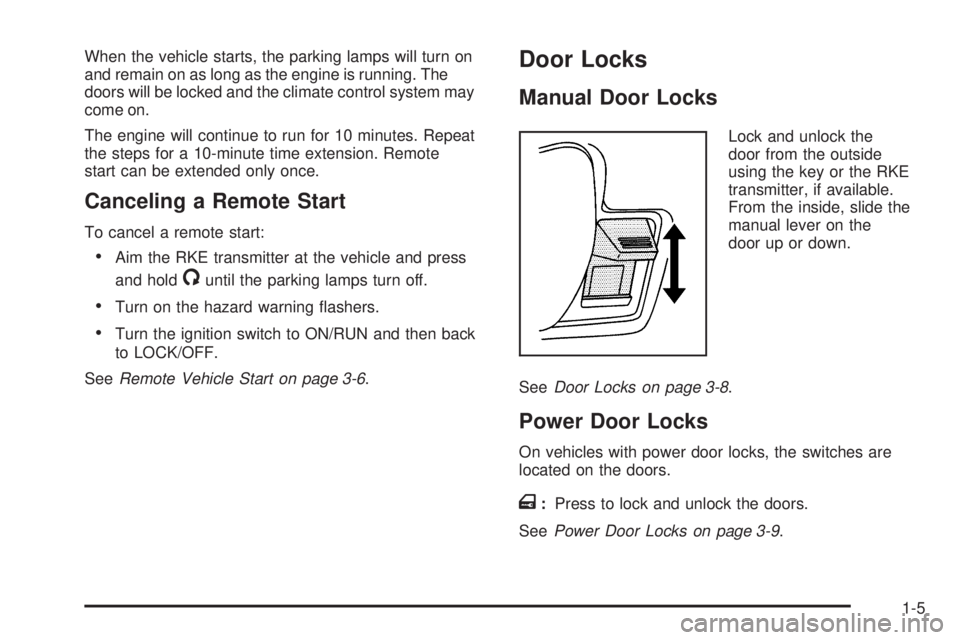
Manual Door Locks
Lock and unlock the
door from the outside
using the key or the RKE
transmitter, if available.
From the inside, slide the
manual lever on the
door up or down.
SeeDoor Locks on page 3-8.
Power Door Locks
On vehicles with power door locks, the switches are
located on the doors.
T:Press to lock and unlock the doors.
SeePower Door Locks on page 3-9.
1-5
Page 12 of 424
Windows
Manual Windows
Operate the manual windows by turning the hand crank
on each door to raise or lower the side door windows.
SeeManual Windows on page 3-17.
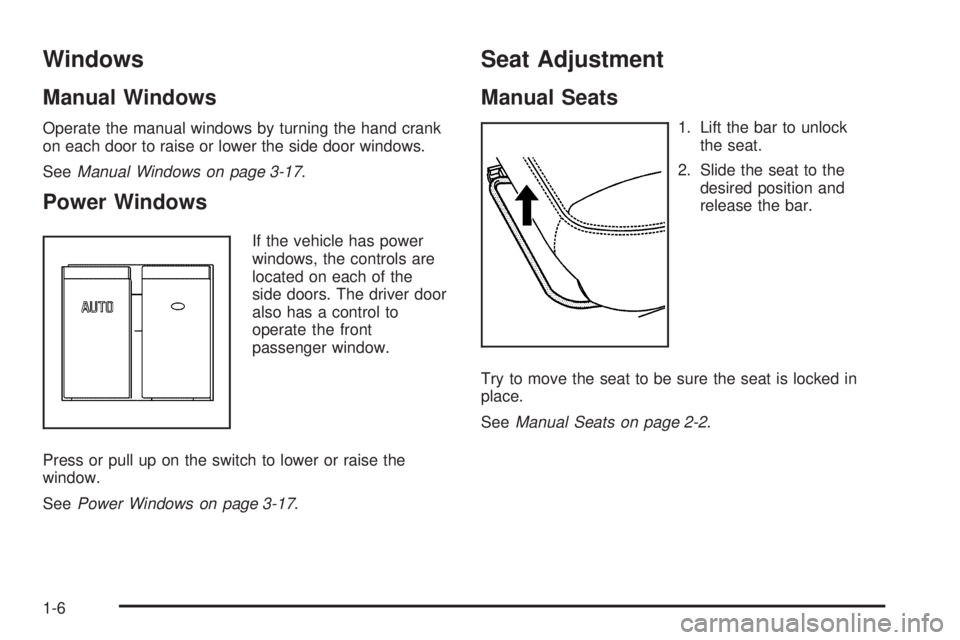
Power Windows
If the vehicle has power
windows, the controls are
located on each of the
side doors. The driver door
also has a control to
operate the front
passenger window.
Press or pull up on the switch to lower or raise the
window.
SeePower Windows on page 3-17.
Seat Adjustment
Manual Seats
1. Lift the bar to unlock
the seat.
2. Slide the seat to the
desired position and
release the bar.
Try to move the seat to be sure the seat is locked in
place.
SeeManual Seats on page 2-2.
1-6
Page 15 of 424
Sensing System for Passenger
Airbag
The passenger sensing system, if equipped, will turn off
the right front passenger frontal airbag under certain
conditions. The driver airbag and roof-rail airbags,
if equipped, are not affected by this.
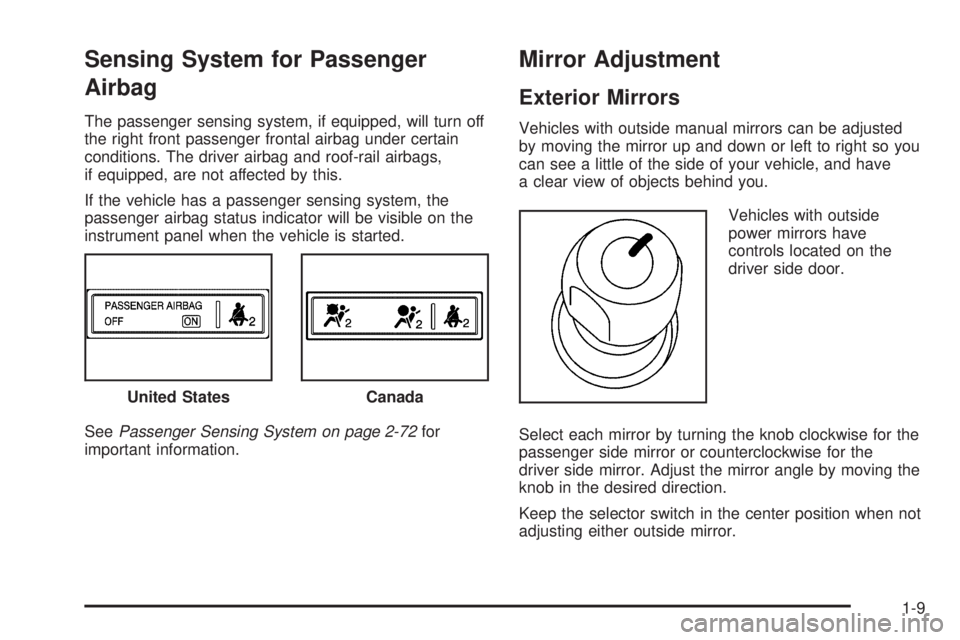
If the vehicle has a passenger sensing system, the
passenger airbag status indicator will be visible on the
instrument panel when the vehicle is started.
SeePassenger Sensing System on page 2-72for
important information.
Mirror Adjustment
Exterior Mirrors
Vehicles with outside manual mirrors can be adjusted
by moving the mirror up and down or left to right so you
can see a little of the side of your vehicle, and have
a clear view of objects behind you.
Vehicles with outside
power mirrors have
controls located on the
driver side door.
Select each mirror by turning the knob clockwise for the
passenger side mirror or counterclockwise for the
driver side mirror. Adjust the mirror angle by moving the
knob in the desired direction.
Keep the selector switch in the center position when not
adjusting either outside mirror. United States
Canada
1-9
Page 17 of 424
Interior Lighting
Dome Lamp
The dome lamps come on when any door is opened.
They turn off after all the doors are closed.
To manually turn on the dome lamps, turn the instrument
panel brightness knob, located on the instrument
panel to the left of the steering column, clockwise to the
farthest position. In this position, the dome lamps
remain on whether a door is opened or closed.
E:The dome lamp override button is located next to
the exterior lamps control.
Press the button in and the dome lamps remain off
when a door is opened. Press the button again to return it
to the extended position so that the dome lamps come on
when a door is opened.
Reading Lamps
For vehicles with reading lamps, press the button
located next to each lamp to turn it on or off.
The vehicle may also have reading lamps in other
locations. The lamps cannot be adjusted.
For more information on interior lighting, see:
•Instrument Panel Brightness on page 4-12.
•Entry/Exit Lighting on page 4-13.
Exterior Lighting
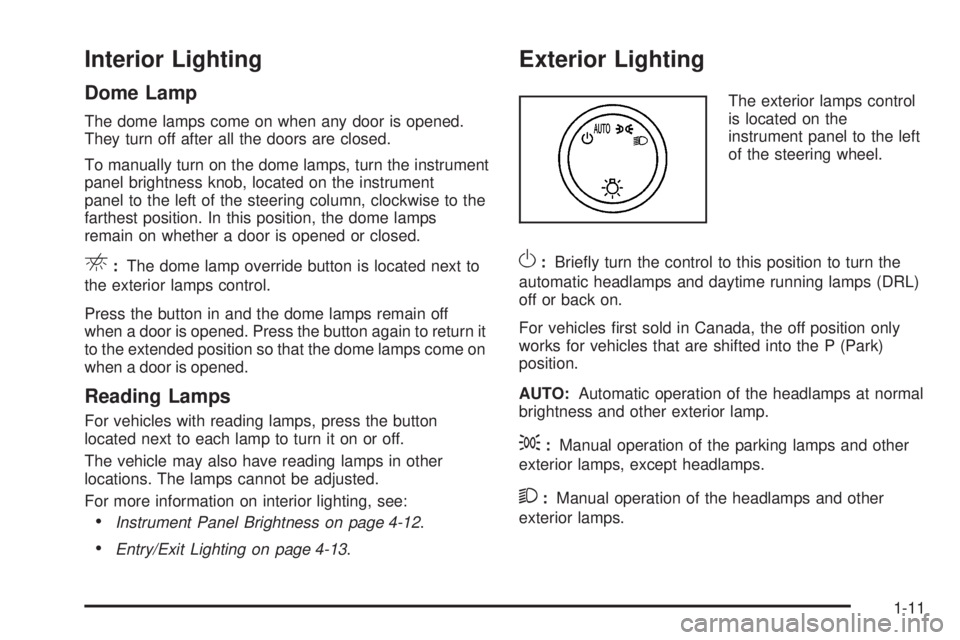
The exterior lamps control
is located on the
instrument panel to the left
of the steering wheel.
O:Briefly turn the control to this position to turn the
automatic headlamps and daytime running lamps (DRL)
off or back on.
For vehicles first sold in Canada, the off position only
works for vehicles that are shifted into the P (Park)
position.
AUTO:Automatic operation of the headlamps at normal
brightness and other exterior lamp.
;:Manual operation of the parking lamps and other
exterior lamps, except headlamps.
2:Manual operation of the headlamps and other
exterior lamps.
1-11
Page 88 of 424
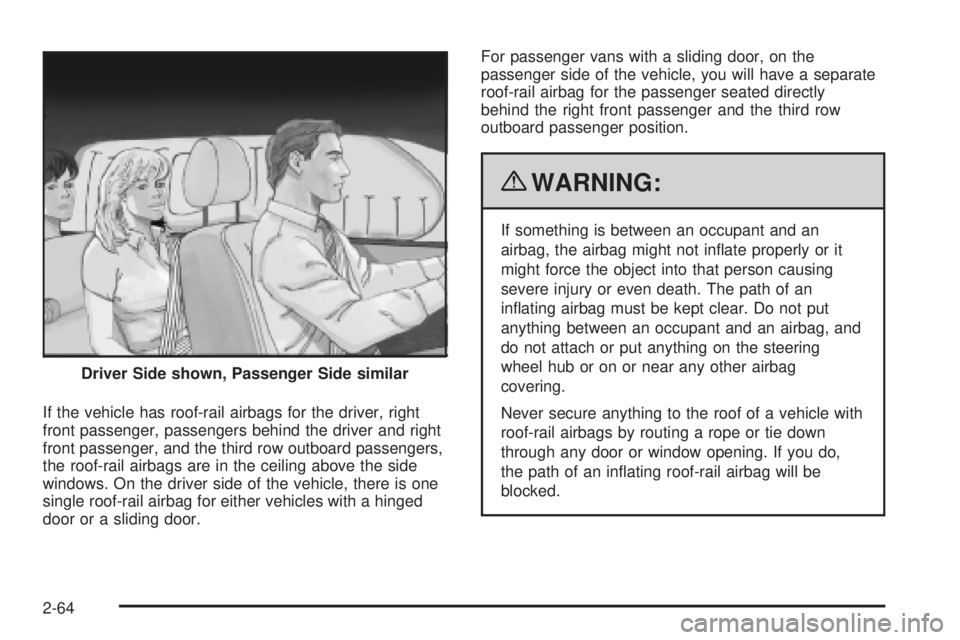
If the vehicle has roof-rail airbags for the driver, right
front passenger, passengers behind the driver and right
front passenger, and the third row outboard passengers,
the roof-rail airbags are in the ceiling above the side
windows. On the driver side of the vehicle, there is one
single roof-rail airbag for either vehicles with a hinged
door or a sliding door.For passenger vans with a sliding door, on the
passenger side of the vehicle, you will have a separate
roof-rail airbag for the passenger seated directly
behind the right front passenger and the third row
outboard passenger position.
{WARNING:
If something is between an occupant and an
airbag, the airbag might not inflate properly or it
might force the object into that person causing
severe injury or even death. The path of an
inflating airbag must be kept clear. Do not put
anything between an occupant and an airbag, and
do not attach or put anything on the steering
wheel hub or on or near any other airbag
covering.
Never secure anything to the roof of a vehicle with
roof-rail airbags by routing a rope or tie down
through any door or window opening. If you do,
the path of an inflating roof-rail airbag will be
blocked. Driver Side shown, Passenger Side similar
2-64
Page 91 of 424
Rollover capable roof-rail airbags are designed to help
contain the head and chest of occupants in the
outboard seating positions in the first, second, and third
rows, if equipped. The rollover capable roof-rail
airbags are designed to help reduce the risk of full or
partial ejection in rollover events, although no system
can prevent all such ejections.
But airbags would not help in many types of collisions,
primarily because the occupant’s motion is not
toward those airbags. SeeWhen Should an Airbag
Inate? on page 2-65for more information.
Airbags should never be regarded as anything more
than a supplement to safety belts.
What Will You See After an Airbag
Inates?
After the frontal airbags inflate, they quickly deflate, so
quickly that some people may not even realize an
airbag inflated. Roof-rail airbags may still be at least
partially inflated for some time after they deploy. Some
components of the airbag module may be hot for
several minutes. For location of the airbag modules, see
What Makes an Airbag Inate? on page 2-66.
The parts of the airbag that come into contact with you
may be warm, but not too hot to touch. There may
be some smoke and dust coming from the vents in the
deflated airbags. Airbag inflation does not preventthe driver from seeing out of the windshield or being
able to steer the vehicle, nor does it prevent people
from leaving the vehicle.
{WARNING:
When an airbag inflates, there may be dust in the
air. This dust could cause breathing problems for
people with a history of asthma or other breathing
trouble. To avoid this, everyone in the vehicle
should get out as soon as it is safe to do so. If
you have breathing problems but cannot get out of
the vehicle after an airbag inflates, then get fresh
air by opening a window or a door. If you
experience breathing problems following an airbag
deployment, you should seek medical attention.
The vehicle has a feature that may automatically unlock
the doors (if equipped with power door locks), turn on
the interior lamps and hazard warning flashers, and shut
off the fuel system after the airbags inflate. You can
lock the doors, turn off the interior lamps and turn the
hazard warning flashers by using the controls for
those features.
2-67
Page 105 of 424
Keys...............................................................3-3
Remote Keyless Entry (RKE) System................3-4
Remote Keyless Entry (RKE) System
Operation...................................................3-4
Remote Vehicle Start......................................3-6
Doors and Locks.............................................3-8
Door Locks....................................................3-8
Power Door Locks..........................................3-9
Cargo Door Relocking.....................................3-9
Delayed Locking.............................................3-9
Programmable Automatic Door Locks..............3-10
Automatic Door Lock.....................................3-10
Automatic Door Unlock..................................3-10
Rear Door Security Locks..............................3-11
Lockout Protection........................................3-12
Sliding Side Door..........................................3-12
60/40 Swing-Out Side Door............................3-13
Rear Doors..................................................3-15
Windows........................................................3-16
Manual Windows..........................................3-17
Power Windows............................................3-17
Swing-Out Windows......................................3-18
Enhanced Technology Glass..........................3-19
Sun Visors...................................................3-20Theft-Deterrent Systems..................................3-20
PASS-Key®III+ Electronic Immobilizer.............3-20
PASS-Key®III+ Electronic Immobilizer
Operation.................................................3-20
Starting and Operating Your Vehicle................3-22
New Vehicle Break-In....................................3-22
Ignition Positions..........................................3-22
Retained Accessory Power (RAP)...................3-23
Starting the Engine.......................................3-23
Fast Idle System..........................................3-25
Engine Coolant Heater..................................3-25
Automatic Transmission Operation
(Six Speed Automatic Transmission)............3-26
Automatic Transmission Operation
(Four Speed Automatic Transmission)..........3-31
Tow/Haul Mode............................................3-33
Parking Brake..............................................3-35
Shifting Into Park..........................................3-36
Shifting Out of Park......................................3-37
Parking Over Things That Burn.......................3-38
Engine Exhaust............................................3-38
Running the Vehicle While Parked..................3-39
Section 3 Features and Controls
3-1