weight GMC SAVANA PASSENGER 2012 User Guide
[x] Cancel search | Manufacturer: GMC, Model Year: 2012, Model line: SAVANA PASSENGER, Model: GMC SAVANA PASSENGER 2012Pages: 424, PDF Size: 6.28 MB
Page 222 of 424
Black plate (14,1)GMC Savana Owner Manual - 2012 - 2nd - 11/11/11
9-14 Driving and Operating
Refer to the vehicle tire and
loading information label for
specific information about the
vehicle's capacity weight and
seating positions. The combined
weight of the driver, passengers,
and cargo should never exceed
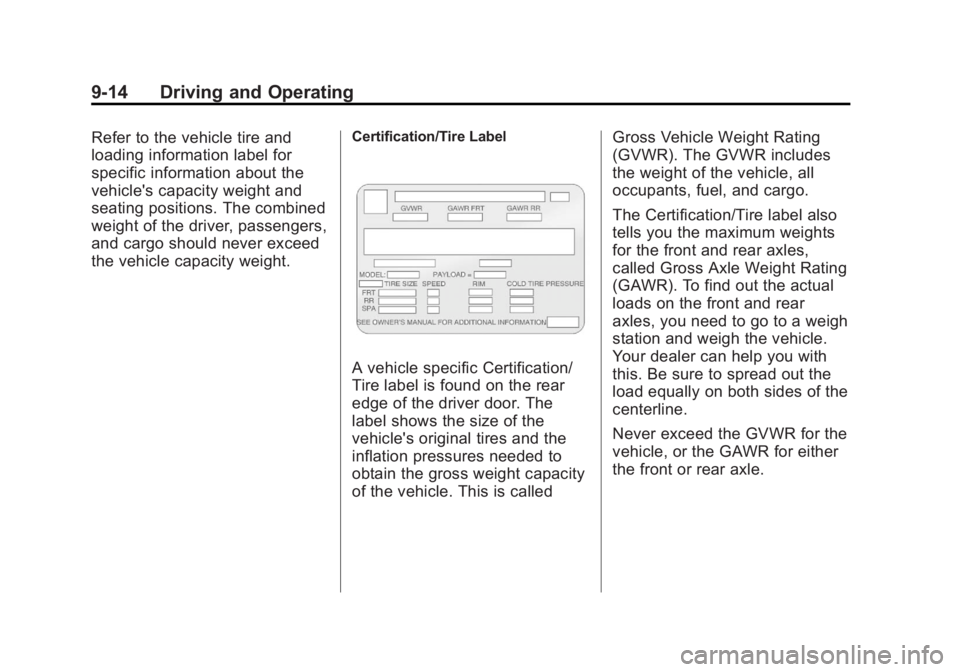
the vehicle capacity weight.Certification/Tire Label
A vehicle specific Certification/
Tire label is found on the rear
edge of the driver door. The
label shows the size of the
vehicle's original tires and the
inflation pressures needed to
obtain the gross weight capacity
of the vehicle. This is calledGross Vehicle Weight Rating
(GVWR). The GVWR includes
the weight of the vehicle, all
occupants, fuel, and cargo.
The Certification/Tire label also
tells you the maximum weights
for the front and rear axles,
called Gross Axle Weight Rating
(GAWR). To find out the actual
loads on the front and rear
axles, you need to go to a weigh
station and weigh the vehicle.
Your dealer can help you with
this. Be sure to spread out the
load equally on both sides of the
centerline.
Never exceed the GVWR for the
vehicle, or the GAWR for either
the front or rear axle.
Page 223 of 424
Black plate (15,1)GMC Savana Owner Manual - 2012 - 2nd - 11/11/11
Driving and Operating 9-15
If there is a heavy load, it should
be spread out.
{WARNING
Do not load the vehicle any
heavier than the Gross
Vehicle Weight Rating
(GVWR), or either the
maximum front or rear Gross
Axle Weight Rating (GAWR).
This can cause systems to
break and change the way the
vehicle handles. This could
cause loss of control and a
crash. Overloading can also
shorten the life of the vehicle.
{WARNING
Things you put inside the
vehicle can strike and injure
people in a sudden stop or
turn, or in a crash.
.Put things in the cargo
area of the vehicle. Try to
spread the weight evenly.
.Never stack heavier
things, like suitcases,
inside the vehicle so that
some of them are above
the tops of the seats.
.Do not leave an
unsecured child restraint
in the vehicle.
(Continued)
WARNING (Continued)
.When you carry something
inside the vehicle, secure
it whenever you can.
.Do not leave a seat folded
down unless you need to.
Add-On Equipment
When you carry removable
items, you may need to put a
limit on how many people you
carry inside the vehicle. Be sure
to weigh the vehicle before you
buy and install the new
equipment.
Page 230 of 424
Black plate (22,1)GMC Savana Owner Manual - 2012 - 2nd - 11/11/11
9-22 Driving and Operating
Leaving the Vehicle With the
Engine Running
{WARNING
It can be dangerous to leave the
vehicle with the engine running.
The vehicle could move suddenly
if the shift lever is not fully in
P (Park) with the parking brake
firmly set. And, if you leave the
vehicle with the engine running, it
could overheat and even catch
fire. You or others could be
injured. Do not leave the vehicle
with the engine running.If you have to leave the vehicle with
the engine running, be sure the
vehicle is in P (Park) and the
parking brake is firmly set before
you leave it. After you move the shift
lever into P (Park), hold the regular
brake pedal down. Then, see if you
can move the shift lever away from
P (Park) without first pulling it toward
you. If you can, it means that the
shift lever was not fully locked into
P (Park).
Torque Lock
If you are parking on a hill and you
do not shift the vehicle into P (Park)
properly, the weight of the vehicle
may put too much force on the
parking pawl in the transmission.
You may find it difficult to pull the
shift lever out of P (Park). This is
called torque lock. To prevent torque
lock, set the parking brake and then
shift into P (Park) properly before
you leave the driver seat. To find out
how, see
“Shifting Into Park”
previously in this section. When you are ready to drive, move
the shift lever out of P (Park) before
you release the parking brake.
If torque lock does occur, you may
need to have another vehicle push
yours a little uphill to take some of
the pressure from the parking pawl
in the transmission, so you can pull
the shift lever out of P (Park).
Shifting out of Park
The vehicle has an automatic
transmission shift lock control
system. You have to fully apply the
brakes before you can shift from
P (Park) when the ignition is in ON/
RUN or ACC/ACCESSORY. See
Automatic Transmission (Six Speed)
on page 9‑25
orAutomatic
Transmission (Four Speed) on
page 9‑28.
Page 253 of 424
Black plate (45,1)GMC Savana Owner Manual - 2012 - 2nd - 11/11/11
Driving and Operating 9-45
Filling a Portable Fuel
Container
{WARNING
Never fill a portable fuel container
while it is in the vehicle. Static
electricity discharge from the
container can ignite the fuel
vapor. You can be badly burned
and the vehicle damaged if this
occurs. To help avoid injury to you
and others:
.Dispense fuel only into
approved containers.
.Do not fill a container while it
is inside a vehicle, in a
vehicle's trunk, pickup bed,
or on any surface other than
the ground.(Continued)
WARNING (Continued)
.Bring the fill nozzle in contact
with the inside of the fill
opening before operating the
nozzle. Contact should be
maintained until the filling is
complete.
.Do not smoke while
pumping fuel.
.Do not use a cellular phone
while pumping fuel.
Towing
General Towing
Information
Only use towing equipment that has
been designed for the vehicle.
Contact your dealer or trailering
dealer for assistance with preparing
the vehicle for towing a trailer.
See the following trailer towing
information in this section:
.For information on driving while
towing a trailer, see “Driving
Characteristics and
Towing Tips.”
.For maximum vehicle and trailer
weights, see “Trailer Towing.”
.For information on equipment to
tow a trailer, see “Towing
Equipment.”
Page 254 of 424
Black plate (46,1)GMC Savana Owner Manual - 2012 - 2nd - 11/11/11
9-46 Driving and Operating
For information on towing a disabled
vehicle, seeTowing the Vehicle on
page 10‑89. For information on
towing the vehicle behind another
vehicle such as a motor home, see
Recreational Vehicle Towing on
page 10‑90.
Driving Characteristics
and Towing Tips
Pulling a Trailer
Here are some important points:
.There are many different laws,
including speed limit restrictions,
having to do with trailering.
Make sure the rig will be legal,
not only where you live but also
where you will be driving.
A good source for this
information can be state or
provincial police.
.Consider using a sway control.
See “Hitches” inTowing
Equipment on page 9‑55.
.Do not tow a trailer at all during
the first 800 km (500 mi) the new
vehicle is driven. The engine,
axle or other parts could be
damaged.
.Then, during the first 800 km
(500 mi) that a trailer is towed,
do not drive over 80 km/h
(50 mph) and do not make starts
at full throttle. This helps the
engine and other parts of the
vehicle wear in at the heavier
loads.
.Vehicles with an automatic
transmissions can tow in
D (Drive). Shift the transmission
to a lower gear if the
transmission shifts too often
under heavy loads and/or hilly
conditions.
Three important considerations
have to do with weight:
.The weight of the trailer.
.The weight of the trailer tongue.
.The weight on the vehicle's tires.
Also see “Tow/Haul Mode” later in
this section for information about the
Tow/Haul button and the Tow/Haul
indicator light.
Page 255 of 424
Black plate (47,1)GMC Savana Owner Manual - 2012 - 2nd - 11/11/11
Driving and Operating 9-47
Driving with a Trailer
{WARNING
When towing a trailer, exhaust
gases may collect at the rear of
the vehicle and enter if the
liftgate, trunk/hatch, or rear-most
window is open.
Engine exhaust contains carbon
monoxide (CO) which cannot be
seen or smelled. It can cause
unconsciousness and even death.
To maximize safety when towing
a trailer:
.Have the exhaust system
inspected for leaks and make
necessary repairs before
starting a trip.
.Never drive with the liftgate,
trunk/hatch, or rear-most
window open.(Continued)
WARNING (Continued)
.Fully open the air outlets on
or under the instrument
panel.
.Adjust the Climate Control
system to a setting that
brings in only outside air and
set the fan speed to the
highest setting. See Climate
Control System in the Index.
For more information about
carbon monoxide, see Engine
Exhaust on page 9‑24. Towing a trailer requires a certain
amount of experience. Get to know
the rig before setting out for the
open road. Get acquainted with the
feel of handling and braking with the
added weight of the trailer. And
always keep in mind that the vehicle
you are driving is now longer and
not as responsive as the vehicle is
by itself.
Before starting, check all trailer
hitch parts and attachments, safety
chains, electrical connectors, lamps,
tires and mirror adjustments. If the
trailer has electric brakes, start the
vehicle and trailer moving and then
apply the trailer brake controller by
hand to be sure the brakes are
working. This checks the electrical
connection at the same time.
During the trip, check occasionally
to be sure that the load is secure,
and that the lamps and any trailer
brakes are still working.
Page 259 of 424
Black plate (51,1)GMC Savana Owner Manual - 2012 - 2nd - 11/11/11
Driving and Operating 9-51
Notice:Pulling a trailer
improperly can damage the
vehicle and result in costly
repairs not covered by the vehicle
warranty. To pull a trailer
correctly, follow the advice in this
section and see your dealer for
important information about
towing a trailer with the vehicle.
To identify the trailering capacity
of the vehicle, read the information
in “Weight of the Trailer” that
appears later in this section.
Trailering is different than just
driving the vehicle by itself.
Trailering means changes in
handling, acceleration, braking,
durability, and fuel economy.
Successful, safe trailering takes
correct equipment, and it has to be
used properly. The following information has many
time-tested, important trailering tips
and safety rules. Many of these are
important for your safety and that of
your passengers. So please read
this section carefully before pulling a
trailer.
Weight of the Trailer
How heavy can a trailer safely be?
It depends on how the rig is used.
For example, speed, altitude, road
grades, outside temperature, and
how much the vehicle is used to pull
a trailer are all important. It can
depend on any special equipment
on the vehicle, and the amount of
tongue weight the vehicle can carry.
See
“Weight of the Trailer Tongue”
later in this section for more
information. Maximum trailer weight is calculated
assuming only the driver is in the
tow vehicle and it has all the
required trailering equipment. The
weight of additional optional
equipment, passengers,and cargo in
the tow vehicle must be subtracted
from the maximum trailer weight.
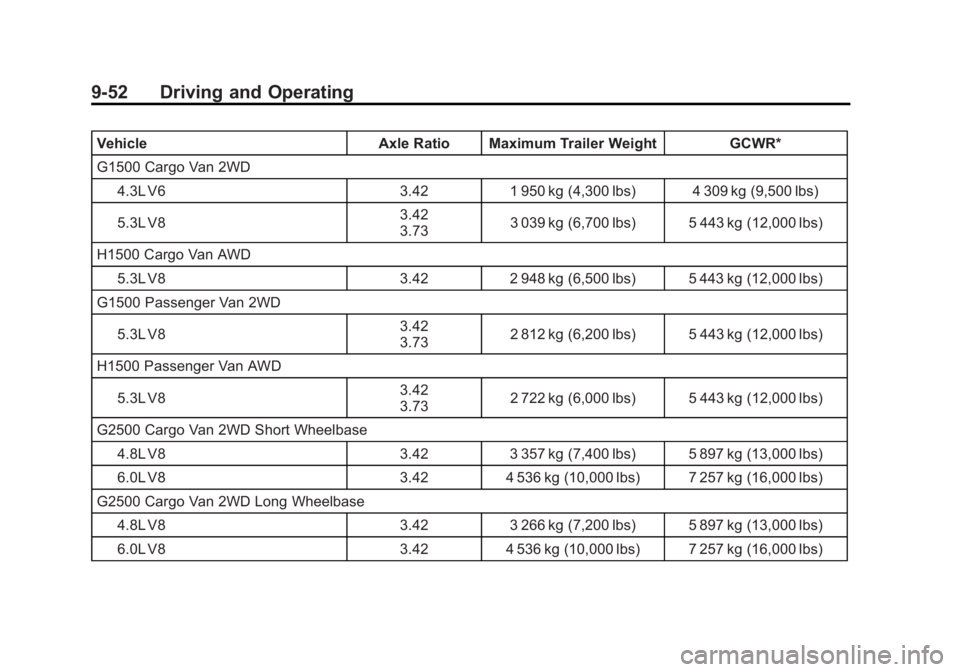
Use the following chart to determine
how much the vehicle can weigh,
based upon the vehicle model and
options.
Page 260 of 424
Black plate (52,1)GMC Savana Owner Manual - 2012 - 2nd - 11/11/11
9-52 Driving and Operating
VehicleAxle Ratio Maximum Trailer Weight GCWR*
G1500 Cargo Van 2WD 4.3L V6 3.421 950 kg (4,300 lbs) 4 309 kg (9,500 lbs)
5.3L V8 3.42
3.733 039 kg (6,700 lbs) 5 443 kg (12,000 lbs)
H1500 Cargo Van AWD 5.3L V8 3.422 948 kg (6,500 lbs) 5 443 kg (12,000 lbs)
G1500 Passenger Van 2WD
5.3L V8 3.42
3.73
2 812 kg (6,200 lbs) 5 443 kg (12,000 lbs)
H1500 Passenger Van AWD
5.3L V8 3.42
3.732 722 kg (6,000 lbs) 5 443 kg (12,000 lbs)
G2500 Cargo Van 2WD Short Wheelbase 4.8L V8 3.423 357 kg (7,400 lbs) 5 897 kg (13,000 lbs)
6.0L V8 3.424 536 kg (10,000 lbs) 7 257 kg (16,000 lbs)
G2500 Cargo Van 2WD Long Wheelbase
4.8L V8 3.423 266 kg (7,200 lbs) 5 897 kg (13,000 lbs)
6.0L V8 3.424 536 kg (10,000 lbs) 7 257 kg (16,000 lbs)
Page 261 of 424
Black plate (53,1)GMC Savana Owner Manual - 2012 - 2nd - 11/11/11
Driving and Operating 9-53
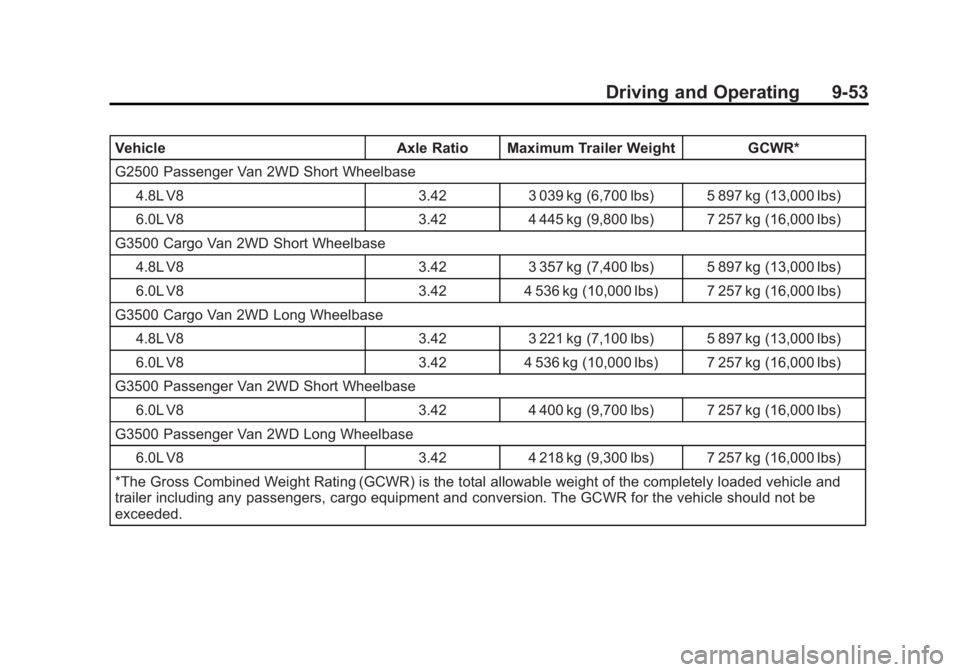
VehicleAxle Ratio Maximum Trailer Weight GCWR*
G2500 Passenger Van 2WD Short Wheelbase 4.8L V8 3.423 039 kg (6,700 lbs) 5 897 kg (13,000 lbs)
6.0L V8 3.424 445 kg (9,800 lbs) 7 257 kg (16,000 lbs)
G3500 Cargo Van 2WD Short Wheelbase 4.8L V8 3.423 357 kg (7,400 lbs) 5 897 kg (13,000 lbs)
6.0L V8 3.424 536 kg (10,000 lbs) 7 257 kg (16,000 lbs)
G3500 Cargo Van 2WD Long Wheelbase 4.8L V8 3.423 221 kg (7,100 lbs) 5 897 kg (13,000 lbs)
6.0L V8 3.424 536 kg (10,000 lbs) 7 257 kg (16,000 lbs)
G3500 Passenger Van 2WD Short Wheelbase 6.0L V8 3.424 400 kg (9,700 lbs) 7 257 kg (16,000 lbs)
G3500 Passenger Van 2WD Long Wheelbase 6.0L V8 3.424 218 kg (9,300 lbs) 7 257 kg (16,000 lbs)
*The Gross Combined Weight Rating (GCWR) is the total allowable weight of the completely loaded vehicle and
trailer including any passengers, cargo equipment and conversion. The GCWR for the vehicle should not be
exceeded.
Page 262 of 424
Black plate (54,1)GMC Savana Owner Manual - 2012 - 2nd - 11/11/11
9-54 Driving and Operating
Ask your dealer for our trailering
information or advice, or write us at
our Customer Assistance Offices.
SeeCustomer Assistance Offices
on page 13‑3 for more information.
Weight of the Trailer Tongue
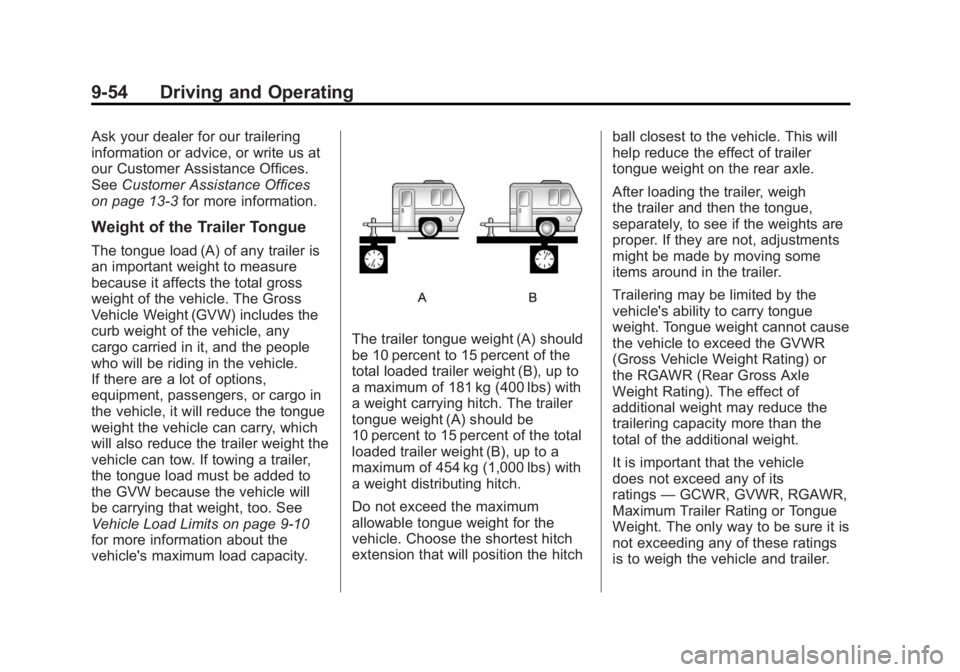
The tongue load (A) of any trailer is
an important weight to measure
because it affects the total gross
weight of the vehicle. The Gross
Vehicle Weight (GVW) includes the
curb weight of the vehicle, any
cargo carried in it, and the people
who will be riding in the vehicle.
If there are a lot of options,
equipment, passengers, or cargo in
the vehicle, it will reduce the tongue
weight the vehicle can carry, which
will also reduce the trailer weight the
vehicle can tow. If towing a trailer,
the tongue load must be added to
the GVW because the vehicle will
be carrying that weight, too. See
Vehicle Load Limits on page 9‑10
for more information about the
vehicle's maximum load capacity.
The trailer tongue weight (A) should
be 10 percent to 15 percent of the
total loaded trailer weight (B), up to
a maximum of 181 kg (400 lbs) with
a weight carrying hitch. The trailer
tongue weight (A) should be
10 percent to 15 percent of the total
loaded trailer weight (B), up to a
maximum of 454 kg (1,000 lbs) with
a weight distributing hitch.
Do not exceed the maximum
allowable tongue weight for the
vehicle. Choose the shortest hitch
extension that will position the hitch ball closest to the vehicle. This will
help reduce the effect of trailer
tongue weight on the rear axle.
After loading the trailer, weigh
the trailer and then the tongue,
separately, to see if the weights are
proper. If they are not, adjustments
might be made by moving some
items around in the trailer.
Trailering may be limited by the
vehicle's ability to carry tongue
weight. Tongue weight cannot cause
the vehicle to exceed the GVWR
(Gross Vehicle Weight Rating) or
the RGAWR (Rear Gross Axle
Weight Rating). The effect of
additional weight may reduce the
trailering capacity more than the
total of the additional weight.
It is important that the vehicle
does not exceed any of its
ratings
—GCWR, GVWR, RGAWR,
Maximum Trailer Rating or Tongue
Weight. The only way to be sure it is
not exceeding any of these ratings
is to weigh the vehicle and trailer.