steering GMC SAVANA PASSENGER 2013 Owners Manual
[x] Cancel search | Manufacturer: GMC, Model Year: 2013, Model line: SAVANA PASSENGER, Model: GMC SAVANA PASSENGER 2013Pages: 398, PDF Size: 6.41 MB
Page 4 of 398
Black plate (4,1)GMC Savana Owner Manual - 2013 - 2nd Edition - 9/25/12
iv Introduction
Danger, Warnings, and
Cautions
Warning messages found on vehicle
labels and in this manual describe
hazards and what to do to avoid or
reduce them.
Dangerindicates a hazard with a
high level of risk which will result in
serious injury or death.
Warning orCaution indicates a
hazard that could result in injury or
death.
{WARNING
These mean there is something
that could hurt you or other
people.
Notice: This means there is
something that could result in
property or vehicle damage. This
would not be covered by the
vehicle's warranty.
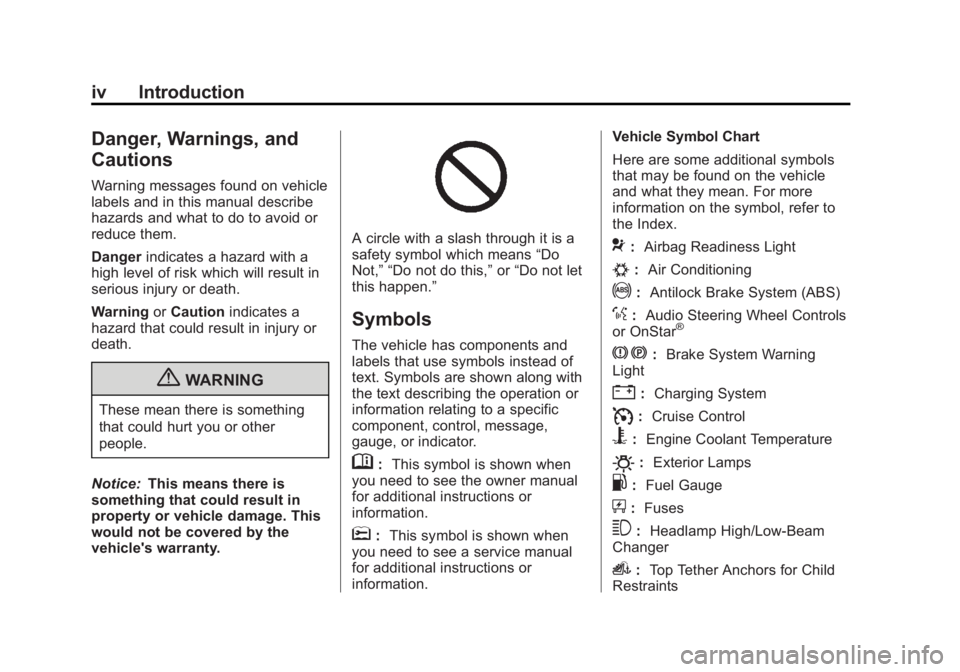
A circle with a slash through it is a
safety symbol which means “Do
Not,” “Do not do this,” or“Do not let
this happen.”
Symbols
The vehicle has components and
labels that use symbols instead of
text. Symbols are shown along with
the text describing the operation or
information relating to a specific
component, control, message,
gauge, or indicator.
M: This symbol is shown when
you need to see the owner manual
for additional instructions or
information.
*: This symbol is shown when
you need to see a service manual
for additional instructions or
information. Vehicle Symbol Chart
Here are some additional symbols
that may be found on the vehicle
and what they mean. For more
information on the symbol, refer to
the Index.
9:
Airbag Readiness Light
#:Air Conditioning
!:Antilock Brake System (ABS)
%:Audio Steering Wheel Controls
or OnStar®
J: Brake System Warning
Light
": Charging System
I:Cruise Control
B: Engine Coolant Temperature
O:Exterior Lamps
.:Fuel Gauge
+:Fuses
3: Headlamp High/Low-Beam
Changer
i: Top Tether Anchors for Child
Restraints
Page 7 of 398
Black plate (1,1)GMC Savana Owner Manual - 2013 - 2nd Edition - 9/25/12
In Brief 1-1
In Brief
Instrument Panel
Instrument Panel . . . . . . . . . . . . . . 1-2
Initial Drive Information
Initial Drive Information . . . . . . . . 1-4
Remote Keyless Entry (RKE)System . . . . . . . . . . . . . . . . . . . . . . 1-4
Remote Vehicle Start . . . . . . . . . 1-4
Door Locks . . . . . . . . . . . . . . . . . . . 1-5
Windows . . . . . . . . . . . . . . . . . . . . . . 1-6
Seat Adjustment . . . . . . . . . . . . . . 1-6
Safety Belts . . . . . . . . . . . . . . . . . . . 1-7
Airbag On-Off Switch . . . . . . . . . 1-8
Passenger Sensing System . . . 1-8
Mirror Adjustment . . . . . . . . . . . . . 1-9
Steering Wheel Adjustment . . . . . . . . . . . . . . . . . 1-10
Interior Lighting . . . . . . . . . . . . . . 1-10
Exterior Lighting . . . . . . . . . . . . . 1-11
Windshield Wiper/Washer . . . . 1-11
Climate Controls . . . . . . . . . . . . . 1-12
Transmission . . . . . . . . . . . . . . . . 1-13
Vehicle Features
Radio(s) . . . . . . . . . . . . . . . . . . . . . 1-14
Satellite Radio . . . . . . . . . . . . . . . 1-15
Portable Audio Devices . . . . . . 1-15
Bluetooth
®. . . . . . . . . . . . . . . . . . . 1-16
Steering Wheel Controls . . . . . 1-16
Cruise Control . . . . . . . . . . . . . . . 1-17
Navigation System . . . . . . . . . . . 1-17
Rear Vision
Camera (RVC) . . . . . . . . . . . . . 1-17
Ultrasonic Parking Assist . . . . 1-17
Power Outlets . . . . . . . . . . . . . . . 1-18
Performance and Maintenance
StabiliTrak®System . . . . . . . . . 1-18
Tire Pressure Monitor . . . . . . . . 1-19
Engine Oil Life System . . . . . . 1-19
Fuel E85 (85% Ethanol) . . . . . 1-19
Driving for Better Fuel Economy . . . . . . . . . . . . . . . . . . . 1-19
Roadside Assistance Program . . . . . . . . . . . . . . . . . . . . 1-20
OnStar
®. . . . . . . . . . . . . . . . . . . . . 1-20
Page 9 of 398
Black plate (3,1)GMC Savana Owner Manual - 2013 - 2nd Edition - 9/25/12
In Brief 1-3
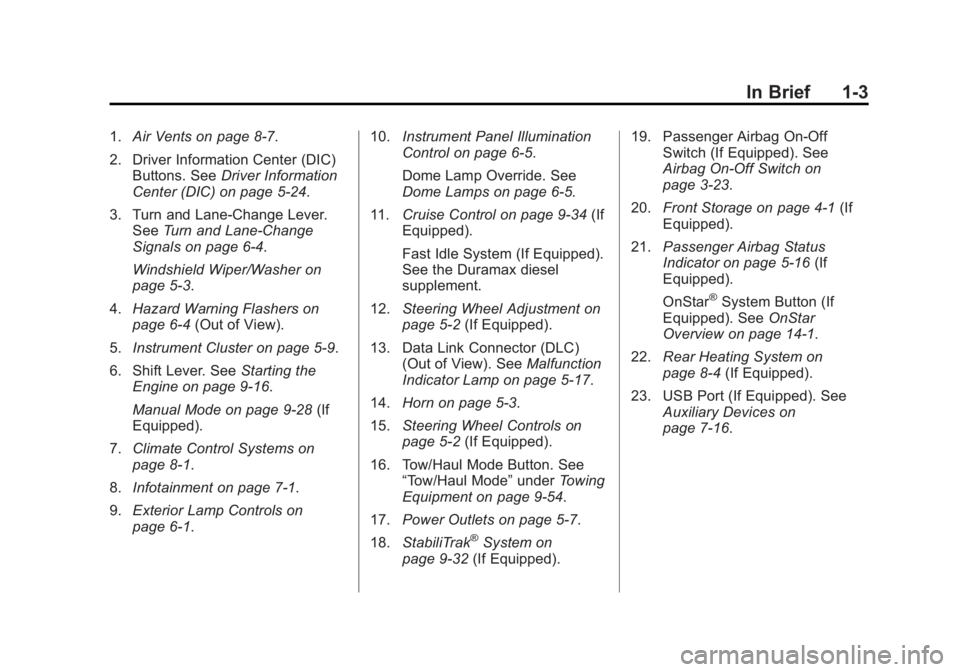
1.Air Vents on page 8‑7.
2. Driver Information Center (DIC) Buttons. See Driver Information
Center (DIC) on page 5‑24.
3. Turn and Lane-Change Lever. See Turn and Lane-Change
Signals on page 6‑4.
Windshield Wiper/Washer on
page 5‑3.
4. Hazard Warning Flashers on
page 6‑4 (Out of View).
5. Instrument Cluster on page 5‑9.
6. Shift Lever. See Starting the
Engine on page 9‑16.
Manual Mode on page 9‑28 (If
Equipped).
7. Climate Control Systems on
page 8‑1.
8. Infotainment on page 7‑1.
9. Exterior Lamp Controls on
page 6‑1. 10.
Instrument Panel Illumination
Control on page 6‑5.
Dome Lamp Override. See
Dome Lamps on page 6‑5.
11. Cruise Control on page 9‑34 (If
Equipped).
Fast Idle System (If Equipped).
See the Duramax diesel
supplement.
12. Steering Wheel Adjustment on
page 5‑2 (If Equipped).
13. Data Link Connector (DLC) (Out of View). See Malfunction
Indicator Lamp on page 5‑17.
14. Horn on page 5‑3.
15. Steering Wheel Controls on
page 5‑2 (If Equipped).
16. Tow/Haul Mode Button. See “Tow/Haul Mode” underTowing
Equipment on page 9‑54.
17. Power Outlets on page 5‑7.
18. StabiliTrak
®System on
page 9‑32 (If Equipped). 19. Passenger Airbag On-Off
Switch (If Equipped). See
Airbag On-Off Switch on
page 3‑23.
20. Front Storage on page 4‑1 (If
Equipped).
21. Passenger Airbag Status
Indicator on page 5‑16 (If
Equipped).
OnStar
®System Button (If
Equipped). See OnStar
Overview on page 14‑1.
22. Rear Heating System on
page 8‑4 (If Equipped).
23. USB Port (If Equipped). See Auxiliary Devices on
page 7‑16.
Page 16 of 398
Black plate (10,1)GMC Savana Owner Manual - 2013 - 2nd Edition - 9/25/12
1-10 In Brief
For vehicles with a manual rearview
mirror, push the tab forward for
daytime use and pull it for nighttime
use to avoid glare from the
headlamps from behind.
SeeManual Rearview Mirror on
page 2‑14.
Steering Wheel
Adjustment
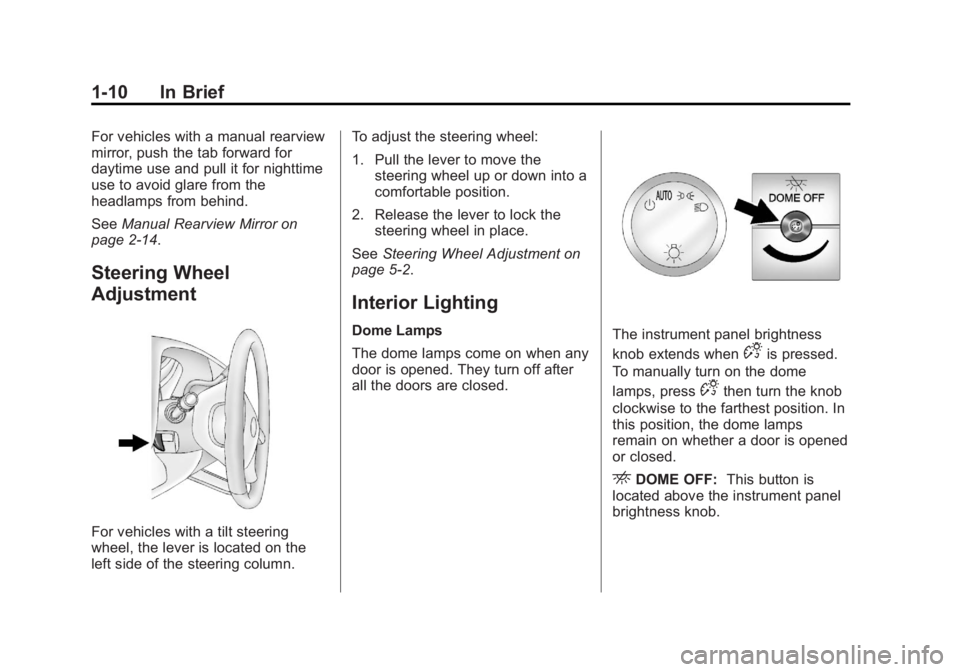
For vehicles with a tilt steering
wheel, the lever is located on the
left side of the steering column. To adjust the steering wheel:
1. Pull the lever to move the
steering wheel up or down into a
comfortable position.
2. Release the lever to lock the steering wheel in place.
See Steering Wheel Adjustment on
page 5‑2.
Interior Lighting
Dome Lamps
The dome lamps come on when any
door is opened. They turn off after
all the doors are closed.The instrument panel brightness
knob extends when
Dis pressed.
To manually turn on the dome
lamps, press
Dthen turn the knob
clockwise to the farthest position. In
this position, the dome lamps
remain on whether a door is opened
or closed.
EDOME OFF: This button is
located above the instrument panel
brightness knob.
Page 17 of 398
Black plate (11,1)GMC Savana Owner Manual - 2013 - 2nd Edition - 9/25/12
In Brief 1-11
Press the button in and the dome
lamps remain off when a door is
opened. Press the button again so
that the dome lamps come on when
a door is opened.
Reading Lamps
For vehicles with reading lamps,
press the button located next to
each lamp to turn it on or off.
The vehicle may also have reading
lamps in other locations. The lamps
cannot be adjusted.
For more information on interior
lighting, see:
.Instrument Panel Illumination
Control on page 6‑5.
.Entry/Exit Lighting on page 6‑6.
Exterior Lighting
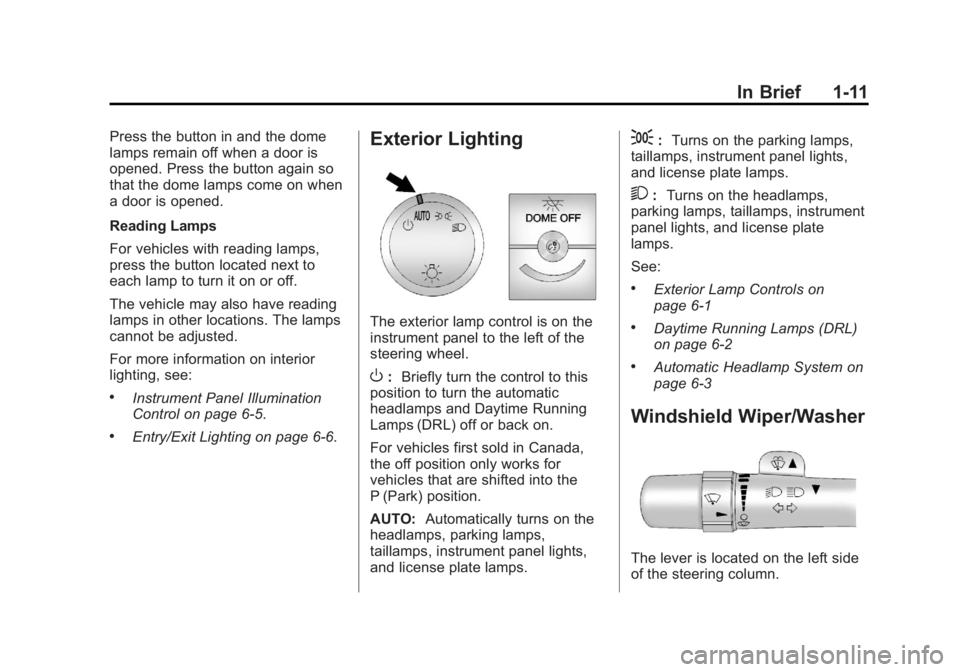
The exterior lamp control is on the
instrument panel to the left of the
steering wheel.
O:Briefly turn the control to this
position to turn the automatic
headlamps and Daytime Running
Lamps (DRL) off or back on.
For vehicles first sold in Canada,
the off position only works for
vehicles that are shifted into the
P (Park) position.
AUTO: Automatically turns on the
headlamps, parking lamps,
taillamps, instrument panel lights,
and license plate lamps.
;: Turns on the parking lamps,
taillamps, instrument panel lights,
and license plate lamps.
2: Turns on the headlamps,
parking lamps, taillamps, instrument
panel lights, and license plate
lamps.
See:
.Exterior Lamp Controls on
page 6‑1
.Daytime Running Lamps (DRL)
on page 6‑2
.Automatic Headlamp System on
page 6‑3
Windshield Wiper/Washer
The lever is located on the left side
of the steering column.
Page 22 of 398
Black plate (16,1)GMC Savana Owner Manual - 2013 - 2nd Edition - 9/25/12
1-16 In Brief
Bluetooth®
For vehicles with a Bluetooth
system, it allows users with a
Bluetooth-enabled cell phone to
make and receive hands-free calls
using the vehicle’s audio system
and controls.
The Bluetooth-enabled cell phone
must be paired with the Bluetooth
system before it can be used in the
vehicle. Not all phones will support
all functions. For more information,
see www.gm.com/bluetooth and
Bluetooth on page 7‑21.
Steering Wheel Controls
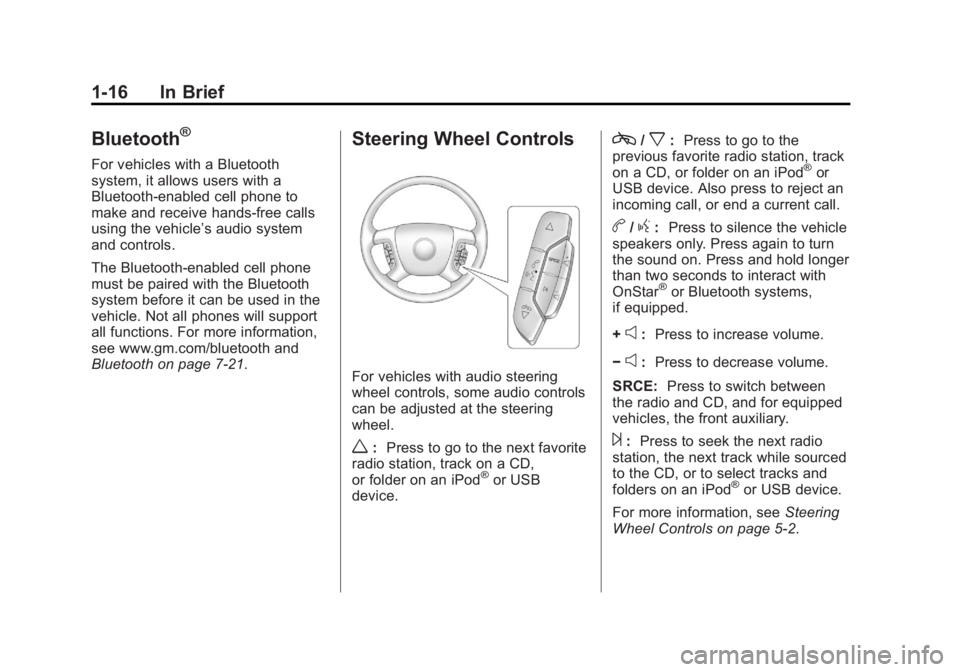
For vehicles with audio steering
wheel controls, some audio controls
can be adjusted at the steering
wheel.
w: Press to go to the next favorite
radio station, track on a CD,
or folder on an iPod
®or USB
device.
c/x: Press to go to the
previous favorite radio station, track
on a CD, or folder on an iPod
®or
USB device. Also press to reject an
incoming call, or end a current call.
b/g: Press to silence the vehicle
speakers only. Press again to turn
the sound on. Press and hold longer
than two seconds to interact with
OnStar
®or Bluetooth systems,
if equipped.
+
e: Press to increase volume.
−
e: Press to decrease volume.
SRCE: Press to switch between
the radio and CD, and for equipped
vehicles, the front auxiliary.
¨: Press to seek the next radio
station, the next track while sourced
to the CD, or to select tracks and
folders on an iPod
®or USB device.
For more information, see Steering
Wheel Controls on page 5‑2.
Page 60 of 398
Black plate (16,1)GMC Savana Owner Manual - 2013 - 2nd Edition - 9/25/12
3-16 Seats and Restraints
Airbag System
The vehicle has the following
airbag:
.A frontal airbag for the driver.
The vehicle may have the following
airbags:
.A frontal airbag for the right front
passenger.
.A roof-rail airbag for the driver
(cargo van).
.A roof-rail airbag for the right
front passenger position
(cargo or passenger van
equipped with a sliding door).
If you have a passenger van
with a right front passenger
roof-rail airbag and a sliding
door, you will also have a
separate roof-rail airbag for the
passenger seated directly
behind the right front passenger
and the third row outboard
passenger position.
.A roof-rail airbag for the driver,
the passenger seated directly
behind the driver, and the third
row outboard passenger position
(passenger van equipped with a
sliding or hinged door).
.A roof-rail airbag for the right
front passenger, the passenger
seated directly behind the right
front passenger, and the
third row outboard passenger
position (passenger van
equipped with a hinged door).
All of the airbags in the vehicle will
have the word AIRBAG embossed
in the trim or on an attached label
near the deployment opening.
For frontal airbags, the word
AIRBAG will appear on the middle
part of the steering wheel for the
driver and on the instrument panel
for the right front passenger.
With roof-rail airbags, the word
AIRBAG will appear along the
headliner or trim. Here are the most important things
to know about the airbag system:
{WARNING
You can be severely injured or
killed in a crash if you are not
wearing your safety belt
—even if
you have airbags. Airbags are
designed to work with safety
belts, but do not replace them.
Also, airbags are not designed to
deploy in every crash. In some
crashes safety belts are your only
restraint. See When Should an
Airbag Inflate? on page 3‑19.
Wearing your safety belt during a
crash helps reduce your chance
of hitting things inside the vehicle
or being ejected from it. Airbags
are “supplemental restraints” to
the safety belts. Everyone in your
vehicle should wear a safety belt
properly —whether or not there is
an airbag for that person.
Page 62 of 398
Black plate (18,1)GMC Savana Owner Manual - 2013 - 2nd Edition - 9/25/12
3-18 Seats and Restraints
Where Are the Airbags?
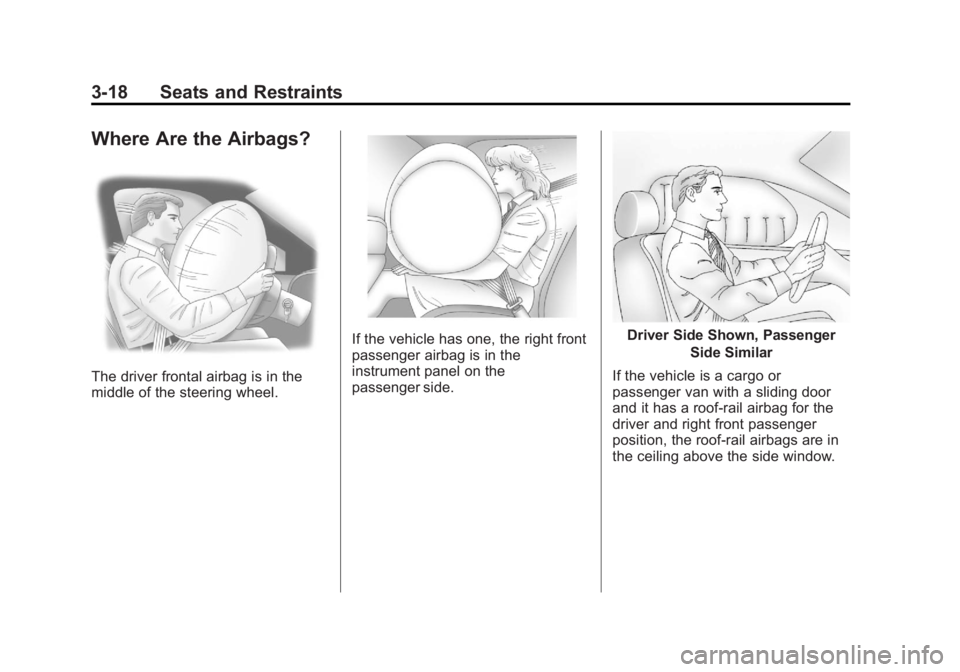
The driver frontal airbag is in the
middle of the steering wheel.
If the vehicle has one, the right front
passenger airbag is in the
instrument panel on the
passenger side.Driver Side Shown, PassengerSide Similar
If the vehicle is a cargo or
passenger van with a sliding door
and it has a roof-rail airbag for the
driver and right front passenger
position, the roof-rail airbags are in
the ceiling above the side window.
Page 63 of 398
Black plate (19,1)GMC Savana Owner Manual - 2013 - 2nd Edition - 9/25/12
Seats and Restraints 3-19
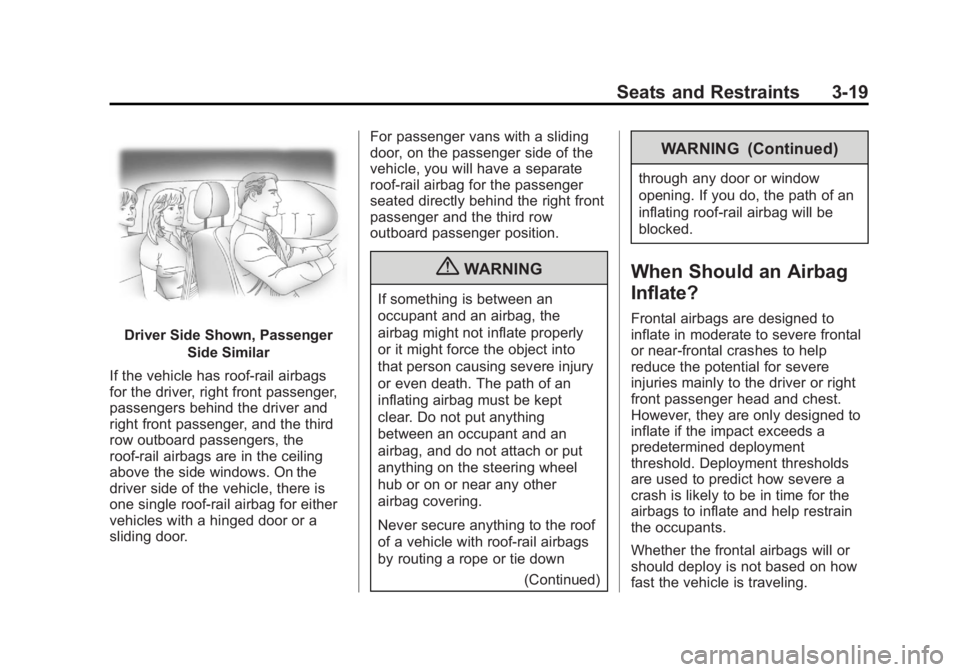
Driver Side Shown, PassengerSide Similar
If the vehicle has roof-rail airbags
for the driver, right front passenger,
passengers behind the driver and
right front passenger, and the third
row outboard passengers, the
roof-rail airbags are in the ceiling
above the side windows. On the
driver side of the vehicle, there is
one single roof-rail airbag for either
vehicles with a hinged door or a
sliding door. For passenger vans with a sliding
door, on the passenger side of the
vehicle, you will have a separate
roof-rail airbag for the passenger
seated directly behind the right front
passenger and the third row
outboard passenger position.
{WARNING
If something is between an
occupant and an airbag, the
airbag might not inflate properly
or it might force the object into
that person causing severe injury
or even death. The path of an
inflating airbag must be kept
clear. Do not put anything
between an occupant and an
airbag, and do not attach or put
anything on the steering wheel
hub or on or near any other
airbag covering.
Never secure anything to the roof
of a vehicle with roof-rail airbags
by routing a rope or tie down
(Continued)
WARNING (Continued)
through any door or window
opening. If you do, the path of an
inflating roof-rail airbag will be
blocked.
When Should an Airbag
Inflate?
Frontal airbags are designed to
inflate in moderate to severe frontal
or near-frontal crashes to help
reduce the potential for severe
injuries mainly to the driver or right
front passenger head and chest.
However, they are only designed to
inflate if the impact exceeds a
predetermined deployment
threshold. Deployment thresholds
are used to predict how severe a
crash is likely to be in time for the
airbags to inflate and help restrain
the occupants.
Whether the frontal airbags will or
should deploy is not based on how
fast the vehicle is traveling.
Page 65 of 398
Black plate (21,1)GMC Savana Owner Manual - 2013 - 2nd Edition - 9/25/12
Seats and Restraints 3-21
In any particular crash, no one can
say whether an airbag should have
inflated simply because of the
damage to a vehicle or because of
what the repair costs were.
For frontal airbags, inflation is
determined by what the vehicle hits,
the angle of the impact, and how
quickly the vehicle slows down.
For roof-rail airbags, deployment is
determined by the location and
severity of the side impact.
In a rollover event, roof‐rail airbag
deployment is determined by the
direction of the roll.
What Makes an Airbag
Inflate?
In a deployment event, the sensing
system sends an electrical signal
triggering a release of gas from the
inflator. Gas from the inflator fills the
airbag causing the bag to break out
of the cover and deploy. The inflator,
the airbag, and related hardware are
all part of the airbag module.Frontal airbag modules are located
inside the steering wheel and
instrument panel. For vehicles with
roof-rail airbags, there are airbag
modules in the ceiling of the vehicle,
near the side windows for the first,
second, and third rows (if equipped).
See
Where Are the Airbags? on
page 3‑18 for more information.
How Does an Airbag
Restrain?
In moderate to severe frontal or
near frontal collisions, even belted
occupants can contact the steering
wheel or the instrument panel. In
moderate to severe side collisions,
even belted occupants can contact
the inside of the vehicle.
Airbags supplement the protection
provided by safety belts. Frontal
airbags distribute the force of the
impact more evenly over the
occupant's upper body, stopping the
occupant more gradually. Roof-rail airbags distribute the force of the
impact more evenly over the
occupant's upper body.
Rollover capable roof-rail airbags
are designed to help contain the
head and chest of occupants in the
outboard seating positions in the
first, second, and third rows,
if equipped. The rollover capable
roof-rail airbags are designed to
help reduce the risk of full or partial
ejection in rollover events, although
no system can prevent all such
ejections.
But airbags would not help in many
types of collisions, primarily
because the occupant's motion is
not toward those airbags. See
When Should an Airbag Inflate? on
page 3‑19
for more information.
Airbags should never be regarded
as anything more than a supplement
to safety belts.