check engine light GMC SIERRA 1500 2006 User Guide
[x] Cancel search | Manufacturer: GMC, Model Year: 2006, Model line: SIERRA 1500, Model: GMC SIERRA 1500 2006Pages: 600, PDF Size: 3.35 MB
Page 318 of 600
Average reaction time is about three-fourths of a second.
But that is only an average. It might be less with one
driver and as long as two or three seconds or more with
another. Age, physical condition, alertness, coordination,
and eyesight all play a part. So do alcohol, drugs, and
frustration. But even in three-fourths of a second,
a vehicle moving at 60 mph (100 km/h) travels
66 feet (20 m). That could be a lot of distance in an
emergency, so keeping enough space between your
vehicle and others is important.
And, of course, actual stopping distances vary greatly
with the surface of the road, whether it is pavement or
gravel; the condition of the road, whether it is wet, dry, or
icy; tire tread; the condition of your brakes; the weight of
the vehicle; and the amount of brake force applied.
Avoid needless heavy braking. Some people drive
in spurts — heavy acceleration followed by heavy
braking — rather than keeping pace with traffic. This is a
mistake. Your brakes may not have time to cool between
hard stops. Your brakes will wear out much faster if you
do a lot of heavy braking. If you keep pace with the traffic
and allow realistic following distances, you will eliminate a
lot of unnecessary braking. That means better braking
and longer brake life.
If your engine ever stops while you are driving, brake
normally but do not pump your brakes. If you do, the
pedal may get harder to push down. If your engine stops,
you will still have some power brake assist.But you will use it when you brake. Once the power assist
is used up, it may take longer to stop and the brake pedal
will be harder to push.
Adding non-GM accessories can affect your vehicle’s
performance. SeeAccessories and Modications
on page 5-4.
Anti-Lock Brake System (ABS)
Your vehicle has anti-lock brakes. ABS is an advanced
electronic braking system that will help prevent a
braking skid.
When you start your engine and begin to drive away, your
anti-lock brake system will check itself. You may hear a
momentary motor or clicking noise while this test is going
on. This is normal.
If there is a problem with
the anti-lock brake system,
this warning light will stay
on. SeeAnti-Lock Brake
System Warning Light on
page 3-42.
Along with ABS, your vehicle has a Dynamic Rear
Proportioning (DRP) system. If there is a DRP problem,
both the brake and ABS warning lights will come on
accompanied by a 10-second chime.
4-6
Page 357 of 600
{CAUTION:
Snow can trap exhaust gases under your
vehicle. This can cause deadly CO (carbon
monoxide) gas to get inside. CO could
overcome you and kill you. You cannot see
it or smell it, so you might not know it is in your
vehicle. Clear away snow from around the base
of your vehicle, especially any that is blocking
your exhaust pipe. And check around again
from time to time to be sure snow does not
collect there.
Open a window just a little on the side of the
vehicle that is away from the wind. This will help
keep CO out.Run your engine only as long as you must. This saves
fuel. When you run the engine, make it go a little faster
than just idle. That is, push the accelerator slightly. This
uses less fuel for the heat that you get and it keeps the
battery charged. You will need a well-charged battery to
restart the vehicle, and possibly for signaling later on with
your headlamps. Let the heater run for a while.
Then, shut the engine off and close the window almost all
the way to preserve the heat. Start the engine again and
repeat this only when you feel really uncomfortable from
the cold. But do it as little as possible. Preserve the fuel
as long as you can. To help keep warm, you can get out
of the vehicle and do some fairly vigorous exercises
every half hour or so until help comes.
4-45
Page 402 of 600
Making Turns
Notice:Making very sharp turns while trailering
could cause the trailer to come in contact with the
vehicle. Your vehicle could be damaged. Avoid
making very sharp turns while trailering.
When you’re turning with a trailer, make wider turns than
normal. Do this so your trailer won’t strike soft shoulders,
curbs, road signs, trees or other objects. Avoid jerky or
sudden maneuvers. Signal well in advance.
Turn Signals When Towing a Trailer
The arrows on your instrument panel will ash whenever
you signal a turn or lane change. Properly hooked up, the
trailer lamps will also ash, telling other drivers you’re
about to turn, change lanes or stop.
When towing a trailer, the arrows on your instrument
panel will ash for turns even if the bulbs on the trailer are
burned out. Thus, you may think drivers behind you are
seeing your signal when they are not. It’s important to
check occasionally to be sure the trailer bulbs are still
working.
Driving On Grades
Reduce speed and shift to a lower gearbeforeyou start
down a long or steep downgrade. If you don’t shift down,
you might have to use your brakes so much that they
would get hot and no longer work well.If you have an automatic transmission, you can tow
in DRIVE (D). You may want to shift the transmission to
a lower gear selection if the transmission shifts too
often (e.g., under heavy loads and/or hilly conditions).
You may also want to activate the tow/haul mode if
the transmission shifts too often. SeeTow/Haul Mode
Light on page 3-50.
If you have a 5-speed manual transmission and you are
towing a trailer, it’s better not to use FIFTH (5) gear.
Just drive in FOURTH (4) gear (or, as you need to, a
lower gear).
If you have a 6-speed manual transmission and you are
towing a trailer, it’s better not to use SIXTH (6) gear.
Drive in FIFTH (5) gear (or, as you need to, a lower gear).
When towing at high altitude on steep uphill grades,
consider the following: Engine coolant at or near sea level
will boil at a lower temperature than at higher altitudes.
If you turn your engine off immediately after towing at
high altitude on steep uphill grades, your vehicle may
show signs similar to engine overheating. To avoid this,
let the engine run while parked, preferably on level
ground, with the automatic transmission in PARK (P) for
at least ve minutes before turning the engine off. For
manual transmissions, let the engine run while parked,
preferably on level ground, with the transmission out
of gear and the parking brake applied, for at least ve
minutes before turning the engine off. If you do get the
overheat warning, seeEngine Overheating on page 5-37.
4-90
Page 432 of 600
Engine Oil (Gasoline Engine)
If your vehicle has a diesel engine, see “Engine Oil” in
the DURAMAX®Diesel Engine Supplement.
If the CHECK OIL LEVEL light appears on the instrument
cluster (except vehicles equipped with the 4.3L engine), it
means you need to check your engine oil level right away.
For more information, seeDriver Information Center
(DIC) on page 3-52.
You should check your engine oil level regularly; this is
an added reminder.
Checking Engine Oil
It is a good idea to check your engine oil every time you
get fuel. In order to get an accurate reading, the oil
must be warm and the vehicle must be on level ground.
The engine oil dipstick handle is a yellow loop. See
Engine Compartment Overview on page 5-14for
the location of the engine oil dipstick.
1. Turn off the engine and give the oil several minutes
to drain back into the oil pan. If you do not do this,
the oil dipstick might not show the actual level.
2. Pull out the dipstick and clean it with a paper towel
or cloth, then push it back in all the way. Remove it
again, keeping the tip down, and check the level.
5-20
Page 447 of 600
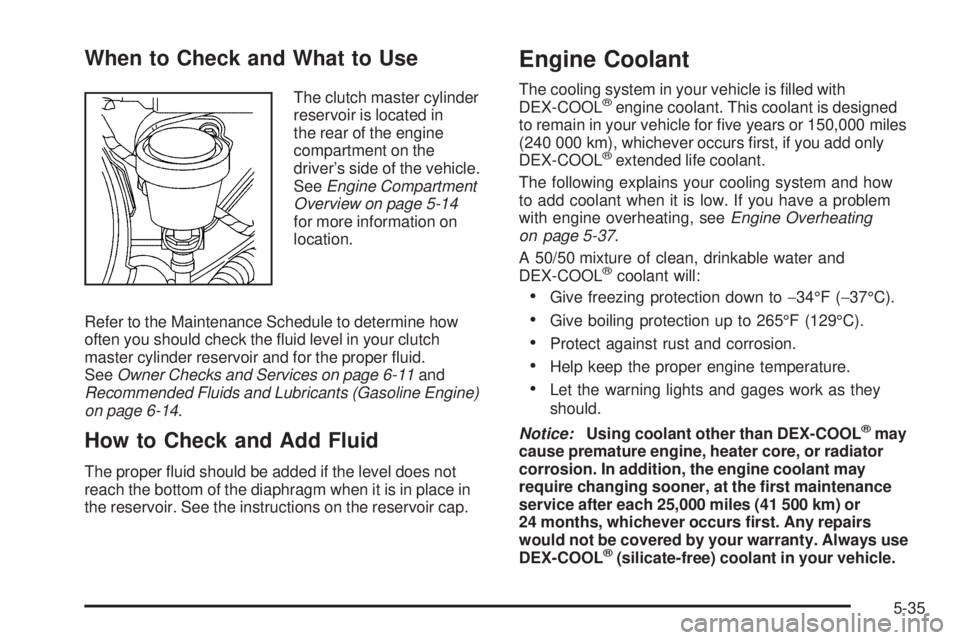
When to Check and What to Use
The clutch master cylinder
reservoir is located in
the rear of the engine
compartment on the
driver’s side of the vehicle.
SeeEngine Compartment
Overview on page 5-14
for more information on
location.
Refer to the Maintenance Schedule to determine how
often you should check the uid level in your clutch
master cylinder reservoir and for the proper uid.
SeeOwner Checks and Services on page 6-11and
Recommended Fluids and Lubricants (Gasoline Engine)
on page 6-14.
How to Check and Add Fluid
The proper uid should be added if the level does not
reach the bottom of the diaphragm when it is in place in
the reservoir. See the instructions on the reservoir cap.
Engine Coolant
The cooling system in your vehicle is lled with
DEX-COOL®engine coolant. This coolant is designed
to remain in your vehicle for ve years or 150,000 miles
(240 000 km), whichever occurs rst, if you add only
DEX-COOL
®extended life coolant.
The following explains your cooling system and how
to add coolant when it is low. If you have a problem
with engine overheating, seeEngine Overheating
on page 5-37.
A 50/50 mixture of clean, drinkable water and
DEX-COOL
®coolant will:
Give freezing protection down to−34°F (−37°C).
Give boiling protection up to 265°F (129°C).
Protect against rust and corrosion.
Help keep the proper engine temperature.
Let the warning lights and gages work as they
should.
Notice:Using coolant other than DEX-COOL
®may
cause premature engine, heater core, or radiator
corrosion. In addition, the engine coolant may
require changing sooner, at the rst maintenance
service after each 25,000 miles (41 500 km) or
24 months, whichever occurs rst. Any repairs
would not be covered by your warranty. Always use
DEX-COOL
®(silicate-free) coolant in your vehicle.
5-35
Page 465 of 600
Notice:Ignoring these steps could result in costly
damage to your vehicle that would not be covered
by your warranty.
Trying to start your vehicle by pushing or pulling it
will not work, and it could damage your vehicle.
1. Check the other vehicle. It must have a 12-volt
battery with a negative ground system.
Notice:If the other vehicle’s system is not a 12-volt
system with a negative ground, both vehicles can
be damaged. Only use vehicles with 12-volt systems
with negative grounds to jump start your vehicle.
2. If you have a vehicle with a diesel engine with two
batteries (or more), you should know before you
begin that, especially in cold weather, you may not
be able to get enough power from a single battery in
another vehicle to start your diesel engine.
If your vehicle has more than one battery, use the
battery that is closer to the starter — this will reduce
electrical resistance.3. Get the vehicles close enough so the jumper cables
can reach, but be sure the vehicles are not touching
each other. If they are, it could cause a ground
connection you do not want. You would not be able
to start your vehicle, and the bad grounding
could damage the electrical systems.
To avoid the possibility of the vehicles rolling, set
the parking brake rmly on both vehicles involved in
the jump start procedure. Put an automatic
transmission in PARK (P) or a manual transmission
in NEUTRAL before setting the parking brake.
If you have a four-wheel-drive vehicle, be sure the
transfer case
is in a drive gear, not in NEUTRAL.
Notice:If you leave your radio or other accessories
on during the jump starting procedure, they could
be damaged. The repairs would not be covered
by your warranty. Always turn off your radio and
other accessories when jump starting your vehicle.
4. Turn off the ignition on both vehicles. Unplug
unnecessary accessories plugged into the cigarette
lighter or accessory power outlets. Turn off the radio
and all lamps that are not needed. This will avoid
sparks and help save both batteries. And it could
save the radio!
5-53
Page 557 of 600
Maintenance Footnotes
(Gasoline Engine)
This maintenance section applies to vehicles with a
gasoline engine. If your vehicle has a diesel engine,
see the maintenance schedule section in the
DURAMAX
®Diesel Engine Supplement.
†The U.S. Environmental Protection Agency or the
California Air Resources Board has determined that the
failure to perform this maintenance item will not nullify
the emission warranty or limit recall liability prior to the
completion of the vehicle’s useful life. We, however,
urge that all recommended maintenance services be
performed at the indicated intervals and the maintenance
be recorded.
#Lubricate the front suspension, ball joints, steering
linkage, transmission shift linkage, and parking brake
cable guides. Ball joints should not be lubricated unless
their temperature is 10°F (−12°C) or higher, or they could
be damaged. Vehicles used under severe commercial
operating conditions require lubrication on a regular basis
every 3,000 miles (5 000 km).
(a)Visually inspect brake lines and hoses for proper
hook-up, binding, leaks, cracks, chang, etc. Inspect
disc brake pads for wear and rotors for surface condition.
Inspect drum brake linings/shoes for wear or cracks.
Inspect other brake parts, including drums, wheel
cylinders, calipers, parking brake, etc.(b)Visually inspect front and rear suspension and
steering system for damaged, loose or missing parts,
signs of wear or lack of lubrication. Inspect power
steering lines and hoses for proper hook-up, binding,
leaks, cracks, chang, etc. Visually check constant
velocity joints, rubber boots, and axle seals for leaks.
(c)Visually inspect hoses and have them replaced if they
are cracked, swollen, or deteriorated. Inspect all pipes,
ttings and clamps; replace with genuine GM parts as
needed. To help ensure proper operation, a pressure test
of the cooling system and pressure cap and cleaning the
outside of the radiator and air conditioning condenser is
recommended at least once a year.
(d)Visually inspect wiper blades for wear or cracking.
Replace wiper blades that appear worn or damaged
or that streak or miss areas of the windshield.
(e)Make sure the safety belt reminder light and all your
belts, buckles, latch plates, retractors, and anchorages
are working properly. Look for any other loose or
damaged safety belt system parts. If you see anything
that might keep a safety belt system from doing its job,
have it repaired. Have any torn or frayed safety belts
replaced. Also look for any opened or broken airbag
coverings, and have them repaired or replaced. The
airbag system does not need regular maintenance.
6-9
Page 589 of 600
Cargo Lamp Light...........................................3-50
Center Console Storage Area...........................2-79
Center Front Passenger Position, Safety Belts....1-25
Center High-Mounted Stoplamp (CHMSL) and
Cargo Lamp...............................................5-67
Chains, Tire...................................................5-89
Check
Engine Light...............................................3-46
Checking Things Under the Hood......................5-12
Chemical Paint Spotting.................................5-120
Child Restraints
Child Restraint Systems...............................1-37
Infants and Young Children...........................1-33
Lower Anchors and Tethers for Children..........1-42
Older Children.............................................1-31
Securing a Child Restraint in a
Rear Seat Position...................................1-54
Securing a Child Restraint in the
Center Front Seat Position........................1-56
Securing a Child Restraint in the Right
Front Seat Position (Crew Cab)..................1-57
Securing a Child Restraint in the Right
Front Seat Position
(Regular and Extended Cab).............1-59, 1-65
Where to Put the Restraint...........................1-40
Chime Level Adjustment.................................3-133
Cigarette Lighter.............................................3-20Cleaning
Aluminum or Chrome-Plated Wheels.............5-118
Exterior Lamps/Lenses................................5-117
Fabric/Carpet............................................5-114
Finish Care...............................................5-117
Inside of Your Vehicle.................................5-113
Instrument Panel, Vinyl, and Other Plastic
Surfaces...............................................5-115
Leather....................................................5-115
Tires........................................................5-119
Underbody Maintenance.............................5-120
Washing Your Vehicle.................................5-116
Weatherstrips............................................5-116
Windshield and Wiper Blades......................5-118
Climate Control System...................................3-21
Dual..........................................................3-22
Dual Automatic............................................3-25
Outlet Adjustment........................................3-30
Clutch, Hydraulic.............................................5-34
Coinholder(s)..................................................2-79
Collision Damage Repair..................................7-10
Comfort Guides, Rear Safety Belt.....................1-29
Content Theft-Deterrent....................................2-19
Control of a Vehicle.......................................... 4-5
Coolant
Engine Temperature Gage............................3-43
Heater, Engine............................................2-25
Surge Tank Pressure Cap.............................5-37
3
Page 591 of 600
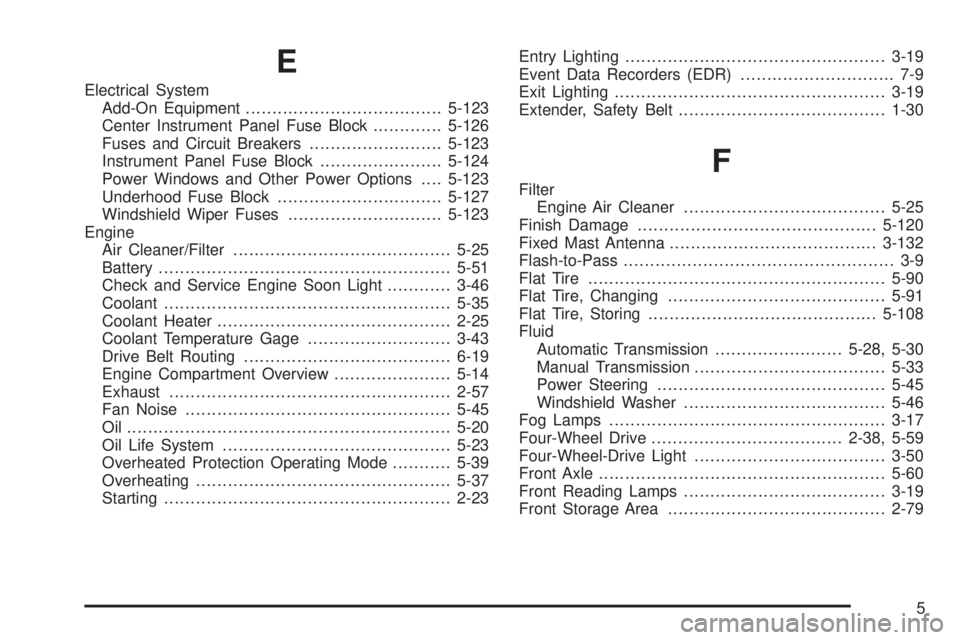
E
Electrical System
Add-On Equipment.....................................5-123
Center Instrument Panel Fuse Block.............5-126
Fuses and Circuit Breakers.........................5-123
Instrument Panel Fuse Block.......................5-124
Power Windows and Other Power Options....5-123
Underhood Fuse Block...............................5-127
Windshield Wiper Fuses.............................5-123
Engine
Air Cleaner/Filter.........................................5-25
Battery.......................................................5-51
Check and Service Engine Soon Light............3-46
Coolant......................................................5-35
Coolant Heater............................................2-25
Coolant Temperature Gage...........................3-43
Drive Belt Routing.......................................6-19
Engine Compartment Overview......................5-14
Exhaust.....................................................2-57
Fan Noise..................................................5-45
Oil .............................................................5-20
Oil Life System...........................................5-23
Overheated Protection Operating Mode...........5-39
Overheating................................................5-37
Starting......................................................2-23Entry Lighting.................................................3-19
Event Data Recorders (EDR)............................. 7-9
Exit Lighting...................................................3-19
Extender, Safety Belt.......................................1-30
F
Filter
Engine Air Cleaner......................................5-25
Finish Damage.............................................5-120
Fixed Mast Antenna.......................................3-132
Flash-to-Pass................................................... 3-9
Flat Tire........................................................5-90
Flat Tire, Changing.........................................5-91
Flat Tire, Storing...........................................5-108
Fluid
Automatic Transmission........................5-28, 5-30
Manual Transmission....................................5-33
Power Steering...........................................5-45
Windshield Washer......................................5-46
Fog Lamps....................................................3-17
Four-Wheel Drive....................................2-38, 5-59
Four-Wheel-Drive Light....................................3-50
Front Axle......................................................5-60
Front Reading Lamps......................................3-19
Front Storage Area.........................................2-79
5
Page 597 of 600
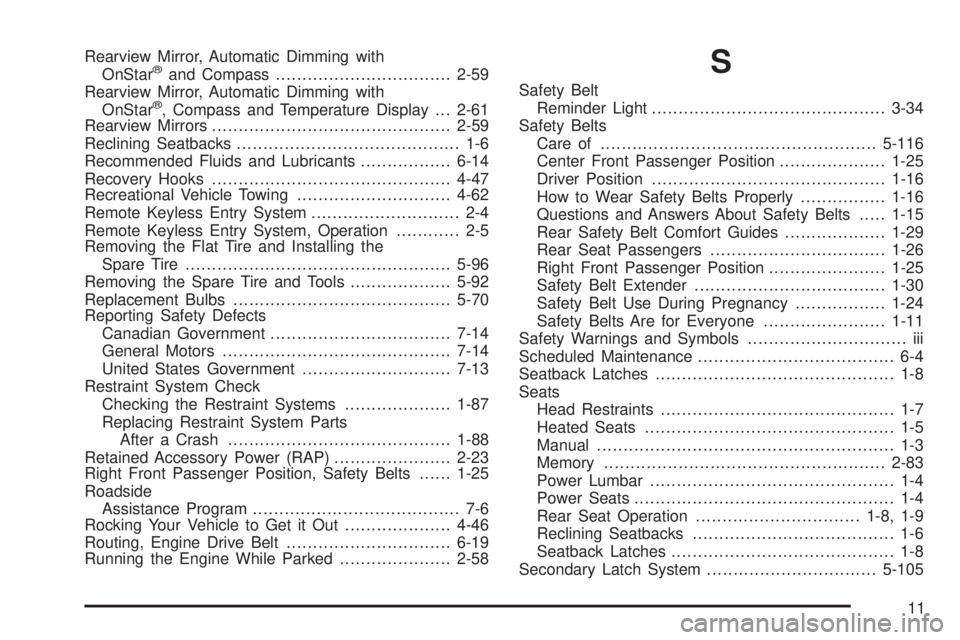
Rearview Mirror, Automatic Dimming with
OnStar®and Compass.................................2-59
Rearview Mirror, Automatic Dimming with
OnStar
®, Compass and Temperature Display . . . 2-61
Rearview Mirrors.............................................2-59
Reclining Seatbacks.......................................... 1-6
Recommended Fluids and Lubricants.................6-14
Recovery Hooks.............................................4-47
Recreational Vehicle Towing.............................4-62
Remote Keyless Entry System............................ 2-4
Remote Keyless Entry System, Operation............ 2-5
Removing the Flat Tire and Installing the
Spare Tire..................................................5-96
Removing the Spare Tire and Tools...................5-92
Replacement Bulbs.........................................5-70
Reporting Safety Defects
Canadian Government..................................7-14
General Motors...........................................7-14
United States Government............................7-13
Restraint System Check
Checking the Restraint Systems....................1-87
Replacing Restraint System Parts
After a Crash..........................................1-88
Retained Accessory Power (RAP)......................2-23
Right Front Passenger Position, Safety Belts......1-25
Roadside
Assistance Program....................................... 7-6
Rocking Your Vehicle to Get it Out....................4-46
Routing, Engine Drive Belt...............................6-19
Running the Engine While Parked.....................2-58
S
Safety Belt
Reminder Light............................................3-34
Safety Belts
Care of....................................................5-116
Center Front Passenger Position....................1-25
Driver Position............................................1-16
How to Wear Safety Belts Properly................1-16
Questions and Answers About Safety Belts.....1-15
Rear Safety Belt Comfort Guides...................1-29
Rear Seat Passengers.................................1-26
Right Front Passenger Position......................1-25
Safety Belt Extender....................................1-30
Safety Belt Use During Pregnancy.................1-24
Safety Belts Are for Everyone.......................1-11
Safety Warnings and Symbols.............................. iii
Scheduled Maintenance..................................... 6-4
Seatback Latches............................................. 1-8
Seats
Head Restraints............................................ 1-7
Heated Seats............................................... 1-5
Manual........................................................ 1-3
Memory.....................................................2-83
Power Lumbar.............................................. 1-4
Power Seats................................................. 1-4
Rear Seat Operation...............................1-8, 1-9
Reclining Seatbacks...................................... 1-6
Seatback Latches.......................................... 1-8
Secondary Latch System................................5-105
11