wheel GMC SIERRA 1500 2011 Owners Manual
[x] Cancel search | Manufacturer: GMC, Model Year: 2011, Model line: SIERRA 1500, Model: GMC SIERRA 1500 2011Pages: 594, PDF Size: 7.88 MB
Page 404 of 594
Black plate (110,1)GMC Sierra Owner Manual - 2011
9-110 Driving and Operating
Ask your dealer for trailering
information or advice, or write us at
our Customer Assistance Offices.
SeeCustomer Assistance Offices
(U.S. and Canada) on page 13‑5
or Customer Assistance Offices
(Mexico) on page 13‑5 for more
information.
Weight of the Trailer Tongue
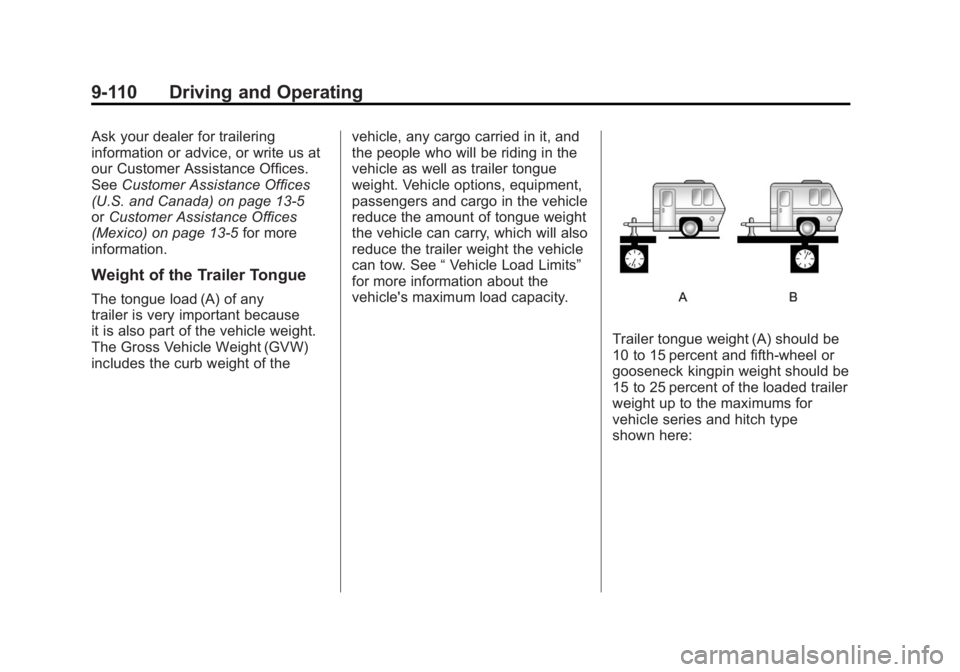
The tongue load (A) of any
trailer is very important because
it is also part of the vehicle weight.
The Gross Vehicle Weight (GVW)
includes the curb weight of the vehicle, any cargo carried in it, and
the people who will be riding in the
vehicle as well as trailer tongue
weight. Vehicle options, equipment,
passengers and cargo in the vehicle
reduce the amount of tongue weight
the vehicle can carry, which will also
reduce the trailer weight the vehicle
can tow. See
“Vehicle Load Limits”
for more information about the
vehicle's maximum load capacity.
Trailer tongue weight (A) should be
10 to 15 percent and fifth-wheel or
gooseneck kingpin weight should be
15 to 25 percent of the loaded trailer
weight up to the maximums for
vehicle series and hitch type
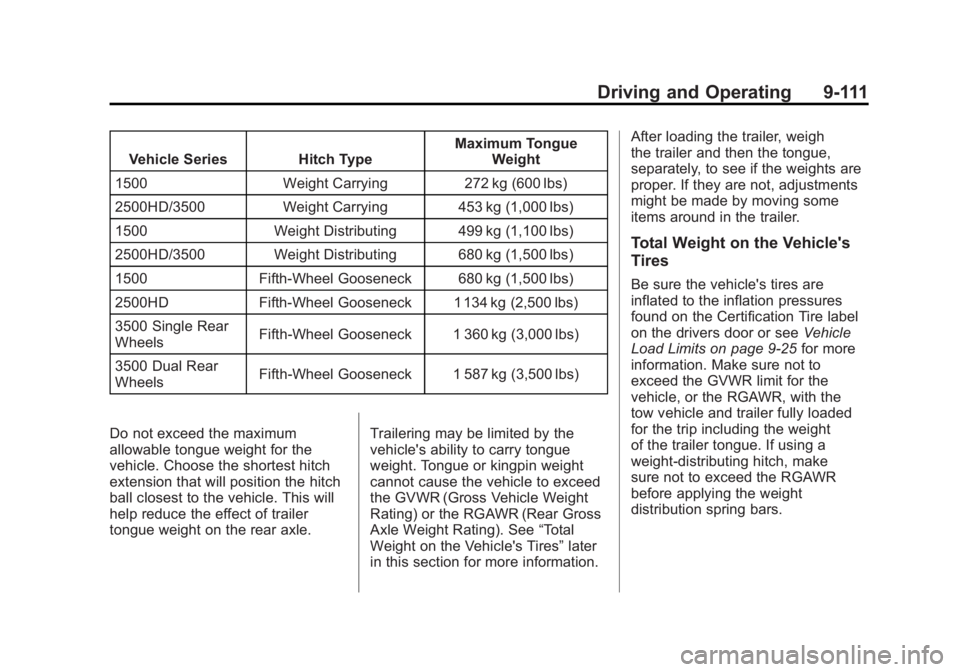
shown here:
Page 405 of 594
Black plate (111,1)GMC Sierra Owner Manual - 2011
Driving and Operating 9-111
Vehicle Series Hitch TypeMaximum Tongue
Weight
1500 Weight Carrying 272 kg (600 lbs)
2500HD/3500 Weight Carrying 453 kg (1,000 lbs)
1500 Weight Distributing 499 kg (1,100 lbs)
2500HD/3500 Weight Distributing 680 kg (1,500 lbs)
1500 Fifth-Wheel Gooseneck 680 kg (1,500 lbs)
2500HD Fifth-Wheel Gooseneck 1 134 kg (2,500 lbs)
3500 Single Rear
Wheels Fifth-Wheel Gooseneck 1 360 kg (3,000 lbs)
3500 Dual Rear
Wheels Fifth-Wheel Gooseneck 1 587 kg (3,500 lbs)
Do not exceed the maximum
allowable tongue weight for the
vehicle. Choose the shortest hitch
extension that will position the hitch
ball closest to the vehicle. This will
help reduce the effect of trailer
tongue weight on the rear axle. Trailering may be limited by the
vehicle's ability to carry tongue
weight. Tongue or kingpin weight
cannot cause the vehicle to exceed
the GVWR (Gross Vehicle Weight
Rating) or the RGAWR (Rear Gross
Axle Weight Rating). See
“Total
Weight on the Vehicle's Tires” later
in this section for more information. After loading the trailer, weigh
the trailer and then the tongue,
separately, to see if the weights are
proper. If they are not, adjustments
might be made by moving some
items around in the trailer.
Total Weight on the Vehicle's
Tires
Be sure the vehicle's tires are
inflated to the inflation pressures
found on the Certification Tire label
on the drivers door or see
Vehicle
Load Limits on page 9‑25 for more
information. Make sure not to
exceed the GVWR limit for the
vehicle, or the RGAWR, with the
tow vehicle and trailer fully loaded
for the trip including the weight
of the trailer tongue. If using a
weight-distributing hitch, make
sure not to exceed the RGAWR
before applying the weight
distribution spring bars.
Page 406 of 594
Black plate (112,1)GMC Sierra Owner Manual - 2011
9-112 Driving and Operating
Weight of the Trailering
Combination
It is important that the combination
of the tow vehicle and trailer
does not exceed any of its weight
ratings—GCWR, GVWR, RGAWR,
Trailer Weight Rating, or Tongue
Weight. The only way to be sure it is
not exceeding any of these ratings
is to weigh the tow vehicle and
trailer combination, fully loaded for
the trip, getting individual weights
for each of these items.
Towing Equipment
Hitches
The correct hitch equipment helps
maintain combination control.
Most small-to-medium trailers can
be towed with a weight-carrying
hitch which simply features a
coupler latched to the hitch ball. Larger trailers may require a
weight-distributing hitch that
uses spring bars to distribute
the trailer tongue weight among
the two vehicle and trailer axles.
Fifth-wheel and gooseneck hitches
may also be used. See
“Weight of
the Trailer Tongue” underTrailer
Towing on page 9‑95 for rating
limits with various hitch types.
If a step-bumper hitch will be used,
the bumper could be damaged
in sharp turns. Make sure there
is ample room when turning to
avoid contact between the trailer
and the bumper.
Consider using sway controls
with any trailer. Ask a trailering
professional about sway controls
or refer to the trailer manufacturer's
recommendations and instructions.
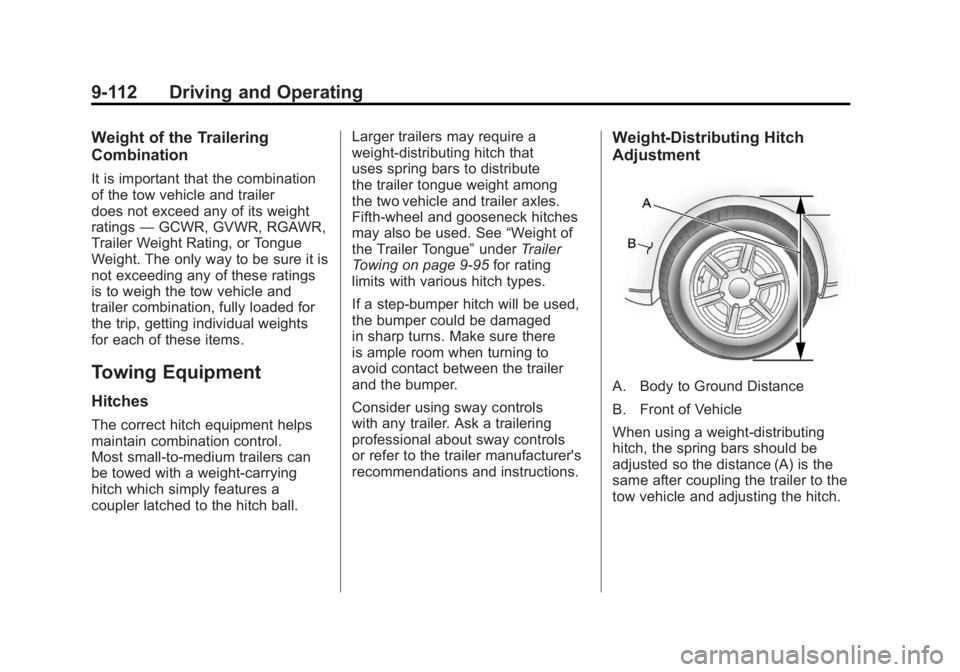
Weight‐Distributing Hitch
Adjustment
A. Body to Ground Distance
B. Front of Vehicle
When using a weight-distributing
hitch, the spring bars should be
adjusted so the distance (A) is the
same after coupling the trailer to the
tow vehicle and adjusting the hitch.
Page 407 of 594
Black plate (113,1)GMC Sierra Owner Manual - 2011
Driving and Operating 9-113
Fifth-Wheel and Gooseneck
Trailering
Fifth-wheel and gooseneck trailers
can be used with many pickup
models. These trailers place a
larger percentage of the weight
(kingpin weight) on the tow vehicle
than conventional trailers. Make
sure this weight does not cause the
vehicle to exceed GAWR or GVWR.
Fifth-wheel or gooseneck kingpin
weight should be 15 to 25 percent of
the trailer weight up to the maximum
amount specified in the trailering
chart for the vehicle. See“Weight of
the Trailer” underTrailer Towing on
page 9‑95 for more information. The hitch should be located in the
pickup bed so that its centerline is
over or slightly in front of the rear
axle. Take care that it is not so far
forward that it will contact the back
of the cab in sharp turns. This is
especially important for short box
pickups. Trailer pin box extensions
and sliding fifth-wheel hitch
assemblies can help this condition.
There should be at least six inches
of clearance between the top of the
pickup box and the bottom of the
trailer shelf that extends over
the box.
Make sure the hitch is attached to
the tow vehicle frame rails. Do not
use the pickup box for support.
Safety Chains
Always attach chains between the
vehicle and the trailer. Cross the
safety chains under the tongue
of the trailer to help prevent the
tongue from contacting the road
if it becomes separated from the
hitch. Instructions about safety
chains may be provided by the
hitch manufacturer or by the trailer
manufacturer. If the trailer being
towed weighs up to 2 271 kg
(5,000 lbs) with a factory-installed
step bumper, safety chains may
be attached to the attaching points
on the bumper; otherwise, safety
chains should be attached to holes
on the trailer hitch platform. Always
leave just enough slack so the
combination can turn. Never allow
safety chains to drag on the ground.
Page 410 of 594
Black plate (116,1)GMC Sierra Owner Manual - 2011
9-116 Driving and Operating
Camper/Fifth-Wheel Trailer Wiring
Package
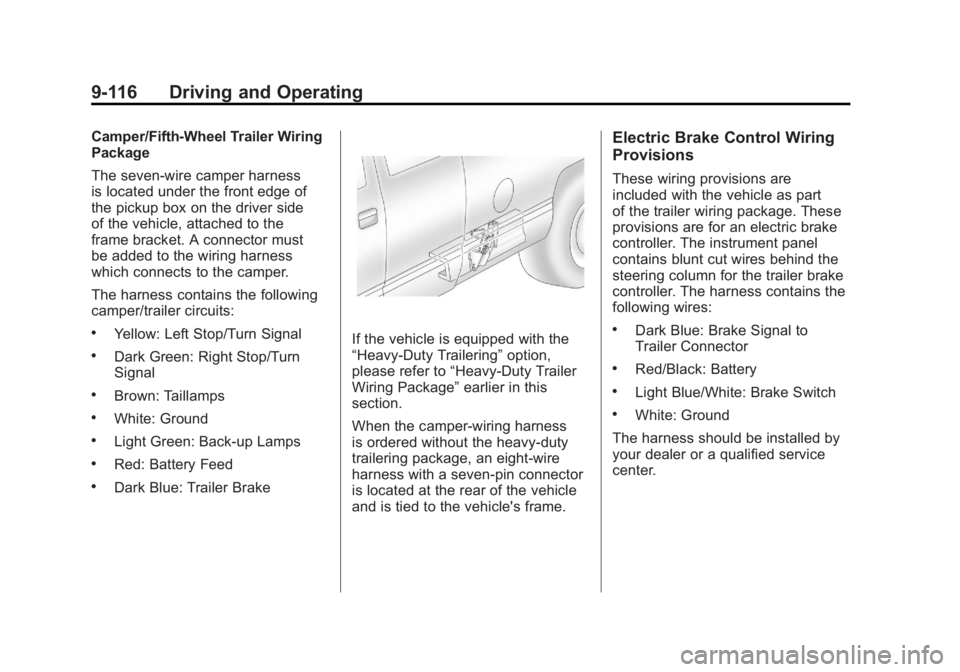
The seven-wire camper harness
is located under the front edge of
the pickup box on the driver side
of the vehicle, attached to the
frame bracket. A connector must
be added to the wiring harness
which connects to the camper.
The harness contains the following
camper/trailer circuits:
.Yellow: Left Stop/Turn Signal
.Dark Green: Right Stop/Turn
Signal
.Brown: Taillamps
.White: Ground
.Light Green: Back-up Lamps
.Red: Battery Feed
.Dark Blue: Trailer Brake
If the vehicle is equipped with the
“Heavy-Duty Trailering”option,
please refer to “Heavy-Duty Trailer
Wiring Package” earlier in this
section.
When the camper-wiring harness
is ordered without the heavy-duty
trailering package, an eight-wire
harness with a seven-pin connector
is located at the rear of the vehicle
and is tied to the vehicle's frame.
Electric Brake Control Wiring
Provisions
These wiring provisions are
included with the vehicle as part
of the trailer wiring package. These
provisions are for an electric brake
controller. The instrument panel
contains blunt cut wires behind the
steering column for the trailer brake
controller. The harness contains the
following wires:
.Dark Blue: Brake Signal to
Trailer Connector
.Red/Black: Battery
.Light Blue/White: Brake Switch
.White: Ground
The harness should be installed by
your dealer or a qualified service
center.
Page 412 of 594
Black plate (118,1)GMC Sierra Owner Manual - 2011
9-118 Driving and Operating
Integrated Trailer Brake
Control System
The vehicle may have an Integrated
Trailer Brake Control (ITBC) system
for electric trailer brakes.
This symbol is located on the
Trailer Brake Control Panel on
vehicles with an Integrated Trailer
Brake Control system. The power
output to the trailer brakes is based
on the amount of brake pressure
being applied by the vehicle’s brake
system. This available power output
to the trailer brakes can be adjusted
to a wide range of trailering
situations.
The ITBC system is integrated
with the vehicle’s brake, antilock
brake, and StabiliTrak (if equipped)
systems. In trailering conditions thatcause the vehicle’s antilock brake
or StabiliTrak systems to activate,
power sent to the trailer's brakes
will be automatically adjusted to
minimize trailer wheel lock-up.
This does not imply that the trailer
has StabiliTrak.
2500 and 3500 series vehicles
with StabiliTrak have a Trailer Sway
Control (TSC) feature. See
Trailer
Sway Control (TSC) on page 9‑124.
2500 and 3500 series vehicles
with StabiliTrak have a Hill Start
Assist (HSA) feature. See Hill Start
Assist (HSA) on page 9‑70.
If the vehicle’s brake, antilock
brake, or StabiliTrak systems are
not functioning properly, the ITBC
system may not be fully functional
or may not function at all. Make
sure all of these systems are
fully operational to ensure full
functionality of the ITBC system.
The ITBC system is powered
through the vehicle's electrical
system. Turning the ignition off
will also turn off the ITBC system. The ITBC system is fully functional
only when the ignition is in ON or
in RUN.
The ITBC system can only be used
with trailers with electric brakes.
{WARNING
Connecting a trailer that is not
compatible with the ITBC system
may result in reduced or complete
loss of trailer braking. There
may be an increase in stopping
distance or trailer instability which
could result in personal injury or
damage to the vehicle, trailer,
or other property. An aftermarket
controller may be available for
use with trailers with surge, air,
or electric‐over‐hydraulic trailer
brake systems. To determine the
type of brakes on the trailer and
the availability of controllers,
check with your trailer
manufacturer or dealer.
Page 416 of 594
Black plate (122,1)GMC Sierra Owner Manual - 2011
9-122 Driving and Operating
Use the following procedure to
correctly adjust Trailer Gain for
each towing condition:
1. Make sure the trailer brakes arein proper working condition.
2. Connect a properly loaded trailer to the vehicle and make
all necessary mechanical
and electrical connections.
See Vehicle Load Limits on
page 9‑25 for more information.
3. After the electrical connection is made to a trailer equipped with
electric brakes:
.A TRAILER CONNECTED
message will be briefly
displayed on the DIC.
.The Trailer Brake Display
Page will appear on the
DIC showing TRAILER
GAIN and TRAILER
OUTPUT.
.In the Trailer Output display
on the DIC, “- - - - - -”will
disappear if there is no
error present. Connecting
a trailer without electric
brakes will not clear the
six dashed lines.
4. Adjust the Trailer Gain by using the gain adjustment (+ / -)
buttons on the Trailer Brake
Control Panel.
5. Drive the vehicle with the trailer attached on a level road
surface representative of the
towing condition and free of
traffic at about 32 to 40 km/h
(20 to 25 mph) and fully apply
the Manual Trailer Brake Apply
Lever.
Adjusting trailer gain at speeds
lower than 32 to 40 km/h
(20 to 25 mph) may result
in an incorrect gain setting. 6. Adjust the Trailer Gain to just
below the point of trailer wheel
lock-up, indicated by trailer
wheel squeal or tire smoke
when a trailer wheel locks.
Trailer wheel lock-up may not
occur if towing a heavily loaded
trailer. In this case, adjust the
Trailer Gain to the highest
allowable setting for the towing
condition.
7. Re-adjust Trailer Gain any time vehicle loading, trailer loading or
road surface conditions change
or if trailer wheel lock-up is
noticed at any time while towing.
Page 421 of 594
Black plate (127,1)GMC Sierra Owner Manual - 2011
Driving and Operating 9-127
Canada
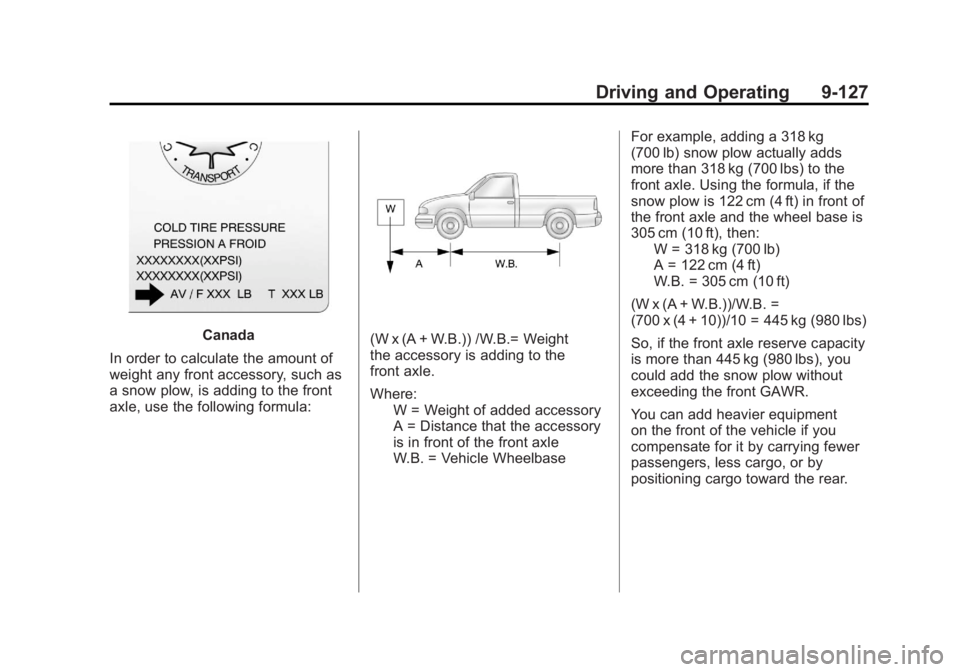
In order to calculate the amount of
weight any front accessory, such as
a snow plow, is adding to the front
axle, use the following formula:(W x (A + W.B.)) /W.B.= Weight
the accessory is adding to the
front axle.
Where: W = Weight of added accessory
A = Distance that the accessory
is in front of the front axle
W.B. = Vehicle Wheelbase For example, adding a 318 kg
(700 lb) snow plow actually adds
more than 318 kg (700 lbs) to the
front axle. Using the formula, if the
snow plow is 122 cm (4 ft) in front of
the front axle and the wheel base is
305 cm (10 ft), then:
W = 318 kg (700 lb)
A = 122 cm (4 ft)
W.B. = 305 cm (10 ft)
(W x (A + W.B.))/W.B. =
(700 x (4 + 10))/10 = 445 kg (980 lbs)
So, if the front axle reserve capacity
is more than 445 kg (980 lbs), you
could add the snow plow without
exceeding the front GAWR.
You can add heavier equipment
on the front of the vehicle if you
compensate for it by carrying fewer
passengers, less cargo, or by
positioning cargo toward the rear.
Page 425 of 594
Black plate (1,1)GMC Sierra Owner Manual - 2011
Vehicle Care 10-1
Vehicle Care
General Information
General Information . . . . . . . . . . 10-2
California Proposition65 Warning . . . . . . . . . . . . . . . . . 10-3
California Perchlorate Materials Requirements . . . . 10-3
Accessories and Modifications . . . . . . . . . . . . . . . 10-3
Vehicle Checks
Doing Your OwnService Work . . . . . . . . . . . . . . . 10-4
Hood . . . . . . . . . . . . . . . . . . . . . . . . 10-5
Engine Compartment Overview . . . . . . . . . . . . . . . . . . . 10-6
Engine Oil . . . . . . . . . . . . . . . . . . . 10-7
Engine Oil Life System . . . . . 10-11
Automatic Transmission Fluid (4-Speed
Transmission) . . . . . . . . . . . . . 10-13
Automatic Transmission Fluid (6-Speed
Transmission) . . . . . . . . . . . . . 10-16
Engine Air Cleaner/Filter . . . . 10-19
Cooling System . . . . . . . . . . . . 10-20
Engine Coolant . . . . . . . . . . . . . 10-22 Engine Overheating . . . . . . . . 10-25
Overheated Engine
Protection
Operating Mode . . . . . . . . . . . 10-28
Engine Fan . . . . . . . . . . . . . . . . . 10-28
Power Steering Fluid . . . . . . . 10-29
Washer Fluid . . . . . . . . . . . . . . . 10-29
Brakes . . . . . . . . . . . . . . . . . . . . . 10-30
Brake Fluid . . . . . . . . . . . . . . . . . 10-32
Battery . . . . . . . . . . . . . . . . . . . . . 10-34
Four-Wheel Drive . . . . . . . . . . . 10-34
Front Axle . . . . . . . . . . . . . . . . . . 10-36
Rear Axle . . . . . . . . . . . . . . . . . . 10-37
Noise Control System . . . . . . 10-38
Starter Switch Check . . . . . . . 10-39
Automatic Transmission Shift
Lock Control Function
Check . . . . . . . . . . . . . . . . . . . . . 10-40
Ignition Transmission Lock Check . . . . . . . . . . . . . . . . . . . . . 10-40
Park Brake and P (Park) Mechanism Check . . . . . . . . 10-40
Wiper Blade Replacement . . . . . . . . . . . . . . 10-41
Glass Replacement . . . . . . . . 10-41
Headlamp Aiming
Headlamp Aiming . . . . . . . . . . 10-42
Bulb Replacement
Bulb Replacement . . . . . . . . . . 10-44
Halogen Bulbs . . . . . . . . . . . . . . 10-44
Headlamps . . . . . . . . . . . . . . . . . 10-44
Pick-Up Box Identification and Fender Marker
Lamps . . . . . . . . . . . . . . . . . . . . 10-45
Taillamps (Chassis Cab Models) . . . . . . . . . . . . . . . . . . . 10-46
Taillamps, Turn Signal, Stoplamps, and Back-Up
Lamps . . . . . . . . . . . . . . . . . . . . 10-46
Center High-Mounted Stoplamp (CHMSL) and
Cargo Lamp . . . . . . . . . . . . . . 10-47
License Plate Lamp . . . . . . . . 10-48
Replacement Bulbs . . . . . . . . . 10-48
Electrical System
Electrical System Overload . . . . . . . . . . . . . . . . . . 10-49
Fuses and Circuit Breakers . . . . . . . . . . . . . . . . . . 10-50
Engine Compartment Fuse Block . . . . . . . . . . . . . . . . . . . . . 10-50
Instrument Panel Fuse Block . . . . . . . . . . . . . . . . . . . . . 10-54
Page 426 of 594
Black plate (2,1)GMC Sierra Owner Manual - 2011
10-2 Vehicle Care
Wheels and Tires
Tires . . . . . . . . . . . . . . . . . . . . . . . . 10-57
Tire Sidewall Labeling . . . . . . 10-58
Tire Designations . . . . . . . . . . . 10-61
Tire Terminology andDefinitions . . . . . . . . . . . . . . . . 10-62
Tire Pressure . . . . . . . . . . . . . . . 10-66
Tire Pressure for High-Speed Operation . . . . . . . . . . . . . . . . . 10-67
Tire Pressure Monitor System . . . . . . . . . . . . . . . . . . . 10-68
Tire Pressure Monitor Operation . . . . . . . . . . . . . . . . . 10-69
Tire Inspection . . . . . . . . . . . . . . 10-73
Tire Rotation . . . . . . . . . . . . . . . 10-73
Dual Tire Rotation . . . . . . . . . . 10-75
When It Is Time for New Tires . . . . . . . . . . . . . . . . . . . . . . 10-76
Buying New Tires . . . . . . . . . . . 10-77
Different Size Tires and Wheels . . . . . . . . . . . . . . . . . . . 10-79 Uniform Tire Quality
Grading . . . . . . . . . . . . . . . . . . . 10-80
Wheel Alignment and Tire Balance . . . . . . . . . . . . . . . . . . . 10-81
Wheel Replacement . . . . . . . . 10-82
Tire Chains . . . . . . . . . . . . . . . . . 10-83
If a Tire Goes Flat . . . . . . . . . . 10-84
Tire Changing . . . . . . . . . . . . . . 10-86
Full-Size Spare Tire . . . . . . . . 10-97
Jump Starting
Jump Starting . . . . . . . . . . . . . . 10-98
Towing
Towing the Vehicle . . . . . . . . 10-103
Recreational Vehicle
Towing . . . . . . . . . . . . . . . . . . . 10-103
Appearance Care
Exterior Care . . . . . . . . . . . . . . 10-108
Interior Care . . . . . . . . . . . . . . . 10-112
Floor Mats . . . . . . . . . . . . . . . . . 10-116
General Information
For service and parts needs,
visit your dealer. You will receive
genuine GM parts and GM-trained
and supported service people.
Genuine GM parts have one of
these marks: