radio GMC SIERRA 1500 2011 Manual PDF
[x] Cancel search | Manufacturer: GMC, Model Year: 2011, Model line: SIERRA 1500, Model: GMC SIERRA 1500 2011Pages: 594, PDF Size: 7.88 MB
Page 474 of 594
Black plate (50,1)GMC Sierra Owner Manual - 2011
10-50 Vehicle Care
Fuses and Circuit
Breakers
If the vehicle is a hybrid, see
the hybrid supplement for more
information.
The wiring circuits in the vehicle
are protected from short circuits
by a combination of fuses, circuit
breakers and fusible thermal links.
This greatly reduces the chance of
fires caused by electrical problems.
Look at the silver-colored band
inside the fuse. If the band is broken
or melted, replace the fuse. Be sure
you replace a bad fuse with a new
one of the identical size and rating.
If you ever have a problem on the
road and don't have a spare fuse,
you can borrow one that has the
same amperage. Just pick somefeature of your vehicle that you can
get along without
–like the radio
or cigarette lighter –and use its
fuse, if it is the correct amperage.
Replace it as soon as you can.
Engine Compartment
Fuse Block
If the vehicle has a diesel engine,
see the Duramax Diesel supplement
for more information.
If the vehicle is a hybrid, see
the hybrid supplement for more
information.
The Engine Compartment Fuse
Block is located in the engine
compartment, on the driver side
of the vehicle.
Lift the cover to access the fuse
block.
Notice: Spilling liquid on any
electrical component on the
vehicle may damage it. Always
keep the covers on any electrical
component.
To remove fuses, hold the end of
the fuse between your thumb and
index finger and pull straight out.
Page 492 of 594
Black plate (68,1)GMC Sierra Owner Manual - 2011
10-68 Vehicle Care
When you end this high‐speed
driving, return the tires to the cold
inflation pressure shown on the
Tire and Loading Information
label. SeeVehicle Load Limits on
page 9‑25 andTire Pressure on
page 10‑66.
Tire Pressure Monitor
System
The Tire Pressure Monitor System
(TPMS) uses radio and sensor
technology to check tire pressure
levels. The TPMS sensors monitor
the air pressure in your tires and
transmit tire pressure readings to
a receiver located in the vehicle.
Each tire, including the spare
(if provided), should be checked
monthly when cold and inflated to
the inflation pressure recommended
by the vehicle manufacturer on the
vehicle placard or tire inflation pressure label. (If your vehicle has
tires of a different size than the size
indicated on the vehicle placard or
tire inflation pressure label, you
should determine the proper tire
inflation pressure for those tires.)
As an added safety feature, your
vehicle has been equipped with a
tire pressure monitoring system
(TPMS) that illuminates a low
tire pressure telltale when one or
more of your tires is significantly
under‐inflated.
Accordingly, when the low tire
pressure telltale illuminates, you
should stop and check your tires as
soon as possible, and inflate them
to the proper pressure. Driving on
a significantly under‐inflated tire
causes the tire to overheat and can
lead to tire failure. Under‐inflation
also reduces fuel efficiency and
tire tread life, and may affect the
vehicle's handling and stopping
ability.Please note that the TPMS is
not a substitute for proper tire
maintenance, and it is the driver's
responsibility to maintain correct tire
pressure, even if under‐inflation
has not reached the level to trigger
illumination of the TPMS low tire
pressure telltale.
Your vehicle has also been
equipped with a TPMS malfunction
indicator to indicate when the
system is not operating properly.
The TPMS malfunction indicator is
combined with the low tire pressure
telltale. When the system detects a
malfunction, the telltale will flash for
approximately one minute and then
remain continuously illuminated.
This sequence will continue upon
subsequent vehicle start‐ups as
long as the malfunction exists.
Page 493 of 594
Black plate (69,1)GMC Sierra Owner Manual - 2011
Vehicle Care 10-69
When the malfunction indicator
is illuminated, the system may
not be able to detect or signal low
tire pressure as intended. TPMS
malfunctions may occur for a variety
of reasons, including the installation
of replacement or alternate tires or
wheels on the vehicle that prevent
the TPMS from functioning properly.
Always check the TPMS malfunction
telltale after replacing one or more
tires or wheels on your vehicle to
ensure that the replacement or
alternate tires and wheels allow
the TPMS to continue to function
properly.
SeeTire Pressure Monitor
Operation on page 10‑69 for
additional information.Federal Communications
Commission (FCC) and
Industry Canada
See Radio Frequency Statement on
page 13‑19 for information
regarding Part 15 of the Federal
Communications Commission
(FCC) rules and Industry Canada
Standards RSS-210/220/310.
Tire Pressure Monitor
Operation
This vehicle may have a Tire
Pressure Monitor System (TPMS).
The TPMS is designed to warn the
driver when a low tire pressure
condition exists. TPMS sensors are
mounted onto each tire and wheel
assembly, excluding the spare tire
and wheel assembly. The TPMS
sensors monitor the air pressure
in the tires and transmit the tire
pressure readings to a receiver
located in the vehicle.
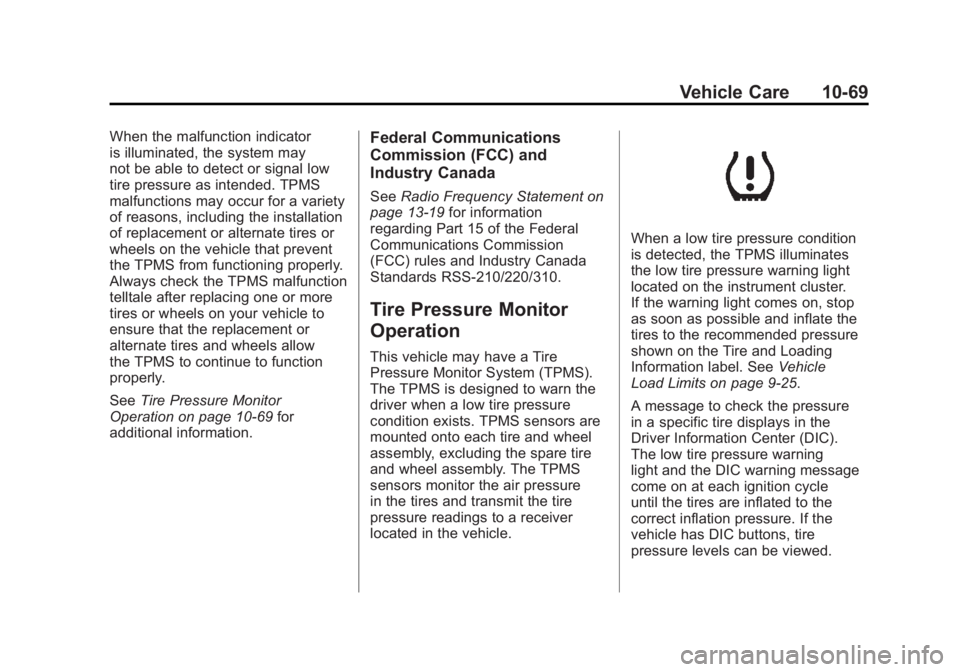
When a low tire pressure condition
is detected, the TPMS illuminates
the low tire pressure warning light
located on the instrument cluster.
If the warning light comes on, stop
as soon as possible and inflate the
tires to the recommended pressure
shown on the Tire and Loading
Information label. See Vehicle
Load Limits on page 9‑25.
A message to check the pressure
in a specific tire displays in the
Driver Information Center (DIC).
The low tire pressure warning
light and the DIC warning message
come on at each ignition cycle
until the tires are inflated to the
correct inflation pressure. If the
vehicle has DIC buttons, tire
pressure levels can be viewed.
Page 495 of 594
Black plate (71,1)GMC Sierra Owner Manual - 2011
Vehicle Care 10-71
.The TPMS sensor matching
process was not done or
not completed successfully
after rotating the tires. The
malfunction light and the DIC
message should go off after
successfully completing the
sensor matching process.
See "TPMS Sensor Matching
Process" later in this section.
.One or more TPMS sensors
are missing or damaged.
The malfunction light and
the DIC message should go
off when the TPMS sensors
are installed and the sensor
matching process is performed
successfully. See your dealer
for service.
.Replacement tires or wheels do
not match the original equipment
tires or wheels. Tires and wheels
other than those recommended
could prevent the TPMS from
functioning properly. SeeBuying
New Tires on page 10‑77.
.Operating electronic devices or
being near facilities using radio
wave frequencies similar to the
TPMS could cause the TPMS
sensors to malfunction.
If the TPMS is not functioning
properly, it cannot detect or signal a
low tire condition. See your dealer
for service if the TPMS malfunction
light and DIC message come on
and stay on.
TPMS Sensor Matching
Process
Each TPMS sensor has a unique
identification code. The identification
code needs to be matched to a
new tire/wheel position after rotating
the vehicle’ s tires or replacing
one or more of the TPMS sensors.
Also, the TPMS sensor matching
process should be performed after
replacing a spare tire with a road
tire containing the TPMS sensor.
The malfunction light and the DIC
message should go off at the next
ignition cycle. The sensors are
matched to the tire/wheel positions,
using a TPMS relearn tool, in the
following order: driver side front tire,
passenger side front tire, passenger
side rear tire, and driver side rear.
See your dealer for service or to
purchase a relearn tool.
Page 523 of 594
Black plate (99,1)GMC Sierra Owner Manual - 2011
Vehicle Care 10-99
3. Get the vehicles close enoughso the jumper cables can reach,
but be sure the vehicles are not
touching each other. If they are,
it could cause an unwanted
ground connection. You would
not be able to start your vehicle,
and the bad grounding could
damage the electrical systems.
To avoid the possibility of the
vehicles rolling, set the parking
brake firmly on both vehicles
involved in the jump start
procedure. Put the automatic
transmission in P (Park) or a
manual transmission in Neutral
before setting the parking brake.
If you have a four-wheel-drive
vehicle, be sure the transfer
case is in a drive gear, not in
Neutral.
Notice: If the radio or other
accessories are left on during
the jump starting procedure, they
could be damaged. The repairs would not be covered by the
warranty. Always turn off the
radio and other accessories
when jump starting the vehicle.
4. Turn off the ignition on both
vehicles. Unplug unnecessary
accessories plugged into the
cigarette lighter or the accessory
power outlets. Turn off the radio
and all the lamps that are not
needed. This will avoid sparks
and help save both batteries.
And it could save the radio!
5. Open the hood on the other vehicle and locate the
positive (+) and negative (−)
terminal locations on that
vehicle.
The positive (+) terminal, is
located under a red plastic
cover at the positive battery
post. To uncover the positive (+)
terminal, open the red plastic
cover.
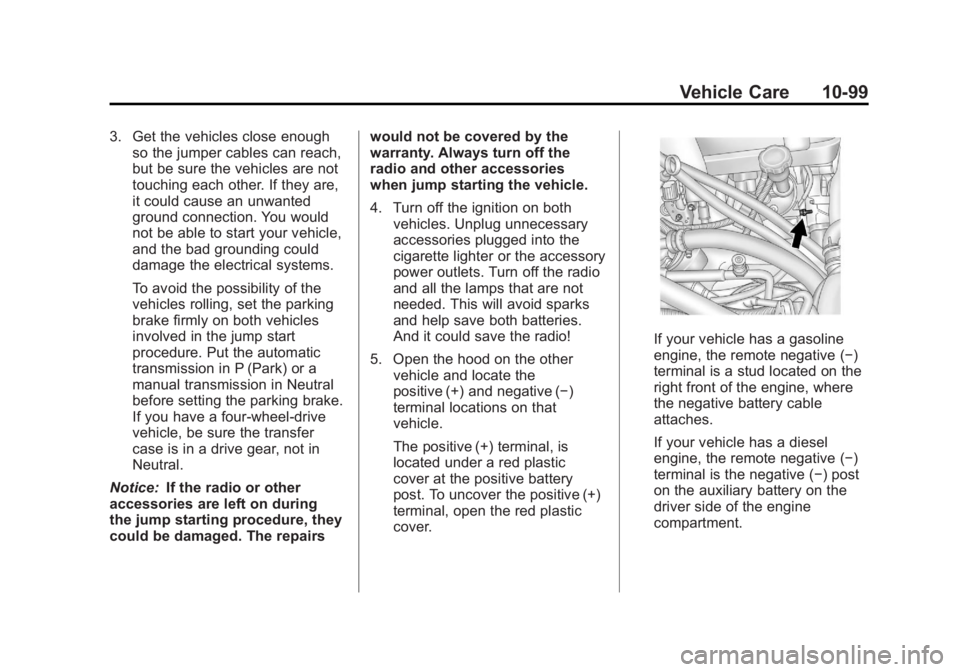
If your vehicle has a gasoline
engine, the remote negative (−)
terminal is a stud located on the
right front of the engine, where
the negative battery cable
attaches.
If your vehicle has a diesel
engine, the remote negative (−)
terminal is the negative (−) post
on the auxiliary battery on the
driver side of the engine
compartment.
Page 561 of 594
Black plate (1,1)GMC Sierra Owner Manual - 2011
Customer Information 13-1
Customer
Information
Customer Information
Customer SatisfactionProcedure
(U.S. and Canada) . . . . . . . . . 13-1
Customer Satisfaction Procedure (Mexico) . . . . . . . . 13-3
Customer Assistance Offices (U.S. and Canada) . . . . . . . . . 13-5
Customer Assistance Offices (Mexico) . . . . . . . . . . . . . . . . . . . . 13-5
Customer Assistance for Text Telephone (TTY) Users
(U.S. and Canada) . . . . . . . . . 13-6
Online Owner Center . . . . . . . . 13-6
GM Mobility Reimbursement Program
(U.S. and Canada) . . . . . . . . . 13-7
Roadside Assistance Program (U.S. and Canada) . . . . . . . . . 13-8
Roadside Assistance Program (Mexico) . . . . . . . . . 13-10
Scheduling Service Appointments
(U.S. and Canada) . . . . . . . . 13-10 Courtesy Transportation
Program (U.S. and
Canada) . . . . . . . . . . . . . . . . . . . 13-11
Collision Damage Repair (U.S. and Canada) . . . . . . . . 13-12
Service Publications Ordering Information . . . . . . 13-15
Reporting Safety Defects
Reporting Safety Defects tothe United States
Government . . . . . . . . . . . . . . . 13-16
Reporting Safety Defects to the Canadian
Government . . . . . . . . . . . . . . . 13-16
Reporting Safety Defects to General Motors . . . . . . . . . . . 13-17
Vehicle Data Recording and
Privacy
Vehicle Data Recording and
Privacy . . . . . . . . . . . . . . . . . . . . 13-17
Event Data Recorders . . . . . . 13-17
OnStar
®. . . . . . . . . . . . . . . . . . . . 13-18
Navigation System . . . . . . . . . 13-18
Radio Frequency Identification (RFID) . . . . . . . 13-19
Radio Frequency Statement . . . . . . . . . . . . . . . . . 13-19
Customer Information
Customer Satisfaction
Procedure (U.S. and
Canada)
Your satisfaction and goodwill
are important to the dealer and
to GMC. Normally, any concerns
with the sales transaction or the
operation of the vehicle will be
resolved by the dealer's sales or
service departments. Sometimes,
however, despite the best intentions
of all concerned, misunderstandings
can occur. If your concern has not
been resolved to your satisfaction,
the following steps should be taken:
STEP ONE: Discuss your concern
with a member of dealership
management. Normally, concerns
can be quickly resolved at that
level. If the matter has already
been reviewed with the sales,
service, or parts manager, contact
the owner of the dealership or the
general manager.
Page 577 of 594
Black plate (17,1)GMC Sierra Owner Manual - 2011
Customer Information 13-17
Reporting Safety Defects
to General Motors
In addition to notifying NHTSA (or
Transport Canada) in a situation like
this, please notify General Motors.
Call 1-800-GMC-8782
(1-800-462-8782), or write:
GMC Customer Assistance Center
P.O. Box 33172
Detroit, MI 48232-5172
In Canada, call 1-800-263-3777
(English) or 1-800-263-7854
(French), or write:
General Motors of Canada Limited
Customer Communication Centre,
Mail Code: CA1-163-005
1908 Colonel Sam Drive
Oshawa, Ontario L1H 8P7
Vehicle Data
Recording and
Privacy
This GM vehicle has a number of
sophisticated computers that record
information about the vehicle’s
performance and how it is driven.
For example, the vehicle uses
computer modules to monitor and
control engine and transmission
performance, to monitor the
conditions for airbag deployment
and deploy airbags in a crash, and,
if so equipped, to provide antilock
braking to help the driver control the
vehicle. These modules may store
data to help the dealer technician
service the vehicle. Some modules
may also store data about how you
operate the vehicle, such as rate of
fuel consumption or average speed.
These modules may also retain the
owner’s personal preferences, such
as radio pre-sets, seat positions,
and temperature settings.
Event Data Recorders
This vehicle has an Event Data
Recorder (EDR). The main purpose
of an EDR is to record, in certain
crash or near crash-like situations,
such as an airbag deployment or
hitting a road obstacle, data that
will assist in understanding how
a vehicle's systems performed.
The EDR is designed to record data
related to vehicle dynamics and
safety systems for a short period of
time, typically 30 seconds or less.
The EDR in this vehicle is designed
to record such data as:
.How various systems in the
vehicle were operating.
.Whether or not the driver and
passenger safety belts were
buckled/fastened.
.How far, if at all, the driver was
pressing the accelerator and/or
brake pedal.
.How fast the vehicle was
traveling.
Page 579 of 594
Black plate (19,1)GMC Sierra Owner Manual - 2011
Customer Information 13-19
Radio Frequency
Identification (RFID)
RFID technology is used in some
vehicles for functions such as tire
pressure monitoring and ignition
system security, as well as in
connection with conveniences
such as key fobs for remote door
locking/unlocking and starting, and
in-vehicle transmitters for garage
door openers. RFID technology in
GM vehicles does not use or record
personal information or link with
any other GM system containing
personal information.
Radio Frequency
Statement
This vehicle has systems that
operate on a radio frequency that
comply with Part 15 of the Federal
Communications Commission (FCC)
rules and with Industry Canada
Standards RSS‐210/220/310.
Operation is subject to the following
two conditions:
1. The device may not causeinterference.
2. The device must accept any interference received, including
interference that may cause
undesired operation of the
device.
Changes or modifications to any
of these systems by other than an
authorized service facility could void
authorization to use this equipment.
Page 581 of 594
Black plate (1,1)GMC Sierra Owner Manual - 2011
INDEX i-1
A
Accessories andModifications . . . . . . . . . . . . . . . . . 10-3
Accessory Power . . . . . . . . . . . . . . 9-40
Active Fuel Management
®. . . . . 9-44
Add-On Electrical Equipment . . . . . . . . . . . . . . . . . . 9-125
Adding a Snow Plow or Similar Equipment . . . . . . . . . . . 9-125
Adjustable Throttle and Brake Pedal . . . . . . . . . . . . . . . . . . 9-35
Adjustments Lumbar, Front Seats . . . . . . . . . . . 3-6
Air Cleaner/Filter, Engine . . . . . 10-19
Air Vents . . . . . . . . . . . . . . . . . . . . . . 8-11
Airbag Light On-Off . . . . . . . . . . . . . . . . . . 5-21
Airbag System Check . . . . . . . . . . . . . . . . . . . . . . . . 3-48
How Does an AirbagRestrain? . . . . . . . . . . . . . . . . . . . 3-35
Passenger Sensing System . . . . . . . . . . . . . . . . . . . . . . 3-40
What Makes an Airbag Inflate? . . . . . . . . . . . . . . . . . . . . . . 3-34 Airbag System (cont.)
What Will You See After
an Airbag Inflates? . . . . . . . . . . 3-35
When Should an Airbag
Inflate? . . . . . . . . . . . . . . . . . . . . . . 3-32
Where Are the Airbags? . . . . . . 3-31
Airbags Adding Equipment to theVehicle . . . . . . . . . . . . . . . . . . . . . . 3-46
On-Off Light . . . . . . . . . . . . . . . . . . 5-21
On-Off Switch . . . . . . . . . . . . . . . . 3-37
Passenger Status Indicator . . . 5-23
Readiness Light . . . . . . . . . . . . . . 5-20
Servicing Airbag-Equipped Vehicles . . . . . . . . . . . . . . . . . . . . . 3-46
System Check . . . . . . . . . . . . . . . . 3-29
Alarm System Anti-Theft . . . . . . . . . . . . . . . . . . . . . 2-12
AM-FM Radio . . . . . . . . . . . . . . . . . . . 7-8
Antenna Satellite Radio . . . . . . . . . . . . . . . . 7-15
Anti-Theft Alarm System . . . . . . . . . . . . . . . . 2-12
Alarm System Messages . . . . . 5-48 Antilock Brake
System (ABS) . . . . . . . . . . . . . . . . 9-68
Warning Light . . . . . . . . . . . . . . . . . 5-28
Appearance Care Exterior . . . . . . . . . . . . . . . . . . . . 10-108
Interior . . . . . . . . . . . . . . . . . . . . . 10-112
Armrest Storage . . . . . . . . . . . . . . . . 4-1
Ashtrays . . . . . . . . . . . . . . . . . . . . . . . 5-12
Assistance Program,
Roadside . . . . . . . . . . . . . . 13-8, 13-10
Audio Players . . . . . . . . . . . . . . . . . 7-15
CD . . . . . . . . . . . . . . . . . . . . . . . . . . . 7-15
CD/DVD . . . . . . . . . . . . . . . . . . . . . . 7-22
Audio System Fixed Mast Antenna . . . . . . . . . . 7-15
Radio Reception . . . . . . . . . . . . . . 7-14
Rear Seat (RSA) . . . . . . . . . . . . . 7-48
Theft-Deterrent Feature . . . . . . . . 7-2
Automatic Door Locks . . . . . . . . . . . . . . . . . . . . 2-9
Headlamp System . . . . . . . . . . . . . 6-4
Automatic Transmission . . . . . . . 9-46 Fluid . . . . . . . . . . . . . . . . . 10-13, 10-16
Manual Mode . . . . . . . . . . . . . . . . . 9-50
Shift Lock ControlFunction Check . . . . . . . . . . . 10-40
Page 590 of 594
Black plate (10,1)GMC Sierra Owner Manual - 2011
i-10 INDEX
Passenger Airbag StatusIndicator . . . . . . . . . . . . . . . . . . . . . 5-23
Passenger Sensing System . . . 3-40
Perchlorate Materials Requirements, California . . . . . 10-3
Personalization Vehicle . . . . . . . . . . . . . . . . . . . . . . . 5-52
Phone Bluetooth . . . . . . . . . . . . . . . . . . . . . 7-50
Pickup Conversion to Chassis Cab . . . . . . . . . . . . . . . . 9-129
Pickup-Box Identification and Fender Marker
Lamps . . . . . . . . . . . . . . . . . . . . . . 10-45
Power Door Locks . . . . . . . . . . . . . . . . . . . . 2-8
Mirrors . . . . . . . . . . . . . . . . . . . . . . . . 2-16
Outlets . . . . . . . . . . . . . . . . . . . . . . . 5-10
Protection, Battery . . . . . . . . . . . . 6-10
Retained Accessory (RAP) . . . 9-40
Seat Adjustment . . . . . . . . . . . . . . . 3-4
Steering Fluid . . . . . . . . . . . . . . . 10-29
Windows . . . . . . . . . . . . . . . . . . . . . 2-19 Pregnancy, Using Safety
Belts . . . . . . . . . . . . . . . . . . . . . . . . . 3-26
Privacy Radio FrequencyIdentification (RFID) . . . . . . . 13-19
Program Courtesy Transportation . . . . .13-11
Proposition 65 Warning, California . . . . . . . . . . . . . . . . . . . . . 10-3
R
Radio FrequencyIdentification (RFID) . . . . . . . . 13-19
Statement . . . . . . . . . . . . . . . . . . 13-19
Radios AM-FM Radio . . . . . . . . . . . . . . . . . . 7-8
CD/DVD Player . . . . . . . . . . . . . . . 7-22
Reception . . . . . . . . . . . . . . . . . . . . 7-14
Satellite . . . . . . . . . . . . . . . . . . . . . . . 7-10
Reading Lamps . . . . . . . . . . . . . . . . . 6-9
Rear Axle . . . . . . . . . . . . . . . . . . . . . 10-37 Locking . . . . . . . . . . . . . . . . . . . . . . . 9-73 Rear Doors . . . . . . . . . . . . . . . . . . . . 2-10
Rear Seat Audio (RSA)
System . . . . . . . . . . . . . . . . . . . . . . . 7-48
Rear Seat Entertainment System . . . . . . . . . . . . . . . . . . . . . . . 7-39
Rear Seat Audio (RSA) . . . . . . . 7-48
Rear Seats . . . . . . . . . . . . . . 3-10, 3-11
Rear Vision Camera (RVC) . . . . 9-78
Rear Windows . . . . . . . . . . . . . . . . . 2-20
Rearview Mirrors . . . . . . . . . . . . . . 2-18 Automatic Dimming . . . . . . . . . . . 2-18
Reclining Seatbacks . . . . . . . . . . . . 3-6
Recommended Fluids and Lubricants . . . . . . . . . . . . . . . . . . . . 11-8
Recommended Fuel . . . . . . . . . . . 9-84
Records Maintenance . . . . . . . . . . . . . . . . .11-12
Recreational Vehicle Towing . . . . . . . . . . . . . . . . . . . . .10-103
Reimbursement Program, GM Mobility . . . . . . . . . . . . . . . . . . 13-7
Remote Keyless Entry (RKE) System . . . . . . . . . . . . . . . . . . . . . . . . 2-3