tire type GMC SIERRA 1500 2011 Owners Manual
[x] Cancel search | Manufacturer: GMC, Model Year: 2011, Model line: SIERRA 1500, Model: GMC SIERRA 1500 2011Pages: 594, PDF Size: 7.88 MB
Page 300 of 594
Black plate (6,1)GMC Sierra Owner Manual - 2011
9-6 Driving and Operating
Loss of Control
Let us review what driving experts
say about what happens when the
three control systems—brakes,
steering, and acceleration —do not
have enough friction where the tires
meet the road to do what the driver
has asked.
In any emergency, do not give up.
Keep trying to steer and constantly
seek an escape route or area of
less danger.
Skidding
In a skid, a driver can lose control of
the vehicle. Defensive drivers avoid
most skids by taking reasonable
care suited to existing conditions,
and by not overdriving those
conditions. But skids are always
possible. The three types of skids correspond
to the vehicle's three control
systems. In the braking skid,
the wheels are not rolling. In the
steering or cornering skid, too much
speed or steering in a curve causes
tires to slip and lose cornering force.
And in the acceleration skid, too
much throttle causes the driving
wheels to spin.
If the vehicle starts to slide, ease
your foot off the accelerator pedal
and quickly steer the way you
want the vehicle to go. If you start
steering quickly enough, the vehicle
may straighten out. Always be ready
for a second skid if it occurs.
Of course, traction is reduced when
water, snow, ice, gravel, or other
material is on the road. For safety,
slow down and adjust your driving to
these conditions. It is important to
slow down on slippery surfaces
because stopping distance is longer
and vehicle control more limited.
While driving on a surface with
reduced traction, try to avoid
sudden steering, acceleration,
or braking, including reducing
vehicle speed by shifting to a lower
gear. Any sudden changes could
cause the tires to slide. You might
not realize the surface is slippery
until the vehicle is skidding. Learn
to recognize warning clues
—such
as enough water, ice, or packed
snow on the road to make a
mirrored surface —and slow
down when you have any doubt.
Remember: Antilock brakes help
avoid only the braking skid.
Page 313 of 594
Black plate (19,1)GMC Sierra Owner Manual - 2011
Driving and Operating 9-19
Driving on Wet Roads
Rain and wet roads can reduce
vehicle traction and affect your
ability to stop and accelerate.
Always drive slower in these types
of driving conditions and avoid
driving through large puddles and
deep‐standing or flowing water.
{WARNING
Wet brakes can cause crashes.
They might not work as well in
a quick stop and could cause
pulling to one side. You could
lose control of the vehicle.(Continued)
WARNING (Continued)
After driving through a large
puddle of water or a car/vehicle
wash, lightly apply the brake
pedal until the brakes work
normally.
Flowing or rushing water creates
strong forces. Driving through
flowing water could cause the
vehicle to be carried away. If this
happens, you and other vehicle
occupants could drown. Do not
ignore police warnings and be
very cautious about trying to
drive through flowing water.
Hydroplaning
Hydroplaning is dangerous. Water
can build up under the vehicle's
tires so they actually ride on the
water. This can happen if the road
is wet enough and you are going
fast enough. When the vehicle is
hydroplaning, it has little or no
contact with the road.
There is no hard and fast rule about
hydroplaning. The best advice is to
slow down when the road is wet.
Page 405 of 594
Black plate (111,1)GMC Sierra Owner Manual - 2011
Driving and Operating 9-111
Vehicle Series Hitch TypeMaximum Tongue
Weight
1500 Weight Carrying 272 kg (600 lbs)
2500HD/3500 Weight Carrying 453 kg (1,000 lbs)
1500 Weight Distributing 499 kg (1,100 lbs)
2500HD/3500 Weight Distributing 680 kg (1,500 lbs)
1500 Fifth-Wheel Gooseneck 680 kg (1,500 lbs)
2500HD Fifth-Wheel Gooseneck 1 134 kg (2,500 lbs)
3500 Single Rear
Wheels Fifth-Wheel Gooseneck 1 360 kg (3,000 lbs)
3500 Dual Rear
Wheels Fifth-Wheel Gooseneck 1 587 kg (3,500 lbs)
Do not exceed the maximum
allowable tongue weight for the
vehicle. Choose the shortest hitch
extension that will position the hitch
ball closest to the vehicle. This will
help reduce the effect of trailer
tongue weight on the rear axle. Trailering may be limited by the
vehicle's ability to carry tongue
weight. Tongue or kingpin weight
cannot cause the vehicle to exceed
the GVWR (Gross Vehicle Weight
Rating) or the RGAWR (Rear Gross
Axle Weight Rating). See
“Total
Weight on the Vehicle's Tires” later
in this section for more information. After loading the trailer, weigh
the trailer and then the tongue,
separately, to see if the weights are
proper. If they are not, adjustments
might be made by moving some
items around in the trailer.
Total Weight on the Vehicle's
Tires
Be sure the vehicle's tires are
inflated to the inflation pressures
found on the Certification Tire label
on the drivers door or see
Vehicle
Load Limits on page 9‑25 for more
information. Make sure not to
exceed the GVWR limit for the
vehicle, or the RGAWR, with the
tow vehicle and trailer fully loaded
for the trip including the weight
of the trailer tongue. If using a
weight-distributing hitch, make
sure not to exceed the RGAWR
before applying the weight
distribution spring bars.
Page 482 of 594
Black plate (58,1)GMC Sierra Owner Manual - 2011
10-58 Vehicle Care
20‐Inch Tires
If your vehicle has the optional
20‐inch P275/55R20 size tires,
they are classified as touring
tires and are designed for
on road use. The low‐profile,
wide tread design is not
recommended for“off‐road”
driving or commercial uses
such as snow plowing. See
Off-Road Driving on page 9‑7
and Adding a Snow Plow
or Similar Equipment on
page 9‑125 for additional
information.
Notice: If the vehicle has
low‐profile tires, they are more
susceptible to damage from
road hazards or curb impact
than standard profile tires. Tire and/or wheel assembly
damage can occur when
coming into contact with
road hazards like, potholes,
or sharp edged objects,
or when sliding into a curb.
The vehicle warranty does
not cover this type of damage.
Keep tires set to the correct
inflation pressure and, when
possible avoid contact with
curbs, potholes, and other
road hazards.
Tire Sidewall Labeling
Useful information about a
tire is molded into the sidewall.
The following illustrations are
examples of a typical P‐Metric
and a LT‐Metric tire sidewall.
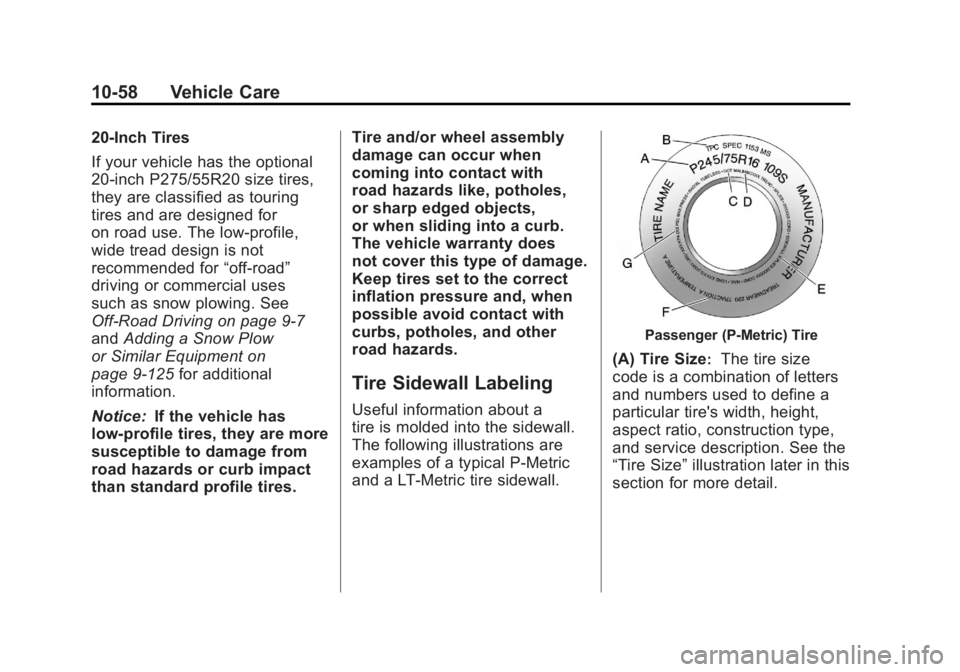
Passenger (P‐Metric) Tire
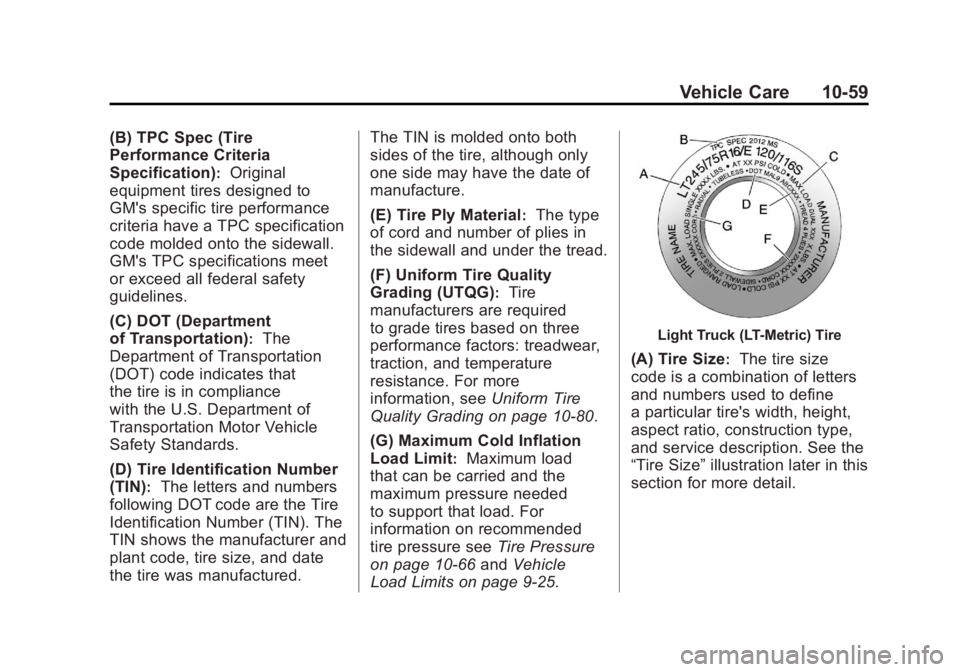
(A) Tire Size:The tire size
code is a combination of letters
and numbers used to define a
particular tire's width, height,
aspect ratio, construction type,
and service description. See the
“Tire Size” illustration later in this
section for more detail.
Page 483 of 594
Black plate (59,1)GMC Sierra Owner Manual - 2011
Vehicle Care 10-59
(B) TPC Spec (Tire
Performance Criteria
Specification)
:Original
equipment tires designed to
GM's specific tire performance
criteria have a TPC specification
code molded onto the sidewall.
GM's TPC specifications meet
or exceed all federal safety
guidelines.
(C) DOT (Department
of Transportation)
:The
Department of Transportation
(DOT) code indicates that
the tire is in compliance
with the U.S. Department of
Transportation Motor Vehicle
Safety Standards.
(D) Tire Identification Number
(TIN)
:The letters and numbers
following DOT code are the Tire
Identification Number (TIN). The
TIN shows the manufacturer and
plant code, tire size, and date
the tire was manufactured. The TIN is molded onto both
sides of the tire, although only
one side may have the date of
manufacture.
(E) Tire Ply Material
:The type
of cord and number of plies in
the sidewall and under the tread.
(F) Uniform Tire Quality
Grading (UTQG)
:Tire
manufacturers are required
to grade tires based on three
performance factors: treadwear,
traction, and temperature
resistance. For more
information, see Uniform Tire
Quality Grading on page 10‑80.
(G) Maximum Cold Inflation
Load Limit
:Maximum load
that can be carried and the
maximum pressure needed
to support that load. For
information on recommended
tire pressure see Tire Pressure
on page 10‑66 andVehicle
Load Limits on page 9‑25.
Light Truck (LT-Metric) Tire
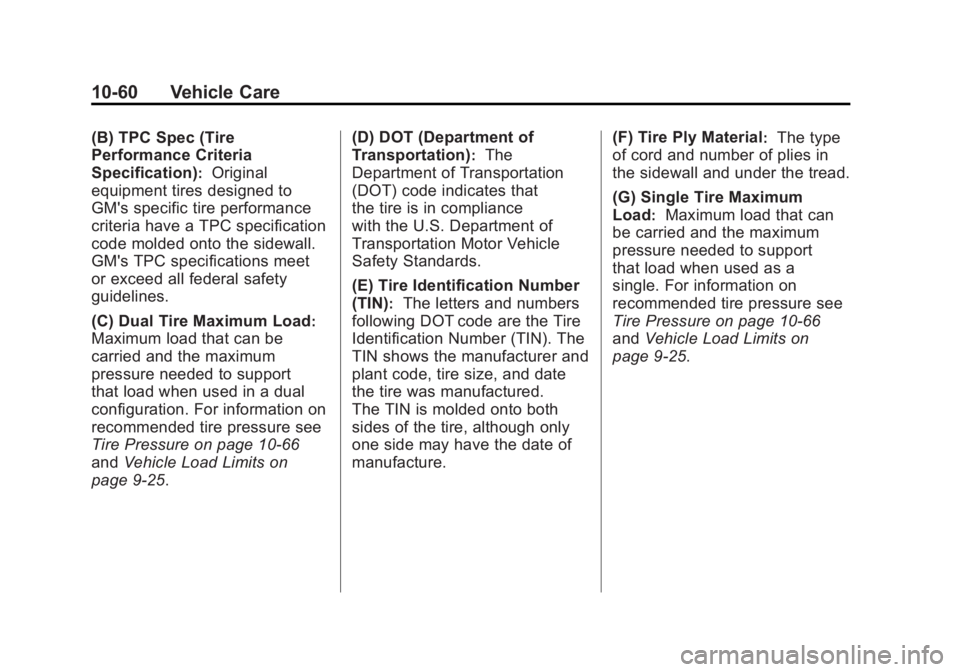
(A) Tire Size:The tire size
code is a combination of letters
and numbers used to define
a particular tire's width, height,
aspect ratio, construction type,
and service description. See the
“Tire Size” illustration later in this
section for more detail.
Page 484 of 594
Black plate (60,1)GMC Sierra Owner Manual - 2011
10-60 Vehicle Care
(B) TPC Spec (Tire
Performance Criteria
Specification)
:Original
equipment tires designed to
GM's specific tire performance
criteria have a TPC specification
code molded onto the sidewall.
GM's TPC specifications meet
or exceed all federal safety
guidelines.
(C) Dual Tire Maximum Load
:
Maximum load that can be
carried and the maximum
pressure needed to support
that load when used in a dual
configuration. For information on
recommended tire pressure see
Tire Pressure on page 10‑66
and Vehicle Load Limits on
page 9‑25. (D) DOT (Department of
Transportation)
:The
Department of Transportation
(DOT) code indicates that
the tire is in compliance
with the U.S. Department of
Transportation Motor Vehicle
Safety Standards.
(E) Tire Identification Number
(TIN)
:The letters and numbers
following DOT code are the Tire
Identification Number (TIN). The
TIN shows the manufacturer and
plant code, tire size, and date
the tire was manufactured.
The TIN is molded onto both
sides of the tire, although only
one side may have the date of
manufacture. (F) Tire Ply Material
:The type
of cord and number of plies in
the sidewall and under the tread.
(G) Single Tire Maximum
Load
:Maximum load that can
be carried and the maximum
pressure needed to support
that load when used as a
single. For information on
recommended tire pressure see
Tire Pressure on page 10‑66
and Vehicle Load Limits on
page 9‑25.
Page 485 of 594
Black plate (61,1)GMC Sierra Owner Manual - 2011
Vehicle Care 10-61
Tire Designations
Tire Size
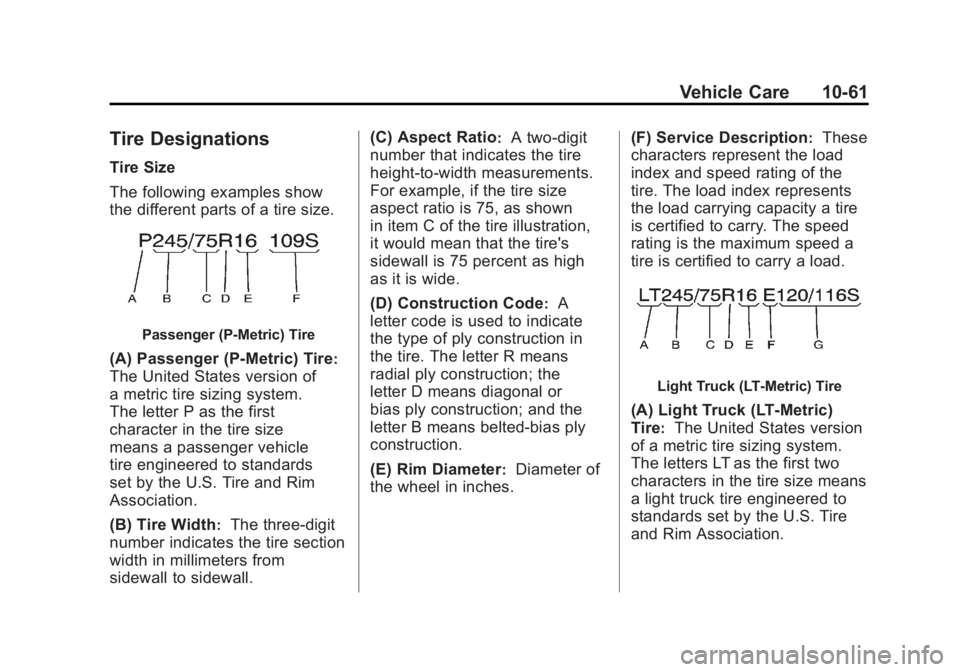
The following examples show
the different parts of a tire size.
Passenger (P‐Metric) Tire
(A) Passenger (P‐Metric) Tire:
The United States version of
a metric tire sizing system.
The letter P as the first
character in the tire size
means a passenger vehicle
tire engineered to standards
set by the U.S. Tire and Rim
Association.
(B) Tire Width
:The three‐digit
number indicates the tire section
width in millimeters from
sidewall to sidewall. (C) Aspect Ratio
:A two‐digit
number that indicates the tire
height‐to‐width measurements.
For example, if the tire size
aspect ratio is 75, as shown
in item C of the tire illustration,
it would mean that the tire's
sidewall is 75 percent as high
as it is wide.
(D) Construction Code
:A
letter code is used to indicate
the type of ply construction in
the tire. The letter R means
radial ply construction; the
letter D means diagonal or
bias ply construction; and the
letter B means belted‐bias ply
construction.
(E) Rim Diameter
:Diameter of
the wheel in inches. (F) Service Description
:These
characters represent the load
index and speed rating of the
tire. The load index represents
the load carrying capacity a tire
is certified to carry. The speed
rating is the maximum speed a
tire is certified to carry a load.
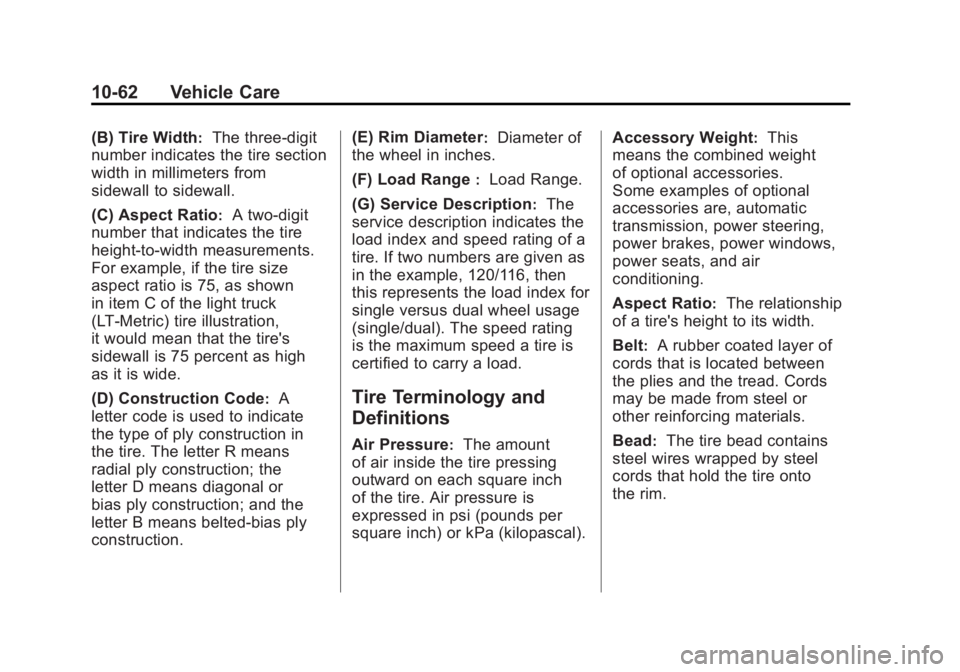
Light Truck (LT‐Metric) Tire
(A) Light Truck (LT‐Metric)
Tire
:The United States version
of a metric tire sizing system.
The letters LT as the first two
characters in the tire size means
a light truck tire engineered to
standards set by the U.S. Tire
and Rim Association.
Page 486 of 594
Black plate (62,1)GMC Sierra Owner Manual - 2011
10-62 Vehicle Care
(B) Tire Width:The three‐digit
number indicates the tire section
width in millimeters from
sidewall to sidewall.
(C) Aspect Ratio
:A two‐digit
number that indicates the tire
height‐to‐width measurements.
For example, if the tire size
aspect ratio is 75, as shown
in item C of the light truck
(LT‐Metric) tire illustration,
it would mean that the tire's
sidewall is 75 percent as high
as it is wide.
(D) Construction Code
:A
letter code is used to indicate
the type of ply construction in
the tire. The letter R means
radial ply construction; the
letter D means diagonal or
bias ply construction; and the
letter B means belted‐bias ply
construction. (E) Rim Diameter
:Diameter of
the wheel in inches.
(F) Load Range
:Load Range.
(G) Service Description
:The
service description indicates the
load index and speed rating of a
tire. If two numbers are given as
in the example, 120/116, then
this represents the load index for
single versus dual wheel usage
(single/dual). The speed rating
is the maximum speed a tire is
certified to carry a load.
Tire Terminology and
Definitions
Air Pressure:The amount
of air inside the tire pressing
outward on each square inch
of the tire. Air pressure is
expressed in psi (pounds per
square inch) or kPa (kilopascal). Accessory Weight
:This
means the combined weight
of optional accessories.
Some examples of optional
accessories are, automatic
transmission, power steering,
power brakes, power windows,
power seats, and air
conditioning.
Aspect Ratio
:The relationship
of a tire's height to its width.
Belt
:A rubber coated layer of
cords that is located between
the plies and the tread. Cords
may be made from steel or
other reinforcing materials.
Bead
:The tire bead contains
steel wires wrapped by steel
cords that hold the tire onto
the rim.
Page 491 of 594
Black plate (67,1)GMC Sierra Owner Manual - 2011
Vehicle Care 10-67
How to Check
Use a good quality pocket-type
gauge to check tire pressure.
You cannot tell if the tires are
properly inflated simply by
looking at them. Radial tires may
look properly inflated even when
they are under-inflated. Check
the tire's inflation pressure when
the tires are cold. Cold means
the vehicle has been sitting for
at least three hours or driven no
more than 1.6 km (1 mile).
Remove the valve cap from the
tire valve stem. Press the tire
gauge firmly onto the valve to
get a pressure measurement.
If the cold tire inflation pressure
matches the recommended
pressure on the Tire and
Loading Information label,
no further adjustment is
necessary. If the pressure
is low, add air until you reach
the recommended amount.If you overfill the tire, release air
by pushing on the metal stem
in the center of the tire valve.
Recheck the tire pressure with
the tire gauge.
Be sure to put the valve caps
back on the valve stems.
They help prevent leaks by
keeping out dirt and moisture.
Tire Pressure for
High-Speed Operation
{WARNING
Driving at high speeds,
160 km/h (100 mph) or higher,
puts an additional strain on tires.
Sustained high-speed driving
causes excessive heat build up
and can cause sudden tire failure.
You could have a crash and you
or others could be killed. Some
high-speed rated tires require
(Continued)
WARNING (Continued)
inflation pressure adjustment
for high speed operation. When
speed limits and road conditions
are such that a vehicle can be
driven at high speeds, make sure
the tires are rated for high speed
operation, in excellent condition,
and set to the correct cold tire
inflation pressure for the
vehicle load.
Vehicles with P265/70R17 or
P275/55R20 size tires require
inflation pressure adjustment
when driving the vehicle at speeds
of 160 km/h (100 mph) or higher.
Set the cold tire inflation pressure
to 20 kPa (3 psi) above the
recommended cold tire pressure
shown on the Tire and Loading
Information label.
Page 502 of 594
Black plate (78,1)GMC Sierra Owner Manual - 2011
10-78 Vehicle Care
GM recommends replacing tires in
sets of four. This is because uniform
tread depth on all tires will help
keep the vehicle performing most
like it did when the tires were new.
Replacing less than a full set of
tires can affect the braking and
handling performance of the vehicle.
SeeTire Inspection on page 10‑73
and Tire Rotation on page 10‑73 for
information on proper tire rotation.
{WARNING
Tires could explode during
improper service. Attempting to
mount or dismount a tire could
cause injury or death. Only your
dealer or authorized tire service
center should mount or dismount
the tires.
{WARNING
Mixing tires could cause you
to lose control while driving.
If you mix tires of different sizes,
brands, or types (radial and
bias-belted tires), the vehicle
might not handle properly, and
you could have a crash. Using
tires of different sizes, brands,
or types could also cause
damage to the vehicle. Be sure
to use the same size, brand,
and type of tires on all wheels.
This vehicle may have a different
size spare than the road tires
(those originally installed on the
vehicle). When new, the vehicle
included a spare tire and wheel
assembly with a similar overall
diameter as the vehicle's road
tires and wheels, so it is all right
to drive on it. Because this spare
was developed for use on the
vehicle, it will not affect vehicle
handling.
{WARNING
Using bias-ply tires on the
vehicle may cause the wheel
rim flanges to develop cracks
after many miles of driving.
A tire and/or wheel could fail
suddenly and cause a crash.
Use only radial-ply tires with
the wheels on the vehicle.
If you must replace the vehicle's
tires with those that do not have
a TPC Spec number, make sure
they are the same size, load range,
speed rating, and construction type
(radial and bias‐belted tires) as the
vehicle's original tires.