key GMC SIERRA 1993 Owner's Manual
[x] Cancel search | Manufacturer: GMC, Model Year: 1993, Model line: SIERRA, Model: GMC SIERRA 1993Pages: 436, PDF Size: 23.88 MB
Page 190 of 436
Your Driving and the Road
Ir
-
, ..-
I
AM407001
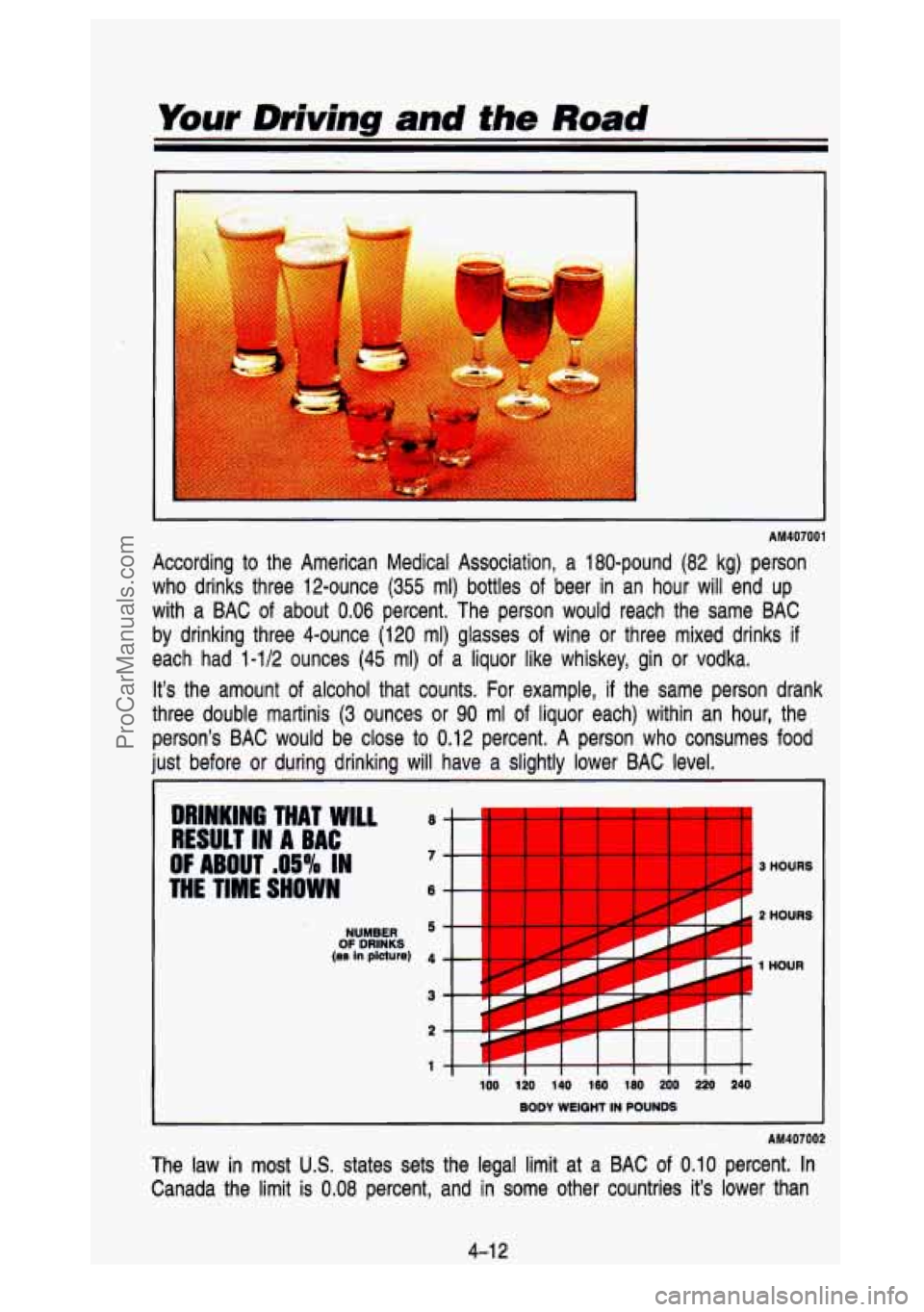
According to the American Medical Association, a 180-pound (82 kg) person
who drinks three 12-ounce
(355 ml) bottles of beer in an hour will end up
with a BAC of about 0.06 percent. The person would reach the same BAC
by drinking three 4-ounce (120 ml) glasses of wine or three mixed drinks
if
each had 1-112 ounces (45 ml) of a liquor like whiskey, gin or vodka.
It’s the amount of alcohol that counts. For example, if the same person drank
three double martinis
(3 ounces or 90 ml of liquor each) within an hour, the
person’s BAC would be close
to 0.12 percent. A person who consumes food
just before or during drinking
will have a slightly lower BAC level.
DRINKING THAT WILL 8
RESULT IN A BAC
OF ABOUT .05% IN
~ THE TlME SHOWN 6
7
OF DRINKS
NUMBER ’
(as in picture) 4
3
t --
2 1
1 i I
100 120 140 160 180 200 220 240
BODY WEIGHT
IN POUNDS
I 3 HOURS
I
YOUR
AM407002
The law in most U.S. states sets the legal limit at a BAC of 0.10 percent. In
Canada the limit is 0.08 percent, and in some other countries it’s lower than
4-1 2
ProCarManuals.com
Page 194 of 436
If you keep pace with the traffic and alllow realieti~ following dbtances, ‘you
will eliminate a lot .of unnecessary braking.. That means - better brakin’g . and
longer brake life;
,* If your engine ever stops while- you’re driving, brake normally but don’t
pump your brakes. If you do, tht$ pedal may get harder to. .push down. If
your- engine stops, you will still have some power $rake, assist But you
will use it when you brake. Once the power assist =is used ‘up, it may
take longer to stop and the brake pedal will be harder to push.
Anti-lock Brakes (ABS)
Your vehicl’e has an ‘advanced electronic braking system that can help keep it
under Control.
When you turn your key on you m.ay .hear a momentary clicking ngise. , ,.
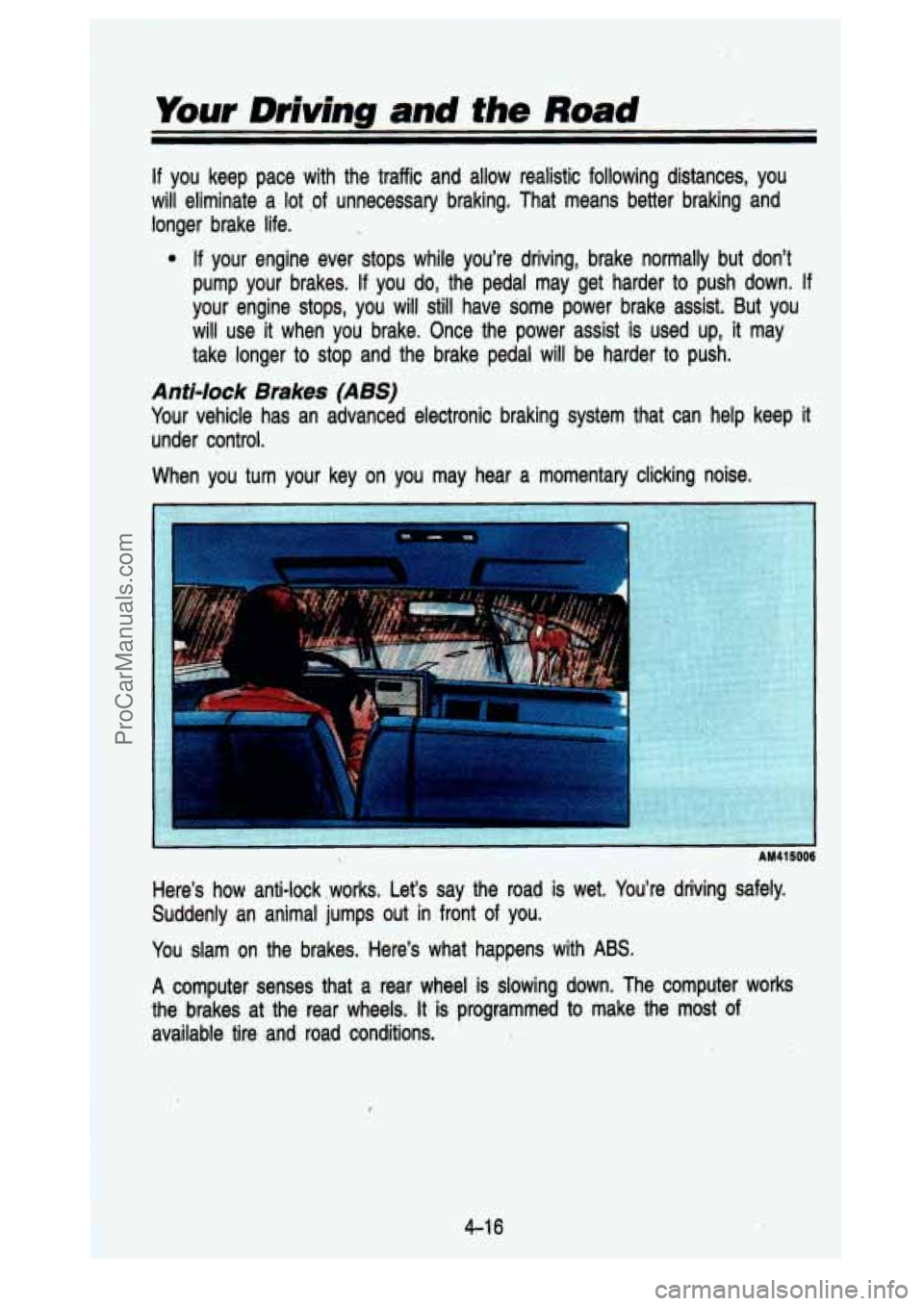
Here’s I how anti-lock .works. Let’s say the road is wet. You’re d.rivilng. sifely.
Suddenly an animal jumps out In frqnt of you.
ProCarManuals.com
Page 205 of 436
Tune your senses to different kinds of signals. -Your eyes, for example, meed
to constantly sweep the terrain for unexpected obstacles. Your .ears need
to
listen for unusual tire or engine sounds. With your arms, hands, feet, and
body you’ll need to respond
to vibrations and vehicle bounce.
Controlling your vehicle is the key
to successful off-road driving. One of the
best ways
to control your vehicle is to control your speed. Here .are some
things
to keep in mind. At higher speeds:
e you approach things fastar and you have less time to scan the terrain
for obstacles.
you have less time
to react. ‘I , ’C _. ’.
you have more vehicle bounce when you drive over obstacles.
you’ll need more distance for braking, especially since you’\
re on an unpaved surface.
CAUTION
When you’re driving off road, bouncing and quick changes in
direction can easily throw you out of position. This could cause you
to lose control and crash. So, whether you’re driving on or off the
road, you and your passengers should wear safety belts.
Scanning the Terrain
Off-road driving can take you over many different kinds of terrain. You need
to be familiar with the terrain and its many different features. Here are some
things
to consider.
Surface Conditions
Off-roading can ta.ke you. over hard-packed dirt, gravel, rocks,\
grass, sand, mud, snow or ice. Each of these sutfaces affects the steering, acceleration,
and braking of your vehicle in different ways. Depending upon the kind of
. surface you are on, you may experience slipping, sliding, wheel\
spinning,
delayed acceleration, poor traction, and longer braking distances\
.
Surface Obstacles
Unseen or hidden obstacles can be hazardous. A rock, log, hole, rut, or
bump can startle you if you’re not prepared for them. Often these obstacles
are hidden by grass, bushes, snow or even the rise and fall of the terrain
itself. -.Here are some things
to consider:
Is the path ahead clear?
Will the surface texture change abruptly up ahead?
4-27
ProCarManuals.com
Page 244 of 436

Hazard Warning Flashers U
I
I
. .' ~.
AM505004
Your hazard warning flashers let you warn others. They also let pol\
ice know
you have a problem. Your front and rear turn signal lights will flash
on and
off. But they won't flash if you are braking.
L'
I K2503
I
r 1
Press the button in to make your front and rear turn signal lights flash on
and off.
Your hazard warning flashers work no matter what position your key is in,
and even if the key isn't in.
5-2
ProCarManuals.com
Page 250 of 436
Problenrs on the Road
Towing Your Vehicle
Try to have a GM dealer or a professional towing service tow your vehicle.
They can provide the right equipment and know how to tow it without dam-
age.
If your vehicle has been changed since it was factory-new, by adding things
like fog lamps, aero skirting, or special tires and wheels, th\
ese things could
be damaged during towing.
Before you do anything, turn on the hazard warning flashers.
When you call, tell the towing service:
That your vehicle has rear-wheel drive, or that it has the four-wheel drive
option.
The make, model, and year of your vehicle.
Whether you can move the shift lever for the transmission and \
transfer case,
if you have one.
If there was an accident, what was damaged.
I A To help avoid injury to you or others:
Never let passengers ride in a vehicle that is being towed.
Never tow faster than safe or posted speeds.
Never tow with damaged parts not fully secured.
Never get under your vehicle after it has been lifted by the tow
truck.
Always use separate safety chains on each side when towing a
vehicle.
When your vehicle is being towed, have the ignition key
off. The steering
wheel should be clamped in a straight-ahead position, with a clamping device
designed for towing service.
Do not use the vehicle’s steering column lock for
this. The transmission and transfer case,
if you have one, should be in Neu-
tral and the parking brake released.
If you have a two-wheel drive vehicle, don’t have your vehicle \
towed on the
rear wheels, unless you must. If the vehicle must be towed on\
the rear
wheels, don’t go more than
35 mph (56 km/h) or farther than 50 miles (80
krn) or your transmission will be damaged. If these limits must be exceeded,
then the rear drive wheels have to be supported on a dolly.
5-8
ProCarManuals.com
Page 289 of 436
2. Unplug the Shut-Off solenoid wire from the fuel pump to prevent the
engine from starting.
3. With the air bleed valve open, turn your ignition key to Start for 10 to
15 seconds to crank (but not start) your engine. Keep doing this until
you can just see some clear fuel at the air bleed valve.
I A Diesel fuel is flammable. It could start a fire if it gets on hot engine
b parts. You could be burned. Don’t let too much fuel flow from the air
bleed valve or screw, and wipe up any spilled fuel with a cloth.
4. Close the air bleed valve, or replace the screw and reconnect \
the
Shut-Off solenoid wire.
5. Turn the ignition key to Start for 10 to 15 seconds at a time until your
engine starts.
Fuel Filter Replacement (6.5L Diesel Engines)
If you want to change the fuel filter yourself, here’s how \
to do it:
1 CAUTION
A Diesel fuel is flammable. It could start a fire if something ignites it,
-L and you could be burned. Don’t let it get on hot .engine parts, and
I keep matches or other ignition sources away.
1. Turn off your engine and set your parking brake.
2. Take off the fuel tank cap. This releases pressure in the tank.
6-1 1
ProCarManuals.com
Page 290 of 436

Service & Appearance Cave
PO503
3. The filter is behind the air cleaner on the intake manifold. \
Unscrew and take
off the ring nut from the the top of the filter head. Lift the element
out of the filter head.
4. If there is any dirt on the element sealing surface of the filter head,
clean it
off.
...
t
PO212
5. Line up the widest key slot in the top of the new element with the
widest key on the filter head
and push the element in until the mating
surfaces touch.
6-1 2
ProCarManuals.com
Page 291 of 436
6. Open the air bleed valve.
7. Turn your ignition key to Run for 10 to 15 seconds. Wait one minute for
the starter to cool. Do this until you can see clear fuel coming from the
air bleed valve.
8. Close the air bleed valve and replace the fuel tank cap.
9. Start your engine and let it idle for five minutes. Be sure to check your
fuel filter for leaks.
Fuel Filter Replacement (62 Diesel Engines)
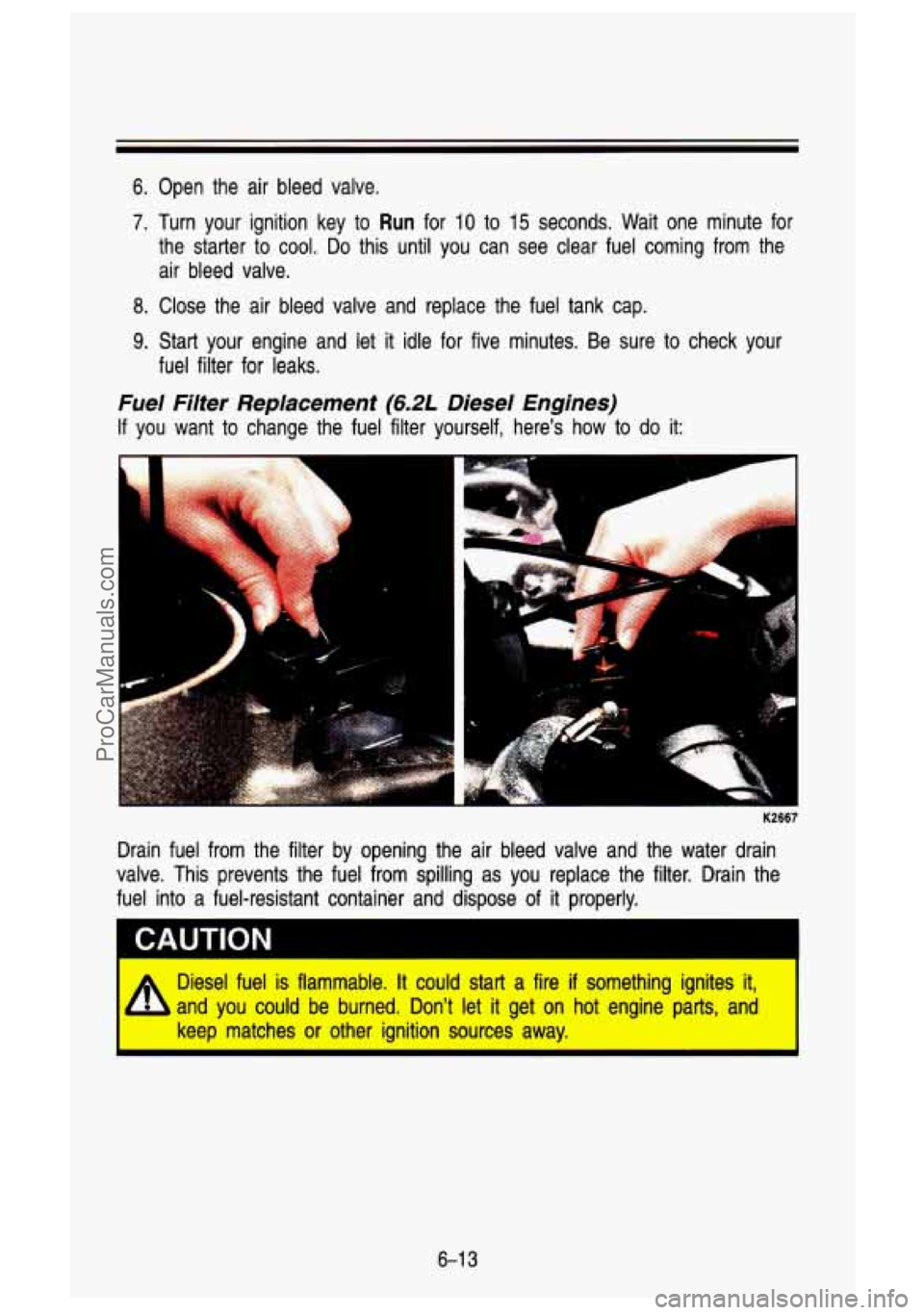
If you want to change the fuel filter yourself, here's how to do it:
'1
K2667
Drain fuel from the filter by opening the air bleed valve and\
the water drain
valve. This prevents the fuel from spilling as you replace the\
filter. Drain the
fuel into a fuel-resistant container and dispose of it properly.
CAUTION I
A
Diesel fuel is flammable. It could start a fire if something ignites it,
and you could be burned. Don't let it get on
hot engine parts, and
keep matches
or other ignition sources away.
6-1 3
ProCarManuals.com
Page 293 of 436

6. Close the water drain valve and connect a hose going from the air bleed\
valve port
to a fuel-resistant container. The inside diameter of the hose
should be one-eighth of an inch.
for the starter to cool.
Do this until you can see clear fuel coming from
the air bleed valve.
7. Turn your ignition key to Start for 10 to 15 seconds. Wait one minute
8. Close the air bleed valve and replace the fuel tank cap.
9. Start your engine and let it idle for five minutes. Be sure to check your
fuel filter for leaks.
Fuels in Foreign Countries (Gasoline Engines)
If you plan on driving in another country outside the US. or Canada,
unleaded fuel may be hard to find.
Do not use leaded gasoline. If you use
even one tank full, your emission controls won’t work well \
or at all. With
continuous use, spark plugs can get fouled, the exhaust system \
can corrode,
and your engine oil can deteriorate quickly. Your vehicle’s three-way catalytic
converter and oxygen sensor will be damaged.
All of that means costly
repairs that wouldn’t be covered by your warranty.
To check on fuel availability, ask an auto club, or contact a major oil
company that does business in the country where you’ll be driving.
You can also write us at the following address for advice. Just tell us where
you’re going and give your Vehicle Identification Number (VIN).
General Motors of Canada Ltd.
International Export Sales
Post Office Box
828
Oshawa, Ontario L1H 7N1, Canada
6-1 5
ProCarManuals.com
Page 402 of 436

Scheduled Maintenance Sewices
When the wheels are removed for rotation, inspect disc brake pads f\
or wear
and rotors for surface condition.
Also inspect drum brake linings for wear and
cracks. Inspect other brake parts, including drums, wheel cylind\
ers, parking
brake, etc., at the same time. Remove any rust
or dirt from the wheel and
mounting surfaces before mounting the wheel.
Inspect brakes more often if driving habits or conditions resull In
frequent braking.
Owner Checks and Services
Listed below are owner checks and services which should be mad\
e at the
time period specified
to help ensure proper safety, emission performance, and
dependability of your vehicle.
Be sure any necessary repairs are completed at once. Whenever \
any fluids
or lubricants are added to your vehicle, make sure they are the proper ones,
as shown
in this Section.
At Least Once a Month
Tire inflation pressure check -Check the tires for proper inflation. If they
are low, inflate them
to the level specified on the certification label or on the
tire inflation charts. See “Loading Your Vehicle’’ or “Inflation-Tire Pressure” in
the Index.
At Least Once a Year
Key lock cylinder lubrication -Lubricate key lock cylinders with engine oil.
See the “Recommended Fluid and Lubricants’’ chart in this section.
Transmission neutral or clutch start switch operation
CAUTION
~
1. Before you start, be sure you have enough room around the veh\
icle.
2. Firmly apply both the manual parking brake and the regular brake. See
“Brakes” and “Parking Brake” in the Index.
Do not use the accelerator
pedal.
3. Be ready to turn off the engine immediately if it starts.
4. On automatic transmission vehicles, try to start the engine in each gear.
The starter should work only in
P (Park) or N (Neutral).
7-22
ProCarManuals.com