manual transmission GMC SIERRA 1993 Owner's Manual
[x] Cancel search | Manufacturer: GMC, Model Year: 1993, Model line: SIERRA, Model: GMC SIERRA 1993Pages: 436, PDF Size: 23.88 MB
Page 208 of 436
Your Driving and the Road
A Turning or driving across steep hills can be dangerous. You could
lose traction, slide sideways, and possibly roll over. You could be
seriously injured or
I 'I' ?d. When driving up hills, always try to go
I straight up.
Ease up on your speed as you approach the top of the hill.
Attach a flag to the vehicle to make you more visible to approaching
traffic on trails or hills.
Sound the horn as you approach the top of hill to let opposing traffic
know you're there.
Use your headlights even during the day. They make you more visible to
oncoming traffic.
I A Driving to the top (crest) of a hill at full speed can muse an
accident.
There could be a drop-off, embankment, cliff, or even
another vehicle. You buld be seriously injured or killed. .As you near
the
top of a hill, slow down and stay alert. I
Q: What should I do if my vehicle stalls, or is about to stall, and I can't
make it
up the hill?
A: If this happens, there are some things you should do, and there are some
things
you must not do. First, here's what you should do:
0
0
0
0
Push the brake pedal to stop the vehicle and keep it from rolling
backwards.
Also, apply the parking brake.
If your engine is still running, shift the transmission into reverse, release
the parking brake, and slowly back down the hill in reverse.
If your engine has stopped running, you'll need to restart it. With the
brake pedal depressed and the parking brake still applied, shift the
transmission to
P (Park) (or, shift to N (Neutral) if your vehicle has a
manual transmission) and restart the engine. Then, shift to Reverse,
release the parking brake, and slowly back down the hill in reverse.
As you are backing down the hill, put your left hand on the ste\
ering
wheel at the
12 o'clock position. This way, you'll be able to tell if your
wheels are straight or turned to the left or right as you back down.
4-30
ProCarManuals.com
Page 209 of 436
Here are some things you must not do if you stall, or are about to stall,
when going up a hill.
Never attempt to prevent a stall by shifting into N (Neutral) (or
depressing the clutch,
if you have a manual transmission) to “rev-up” the
engine and regain forward momentum. This won’t work. Your vehicle will
roll backwards very quickly and you could go out of control.
Instead, apply the regular brake to stop the vehicle. Then apply the parking
brake. Shift into reverse, release the parking brake, and slowl\
y back down.
Never attempt to turn around if you are about to stall when going up a
hill. If the hill is steep enough to stall your vehicle, it’s steep enough to
cause you. to roll over
if you turn around. If you can’t make it up the
hill, you must back down the hill.
Q: Suppose, after stalling, I try to back down the hill and decide I just
can’t
do it. What should I do?
A: Set the parking brake, put your transmission in P (Park) (or the manual
transmission in first gear), and turn off the engine. Leave the vehicle and \
go
get some help. Exit on the uphill side and stay clear of the\
path the vehicle
would take
if it rolled downhill. Do not shift the transfer case to N (Neutral)
when you leave the vehicle. Leave it in some gear.
Shifting the transfer case to
N (Neutral) can cause your vehicle to
roll even
if the transmission is in P (Park) (or, if you have the
manual transmission, even
if you’re in gear). This is because the N
(Neutral) position on the transfer case overrides the transmis\
sion. If
you are going to leave your vehicle, set the parking brake and shi”
the transmission to
P (Park) (or, put your manual transmission in f
gear). But do not shift the transfer case to the N (Neutral) positior
Leave the transfer case in the
2 Wheel, 4 High or 4 Low position.
1
Lriving Downhill
When off-roading takes you downhill, you’ll want to consider a number of
things:
How steep is the downhill? Will
I be able to maintain vehicle control?
What’s the surface like? Smooth? Rough? Slippery? Hard-packed \
dirt? Grave
I?
Are there hidden surface obstacles? Ruts? Logs? Boulders?
What’s at the bottom
of the hill? Is there a hidden creek bank or even a
river bottom with large rocks?
4-31
ProCarManuals.com
Page 210 of 436

Your Driving and the Road
If you decide you can go down a hill safely, then try to keep your vehicle
headed straight down, and use a low gear. This way, engine dr\
ag can help
your brakes and they won’t have to do
all the work. Descend slowly, keeping
your vehicle under control at all times.
CAUTION
A Heavy braking when going down a hill can cause your brakes to
overheat and fade. This could cause
loss of control and a serious ‘
accident. Apply the brakes lightly when descending a hill and use a
low gear to keep vehicle speed under
control.
Q: Are there some things I should not do when driving down a hili?
A: Yes! These are important because if you ignore them you could lose
control and have a serious accident.
When driving downhill, avoid turns that take you across the in\
cline of the
hill.
A hill that’s not too steep to drive down may be too steep to drive
across. You could
roll over if you don’t drive straight down.
Never go downhill with the transmission in N (Neutral), or with the clutch
pedal depressed in a manual shift. This is called “free-whee\
ling,” Your
brakes will have
to do all the work and could overheat and fade.
Avoid braking so hard that you lock the wheels when going downhill. If
your front wheels are locked, you can’t steer your vehicle. \
If your wheels
lock up during downhill braking, you may feel the vehicle star\
ting to slide
sideways.
To regain your direction, just ease off the brakes and steer to
keep the front of the vehicle pointing straight downhill.
Q: Am I likely to stall when going downhill?
A: It’s much more likely to happen going uphill. But if it happens going
downhill, here’s what to do.
Stop your vehicle by applying the regular brakes. Apply the pa\
rking
brake.
Shift to P (Park) (or to Neutral with the manual transmission) and, while
still braking, restart the engine.
Shift back to a low gear, release the parking brake, and drive straight
down.
If the engine won’t start, get out and get help.
4-32
ProCarManuals.com
Page 225 of 436

As in any driving situation, keep pace with traffic and allow adequat\
e
following distances.
Hill and Mountain Roads
I r
AM470001
Driving on steep hills or mountains is different from driving in flat or rolling
terrain.
If you drive regularly in steep country, or if you’re planning to visit
there, here are some tips that can make your trips safer and \
more enjoyable.
(See “Off-Road” in the Index for information about driving off-road.)
Keep your vehicle in good shape. Check all fluid levels and also the
brakes, tires, cooling system and transmission. These parts can \
work
hard on mountain roads.
Know how to go down hills. The most important thing to know is this: let
your engine do some
of the slowing down. Don’t make your brakes do it
all. Shift to a lower gear when you go down a steep or long hill. That
way, you will slow down without excessive use of your brakes.
If you don’t shift down,’ your brakes could get so hot that they
- b wouldn’t work well. You would then have poor braking or even none
going
down a hill. You could crash. .Shift down to let your engine
assist your brakes on a steep downhill slope. I I
4-47
ProCarManuals.com
Page 226 of 436
I CAUTION
A Coasting downhill in N (Neutral) or with the ignition off is dangerous.
E ‘ Your brakes will have to do all the work of slowing down. They could
get
so hot that they wouldn’t work well. You could crash. Always
have your engine running and your vehicle in gear when you go
downhill.
l I
e
e
e
e
e
Know how to go uphill. You may want to shift down to a lower gear.
The lower gears help cool your engine and transmission, and yo\
u can
climb the hill better.
Stay .in your own lane when driving on two-lane roads in hills or
mountains. Don’t swing wide
or cut across the center of the road. Drive
at speeds that let you stay in your own lane. That way, you won’t be
surprised by a vehicle coming toward you in the same lane.
It takes longer to pass another vehicle when you’re going uphill. You’ll
want
to leave extra room to pass. If a vehicle is passing you and
doesn’t have enough room,
slow down to make it easier for the other
vehicle to get by.
As you go over the top of a hill, be alert. There could be something in
your lane, like a stalled car
or an accident.
You may see highway signs on mountains that warn of special problems.
Examples are long grades, passing or no-passing zones, a fallin\
g rocks
area, or winding roads. Be alert to these and take appropriate action.
Winter driving can present special problems. See “Winter Driv\
ing” in the
Index.
4-48
ProCarManuals.com
Page 229 of 436
AM470053
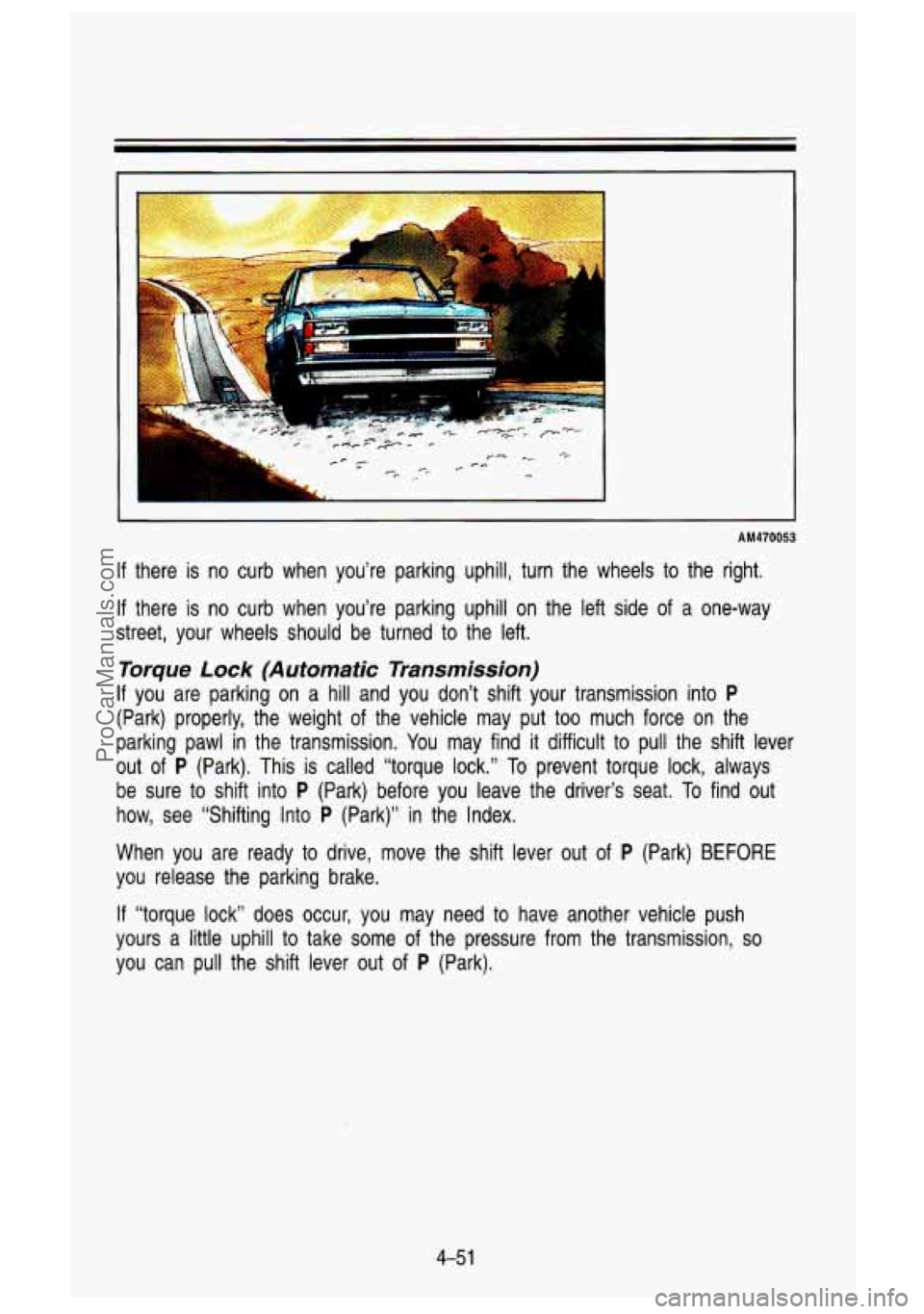
If there is no curb when you’re parking uphill, turn the wheels to the right.
If there is no curb when you’re parking uphill on the left side of a one-way
street, your wheels should be turned to the left.
Torque Lock (Automatic Transmission)
If you are parking on a hill and you don’t shift your tra\
nsmission into P
(Park) properly, the weight of the vehicle may put too much force on the
parking pawl in the transmission. You may find it difficult to pull the shift lever
out of
P (Park). This is called “torque lock.” To prevent torque lock, always
be sure to shift into
P (Park) before you leave the driver’s seat. To find out
how, see “Shifting Into
P (Park)” in the Index.
When you are ready to drive, move the shift lever out
of P (Park) BEFORE
you release the parking brake.
If “torque lock” does occur, you may need to have another vehicle push
yours a little uphill to take some of the pressure from the transmission,
so
you can pull the shift lever out of P (Park).
4-5 1
ProCarManuals.com
Page 238 of 436
Your Driving and the Road
drivers behind you are seeing your signal when they are not. It’s important to
check occasionally to be sure the trailer bulbs are still working.
Driving on Grades
Reduce speed and shift to a lower gear before you start down long or steep
downgrade.
If you don’t shift down, you might have to use your brakes so
much that they would get hot and no longer work well.
On a long uphill grade, shift down and reduce your speed to
45 mph (70
kmlh) or less to reduce the possibility of engine and transmission overheating.
IT you have an automatic transmission, you should use D (or, as you need to,
a lower gear) when towing a trailer. Operating your vehicle i\
n
D when towing
a trailer will minimize heat buildup and extend the life of your transmission.
Or, if you have a manual transmission with fifth gear and you are towing a
trailer, it’s better not to use fifth gear. Just drive in fourth gear
(or, as you
need to, a lower gear).
Parking on Hills
You really should not park your vehicle, with a trailer attached, \
on a hill. If
something goes wrong, your rig could start to move. People can\
be injured
and both your vehicle and the trailer can be damaged.
But
if you ever have to park your rig on a hill, here’s how to do it:
1. Apply your regular brakes, but don’t shift into P (Park) yet, or into gear
2. Have someone place chocks under the trailer wheels.
for a manual transmission.
3. When the wheel chocks are
in place, release the regular brakes until the
chocks absorb the load.
4. Reapply the regular brakes. Then apply your parking brake, and \
then
5. If you have a four-wheel-drive vehicle, be sure the transfer case is in a
6. Release the regular brakes.
shift
to
P (Park), or R (Reverse) for a manual transmission.
drive gear-not in
N (Neutral).
4-60
ProCarManuals.com
Page 239 of 436
CAUTION
It can be dangerous to get out of your vehicle if the shift lever is not
fully in
P (Park) with the parking brake firmly set. Your vehicle can
roll.
If you have left the engine running, the vehicle can move suddenl\
y.
You
or others could be injured. To be sure your vehicle won’t move,
when you’re on fairly level ground, use the steps that follow.
If you have four-wheel drive and your transfer case is in N (Neutral),
your vehicle will be free to
roll, even if your shift lever is in P (Park).
So, be sure the transfer case is in a drive gear-not in N (Neutral).
If you are parking on a hill, or if you’re pulling a trailer, also see
“Parking On Hills” in the Index.
When You Are Ready to Leave After Parklng on a Hill
1. Apply your regular brakes and hold the pedal down while you:
Start your engine;
Shift into a gear; and
Release the parking brake.
2. Let up on the brake pedal.
3. Drive slowly until the trailer is clear of the chocks.
4. Stop and have someone pick up and store the chocks.
Maintenance When Trailer To wing
Your vehicle will need service more often when you’re pulling a trailer. See
the Maintenance Schedule for more on this. Things that are esp\
ecially
important in trailer operation are automatic transmission fluid (don’t overfill),
engine oil, axle lubricant, belts, cooling system, and brake ad\
justment. Each
of these is covered in this manual, and the Index will help \
you find them
quickly.
If you’re trailering, it’s a good idea to review these sections before
you start your trip.
Check periodically
to see that all hitch nuts and bolts are tight.
mailer Wiring Harness
See “Trailer Wiring Harness’’ in the Index.
4-61
ProCarManuals.com
Page 240 of 436

Your Driving and the Road
Power Winches
i !
If you wish to use a power winch on your vehicle, only use it \
when your
vehicle is stationary or anchored.
i
NOTICE
Use the regular brakes, set the parking brake or block the wh\
eels to keep
your vehicle from rolling.
Power rake-off (PTO)
Before using a power take-off, refer to the manufacturer’s or installer’s
instructions.
To engage a power take-off:
1. Set ths parking brake.
2. Shift the transmission into N (Neutral).
3. Hold the clutch pedal down and engage the power take-off.
*
If you are going to drive the vehicle, shift the transmission int\
o the gear
you want. Then shift the transfer case into the range you wan\
t
(if you
have four-wheel-drive), apply the regular brakes and release th\
e parking
brake.
When you release the clutch, the power take-off will start.
4. Release the clutch (and the regular brakes) as you normally \
would.
4-62
ProCarManuals.com
Page 241 of 436
Using a Transfer Case Mounted Power Take-Off (Manual
Transmission)
1. Set the parking brake.
2. Shift the transfer case into N (Neutral).
3. Hold the clutch pedal down. If the vehicle will remain in the same place,
4. Engage the power take-off.
shift the transmission into the highest
gear.
If you are going to drive the vehicle, shift the transmission into the gear
you want. Then shift the transfer case into the range you wan\
t, apply
the regular brakes and release the parking brake.
5 Release the clutch (and the regular brakes) as you normally \
would.
Using a Transfer Case Mounted Power Take-Off (Automatic
Transmission)
When you release the clutch, the power take-off will start.
1 I Set the parking brake.
2. Shift the transfer case into N (Neutral).
3. Shift the transmission into N (Neutral).
4. Engage the power take-off.
If you are going to drive the vehicle, shift the transfer case into the
range you want. Then apply the regular brakes and release the \
parking
brake.
5. Shift the transmission to D (Drive) to start the power take-off.
6. Release the regular brakes to drive the vehicle.
4-63
ProCarManuals.com