ESP GMC SIERRA 1993 Owners Manual
[x] Cancel search | Manufacturer: GMC, Model Year: 1993, Model line: SIERRA, Model: GMC SIERRA 1993Pages: 436, PDF Size: 23.88 MB
Page 30 of 436

Seats & Safety Belts
i
1
AM115008
or the safety belts!
With safety belts, you slow down as the vehicle does. You get\
more time
to
stop. You stop over more distance, and your strongest bones take the for\
ces.
That’s why safety belts make such good sense.
Here Are Questions Many People Ask About Safety
Belts-and the Answers
Q: Won’t I be trapped in the vehicle after an accident if I’m wearing a
safety belt?
A: You could be-whether you’re wearing a safety belt or not. But you can
easily unbuckle a safety belt, even
if you’re upside down. And your chance of
being conscious during and after an accident,
so you can unbuckle and get
out, is
much greater if you are belted.
Q: Why don’t they just put in air bags so people won’t have to wear
safety belts?
A: “Air bags,” or Supplemental Inflatable Restraint systems, are in some
vehicles today and will be in more of them in the future. But they are
supplemental systems only-so they work
with safety belts, not instead of
them. Every “air bag” system ever offered for sale has required the use
of
safety belts. Even if you’re in a vehicle that has “air bags,” you still have to
buckle up to get the most protection. That’s true not only in frontal collisions,
but especially in side and other collisions.
1-1 6
ProCarManuals.com
Page 74 of 436
Features & Controls
Door Locks
Unlocked doors can be dangerous. g&sr'!G,, *- -.&&e;
$%$out. &z;;: When a door is locked, th Inside handle l't OD( it.
13+AFyOutsi' s can easily e-L-!r thro I an unlocKed aoor wnen you slow
e&%or stop your vehicle.
ssengers-especially children-can easily open the
doors and
fa1 *
.. L. _I.." L . 7..
y'?,. Lt;-
:;S? -*
,- . .,$'.> x, .dL& -? ;:+ Y? -- This may not be so obvious: You increase the chance of being
thrown out
of the vehicle in a crash if the doors aren't locked. Wear
safety belts properly, lock your
doors, and vou will be far better off
whenever vou drive vour vehicle.
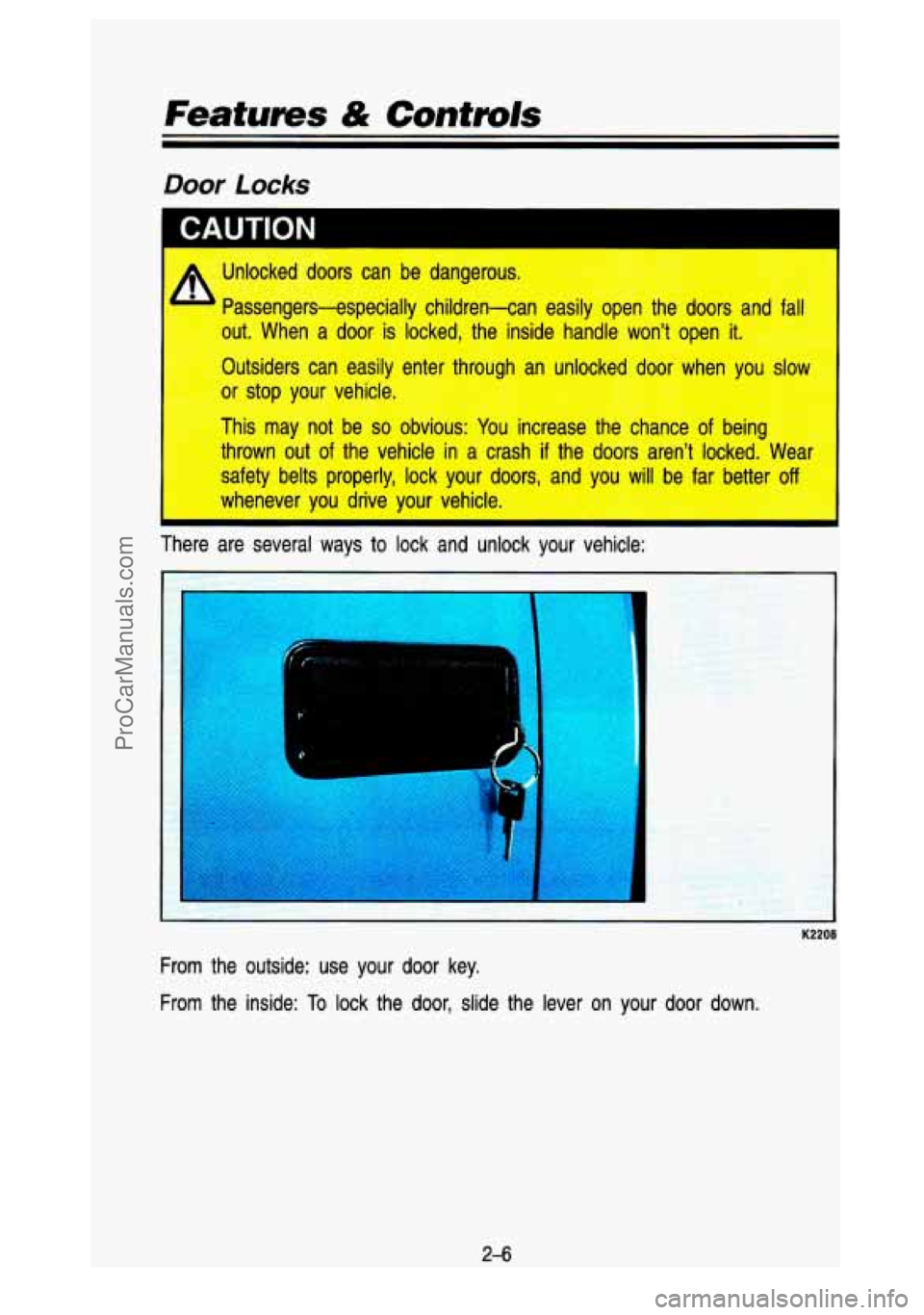
There are several ways to lock and unlock your vehicle:
2-6
ProCarManuals.com
Page 77 of 436
If you have a quick-release tailgate it can be removed by:
1. Raising the tailgate slightly and removing both retaining cables.
2. Lift the tailgate at the right side and pull it out at the left side.
Reverse the above procedure to reinstall. Make sure the tailgate is secure.
Then
Vehicle theft is a big business, especially in some cities. Although your
vehicle has a number of theft deterrent features, we know that nothing we
put on it can make it impossible to steal. However, there are ways you can
help.
Key in the Ignition: If you walk away from your vehicle with the keys inside,
it’s an easy target for joy riders or professional thieves-so don’t do it. When
you park your vehicle and open the driver’s door, you’ll hear a tone reminding
you to remove your key from the ignition and take it with you. Always do
this. Your steering wheel will be locked, and
so will your ignition. If you have
an automatic transmission, taking your key out also locks your \
transmission.
And remember to lock the doors.
Parking at Night: Park in a lighted spot, close all windows and lock your
vehicle. Remember to keep your valuables out of sight. Put them in a storage
area, or take them with you.
Parking Lots: If you park in a lot where someone will be watching your vehicle\
,
it’s best to lock it up and take your keys. But what
if you have to leave your
ignition key? What
if you have to leave something valuable in your vehicle?
Put your valuables in a storage area or console.
Lock the console.
Lock all doors except the driver’s,
Then take the door key with you.
2-9
ProCarManuals.com
Page 112 of 436

Features & Controls
beam lights with fog lamps at all times, or that headlights b\
e turned on
whenever you must use your windshield wipers.
In addition, most jurisdictions
prohibit driving solely with parking lights, especially at dawn \
or dusk. It is
recommended that you check with your own state or provincial h\
ighway
authority for applicable lighting regulations.
Headight High-Low Beam
- K2242
To change the headlights from low beam to high or high to low, \
pull the turn
signal lever all the way toward you. Then release
it. When the high beams
are on, this blue light
on the instrument panel also will be on.
2-44
ProCarManuals.com
Page 169 of 436
Audio Systems
Your Delco@ audio system has been designed to operate easily and give
years of listening pleasure. But you will get the most enjoyment out of it,
if
you acquaint yourself with it first. Find out what your Delco@ system can do
and how to operate all its controls, to be sure you’re getting the most out of
the advanced engineering that went into
it.
Hearing damage from loud noise is almost undetectable until it is too
late. Your hearing can adapt to higher volumes of sound. Sound that
seems normal can be loud and harmful to your hearing. Take
precautions by adjusting the volume control on your radio to a safe
sound level before hearing adapts to
it.
To help avoid hearing loss or damage: I a-
s
Adjust the volume control to the lowest setting.
Increase volume slowly until you hear comfortably and clearly.
I NOTICE I
FM Stereo
FM stereo will give you the best sound. But FM signals will reach only about
10 to 40 miles (16 to 65 km). And, tall buildings or hills can interfere with
FM signals, causing the sound to come and go.
AM
The range for most AM stations is greater than for FM, especially at night.
The longer range, however, can cause stations to interfere with each other.
AM can pick up noise from things like electrical storms and power\
lines. If
the noise interferes with your listening,
try reducing the treble to lessen the
noise.
3-9
ProCarManuals.com
Page 191 of 436
that. The BAC will be over 0.10 percent after three to six drinks (in one
hour).
Of course, as we’ve seen, it depends on how much alcohol is in the
drinks, and how quickly the person drinks them.
But it’s very important to keep in mind that the ability to drive is affected well
below a BAC of
0.10 percent. Research shows that the driving skills of many
people are impaired at a BAC approaching
0.05 percent, and that the effects
are worse at night. All drivers are impaired at BAC levels above
0,05 percent.
Statistics show that the chance of being in an accident increases sharply for
drivers who have a BAC of
0.05 percent or above. A driver with a BAC level
of
0.06 percent (three beers in one hour for a 180-pound or 82 kg person)
has doubled his or her chance of having an accident. At a BAC level of 0.10
percent, the chance of that driver having an accident is six times greater; at
a level of
0.15 percent, the chances are twenty-five times greater! And, the
body takes about an hour to rid itself of the alcohol in one drink.
No amount
of coffee or number
of cold showers will speed that up.
“1’11 be careful” isn’t the right answer. What if there’s an emergency, a need
to take sudden action, as when a child darts into the street?
A person with a
higher BAC might not be able to react quickly enough to avoid the collision.
There’s something else about drinking and driving that many \
people don’t know. Medical research shows that alcohol in a person’s system can make
crash injuries worse. That’s especially true for brain, spinal cord and heart
injuries. That means that
if anyone who has been drinking-driver or
passenger-is in a crash, the chance of being killed or permanently disabled
is higher than
if that person had not been drinking. And we’ve already seen
that the chance of
a crash itself is higher for drinking drivers.
CAUTION
A Drinking and then driving is very dangerous. Your reflexes,
- perceptions, and judgment will be affected by even a small amount
of alcohol. You could have a serious-or even fatal-accident
if you
drive after drinking. Please don’t drink and drive or ride with a driver
who has been drinking. Ride home in a cab; or
if you’re with a
group, designate a driver who will not drink.
4-1
3
ProCarManuals.com
Page 197 of 436

Rear Drum Brakes
If you have rear drum brakes, they don’t have the wear indicators, \
but if you
ever hear a rear brake rubbing noise, have the rear brake lining inspected.
Also, the rear brake drums should be removed and inspected each time\
the
tires are removed for rotation or changing. When you have the \
front brakes replaced, have the rear brakes inspected, too.
Brake linings should always be replaced as complete axle sets.
Brake Pedal Travel
See your dealer if the brake pedal does not return to normal height, or if
there is a rapid increase in pedal travel. This could be a sign of brake
trouble.
Brake Adjusiment
Every time you make a brake stop, your disc brakes adjust for\
wear. If your
brake pedal goes down farther than normal, your rear drum brak\
es may need
adjustment. Adjust them by backing up and firmly applying the brakes a few
times.
Braking In Emergencies
At some time, nearly every driver gets into a situation that requires hard
braking. You have the rear wheel anti-lock braking system. Your front wheels
can stop rolling when you brake very hard. Once they
do, the vehicle can’t
respond to your steering. Momentum will carry it in whatever direction it was
headed when the wheels stopped rolling. That could be off the \
road, into the
very thing you were trying to avoid, or into traffic.
So, use a “squeeze” braking technique. This will give you max\
imum braking
while maintaining steering control. You
do this by pushing on the brake pedal
with steadily increasing pressure. When you
do, it will help maintain steering
control. In many emergencies, steering can help you more than even the very
best braking.
Steering
Power Sieerhg
If you lose power steering assist because the engine stops or \
the system
fails to function, you can steer but it will take much more effort.
4-1 9
ProCarManuals.com
Page 201 of 436

Not necessarily! Passing another vehicle on a two-lane highway is a
potentially dangerous move, since the passing vehicle occupies t\
he same lane
as oncoming traffic for several seconds.
A miscalculation, an error in
judgment, or a brief surrender to frustration or anger can suddenly put the
passing driver face to face with the worst of all traffic accidents-the head-on
collision.
So here are some tips for passing:
e
e
e
e
e
“Drive ahead.” Look down the road, to the sides, and to crossroads for
situations that might affect your passing patterns.
If you have any doubt
whatsoever about making a successful pass, wait for a better t\
ime.
Watch for traffic signs, pavement markings, and lines. If you \
can see a
sign up ahead that might indicate a turn or an intersection, delay your
pass.
A broken center line usually indicates it’s all right to pass
(providing the road ahead is clear). Never cross a solid line on your side
of the lane or a double solid line, even
if the road seems empty of
approaching traffic.
If you suspect that the driver of the vehicle you want to pass isn’t aware
of your presence, tap the horn a couple of times before passing.
Do not get too close to the vehicle you want to pass while you’re
awaiting an opportunity. For one thing, following too closely r\
educes your
area of vision, especially
if you’re following a larger vehicle. Also, you
won’t have adequate space
if the vehicle ahead suddenly slows or stops.
Keep back a reasonable distance.
When it looks like a chance to pass is coming up, start
to accelerate
but stay in the right lane and don’t get too close. Time your move
so
you will be increasing speed as the time comes to move into the other
lane.
If the way is clear to pass, you will have a “running start” that
more than makes up for the distance you would lose by droppin\
g back.
And
if something happens to cause you to cancel your pass, you need
only slow down and drop back again and wait for another oppor\
tunity.
If other cars are lined up to pass a slow vehicle, wait your turn. But
take care that someone isn’t trying to pass you as you pull out to pass
the slow vehicle. Remember to glance over your shoulder and check the
blind spot.
Check your mirrors, glance over your shoulder, and start your \
left lane
change signal before moving out of the right lane
to pass. When you
are far enough ahead of the passed vehicle to see its front in your
inside mirror, activate your right lane change signal and move \
back into
4-23
ProCarManuals.com
Page 202 of 436

Your Driving and the Road
the right lane. (Remember that your right outside mirror is c\
onvex. The
vehicle you just passed may seem to be farther away from you \
than
it
really is).
Try not to pass more than one vehicle at a time on two-lane roads.
Don’t overtake a slowly moving vehicle too rapidly. Even though the
Reconsider before passing the next vehicle.
brake lights are not flashing, it may be slowing down
or starting to turn.
If you’re being passed, make it easy for the following driver to get ahead
of you. Perhaps you can ease a little
to the right.
Loss of Control
Let’s review what driving experts say about what happens whe\
n the three
control systems (brakes, steering and acceleration) don’t ha\
ve enough friction
where the tires meet the road to do what the driver has asked.
In any emergency, don’t give up. Keep trying to steel+-, arid constantly seek an
escape route
or area of less danger.
Skidding
In a skid, a driver can lose control of the vehicle. Defensive drivers avoid
most skids by taking reasonable care suited
to existing conditions, and by not
“overdriving” those conditions. But skids are always possib\
le.
The three types
of skids correspond to your vehicle’s three control systems.
In the braking skid your wheels aren’t rolling. In the steering
or cornering
skid, too much speed
or steering in a curve causes tires to slip and lose
cornering force. And in the acceleration skid too much throttle\
causes the
driving wheels to spin.
A cornering skid and an acceleration skid are best handled by ea\
sing your
foot
off the accelerator pedal. If your vehicle starts to slide (as when you turn
a corner on a wet, snow-
or ice-covered road), ease your foot off the
accelerator pedal as soon as you feel the vehicle start to sl\
ide. Quickly steer
the way you want the vehicle
to go. If you start steering quickly enough, your
vehicle
will straighten out. As it does, straighten the front wheels.
Of course, traction is reduced when water, snow, ice, gravel, or other material
is on the road.
For safety, you’ll want to slow down and adjust your driving to
these conditions. It is important to slow down on slippery surfaces because
stopping distance will be longer and vehicle control more limit\
ed.
While driving on a surface with reduced traction,
try your best to avoid
sudden steering, acceleration,
or braking (including engine braking by shifting
to a lower gear). Any sudden changes could cause the tires to slid\
e. You
4-24
ProCarManuals.com
Page 204 of 436
Your Driving and the Road
Loading Your Vehicle for Off-Road Driving
There are some important things to remember about how to load your
vehicle.
The heaviest things should be on the load floor and forward of your rear
Be sure the load is secured properly, so driving on the off-road terrain
axle. Put heavier items as far forward as you can.
doesn’t toss things around.
CAUTION
Cargo on the load floor piled higher than the seatbacks can be
3 thrown forward during a sudden stop. You or your passengers
could be injured. Keep cargo below the top
01 le seatbacks.
- Unsecured cargo on the load floor ca- >e tossecl about when
3-7 driving over rough terrain. You or your passengers can be strum
& by flying objects. Secure the cargo properly*
Heavy loads on the roof raise the vehicle’s center of gravi\
ty.
making it more likely
to roll over. You can be seriously injured
the vehicle rolls over. Put heavy loads inside the cargo area, not
on the roof. Keep in the cargo area as far forward and
low as Dossible.
I
You’ll find other important information in this manual. See “Vehicle Loading,’’
and “Tires” in the Index.
Traveling to Remote Areas
It makes sense to plan your trip, especially when going to a remote area.
Know the terrain and plan your route. You are much less likely to get bad
surprises. Get accurate maps of trails and terrain.
Try to learn of any blocked
or closed roads.
It’s also a good idea to travel with at least one other v\
ehicle. If something
happens to one of them, the other can help quickly.
Does your vehicle have a winch?
If so, be sure to read the winch
instructions. In a remote area,
a winch can be handy if you get stuck. But
you’ll want to know how to use
it properly.
Getting Familiar with Off-Road Driving
It’s a good idea to practice in an area that’s safe and close to home before
you
go into the wilderness. Off-road driving does require some new and\
different driving skills. Here’s what we mean.
4-26
ProCarManuals.com