oil pressure GMC SIERRA 1993 Owners Manual
[x] Cancel search | Manufacturer: GMC, Model Year: 1993, Model line: SIERRA, Model: GMC SIERRA 1993Pages: 436, PDF Size: 23.88 MB
Page 14 of 436
How To Use This Manual
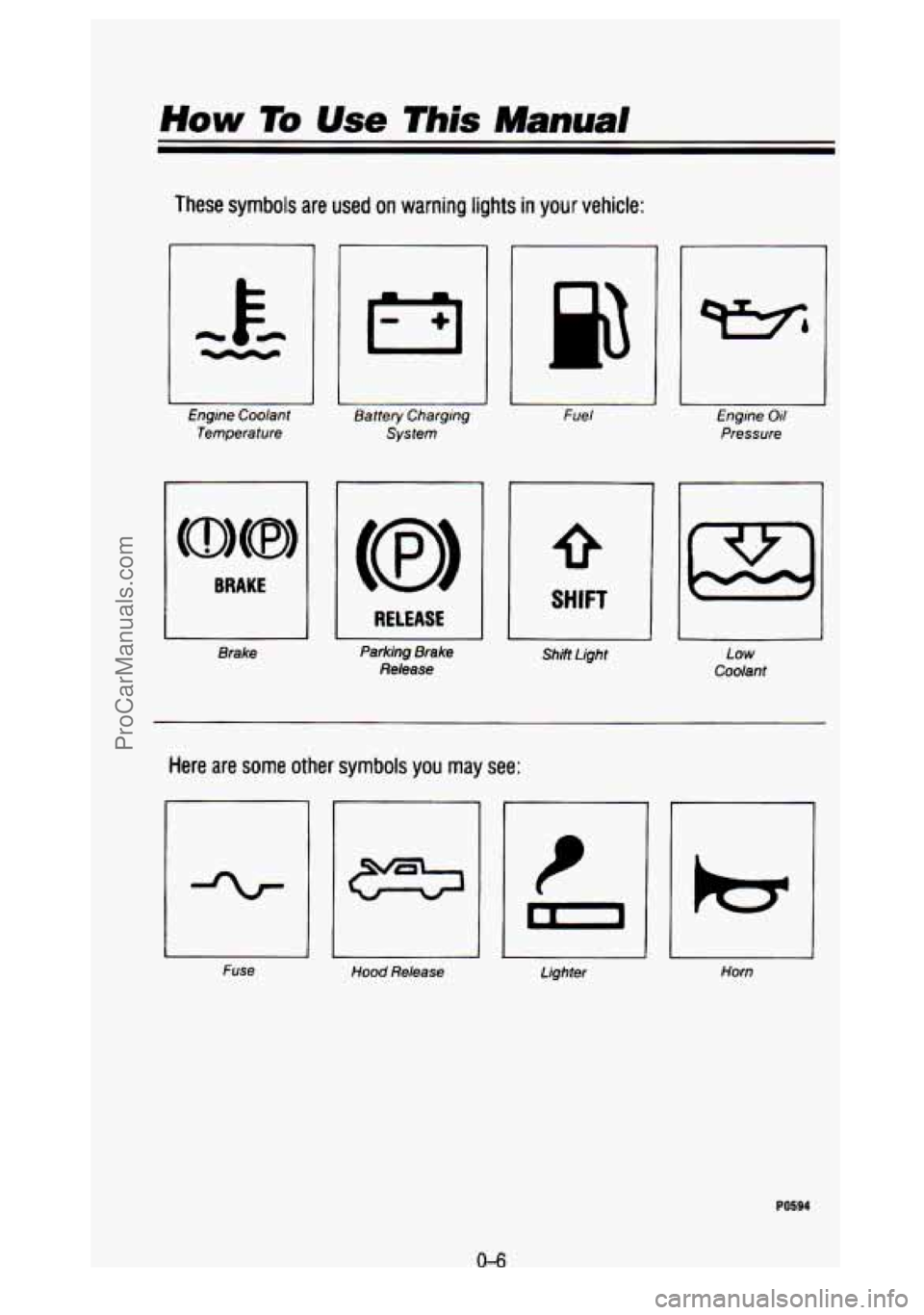
These symbols are used on warning lights in your vehicle:
1-
Engine Coolant Temperature
BRAKE
Brake Battery
Charging
System
I RELEASE
Parking Brake Release
s Fuel
SHIFT
Shift Light
Engine Oil
Pressure
Low
Coolant
Here are some other symbols you may see:
Fuse
I II
Hood Release Lighter Horn
PO594
0-6
ProCarManuals.com
Page 85 of 436
When your engine is cold, let it run for a few minutes before you move your
vehicle. This lets oil pressure build up. Your engine will sound louder when
it's cold.
NOTIP
-
If you're not in an idling vehicle and the engine overheats, you wouldn't
there to see the coolant temperature gage. This could damage your
hicle. Don't let vour enaine run when you're not
in vour vehicle.
Cold Weather Starting (Diesel Engine)
The following tips will help you get good starting in cold weather.
Use
SAE IOW-30 oil when the outside temperature drops below freezing.
When the outside temperature drops below
0°F (-18"C), use your engine
block heater.
If you park your vehicle in a garage, you shouldn't need to use \
the block
heater until the garage temperature goes below
0°F (-18"C), no matter how
cold it is outside.
To use the engine block heater, first turn
off the engine. Then open the hood,
unwrap the electrical cord and plug it in. It uses normal house voltage
(110
volts), but:
2-1 7
ProCarManuals.com
Page 157 of 436
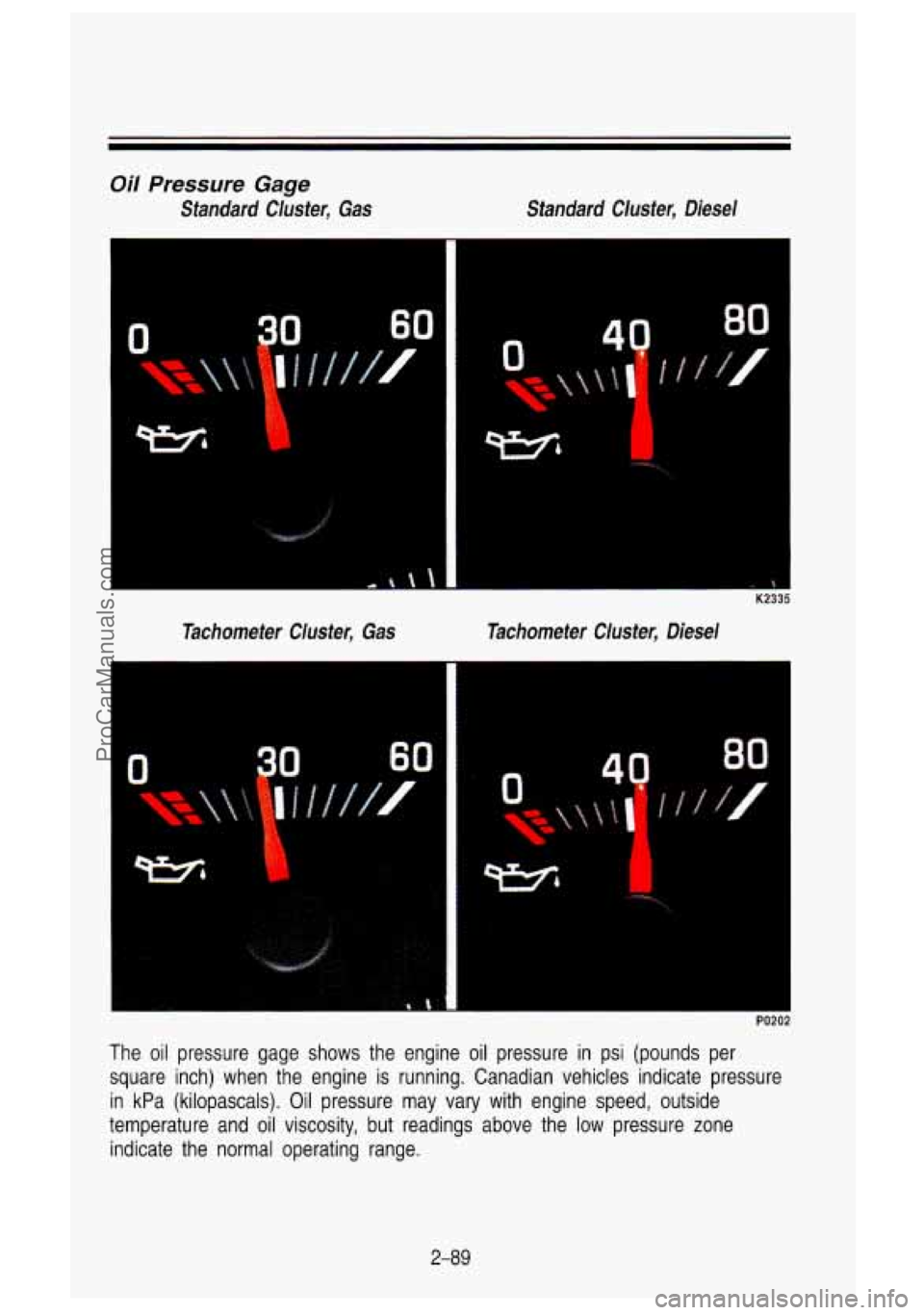
Oil Pressure Gage
Standard Cluster, Gas Standard Cluster, Diesel
60
K2335
Tachometer Cluster, Gas Tachometer Cluster, Diesel
The oil pressure gage shows the engine oil pressure in psi (pounds per
square inch) when the engine is running. Canadian vehicles ind\
icate pressure
in kPa (kilopascals). Oil pressure may vary with engine speed\
, outside
temperature and
oil viscosity, but readings above the low pressure zone
indicate the normal operating range.
2-89
ProCarManuals.com
Page 158 of 436
Features & Controls
A reading in the low pressure zone may be caused by a dangerously low oil
level or other problem causing low oil pressure. Check your oil as soon as
possible.
bnu I IUIY
+ Don’t keep driving if the oil pressure is low. If you do, your engine
can become
so hot that it catches on fire. You or others could be
burned. Check your oil as soon as possible and have your vehicle
serviced.
I NOTICE
Damage to your engine from neglected oil problems can be costly anc
not covered by your warranty.
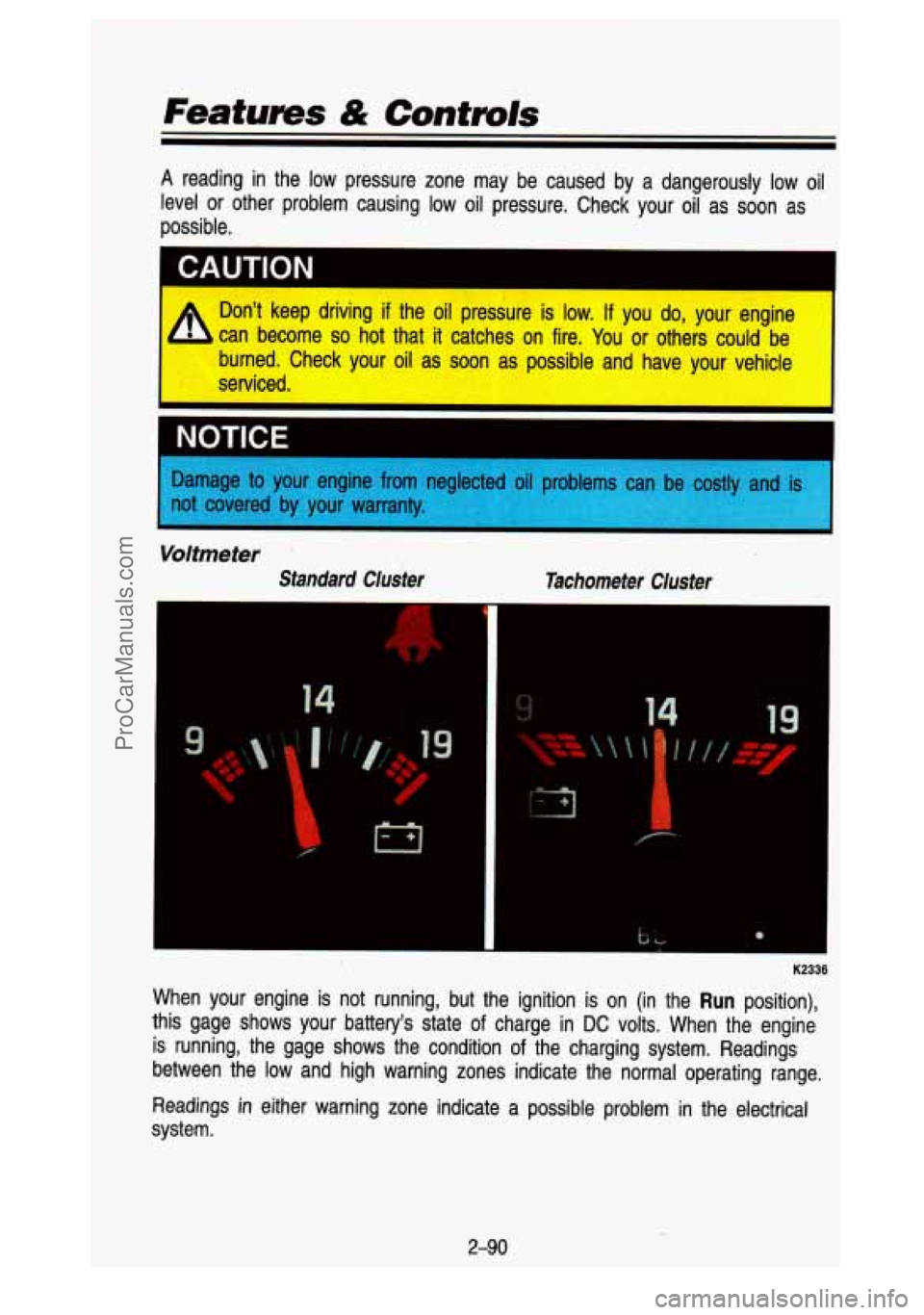
Voltmeter
Standard Cluster Tachometer Cluster
14 14
A
K2336
When your engine is not running, but the ignition is on (in the Run position),
this gage shows your battery’s state of charge in DC volts. When the engine
is running, the gage shows the condition of the charging system. Readings
between the low and high warning zones indicate the normal ope\
rating range.
Readings
in either warning zone indicate a possible problem in the electrical
system.
2-90
ProCarManuals.com
Page 223 of 436
 as extra warning that you are about to slow
down and ex")
close behind you, you can allow a little extra time and flash\
your brake lights (in addition to your turn signal) as extra warning that you are about to slow
down and exit.
The exit ramp can be curvea, somerlmes quite sharply. The exit\
speed is
usually posted. Reduce your speed according to your speedometer,\
not to
your sense of motion. After driving for any distance at higher\
speeds, you
may tend to think you are going slower than you actually are.\
For example,
40 rnph (65 km/h) might seem like only 20 mph (30 km/h). Obviously, this
could lead to serious trouble
on a ramp designed for 20 mph (30 kmlh)!
Driving a Long Distance
Although most long trips today are made on freeways, there are\
still many
made on regular highways.
Long-distance driving on freeways and regular highways is the s\
ame in some
ways. The trip has to be planned and the vehicle prepared, you drive at\
higher-than-city speeds, and there are longer turns behind the \
wheel. You’ll
enjoy your trip more
if you and your vehicle are in good shape. Here are
some tips for a successful long trip.
Before Leaving on a Long Trip
Make sure you’re ready. Try to be well rested. If you must start when you’re
not fresh-such as after a day’s work-don’t plan to make too many miles
that first part of the journey. Wear comfortable clothing and \
shoes you can easily drive in.
Is your vehicle ready for a long trip? If you keep it serviced and maintained,
it’s ready to go.
If it needs service, have it done before starting out. Of
course, you’ll find experienced and able service experts in \
your vehicle’s
dealerships all across North America. They’ll be ready and willing to help \
if
you need it.
Here are some things you can check before a trip:
Windshield Washer Fluid: Is the reservoir full? Are all windows clean
Wiper Blades: Are they in good shape?
Fuel, Engine Oil, Other Fluids: Have you checked all levels?
Lights: Are they all working? Are the lenses clean?
Tires: They are vitally important to a safe, trouble-free trip. Is the tread
good enough for long distance driving? Are the tires all inflated to the
recommended pressure? inside and outside?
445
ProCarManuals.com
Page 253 of 436
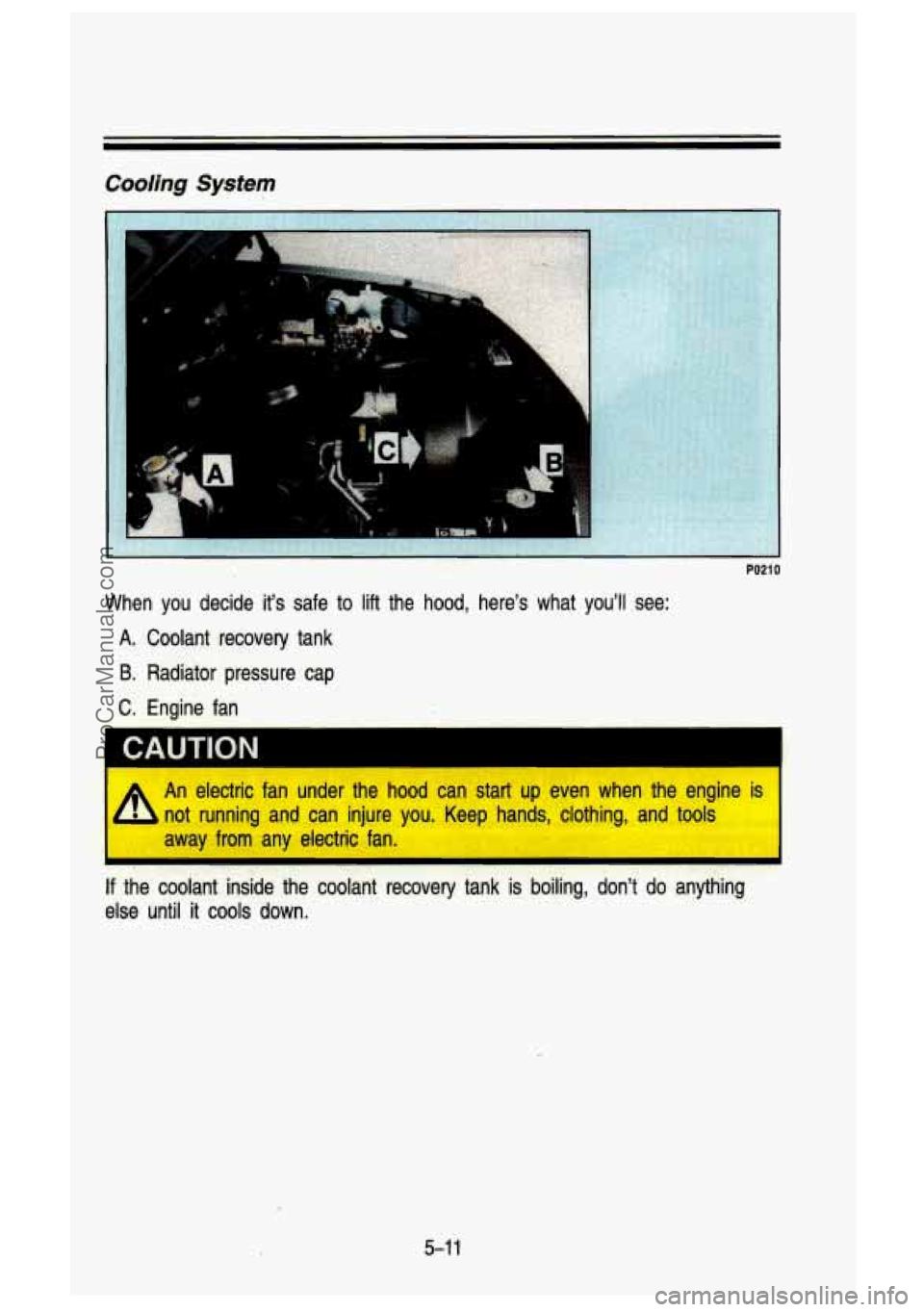
Cooling System
PO21 0
When you decide it’s safe to lift the hood, here’s what you’ll see:
A. Coolant recovery tank
B. Radiator pressure cap
C. Engine fan
CAUTION
‘4
An electric fan under the hood can start up even when the engine\
is
not running and can injure you. Keep hands, clothing, and tool\
s
away from any electric fan.
m
If the coolant inside the coolant recovery tank is boiling, don’t do anything
else until it cools down.
5-1 1
ProCarManuals.com
Page 364 of 436
Service & Appearance Care
Rinse the section with a clean, wet sponge.
Wipe off what’s left with a slightly damp paper towel or cloth.
Then dry it immediately with an air hose, a hair dryer or a heat lamp.
I
~~~
careful with a hair dryer or heat lamp. You could scorch me lauric.
Wipe with a clean cloth.
Using Solvent-Type Cleaner on Fabric
First, see if you have to use solvent-type cleaner at all. Some spots and
stains will clean
off better with just water and mild soap.
If you need to use it, then:
Gently scrape excess soil from the trim material with a clean,\
dull knife
or scraper. Use very little cleaner, light pressure and clean cloths
(preferably cheesecloth). Cleaning should start at the outside \
of the stain,
“feathering” toward the center. Keep changing to a clean section of the
cloth.
When you clean a stain from fabric, immediately dry the area with an
air hose, hair dryer,
or heat lamp to help prevent a cleaning ring. (See
previous NOTICE.)
Fabric Protection
Your vehicle has upholstery that has been treated with ScotchgardTM \
Fabric
Protector, a
3M product. ScotchgardTM protects fabrics by repelling oil and
water, which are the carriers of most stains. Even with this protection, you
still need to clean your upholstery often
to keep it looking new.
Further information on cleaning is available by calling 1-800-433-3296
(in
Minnesota, 1-800-642-61 67).
Special Cleaning Problems
Greasy or Oily Stains: Like grease, oil, butter, margarine, shoe polish, coffee
with cream, chewing gum, cosmetic creams, vegetable oils, wax c\
rayon, tar
and asphalt.
Carefully scrape off excess stain.
Then follow the solvent-type instructions above.
Shoe polish, wax crayon, tar and asphalt will stain if left on a vehicle
seat fabric. They should be removed as soon as possible. Be c\
areful,
because the cleaner will dissolve them and may cause them to bleed.
6-86
ProCarManuals.com
Page 398 of 436
Scheduled Maintenance Services
Explanation Of Scheduled Maintenance Services
Below are explanations of the services listed in the maintenance charts.
The proper fluids and lubricants to use are listed in this section. Make sure
whoever services your vehicle uses these. All parts should be \
replaced and
all necessary repairs done before you or anyone else drives the ve\
hicle.
1.
ENGINE OIL AND OIL FILTER CHANGE* -ALWAYS USE SG OR
SGKE QUALITY, ENERGY CONSERVING II OILS OF THE PROPER
VISCOSITY. To determine the preferred viscosity oil for your vehicle’s
engine (e.g. SAE 5W-30 or 10W-30), see “Engine Oil” in the Index.
2. CHASSIS LUBRICATION -Lubricate the front suspension, king pin
bushings, steering linkage, transmission, and transfer case shift\
linkage,
parking brake cable guides, propshaft splines (2 wheel drive), brake
pedal springs, and clutch pedal springs at the intervals specified.
If you have a 3500 HD, lubricate the king pins and king pin bushings
every 1,500 miles
(2500 km) for Maintenance Schedule 1, or every 3,000
(5000 km) for Maintenance Schedule 2.
Ball joints and king pin bushings should not be lubricated unless their
temperature is
10°F (-12”C), or higher. When the weather is cold, let
them warm up before lubrication or they could be damaged.
Also, be sure to check
all the vehicle fluid levels at this time.
3.
CLUTCH FORK BALL STUD LUBRICATION -Lubricate the clutch fork
ball stud through the fitting on the clutch housing. Lubricant must be
added “sparingly” to the fitting, as only.
0066 Ib. (.003 kg) is required to
lubricate the ball stud surface.
Do not add lubricant more often than the
intervals in the Maintenance Charts.
Too much lubricant will damage
the clutch assembly.
4. ENGINE IDLE SPEED ADJUSTMENT (DIESEL ENGINES)* -Adjust to
the specifications shown on the underhood label. You must use
calibrated test equipment.
5. COOLING SYSTEM SERVICE* -Drain, flush and refill system with new
coolant. See “Engine Coolant’’ in the Index for the proper coolant and
mixture to use in your vehicle.
Also inspect the hoses and replace them
if they are cracked, swollen, or
deteriorated. Tighten all hose clamps (except constant tension \
clamps).
Remove debris and clean the outside
of the radiator and air conditioning
condenser. Wash the radiator neck.
To ensure proper operation, pressure
test the radiator and cap.
* An Emission Control Service
7-1
8
ProCarManuals.com
Page 401 of 436

23. EXHAUST PRESSURE REGULATOR VALVE INSPECTION* -Check that
the valve works properly. Correct any binding. Inspect hoses fo\
r cracks, chafing or decay. Replace parts as needed.
24.
TIRE AND WHEEL ROTATION AND INSPECTION -For proper wear
and maximum tire life, rotate tires at the first
6,000 miles (1 0 000
kilometers) for Schedule I (t) or 7,500 miles (12 500 kilometers) for
Schedule
II (.) and then every 15,000 miles (25 000 kilometers)
thereafter. Follow the instructions and patterns shown in Section 6.
Check tires for uneven wear or damage.
If irregular or premature wear is
apparent, check wheel alignment. Also, check for damaged wheels.\
See
“Tires” in the Index for more information.
For dual wheels, whenever the vehicle, wheels, or fasteners are new,
have the wheel fastener torque set at the first 100,
1,000 and 6,000
miles (160, 1600 and 10
000 km).
For 3500 H.D. Models, block the tires opposite those being removed to
keep the vehicle from rolling.
25.
DRIVE AXLE SERVICE -Check readfront axle fluid level and add as
needed. Check constant velocity joints and axle seals for leaki\
ng.
Locking differential-Drain fluid at first oil change and refill. Check
fluid level and add as needed at subsequent oil changes.
In dusty
areas, or trailer towing applications drain fluid at every 15,0\
00 miles
(24 135 kilometers) and refill$
every oil change. In dusty areas, or trailer towing applications, drain
fluid every 15,000 miles
(24 135 kilometers) and refi1l.t
More frequent lubrication may be required on heavy-duty or off-road
use.
Standard differential -Check fluid level and add as needed at
26.
BRAKE SYSTEM INSPECTION -When the engine oil is changed,
inspect the lines and hoses for proper hookup, binding, leaks, \
cracks,
chafing, etc. Check the parking brake adjustment, and the fluid level in
the master cylinder.
A low fluid level can indicate worn disc brake pads
which may need to be sewiced.t
*An Emission Control Service
tA fluid
loss in these systems may indicate a problem. Have them
inspected and repaired at once.
7-2
1
ProCarManuals.com
Page 402 of 436

Scheduled Maintenance Sewices
When the wheels are removed for rotation, inspect disc brake pads f\
or wear
and rotors for surface condition.
Also inspect drum brake linings for wear and
cracks. Inspect other brake parts, including drums, wheel cylind\
ers, parking
brake, etc., at the same time. Remove any rust
or dirt from the wheel and
mounting surfaces before mounting the wheel.
Inspect brakes more often if driving habits or conditions resull In
frequent braking.
Owner Checks and Services
Listed below are owner checks and services which should be mad\
e at the
time period specified
to help ensure proper safety, emission performance, and
dependability of your vehicle.
Be sure any necessary repairs are completed at once. Whenever \
any fluids
or lubricants are added to your vehicle, make sure they are the proper ones,
as shown
in this Section.
At Least Once a Month
Tire inflation pressure check -Check the tires for proper inflation. If they
are low, inflate them
to the level specified on the certification label or on the
tire inflation charts. See “Loading Your Vehicle’’ or “Inflation-Tire Pressure” in
the Index.
At Least Once a Year
Key lock cylinder lubrication -Lubricate key lock cylinders with engine oil.
See the “Recommended Fluid and Lubricants’’ chart in this section.
Transmission neutral or clutch start switch operation
CAUTION
~
1. Before you start, be sure you have enough room around the veh\
icle.
2. Firmly apply both the manual parking brake and the regular brake. See
“Brakes” and “Parking Brake” in the Index.
Do not use the accelerator
pedal.
3. Be ready to turn off the engine immediately if it starts.
4. On automatic transmission vehicles, try to start the engine in each gear.
The starter should work only in
P (Park) or N (Neutral).
7-22
ProCarManuals.com