steering GMC SIERRA 1993 Owners Manual
[x] Cancel search | Manufacturer: GMC, Model Year: 1993, Model line: SIERRA, Model: GMC SIERRA 1993Pages: 436, PDF Size: 23.88 MB
Page 77 of 436
If you have a quick-release tailgate it can be removed by:
1. Raising the tailgate slightly and removing both retaining cables.
2. Lift the tailgate at the right side and pull it out at the left side.
Reverse the above procedure to reinstall. Make sure the tailgate is secure.
Then
Vehicle theft is a big business, especially in some cities. Although your
vehicle has a number of theft deterrent features, we know that nothing we
put on it can make it impossible to steal. However, there are ways you can
help.
Key in the Ignition: If you walk away from your vehicle with the keys inside,
it’s an easy target for joy riders or professional thieves-so don’t do it. When
you park your vehicle and open the driver’s door, you’ll hear a tone reminding
you to remove your key from the ignition and take it with you. Always do
this. Your steering wheel will be locked, and
so will your ignition. If you have
an automatic transmission, taking your key out also locks your \
transmission.
And remember to lock the doors.
Parking at Night: Park in a lighted spot, close all windows and lock your
vehicle. Remember to keep your valuables out of sight. Put them in a storage
area, or take them with you.
Parking Lots: If you park in a lot where someone will be watching your vehicle\
,
it’s best to lock it up and take your keys. But what
if you have to leave your
ignition key? What
if you have to leave something valuable in your vehicle?
Put your valuables in a storage area or console.
Lock the console.
Lock all doors except the driver’s,
Then take the door key with you.
2-9
ProCarManuals.com
Page 78 of 436

Features & Controls
New Vehicle “Bmak-Rn99
1 NOTICE
Jr modern vehicle doesn’t need an elaborate “break-in.” But\
it will
perform better in the long run
if you follow these guidelines:
Keep your speed at 55 mph (88 kmlh) or less for the first 500 miles
(804 km).
Don’t drive at any one speed-fast or slow-for the first 500 miles
(804 km). Don’t make full-throttle starts.
Avoid making hard stops for the first 200 miles (322 km) or so.
During this time your new brake linings aren’t yet broken in. Hard
stops with new linings can mean premature wear and earlier
replacement. Follow this “breaking-in” guideline every time you get
new brake linings.
If you have
a 3500 HD Model, see “Parking Brake” in the Index.
Ignition Switch
Use your square key to start your vehicle. The square key lets you turn the
ignition switch
to five different positions:
6 1
RUN
KO404
Acc (Accessory): Acc lets you use things like the radio and the windshield
wipers when the engine
is off. To get into Acc, push in the key and turn it
toward you. Your steering wheel will remain locked, just as it was before you
inserted the key.
2-1 0
ProCarManuals.com
Page 79 of 436

LOCK: This position locks your ignition, steering wheel and transmissi\
on. It’s
a theft deterrent feature.
You will only be able to remove your key when the
ignition is turned
to LOCK.
Off: This position lets you turn off the engine but still turn the steering wheel.
Use Off
if you must have your vehicle in motion while the engine is off (for
example,
if your vehicle is being pushed).
Run: This is the position for driving.
Start: This starts your engine.
A On manual transmission vehicles, turning the key to LOCK will lock I
A the steering column and result in a loss of ability to steer the
vehicle. This could cause a collision.
If you need to turn the engine
off while the vehicle is moving, turn the key only to OFF. Don’t move
the key release lever while the vehicle is moving.
-
f your key seems stuck in LOCK and you can’t turn it, be sure it is all
:he way in.
If it is, then turn the steering wheel left and right while you
:urn the key hard. But turn the key only with your hand. Usi\
ng a tool to
‘orce
it could break the key or the ignition switch. If none of this works,
:hen your vehicle needs service.
NOTICT
I
Key Release Levc-
KO495
The ignition key cannot be removed from the ignition of manual transmission
vehicles unless the key release lever is used.
2-1 1
ProCarManuals.com
Page 80 of 436
Features & Controls
A On manual transmission vehicles, turning the key to LOCK will lock
3 steering column and result in a loss of ability to steer the
vehicle. This could cause a collision. If you need to turn th\
e engine
off while the vehicle is moving, turn the key only to OFF. Don’t move
the key -‘?ase lever while the vehicle is mc
IQ.
To Remove the Key
On manual transmission vehicles, turn the key to the LOCK position while
pressing the key release lever down. Keeping your finger on the lever, pull
the key straight out.
On automatic transmission vehicles, turn the key to
LOCK and pull it straight
out.
Starting Your Gasoline Engine
If you have a diesel engine, see “Starting Your Diesel Engine” in the Index.
Engines start differently. The 8th digit of your Vehicle Identification Number
(VIN) shows the code letter or number for your engine. You will find the VIN
at the top left
of your instrument panel. (See “Vehicle Identification Number”\
in the Index.)
Follow the proper steps to start the engine.
To Starl Your 4.3 Liter (Code Z) engine
or
5.0 Liter (Code H) engine:
1. Automatic Transmission
Move your shift lever to P (Park) or N (Neutral). Your engine won’t start
in any other position-that’s a safety feature. To restart when you’re
already moving, use
N (Neutral) only.
NOTICE I
Manual Transmission
Shift your gear selector to neutral and hold the clutch pedal to the floor
while starting the engine. Your vehicle won’t start if the clutch pedal is
not all the way down-that’s a safety feature.
2-1 2
ProCarManuals.com
Page 99 of 436
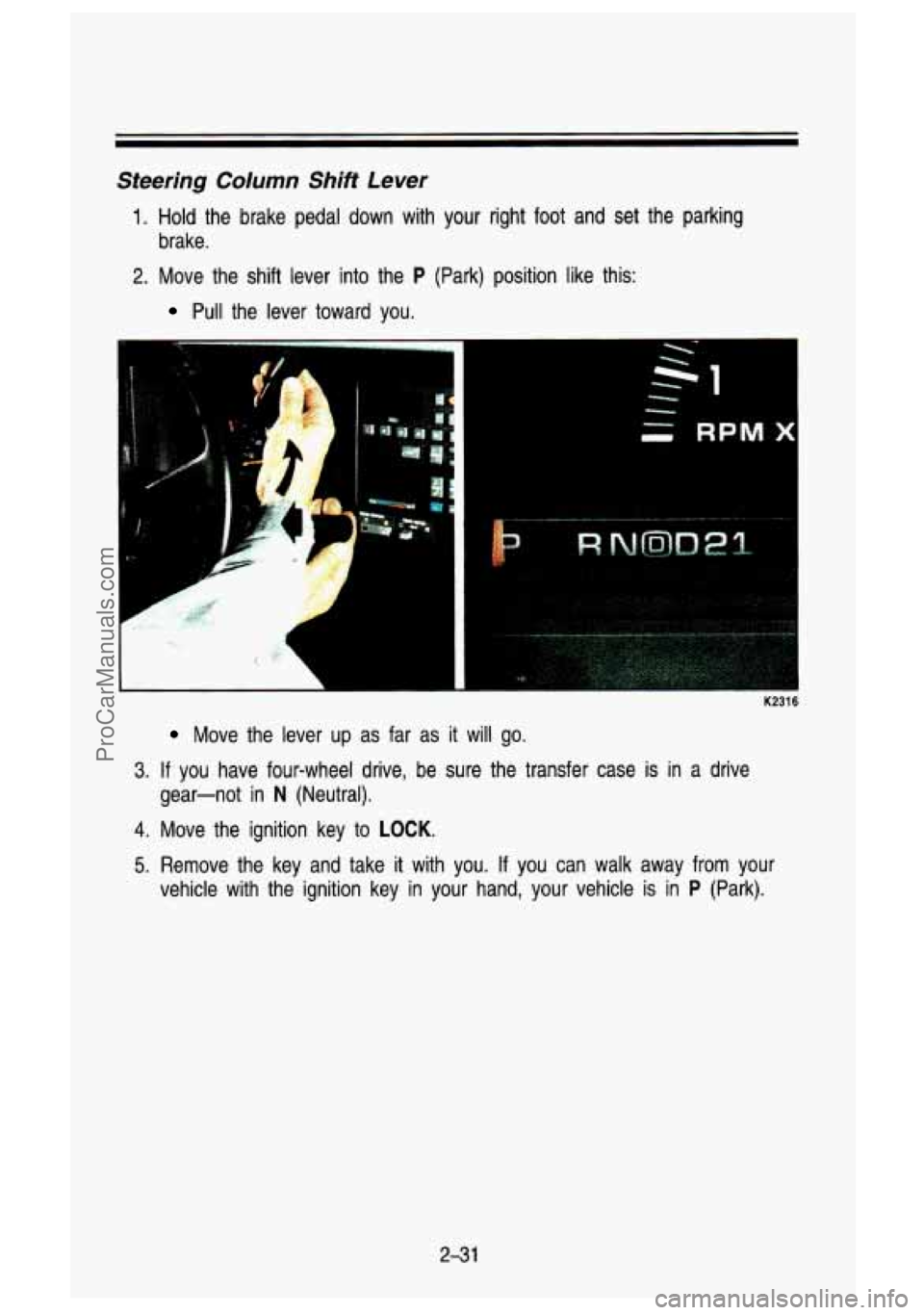
Steering Column Shift Lever
1. Hold the brake pedal down with your right foot and set the parking
brake.
2. Move the shift lever into the P (Park) position like this:
Pull the lever toward you.
~- - --
w KL" I"
Move the lever up as far as it will go.
3. If you have four-wheel drive, be sure the transfer case is in a drive
4. Move the ignition key to LOCK.
5. Remove the key and take it with you. If you can walk away from your
vehicle with the ignition key
in your hand, your vehicle is in P (Park).
gear-not
in N (Neutral).
2-31
ProCarManuals.com
Page 109 of 436

K2185
A ti")
Horn
I'
c
E,
I
K2319
To sound the horn, press the pad with the horn symbol on it. Th\
e pad is
located in the center
of the steering wheel.
Tilt Wheel (Option)
K2185
A tilt steering wheel allows you to adjust the steering wheel be\
fore you drive.
You can also raise it to the highest level to give your legs more room when
you exit and enter the vehicle.
2-41
ProCarManuals.com
Page 110 of 436
Features & ContrOrs
To tilt the wheel, hold the steering wheel and pull the lever. Move the
steering wheel to a comfortable level, then release the lever to
lock the wheel
in place.
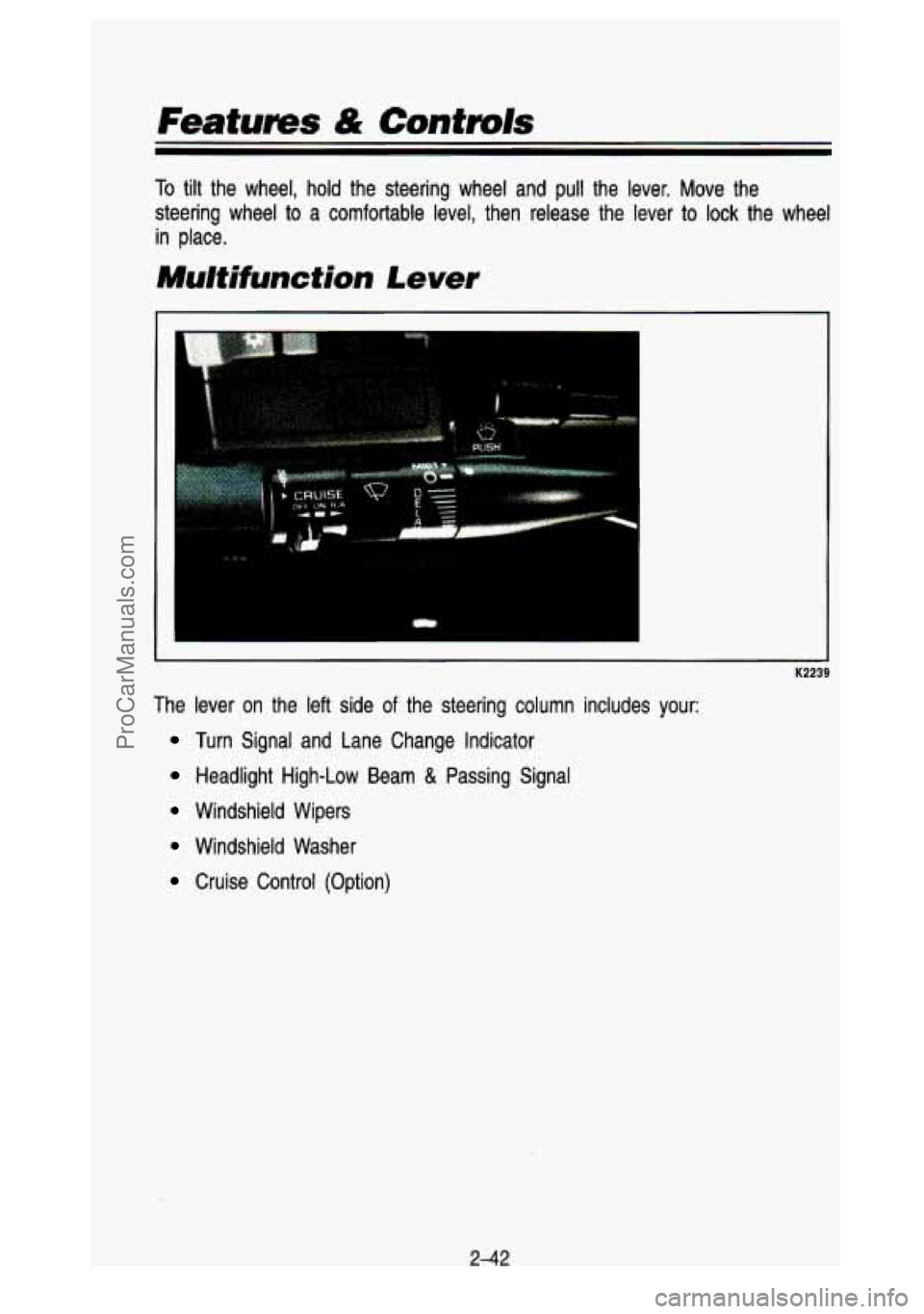
Mu/tifunction Lever
The lever on the left side of the steering column includes your:
Turn Signal and Lane Change Indicator
Headlight High-Low Beam & Passing Signal
Windshield Wipers
Windshield Washer
Cruise Control (Option)
2-42
ProCarManuals.com
Page 179 of 436
Your Driving and the Road
.
Here you’ll find information about driving different kinds of roads and in
varying weather conditions
. We’ve also included many other useful tips on
driving
.
Road Signs ........................................................................\
.................................... 4-3
Defensive Driving ........................................................................\
........................ 4-10
Drunken Driving ........................................................................\
........................... 4-11
Control of a Vehicle ........................................................................\
.................... 4-14
Braking ........................................................................\
...................................... 4-14
Steering ........................................................................\
.................................... 4-19
Steering in Emergencies ........................................................................\
......... 4-21
rassing ........................................................................\
..................................... 4-22
Loss of Control ........................................................................\
........................ 4-24
Off-Road Driving With Your Four-wheel Drive Vehicle
.................................... 4-25
Driving at Night
.............. w..i*&r,+v ........................................................................\
4-36
Driving in the Rain ........................................................................\
...................... 4-30
Driving in Fog, Mist and Haze ........................................................................\
.. 4-41
City Driving ........................................................................\
.................................. 4-42
Freeway Driving ........................................................................\
........................... 4-43
Driving a Long Distance ........................................................................\
............. 4-45
Hill and Mountain Roads ........................................................................\
............ 4-47
4-1
ProCarManuals.com
Page 192 of 436
Your Driving and the Road
Control of a Vehicle
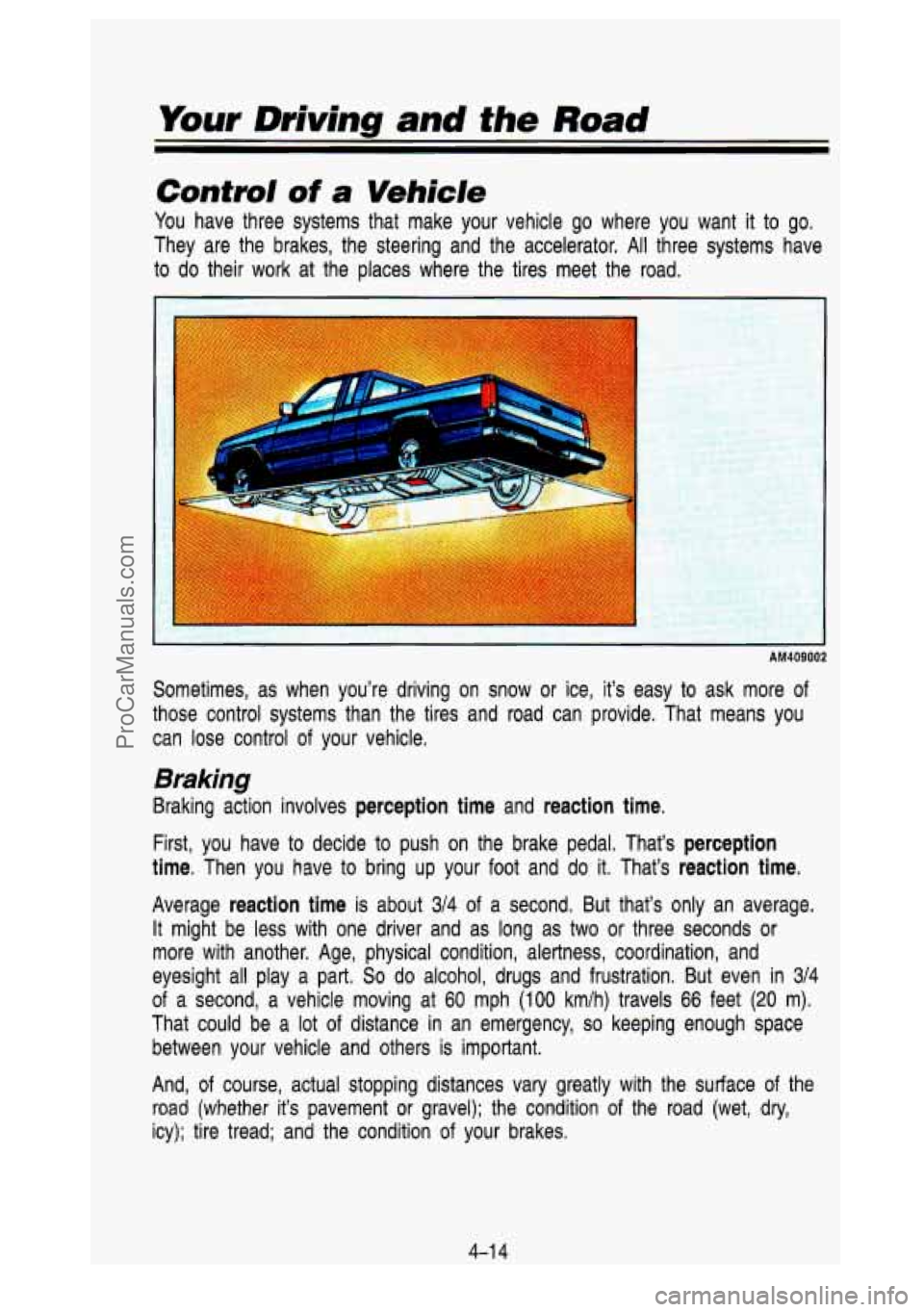
You have three systems that make your vehicle go where you want it to go.
They are the brakes, the steering and the accelerator.
All three systems have
to
do their work at the places where the tires meet the road.
AM409002
Sometimes, as when you’re driving on snow or ice, it’s e\
asy to ask more of
those control systems than the tires and road can provide. Tha\
t means you can
lose control of your vehicle.
Braking
Braking action involves perception time and reaction time.
First, you have to decide to push on the brake pedal. That’s perception
time.
Then you have to bring up your foot and do it. That’s reaction time.
Average reaction time is about 314 of a second. But that’s only an average.
It might be less with one driver and as long as two or thre\
e seconds or
more with another. Age, physical condition, alertness, coordinati\
on, and
eyesight all play a part.
So do alcohol, drugs and frustration. But even in 3/4
of a second, a vehicle moving at 60 mph (100 km/h) travels 66 feet (20 m).
That could be a lot
of distance in an emergency, so keeping enough space
between your vehicle and others
is important.
And, of course, actual stopping distances vary greatly with the surface of the
road (whether it’s pavement or gravel); the condition of the road (wet, dry,
icy): tire tread; and the condition of your brakes,
4-1 4
ProCarManuals.com
Page 197 of 436

Rear Drum Brakes
If you have rear drum brakes, they don’t have the wear indicators, \
but if you
ever hear a rear brake rubbing noise, have the rear brake lining inspected.
Also, the rear brake drums should be removed and inspected each time\
the
tires are removed for rotation or changing. When you have the \
front brakes replaced, have the rear brakes inspected, too.
Brake linings should always be replaced as complete axle sets.
Brake Pedal Travel
See your dealer if the brake pedal does not return to normal height, or if
there is a rapid increase in pedal travel. This could be a sign of brake
trouble.
Brake Adjusiment
Every time you make a brake stop, your disc brakes adjust for\
wear. If your
brake pedal goes down farther than normal, your rear drum brak\
es may need
adjustment. Adjust them by backing up and firmly applying the brakes a few
times.
Braking In Emergencies
At some time, nearly every driver gets into a situation that requires hard
braking. You have the rear wheel anti-lock braking system. Your front wheels
can stop rolling when you brake very hard. Once they
do, the vehicle can’t
respond to your steering. Momentum will carry it in whatever direction it was
headed when the wheels stopped rolling. That could be off the \
road, into the
very thing you were trying to avoid, or into traffic.
So, use a “squeeze” braking technique. This will give you max\
imum braking
while maintaining steering control. You
do this by pushing on the brake pedal
with steadily increasing pressure. When you
do, it will help maintain steering
control. In many emergencies, steering can help you more than even the very
best braking.
Steering
Power Sieerhg
If you lose power steering assist because the engine stops or \
the system
fails to function, you can steer but it will take much more effort.
4-1 9
ProCarManuals.com