brake light GMC SIERRA 1994 User Guide
[x] Cancel search | Manufacturer: GMC, Model Year: 1994, Model line: SIERRA, Model: GMC SIERRA 1994Pages: 404, PDF Size: 20.91 MB
Page 184 of 404
If you decide you can go down a hill safely, then try to keep your vehicle
headed straight down, and use
a low gear. This way, engine drag can help
your brakes and they won’t have to do all the work. Descend slowly,
keeping your vehicle under control at
all times.
A CAUTION:
Heavy braking when going down a hill can cause your brakes to
overheat and fade. This could cause loss of control and a ser\
ious
accident. Apply the brakes lightly when descending a hill
and
use a low gear to keep vehicle speed under control.
Q: Are there some things I should not do when driving down a hill?
A: Yes! These are important because if you ignore them you could lose
control and have
a serious accident.
When driving downhill, avoid turns that take you across the incline of
the hill. A hill that’s not too steep to drive down may be too steep to
drive across. You could roll over if you don’t drive straight down.
0 Never go downhill with the transmission in “N” (Neutral) , or with the
clutch pedal depressed in a manual shift . This is called
“free-wheeling.” Your brakes will have to do
all the work and could
overheat and fade.
Avoid braking so hard that you lock the front wheels when going
downhill.
If your front wheels are locked, you can’t steer your vehicle.
If your wheels lock up during downhill braking, you
may feel the
vehicle starting
to slide sideways. To regain your direction, just ease off
the brakes and steer to keep the front of the vehicle pointing straight
downhill.
0: Am I likely to stall when going downhill?
A: It’s much more likely to happen going uphill. But if it happens going
downhill, here’s what to do.
0 Stop your vehicle by applying the regular brakes. Apply the parking
brake.
Shift to ‘bP’ (Park) (or to Neutral with the lnanual transmission) and,
while still braking, restart the engine.
0 Shift back to a low gear, release the parking brake, and drive straight
down.
0 If the engine won’t start, get out and get hclp.
4-20
ProCarManuals.com
Page 187 of 404
Hard packed snow and ice offer the worst tire traction. On these surfxes,
it’s very easy to lose control. On wet ice, for example, the traction
is so poor
that you will have difficulty accelerating. And
if you do get moving, poor
steering and difficult braking can cause you to slide out of control.
Driving In Water
Light rain causes no special off-road driving problems. But heavy rain can
mean flash flooding, and flood waters demand extreme caution.
Find out how deep the water is before you drive through it. If it’s deep
enough to cover your wheel hubs, axles, or exhaust pipe, don’t try
it - you
probably won’t get through.
Also, water that deep can damage your axle and
other vehicle parts.
If the water isn’t too deep, then drive through it slowly. At fast speeds, water
splashes on your ignition system and your vehicle can stall. Stalling can
also
occur if you get your tailpipe under water. And, as long as your tailpipe is
under water, you’ll never be able
to start your engine. When you go through
water, remember that when your brakes get wet, it may take you longer to
stop.
If you have
a diesel engine, see “Driving Through Water (Diesel Engines)”
in the Index for more information
on driving through water.
4-23
ProCarManuals.com
Page 188 of 404
After Off-Road Driving
Remove any brush or debris that has collected on the underbody, chassis or
under the hood. These accumulations can be
a fire hazard.
After operation
in mud or sand, have the brake linings cleaned and checked.
These substances can cause glazing and uneven braking. Check the body
structure, steering, suspension, wheels, tires, and exhaust system for
damage. Also, check the fuel lines and cooling system for any leakage.
Your vehicle will require more frequent service due to off-road use. Refer
to the Maintenance Schedule for additional information.
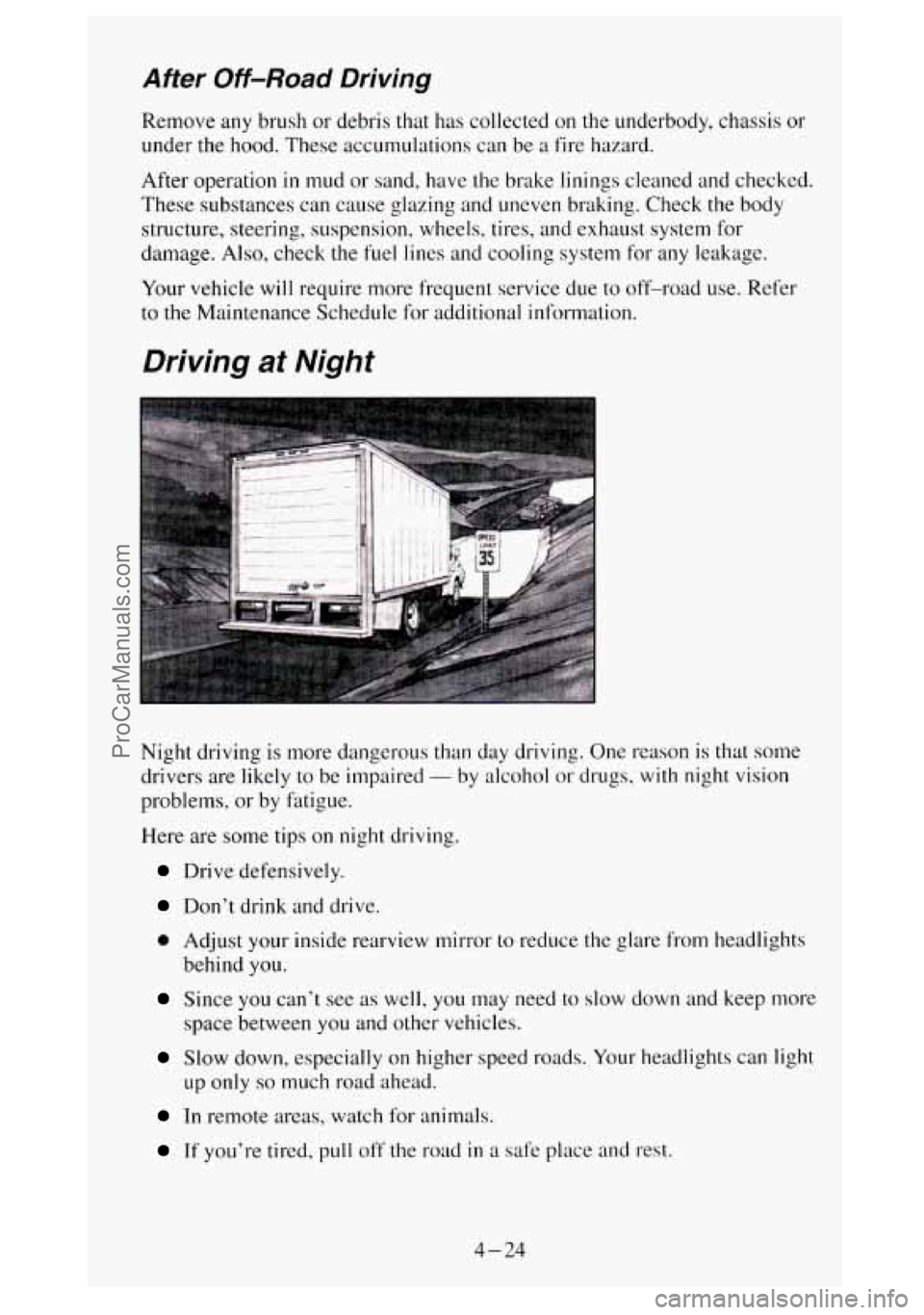
Driving at Night
Night driving is more dangerous than day driving. One reason is that some
drivers are likely to be impaired
- by alcohol or drugs. with night vision
problems,
or by fatigue.
Here are some tips
on night driving.
Drive defensively.
Don’t drink and drive.
a Adjust your inside rearview mirror to reduce the glare from headlights
behind you.
Since you can’t see as well, you may need to slow down and keep more
space between you and other vehicles.
Slow down, especially on higher speed roads. Your headlights can light
up only so much road ahead.
In remote areas, watch for animals.
If you’re tired, pull off the road in a safe place and rest.
4-24
ProCarManuals.com
Page 200 of 404
I
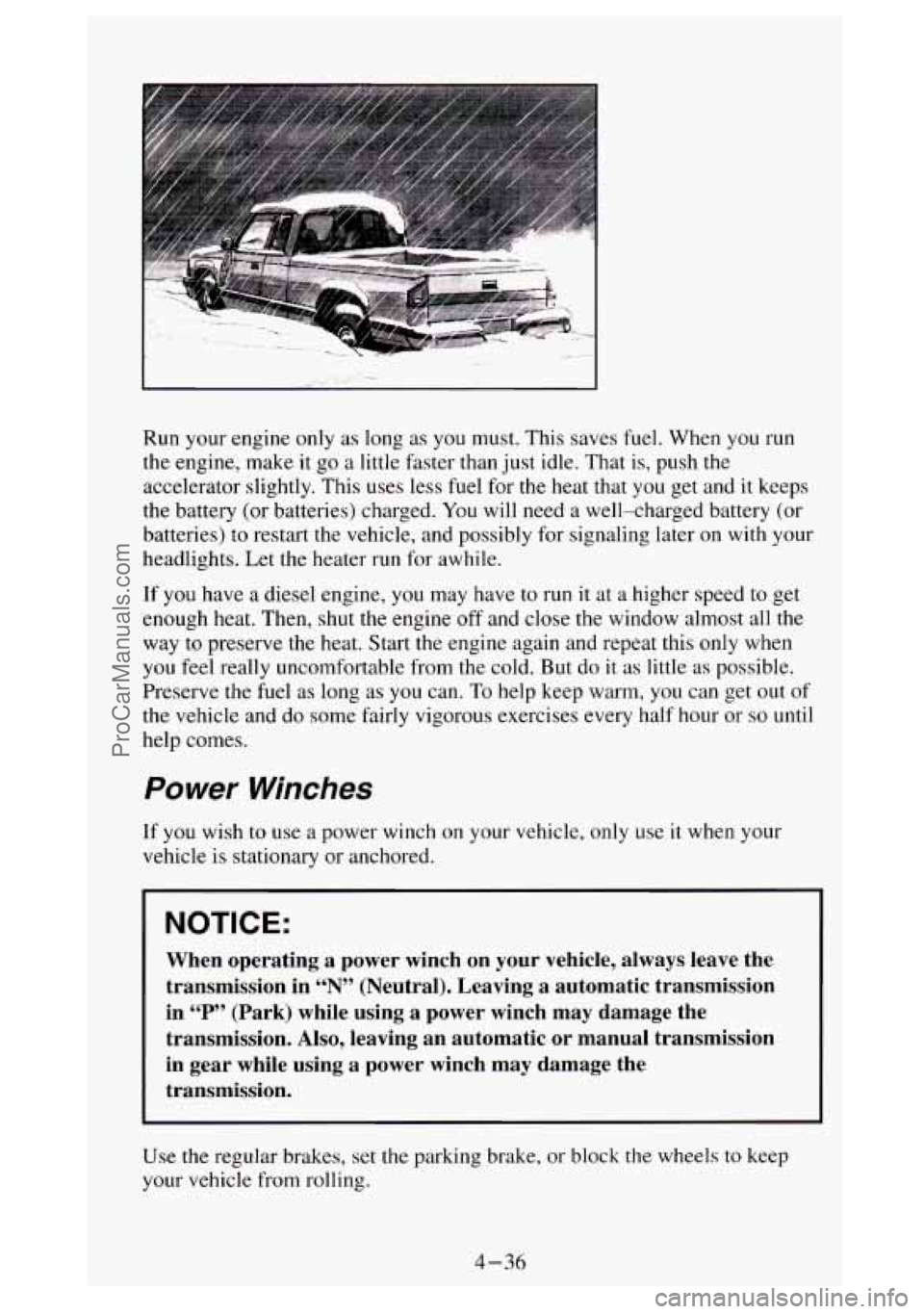
Run your engine only as long as you must. This saves fuel. When you run
the engine, make it go a little faster than just idle. That is, push the
accelerator slightly. This uses less fuel for the heat that you get and it keeps
the battery (or batteries) charged.
You will need a well-charged battery (or
batteries) to restart the vehicle, and possibly for signaling later on with your
headlights. Let the heater run for awhile.
If you have a diesel engine, you may have to run it at a higher speed to get
enough heat. Then, shut the engine off and close
the window almost all the
way to preserve the heat. Start the engine again and repeat this only when
you feel really uncomfortable from the cold. But do it as little as possible.
Preserve the fuel
as long as you can. To help keep warm, you can get out of
the vehicle and do some fairly vigorous exercises every half hour or so until
help comes.
Power Winches
If you wish to use a power winch on your vehicle, only use it when your
vehicle
is stationary or anchored.
When operating a power winch on your vehicle, always leave the\
transmission
in "N" (Neutral). Leaving a automatic transmission
in "P" (Park) while using a power winch may damage the
transmission.
Also, leaving an automatic or manual transmission
in gear while using a power winch may damage the
transmission.
Use the regular brakes, set the parking brake, or block the wheels to keep
your vehicle
from rolling.
4-36
ProCarManuals.com
Page 206 of 404
Before you start, check the trailer hitch and platform, safety chains,
electrical connector, lights, tires and mirror adjustment. If the trailer has
electric brakes, start your
vehicle and trailer moving and then apply the
trailer brake controller by hand to be sure the brakes are working. This lets
you check your electrical connection at
the same time.
During your trip, check occasionally to be sure that the load is secure, and
that the lights and any trailer brakes are still working.
Following Distance
Stay at least twice as far behind the vehicle ahead as you would when
driving your vehicle without a trailer. This can help
you avoid situations that
require heavy braking and sudden turns.
Passing
You’ll need more passing distance up ahead when you’re towing a trailer.
And, because you’re a good deal longer, you’ll need to
go much farther
beyond the passed vehicle before
you can return to your lane.
Backing Up
Hold the bottom of the steering wheel with one hand. Then, to move the
trailer to the left, just move that hand to the
left. To move the trailer to the
right, move your hand to
the right. Always back up slowly and, if possible?
have someone guide you.
Making Turns
When you’re turning with a trailer, make wider turns than normal. Do this
so your trailer won’t strike soft shoulders, curbs, road signs, trees, or other
objects. Avoid jerky or sudden maneuvers. Signal well in advance.
Turn Signals When Towing a Trailer
When you tow a trailer, your vehicle has to have a different turn signal
flasher and extra wiring. The green arrows
on your instrument panel will
flash whenever you signal a turn or lane change. Properly hooked up, the
trailer lights will also flash, telling other drivers you’re about to turn,
change lanes or stop.
When towing a trailer, the green arrows on your instrument panel will flash
for turns even if the bulbs
on the trailer are burned out. Thus, you may think
drivers behind you are seeing your signal when
they are not. It’s important
to check occasionally
to be sure the trailer bulbs are still working.
4-42
ProCarManuals.com
Page 208 of 404
A CAUTION:
It can be dangerous to get out of your vehicle if the shift lever is
not fully in “P” (Park) with the parking brake firmly set. Your
vehicle can roll.
If’ you have left the engine running, the vehicle can move
suddenly. You or others could be injured.
To be sure your vehicle
won’t move, even when you’re on fairly level ground, use the
steps that follow.
If you have four-wheel drive and your transfer case is in “N”
(Neutral), your vehicle will be free to roll, even if your shift lever
is in
“P” (Park). So, be sure the transfer case is in a drive gear
- not in “N” (Neutral).
If you are parking on a hill, or if you’re pulling a trailer, also see
“Parking
On Hills” in the Index.
When You Are Ready to Leave After Parking on a Hill
1. Apply your regular brakes and hold the pedal down while you:
Start your engine;
Shift into a gear; and
0 Release the parking brake.
2. Let up on the brake pedal.
3. Drive slowly until the trailer is clear of the chocks.
4. Stop and have someone pick up and store the chocks.
Maintenance When Trailer Towing
Your vehicle will need service more often when you’re pulling a trailer. See
the Maintenance Schedule for more on this. Things that are especially
important in trailer operation are automatic
fluid (don’t overfill), engine oil,
axle lubricant, belts, cooling system, and brake adjustment. Each of these
is
covered in this manual, and the Index will help you find them quickly. If
you’re trailering, it’s
a good idea to review these sections before you start
your trip.
Check periodically to see that all hitch nuts and bolts are tight.
Trailer Light Wiring
See “Trailer Wiring Harness” in the Index.
4-44
ProCarManuals.com
Page 212 of 404
To Jump Start Your Vehicle
1. Check the other vehicle. It must have a 12-volt battery with a negative
ground system.
I NOTICE:
If the other system isn’t a 12-volt system with a negative
ground, both vehicles can be damaged.
If you have a diesel engine vehicle with two batteries (or more), you
should know before
you begin that, especially in cold weather, you may
not be able to get enough power from
a single battery in another
vehicle to start your diesel engine.
If your vehicle
has more than one battery, use the battery that’s on the
passenger side
of the vehicle - this will reduce electrical resistance.
sure the vehicle’s aren’t touching each other.
If they are, it could cause
a ground connection you don’t want. You wouldn’t be able to start your
vehicle, and the bad grounding could damage
the electrical systems.
You could be injured
if the vehicles roll. Set the parking brake firmly
on each vehicle. Put an automatic transmission
in “P” (Park) or a
manual transmission in “N” (Neutral). If you have a four-wheel-drive
vehicle, be sure
the transfer case is not in “N” (Neutral).
2. Get the vehicles
close enough
so the jumper cables can reach, but be
3. Turn off the ignition on both vehicles. Turn off all lights that aren’t
needed, and radios. This will avoid sparks and help save both batteries.
And it could save
your radio!
NOTICE:
If you leave your radio on, it could be badly damaged. The
repairs wouldn’t be covered by your warranty.
4. Open the hoods and locate the batteries. Find the positive (+) and
negative
(-) terminals on each battery.
5-4
ProCarManuals.com
Page 258 of 404
If the light comes on at any other time, use this chart.
“Water in Fuel” Light Chart
Problem
Light comes on intermittently.
Light stays on:
1. At temperatures above
freezing.
2. At temperatures below
freezing.
Recommended Action
Drain water from fuel filter.
Drain fuel filter immediately. If no
water
can be drained and light stays
on, see your dealer for assistance.
Drain fuel filter immediately. If no
water can be drained
- water may
be frozen. Open the air bleed valve
to check
for fuel pressure. If no fuel
pressure is present, replace the
fuel
filter.
3. Immediately after refueling - Fuel tank purging required. See
large amount of water possibly your dealer for assistance.
pumped into fuel tank.
Hesitation or “flat” performance at high speed or during hard acceleration
may be an indication of premature fuel filter plugging due
to dirty or
contaminated fuel, The filter element may need to be changed
if this
happens. See your dealer for assistance.
NOTICE:
If you drive when this warning light is on, you can damage y\
our
fuel injection system and your engine. If the light comes on right
after you refuel,
it means water was pumped into your fuel tank.
Turn off your engine immediately. Then, have the water drained \
at once.
To drain water:
1. Stop and park the vehicle in a safe place. Turn off the engine and apply
the parking brake.
2. Remove the fuel tank cap.
3. Place a fuel-resistant container under the filter drain hose.
6-8
ProCarManuals.com
Page 298 of 404
Brake Wear
Your vehicle has front disc brakes and rear drum brakes. If you have a
C 3500 HD model, it has four-wheel disc brakes.
Disc brake pads have built-in wear indicators that make
a high-pitched
warning sound when the brake pads are worn and new pads are needed. The
sound may come and go or be heard
all the time your vehicle is moving
(except when you are pushing on the brake pedal firmly).
The brake wear warning sound means that sooner or later your
brakes won’t work well. That could lead to an accident.
When
you hear the brake wear warning sound, have your vehicle
serviced.
NOTICE:
Continuing to drive with worn-out brake pads could result in
costly brake repair.
Some driving conditions or climates may cause a brake squeal when the
brakes are first applied or lightly applied. This does not mean something is
wrong with your brakes.
If
you have rear drum brakes, they don’t have wear indicators, but if you
ever hear a rear brake rubbing noise, have
the rear brake linings inspected.
Also, the rear brake drums should be removed and inspected each time the
tires are removed for rotation or changing. When you have
the front brakes
replaced, have the rear brakes inspected, too.
Brake linings should always be replaced
as complete axle sets.
Brake Pedal Travel
See your dealer if the brake pedal does not return to normal height, or if
there is a rapid increase in pedal travel. This could be a sign of brake
trouble.
6-48
ProCarManuals.com
Page 313 of 404
Trailer Wiring Harness
The optional seven-wire trailer wiring harness is protected by an in-line
fuse
in the battery feed wire. This fuse is near the junction block. See
“Trailer Wiring Harness”
in the Index for more information.
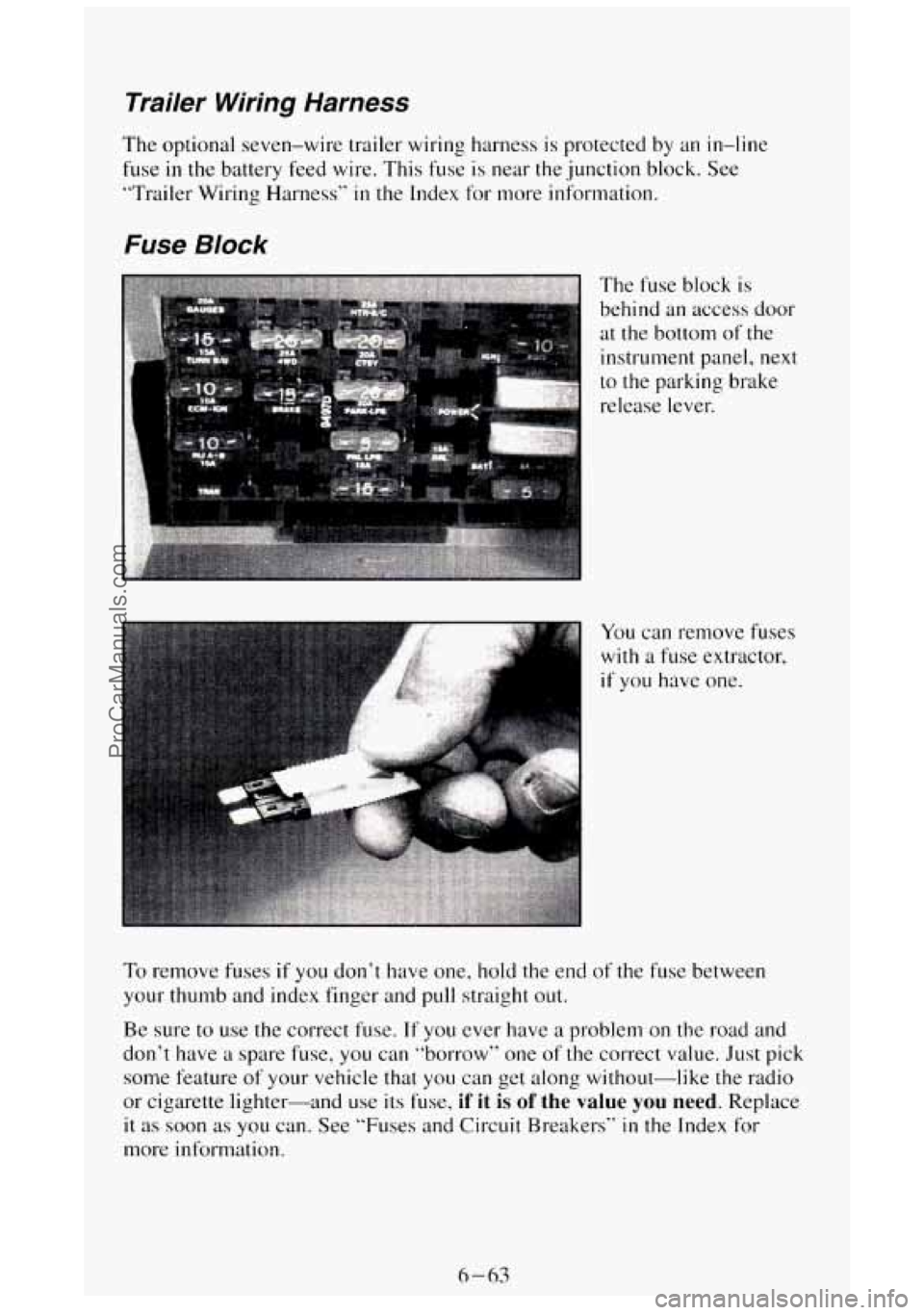
Fuse Block
The fuse block is
behind an access door
at the bottom of the
instrument panel,
next
to the parking brake
release lever.
To remove fuses if you don’t have one, hold the end of the fuse between
your thumb and index finger and pull straight out.
Be, sure to use the correct fuse.
If you ever have a problem on the road and
don’t have a spare fuse, you can “borrow” one of the correct value. Just pick
some feature
of your vehicle that you can get along without-like the radio
or cigarette lighter--and use
its fuse, if it is of the value you need. Replace
it as soon as you can. See “Fuses and Circuit Breakers“ in the Index for
more information.
6-63
ProCarManuals.com