check engine GMC SIERRA 1994 User Guide
[x] Cancel search | Manufacturer: GMC, Model Year: 1994, Model line: SIERRA, Model: GMC SIERRA 1994Pages: 404, PDF Size: 20.91 MB
Page 194 of 404
Reduce your speed according to your speedometer, not to your sense of
motion. After driving for any distance at higher speeds, you may tend
to
think you are going slower than you actually are.
Before Leaving on a Long Trip
Make sure you’re ready. Try to be well rested. If you must start when you’re
not fresh
- such as after a day’s work - don’t plan to make too many
miles that first part
of the journey. Wear comfortable clothing and shoes you
can easily drive in.
Is your vehicle ready for a long trip? If you keep it serviced and maintained,
it’s ready to go.
If it needs service, have it done before starting out. Of
course, you’ll find experienced and able service experts
in Vehicle
dealerships all across
North America. They’ll be ready and willing to help if
you need it.
Here are some things you can check before a trip:
Windshield Washer Fluid: Is the reservoir full? Are all windows clean
inside and outside?
Wiper Blades: Are they in good shape‘?
Fuel, Engine Oil, Other Fluids: Have you checked all levels?
0 Lights: Are they all working? Are the lenses clean‘?
0 Tires: They are vitally important to a safe, trouble-free trip. Is the tread
good enough for long-distance driving‘? Are the tires all inflated
to the
recommended pressure‘?
0 Weather Forecasts: What’s the weather outlook along your route?
Should you delay your trip
a short time to avoid a major storm system?
0 Maps: Do you have up-to-date maps?
Highway Hypnosis
Is there actually such a condition as “highway hypnosis”? Or is it just plain
falling asleep at the wheel?
Call it highway hypnosis, lack of awareness, or
whatever.
There is something about
an easy stretch of road with the same scenery,
along with the hum of the tires on
the road, the drone of the engine, and the
rush of the wind against the vehicle that can make you sleepy. Don’t let it
happen to you! If
it does, your vehicle can leave the road in less than a
second, and you could crash and be injured.
4-30
ProCarManuals.com
Page 195 of 404
What can you do about highway hypnosis? First, be aware that it can
happen.
Then here are some tips:
0 Make sure your vehicle is well ventilated, with a comfortably cool
interior.
Keep your eyes moving. Scan the road ahead and to the sides. Check
your mirrors and your instruments frequently.
0 If you get sleepy, pull off the road into a rest, service, or parking area
and take a nap, get some exercise, or both.
For safety, treat drowsiness
on the highway
as an emergency.
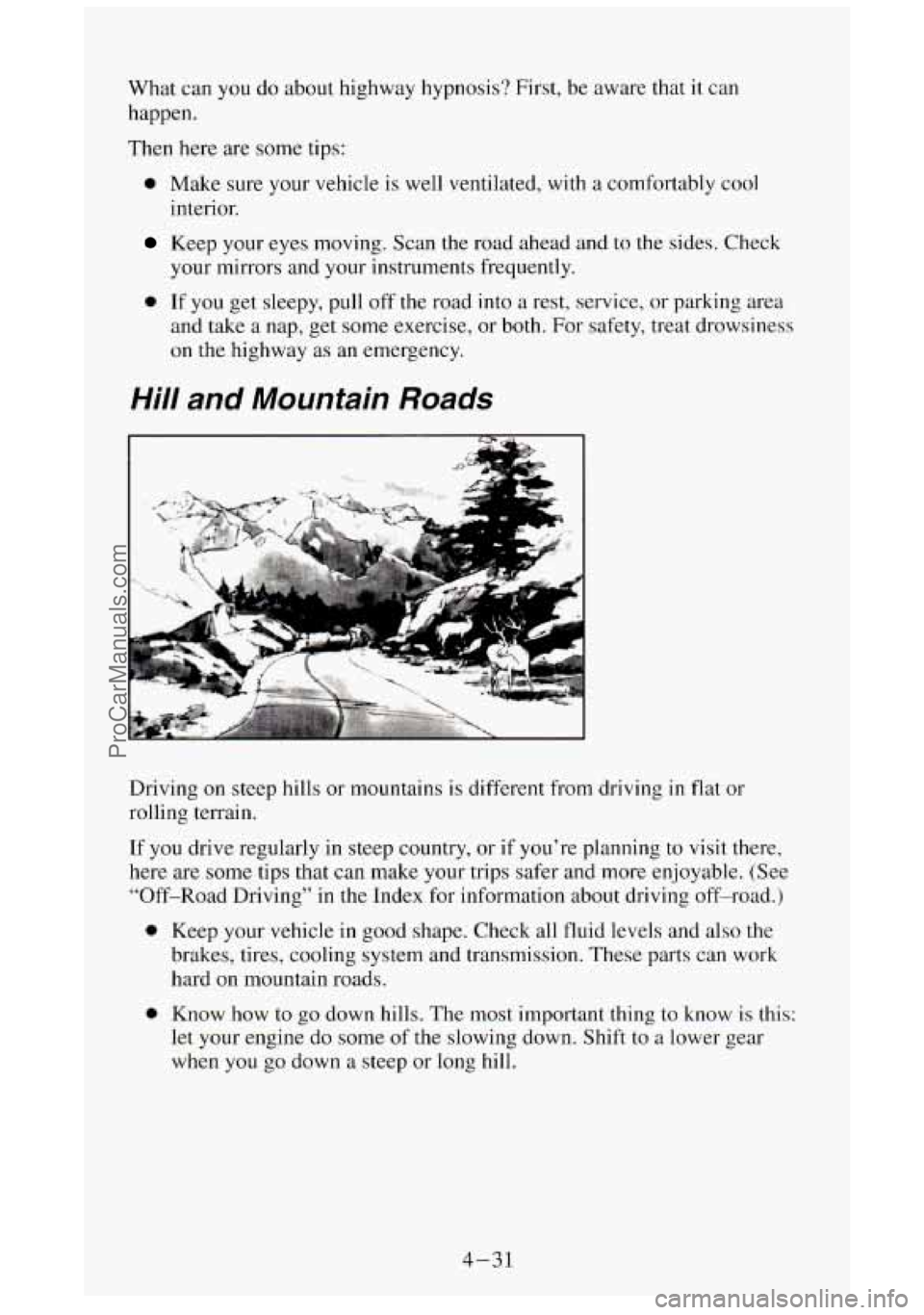
Hill and Mountain Roads
Driving on steep hills or mountains is different from driving in flat or
rolling terrain.
If you drive regularly in steep country, or if you're planning to visit there,
here are some tips that can make your trips safer and more enjoyable. (See
"Off-Road Driving" in the Index for information about driving off-road.)
0 Keep your vehicle in good shape. Check all fluid levels and also the
brakes, tires, cooling system and transmission. These parts can work
hard
on mountain roads.
0 Know how to go down hills. The most important thing to know is this:
let your engine do some of the slowing down. Shift to a lower gear
when you go down
a steep or long hill.
4-31
ProCarManuals.com
Page 199 of 404
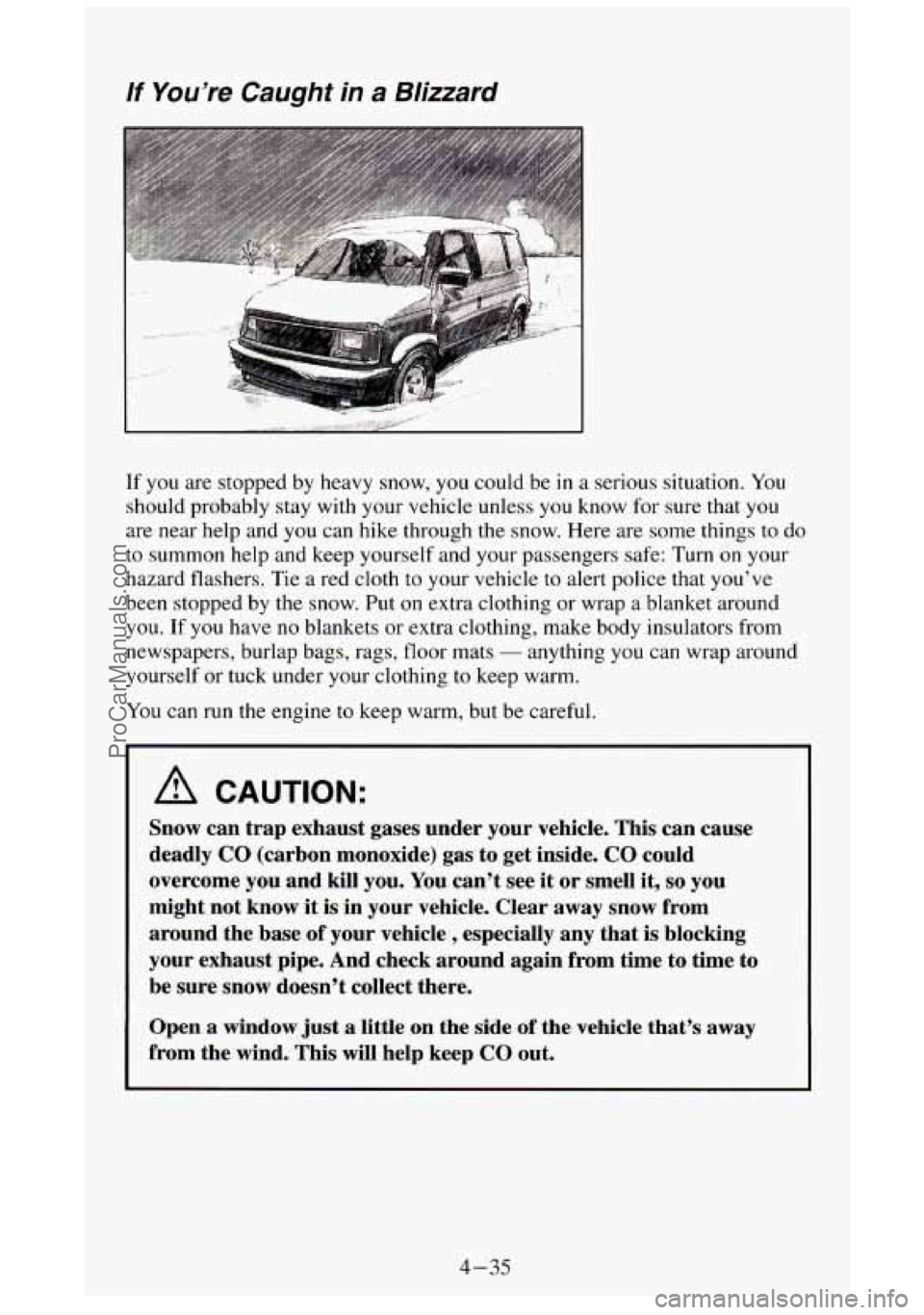
If You’re Caught in a Blizzard
If you are stopped by heavy snow, you could be in a serious situation. You
should probably stay with your vehicle unless you know for sure that you
are near help and you can hike through the snow. Here are some things
to do
to summon help and keep yourself and your passengers safe: Turn on your
hazard flashers. Tie a red cloth to your vehicle
to alert police that you’ve
been stopped
by the snow, Put on extra clothing or wrap a blanket around
you.
If you have no blankets or extra clothing, make body insulators from
newspapers, burlap bags, rags, floor mats - anything you can wrap around
yourself or tuck under your clothing
to keep warm.
You can run the engine to keep warm, but be careful.
A CAUTION:
Snow can trap exhaust gases under your vehicle. This can cause
deadly
CO (carbon monoxide) gas to get inside. CO could
overcome you and kill you.
You can’t see it or smell it, so you
might not know
it is in your vehicle. Clear away snow from
around the base
of your vehicle , especially any that is blocking
your exhaust pipe. And check around again from time
to time to
be sure snow doesn’t collect there.
Open
a window just a little on the side of the vehicle that’s away
from the wind. This will help keep CO out.
4-35
ProCarManuals.com
Page 208 of 404
A CAUTION:
It can be dangerous to get out of your vehicle if the shift lever is
not fully in “P” (Park) with the parking brake firmly set. Your
vehicle can roll.
If’ you have left the engine running, the vehicle can move
suddenly. You or others could be injured.
To be sure your vehicle
won’t move, even when you’re on fairly level ground, use the
steps that follow.
If you have four-wheel drive and your transfer case is in “N”
(Neutral), your vehicle will be free to roll, even if your shift lever
is in
“P” (Park). So, be sure the transfer case is in a drive gear
- not in “N” (Neutral).
If you are parking on a hill, or if you’re pulling a trailer, also see
“Parking
On Hills” in the Index.
When You Are Ready to Leave After Parking on a Hill
1. Apply your regular brakes and hold the pedal down while you:
Start your engine;
Shift into a gear; and
0 Release the parking brake.
2. Let up on the brake pedal.
3. Drive slowly until the trailer is clear of the chocks.
4. Stop and have someone pick up and store the chocks.
Maintenance When Trailer Towing
Your vehicle will need service more often when you’re pulling a trailer. See
the Maintenance Schedule for more on this. Things that are especially
important in trailer operation are automatic
fluid (don’t overfill), engine oil,
axle lubricant, belts, cooling system, and brake adjustment. Each of these
is
covered in this manual, and the Index will help you find them quickly. If
you’re trailering, it’s
a good idea to review these sections before you start
your trip.
Check periodically to see that all hitch nuts and bolts are tight.
Trailer Light Wiring
See “Trailer Wiring Harness” in the Index.
4-44
ProCarManuals.com
Page 212 of 404
To Jump Start Your Vehicle
1. Check the other vehicle. It must have a 12-volt battery with a negative
ground system.
I NOTICE:
If the other system isn’t a 12-volt system with a negative
ground, both vehicles can be damaged.
If you have a diesel engine vehicle with two batteries (or more), you
should know before
you begin that, especially in cold weather, you may
not be able to get enough power from
a single battery in another
vehicle to start your diesel engine.
If your vehicle
has more than one battery, use the battery that’s on the
passenger side
of the vehicle - this will reduce electrical resistance.
sure the vehicle’s aren’t touching each other.
If they are, it could cause
a ground connection you don’t want. You wouldn’t be able to start your
vehicle, and the bad grounding could damage
the electrical systems.
You could be injured
if the vehicles roll. Set the parking brake firmly
on each vehicle. Put an automatic transmission
in “P” (Park) or a
manual transmission in “N” (Neutral). If you have a four-wheel-drive
vehicle, be sure
the transfer case is not in “N” (Neutral).
2. Get the vehicles
close enough
so the jumper cables can reach, but be
3. Turn off the ignition on both vehicles. Turn off all lights that aren’t
needed, and radios. This will avoid sparks and help save both batteries.
And it could save
your radio!
NOTICE:
If you leave your radio on, it could be badly damaged. The
repairs wouldn’t be covered by your warranty.
4. Open the hoods and locate the batteries. Find the positive (+) and
negative
(-) terminals on each battery.
5-4
ProCarManuals.com
Page 213 of 404
5. Check that the jumper cables don't have loose or missing insulation. 'Ir'
they do, you could get a shock. The vehicles could be damaged, too.
Before
you connect the cables, here are some basic things you should
know. Positive
(+) will go to positive (+) and negative (-) will go to
negative
(-) or a metal engine part. Don't connect (+) to (-) or you'll
get a short that would damage the battery and maybe other parts, too.
5-5
ProCarManuals.com
Page 251 of 404
Service & Appearance Care
Section
Here you will find information about the care of your vehicle . This section
begins with service and fuel information. and then it shows how to check
important fluid and lubricant levels
. There is also technical information
about your vehicle. and a section devoted to its appearance care
.
Service ................................................... 6-3
Fuel (Gasoline Engines)
...................................... 6-4
Diesel Fuel Requirements and Fuel System
...................... 6-5
Checking Things Under the Hood
............................. 6-15
HoodRelease
.......................................... 6-15
Cleaning Your Diesel Engine
.............................. 6-16
Noise Control System .................................... 6-16
Engine Oil (Except Diesel)
................................ 6-17
Engine Oil (Diesel Engines)
............................... 6-24
iri
Air Cleaner ............................................ 6-29
Automatic Fluid ........................................ 6-30
ManualFluid
........................................... 6-33
Hydraulic Clutch
........................................ 6-34
RearAxle ............................................. 6-35
mnsfer Case
.......................................... 6-36
FrontAxle
............................................. 6-37
Engine Coolant
......................................... 6-38
Power Steering Fluid
.................................... 6-43
6-1
ProCarManuals.com
Page 256 of 404
Fuel Requirements
NOTICE:
Diesel fuel or fuel additives not recommended in this manual
could damage your fuel system and engine. Your warranty
wouldn’t cover this damage. And:
Diesel fuel that has been mixed with engine oil could damage
your engine and emission controls. Always check with your
service station operator to make sure his diesel fuel has not
been mixed with engine oil.
If you ever run out of diesel fuel, it can be difficult to restart
your engine. “Running Out of Fuel,” later in this section, tells
you how to get it started again.
To avoid all this, try never to
let your tank get empty.
What Fuel to Use
For best results, use number 2-D diesel fuel year-round (above and below
freezing conditions) as oil companies blend number
2-D fuel to address
climate differences. Number
1-D diesel fuel may be used in below freezing
weather, however, it will produce a power and
fuel economy loss. The use
of number
1-D diesel fuel in warm or hot climates may result in stalling,
poor starting when the engine
is hot and may damage the fuel injection
system.
Diesel fuel may foam when you fill your tank. This can cause the automatic
pump nozzle to shut off, even though your tank isn’t full. If this happens,
just wait for the foaming to stop and then continue to
fill your tank.
A CAUTION:
Heat coming from the engine may cause the fuel to expand and
force the fuel out of your tank. If something ignites the fuel,
a
fire could start and people could be burned. To help avoid this,
fill your fuel tank only until the automatic nozzle shuts
off.
Don’t try to “top it off.”
6-6
ProCarManuals.com
Page 257 of 404
Cold Weather Operation
In cold weather (below 20”F, or -7”C), use 1-D or “Winterized” Number
2-D fuel (a blend of I-D and 2-D). Be sure you get the right fuel. In very
cold temperatures (when
it stays below 0°F or -1 8OC), use Number 1-D.
If you’re driving in very cold temperatures and can’t get Number I-D or a
“winterized” Number
2-D, you can use one gallon of kerosene for every
two gallons
of diesel fuel. Once you add the kerosene, run your engine for
several minutes
so the fuels will mix. Add kerosene only when the
temperature falls below
0°F (-1 8” C), because the fuel economy of kerosene
isn’t
as good as that of diesel fuel.
NOTICE:
Never use home heating oil or gasoline in your diesel engine.
They can cause engine damage.
In cold weather, your fuel filter may become clogged (waxed), especially if
you use Number
2-D diesel fuel that hasn’t been “winterized.” To unclog it,
warm the filter to between 32°F and 50°F (0°C to 10°C). You won’t need
to replace
it.
Water in Fuel
Sometimes, water can be pumped into your fuel tank along with your diesel
fuel. This can happen
if a service station doesn’t regularly inspect and clean
its
fuel tanks, or if it gets contaminated fuel from its suppliers.
If this happens,
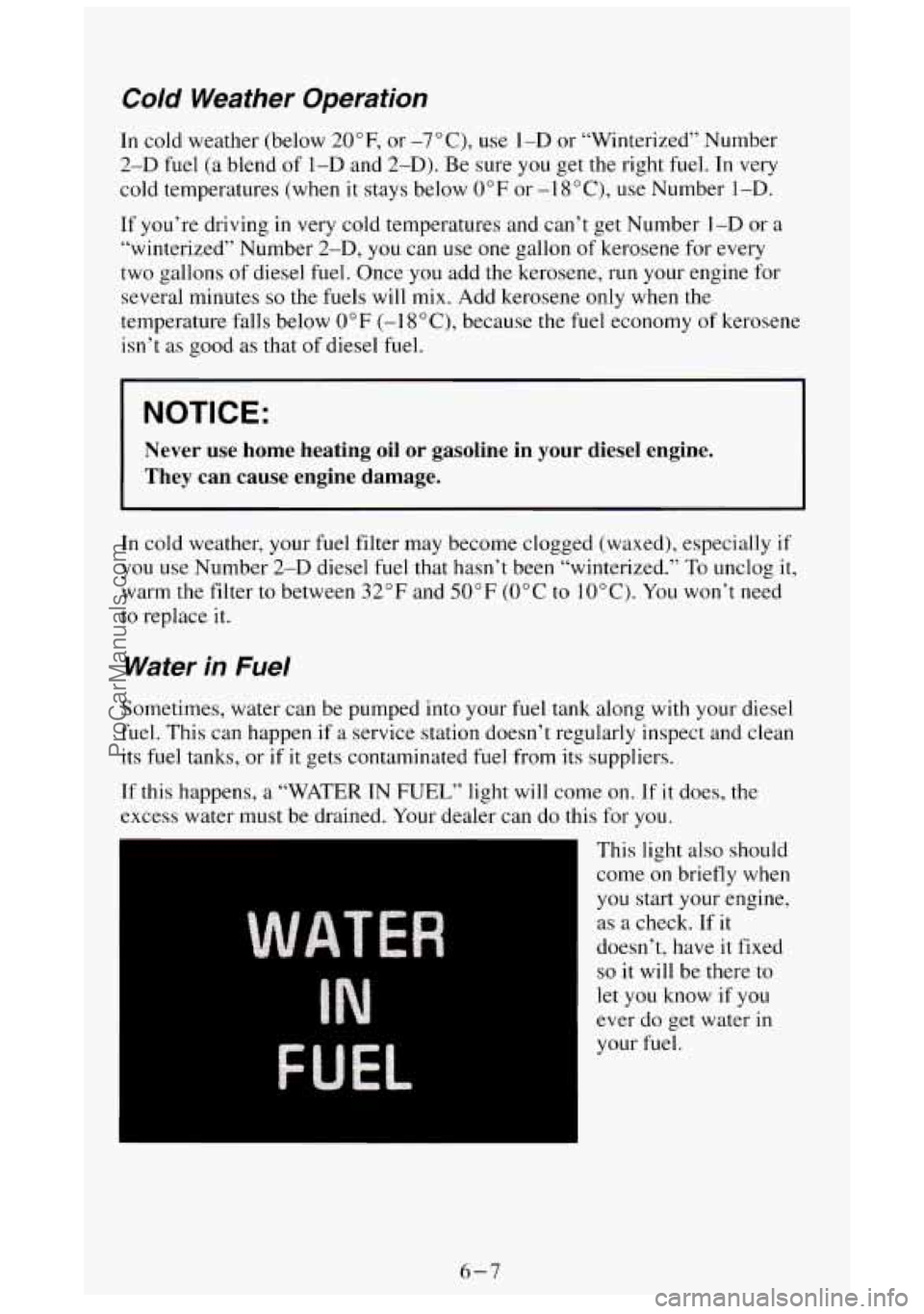
a “WATER IN FUEL” light will come on. If it does, the
excess water must be drained. Your dealer can do this
for you.
This light also should
come on briefly when
you start your engine,
as a check. If it
doesn’t, have it fixed
so it will be there to
let you know if you
ever
do get water in
your fuel.
L
6-7
ProCarManuals.com
Page 258 of 404
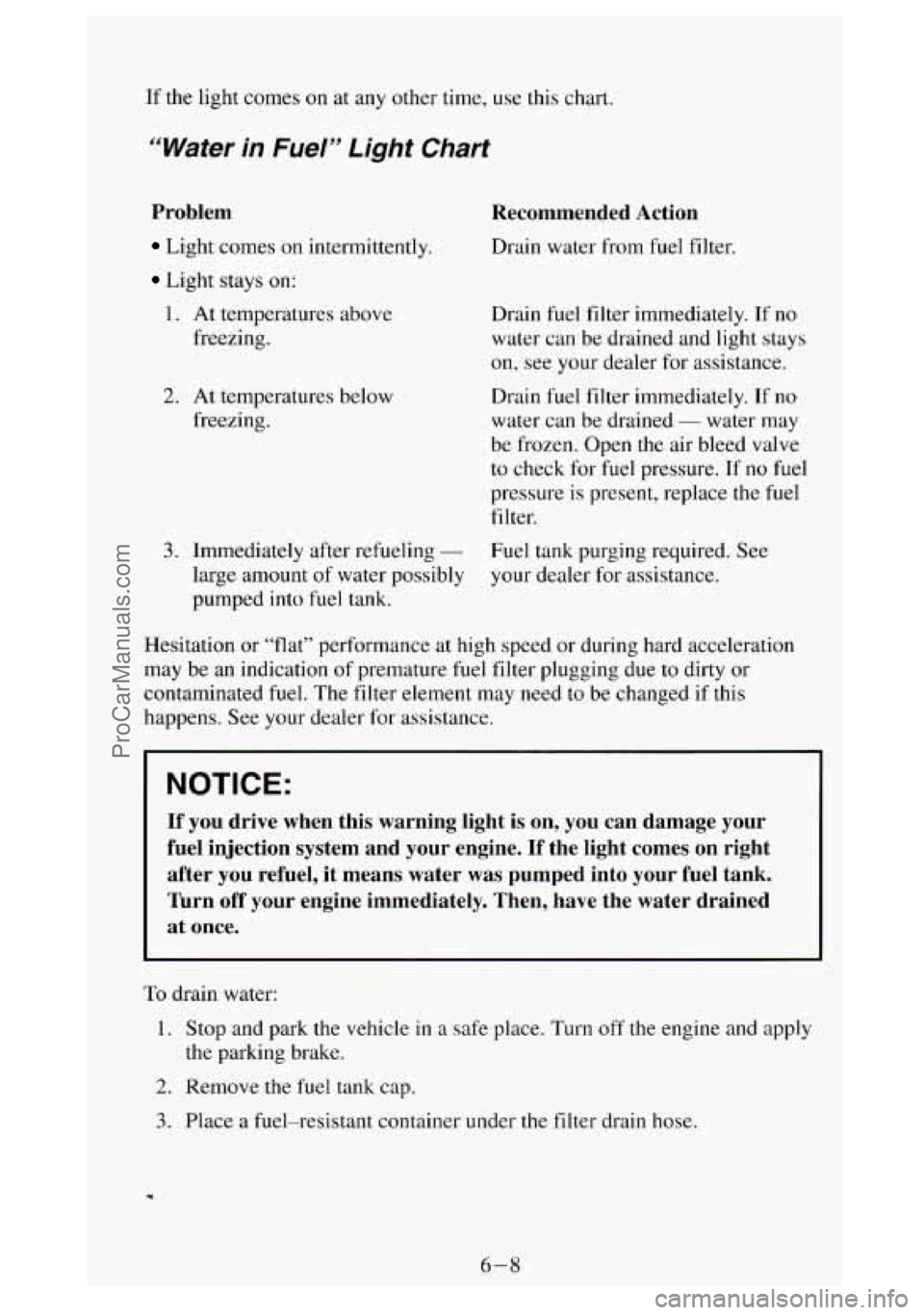
If the light comes on at any other time, use this chart.
“Water in Fuel” Light Chart
Problem
Light comes on intermittently.
Light stays on:
1. At temperatures above
freezing.
2. At temperatures below
freezing.
Recommended Action
Drain water from fuel filter.
Drain fuel filter immediately. If no
water
can be drained and light stays
on, see your dealer for assistance.
Drain fuel filter immediately. If no
water can be drained
- water may
be frozen. Open the air bleed valve
to check
for fuel pressure. If no fuel
pressure is present, replace the
fuel
filter.
3. Immediately after refueling - Fuel tank purging required. See
large amount of water possibly your dealer for assistance.
pumped into fuel tank.
Hesitation or “flat” performance at high speed or during hard acceleration
may be an indication of premature fuel filter plugging due
to dirty or
contaminated fuel, The filter element may need to be changed
if this
happens. See your dealer for assistance.
NOTICE:
If you drive when this warning light is on, you can damage y\
our
fuel injection system and your engine. If the light comes on right
after you refuel,
it means water was pumped into your fuel tank.
Turn off your engine immediately. Then, have the water drained \
at once.
To drain water:
1. Stop and park the vehicle in a safe place. Turn off the engine and apply
the parking brake.
2. Remove the fuel tank cap.
3. Place a fuel-resistant container under the filter drain hose.
6-8
ProCarManuals.com