lights GMC SIERRA 1994 User Guide
[x] Cancel search | Manufacturer: GMC, Model Year: 1994, Model line: SIERRA, Model: GMC SIERRA 1994Pages: 404, PDF Size: 20.91 MB
Page 112 of 404
Mirrors
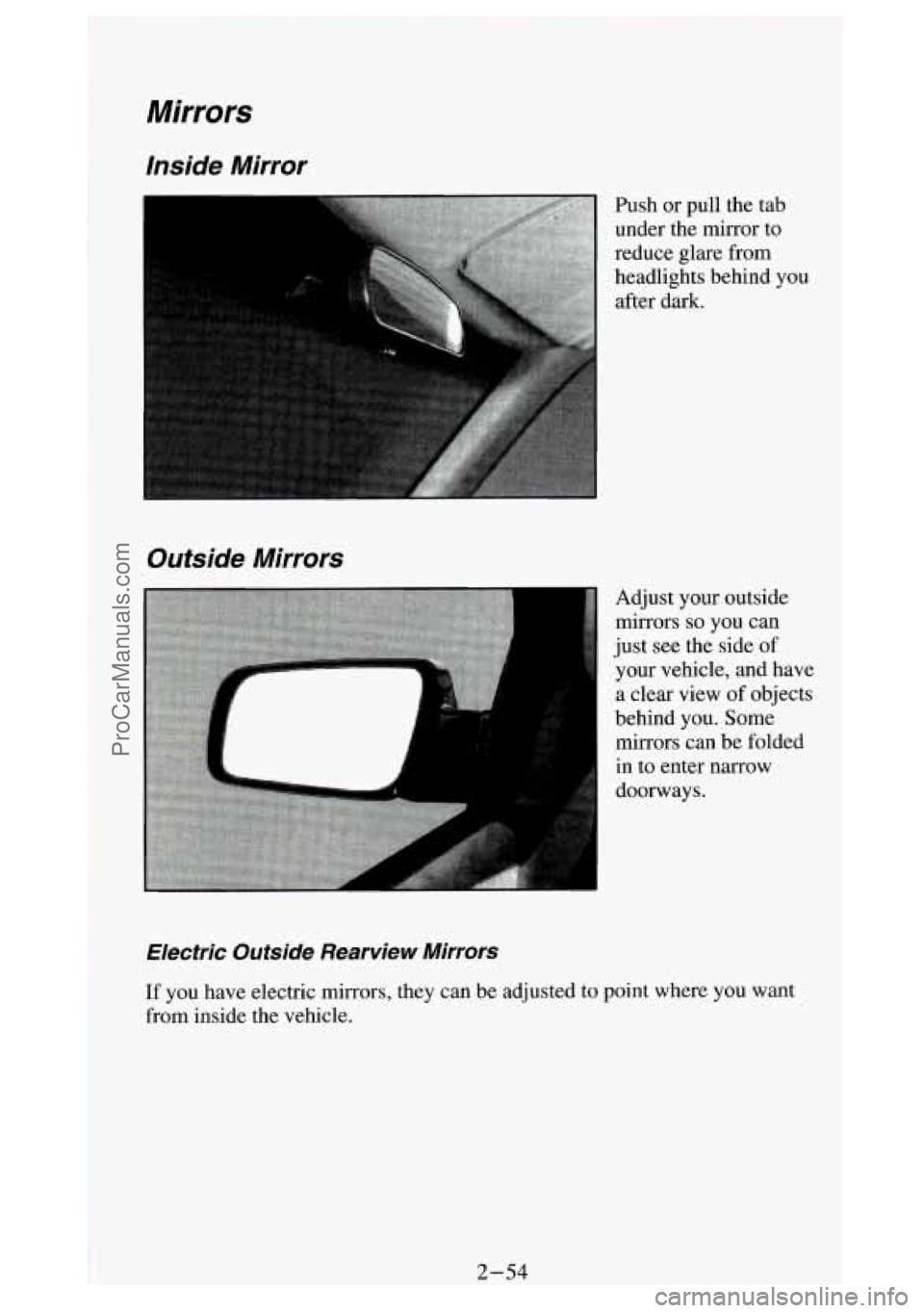
Inside Mirror
Push or pull the tab
under the mirror to
reduce glare from
headlights behind you
after dark.
Outside Mirrors
1
Electric Outside Rearwie w Mirrors
Adjust your outside
mirrors
so you can
just see the side of
your vehicle, and have
a clear view
of objects
behind you. Some
mirrors can be folded
in to enter narrow
doorways.
If you have electric mirrors, they can be adjusted to point where you want
from inside the vehicle.
ProCarManuals.com
Page 114 of 404
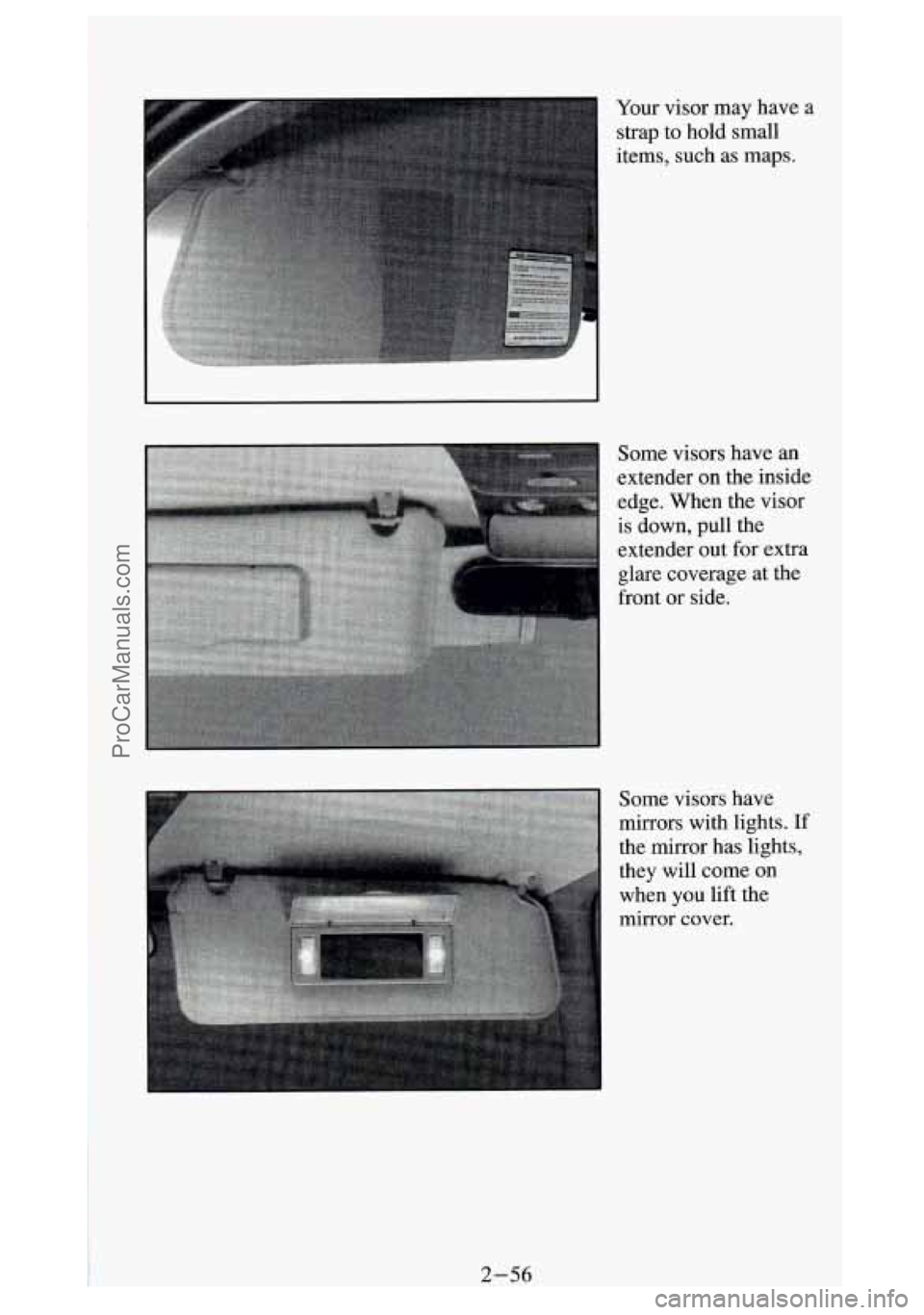
Your visor may have a
strap to hold small
items, such as maps.
Some visors have an
extender on the inside
edge. When
the visor
is down, pull the
extender out for extra
glare coverage at the
front
or side.
Some visors have
mirrors with lights.
If
the &or has lights,
they will come
on
when you lift the
mirror cover.
ProCarManuals.com
Page 127 of 404

To reset the trip odometer, fully press the reset button located \
near the trip
odometer readout. If the reset button is not fully pressed, the trip odometer
may not go all the way back to zero. If it doesn’t, you may have to press the
reset button again to reset the readout to zero.
Tachometer
If you have a
tachometer, it displays
the engine speed in
revolutions per minute
(rpm).
I NOTICE:
Do not operate the engine with the tachometer in the red area\
,
your engine or other parts could be damaged.
Damage to your engine or vehicle caused by operating the
engine in the red area isn’t covered by your vehicle warranty.
Warning Lights and Indicators
This section describes the warning lights and gages that may b\
e on your
vehicle. The pictures will help you locate them.
Warning lights and gages can signal that something
is wrong before it
becomes serious enough to cause an expensive repair or replacem\
ent.
Paying attention to your warning lights and gages could also s\
ave you or
others from injury.
Warning lights go on when there may be
or is a problem with one of your
vehicle’s functions.
As you will see in the details on the next few pages,
some warning lights come on briefly when you turn the ignition\
key just to
let you know they’re working.
If you are familiar with this section, you
should not be alarmed when this happens.
2-69
ProCarManuals.com
Page 128 of 404
Gages can indicate when there may be or is a problem with one of your
vehicle’s functions. Often gages and warning lights work together to let
you
know when there’s a problem with your vehicle.
When one of the warning lights comes on and stays on when you are
driving,
or when one of the gages shows there may be a problem, check the
section that tells you what to do about
it. Please follow the manual’s advice.
Waiting
to do repairs can be costly - and even dangerous. So please get to
know your warning lights and gages. They’re
a big help.
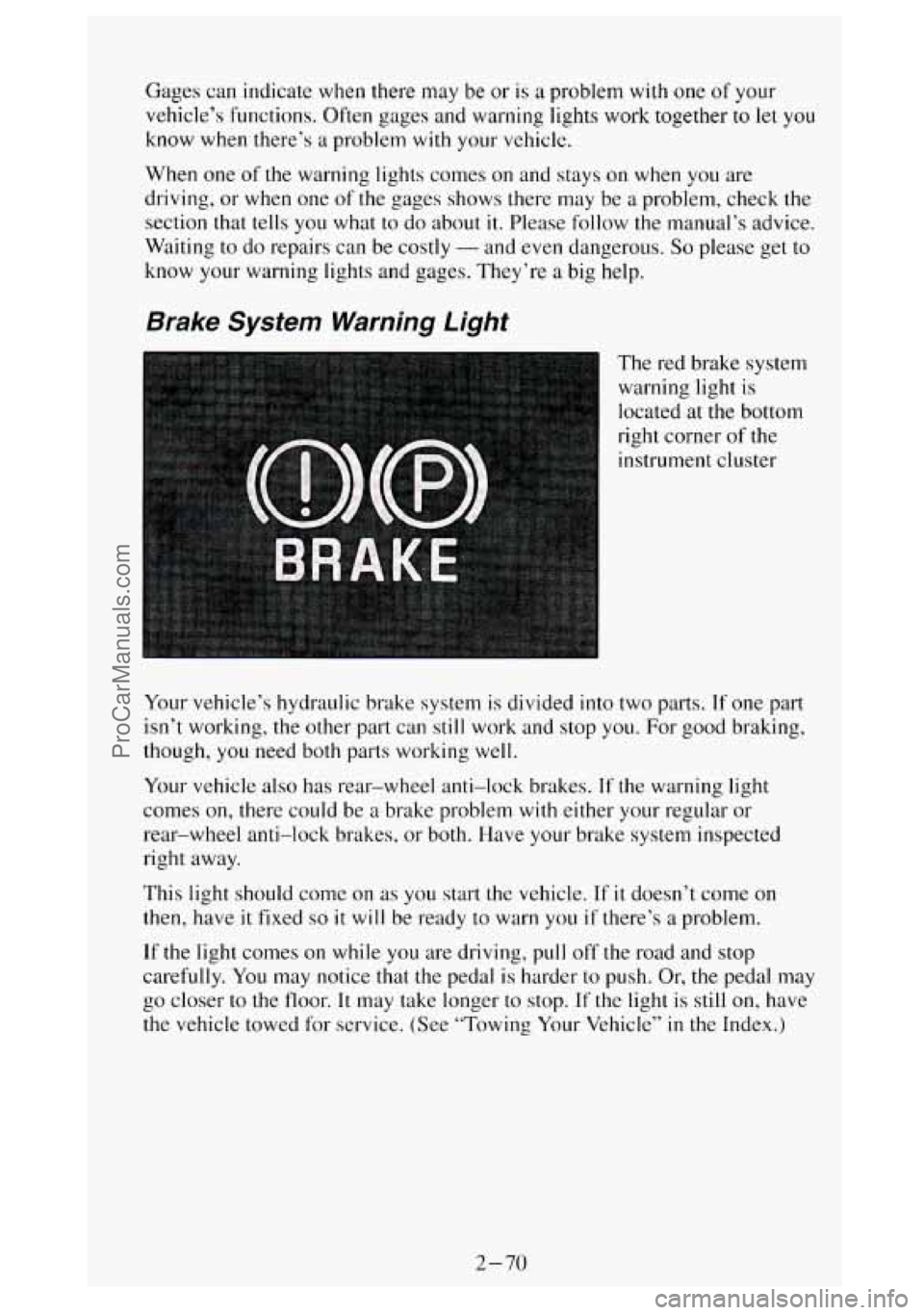
Brake System Warning Light
The red brake system
warning light is
located at the bottom
right corner
of the
instrument cluster
Your vehicle’s hydraulic brake system
is divided into two parts. If one part
isn’t working, the other part can still work and stop you. For good braking,
though, you need both parts working well.
Your vehicle also has rear-wheel anti-lock brakes.
If the warning light
comes on, there could be
a brake problem with either your regular or
rear-wheel anti-lock brakes, or both. Have your brake system inspected
right away.
This light should come on
as you start the vehicle. If it doesn’t come on
then, have it fixed so it will be ready to warn you if there’s a problem.
If the light comes on while you are driving, pull off the road and stop
carefully.
You may notice that the pedal is harder to push. Or, the pedal may
go closer
to the floor. It may take longer to stop. If the light is still on, have
the vehicle towed for service. (See “Towing Your Vehicle”
in the Index.)
2-70
ProCarManuals.com
Page 133 of 404
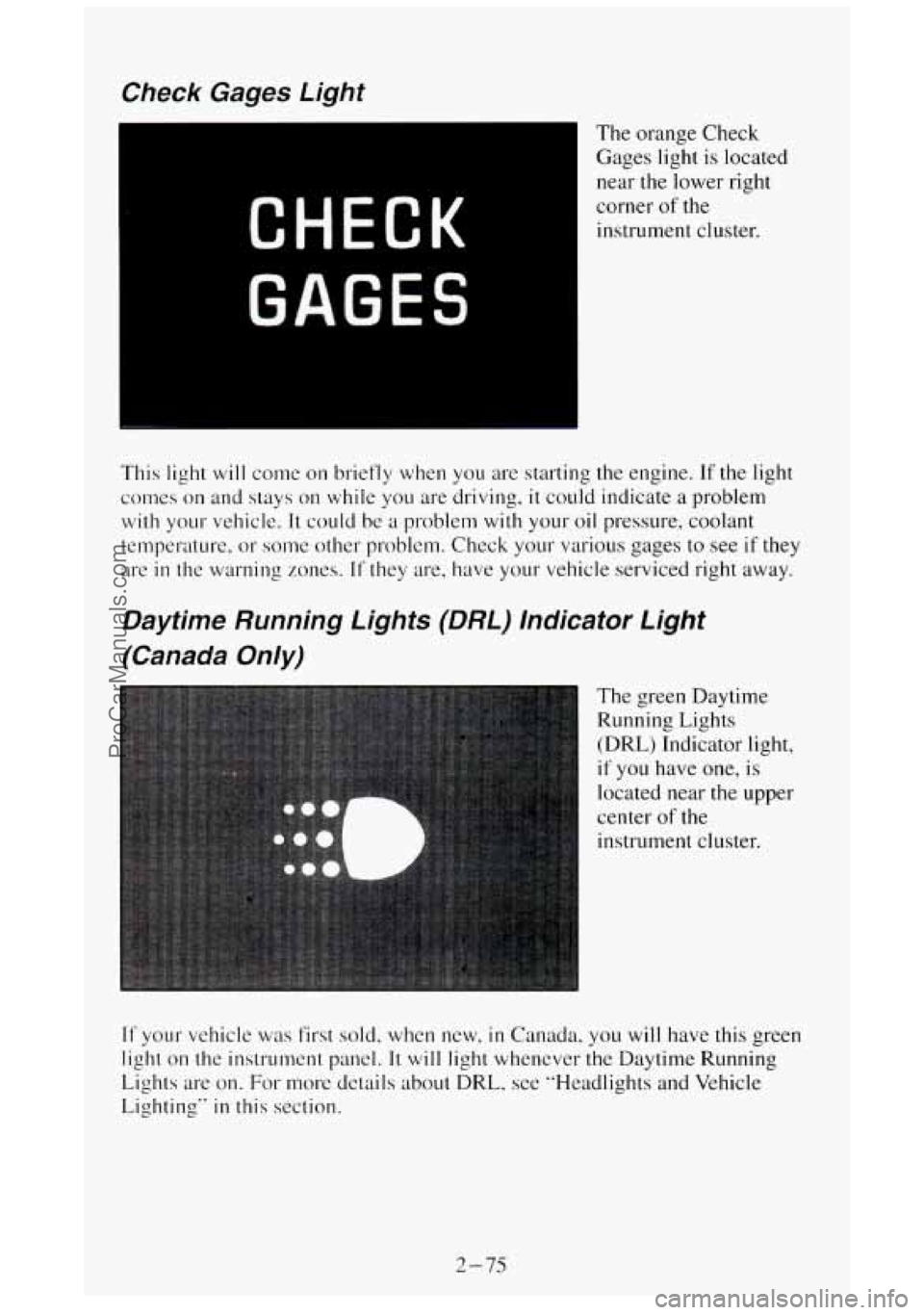
Check Gages Light
The orange Check
Gages light is located
near the lower right
corner
of the
instrument cluster.
This light
will come on briefly when you are starting the engine. If the light
comes
on and stays on while you are driving. it could indicate a problem
with your vehicle. It could be a problem with your oil pressure, coolant
temperature. or some other problem. Chcck your various gages
to see if they
are
in the warning zones. If they are, have your vehicle serviced right away.
Daytime Running Lights (DRL) Indicator Light
(Canada Only)
The green Daytime
Running Lights
(DRL) Indicator light,
if you have one, is
located near the upper
center
of the
instrument cluster.
If your vehicle was first sold. when new. in Canada, you will have this green
lighl on the instrument pancl.
It will light whenever the Daytime Running
Lights
are on. For more details about DRL, sce "Headlights and Vehicle
Lighting'.
in this section.
2-75
ProCarManuals.com
Page 134 of 404
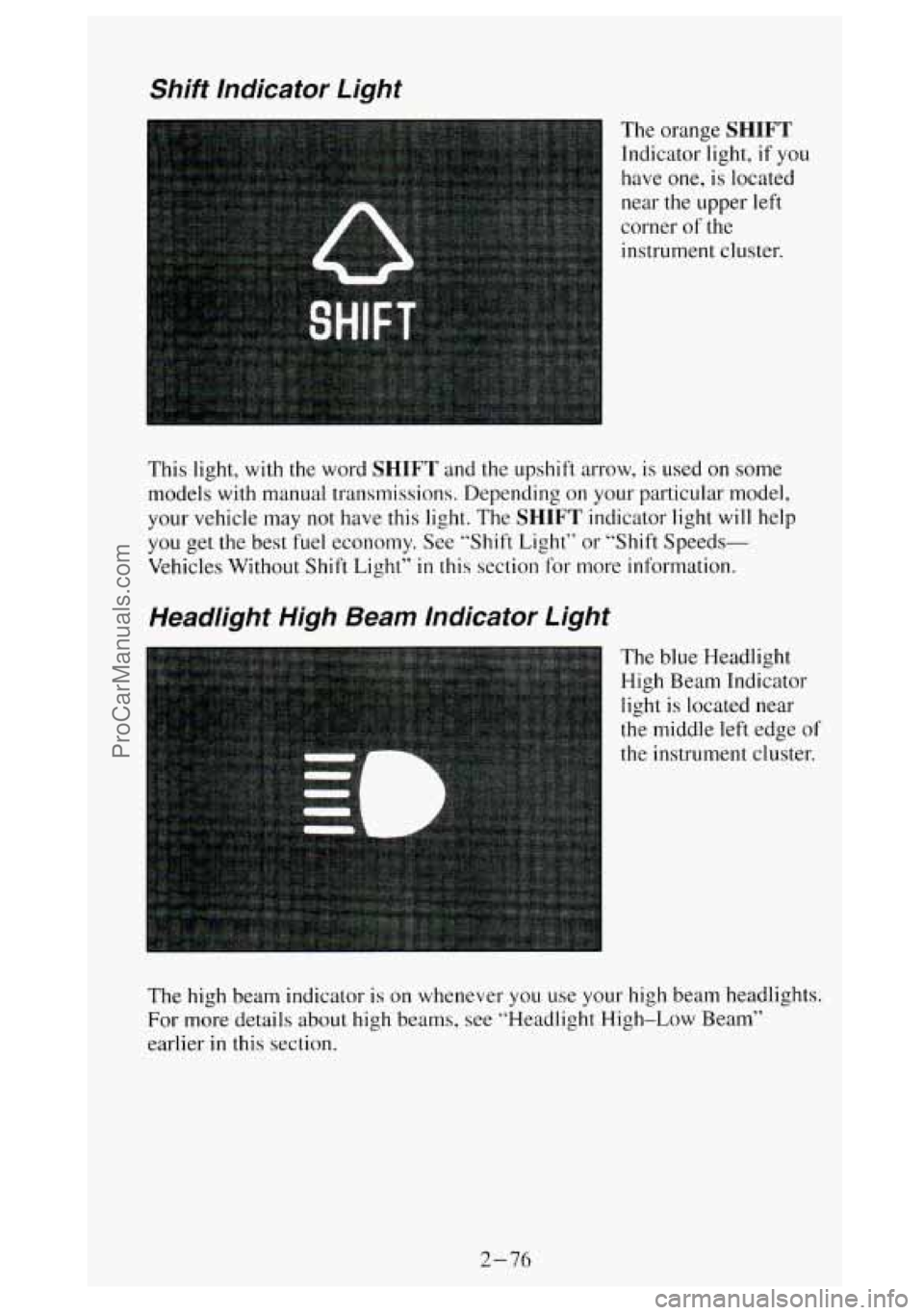
Shift Indicator Light
The orange SHIFT
Indicator light, if you
have one,
is located
near the upper left
corner of the
instrument cluster.
This light, with the word
SHIFT and the upshift arrow, is used on some
models with manual transmissions. Depending on your particular model,
your vehicle may
not have this light. The SHIFT indicator light will help
you get the best fuel economy. See “Shift Light” or “Shift Speeds-
Vehicles Without Shift Light”
in this section for more information.
Headlight High Beam Indicator Light
light is located near
the middle left edge of
the instrument cluster.
The high beam indicator
is on whenever you use your high beam headlights.
For more details about high beams, see “Headlight High-Low Beam”
earlier
in this section.
2-76
.
ProCarManuals.com
Page 135 of 404
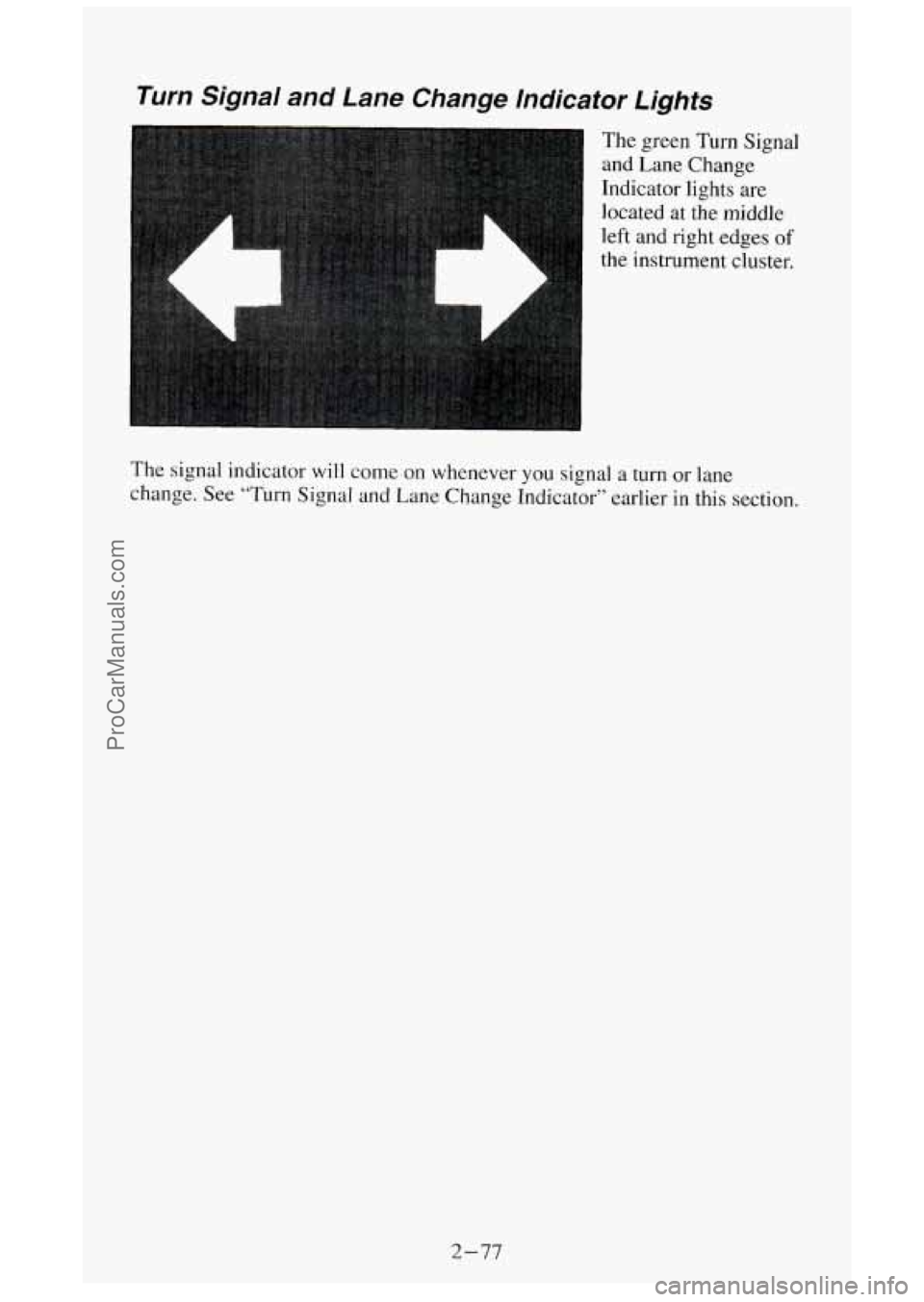
Turn Signal and Lane Change lndicator Lights
A
A
The green Turn Signal
and Lane Change
Indicator lights are
located at the middle
left and right edges
of
the instrument cluster.
The signal indicator
will come on whenever you signal a turn or lane
change. See “Turn Signal and Lane Change Indicator” earlier in this section.
2-77
ProCarManuals.com
Page 148 of 404
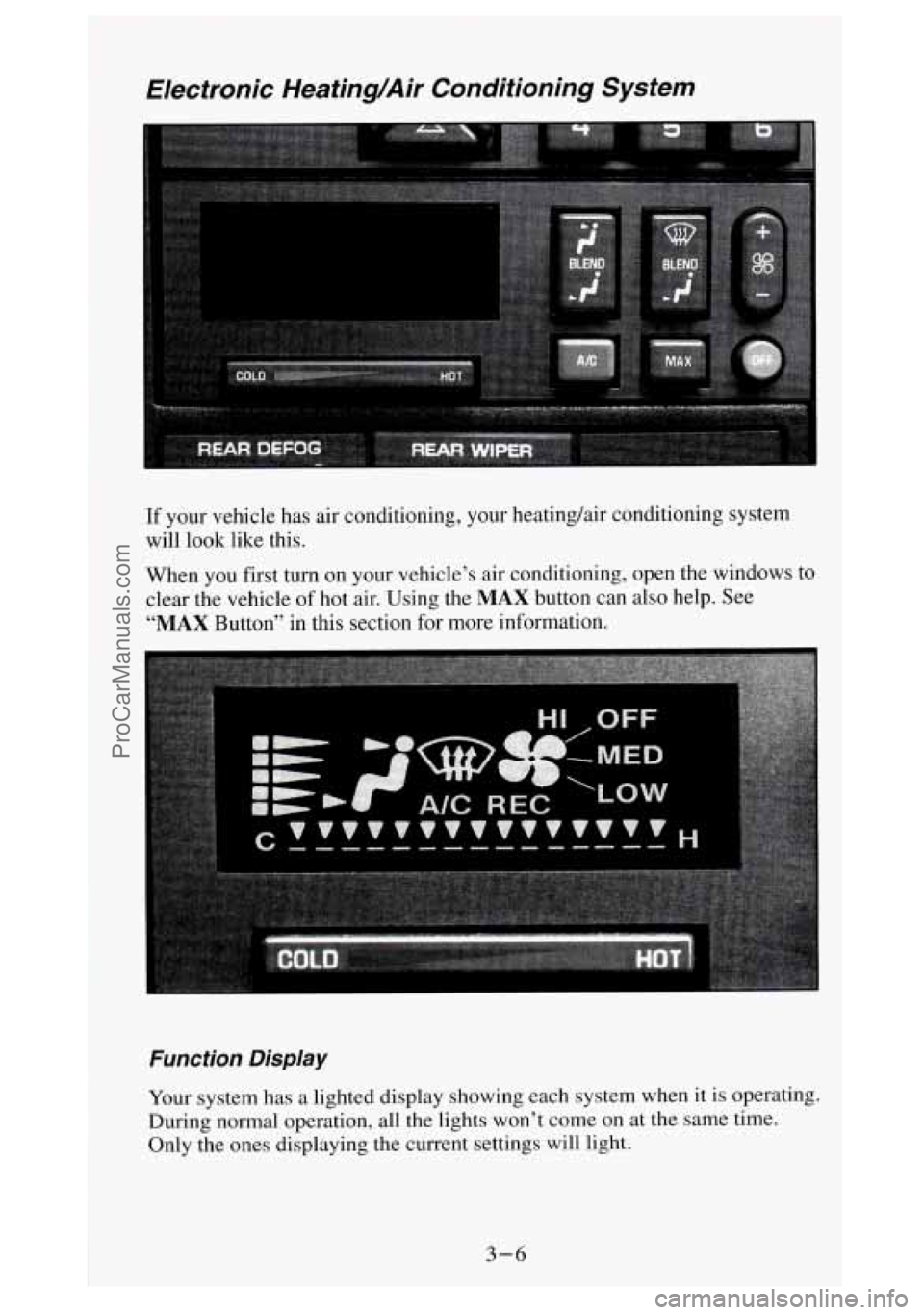
Electronic Heating/Air Conditioning System
If your vehicle has air conditioning, your heating/air conditioning system
will look like this.
When
you first turn on your vehicle’s air conditioning, open the windows to
clear the vehicle of hot air. Using the
MAX button can also help. See
“MAX Button” in this section for more information.
Function Display
Your system has a lighted display showing each system when it is operating.
During normal operation, all the lights won’t come
on at the same time.
Only the ones displaying the current settings will
light.
3-6
ProCarManuals.com
Page 175 of 404
0
0
0
0
0
0
0
0
Watch for traffic signs, pavement markings, and lines. If you can see a
sign
up ahead that might indicate a turn or an intersection, delay your
pass.
A broken center line usually indicates it’s all right to pass
(providing the road ahead is clear). Never cross
a solid line on your
side of the lane or
a double solid line, even if the road seems empty of
approaching traffic.
Do not get too close to the vehicle you want to pass while you’re
awaiting an opportunity. For one thing, following
too closely reduces
your area of
vision, especially if you’re following a larger vehicle.
Also, you won’t have adequate space if the vehicle ahead suddenly
slows or stops. Keep back
a reasonable distance.
When
it looks like a chance to pass is coming up, start to accelerate but
stay
in the right lane and don’t get too close. Time your move so you
will be increasing speed as the time comes to move into the other lane.
If the way is clear to pass,
you will have a “running start” that more
than makes up for the distance you would lose by dropping back. And
if something happens to cause you to cancel your pass, you need only
slow down and drop back again and wait for another opportunity.
If other cars are lined up to pass a slow vehicle, wait your turn. But
take care that someone isn’t trying to pass you
as you pull out to pass
the slow vehicle. Remember to glance over your shoulder and check
the blind spot.
Check your mirrors
, glance over your shoulder, and start your left lane
change signal before moving out of the right lane to pass. When
you
are far enough ahead of the passed vehicle to see its front in your inside
mirror, activate your right lane change signal and move back into the
right lane. (Remember that
if your right outside mirror is convex, the
vehicle
you just passed may seem to be farther away from you than it
really is.)
Try
not to pass more than one vehicle at a time on two-lane roads.
Reconsider before passing the
next vehicle.
Don’t overtake
a slowly moving vehicle too rapidly. Even though the
brake lights are not flashing,
it may be slowing down or start
If you’re being passed, make it easy for the following driver
ahead
of you. Perhaps you can ease a little to the right. ;ing to turn.
to get
Loss of Control
Let’s
review what driving experts say about what happens when the three
control systems (brakes, steering and acceleration) don’t have enough
friction where
the tires meet the road to do what the driver has asked.
In any emergency, don’t give up. Keep trying to steer and constantly seek
an
escape route or area of less danger.
4-11
ProCarManuals.com
Page 180 of 404
When you drive over obstacles or rough terrain, keep a firm grip on the
steering wheel.
Ruts, troughs, or other surface features can jerk the wheel
out of your hands if you’re not prepared.
When
you drive over bumps, rocks, or other obstacles, your wheels can
leave
the ground. If this happens, even with one or two wheels, you can’t
control the vehicle
as well or at all.
Because you will be on an unpaved surface, it’s especially important
to
avoid sudden acceleration, sudden turns. or sudden braking.
In
a way, off-road driving requires a different kind of alertness from driving
on paved roads and highways. There are no road signs, posted speed limits
or signal lights.
You have to use your own good .judgment about what is safe
and what isn’t.
Drinking and driving can be very dangerous on any road. And this
is
certainly true for off-road driving. At the very time you need special
alertness and driving skills, your reflexes, perceptions and judgment can be
affected by even
a small amount of alcohol. You could have a serious - or
even
fatal - accident if you drink and drive or ride with a driver who has
been drinking. (See “Drunken Driving”
in the Index.)
Driving On Off-Road Hills
Off-road driving often takes you up, down, or across a hill. Driving safely
on hills requires good judgment and an understanding of what your vehicle
can and can’t do. There are some hills that simply can’t be driven, no matter
how well built the vehicle.
A CAUTION:
Many hills are simply too steep for any vehicle. If you drive up
them, you will stall.
If you drive down them, you can’t control
yorrr speed. If you drive across them, you will roll over. You
could be seriously injured or killed.
If you have any doubt about
the steepness, don’t drive the hill.
Approaching a Hill
When you approach a hill, you need to decide if it’s one of those hills that’s
just too steep to climb, descend, or cross. Steepness can be hard to judge.
Oil a very small hill, for example, there may be a smooth, constant incline
with only
a small change in elevation where you can easily see all the way
to
the top. On a large hill. the incline may get steeper as you near the top,
but
you may not see this because the crest of the hill is hidden by bushes,
grass, or shrubs.
4-16
ProCarManuals.com