parking brake GMC SIERRA 1994 Owner's Manual
[x] Cancel search | Manufacturer: GMC, Model Year: 1994, Model line: SIERRA, Model: GMC SIERRA 1994Pages: 404, PDF Size: 20.91 MB
Page 202 of 404

If you are going to drive the vehicle, shift the transmission into th\
e gear
you want. Then shift the transfer case into the range you want, apply
the regular brakes and release the parking brake.
When you release the clutch, the power take-off will start.
5. Release the clutch (and the regular brakes) as you normally \
would.
Using a Transfer Case Mounted Power Take-Off
(Automatic Transmission)
1. Set the parking brake.
2. Shift the transfer case into “N’ (Neutral).
3. Shift the transmission into “N’ (Neutral).
4. Engage the power take-off.
If you are going to drive the vehicle, shift the transfer case into \
the
range you want. Then apply the regular brakes and release
the parking
brake.
5. Shift the transmission to “D” (Drive) to start the powe\
r take-off.
6. Release the regular brakes to drive the vehicle.
Towing a Trailer
NOTICE:
Pulling a trailer improperly can damage your vehicle and result\
in costly repairs not covered by your warranty.
To pull a trailer
correctly, follow the advice in this section, and see your Veh\
icle
dealer for important information about towing a trailer with
your vehicle.
ProCarManuals.com
Page 207 of 404
Driving On Grades
Reduce speed and shift to a lower gear before you start down a long or
steep downgrade.
If you don’t shift down, you might have to use your
brakes
so much that they would get hot and no longer work well.
On a long uphill grade, shift down and reduce your speed to around
45 mph
(70 km/h) to reduce the possibility of engine and transmission overheating.
When towing at high altitude with steep uphill grades,you need to consider
the following information. The lower atmospheric pressure at high altitude
allows your vehicles engine coolant to boil at a lower temperature than at
normal altitudes.
If you immediately turn your engine off after towing at high altitude with
steep uphill grades, your vehicle may show signs similar
to engine
overheating.
To avoid this, let your vehicle operate in a parked position with
the transmission in
“N” (Neutral) for a few minutes before you turn off the
engine. If you do get the overheat warning, see “Engine Overheating” in
the Index.
If you have an automatic transmission, you should use
“D” (or, as you need
to, a lower gear) when towing a trailer. Operating your vehicle in
“D” when
towing a trailer will minimize heat buildup and extend the life
of your
transmission.
If you have a manual transmission and
you are towing a trailer, it’s better
not to use fifth gear. Just drive in fourth gear (or, as you need to, a lower
gear).
Parking on Hills
You really should not park your vehicle, with a trailer attached, on a hill. If
something goes wrong, your rig could start
to move. People can be injured,
and both your vehicle and the trailer can be damaged.
But if you ever have to park your rig on a hill, here’s how
to do it:
1.
2.
3.
4.
5.
6.
Apply your regular brakes, but don’t shift into “P’ (Park) yet, or in gear
for a manual transmission.
Have someone place chocks under the trailer wheels.
When the wheel chocks are in place, release the regular brakes until the
chocks absorb
the load.
Re-apply the regular brakes. Then apply your parking brake, and then
shift to
“P7, (Park), or “R” (Reverse) for a manual transmission.
If
you have a four-wheel-drive vehicle, be sure the transfer case is in a
drive gear-not in
“N7 (Neutral).
Release
the regular brakes.
4-43
ProCarManuals.com
Page 208 of 404
A CAUTION:
It can be dangerous to get out of your vehicle if the shift lever is
not fully in “P” (Park) with the parking brake firmly set. Your
vehicle can roll.
If’ you have left the engine running, the vehicle can move
suddenly. You or others could be injured.
To be sure your vehicle
won’t move, even when you’re on fairly level ground, use the
steps that follow.
If you have four-wheel drive and your transfer case is in “N”
(Neutral), your vehicle will be free to roll, even if your shift lever
is in
“P” (Park). So, be sure the transfer case is in a drive gear
- not in “N” (Neutral).
If you are parking on a hill, or if you’re pulling a trailer, also see
“Parking
On Hills” in the Index.
When You Are Ready to Leave After Parking on a Hill
1. Apply your regular brakes and hold the pedal down while you:
Start your engine;
Shift into a gear; and
0 Release the parking brake.
2. Let up on the brake pedal.
3. Drive slowly until the trailer is clear of the chocks.
4. Stop and have someone pick up and store the chocks.
Maintenance When Trailer Towing
Your vehicle will need service more often when you’re pulling a trailer. See
the Maintenance Schedule for more on this. Things that are especially
important in trailer operation are automatic
fluid (don’t overfill), engine oil,
axle lubricant, belts, cooling system, and brake adjustment. Each of these
is
covered in this manual, and the Index will help you find them quickly. If
you’re trailering, it’s
a good idea to review these sections before you start
your trip.
Check periodically to see that all hitch nuts and bolts are tight.
Trailer Light Wiring
See “Trailer Wiring Harness” in the Index.
4-44
ProCarManuals.com
Page 212 of 404
To Jump Start Your Vehicle
1. Check the other vehicle. It must have a 12-volt battery with a negative
ground system.
I NOTICE:
If the other system isn’t a 12-volt system with a negative
ground, both vehicles can be damaged.
If you have a diesel engine vehicle with two batteries (or more), you
should know before
you begin that, especially in cold weather, you may
not be able to get enough power from
a single battery in another
vehicle to start your diesel engine.
If your vehicle
has more than one battery, use the battery that’s on the
passenger side
of the vehicle - this will reduce electrical resistance.
sure the vehicle’s aren’t touching each other.
If they are, it could cause
a ground connection you don’t want. You wouldn’t be able to start your
vehicle, and the bad grounding could damage
the electrical systems.
You could be injured
if the vehicles roll. Set the parking brake firmly
on each vehicle. Put an automatic transmission
in “P” (Park) or a
manual transmission in “N” (Neutral). If you have a four-wheel-drive
vehicle, be sure
the transfer case is not in “N” (Neutral).
2. Get the vehicles
close enough
so the jumper cables can reach, but be
3. Turn off the ignition on both vehicles. Turn off all lights that aren’t
needed, and radios. This will avoid sparks and help save both batteries.
And it could save
your radio!
NOTICE:
If you leave your radio on, it could be badly damaged. The
repairs wouldn’t be covered by your warranty.
4. Open the hoods and locate the batteries. Find the positive (+) and
negative
(-) terminals on each battery.
5-4
ProCarManuals.com
Page 216 of 404
When you call, tell the towing service:
That your vehicle has rear-wheel drive, or that it has the four-wheel
drive option.
The make, model, and year of your vehicle.
Whether you can move the shift lever for the transmission and transfer
case,
if you have one.
If there was an accident, what was damaged.
1
When your vehicle is being towed, have the ignition key off. The steering
wheel should be clamped
in a straight-ahead position, with a clamping
device designed for towing service.
Do not use the vehicle’s steering
column lock for this. The transmission and transfer case,
if you have one,
should be in Neutral and
the parking brake released.
5-8
ProCarManuals.com
Page 258 of 404
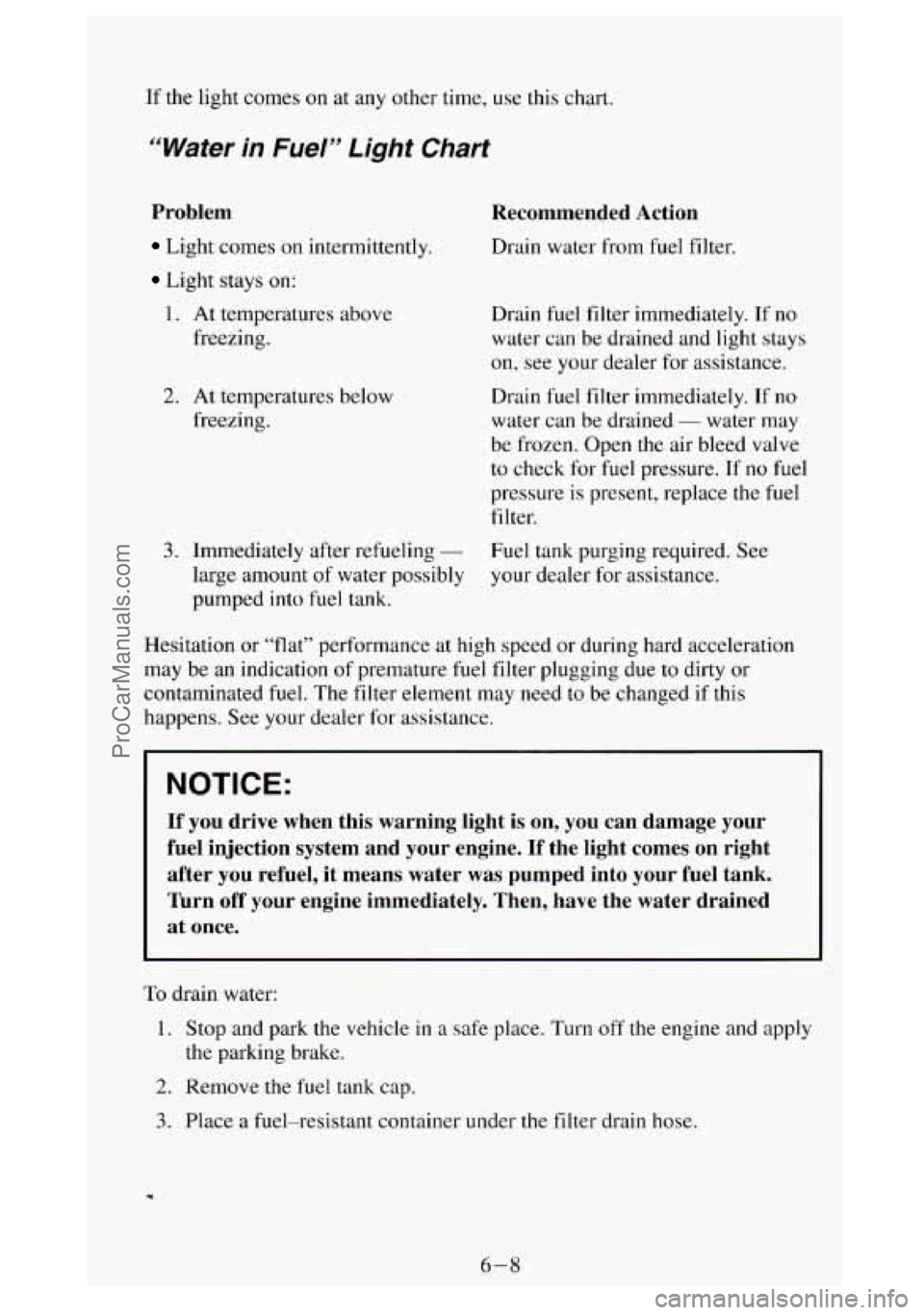
If the light comes on at any other time, use this chart.
“Water in Fuel” Light Chart
Problem
Light comes on intermittently.
Light stays on:
1. At temperatures above
freezing.
2. At temperatures below
freezing.
Recommended Action
Drain water from fuel filter.
Drain fuel filter immediately. If no
water
can be drained and light stays
on, see your dealer for assistance.
Drain fuel filter immediately. If no
water can be drained
- water may
be frozen. Open the air bleed valve
to check
for fuel pressure. If no fuel
pressure is present, replace the
fuel
filter.
3. Immediately after refueling - Fuel tank purging required. See
large amount of water possibly your dealer for assistance.
pumped into fuel tank.
Hesitation or “flat” performance at high speed or during hard acceleration
may be an indication of premature fuel filter plugging due
to dirty or
contaminated fuel, The filter element may need to be changed
if this
happens. See your dealer for assistance.
NOTICE:
If you drive when this warning light is on, you can damage y\
our
fuel injection system and your engine. If the light comes on right
after you refuel,
it means water was pumped into your fuel tank.
Turn off your engine immediately. Then, have the water drained \
at once.
To drain water:
1. Stop and park the vehicle in a safe place. Turn off the engine and apply
the parking brake.
2. Remove the fuel tank cap.
3. Place a fuel-resistant container under the filter drain hose.
6-8
ProCarManuals.com
Page 261 of 404
A CAUTION:
Diesel fuel is flammable. It could start a fire if it gets on hot
engine parts. You could be burned. Don’t let too much fuel flow
from the air bleed valve, and wipe up any spilled fuel with
a
cloth.
3. Close the air bleed valve.
4. Turn the ignition key to “Start” for 10 to 15 seconds at a time until your
engine starts.
Fuel Filter Replacement (Diesel Engines)
If you want to change the fuel filter yourself, here’s how to do it:
Before you remove the filter, drain any water that may have collected in the
fuel filter or filter head. See “Water in Fuel” earlier in this section to find
out how to remove water from the fuel system.
Then, drain
fuel from the filter by opening the air bleed valve and the water
drain valve. This prevents the fuel from spilling as
you replace the filter.
Drain the fuel into
a fuel-resistant container and dispose of it properly.
A CAUTION:
Diesel fuel is flammable. It could start a fire if something ignites
it, and you could be burned. Don’t let it get on hot engine parts,
and keep matches or other ignition sources away.
I. Turn off the engine and apply the parking brake.
2. Take off the fuel tank cap. This releases vacuum in the tank.
3. The filter is located at the rear of the intake manifold.
6-11
ProCarManuals.com
Page 281 of 404
I NOTICE:
Too much or too little fluid can damage your transmission. Too
much can mean that some of the fluid could come out and fall on
hot engine parts or exhaust system, starting
a fire. Be sure to get
an accurate reading
if you check your transmission fluid.
Wait at least 30 minutes before checking the transmission fluid level if you
have been driving:
0 When outside temperatures are above 90°F (32°C).
At high speed for quite a while.
0 In heavy traffic - especially in hot weather.
While pulling a trailer.
IU get the right reading, the fluid should be at normal operating
temperature, which
is 180°F to 200°F (82°C to 93°C).
To check trunsmissioltfluid hot: Get the vehicle warmed up by driving
about
15 miles (24 km) when outside temperatures are above 50°F (1 0°C).
If it’s colder than
50°F (lO”C), drive the vehicle in “D” (3rd Gear) until the
engine temperature gage moves and then remains steady for ten minutes.
Then follow
the hot check procedures.
To check trmzsnzissiorz jZuid cold: A cold check is made after the vehicle has
been sitting for eight hours
or more with the engine off and is used only as a
reference. Let
the engine run at idle for five minutes if outside temperatures
are
50°F ( 10°C) or more. If it’s colder than 50°F (lO”C), you may have to
idle the engine longer. Should the fluid level be low during a cold check,
you must perform a hot check before adding fluid. This will give you a
more accurate reading of the fluid level.
To check the fluid hot or cold
Park your vehicle on a level place.
With the parking brake applied, place the shift lever in “P” (Park).
With your foot on the brake pedal, move the shift lever through each
gear range, pausing for about three seconds
in each range. Then,
position
the shift lever in “P’ (Park).
Let the engine run at idle for three minutes or more.
6-31
ProCarManuals.com
Page 313 of 404
Trailer Wiring Harness
The optional seven-wire trailer wiring harness is protected by an in-line
fuse
in the battery feed wire. This fuse is near the junction block. See
“Trailer Wiring Harness”
in the Index for more information.
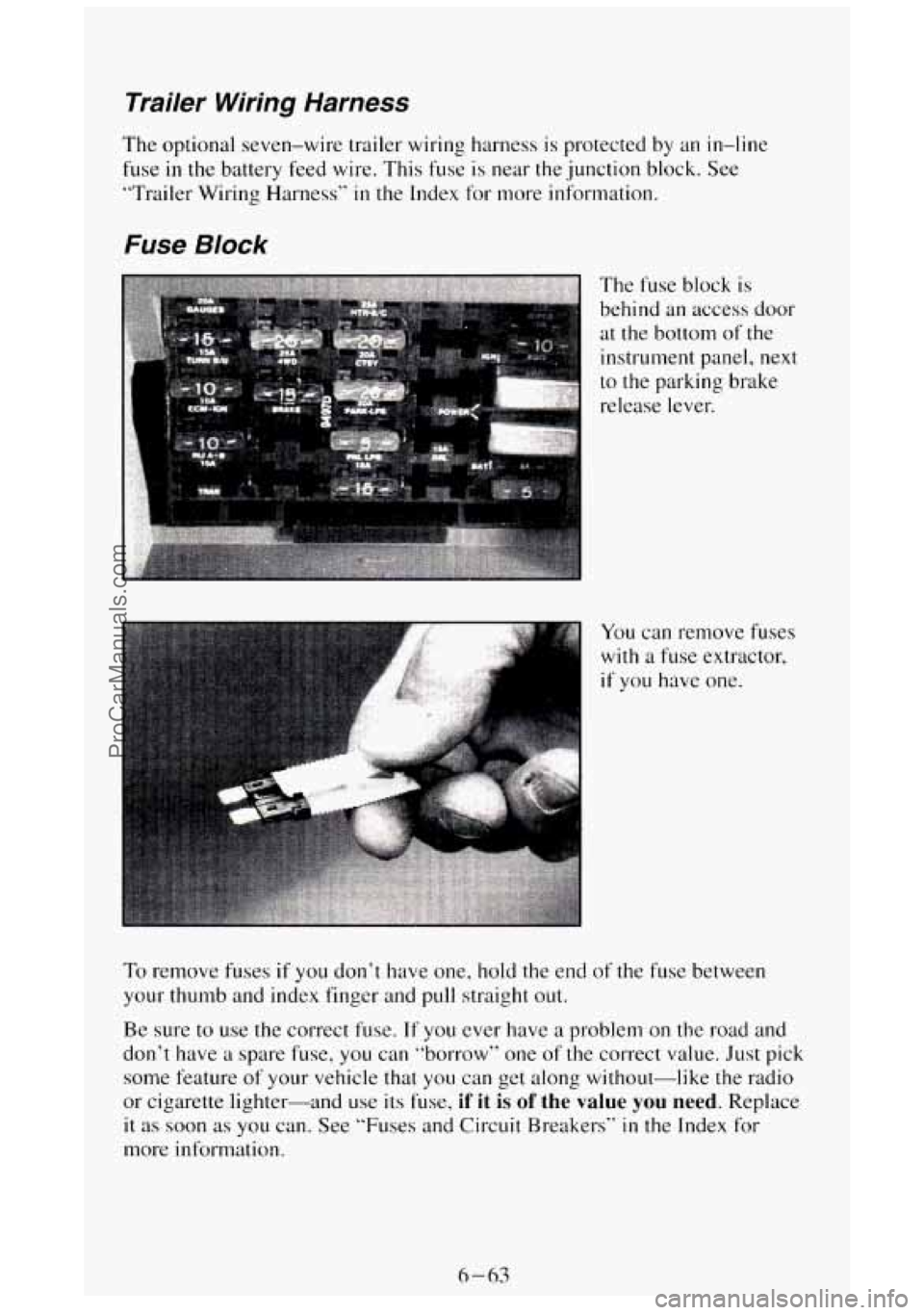
Fuse Block
The fuse block is
behind an access door
at the bottom of the
instrument panel,
next
to the parking brake
release lever.
To remove fuses if you don’t have one, hold the end of the fuse between
your thumb and index finger and pull straight out.
Be, sure to use the correct fuse.
If you ever have a problem on the road and
don’t have a spare fuse, you can “borrow” one of the correct value. Just pick
some feature
of your vehicle that you can get along without-like the radio
or cigarette lighter--and use
its fuse, if it is of the value you need. Replace
it as soon as you can. See “Fuses and Circuit Breakers“ in the Index for
more information.
6-63
ProCarManuals.com
Page 366 of 404
Explanation Of Scheduled Mainienance Services
Below are explanations of the services listed in the maintenance charts.
The proper fluids and lubricants to use are listed in this section. Make sure
whoever services your vehicle uses these. All parts should be replaced and
all necessary repairs done before you or anyone else drives the vehicle.
1. ENGINE OIL AND OIL FILTER CHANGE“‘ - ALWAYS USE
SJ3 ENERGY CONSERVING I1 (GASOLINE ENGINE) OR CF-4/SH
(DIESEL ENGINE) QUALITY OILS
OF THE PROPER VISCOSITY.
To determine the preferred viscosity oil for your vehicle’s engine (e.g.
SAE 5W-30 or 10W-30), see “Engine Oil”
in the Index.
2. CHASSIS LUBRICATION - Lubricate the front suspension, king
pin bushings, steering linkage, transmission, and transfer case shift
linkage, parking brake cable guides, rear driveline center splines and
front axle propshaft splines, brake pedal springs, and clutch pedal
springs at the intervals specified.
If you have a 3500
HD, lubricate the king pins and king pin bushings,
every
1,500 miles (2500 km) for Maintenance Schedule I, or every
3,000 (5000 km) for Maintenance Schedule 11.
Ball joints and king pin bushings should not be lubricated unless their
temperature
is 10” F (-12”C), or higher. When the weather is cold, let
them warm up before lubrication or
they could be damaged.
Also, be sure
to check all the vehicle fluid levels at this time.
3.
CLUTCH FORK BALL STUD LUBRICATION (5-SPEED
MANUAL TRANSMISSION WITH DEEP LOW
) - Lubricate the
clutch fork ball stud through the fitting
on the clutch housing.
Lubricant must be added “sparingly” to
the fitting, as only .0066 lb.
(.003 kg) is required to lubricate the ball stud surface. Do not add
lubricant more often than the intervals
in the Maintenance Charts. Too
much lubricant will damage the clutch assembly.
4. COOLING SYSTEM SERVICE”’? - Drain, flush and refill system
with new coolant. See “Engine Coolant” in the Index for
the proper
coolant and mixture to use
in your vehicle.
Also inspect the hoses and replace them
if they are cracked, swollen, or
deteriorated. Tighten all hose clamps (except constant tension clamps).
Remove debris and clean the outside of the radiator and air
conditioning condenser. Wash the radiator neck.
To ensure proper
operation, pressure test.
the radiator and cap.
* An Emission Control Service
?A fluid
loss in these systems may indicate a problem. Have them
inspected and repaired at once.
7-18
ProCarManuals.com