air filter GMC SIERRA 1994 Owners Manual
[x] Cancel search | Manufacturer: GMC, Model Year: 1994, Model line: SIERRA, Model: GMC SIERRA 1994Pages: 404, PDF Size: 20.91 MB
Page 258 of 404
If the light comes on at any other time, use this chart.
“Water in Fuel” Light Chart
Problem
Light comes on intermittently.
Light stays on:
1. At temperatures above
freezing.
2. At temperatures below
freezing.
Recommended Action
Drain water from fuel filter.
Drain fuel filter immediately. If no
water
can be drained and light stays
on, see your dealer for assistance.
Drain fuel filter immediately. If no
water can be drained
- water may
be frozen. Open the air bleed valve
to check
for fuel pressure. If no fuel
pressure is present, replace the
fuel
filter.
3. Immediately after refueling - Fuel tank purging required. See
large amount of water possibly your dealer for assistance.
pumped into fuel tank.
Hesitation or “flat” performance at high speed or during hard acceleration
may be an indication of premature fuel filter plugging due
to dirty or
contaminated fuel, The filter element may need to be changed
if this
happens. See your dealer for assistance.
NOTICE:
If you drive when this warning light is on, you can damage y\
our
fuel injection system and your engine. If the light comes on right
after you refuel,
it means water was pumped into your fuel tank.
Turn off your engine immediately. Then, have the water drained \
at once.
To drain water:
1. Stop and park the vehicle in a safe place. Turn off the engine and apply
the parking brake.
2. Remove the fuel tank cap.
3. Place a fuel-resistant container under the filter drain hose.
6-8
ProCarManuals.com
Page 260 of 404
~ NOTICE:
If
there is water in your diesel fuel and the weather is warm or
humid, fungus and bacteria can grow in the fuel. They can
damage your fuel system. You'll need
a diesel fuel biocide to
sterilize your fuel system. Your dealer can advise you if you ever
need this.
If your fuel tank needs to be purged to remove water, see your
dealer or
a qualified technician. Improper purging can damage
your fuel system.
Running Out of Fuel (Diesel Engines)
If the engine stalls and you think that you've run out of fuel, do this:
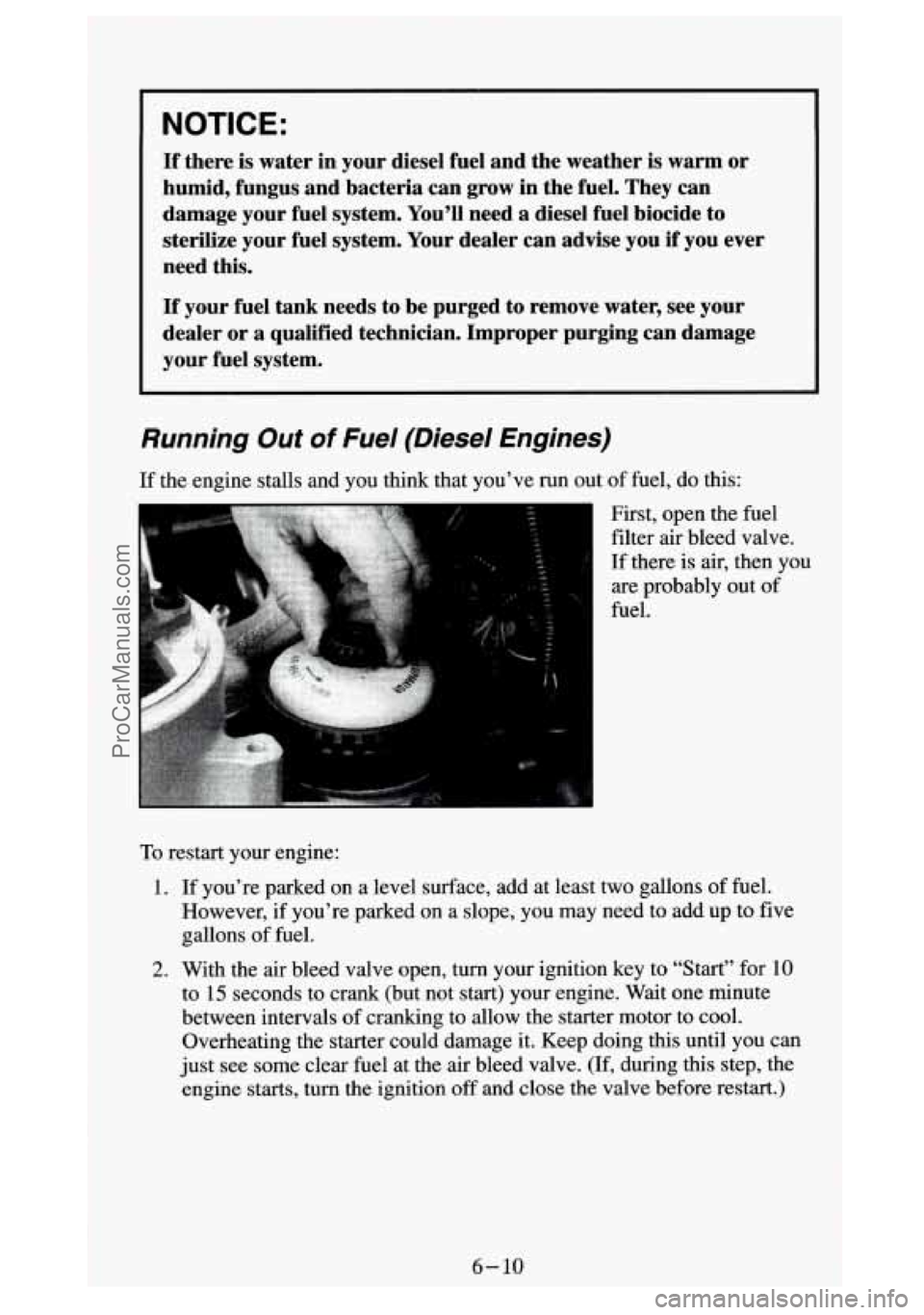
First, open the fuel
filter
air bleed valve.
If there is air, then you are probably out of
fuel.
To restart your engine:
1. If you're parked on a level surface, add at least two gallons of fuel.
However, if you're parked on a slope, you may need to add up to five
gallons of fuel.
2. With the air bleed valve open, turn your ignition key to "Sta\
rt" for 10
to 15 seconds to crank (but not start) your engine. Wait one minut\
e
between intervals of cranking to allow the starter motor to cool.
Overheating the starter could damage it. Keep doing this until you can
just see some clear fuel at the air bleed valve. (If, during this ste\
p, the
engine starts, turn the ignition
off and close the valve before restart.)
6-10
ProCarManuals.com
Page 261 of 404
A CAUTION:
Diesel fuel is flammable. It could start a fire if it gets on hot
engine parts. You could be burned. Don’t let too much fuel flow
from the air bleed valve, and wipe up any spilled fuel with
a
cloth.
3. Close the air bleed valve.
4. Turn the ignition key to “Start” for 10 to 15 seconds at a time until your
engine starts.
Fuel Filter Replacement (Diesel Engines)
If you want to change the fuel filter yourself, here’s how to do it:
Before you remove the filter, drain any water that may have collected in the
fuel filter or filter head. See “Water in Fuel” earlier in this section to find
out how to remove water from the fuel system.
Then, drain
fuel from the filter by opening the air bleed valve and the water
drain valve. This prevents the fuel from spilling as
you replace the filter.
Drain the fuel into
a fuel-resistant container and dispose of it properly.
A CAUTION:
Diesel fuel is flammable. It could start a fire if something ignites
it, and you could be burned. Don’t let it get on hot engine parts,
and keep matches or other ignition sources away.
I. Turn off the engine and apply the parking brake.
2. Take off the fuel tank cap. This releases vacuum in the tank.
3. The filter is located at the rear of the intake manifold.
6-11
ProCarManuals.com
Page 262 of 404
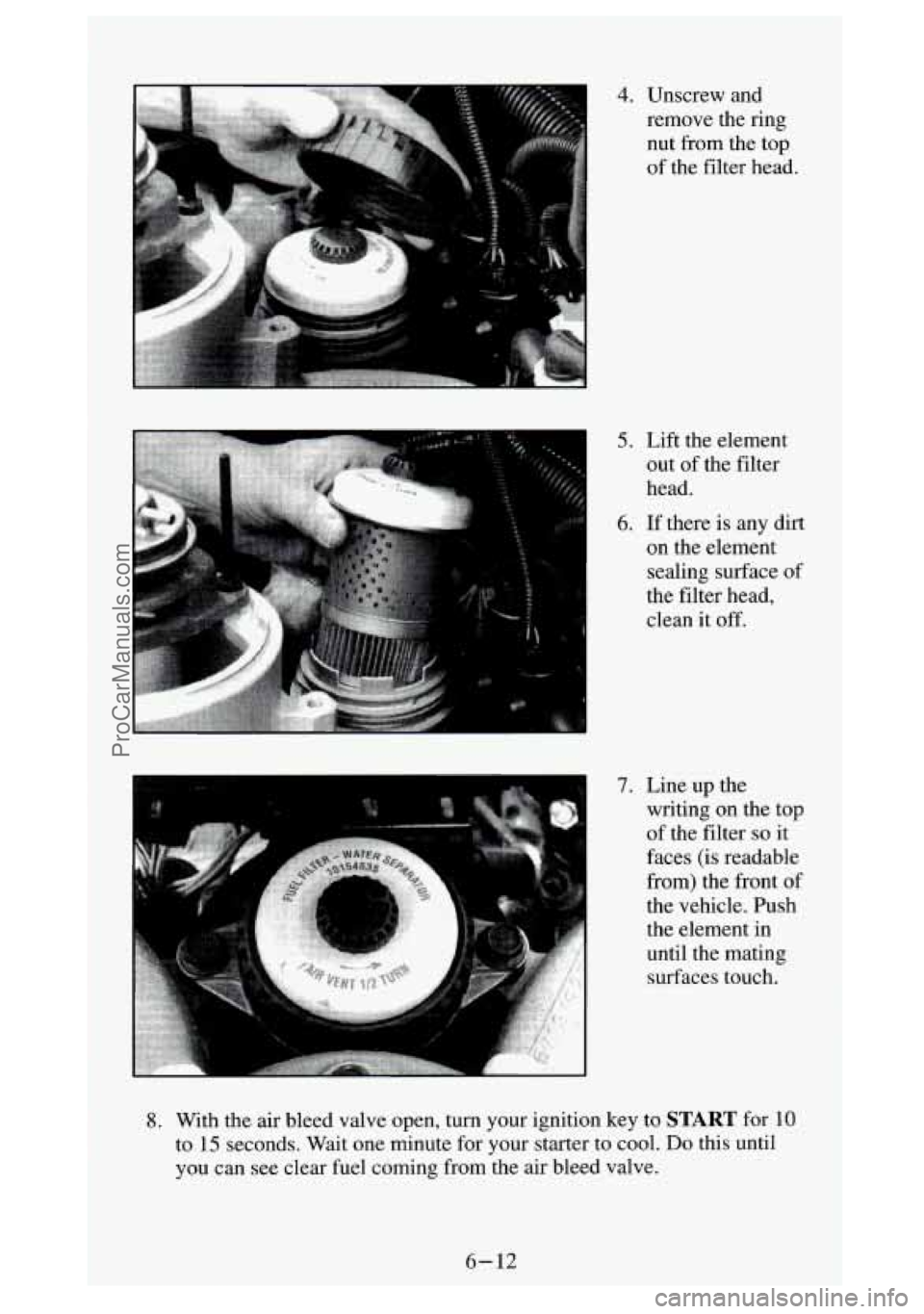
4. Unscrew and
remove the ring
nut from the top
of the filter head.
7. Line up the
writing on the top
of the filter
so it
faces (is readable
from) the front of
the vehicle. Push
the element in
until the mating
surfaces touch.
5. Lift the element
out of the filter
head.
6. If there is any dirt
on the element
sealing surface of
the filter head,
clean it
off.
8. With the air bleed valve open, turn your ignition key to START for 10
to 15 seconds. Wait one minute for your starter to cool. Do this until
you can see clear fuel coming from the air bleed valve.
ProCarManuals.com
Page 263 of 404
9. Close the air bleed valve and replace the fuel cap.
10. Start your engine and let it idle for five minutes. Check your fuel filter
and air bleed valve for leaks.
Fuels in Foreign Countries
If you plan on driving in another country outside the U.S. or Canada,
unleaded fuel may be hard to find. Do not use leaded gasoline.
If you use
even one tankful, your emission controls won’t work well or at all. With
continuous use, spark plugs can get fouled, the exhaust system can corrode,
and your engine oil can deteriorate quickly. Your vehicle’s oxygen sensor
will be damaged. All of that means costly repairs that wouldn’t be covered
by your warranty.
To check on fuel availability, ask an auto club, or contact a major oil
company that does business
in the country where you’ll be driving.
You can also write us at the following address for advice. Just tell us where
you’re going and give your Vehicle Identification Number (VIN).
General Motors Overseas Distribution Corporation,
North American Export Sales (NAES)
1908 Colonel
Sam Drive
Oshawa, Ontario
L1H 8P7
Filling Your Tank
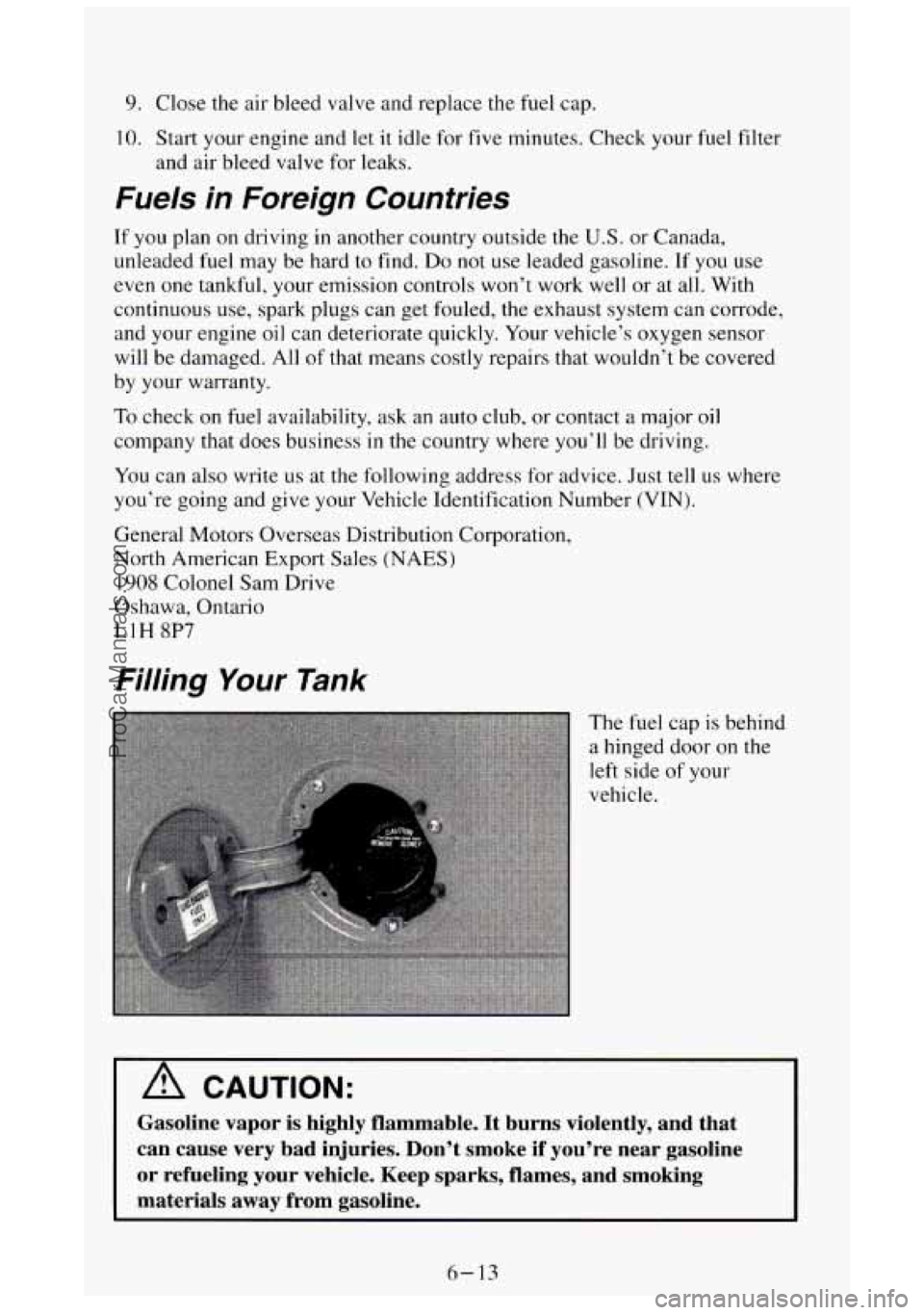
The fuel cap is behind
a hinged door on the
left side of your
vehicle.
/i CAUTION:
Gasoline vapor is highly flammable. It burns vioIently, and tha\
t
can cause very
bad injuries. Don’t smoke if you’re near gasoline
or refueling your vehicle. Keep sparks, flames, and smoking
materials away from gasoline.
6-13
ProCarManuals.com
Page 279 of 404
Air Cleaner
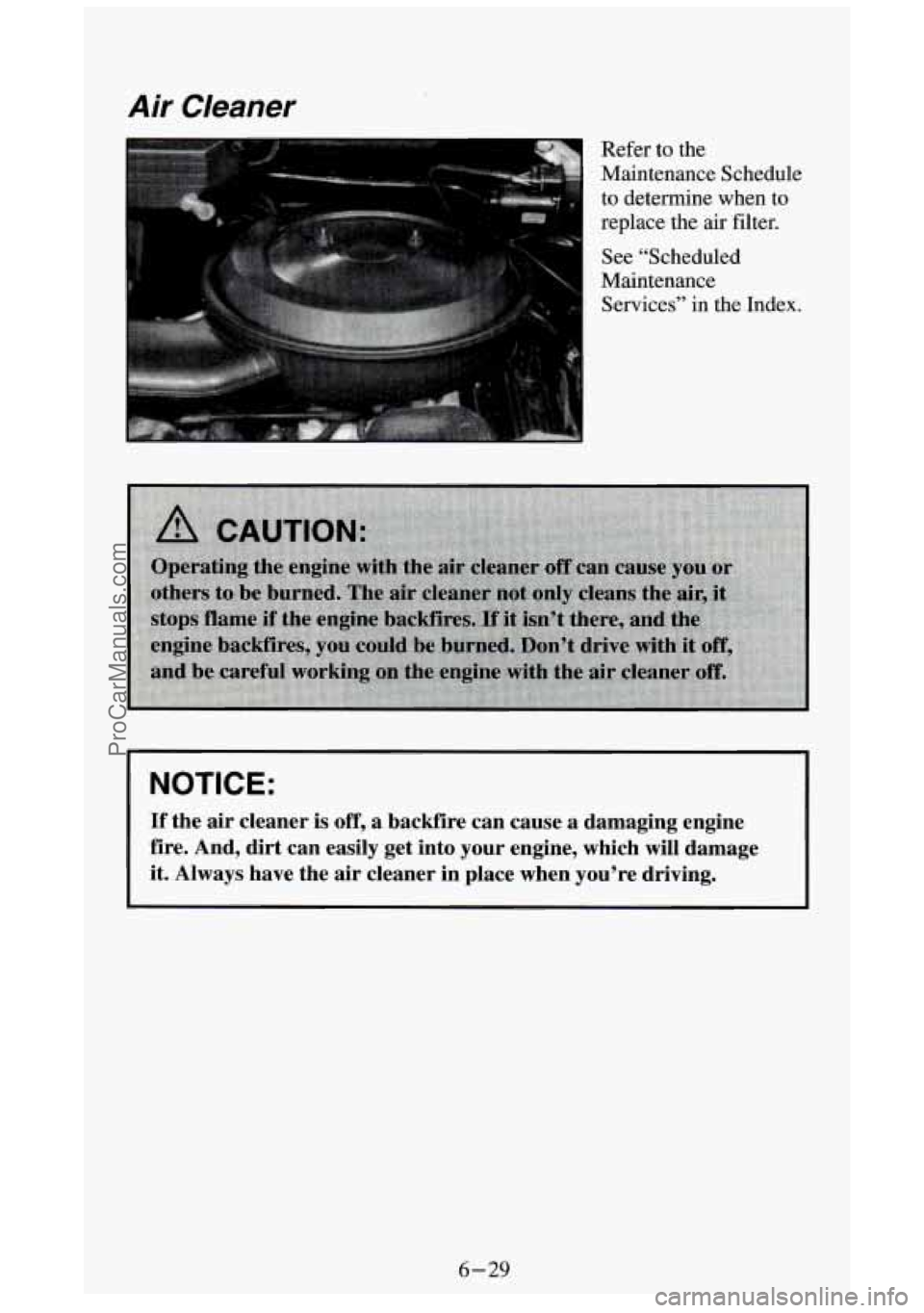
Refer to the
Maintenance Schedule
to determine when to
replace the air filter.
See “Scheduled
Maintenance Services” in the Index.
NOTICE:
If the air cleaner is off, a backfire can cause a damaging engine
fire. And, dirt can easily get into your engine, which will d\
amage
it. Always have the air cleaner in place when you’re drivin\
g.
6-29
ProCarManuals.com
Page 280 of 404
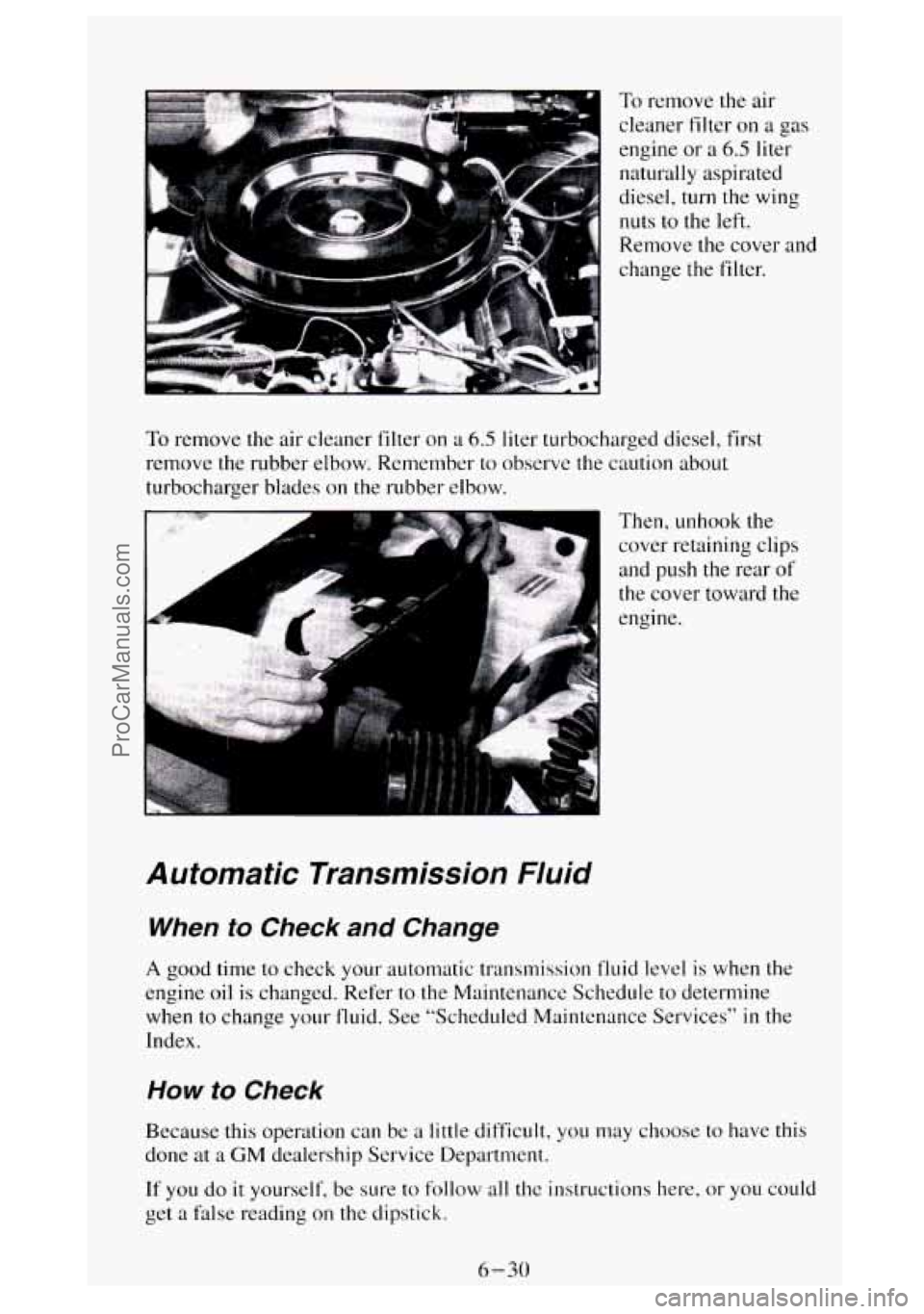
.-. -1 To remove the air
cleaner filter on
a gas
engine or a 6.5 liter
naturally aspirated
diesel,
turn the wing
nuts to the left.
Remove the cover and
change the filter.
Then, unhook the
cover retaining clips
and push the rear
of
the cover toward the
engine.
Automatic Transmission Nuid
When to Check and Change
A good time to check your automatic transmission fluid level is when the
engine oil is changed. Refer
to the Maintenance Schedule to determine
when to change your fluid. See “Scheduled Maintenance Services”
in the
Index.
How to Check
Because this operation can be a little difficult, you may choose to have this
done at
a GM dealership Service Department.
If you do it yourself, be SLIK to follow all the instructions here, or you could
get a false reading on the dipstick.
6 - 30
ProCarManuals.com
Page 344 of 404
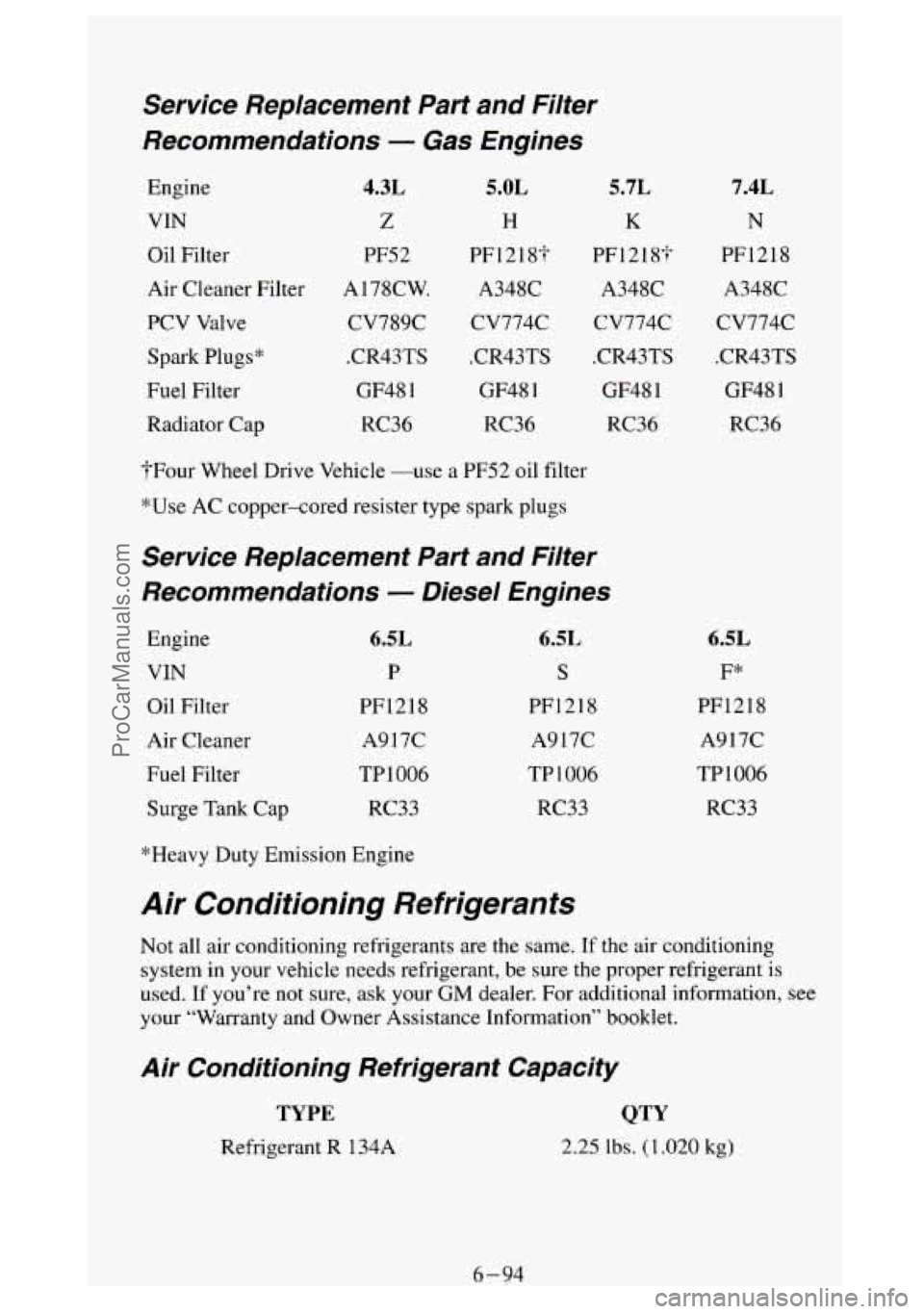
Service Replacement Part and Filter
Recommendations
- Gas Engines
Engine
VIN
Oil Filter
Air Cleaner Filter
PCV Valve
Spark Plugs*
Fuel Filter Radiator Cap
4.3L
z
PF52
A178CW. CV789C
.CR43TS
GF48
1
RC36
5.OL
H
PF1218T A348C
cv774c
.CR43TS GF48
1
RC36
5.7L
K
PF1218t A348C
cv774c
.CR43TS GF48 1
RC36
“four Wheel Drive Vehicle -use a PF52 oil filter
*Use AC copper-cored resister type spark plugs
Service Replacement Part and Filter
Recommendations
- Diesel Engines
Engine
VIN
Oil Filter
Air Cleaner
Fuel Filter Surge Tank Cap 6.5L
P
PF1218
A9 17C
TP 1006
RC33
6.5L
S
PF1218 A917C
TP 1006
RC33
7.4L
N
PF1218 A348C
cv774c
.CR43TS GF48
1
RC36
6.5L
F*
PF1218 A917C
TP 1006
RC33
“Heavy Duty Emission Engine
Air Conditioning Refrigerants
Not all air conditioning refrigerants are the same. If the air conditioning
system in your vehicle needs refrigerant, be sure the proper refrigerant is
used.
If you’re not sure, ask your GM dealer. For additional information, see
your “Warranty and Owner Assistance Information” booklet.
Air Conditioning Refrigerant Capacity
TYPE
Refrigerant R 134A
QTY
2.25 lbs. (1.020 kg)
6-94
ProCarManuals.com
Page 362 of 404
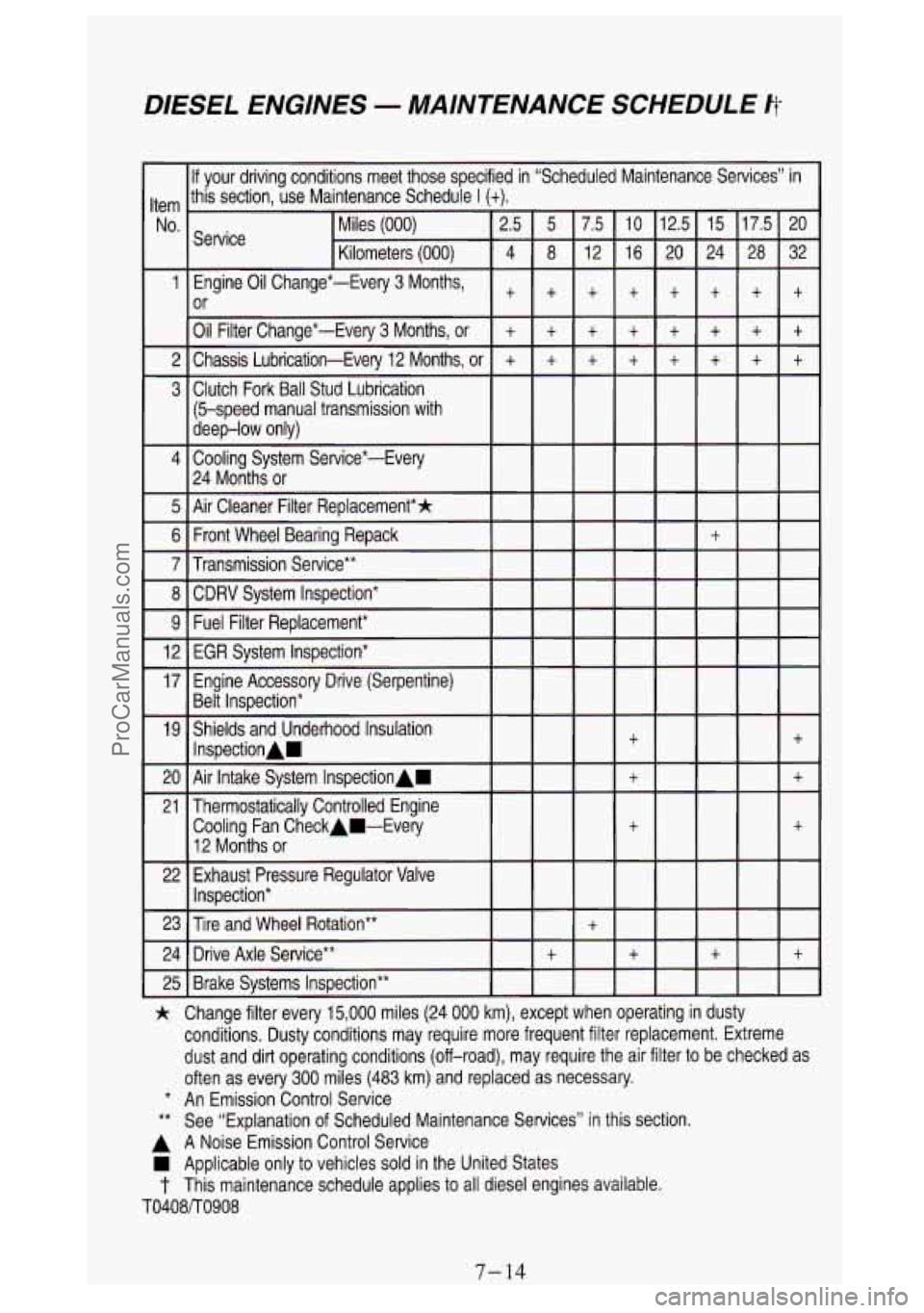
DIESEL ENGINES - MAINTENANCE SCHEDULE yf
20 Air Intake System InspectionAB t t
21 Thermostatically Controlled Engine
Cooling Fan CheckAW-Every
t t
12 Months or
Inspection*
22 Exhaust Pressure Regulator Valve
23 Tire and Wheel Rotation**
t
24 Drive Axle Service** t t t +
25 Brake Systems Inspection**
A Change filter every 15,000 miles (24 000 km), except when op\
erating
in dusty
conditions. Dusty conditions may require more frequent filter re\
placement. Extreme
dust and dirt operating conditions (off-road), may require the air \
filter to be checked as
often as every 300 miles (483 km) and replaced as necessary.
* An Emission Control Service
** See “Explanation of Scheduled Maintenance Services” in this section.
A A Noise Emission Control Service
1 Applicable only to vehicles sold in the United States
t This maintenance schedule applies to all diesel engines available.
T0408/T0908
7-14
ProCarManuals.com
Page 366 of 404
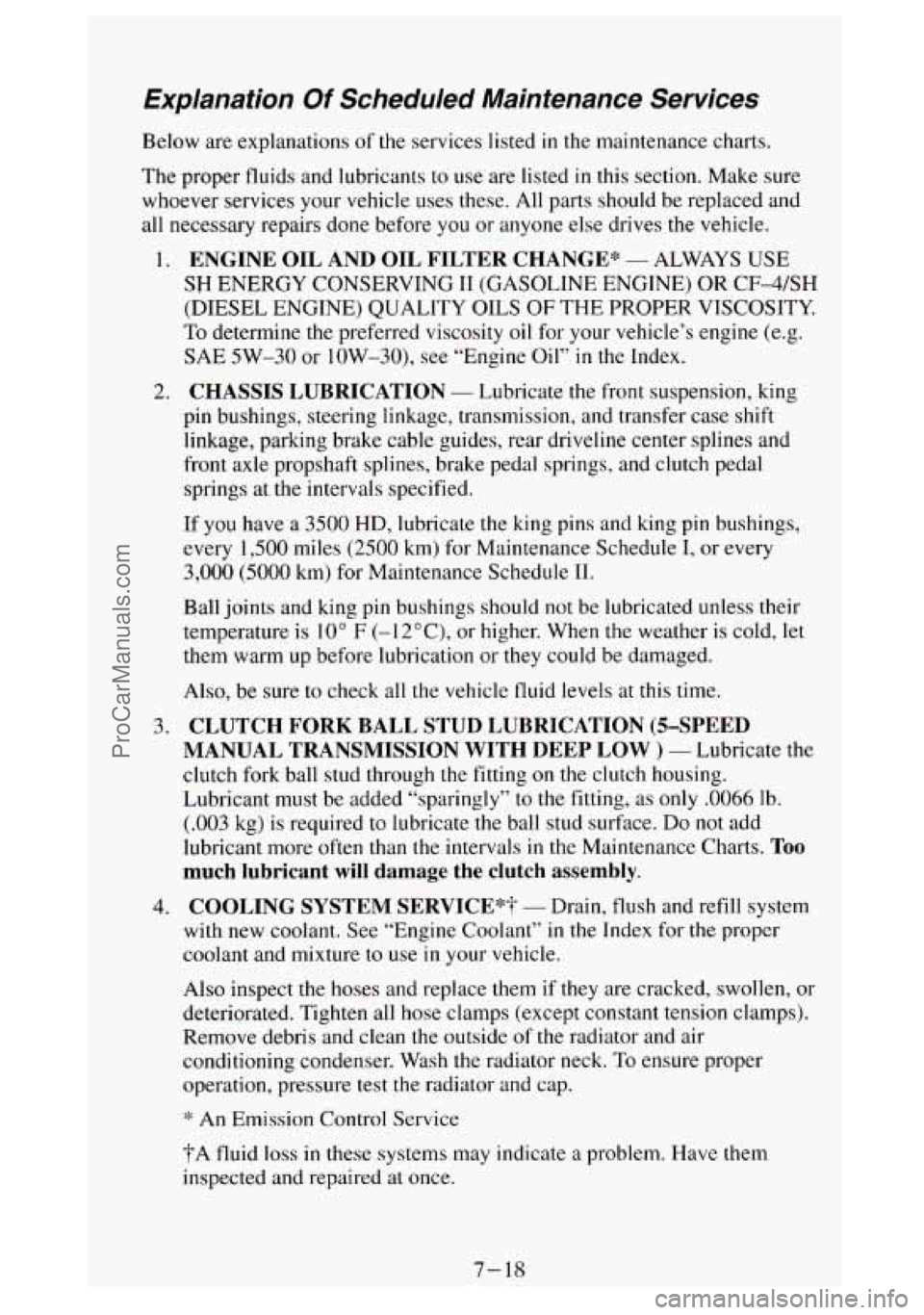
Explanation Of Scheduled Mainienance Services
Below are explanations of the services listed in the maintenance charts.
The proper fluids and lubricants to use are listed in this section. Make sure
whoever services your vehicle uses these. All parts should be replaced and
all necessary repairs done before you or anyone else drives the vehicle.
1. ENGINE OIL AND OIL FILTER CHANGE“‘ - ALWAYS USE
SJ3 ENERGY CONSERVING I1 (GASOLINE ENGINE) OR CF-4/SH
(DIESEL ENGINE) QUALITY OILS
OF THE PROPER VISCOSITY.
To determine the preferred viscosity oil for your vehicle’s engine (e.g.
SAE 5W-30 or 10W-30), see “Engine Oil”
in the Index.
2. CHASSIS LUBRICATION - Lubricate the front suspension, king
pin bushings, steering linkage, transmission, and transfer case shift
linkage, parking brake cable guides, rear driveline center splines and
front axle propshaft splines, brake pedal springs, and clutch pedal
springs at the intervals specified.
If you have a 3500
HD, lubricate the king pins and king pin bushings,
every
1,500 miles (2500 km) for Maintenance Schedule I, or every
3,000 (5000 km) for Maintenance Schedule 11.
Ball joints and king pin bushings should not be lubricated unless their
temperature
is 10” F (-12”C), or higher. When the weather is cold, let
them warm up before lubrication or
they could be damaged.
Also, be sure
to check all the vehicle fluid levels at this time.
3.
CLUTCH FORK BALL STUD LUBRICATION (5-SPEED
MANUAL TRANSMISSION WITH DEEP LOW
) - Lubricate the
clutch fork ball stud through the fitting
on the clutch housing.
Lubricant must be added “sparingly” to
the fitting, as only .0066 lb.
(.003 kg) is required to lubricate the ball stud surface. Do not add
lubricant more often than the intervals
in the Maintenance Charts. Too
much lubricant will damage the clutch assembly.
4. COOLING SYSTEM SERVICE”’? - Drain, flush and refill system
with new coolant. See “Engine Coolant” in the Index for
the proper
coolant and mixture to use
in your vehicle.
Also inspect the hoses and replace them
if they are cracked, swollen, or
deteriorated. Tighten all hose clamps (except constant tension clamps).
Remove debris and clean the outside of the radiator and air
conditioning condenser. Wash the radiator neck.
To ensure proper
operation, pressure test.
the radiator and cap.
* An Emission Control Service
?A fluid
loss in these systems may indicate a problem. Have them
inspected and repaired at once.
7-18
ProCarManuals.com