engine overheat GMC SIERRA 1994 Owners Manual
[x] Cancel search | Manufacturer: GMC, Model Year: 1994, Model line: SIERRA, Model: GMC SIERRA 1994Pages: 404, PDF Size: 20.91 MB
Page 6 of 404
Table of Contents
Introduction - How to Use this Manual
This section tells you how to use your manual and includes safety
and vehicle damage warnings and symbols.
Section 1 - Seats and Safety Restraints
This section tells you how to use your seats and safety restraints
properly.
Section 2 - Features & Controls
This section explains how to start and operate your Vehicle.
Section 3 - Comfort Controls & Audio Systems
This section tells you how to adjust the ventilation and comfort
controls and how to operate your audio system.
Section 4 - Your Driving and the Road
Here you’ll find helpful information and tips about the road\
and
how to drive under different conditions.
Section 5 - Problems on the Road
This section tells you what to do if you have a problem while
driving, such as
a flat tire or engine overheating.
Section 6 - Service & Appearance Care
Here the manual tells you how to keep your Vehicle running
properly and looking good.
Section 7- Schedule Maintenance Services
This section tells you when to perform vehicle maintenance and
what fluids and lubricants to use.
Section 8 - Customer Assistance Information
This section tells you how to contact your GM division for
assistance and
how to get service publications. It also gives you
information on “Reporting Safety Defects” on page
8-4.
Index
Here’s an alphabetical listing of almost every subject in th\
is
manual. You can use
it to quickly find something you want to read.
iv
ProCarManuals.com
Page 75 of 404
4. If the engine does not start after 15 seconds of cranking, turn the
ignition key to
OFF. Wait one minute for the starter to. cool, then try
the
same steps again.
If you’re trying
to start your engine after you’ve run out of fuel, follow the
steps in “Running Out of Fuel” (see “Diesel Fuel Requirements and Fuel
System” in the Index).
When your engine
is cold, let it run for a few minutes before you move your
vehicle. This lets oil pressure build up. Your engine will sound louder
when
it’s cold.
I NOTICE:
If you’re not in an idling vehicle and the engine overheats, you
wouldn’t be there to see the coolant temperature gage. This \
could damage your vehicle. Don’t let your engine run when
you’re not
in your vehicle.
Cold Weather Starting (Diesel Engine)
The following tips will help you get good starting in cold weather.
Use
SAE 1OW-30 oil when the outside temperature drops below freezing.
When the outside temperature drops below
0°F (- 1 SOC), use your engine
coolant heater.
If you park your vehicle
in a garage, you shouldn’t need to use the coolant
heater
until the garage temperature goes below 0°F (-18OC), no matter how
cold it is outside.
To use the engine coolant heater, first turn off the engine. Then open the
hood, unwrap the electrical cord and plug it in. It uses normal house voltage
(I 10 volts), but:
2-17
ProCarManuals.com
Page 131 of 404
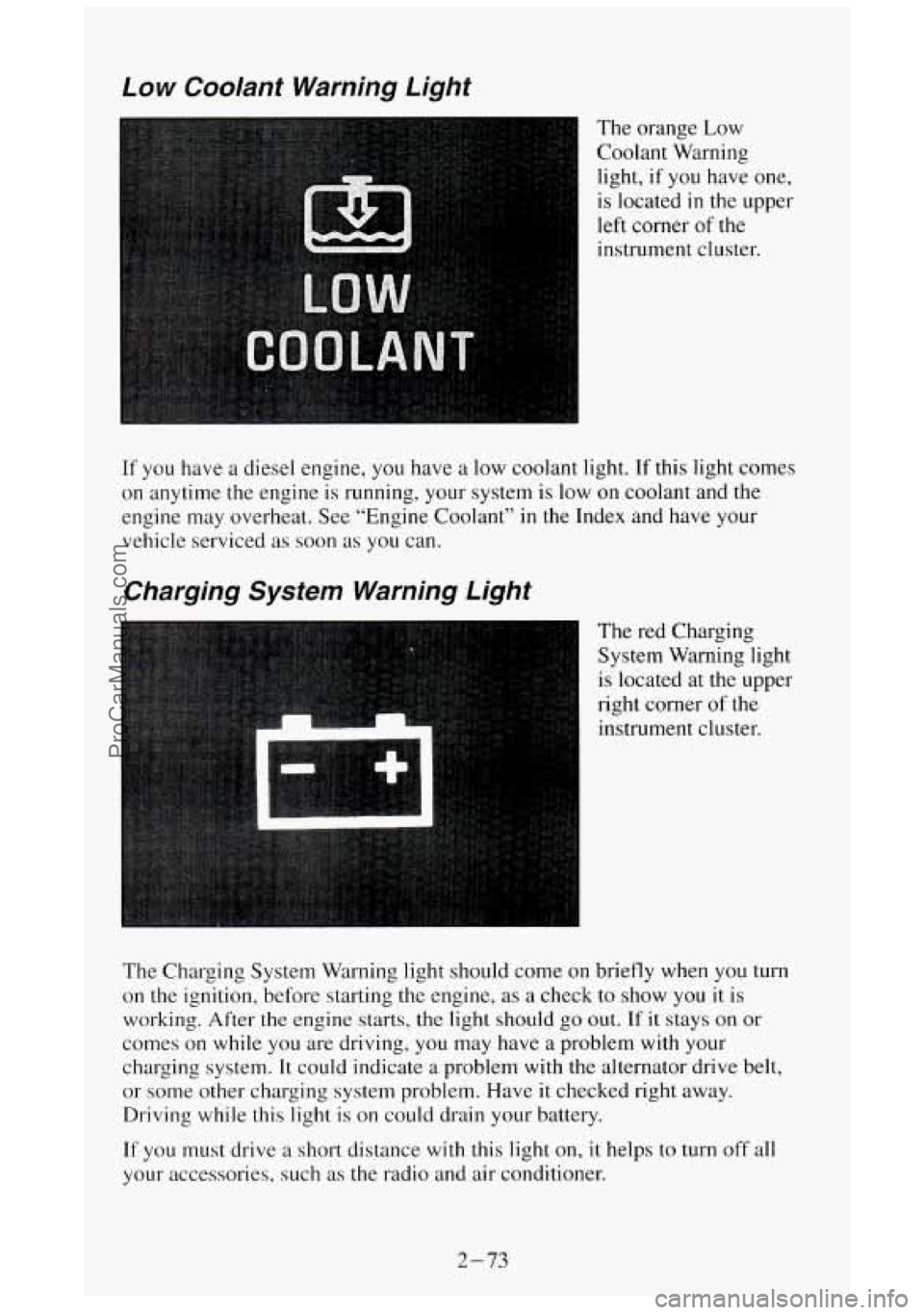
Low Coolant Warning Light
The orange Low
Coolant Warning
light, if you have one,
is located
in the upper
left corner of the
instrument cluster.
If you have
on anytime
engine may a
diesel engine, you have a low coolant light. If this light comes
the engine is running, your system
is low on coolant and the
overheat. See “Engine Coolant”
in the Index and have your
vehicle serviced as soon as you can.
Charging System Warning Light
The red Charging
System Warning light
I is located at the upper
right corner
of the
instrument cluster.
The Charging System Warning light should come on briefly when
you turn
on the ignition, before starting the engine, as a check to show you it is
working. After the engine starts, the light should go
out. If it stays on or
comes on while you are driving, you may have a problem with your
charging system.
It could indicate a problem with the alternator drive belt,
or some other charging system problem.
Have it checked right away.
Driving while this light is on could drain your battery.
If you must drive a short distance with this light on, it helps to turn off all
your accessories, such as the radio and air conditioner.
2-73
ProCarManuals.com
Page 137 of 404
actually took a little more or less than half the tank’s capacity to fill the
tank.
The gage moves a little when you turn a corner or speed up.
The gage doesn’t go back to empty when you turn off the ignition.
None of these indicate a problem with
the fuel gage.
For information on how to
fill your fuel tank, see “Fuel - Filling Your
Tank”
in the Index.
For your fuel tank capacity, see
“Fuel --Tank Capacity” in the Index.
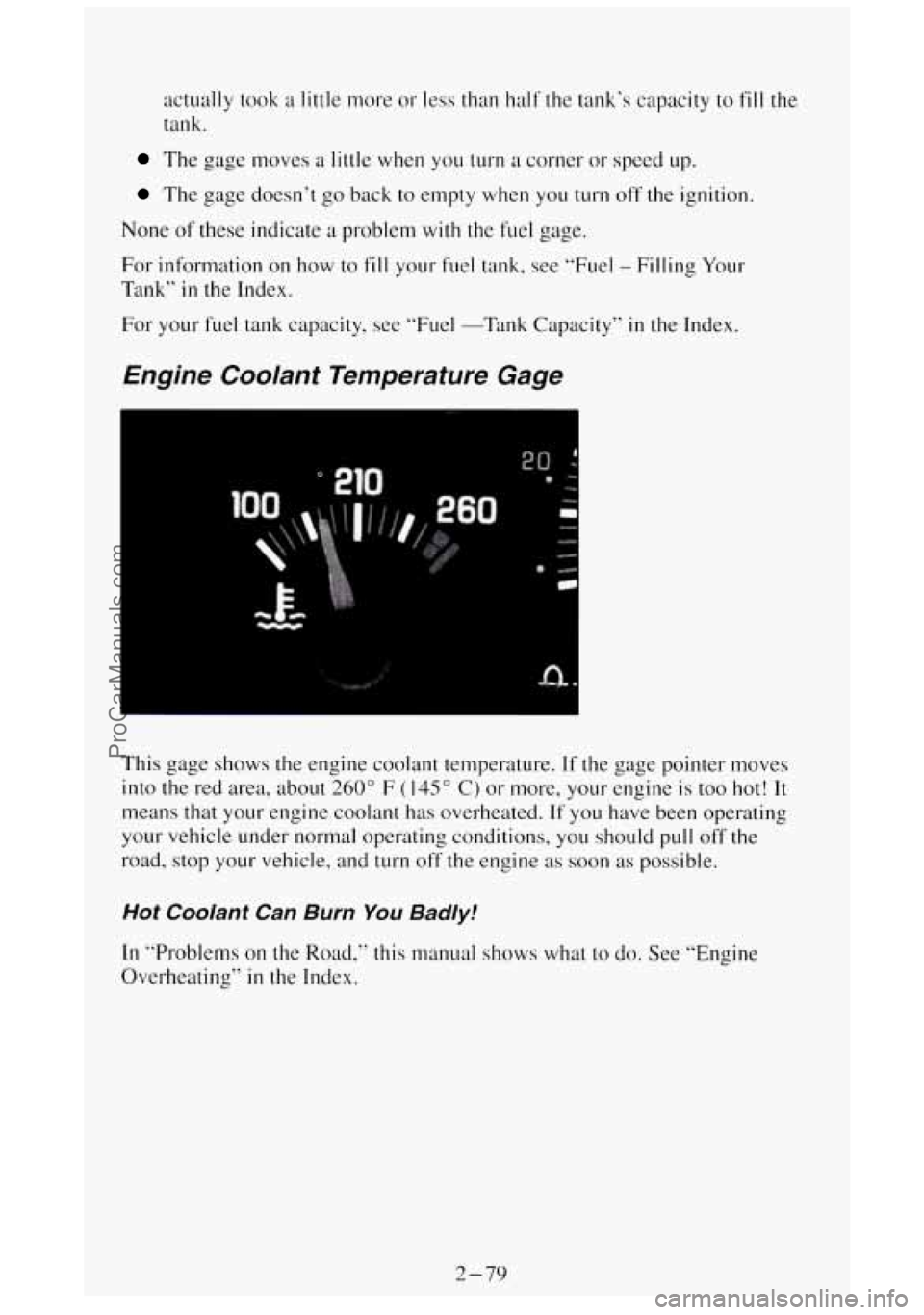
Engine Coolant Temperature Gage
This gage shows the engine coolant temperature. If the gage pointer moves
into the red area, about
260” F ( 145” C) or more, your engine is too hot! It
means that your engine coolant has overheated. If you have been operating
your vehicle under normal operating conditions, you should pull off the
road, stop
your vehicle, and turn off the engine as soon as possible.
Hot Cooianf Can Burn You Badly!
In “Problems on the Road,” this ~nanual shows what to do. See “Engine
Overheating”
in the Index.
2-79
ProCarManuals.com
Page 184 of 404
If you decide you can go down a hill safely, then try to keep your vehicle
headed straight down, and use
a low gear. This way, engine drag can help
your brakes and they won’t have to do all the work. Descend slowly,
keeping your vehicle under control at
all times.
A CAUTION:
Heavy braking when going down a hill can cause your brakes to
overheat and fade. This could cause loss of control and a ser\
ious
accident. Apply the brakes lightly when descending a hill
and
use a low gear to keep vehicle speed under control.
Q: Are there some things I should not do when driving down a hill?
A: Yes! These are important because if you ignore them you could lose
control and have
a serious accident.
When driving downhill, avoid turns that take you across the incline of
the hill. A hill that’s not too steep to drive down may be too steep to
drive across. You could roll over if you don’t drive straight down.
0 Never go downhill with the transmission in “N” (Neutral) , or with the
clutch pedal depressed in a manual shift . This is called
“free-wheeling.” Your brakes will have to do
all the work and could
overheat and fade.
Avoid braking so hard that you lock the front wheels when going
downhill.
If your front wheels are locked, you can’t steer your vehicle.
If your wheels lock up during downhill braking, you
may feel the
vehicle starting
to slide sideways. To regain your direction, just ease off
the brakes and steer to keep the front of the vehicle pointing straight
downhill.
0: Am I likely to stall when going downhill?
A: It’s much more likely to happen going uphill. But if it happens going
downhill, here’s what to do.
0 Stop your vehicle by applying the regular brakes. Apply the parking
brake.
Shift to ‘bP’ (Park) (or to Neutral with the lnanual transmission) and,
while still braking, restart the engine.
0 Shift back to a low gear, release the parking brake, and drive straight
down.
0 If the engine won’t start, get out and get hclp.
4-20
ProCarManuals.com
Page 207 of 404
Driving On Grades
Reduce speed and shift to a lower gear before you start down a long or
steep downgrade.
If you don’t shift down, you might have to use your
brakes
so much that they would get hot and no longer work well.
On a long uphill grade, shift down and reduce your speed to around
45 mph
(70 km/h) to reduce the possibility of engine and transmission overheating.
When towing at high altitude with steep uphill grades,you need to consider
the following information. The lower atmospheric pressure at high altitude
allows your vehicles engine coolant to boil at a lower temperature than at
normal altitudes.
If you immediately turn your engine off after towing at high altitude with
steep uphill grades, your vehicle may show signs similar
to engine
overheating.
To avoid this, let your vehicle operate in a parked position with
the transmission in
“N” (Neutral) for a few minutes before you turn off the
engine. If you do get the overheat warning, see “Engine Overheating” in
the Index.
If you have an automatic transmission, you should use
“D” (or, as you need
to, a lower gear) when towing a trailer. Operating your vehicle in
“D” when
towing a trailer will minimize heat buildup and extend the life
of your
transmission.
If you have a manual transmission and
you are towing a trailer, it’s better
not to use fifth gear. Just drive in fourth gear (or, as you need to, a lower
gear).
Parking on Hills
You really should not park your vehicle, with a trailer attached, on a hill. If
something goes wrong, your rig could start
to move. People can be injured,
and both your vehicle and the trailer can be damaged.
But if you ever have to park your rig on a hill, here’s how
to do it:
1.
2.
3.
4.
5.
6.
Apply your regular brakes, but don’t shift into “P’ (Park) yet, or in gear
for a manual transmission.
Have someone place chocks under the trailer wheels.
When the wheel chocks are in place, release the regular brakes until the
chocks absorb
the load.
Re-apply the regular brakes. Then apply your parking brake, and then
shift to
“P7, (Park), or “R” (Reverse) for a manual transmission.
If
you have a four-wheel-drive vehicle, be sure the transfer case is in a
drive gear-not in
“N7 (Neutral).
Release
the regular brakes.
4-43
ProCarManuals.com
Page 209 of 404
Problems on the Road
Section
Here you’ll find what to do about some problems that can occur on the road .
Hazard Warning Flasher ..................................... 5-2
Other Warning Devices ...................................... 5-3
Jumpstarting .............................................. 5-3
TowingYourVehicle ........................................ 5-7
Engine Overheating ........................................ 5-11
Engine Fan Noise .......................................... 5-25
If a Tire Goes Flat ......................................... 5-25
Changing
a Flat Tire ..................................... 5-26
Jackstorage
........................................... 5-29
SpareTire
............................................. 5-29
If You’re Stuck:
In Sand. Mud. Ice or Snow ..................... 5-40
5-1
ProCarManuals.com
Page 219 of 404
,ngine Overheating
You will find a coolant temperature gage on your vehicle instrument panel.
If you have a diesel engine, you will also find a low coolant light on your
instrument panel.
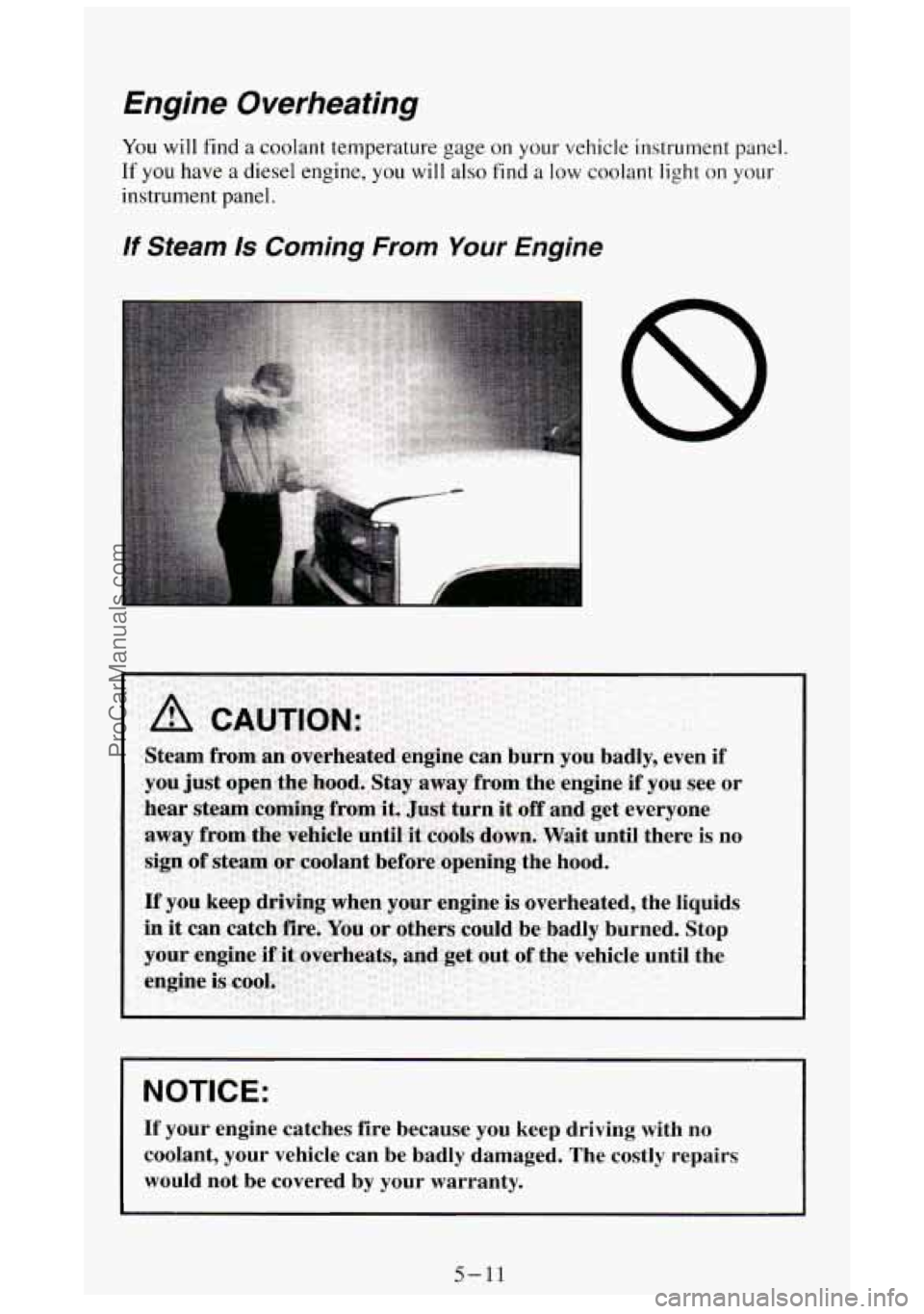
If Steam 1s Coming From Your Engine
NOTICE:
If your engine catches fire because you keep driving with no
coolant, your vehicle can be badly damaged. The costly repairs
would not be covered by your warranty.
5-11
ProCarManuals.com
Page 220 of 404
If No Steam Is Coming From Your Engine
If you get the overheat warning but see or hear no steam, the problem may
not be too serious. Sometimes the engine can get a little too hot when you:
Climb a long hill on a hot day.
0 Stop after high speed driving.
Idle for long periods in traffic.
Tow a trailer.
If you get the overheat warning with no sign of steam, try this for
a minute
or
so:
1. If you have an air conditioner, turn it off.
2. Turn on your heater to full hot at the highest fan speed and open the
window as necessary.
3. If you’re in a traffic jam, shift to “N” (Neutral).
If
you no longer have the overheat warning, you can drive. Just to be safe,
drive slower for about ten minutes. If the warning doesn’t come back
on,
you can drive normally.
If the warning continues, pull over, stop, and park your vehicle right away.
If there’s still no sign of steam, push the accelerator
until the engine speed is
about twice
as fast as normal idle speed. Bring the engine speed back to
normal idle speed after two or three minutes.
Now see if the warning stops.
But then,
if you still have the warning, TURN OFF THE ENGINE AND
GET EVERYONE OUT OF THE VEHICLE until it cools down.
You
may decide not to lift the hood but to get service help right away.
5-12
ProCarManuals.com
Page 223 of 404

I NOTICE:
In cold weather, water can freeze and crack the engine, radiator, \
heater core and other parts. Use the recommended coolant.
When the coolant in the coolant recovery tank is at or above the COLD
mark, start your vehicle.
If the overheat warning continues, there’s one more thing you can try. You
can add the proper coolant mix directly to the radiator!, but be sure the
cooling system is cool before
you do it.
5-15
ProCarManuals.com