fuel filter GMC SIERRA 1994 Owners Manual
[x] Cancel search | Manufacturer: GMC, Model Year: 1994, Model line: SIERRA, Model: GMC SIERRA 1994Pages: 404, PDF Size: 20.91 MB
Page 257 of 404
Cold Weather Operation
In cold weather (below 20”F, or -7”C), use 1-D or “Winterized” Number
2-D fuel (a blend of I-D and 2-D). Be sure you get the right fuel. In very
cold temperatures (when
it stays below 0°F or -1 8OC), use Number 1-D.
If you’re driving in very cold temperatures and can’t get Number I-D or a
“winterized” Number
2-D, you can use one gallon of kerosene for every
two gallons
of diesel fuel. Once you add the kerosene, run your engine for
several minutes
so the fuels will mix. Add kerosene only when the
temperature falls below
0°F (-1 8” C), because the fuel economy of kerosene
isn’t
as good as that of diesel fuel.
NOTICE:
Never use home heating oil or gasoline in your diesel engine.
They can cause engine damage.
In cold weather, your fuel filter may become clogged (waxed), especially if
you use Number
2-D diesel fuel that hasn’t been “winterized.” To unclog it,
warm the filter to between 32°F and 50°F (0°C to 10°C). You won’t need
to replace
it.
Water in Fuel
Sometimes, water can be pumped into your fuel tank along with your diesel
fuel. This can happen
if a service station doesn’t regularly inspect and clean
its
fuel tanks, or if it gets contaminated fuel from its suppliers.
If this happens,
a “WATER IN FUEL” light will come on. If it does, the
excess water must be drained. Your dealer can do this
for you.
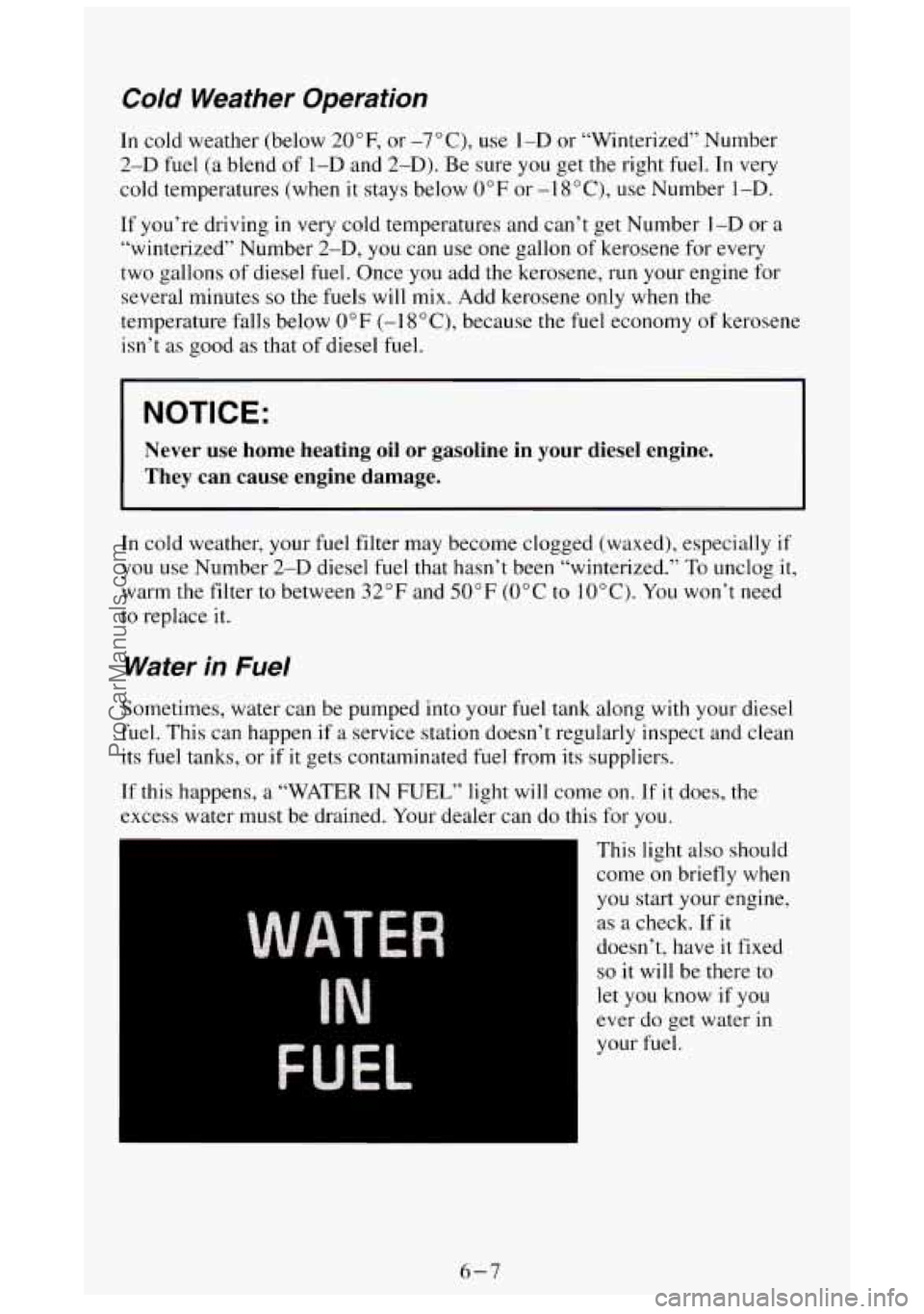
This light also should
come on briefly when
you start your engine,
as a check. If it
doesn’t, have it fixed
so it will be there to
let you know if you
ever
do get water in
your fuel.
L
6-7
ProCarManuals.com
Page 258 of 404
If the light comes on at any other time, use this chart.
“Water in Fuel” Light Chart
Problem
Light comes on intermittently.
Light stays on:
1. At temperatures above
freezing.
2. At temperatures below
freezing.
Recommended Action
Drain water from fuel filter.
Drain fuel filter immediately. If no
water
can be drained and light stays
on, see your dealer for assistance.
Drain fuel filter immediately. If no
water can be drained
- water may
be frozen. Open the air bleed valve
to check
for fuel pressure. If no fuel
pressure is present, replace the
fuel
filter.
3. Immediately after refueling - Fuel tank purging required. See
large amount of water possibly your dealer for assistance.
pumped into fuel tank.
Hesitation or “flat” performance at high speed or during hard acceleration
may be an indication of premature fuel filter plugging due
to dirty or
contaminated fuel, The filter element may need to be changed
if this
happens. See your dealer for assistance.
NOTICE:
If you drive when this warning light is on, you can damage y\
our
fuel injection system and your engine. If the light comes on right
after you refuel,
it means water was pumped into your fuel tank.
Turn off your engine immediately. Then, have the water drained \
at once.
To drain water:
1. Stop and park the vehicle in a safe place. Turn off the engine and apply
the parking brake.
2. Remove the fuel tank cap.
3. Place a fuel-resistant container under the filter drain hose.
6-8
ProCarManuals.com
Page 260 of 404
~ NOTICE:
If
there is water in your diesel fuel and the weather is warm or
humid, fungus and bacteria can grow in the fuel. They can
damage your fuel system. You'll need
a diesel fuel biocide to
sterilize your fuel system. Your dealer can advise you if you ever
need this.
If your fuel tank needs to be purged to remove water, see your
dealer or
a qualified technician. Improper purging can damage
your fuel system.
Running Out of Fuel (Diesel Engines)
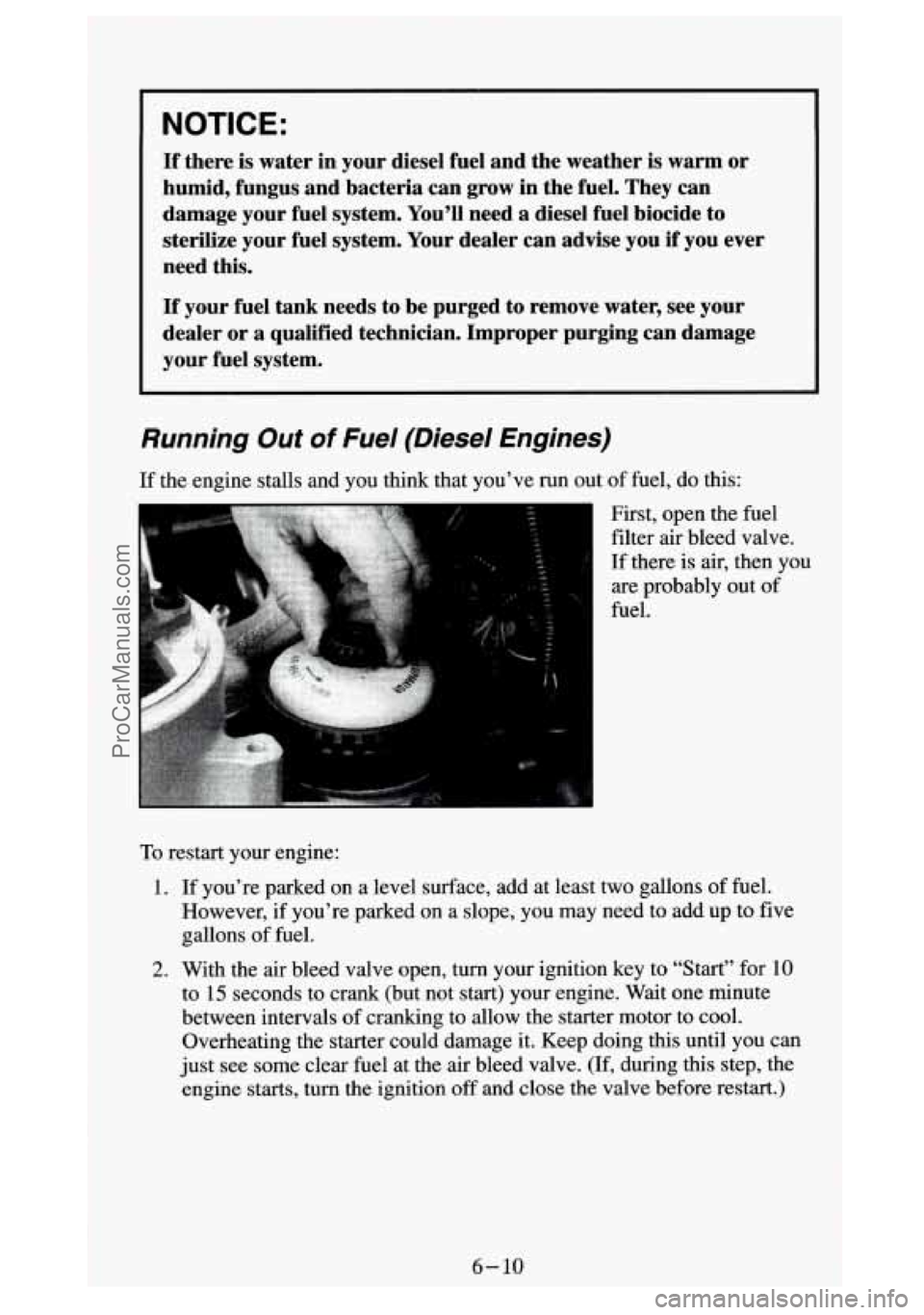
If the engine stalls and you think that you've run out of fuel, do this:
First, open the fuel
filter
air bleed valve.
If there is air, then you are probably out of
fuel.
To restart your engine:
1. If you're parked on a level surface, add at least two gallons of fuel.
However, if you're parked on a slope, you may need to add up to five
gallons of fuel.
2. With the air bleed valve open, turn your ignition key to "Sta\
rt" for 10
to 15 seconds to crank (but not start) your engine. Wait one minut\
e
between intervals of cranking to allow the starter motor to cool.
Overheating the starter could damage it. Keep doing this until you can
just see some clear fuel at the air bleed valve. (If, during this ste\
p, the
engine starts, turn the ignition
off and close the valve before restart.)
6-10
ProCarManuals.com
Page 261 of 404
A CAUTION:
Diesel fuel is flammable. It could start a fire if it gets on hot
engine parts. You could be burned. Don’t let too much fuel flow
from the air bleed valve, and wipe up any spilled fuel with
a
cloth.
3. Close the air bleed valve.
4. Turn the ignition key to “Start” for 10 to 15 seconds at a time until your
engine starts.
Fuel Filter Replacement (Diesel Engines)
If you want to change the fuel filter yourself, here’s how to do it:
Before you remove the filter, drain any water that may have collected in the
fuel filter or filter head. See “Water in Fuel” earlier in this section to find
out how to remove water from the fuel system.
Then, drain
fuel from the filter by opening the air bleed valve and the water
drain valve. This prevents the fuel from spilling as
you replace the filter.
Drain the fuel into
a fuel-resistant container and dispose of it properly.
A CAUTION:
Diesel fuel is flammable. It could start a fire if something ignites
it, and you could be burned. Don’t let it get on hot engine parts,
and keep matches or other ignition sources away.
I. Turn off the engine and apply the parking brake.
2. Take off the fuel tank cap. This releases vacuum in the tank.
3. The filter is located at the rear of the intake manifold.
6-11
ProCarManuals.com
Page 262 of 404
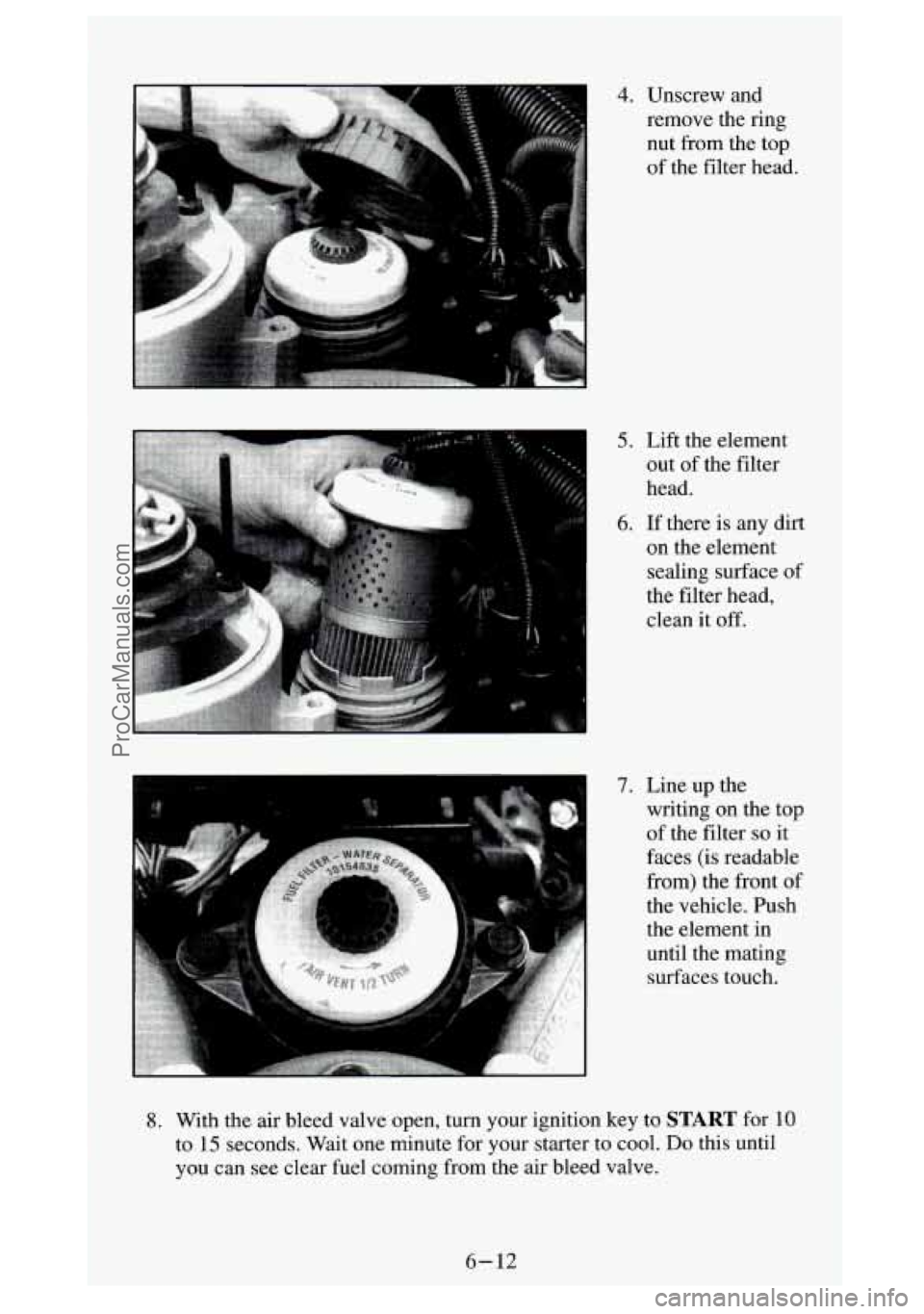
4. Unscrew and
remove the ring
nut from the top
of the filter head.
7. Line up the
writing on the top
of the filter
so it
faces (is readable
from) the front of
the vehicle. Push
the element in
until the mating
surfaces touch.
5. Lift the element
out of the filter
head.
6. If there is any dirt
on the element
sealing surface of
the filter head,
clean it
off.
8. With the air bleed valve open, turn your ignition key to START for 10
to 15 seconds. Wait one minute for your starter to cool. Do this until
you can see clear fuel coming from the air bleed valve.
ProCarManuals.com
Page 263 of 404
9. Close the air bleed valve and replace the fuel cap.
10. Start your engine and let it idle for five minutes. Check your fuel filter
and air bleed valve for leaks.
Fuels in Foreign Countries
If you plan on driving in another country outside the U.S. or Canada,
unleaded fuel may be hard to find. Do not use leaded gasoline.
If you use
even one tankful, your emission controls won’t work well or at all. With
continuous use, spark plugs can get fouled, the exhaust system can corrode,
and your engine oil can deteriorate quickly. Your vehicle’s oxygen sensor
will be damaged. All of that means costly repairs that wouldn’t be covered
by your warranty.
To check on fuel availability, ask an auto club, or contact a major oil
company that does business
in the country where you’ll be driving.
You can also write us at the following address for advice. Just tell us where
you’re going and give your Vehicle Identification Number (VIN).
General Motors Overseas Distribution Corporation,
North American Export Sales (NAES)
1908 Colonel
Sam Drive
Oshawa, Ontario
L1H 8P7
Filling Your Tank
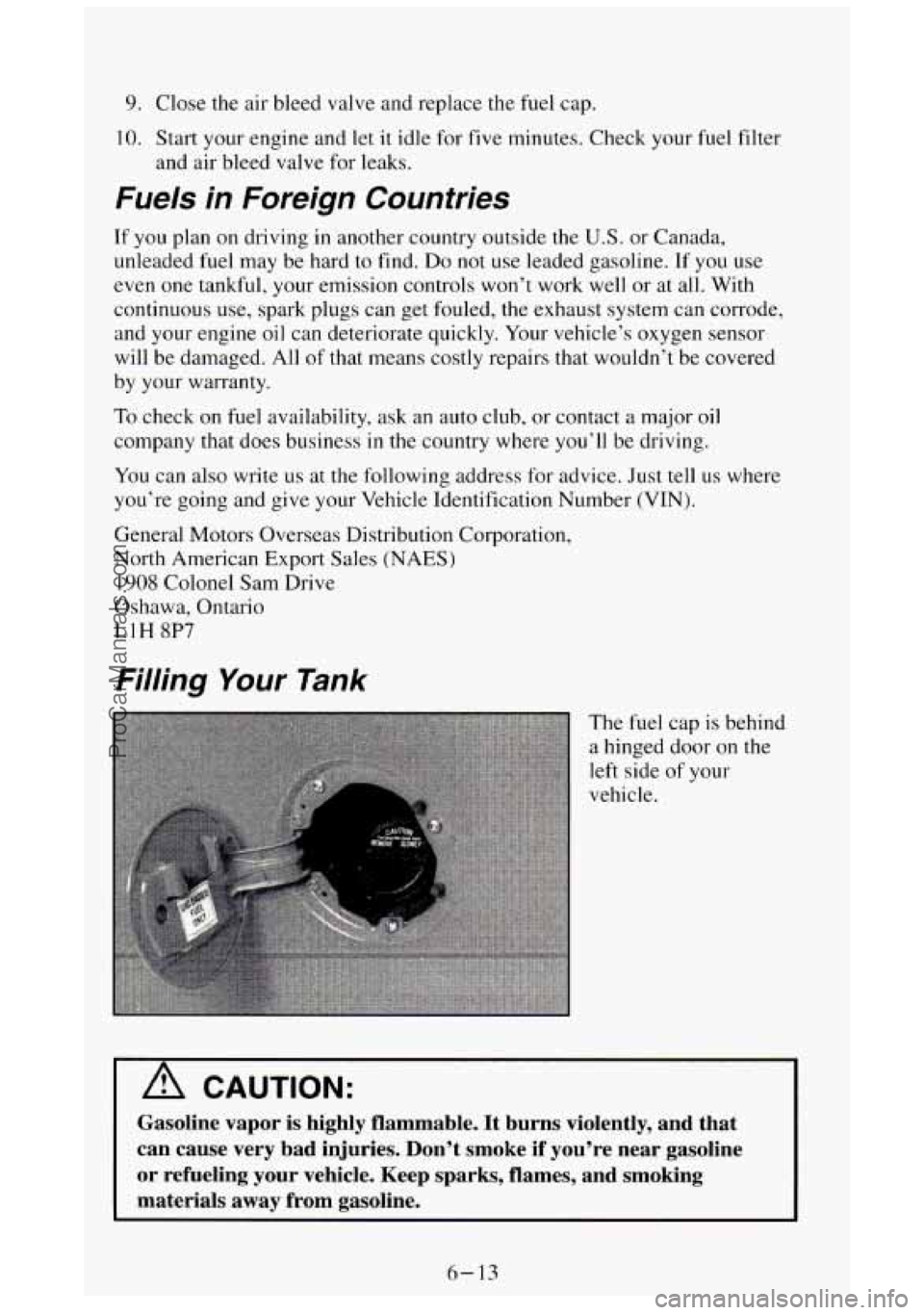
The fuel cap is behind
a hinged door on the
left side of your
vehicle.
/i CAUTION:
Gasoline vapor is highly flammable. It burns vioIently, and tha\
t
can cause very
bad injuries. Don’t smoke if you’re near gasoline
or refueling your vehicle. Keep sparks, flames, and smoking
materials away from gasoline.
6-13
ProCarManuals.com
Page 274 of 404
What to Do with Used Oil
Did you know that used engine oil contains certain elements that may be
unhealthy for your skin and could even cause cancer? Don't let used
oil stay
on your skin for very long. Clean your skin and nails with soap and water,
or
a good hand cleaner. Wash or properly throw away clothing or rags
containing used engine oil. (See
the manufacturer's warnings about the use
and disposal of oil products.)
Used oil can be a real threat
to the environment. If you change your own oil,
be sure t.o drain all free-tlowing
oil from the filter before disposal. Don't
ever dispose of
oil by putting it in the trash, pouring it on the ground, into
sewers, or into streams or bodies of water. Instead, recycle it by taking it to
a place that collects used oil. If you have a problem properly disposing of
your used oil, ask your dealer, a service station or a local recycling center
for help.
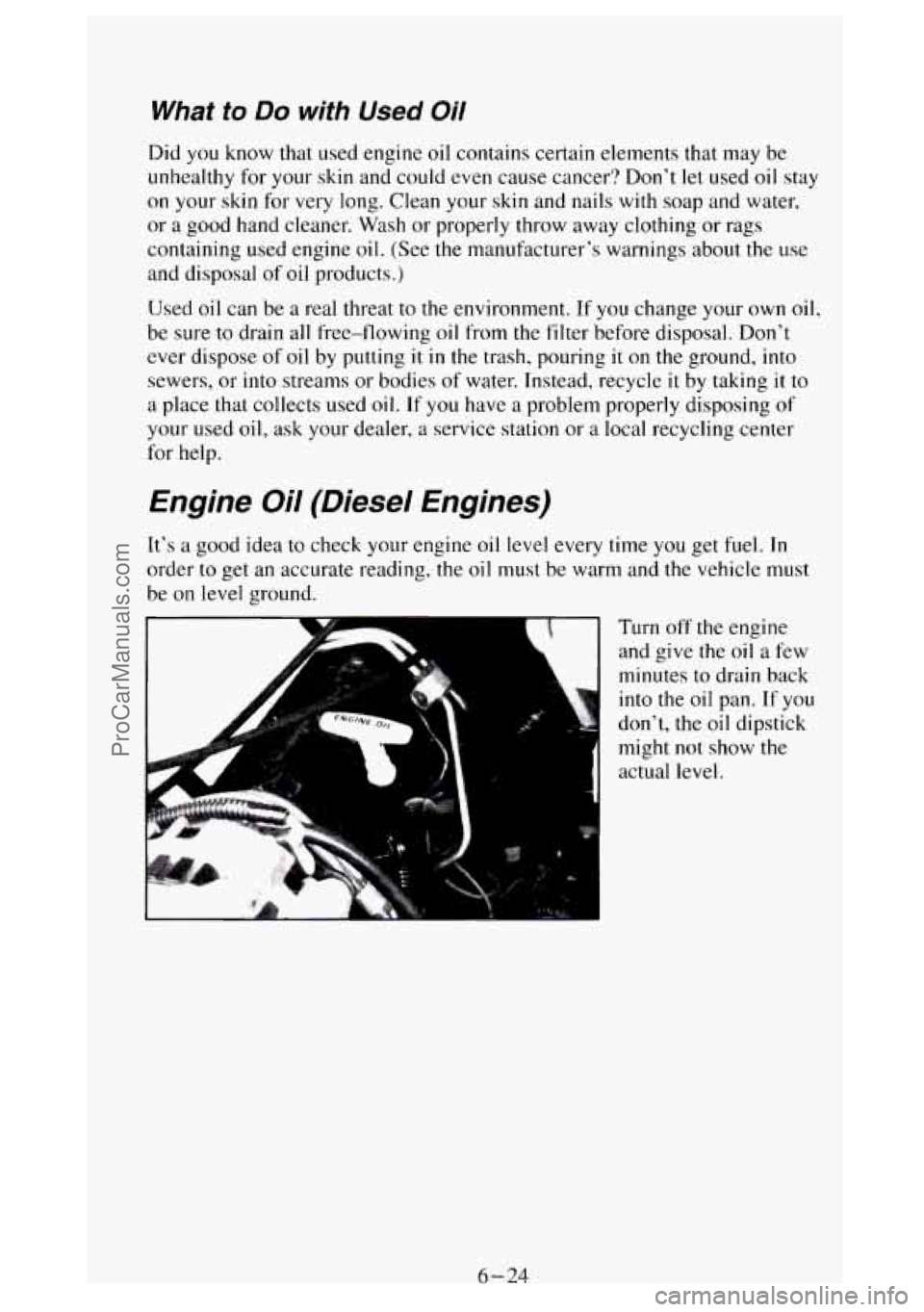
Engine Oil (Diesel Engines)
It's a good idea to check your engine oil level every time you get fuel. In
order
to get an accurate reading, the oil must be warm and the vehicle must
be
on level ground.
Turn off
the engine
and give the oil
a few
minutes to drain back
into
the oil pan. If you
don't, the
oil dipstick
might
not show-the
actual
level.
5-24
ProCarManuals.com
Page 343 of 404
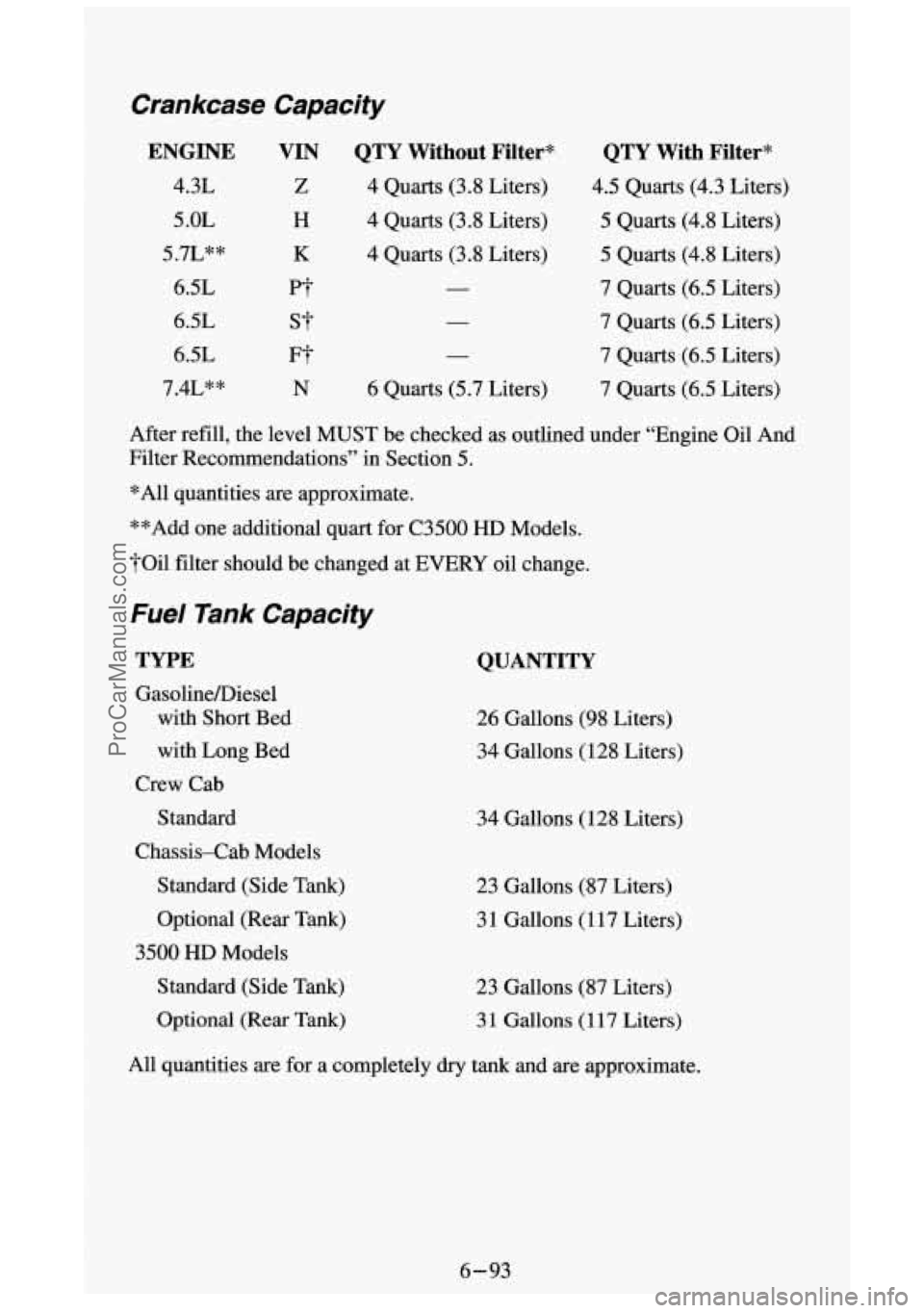
Crankcase Capacity
ENGINE VIN QTY Without Filter*
4.3L Z 4 Quarts (3.8 Liters)
5.7L**
K 4 Quarts (3.8 Liters)
5
.OL
H 4 Quarts (3.8 Liters)
6.5L
Pt -
6.5L st -
6.5L H- -
7 .a* * N 6 Quarts (5.7 Liters)
QTY With Filter*
4.5 Quarts (4.3 Liters)
5 Quarts (4.8 Liters)
5 Quarts (4.8 Liters)
7 Quarts
(6.5 Liters)
7 Quarts (6.5 Liters)
7 Quarts (6.5 Liters)
7 Quarts (6.5 Liters)
After refill, the level MUST be checked as outlined under “\
Engine Oil And
Filter Recommendations’’ in Section
5.
*All quantities are approximate.
**Add one additional quart for C3500
HD Models.
?Oil filter should be changed at EVERY oil change.
Fuel Tank Capacity
TYPE
GasolineDiesel with Short Bed
with Long Bed
Crew Cab Standard
Chassis-Cab Models Standard (Side Tank)
Optional (Rear Tank)
3500
HD Models
Standard (Side Tank)
Optional (Rear Tank)
QUANTITY
26 Gallons (98 Liters) 34 Gallons (128 Liters)
34 Gallons (128 Liters)
23 Gallons (87 Liters)
3 1 Gallons (1 17 Liters)
23 Gallons (87 Liters)
3 1 Gallons (1 17 Liters)
All quantities are for a completely
dry tank and are approximate.
I
6-93
ProCarManuals.com
Page 344 of 404
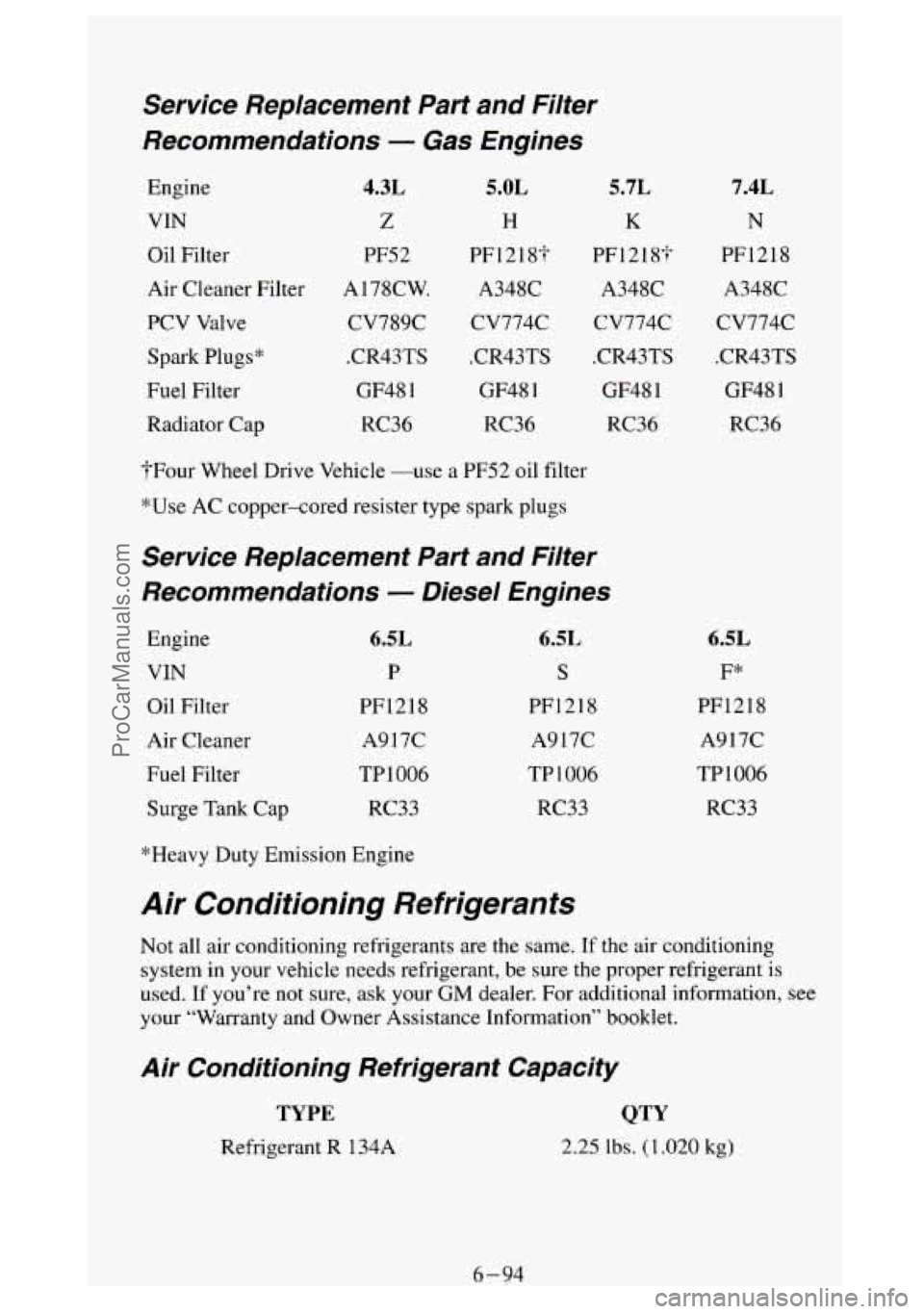
Service Replacement Part and Filter
Recommendations
- Gas Engines
Engine
VIN
Oil Filter
Air Cleaner Filter
PCV Valve
Spark Plugs*
Fuel Filter Radiator Cap
4.3L
z
PF52
A178CW. CV789C
.CR43TS
GF48
1
RC36
5.OL
H
PF1218T A348C
cv774c
.CR43TS GF48
1
RC36
5.7L
K
PF1218t A348C
cv774c
.CR43TS GF48 1
RC36
“four Wheel Drive Vehicle -use a PF52 oil filter
*Use AC copper-cored resister type spark plugs
Service Replacement Part and Filter
Recommendations
- Diesel Engines
Engine
VIN
Oil Filter
Air Cleaner
Fuel Filter Surge Tank Cap 6.5L
P
PF1218
A9 17C
TP 1006
RC33
6.5L
S
PF1218 A917C
TP 1006
RC33
7.4L
N
PF1218 A348C
cv774c
.CR43TS GF48
1
RC36
6.5L
F*
PF1218 A917C
TP 1006
RC33
“Heavy Duty Emission Engine
Air Conditioning Refrigerants
Not all air conditioning refrigerants are the same. If the air conditioning
system in your vehicle needs refrigerant, be sure the proper refrigerant is
used.
If you’re not sure, ask your GM dealer. For additional information, see
your “Warranty and Owner Assistance Information” booklet.
Air Conditioning Refrigerant Capacity
TYPE
Refrigerant R 134A
QTY
2.25 lbs. (1.020 kg)
6-94
ProCarManuals.com
Page 367 of 404
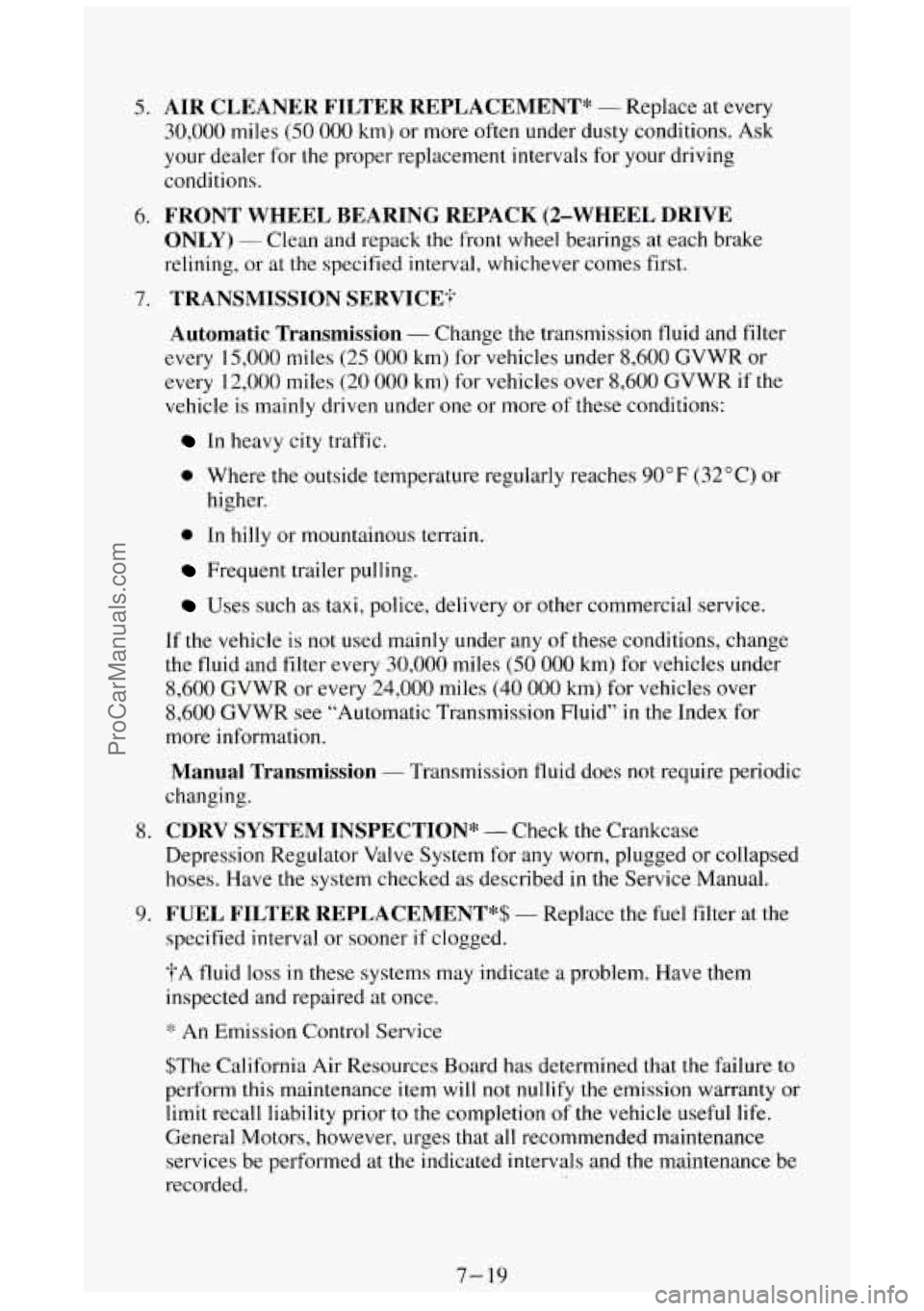
5. AIR CLEANER FILTER REPLACEMENT* - Replace at every
30,000 miles (50 000 km) or more often under dusty conditions. Ask
your dealer for the proper replacement intervals for your driving
conditions.
6. FRONT WHEEL BEARING REPACK (2-WHEEL DRIVE
ONLY)
- Clean and repack the front wheel bearings at each brake
relining, or at
the specified interval, whichever comes first.
7. TRANSMISSION SERVICE’/-
Automatic Transmission
- Change the transmission fluid and filter
every
15,000 miles (25 000 km) for vehicles under 8,600 GVWR or
every 12,000 miles
(20 000 km) for vehicles over 8,600 GVWR if the
vehicle is mainly driven under one or more
of these conditions:
In heavy city traffic.
0 Where the outside temperature regularly reaches 90°F (32°C) or
0 In hilly or mountainous terrain.
higher.
Frequent
trailer pulling.
Uses such as taxi, police, delivery or other commercial service.
If the vehicle
is not used mainly under any of these conditions, change
the fluid and filter every
30,000 miles (50 000 km) for vehicles under
8,600
GVWR or every 24,000 miles (40 000 km) for vehicles over
8,600 GVWR see “Automatic Transmission Fluid”
in the Index for
more information.
Manual Transmission - Transmission fluid does not require periodic
changing.
8. CDRV SYSTEM INSPECTION* - Check the Crankcase
Depression Regulator Valve System for any worn, plugged or collapsed
hoses. Have the system checked as described in the Service Manual.
9. FUEL FILTER REPLACEMENT*$ - Replace the fuel filter at the
specified interval or sooner if clogged.
?A fluid loss
in these systems may indicate a problem. Have them
inspected and repaired at once.
:i: An Emission Control Service
$The California Air Resources Board bas determined that the failure to
perform this maintenance item will not
nullify the emission warranty or
limit recall liability prior to the completion
of the vehicle useful life.
General Motors, however, urges that all recommended maintenance
services be performed at the indicated intervals and the maintenance be
recorded.
7-19
ProCarManuals.com