oil temperature GMC SIERRA 1994 Owners Manual
[x] Cancel search | Manufacturer: GMC, Model Year: 1994, Model line: SIERRA, Model: GMC SIERRA 1994Pages: 404, PDF Size: 20.91 MB
Page 11 of 404
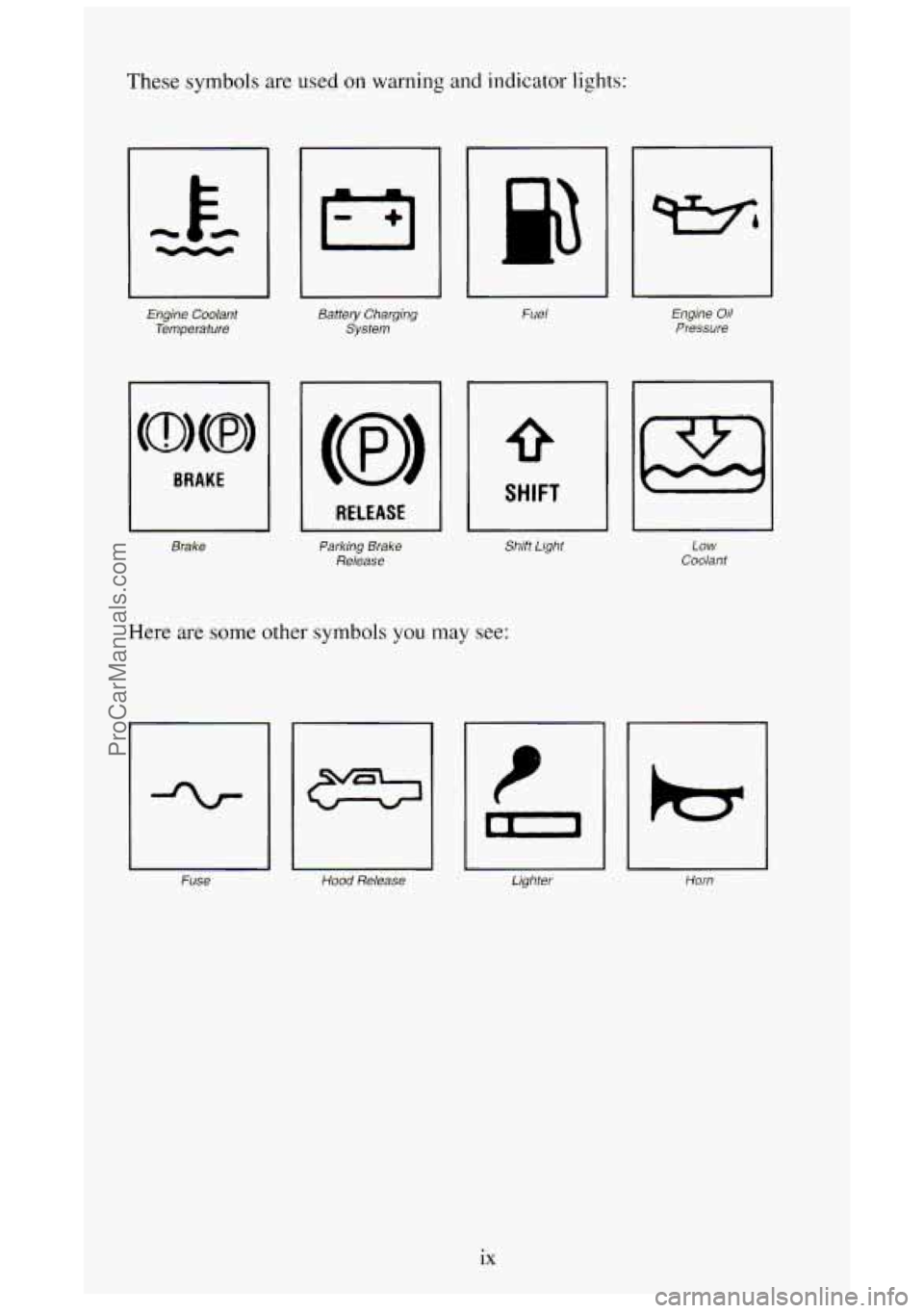
These symbols are used on warning and indicator lights:
Engine Coolant
Temperature Battery Charging
System
I I RELEASE I
Brake Parking Brake
Release
0
SHIFT
Shift Light
Here are some other symbols you may see:
Fuse
Fuel
Hood Release Lighter
I
Engine Oil
Pressure
Low Coolant
I Horn
ix
ProCarManuals.com
Page 75 of 404
4. If the engine does not start after 15 seconds of cranking, turn the
ignition key to
OFF. Wait one minute for the starter to. cool, then try
the
same steps again.
If you’re trying
to start your engine after you’ve run out of fuel, follow the
steps in “Running Out of Fuel” (see “Diesel Fuel Requirements and Fuel
System” in the Index).
When your engine
is cold, let it run for a few minutes before you move your
vehicle. This lets oil pressure build up. Your engine will sound louder
when
it’s cold.
I NOTICE:
If you’re not in an idling vehicle and the engine overheats, you
wouldn’t be there to see the coolant temperature gage. This \
could damage your vehicle. Don’t let your engine run when
you’re not
in your vehicle.
Cold Weather Starting (Diesel Engine)
The following tips will help you get good starting in cold weather.
Use
SAE 1OW-30 oil when the outside temperature drops below freezing.
When the outside temperature drops below
0°F (- 1 SOC), use your engine
coolant heater.
If you park your vehicle
in a garage, you shouldn’t need to use the coolant
heater
until the garage temperature goes below 0°F (-18OC), no matter how
cold it is outside.
To use the engine coolant heater, first turn off the engine. Then open the
hood, unwrap the electrical cord and plug it in. It uses normal house voltage
(I 10 volts), but:
2-17
ProCarManuals.com
Page 133 of 404
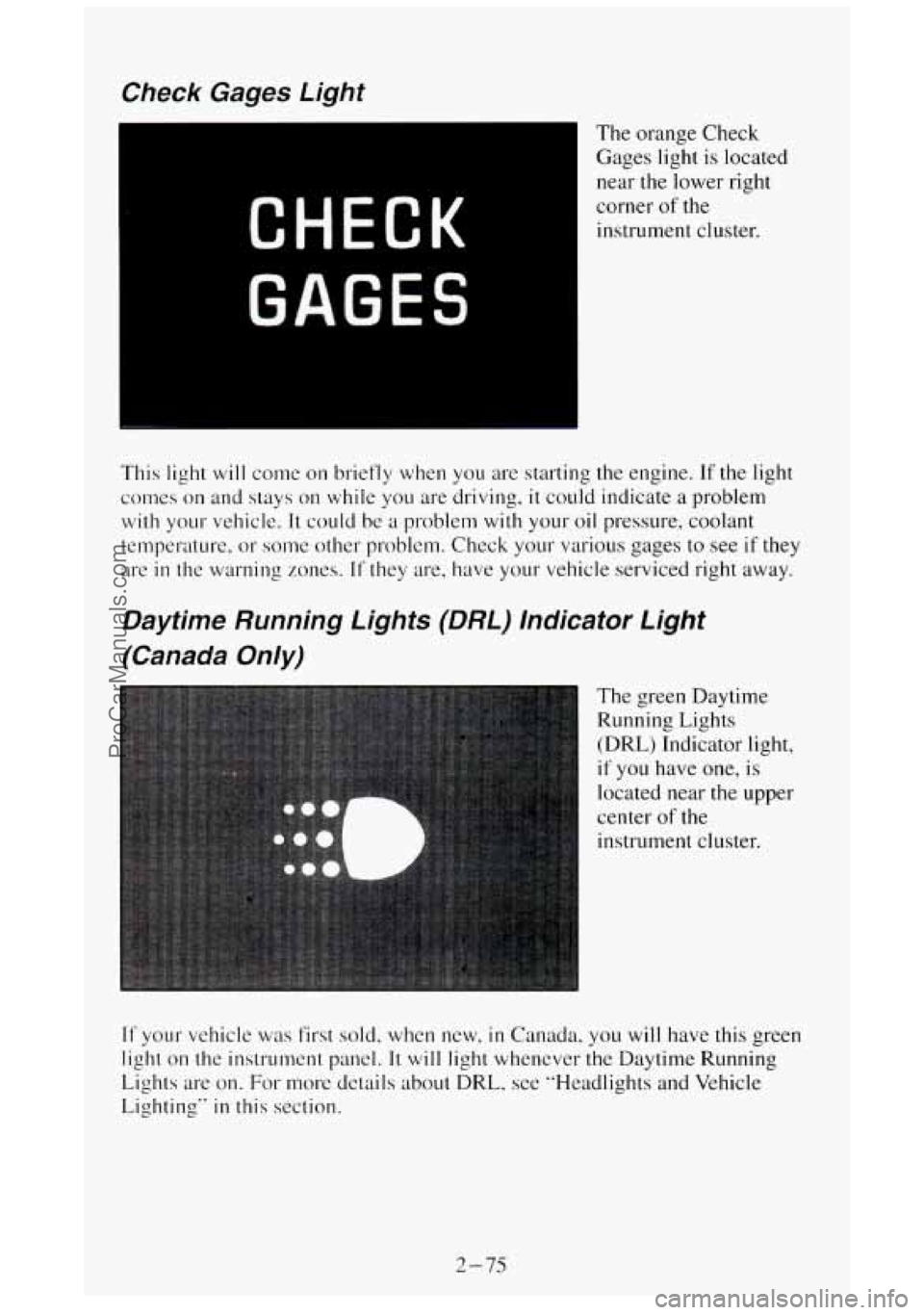
Check Gages Light
The orange Check
Gages light is located
near the lower right
corner
of the
instrument cluster.
This light
will come on briefly when you are starting the engine. If the light
comes
on and stays on while you are driving. it could indicate a problem
with your vehicle. It could be a problem with your oil pressure, coolant
temperature. or some other problem. Chcck your various gages
to see if they
are
in the warning zones. If they are, have your vehicle serviced right away.
Daytime Running Lights (DRL) Indicator Light
(Canada Only)
The green Daytime
Running Lights
(DRL) Indicator light,
if you have one, is
located near the upper
center
of the
instrument cluster.
If your vehicle was first sold. when new. in Canada, you will have this green
lighl on the instrument pancl.
It will light whenever the Daytime Running
Lights
are on. For more details about DRL, sce "Headlights and Vehicle
Lighting'.
in this section.
2-75
ProCarManuals.com
Page 138 of 404
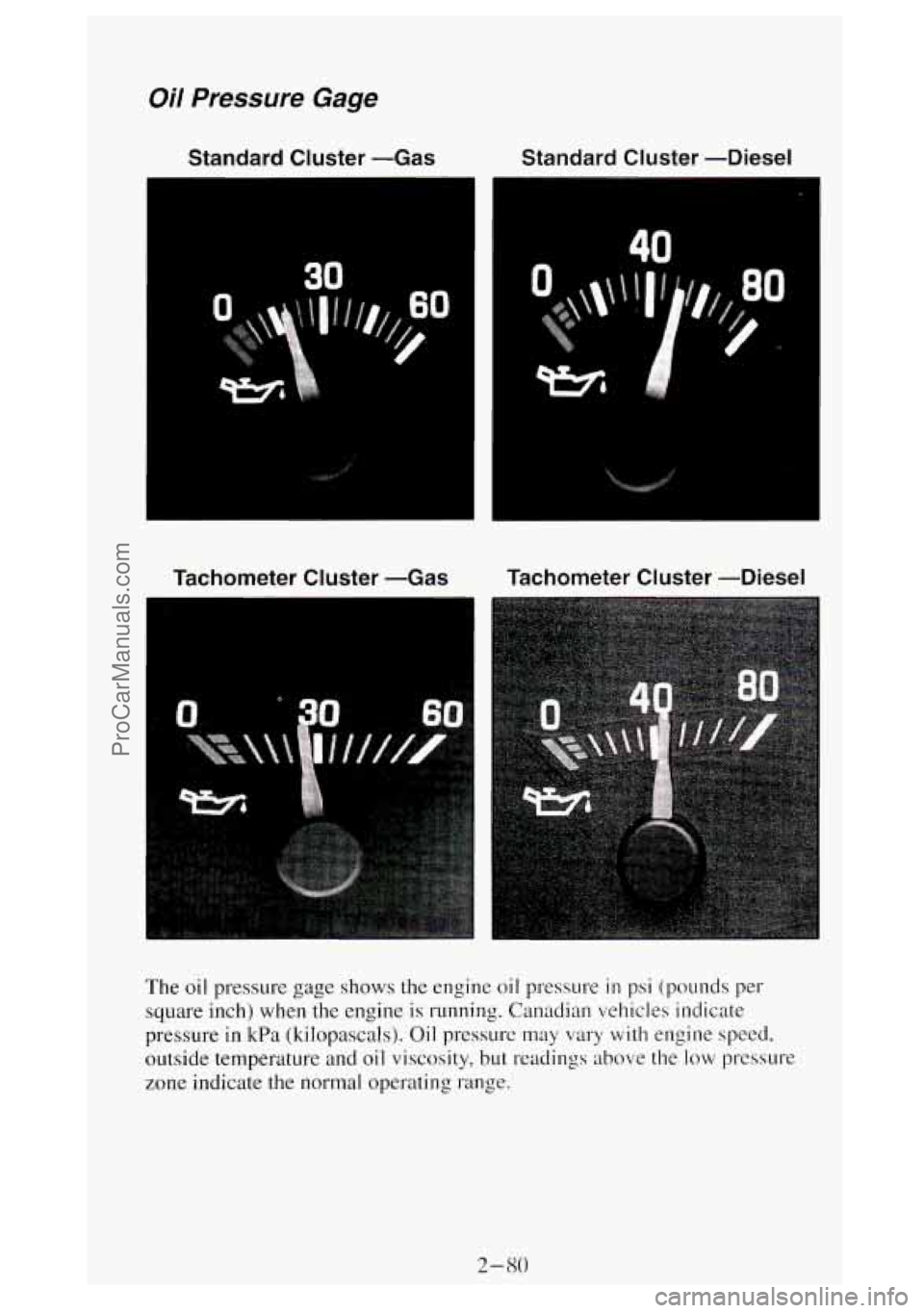
Oil Pressure Gage
Standard Cluster -Gas Standard Cluster -Diesel
30
I
Tachometer Cluster -Gas Tachometer Cluster -Diesel
The oil pressure gage shows the engine oil pressure in psi (pounds per
square inch) when the engine
is running. Canadian vehicles indicate
pressure
in kPa (kilopascals). Oil pressure may vary with engine speed,
outside temperature and
oil viscosity, but readings above the low pressure
zone indicate the normal operating range.
2- 80
ProCarManuals.com
Page 207 of 404
Driving On Grades
Reduce speed and shift to a lower gear before you start down a long or
steep downgrade.
If you don’t shift down, you might have to use your
brakes
so much that they would get hot and no longer work well.
On a long uphill grade, shift down and reduce your speed to around
45 mph
(70 km/h) to reduce the possibility of engine and transmission overheating.
When towing at high altitude with steep uphill grades,you need to consider
the following information. The lower atmospheric pressure at high altitude
allows your vehicles engine coolant to boil at a lower temperature than at
normal altitudes.
If you immediately turn your engine off after towing at high altitude with
steep uphill grades, your vehicle may show signs similar
to engine
overheating.
To avoid this, let your vehicle operate in a parked position with
the transmission in
“N” (Neutral) for a few minutes before you turn off the
engine. If you do get the overheat warning, see “Engine Overheating” in
the Index.
If you have an automatic transmission, you should use
“D” (or, as you need
to, a lower gear) when towing a trailer. Operating your vehicle in
“D” when
towing a trailer will minimize heat buildup and extend the life
of your
transmission.
If you have a manual transmission and
you are towing a trailer, it’s better
not to use fifth gear. Just drive in fourth gear (or, as you need to, a lower
gear).
Parking on Hills
You really should not park your vehicle, with a trailer attached, on a hill. If
something goes wrong, your rig could start
to move. People can be injured,
and both your vehicle and the trailer can be damaged.
But if you ever have to park your rig on a hill, here’s how
to do it:
1.
2.
3.
4.
5.
6.
Apply your regular brakes, but don’t shift into “P’ (Park) yet, or in gear
for a manual transmission.
Have someone place chocks under the trailer wheels.
When the wheel chocks are in place, release the regular brakes until the
chocks absorb
the load.
Re-apply the regular brakes. Then apply your parking brake, and then
shift to
“P7, (Park), or “R” (Reverse) for a manual transmission.
If
you have a four-wheel-drive vehicle, be sure the transfer case is in a
drive gear-not in
“N7 (Neutral).
Release
the regular brakes.
4-43
ProCarManuals.com
Page 257 of 404
Cold Weather Operation
In cold weather (below 20”F, or -7”C), use 1-D or “Winterized” Number
2-D fuel (a blend of I-D and 2-D). Be sure you get the right fuel. In very
cold temperatures (when
it stays below 0°F or -1 8OC), use Number 1-D.
If you’re driving in very cold temperatures and can’t get Number I-D or a
“winterized” Number
2-D, you can use one gallon of kerosene for every
two gallons
of diesel fuel. Once you add the kerosene, run your engine for
several minutes
so the fuels will mix. Add kerosene only when the
temperature falls below
0°F (-1 8” C), because the fuel economy of kerosene
isn’t
as good as that of diesel fuel.
NOTICE:
Never use home heating oil or gasoline in your diesel engine.
They can cause engine damage.
In cold weather, your fuel filter may become clogged (waxed), especially if
you use Number
2-D diesel fuel that hasn’t been “winterized.” To unclog it,
warm the filter to between 32°F and 50°F (0°C to 10°C). You won’t need
to replace
it.
Water in Fuel
Sometimes, water can be pumped into your fuel tank along with your diesel
fuel. This can happen
if a service station doesn’t regularly inspect and clean
its
fuel tanks, or if it gets contaminated fuel from its suppliers.
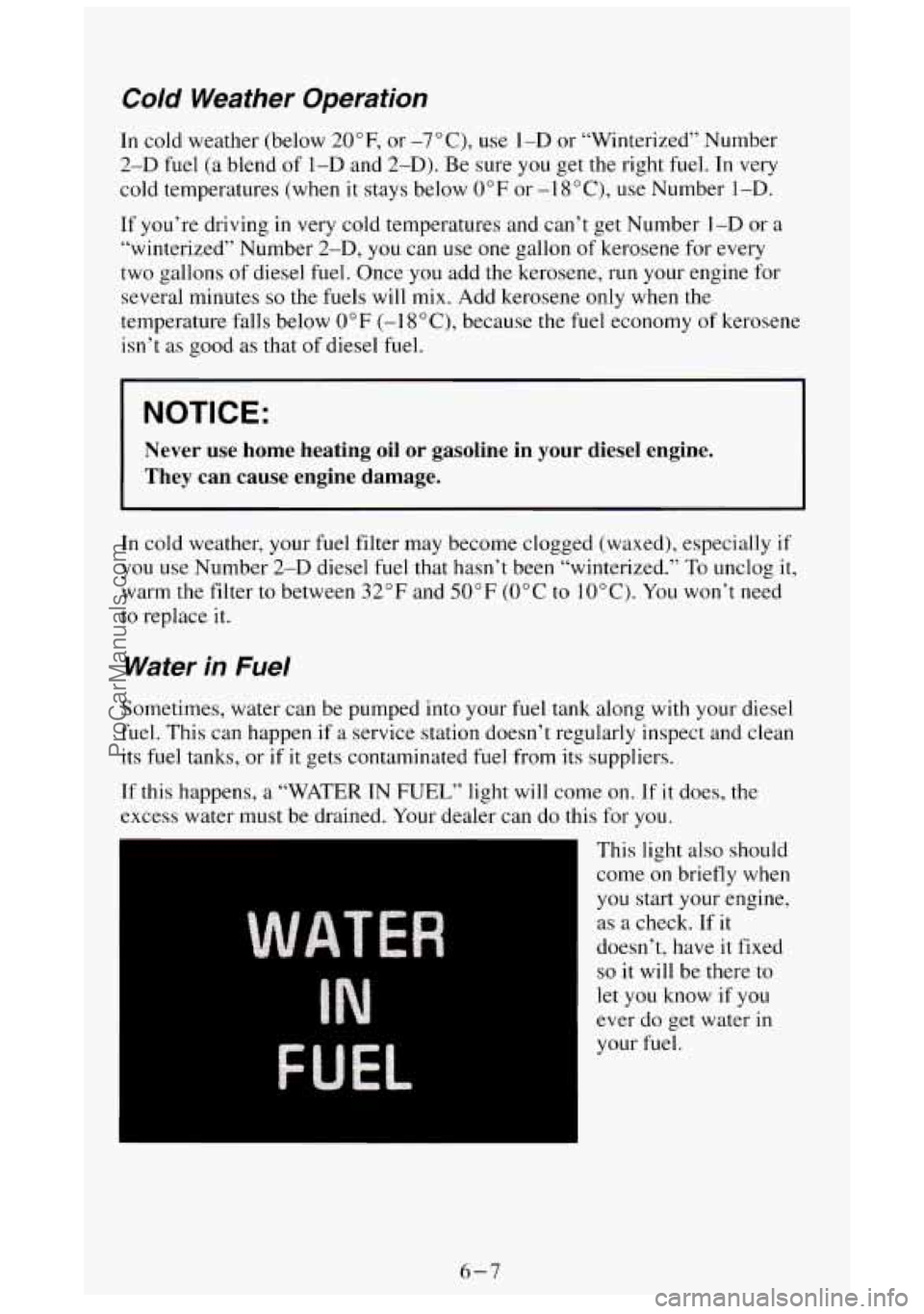
If this happens,
a “WATER IN FUEL” light will come on. If it does, the
excess water must be drained. Your dealer can do this
for you.
This light also should
come on briefly when
you start your engine,
as a check. If it
doesn’t, have it fixed
so it will be there to
let you know if you
ever
do get water in
your fuel.
L
6-7
ProCarManuals.com
Page 270 of 404
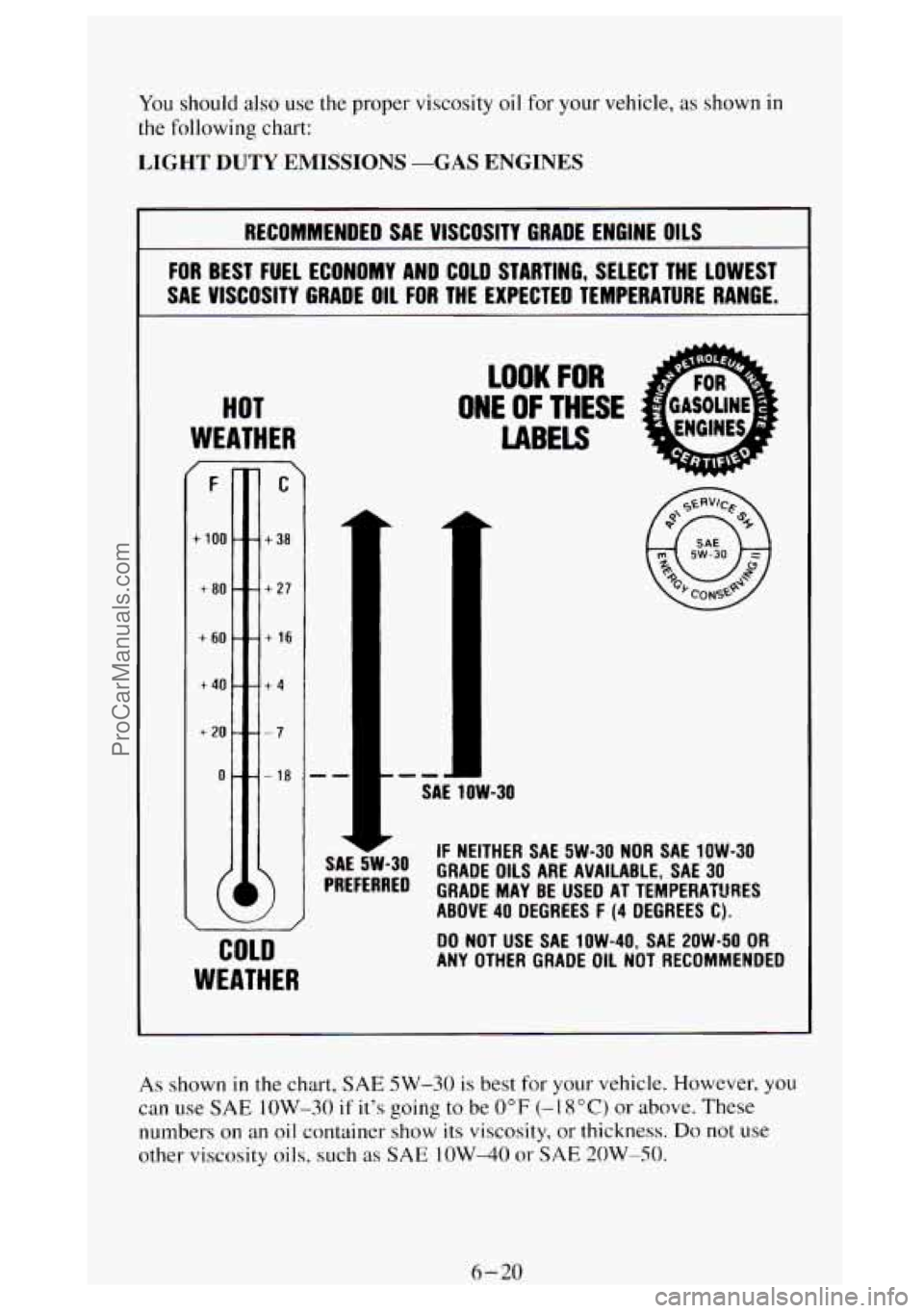
You should also use the proper viscosity oil for your vehicle, as shown in
the following chart:
LIGHT DUTY EMISSIONS -GAS ENGINES
RECOMMENDED SAE VISCOSITY GRADE ENGINE OILS
FOR BEST FUEL ECONOMY AND COLD STARTING, SELECT THE LOWEST
SAE VISCOSITY GRADE OIL
FOR THE EXPECTED TEMPERATURE RANGE.
HOT
WEATHER
F
tlOO -
+80 -
+60 -
+40 -
+20 -
0-
C
t 38
t 27
t 16
t4
-7
- 18
m LOOK
ONE OF THESE
LABELS
-- -1 -I SAE 1OW-30
IF NEITHER SAE 5W-30 NOR SAE 1OW-30
5w-30 GRADE OILS ARE AVAILABLE, SAE 30
PREFERRED GRADE MAY BE USED AT TEMPERATURES
ABOVE
40 DEGREES F (4 DEGREES C).
DO NOT USE SAE 1OW-40, SAE 2OW-50 OR
ANY OTHER GRADE OIL NOT RECOMMENDED
As shown in the chart, SAE SW-30 is best for your vehicle. However, you
can use SAE 1OW-30 if it’s going to be 0°F (-1 8°C) or above. These
numbers on an
oil container show its viscosity, or thickness. Do not use
other viscosity oils, such as SAE lOW-40 or SAE 20W-50.
6-20
ProCarManuals.com
Page 271 of 404
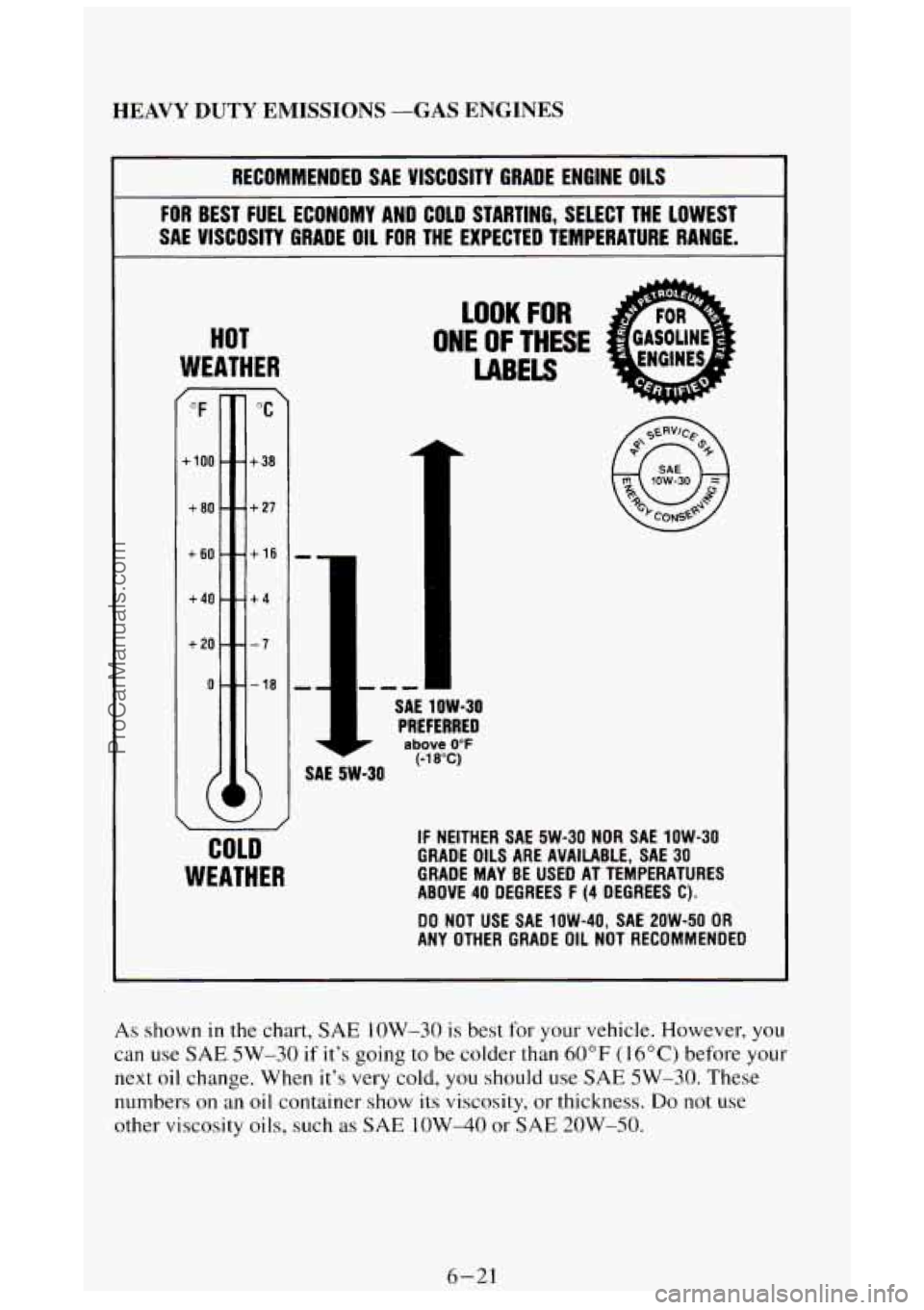
HEAVY DUTY EMISSIONS -GAS ENGINES
RECOMMENDED SAE VISCOSITY GRADE ENGINE OILS
FOR BEST FUEL ECONOMY AND COLD STARTING, SELECT THE LOWEST
SAE VISCOSITY GRADE OIL
FOR THE EXPECTED TEMPERATURE RANGE.
HOT
WEATHER
m
“F OC
+loo - - +3a
+80 - - +27
+60 --+16
+40--+4
+20---7
0 ---18
I SAE
COLD
WEATHER
LOOK FOR
ONE OF THESE
LABELS
SAE 1OW-30
PREFERRED
above 0°F (-1 SOC)
~ 5W-30
IF NEITHER SAE 5W-30 NOR SAE 1OW-30
GRADE OILS ARE AVAILABLE, SAE 30
GRADE MAY BE USED AT TEMPERATURES
ABOVE
40 DEGREES F (4 DEGREES C).
ANY OTHER GRADE
OIL NOT RECOMMENDED
DO NOT USE SAE 1OW-40, SAE 2OW-50 OR
As shown in the chart, SAE 1OW-30 is best for your vehicle. However, you
can use
SAE 5W-30 if it’s going to be colder than 60°F (16°C) before your
next
oil change. When it’s very cold, you should use SAE 5W-30. These
numbers on an oil container
show its viscosity, or thickness. Do not use
other viscosity oils, such as
SAE low40 or SAE 20W-50.
6-21
ProCarManuals.com
Page 277 of 404
DIESEL ENGINES
RECOMMENDHI SAE VISCOSITY GRADE ENGINE OILS
SELECT THE SAE GRADE OIL BASED ON
THE EXPECTED TEMPERATURE RANGE
BEFORE NEXT
OIL CHANGE
HOT
WEATHER
;F
k 100
+60 --+16
+32 -- 0
0 -- -18
-20 - -29
---I
---I SAE low*
SAE 15W-40
PREFERRED
above 0°F (- 18%)
830
I SAE r 30
COLD
WEATHER
DO NOT USE SAE 1OW-40, SAE 2OW-50 OR
ANY OTHER GRADE OIL NOT RECOMMENDED
SAE 15W-40
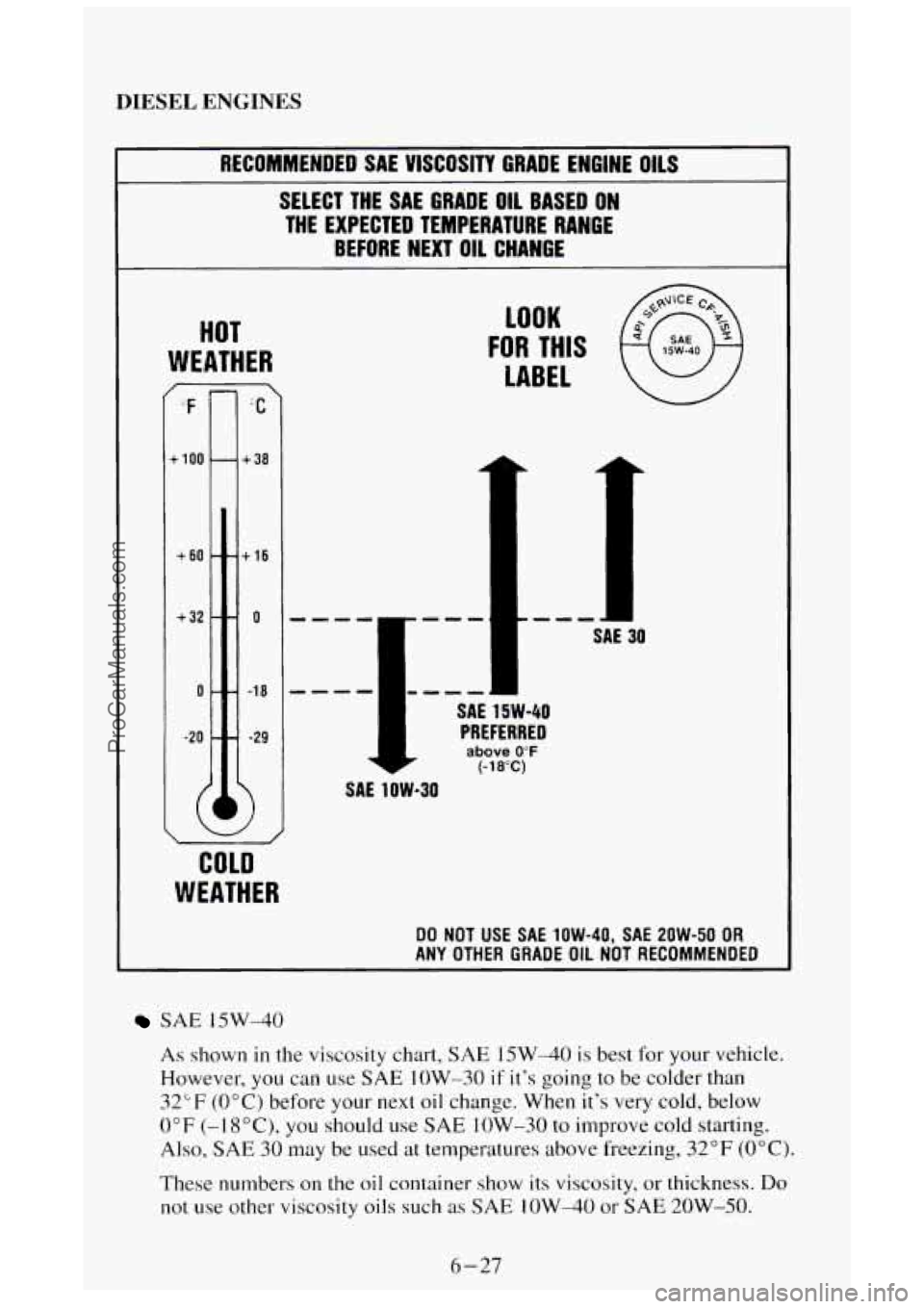
As shown in the viscosity chart, SAE 15W-40 is best for your vehicle.
However, you can use
SAE 1OW-30 if it’s going to be colder than
32°F (0°C) before your next oil change. When it’s very cold, below
0°F (-I 8OC), you should use SAE 1,0W-30 to improve cold starting.
Also, SAE 30 may be used at temperatures above freezing, 32°F (0°C).
These numbers on the oil container show its viscosity, or thickness. Do
not use other viscosity oils such as SAE 10W-40 or SAE 2OW-50.
4-27
ProCarManuals.com
Page 288 of 404
What to use
Refer to the Maintenance Schedule to determine what kind of lubricant to
use. See “Recommended Fluids and Lubricants”
in the Index.
Engine Coolant
The following explains your cooling system and how to add coolant when it
is low. If you have a problem with engine overheating, see “Engine
Overheating”
in the Index.
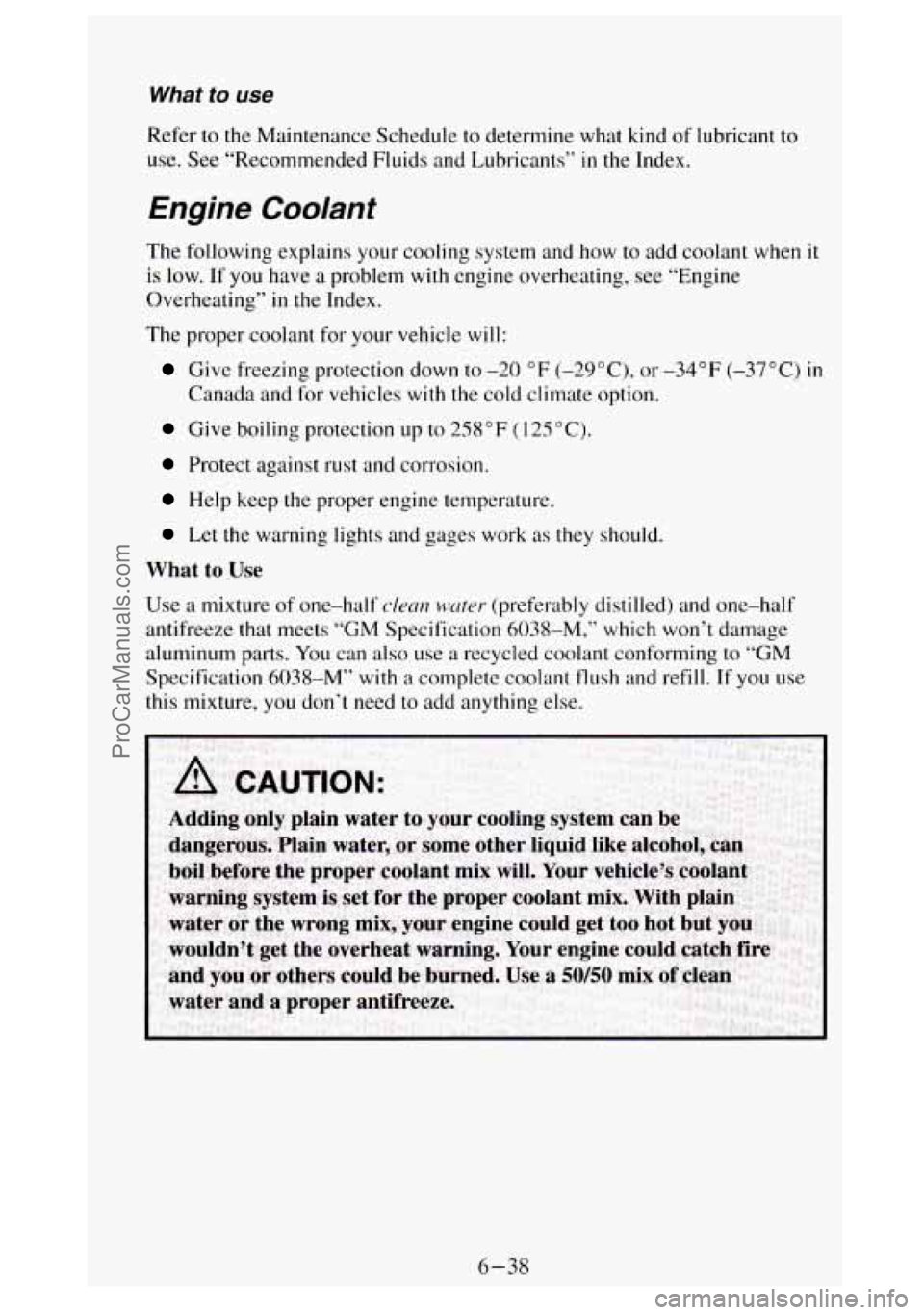
The proper coolant for your vehicle
will:
Give freezing protection down to -20 OF (-29”C), or -34°F (-37°C) in
Canada and for vehicles with the cold climate option.
Give boiling protection up to 258 OF ( 125 O C).
Protect against rust and corrosion.
Help keep the proper engine temperature.
Let the warning lights and gages work as they should.
What to Use
Use a mixture of one-half clean wuter (preferably distilled) and one-half
antifreeze that meets
“GM Specification 6038-M,” which won’t damage
aluminum parts.
You can also use a recycled coolant conforming to “GM
Specification 6038-M” with a complete coolant flush and refill. If you use
this mixture, you don’t need to add anything else.
6-38
ProCarManuals.com