radiator GMC SIERRA 1994 Owners Manual
[x] Cancel search | Manufacturer: GMC, Model Year: 1994, Model line: SIERRA, Model: GMC SIERRA 1994Pages: 404, PDF Size: 20.91 MB
Page 102 of 404
NOTICE:
0 When using concentrated washer fluid, follow the
manufacturer’s instructions for adding water.
Don’t mix water with ready-to-use washer fluid. Water can
cause the solution to freeze and damage your washer fluid
tank and other parts of the washer system.
Also, water
doesn’t clean as well as washer fluid.
Fill your washer fluid tank only 314 full when it’s very cold.
This allows for expansion, which could damage the tank if it is
completely full.
0 Don’t use radiator antifreeze in your windshield washer. It
can damage your washer system and paint.
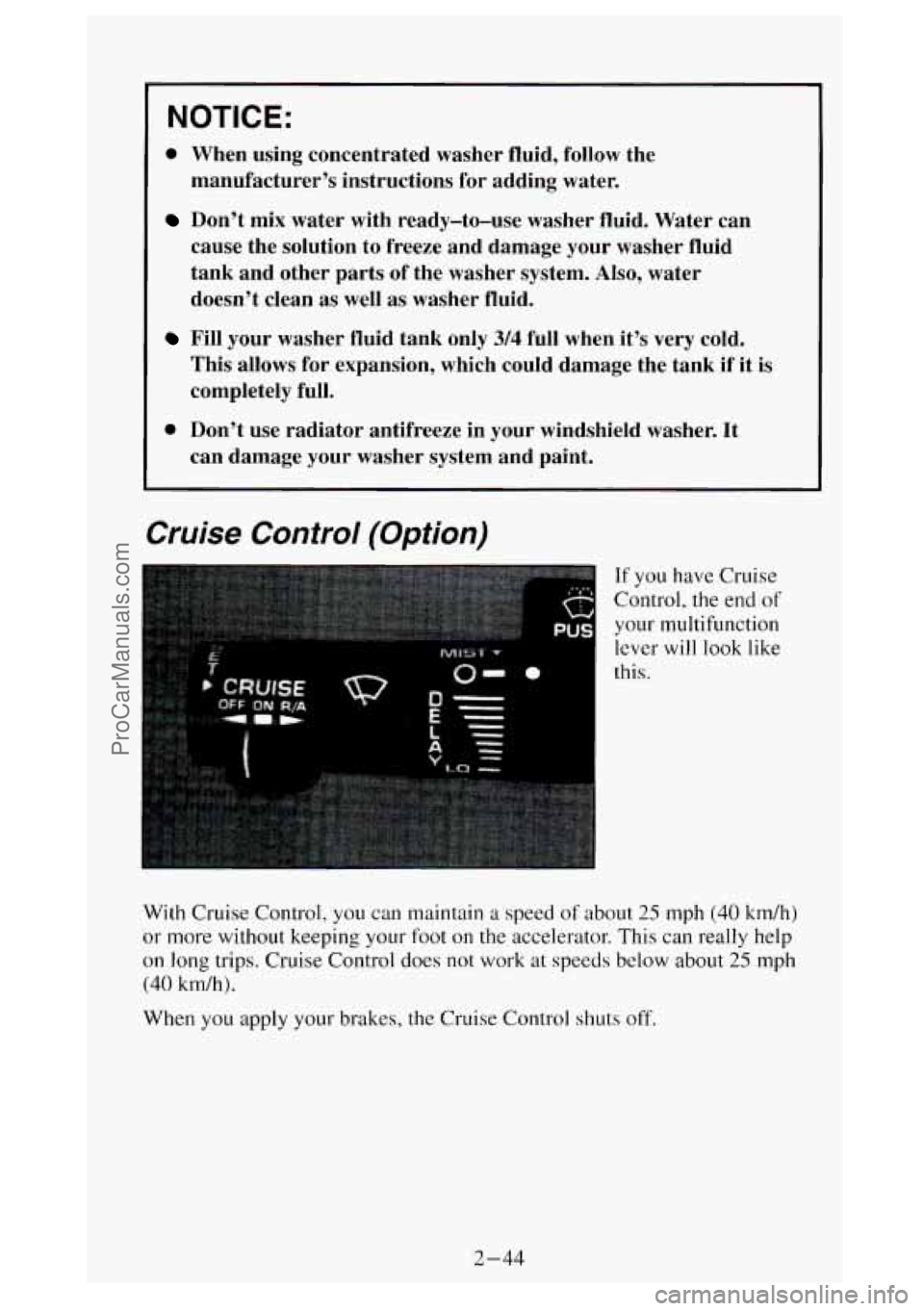
Cruise Control (Option)
If you have Cruise
Control,
the end of
your multifunction
lever
will look like
this.
With Cruise Control, you can maintain a speed
of about 25 mph (40 km/h)
or more without keeping your foot
on the accelerator. This can really help
on long trips. Cruise Control does not work at speeds below about 25 mph
(40 km/h).
When
you apply your brakes, the Cruise Control shuts off.
2-44
ProCarManuals.com
Page 221 of 404
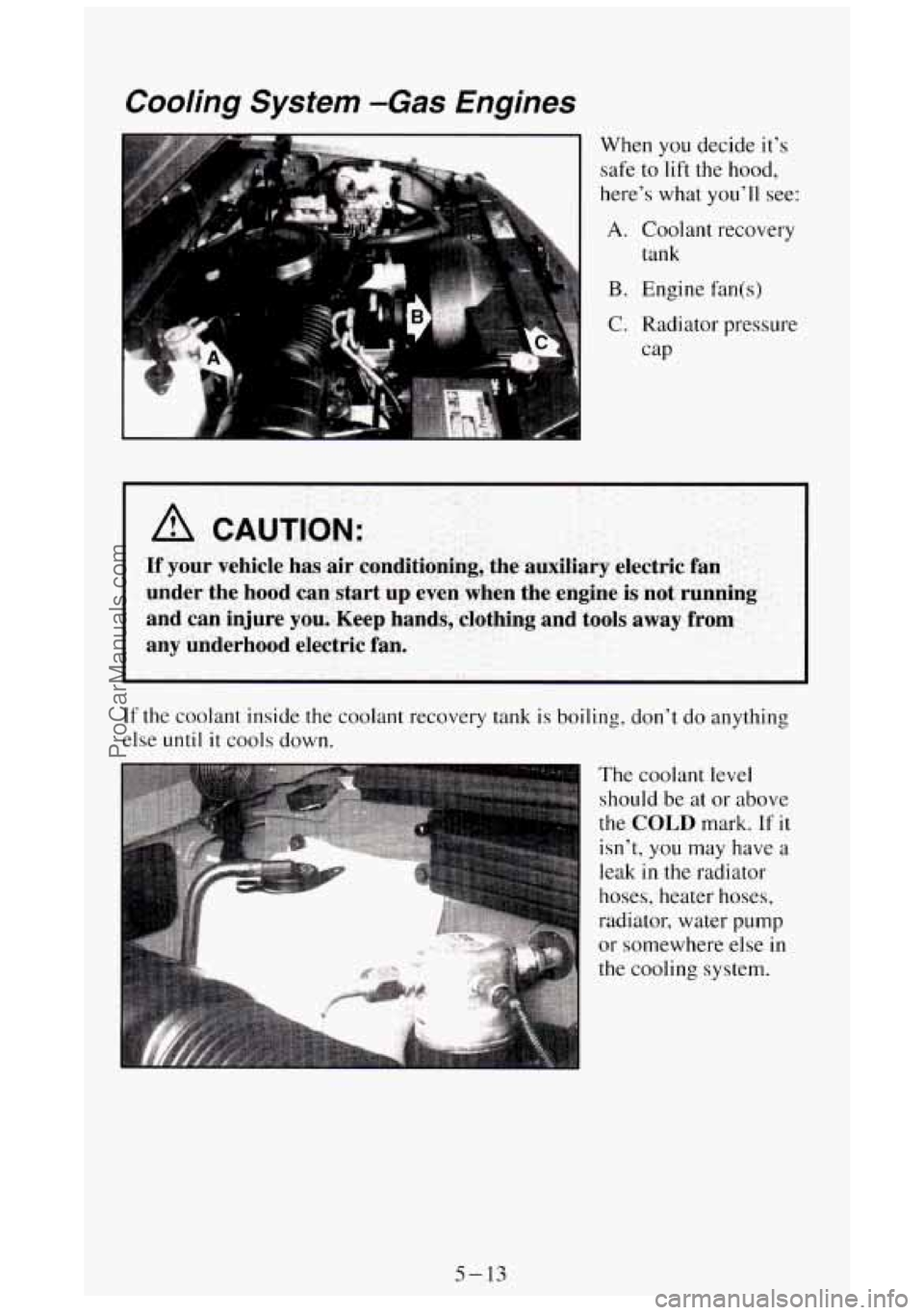
Cooling System -Gas Engines
When you decide it's
safe to lift the hood,
here's what you'll see:
A. Coolant recovery
tank
B. Engine fan(s)
C. Radiator pressure
cap
A CAUTION:
If your vehicle has air conditioning, the auxiliary electric fan
under the hood can start up even when
the engine is not running
and can injure you. Keep hands, clothing and tools away from
any underhood electric fan.
If the coolant inside the coolant recovery tank is boiling, don't do anything
else until it
cools down.
The coolant level
should be at or above
the
COLD mark. If it
isn't, you may have a
leak in the radiator
hoses, heater hoses,
radiator, water
pump
or somewhere else in
the cooling system.
5-13
ProCarManuals.com
Page 223 of 404

I NOTICE:
In cold weather, water can freeze and crack the engine, radiator, \
heater core and other parts. Use the recommended coolant.
When the coolant in the coolant recovery tank is at or above the COLD
mark, start your vehicle.
If the overheat warning continues, there’s one more thing you can try. You
can add the proper coolant mix directly to the radiator!, but be sure the
cooling system is cool before
you do it.
5-15
ProCarManuals.com
Page 225 of 404
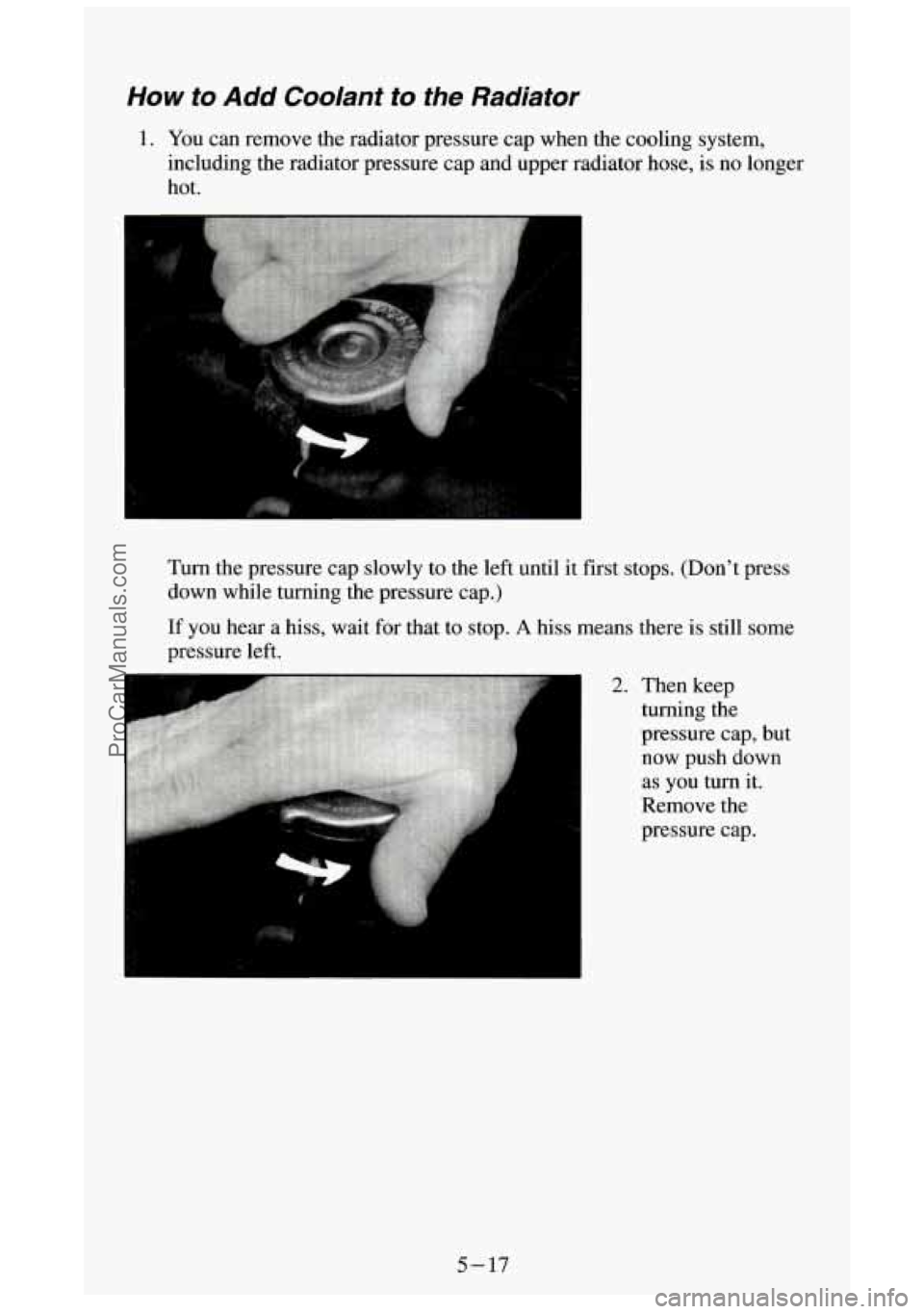
How to Add Coolant to the Radiator
1. You can remove the radiator pressure cap when the cooling system,
including the radiator pressure cap and upper radiator hose, is no longer
hot.
Turn the pressure cap slowly to the left until it first stops. (Don’t press
down while turning the pressure cap.)
If you hear a hiss, wait for that
to stop. A hiss means there is still some
pressure left.
I
r
5-17
ProCarManuals.com
Page 226 of 404
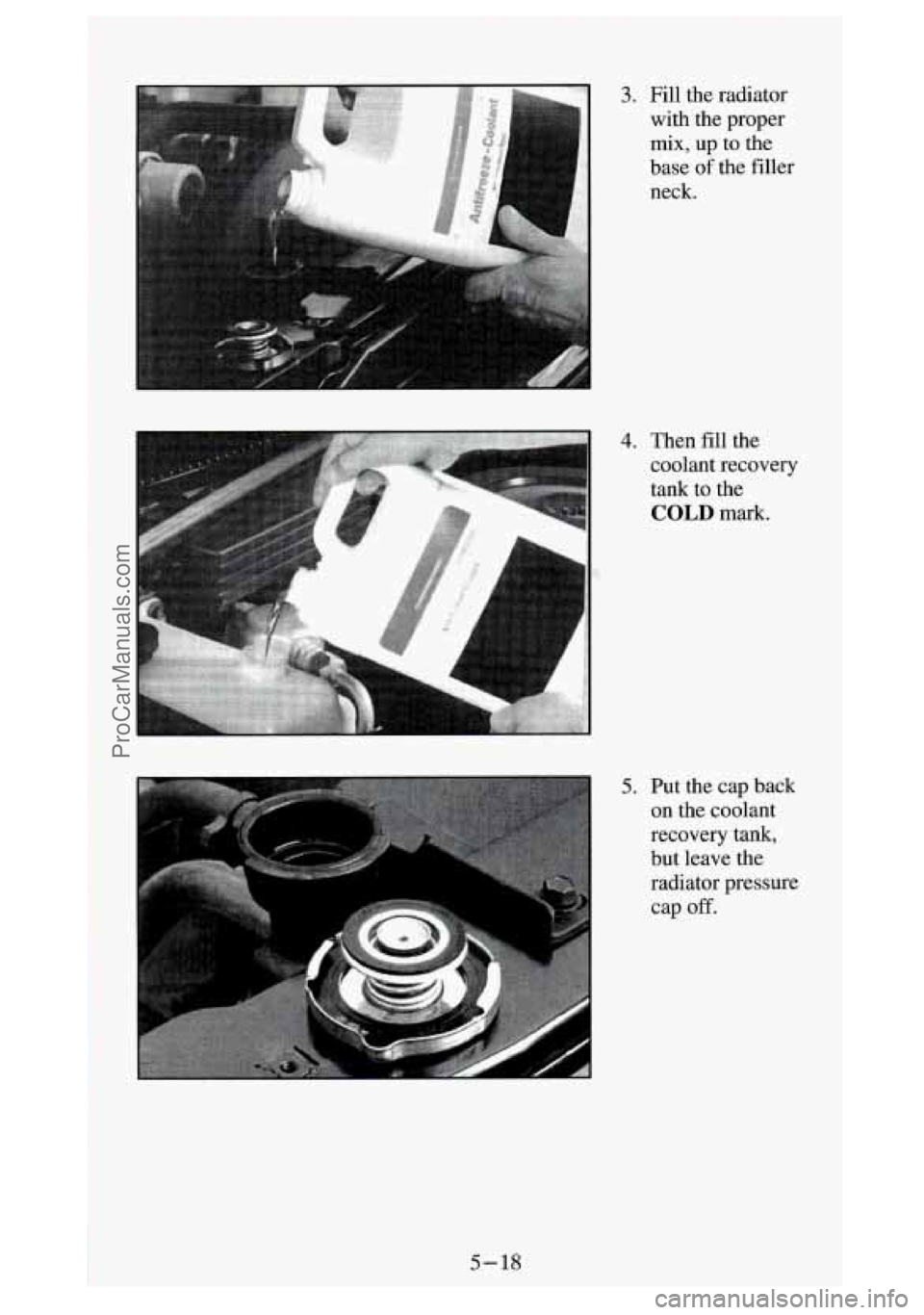
3. Fill the radiator
with the proper
mix, up to the
base
of the filler
neck.
4. Then fill the
coolant recovery
tank
to the
COLD mark.
5. Put the cap back
on the coolant
recovery tank,
but leave the
radiator pressure cap
off.
ProCarManuals.com
Page 227 of 404
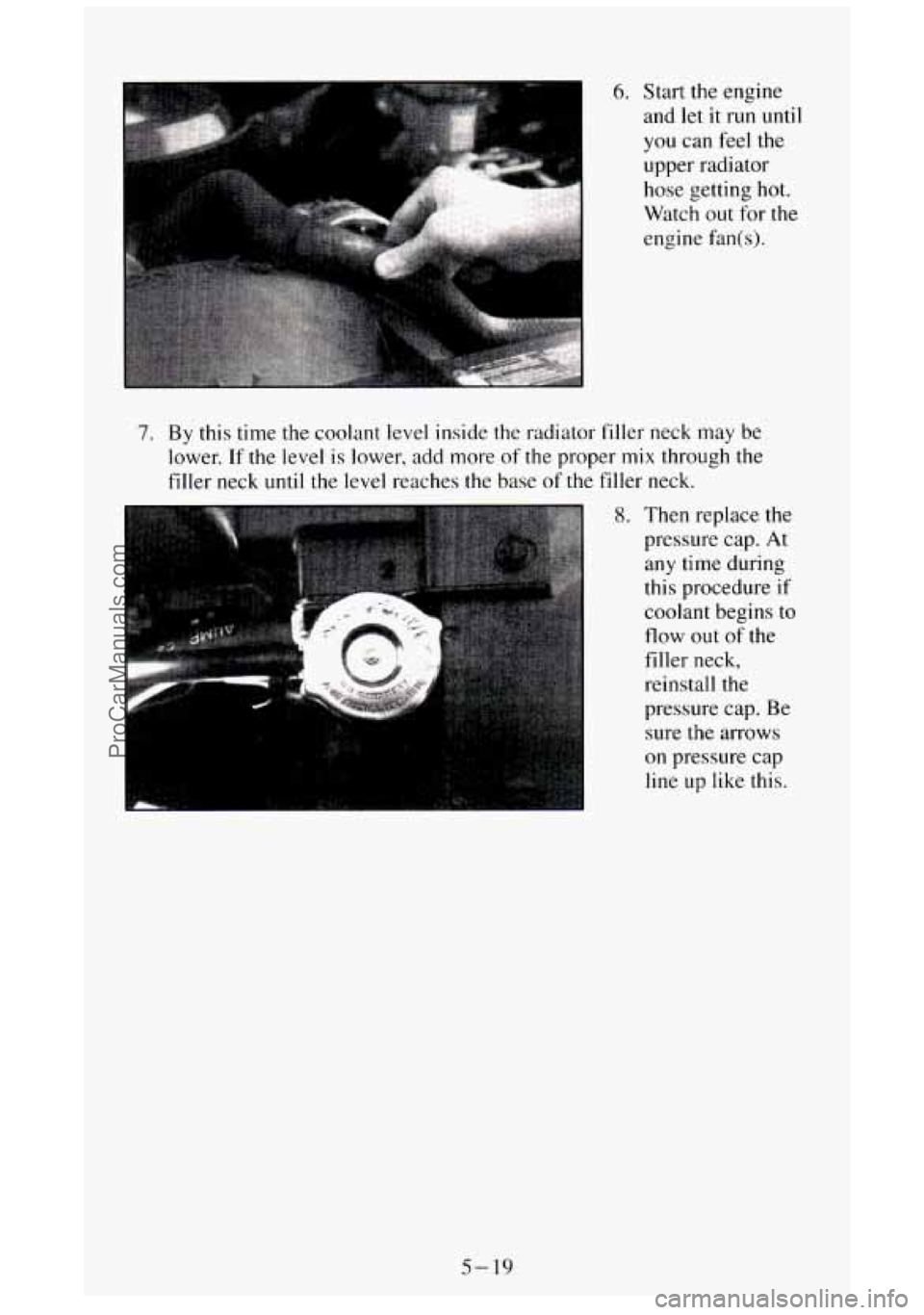
I 6. Start the engine
and let it run
until
you can feel the
upper radiator
hose getting hot.
Watch out for
the
engine fan(s).
7. By this time the coolant level inside the radiator filler neck may be
lower.
If the level is lower, add more of the proper mix through the
filler neck until the level reaches the hase
of the filler neck.
8. Then replace the
pressure cap. At
any time during
this procedure
if
coolant begins to
flow out of the
filler neck,
reinstall the
pressure cap. Be
sure the arrows
on pressure cap
line up like this.
5-19
ProCarManuals.com
Page 228 of 404

A CAUTION:
If your vehicle has air conditioning, the auxiliary electric fa\
n
under the hood can start up even when the engine
is not running
and can injure you. Keep hands, clothing and tools away
from
any underhood electric fan.
If the coolant inside the coolant surge tank is boiling, don’t do anything else
until it cools down.
E The coolant level
should be slightly
above the
COLD
mark. If it isn’t, you
may have a leak in the
radiator hoses, heater
hoses, radiator, water
pump or somewhere
else
in the cooling
system.
5-20
ProCarManuals.com
Page 230 of 404

... . . , .. ..,. ~.
NOTICE:
In cold weather, water can freeze and crack the engine, radiator, \
heater
core and other parts. So use the recommended coolant.
5 -22
ProCarManuals.com
Page 231 of 404

1. You can remove the coolant surge tank pressure cap when the coolin\
g
system, including the coolant surge tank pressure cap and upper\
radiator hose, is no longer hot.
I
Turn the pressure cap slowly to the left until it first stops. (Don't press
down while turning the pressure cap.)
If you hear a hiss, wait for that to stop. A hiss means there is still some
pressure left.
2. Then keep
turning the cap,
but now push down as
you turn
it. Remove the
pressure cap.
5-23
ProCarManuals.com
Page 232 of 404
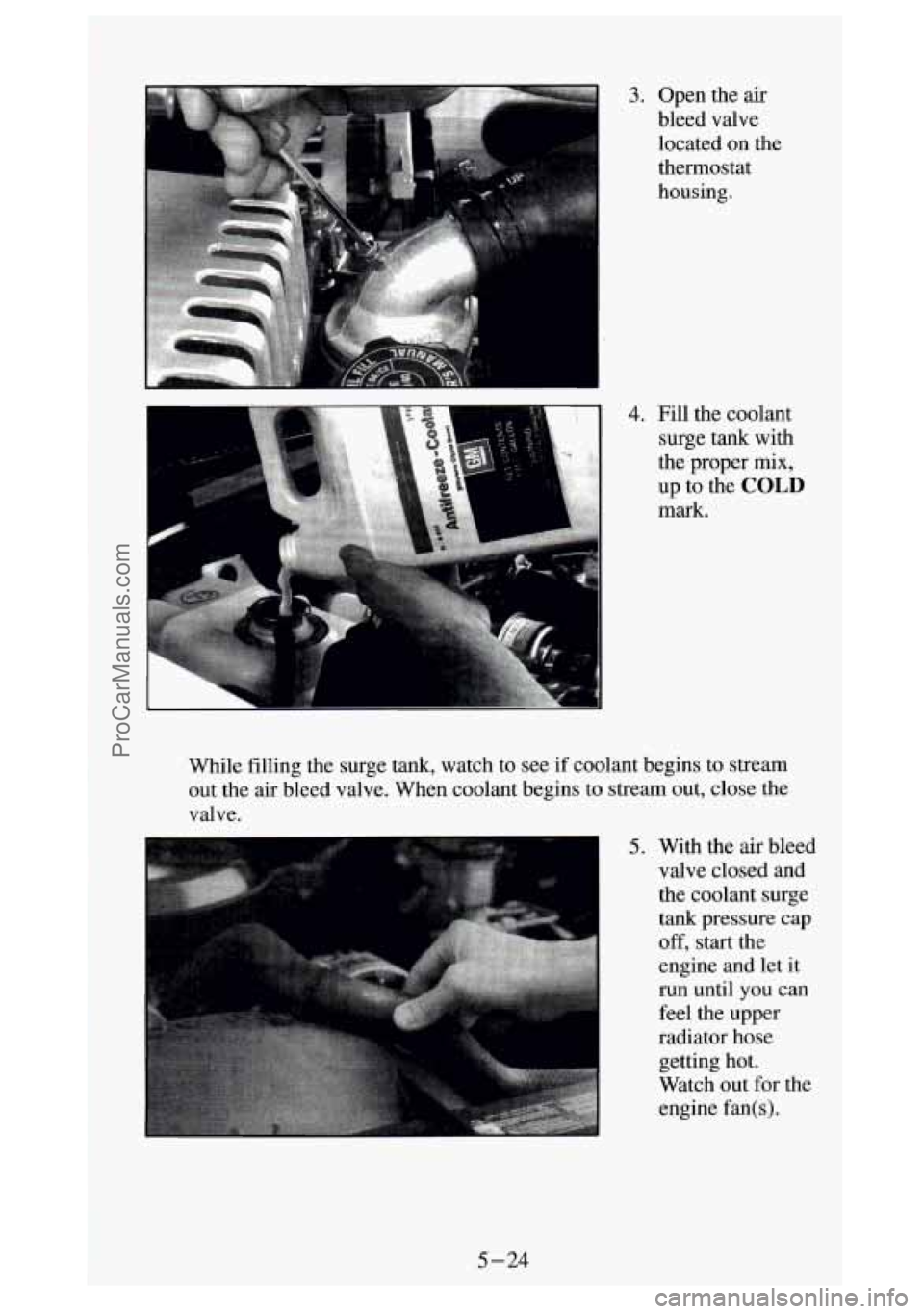
3. Open the air
bleed valve
located on the
thermostat
housing.
4. Fill the coolant
surge tank with
the proper mix,
up to the
COLD
mark.
While filling the surge tank, watch to see
if coolant begins to stream
out the air bleed valve. When coolant begins to stream out, close the
valve.
>. _:
5. With the air bleed
valve closed and
the coolant surge
tank pressure cap
off, start the
engine and let it
run until
you can
feel the upper
radiator hose getting hot.
Watch out for the
engine fan(s).
5-24
ProCarManuals.com