brake GMC SIERRA 1995 User Guide
[x] Cancel search | Manufacturer: GMC, Model Year: 1995, Model line: SIERRA, Model: GMC SIERRA 1995Pages: 488, PDF Size: 26.01 MB
Page 90 of 488
NOTICE:
Driving with the parking brake on can cause your rear brakes to
overheat. You may have to replace them, and you could also
damage other parts of your vehicle. Always check to be sure
your parking brake is fully released before you drive.
If you are towing a trailer and are parking on any hill: See “Towing a
Trailer” in the Index. That section shows what to do first to keep the trailer
from moving.
Propshaft Brake Burnish Procedure
If you have a 3500 HD model, it is recommended that the propshaft mounted
parking brake be burnished
as part of the new vehicle break in. The parking
brake will work best after
it has been burnished following these instructions.
Make
10 (ten) stops, using the parking brake foot pedal, from 20 mph (32
km/h) about
2 1/2 miles (4 km) apart. In between stops, drive the vehicle at
20 mph (32 km/h).
Torque Lock
When parking, the weight of the vehicle may put too much force on the
parking pawl
in the transmission. It may be difficult to pull the selector
lever out of
PARK (P). This is called ”torque lock.” To find out how to
avoid torque lock, see “Torque Lock” later in this section.
Shifting lnto PARK (P) (Automatic
Transmission Models Only)
2-28
ProCarManuals.com
Page 91 of 488
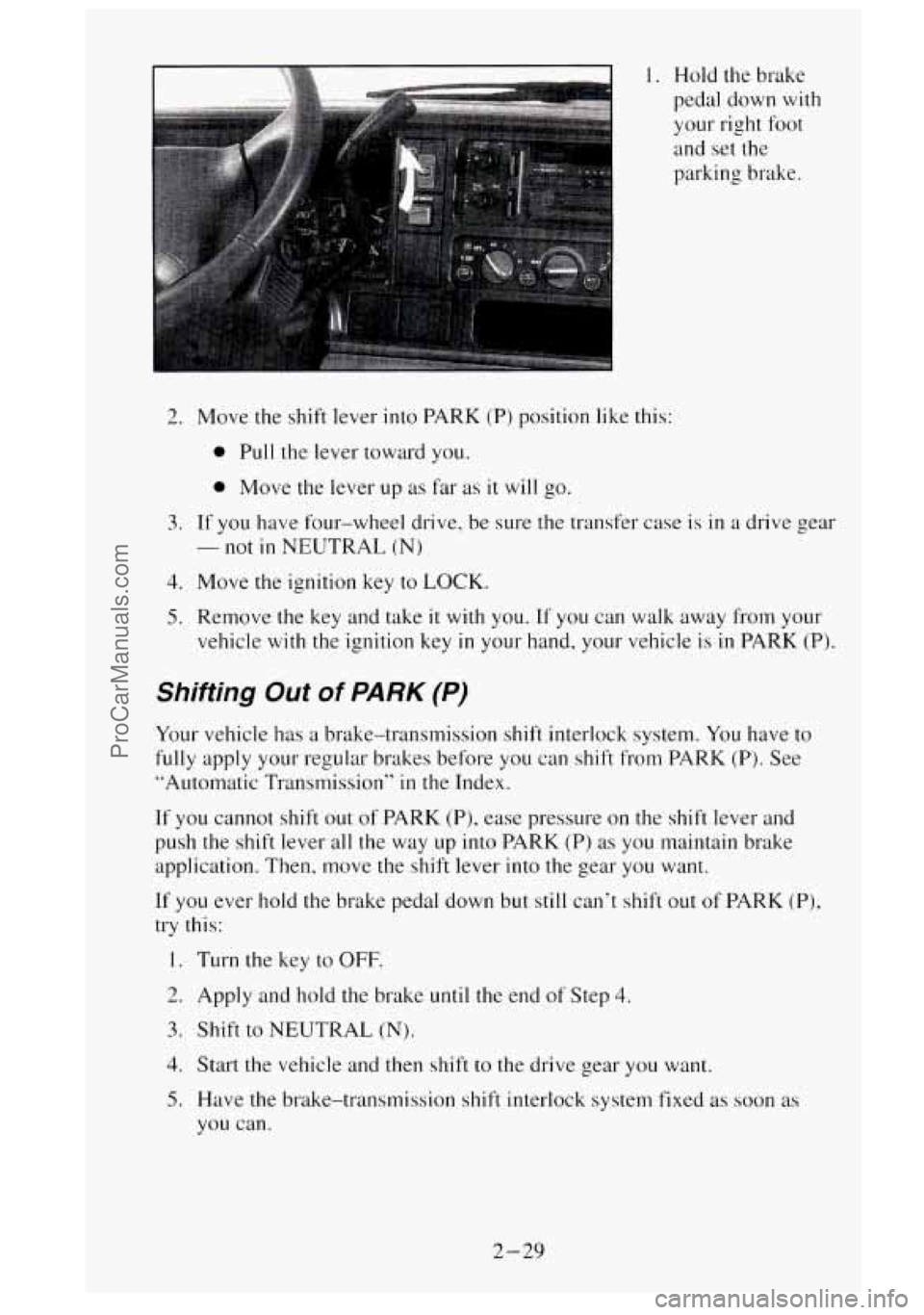
I. Hold the brake
pedal down
with
your right foot
and set the
parking brake.
2. Move the shift lever into PARK (P) position like this:
0 Pull the lever toward you.
0 Move the lever up as far as it will go.
3. If you have four-wheel drive, be sure the transfer case is in a drive gear
- not in NEUTRAL (N)
4. Move the ignition key to LOCK.
5. Remove the key and take it with you. If you can walk away from your
vehicle
with the ignition key in your hand, your vehicle is in PARK (P).
Shifting Out of PARK (P)
Your vehicle has a brake-transmission shift interlock system. You have to
fully apply your regular brakes before you can shift from PARK (P). See
“Automatic Transmission”
in the Index.
If you cannot shift out of PARK (P), ease pressure on the shift lever and
push the shift lever all the way up into PARK (P) as you maintain brake
application. Then, move the shift lever into the gear you want.
If you ever hold the brake pedal down but still can’t shift out of PARK (P),
try this:
1. Turn the key to OFF.
2. Apply and hold the brake until the end of Step 4.
3. Shift to NEUTRAL (N).
3. Start the vehicle and then shift to the drive gear you want.
5. Have the brake-transmission shift interlock system fixed as soon as
you can.
2-29
ProCarManuals.com
Page 92 of 488
Leaving Your Vehicle With the Engine Running
(Automatic Transmission Models
Only)
A CAUTION:
It can be dangerous to leave your vehicle with the engine
running. Your vehicle could move suddenly if the shift lever
is
not fully in PARK (P) with the parking brake firmly set. If you
have four-wheel drive with a manual transfer case shift lever
and your transfer case is in
NEUTRAL (N), your vehicle will be
free to roll, even if your shift lever is in PARK
(P). So be sure the
transfer case
is in a drive gear - not in NEUTRAL (N). And, if
you leave the vehicle with the engine running, it could overheat
and even catch fire.
You or others could be injured. Don’t leave
your vehicle with the engine running unless you have to.
If you have to leave your vehicle with the engine running, be sure your
vehicle is in PARK (P) and your parking brake is firmly set before you leave
it. After you’ve moved the shift lever into the PARK (P) position, hold the
regular brake pedal down. Then. see
if you can move the shift lever away
from PARK (P) without first pulling
it toward you.
If
you can, it means that the shift lever wasn’t fully locked into PARK (P).
Torque Lock (Automatic Transmission)
If you are parking on a hill and you don’t shift your transmission into PARK
(P) properly, the weight of the vehicle may put too much force on the
parking pawl in the transmission.
You may find it difficult to pull the shift
lever out of PARK (P). This is called “torque lock.” To prevent torque lock,
set the parking brake and then shift into PARK (P) properly before you
leave the driver’s seat.
To find out how, see “Shifting Into PARK (P)” in the
Index.
When you are ready to drive, move the shift lever out
of PARK (P) before
you release the parking brake.
If “torque lock” does occur, you may need to have another vehicle push
yours
a little uphill to take some of the pressure from the transmission, so
you can pull the shift lever out of PARK (P).
2-30
ProCarManuals.com
Page 93 of 488
Parking Your Vehicle (Manual Transmission
Models Only)
Before you get out of your vehicle, put your manual transmission in
REVERSE (R), turn off the engine, and firmly apply the parking brake.
If you have four-wheel drive, be sure your transfer case is in a drive gear.
Your vehicle could roll if it isn't.
If you are parking on
a hill, or if your pulling a trailer, see "Parking on
Hills" or '"Towing a Trailer" in the Index.
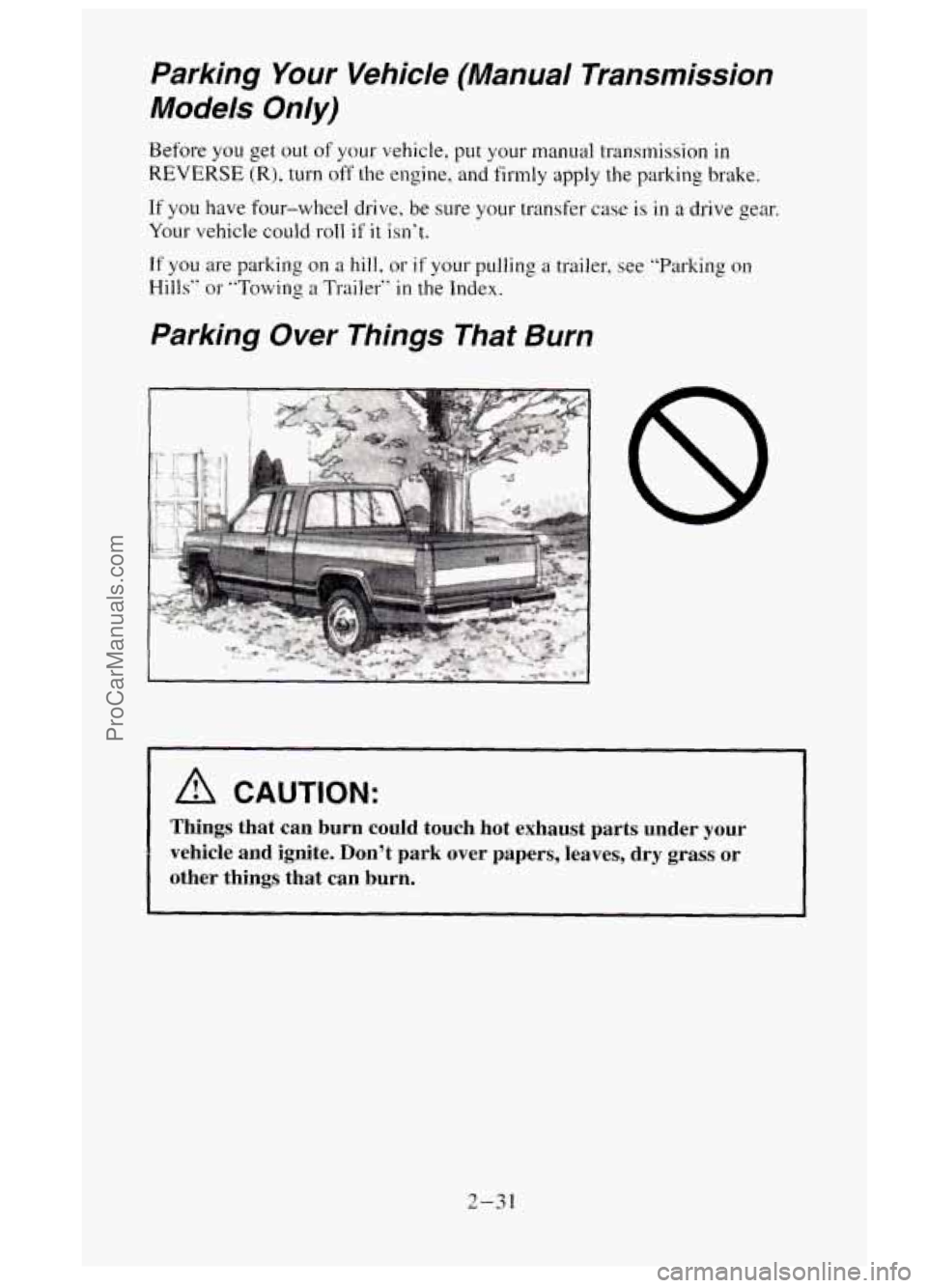
Parking Over Things That Burn
1 A CAUTION:
Things that can burn could touch hot exhaust parts under your \
vehicle and ignite. Don't park over papers, leaves, dry grass
or
other things that can burn.
2-31
ProCarManuals.com
Page 95 of 488
A CAUTION:
Idling the engine with the air system control off could allow
dangerous exhaust into your vehicle (see the earlier Caution
under “Engine Exhaust”).
Also, idling in a closed-in place can let deadly carbon monoxide
~ (CO) into your vehicle even if the fan switch is at the highest
setting. One place this can happen is a garage. Exhaust
- with
CO - can come in easily. NEVER park in a garage with the
engine running.
Another closed-in place can be
a blizzard. (See “Blizzard” in the
Index.)
A CAUTION:
It can be dangerous to get out of your vehicle if the shift lever is
not fully in PARK
(P) with the parking brake firmly set. Your
vehicle can roll. Don’t leave your vehicle when the engine
is
running unless you have to. If you’ve left the engine running, the
vehicle can move suddenly. You or others could be injured.
To be
sure your vehicle won’t move, even when you’re on fairly level
ground, always set your parking brake and move the shift lever
to PARK
(P).
If you have four-wheel drive and your transfer case is in NEUTRAL (N),
your vehicle
will be free to roll, even if your shift lever is in PARK (P). So,
be sure the transfer case is in a drive gear - not in NEUTRAL (N). Always
set your parking brake. Follow the proper steps to be sure your vehicle
won’t move. See “Shifting Into PARK
(P)“ in the Index.
If you’re pulling a trailer. see ”Towing a Trailer“ in the Index.
Four- Wheel Drive
If your vehicle has four-wheel drive, you can send your engine‘s driving
power
to all four wheels for extra traction. To get the most satisfaction out
of four-wheel drive, you must be familiar with it’s operation. Read the part
that follows before using four-wheel drive.
You should use 2-WHEEL
HIGH (2H) for most normal driving conditions.
2-33
ProCarManuals.com
Page 105 of 488
NOTICE:
When using concentrated washer fluid, follow the
manufacturer’s instructions for adding water.
0 Don’t mix water with ready-to-use washer fluid. Water can cause the solution to freeze and damage your washer fluid
tank and other parts of the washer system.
Also, water
doesn’t clean as well as washer fluid.
0 Fill your washer fluid tank only 3/4 full when it’s very cold.
This allows for expansion, which could damage the tank if it is
completely full.
Don’t use radiator antifreeze in your windshield washer. It
can damage your washer system and paint.
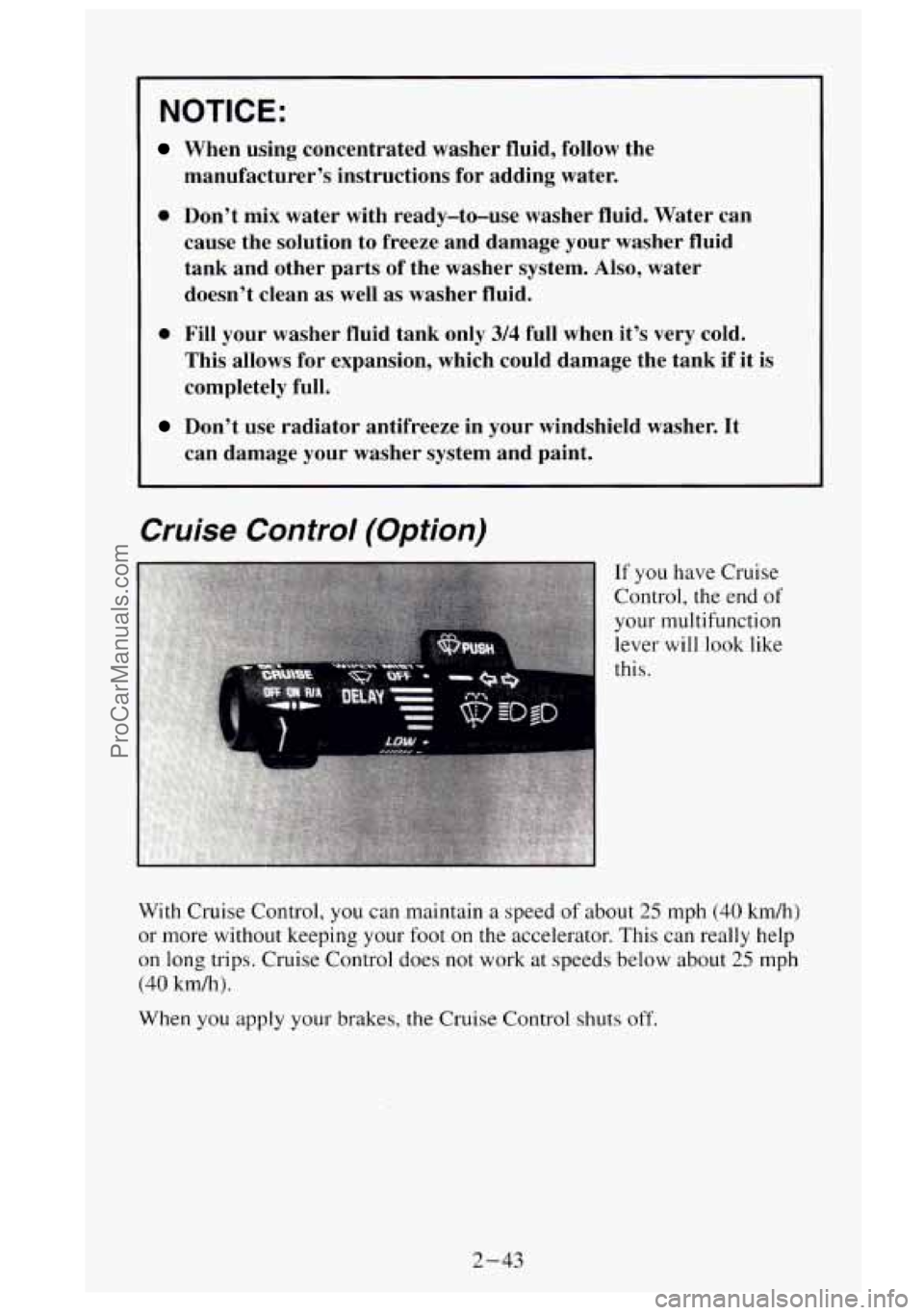
Cruise Control (Option)
If you have Cruise
Control, the end
of
your multifunction
lever
will look like
this.
With Cruise Control,
you can maintain a speed of about 25 mph (40 kdh)
or more without keeping your foot on the accelerator. This can really help
on
long trips. Cruise Control does not work at speeds below about 25 mph
(40 kmk).
When you apply your brakes, the Cruise Control shuts off.
2-43
ProCarManuals.com
Page 107 of 488
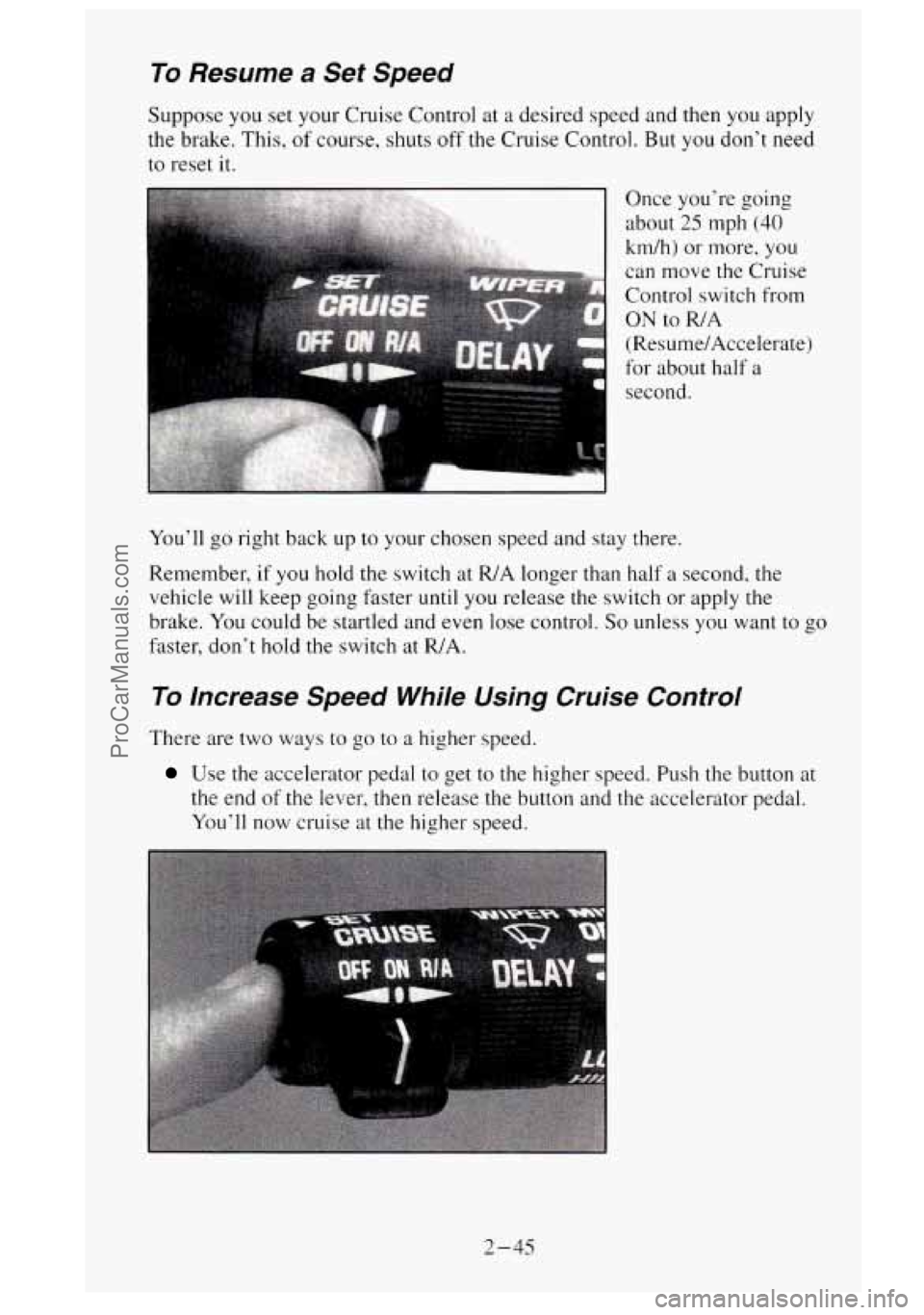
To Resume a Set Speed
Suppose you set your Cruise Control at a desired speed and then you apply
the brake. This, of course, shuts off the Cruise Control. But you don't need
to reset
it.
i second.
You'll go right back
up to your chosen speed and stay there.
Remember,
if you hold the switch at R/A longer than half a second, the
vehicle will keep going faster
until you release the switch or apply the
brake.
You could be startled and even lose control. So unless you want to go
faster, don't hold the switch at WA.
To lncrease Speed While Using Cruise Control
There are two ways to go to a higher speed.
Use the accelerator pedal to get to the higher speed. Push the button at
the end
of the lever, then release the button and the accelerator pedal.
You'll now cruise at the higher speed.
2-45
ProCarManuals.com
Page 109 of 488
Using Cruise Control on Hills
How well your Cruise Control will work on hills depends upon your speed,
load. and the steepness of the hills. When going
up steep hills, you may
have to step
on the accelerator pedal to maintain your speed. If the steepness
of the hill causes the vehicle speed to drop more than 15 mph (9.4 km/h)
below the set
speed, your Cruise Control will automatically disengage.
When going downhill, you may have to brake or shift
to a lower gear to
keep your speed down. Of course, applying the brake takes you out of
Cruise Control. Many drivers find this to be too much trouble and don’t use
Cruise Control on steep hills.
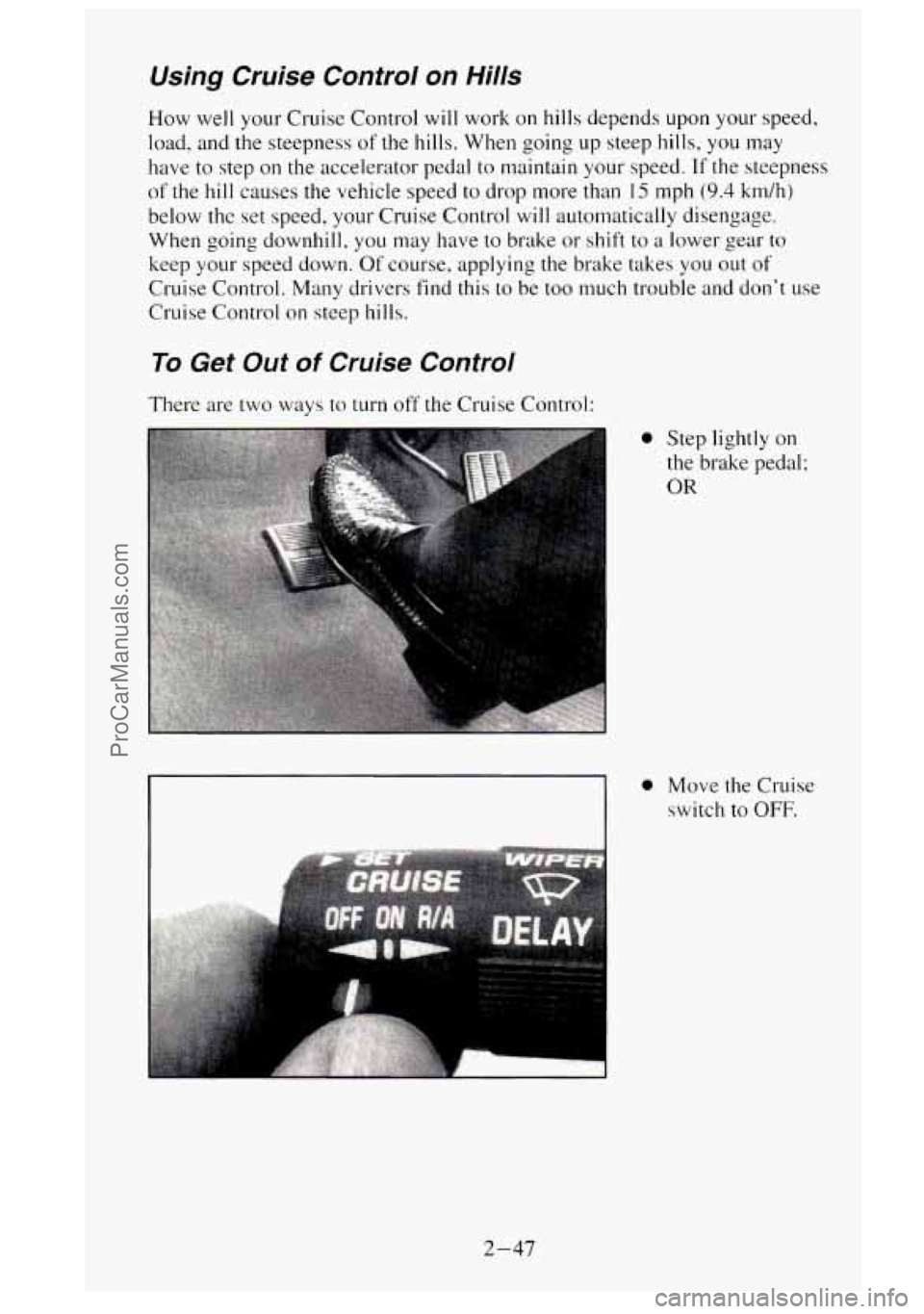
To Get Out of Cruise Control
There are two ways to turn off the Cruise Control:
0 Step lightly on
the brake pedal;
OR
I I 0 Move the Cruise
I
switch to OFF.
2-47
ProCarManuals.com
Page 112 of 488
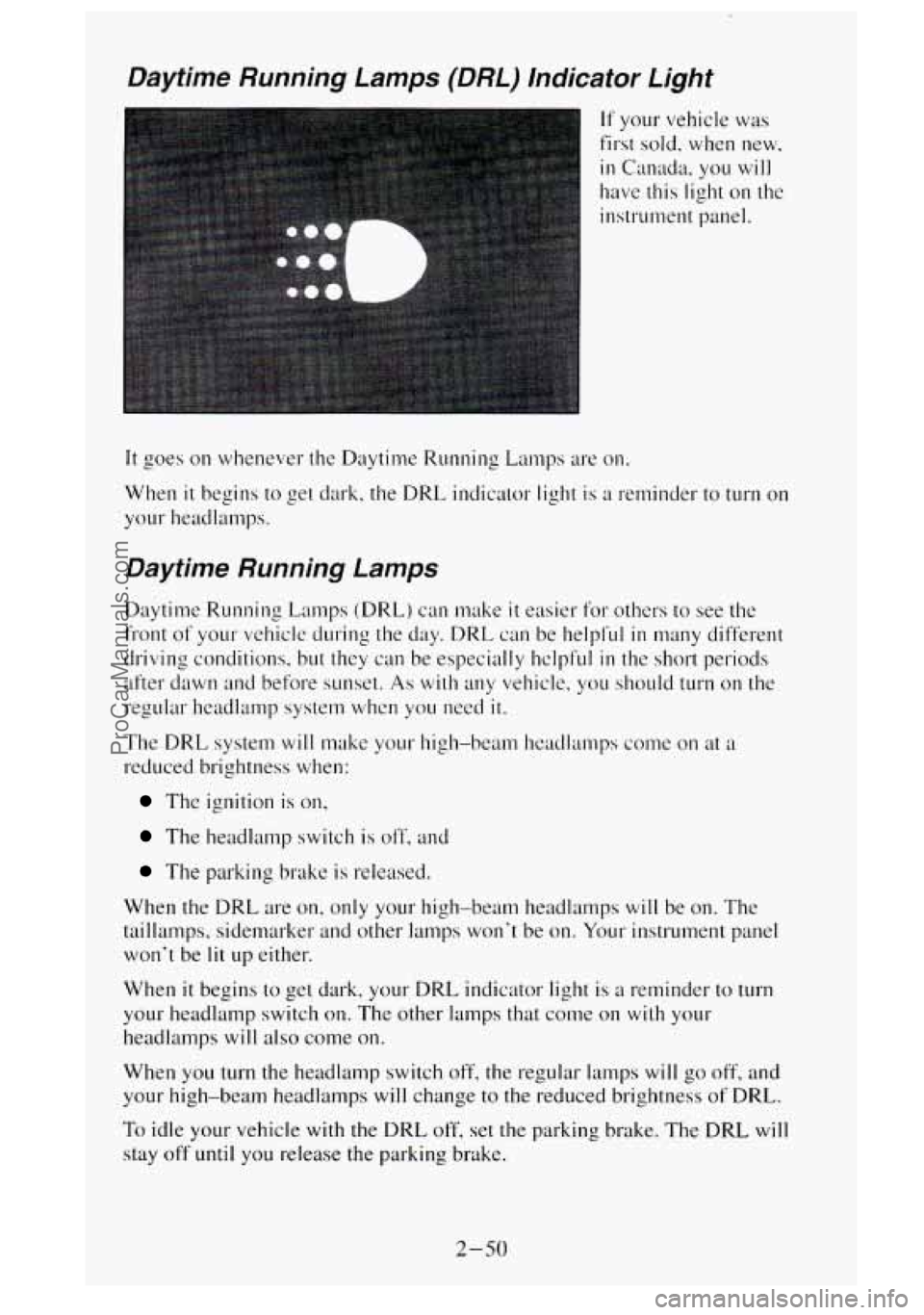
Daytime nunning Lamps (DRL) Indicator Light
If your vehicle was
first sold. when new,
in Canada, you will
have this light on the
instrument panel.
It goes on whenever the Daytime Running Lamps are on.
When
it begins to get dark, the DRL indicator light is a reminder to turn on
your headlanlps.
Daytime Running Lamps
Daytime Running Lamps (DRL) can make it easier for others to see the
front of your vehicle during the day. DRL can be helpfL11
in many different
driving conditions. but they
can be especially hclpful in the short periods
after dawn and before sunset.
As with any vehicle, you should turn on the
regular headlamp system when
you need it.
The DRL system will make your high-beam headlamps come on at a
reduced brightness when:
The ignition is on,
The headlamp switch is off, and
The parking brake is released.
When the
DRL are on, only your high-beam headlamps will be on. The
taillamps, sidemarker and other lamps won‘t be on. Your instrument panel
won’t be
lit up either.
When
it begins to get dark, your DRL indicator light is a reminder to turn
your headlamp switch on. The other lamps that come on with your
headlamps
will also come on.
When you
turn the headlamp switch off, the regular lamps will go off, and
your high-beam headlamps will change
to the reduced brightness of DRL.
To idle your vehicle with the DRL off, set the parking brake. The DRL will
stay off until you release the parking brake.
2-50
ProCarManuals.com
Page 130 of 488
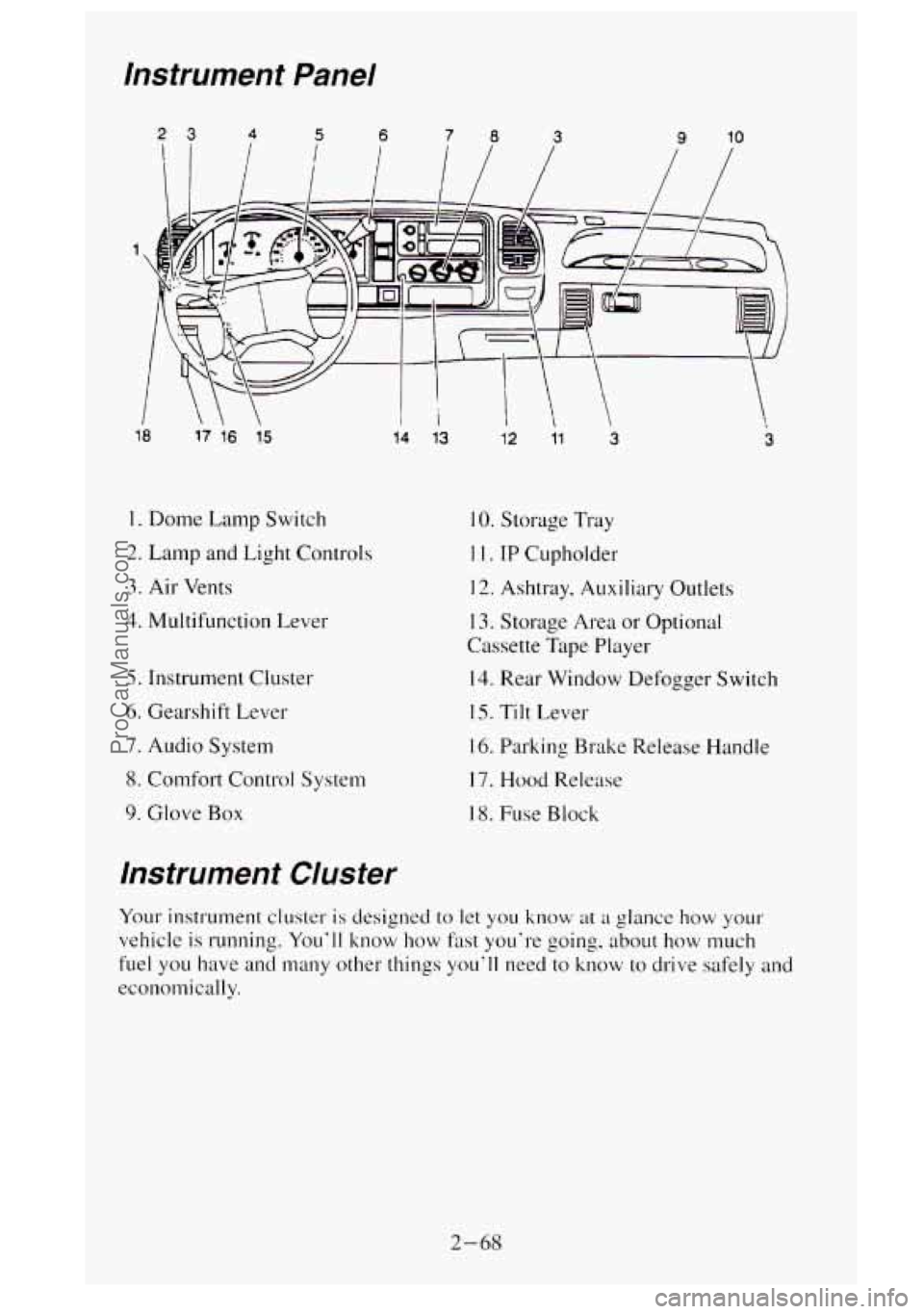
instrument Panel
18 17 16 15
1. Dome Lamp Switch
2. Lamp and Light Controls
3. Air Vents
4. Multifunction Lever
5. Instrument Cluster
6. Gearshift Lever
7. Audio System
8. Comfort Control System
9. Glove
Box
14 13
instrument Cluster
12 1' 3 3
IO. Storage Tray
1 I. IP Cupholder
12. Ashtray, Auxiliary Outlets
I 3. Storage Area or Optional
Cassette Tape Player
14. Rear Window Defogger Switch
IS. Tilt Lever
16. Parking Brake Release Handle
17. Hood Release
18. Fuse
Block
Your instrument cluster is designed to let you know at a glance how your
vehicle is running. You'll
know how fast you're going, about how much
fuel you have and many other things you'll need to know to drive safely and
economically.
2-68
ProCarManuals.com