check oil GMC SIERRA 1995 User Guide
[x] Cancel search | Manufacturer: GMC, Model Year: 1995, Model line: SIERRA, Model: GMC SIERRA 1995Pages: 488, PDF Size: 26.01 MB
Page 288 of 488
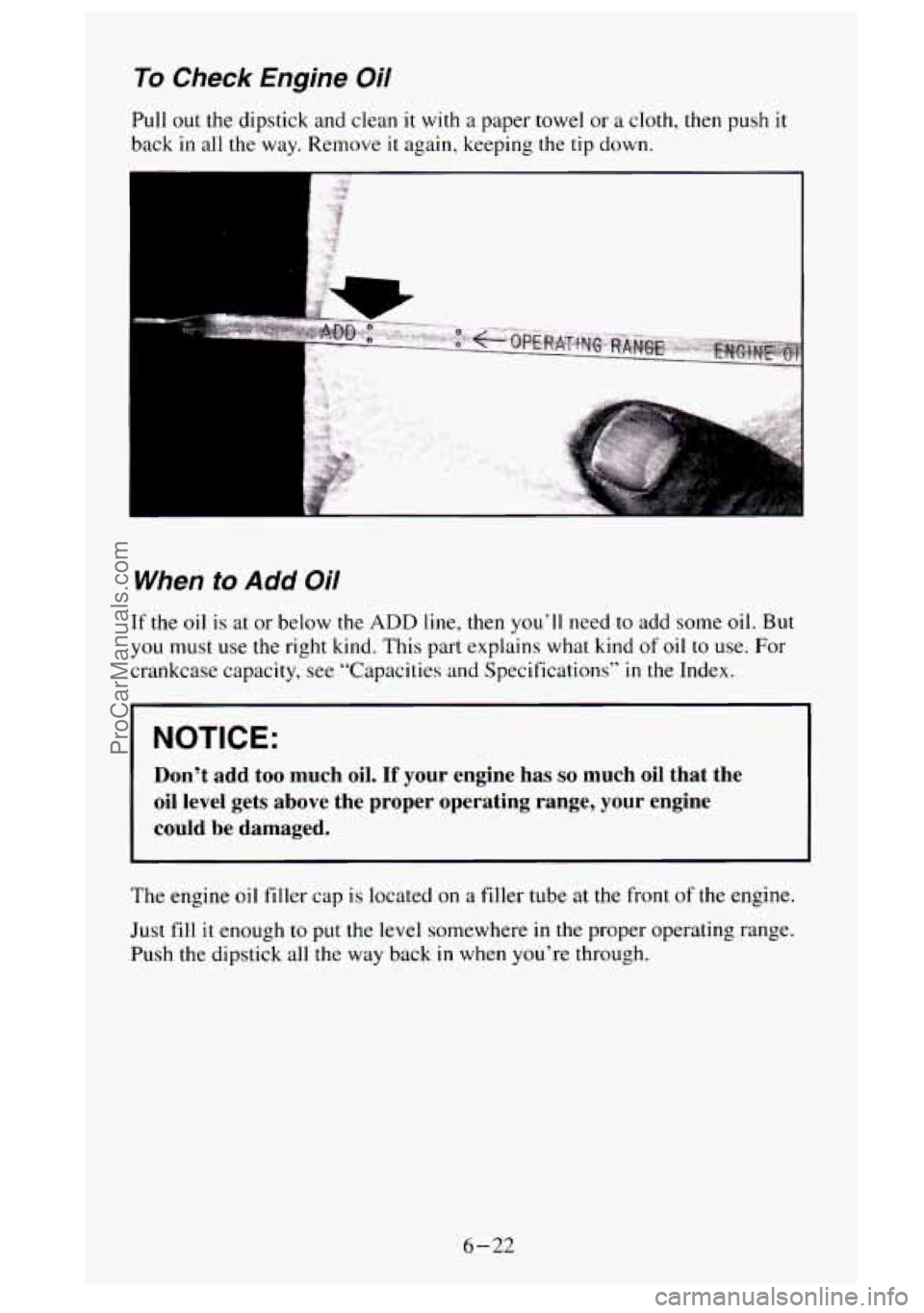
To Check Engine Oil
Pull out the dipstick and clean it with a paper towel or a cloth, then push it
back in all the way. Remove it again, keeping the tip down.
When to Add Oil
If the oil is at or below the ADD line, then you’ll need to add some oil. But
you must use the right kind. This part explains what kind of oil to use. For
crankcase capacity, see “Capacities and Specifications”
in the Index.
I I
I NOTICE: I
Don’t add too much oil. If your engine has so much oil that the
oil level gets above the proper operating range, your engine
could be damaged.
I I
The engine oil filler cap is located on a filler tube at the front of the engine.
Just fill it
enough to put the level somewhere in the proper operating range.
Push the dipstick
all the way back in when you’re through.
6-22
ProCarManuals.com
Page 293 of 488
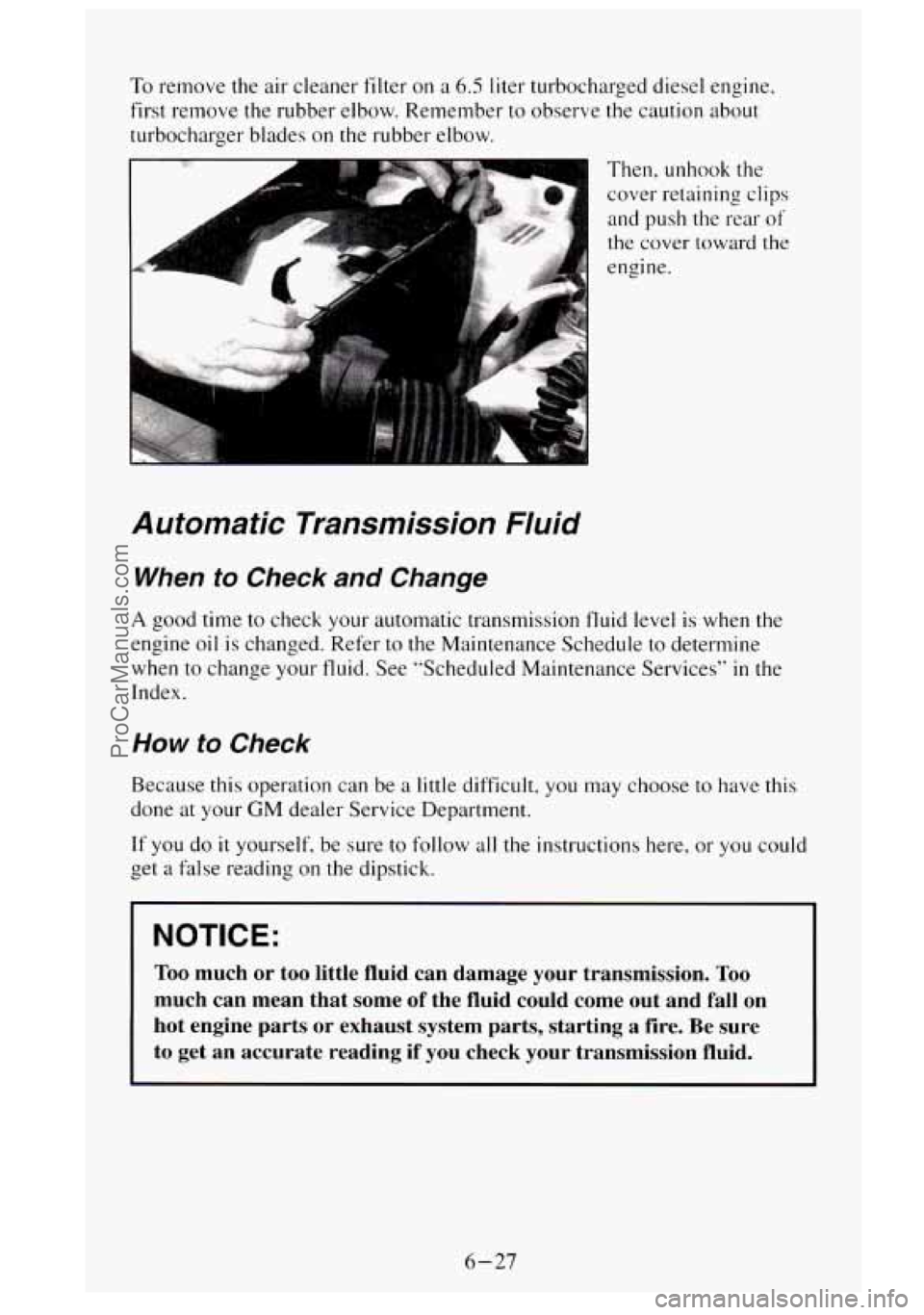
To remove the air cleaner filter on a 6.5 liter turbocharged diesel engine,
first remove the rubber elbow. Remember to observe the caution about
turbocharger blades on the rubber elbow.
Then, unhook the
cover retaining clips
and push the rear
of
the cover toward the
engine.
Automatic Transmission Fluid
When to Check and Change
A good time to check your automatic transmission fluid level is when the
engine
oil is changed. Refer to the Maintenance Schedule to determine
when to change your fluid. See "Scheduled Maintenance Services''
in the
Index.
How to Check
Because this operation can be a little difficult, you may choose to have this
done at your
GM dealer Service Department.
If you do
it yourself, be sure to follow all the instructions here, or you could
get
a false reading on the dipstick.
NOTICE:
Too much or too little fluid can damage your transmission. Too
much can mean that some of the fluid could come out and fall on
hot engine parts or exhaust system parts, starting a fire. Be \
sure
to get an accurate reading if you check your transmission fluid.
6-27
ProCarManuals.com
Page 296 of 488
How to Add Fluid
Refer to the Maintenance Schedule to determine what kind of transmission
fluid
to use. See “Recommended Fluids and Lubricants” in the Index.
Add fluid only after checking the transmission fluid
HOT. (A COLD check
is used
only as a reference.) If the fluid level is low, add only enough of the
proper fluid to bring the level up
to the HOT area for a hot check. It doesn’t
take much fluid, generally less than a
int. Don ’t overfill. We recommend
you use only fluid labeled DEXRON
-111, because fluid with that label is
made especially for your automatic transmission. Damage caused by fluid
other than DEXRON@-I11 is not covered by your
new vehicle warranty.
8
0 After adding fluid, recheck the fluid level as described under “How to
Check.”
0 When the correct fluid level is obtained, push the dipstick back in all
the way; then flip the handle down
to lock the dipstick in place.
Manual Transmission Fluid
When to Check
A good time to have it checked is when the engine oil is changed. However,
the fluid
in your manual transmission doesn’t require changing.
How to Check
Because this operation can be a little difficult, you may choose to have this.
done at your
GM dealer Service Department.
If you do it yourself, be sure to follow all the instructions here, or you could
get a false reading.
NOTICE:
Too much or too little fluid can damage your transmission. Too
much can mean that some of the fluid could come out and fall on
hot engine parts or exhaust system parts, starting a fire.
Be sure
to get an accurate reading if you check your transmission fluid.
Check the fluid level only when your engine is off, the vehicle is parked on
a level place and the transmission is cool enough for you to rest your fingers
on the transmission case.
6-30
ProCarManuals.com
Page 309 of 488
(or remove) brake fluid, as necessary, only when work is done on the brake
hydraulic system.
A CAUTION:
If you have too much brake fluid, it can spill on the engine. The
fluid will burn
if the engine is hot enough. You or others could
be burned, and your vehicle could be damaged. Add brake fluid
only when work is done on the brake hydraulic system.
Refer to the Maintenance Schedule to determine when to check your brake
fluid. See “Periodic Maintenance Inspections”
in the Index.
To Check Brake Fluid
You can check the brake fluid without taking off the cap. Just look at the
windows on the brake fluid reservoir. The fluid levels should be above MIN.
If they aren’t, have your brake system checked to see if there is a leak.
After work
is done on the brake hydraulic system, make sure the levels are
above MIN and below the top
of each window.
What to Add
When you do need brake fluid, use only DOT-3 brake fluid - such as
Delco Supreme 11
@ (GM Part No. 1052535). Use new brake fluid from a
sealed container only, and always clean the brake fluid reservoir cap before
removing it.
NOTICE:
Don’t let someone put in the wrong kind of fluid. For
example, just
a few drops of mineral-based oil, such as engine
oil, in your brake system can damage brake system parts
so
badly that they’ll have to be replaced.
Brake fluid can damage paint, so be careful not to spill brake
fluid on your vehicle.
If you do, wash it off immediately. See
“Appearance Care” in the Index.
6-43
ProCarManuals.com
Page 312 of 488
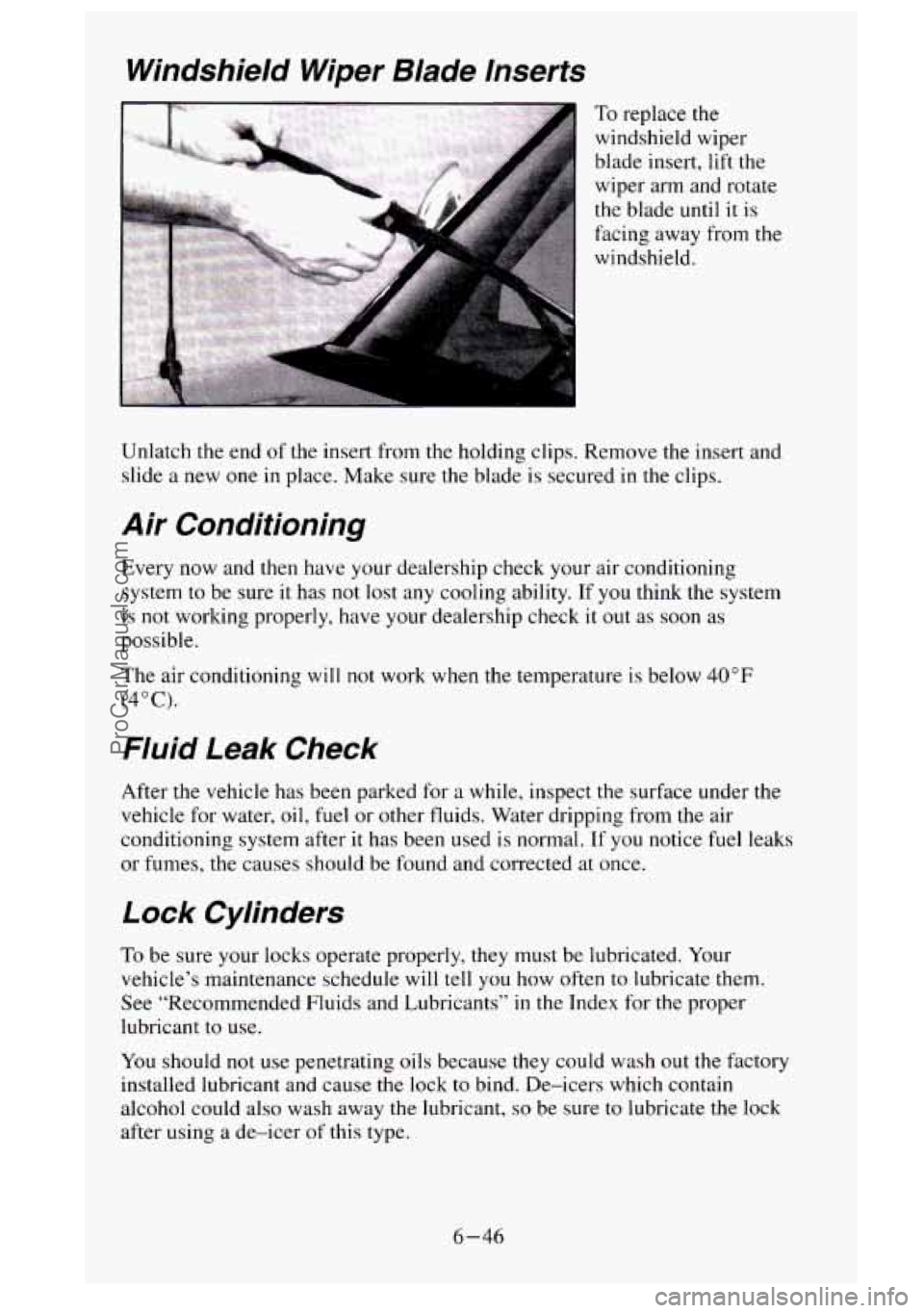
Windshield Wiper Blade Inserts
To replace the
windshield wiper
blade insert, lift
the
wiper arm and rotate
the blade until
it is
facing away from the
windshield.
Unlatch the end
of the insert from the holding clips. Remove the insert and
slide
a new one in place. Make sure the blade is secured in the clips.
Air Conditioning
Every now and then have your dealership check your air conditioning
system to be sure it
has not lost any cooling ability. If you think the system
is not working properly, have your dealership check it out as soon as
possi bleb
The air conditioning will
not work when the temperature is below 40°F
(4°C).
Fluid Leak Check
After the vehicle has been parked for a while, inspect the surface under the
vehicle for water, oil, fuel
or other fluids. Water dripping from the air
conditioning system after it has been used is normal.
If you notice fuel leaks
or fumes, the causes should be found and corrected at once.
Lock Cylinders
To be sure your locks operate properly, they must be lubricated. Your
vehicle’s maintenance schedule will tell you how often to lubricate them.
See “Recommended Fluids and Lubricants” in the Index for
the proper
lubricant to use.
You should
not use penetrating oils because they could wash out the factory
installed lubricant and cause
the lock to bind. De-icers which contain
alcohol could also
wash away the lubricant, so be sure to lubricate the lock
after using
a de-icer of this type.
6-46
ProCarManuals.com
Page 349 of 488
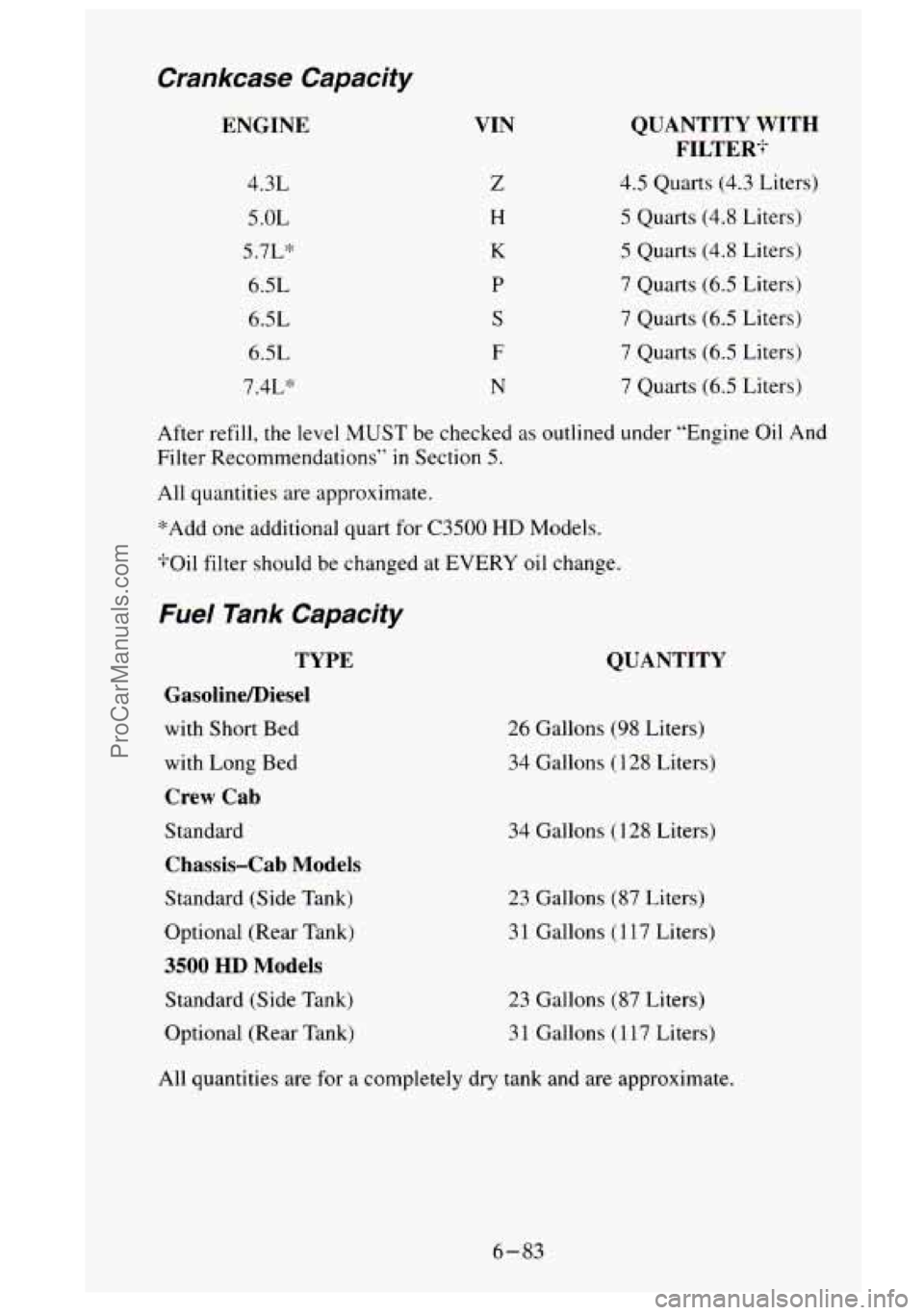
CranKcase Capacity
ENGINE
4.3L 5 .OL
5.7L“
6.5L
6.5L
6.5L
7.4L>$
VIN
Z
€4
K
P
S
F
N
QUANTITY WITH
FILTER*
4.5 Quarts (4.3 Liters)
5 Quarts (4.8 Liters)
5 Quarts (4.8 Liters)
7 Quarts (6.5 Liters)
7 Quarts
(6.5 Liters)
7 Quarts (6.5 Liters)
7 Quarts (6.5 Liters)
After refill, the level
MUST be checked as outlined under “Engine Oil And
Filter Recommendations”
in Section 5.
All quantities are approximate.
“Add one additional quart for
C3500 HD Models.
+Oil filter should be changed at EVERY oil change.
Fuel Tank Capacity
TYPE
Gasoline/Diesel
with Short Bed
with Long Bed
Crew Cab
Standard
Chassis-Cab Models
Standard (Side Tank)
Optional (Rear Tank)
3500 HD Models
Standard (Side Tank)
Optional (Rear Tank)
QUANTITY
26 Gallons (98 Liters)
34 Gallons
(1 28 Liters)
34 Gallons
(1 28 Liters)
23 Gallons (87 Liters)
3
1 Gallons (1 17 Liters)
23 Gallons (87 Liters)
3 1 Gallons ( 117 Liters)
All quantities are
for a completely dry tank and are approximate.
6-83
ProCarManuals.com
Page 361 of 488
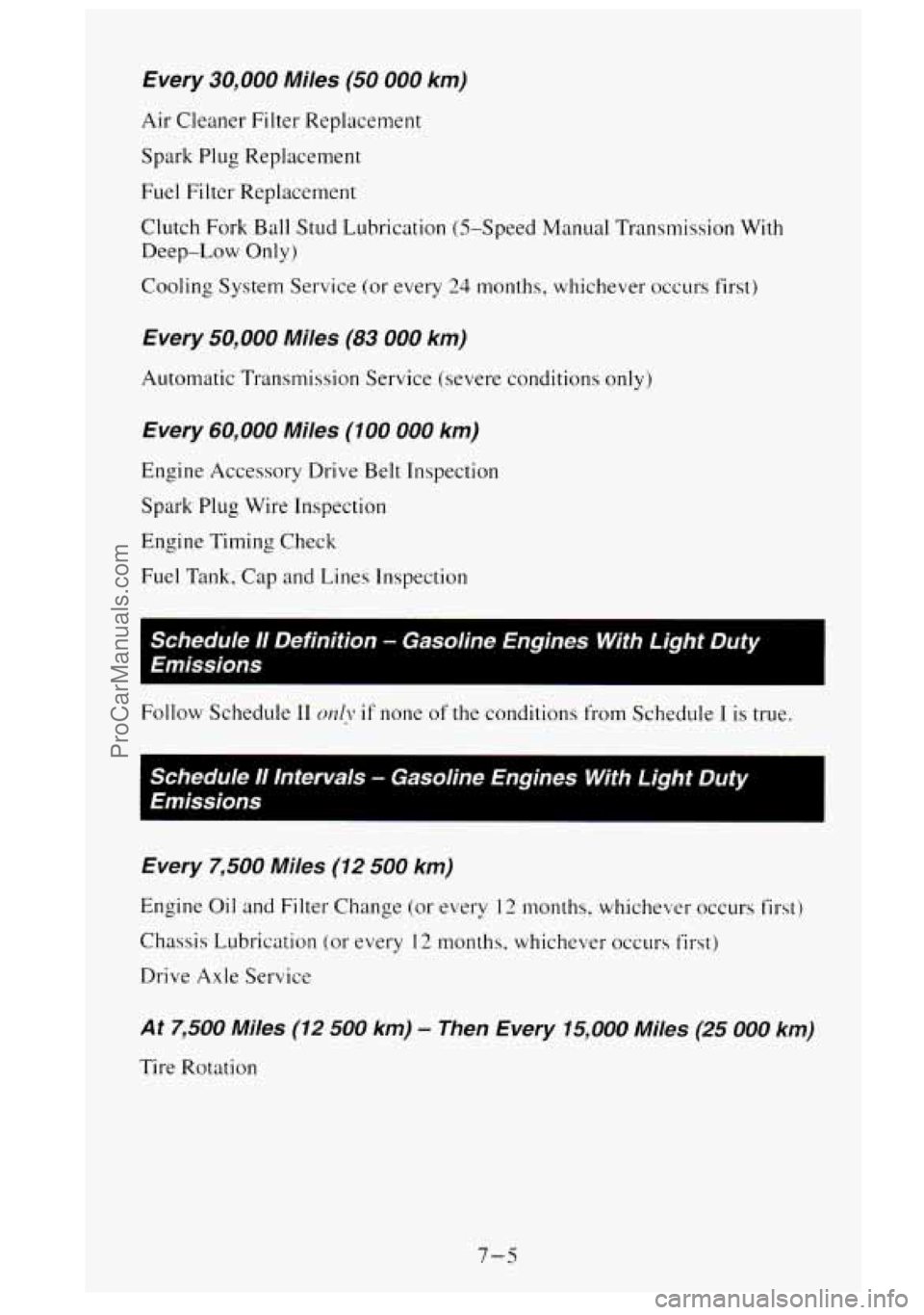
Every 30,000 Miles (50 000 km)
Air Cleaner Filter Replacement
Spark Plug Replacement
Fuel Filter Replacement
Clutch
Fork Ball Stud Lubrication (5-Speed Manual Transmission With
Deep-Low Only)
Cooling System Service (or every
24 months, whichever occurs first)
Every 50,000 Miles (83 000 km)
Automatic Transmission Service (severe conditions only)
Every 60,000 Miles (100 000 km)
Engine Accessory Drive Belt Inspection
Spark Plug Wire Inspection
Engine Timing Check
Fuel Tank, Cap and Lines Inspection
Schedule 11 Definition - Gasoline Engines With Light Duty
Emissions
Follow Schedule I1 only if none of the conditions from Schedule I is true.
Schedule I1 Intervals - Gasoline Engines With Light Duty
Emissions
Every
7,500 Miles (12 500 km)
Engine Oil and Filter Change (or every 12 months, whichever occurs first)
Chassis Lubrication (or every
12 months, whichever occurs first)
Drive Axle Service
At 7,500 Miles (12 500 km) - Then Every 15,000 Miles (25 000 km)
Tire Rotation
7-5
ProCarManuals.com
Page 363 of 488
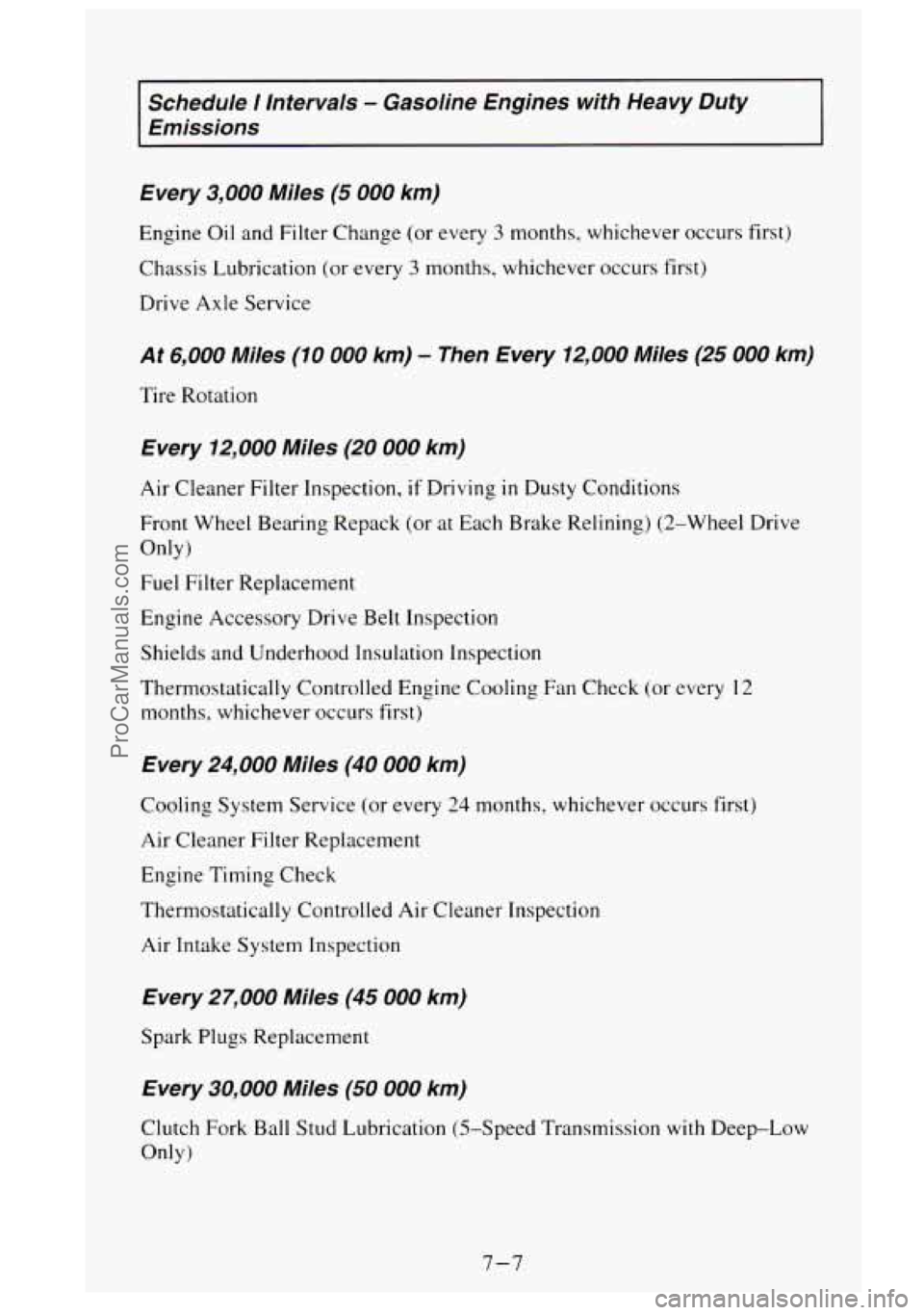
Schedule I Intervals - Gasoline Engines with Heavy Duty
Emissions
Every
3,000 Miles (5 000 km)
Engine Oil and Filter Change (or every 3 months, whichever occurs first)
Chassis Lubrication (or every
3 months, whichever occurs first)
Drive Axle Service
At 6,000 Miles (10 000 km) - Then Every 12,000 Miles (25 000 km)
Tire Rotation
Every 12,000 Miles (20 000 km)
Air Cleaner Filter Inspection, if Driving in Dusty Conditions
Front Wheel Bearing Repack (or at Each Brake Relining) (2-Wheel Drive
Only
1
Fuel Filter Replacement
Engine Accessory Drive Belt Inspection
Shields
and Underhood Insulation Inspection
Thermostatically Controlled Engine Cooling Fan Check (or every
12
months, whichever occurs first)
Every 24,000 Miles (40 000 km)
Cooling System Service (or every 24 months, whichever occurs first)
Air Cleaner Filter Replacement
Engine Timing Check
Thermostatically Controlled Air Cleaner Inspection
Air Intake System Inspection
Every 27,000 Miles (45 000 km)
Spark Plugs Replacement
Every 30,000 Miles (50 000 km)
Clutch Fork Ball Stud Lubrication (%Speed Transmission with Deep-Low
Only)
7-7
ProCarManuals.com
Page 364 of 488
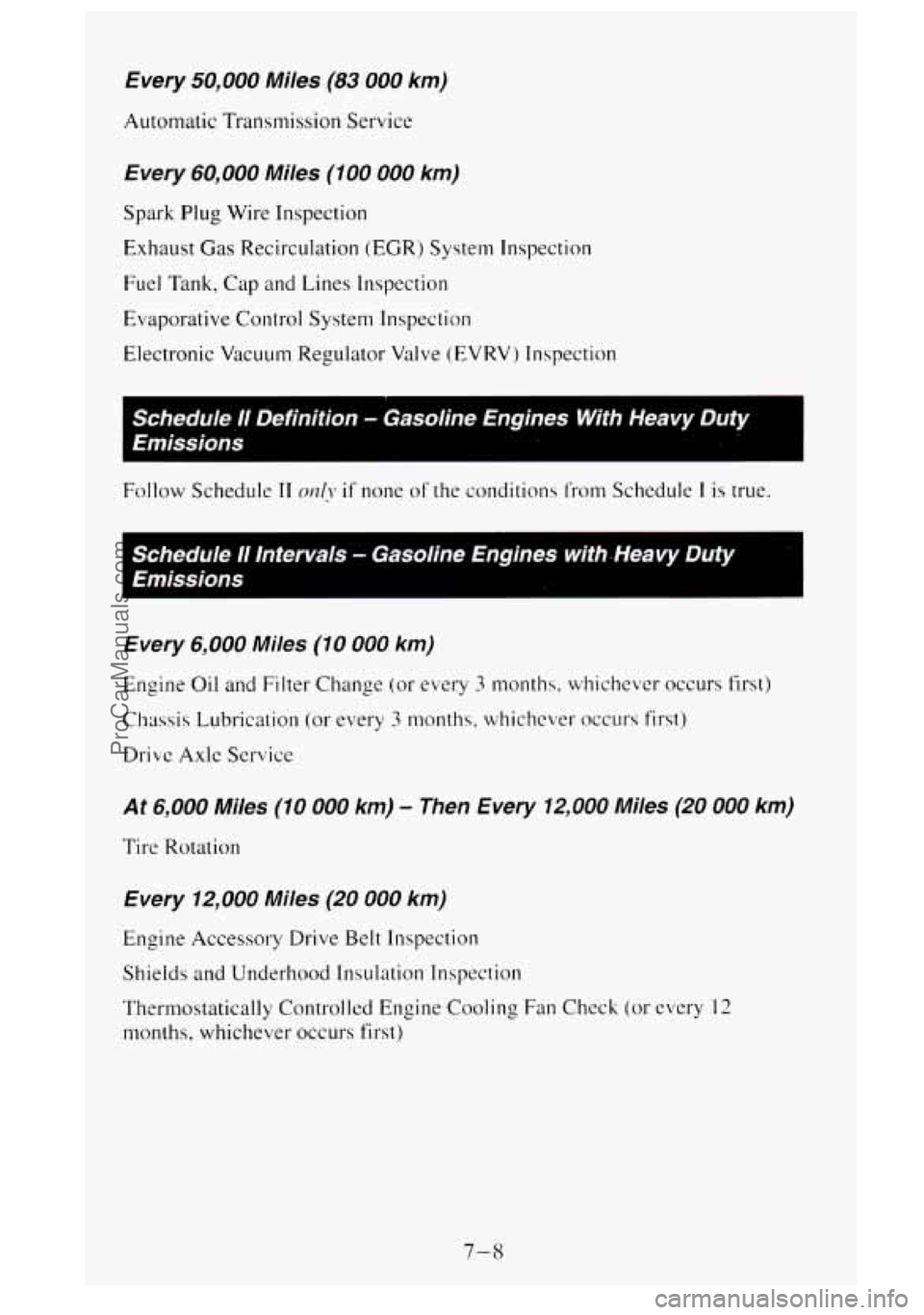
Every 50,000 Miles (83 000 km)
Automatic Transinission Service
Every 60,000 Miles (100 000 km)
Spark Plug Wire Inspection
Exhaust Gas Recirculation (EGR) System Inspection
Fuel Tank, Cap and Lines Inspection
Evaporative Control System Inspection
Electronic Vacuum Regulator Valve
(EVRV j Inspection
Schedule I1 Definition - Gasoline Engines With Heavy Duty
Emissions
Follow Schedule TI only if none of the conditions from Schedule I is true.
Schedule I1 Intervals - Gasoline Engines with-Heavy Duty
Emissions
Every
6,000 Miles (10 000 km)
Engine Oil and Filter Change (or every 3 months. whichever occurs first)
Clussis Lubrication (or every 3 months, whichever occurs first)
Drivc Axle Scrvice
At 6,000 Miles (10 000 km) - Then Every 12,000 Miles (20 000 km)
Tire Rotation
Every 12,000 Miles (20 000 km)
1
Engine Accessory Drive Belt Inspection
Shields and Underhood Insulation Inspection
Thermostatically Controlled Engine Cooling
Fan Check (or every 12
months, whichever occurs first)
7-8
ProCarManuals.com
Page 366 of 488
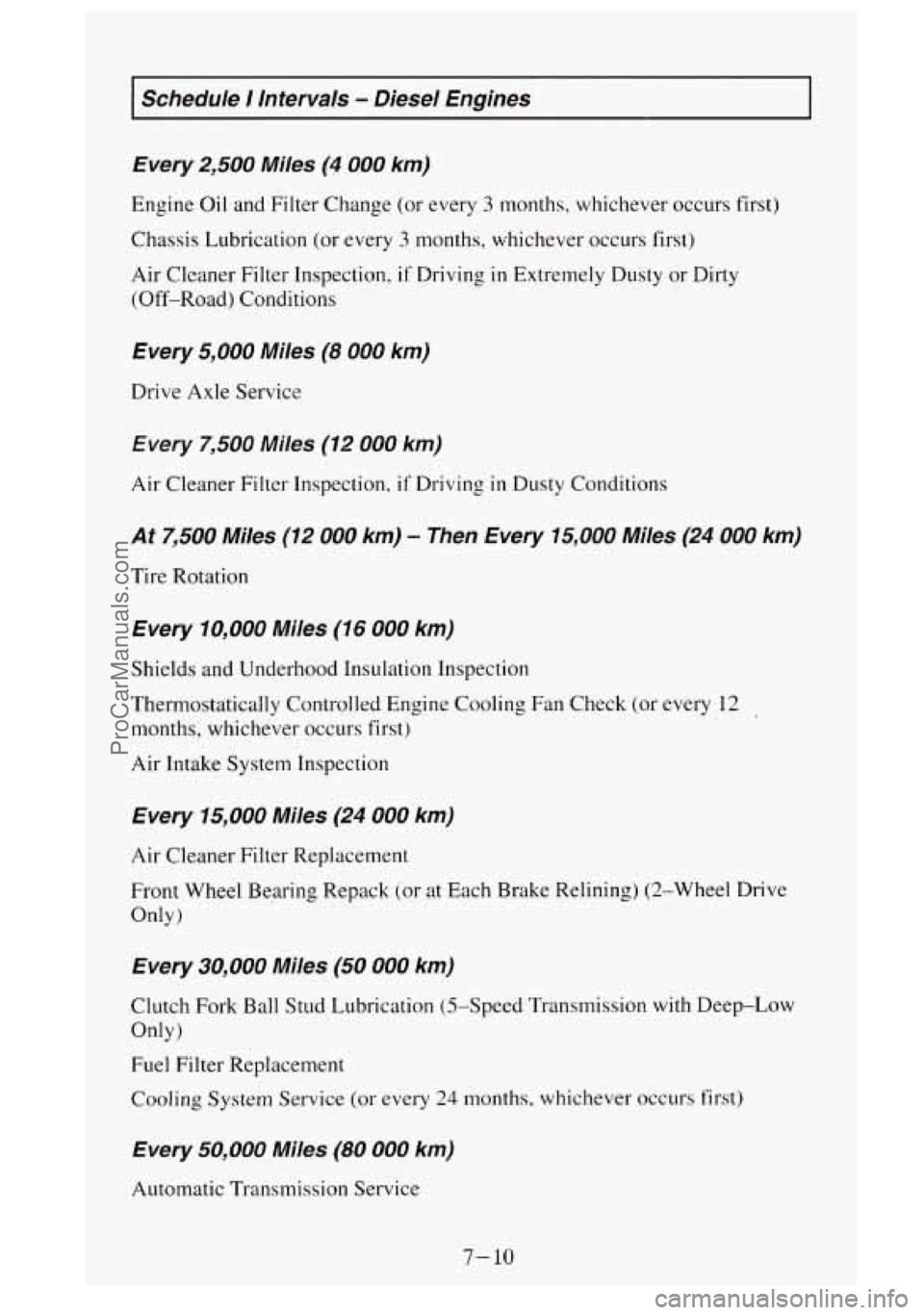
I Schedule I Intervals - Diesel Engines I
Every 2,500 Miles (4 000 km)
Engine Oil and Filter Change (or every 3 months, whichever occurs first)
Chassis Lubrication (or every
3 months, whichever occurs first)
Air Cleaner Filter Inspection.
if Driving in Extremely Dusty or Dirty
(Off-Road) Conditions
Every 5,000 Miles (8 000 km)
Drive Axle Service
Every 7,500 Miles (12 000 km)
Air Cleaner Filter Inspection, if Driving in Dusty Conditions
At 7,500 Miles (12 000 km) - Then Every 15,000 Miles (24 000 km)
Tire Rotation
Every 10,000 Miles (I 6 000 km)
Shields and Underhood Insulation Inspection
Thermostatically Controlled Engine Cooling Fan Check (or every
12
months, whichever occurs first)
Air Intake System Inspection
Every 15,000 Miles (24 000 km)
Air Cleaner Filter Replacement
Front Wheel Bearing Repack
(or at Each Brake Relining) (2-Wheel Drive
Only j
Every 30,000 Miles (50 000 km)
Clutch Fork Ball Stud Lubrication (%Speed Transmission with Deep-Low
Only:)
Fuel Filter Replacement
Cooling
System Service (or every 24 months, whichever occurs first)
Every 50,000 Miles (80 000 km)
Automatic Transmission Service
7- 10
ProCarManuals.com