clock GMC SIERRA 1995 User Guide
[x] Cancel search | Manufacturer: GMC, Model Year: 1995, Model line: SIERRA, Model: GMC SIERRA 1995Pages: 488, PDF Size: 26.01 MB
Page 182 of 488
Suppose you’re steering through a sharp curve. Then you suddenly
accelerate.
Both control systems - steering and acceleration - have to do
their work where the tires meet the road. Adding the sudden acceleration
can demand too much of those places. You can lose control.
What should you do if
this ever happens‘? Ease up on the accelerator pedal,
steer the vehicle the way you want
it to go, and slow down.
Speed limit signs near curves warn that you should adjust your speed.
Of
course, the posted speeds are based on good weather and road conditions.
Under less fivorable conditions you’ll want to go slower.
If you need to reduce your speed as
you approach a curve, do it before you
enter the curve, while your front wheels are straight ahead.
Try
to adjust your speed so you can “drive” through the curve. Maintain a
reasonable, steady speed. Wdit to accelerate until you are out of the curve,
and then accelerate gently
into the straightaway.
Steering in Emergencies
There are times when steering can be more effective than braking. For
example, you come over a
hill and find a truck stopped in your lane, or a car
suddenly
pulls out from nowhere, or a child darts out from between parked
cars and stops right in front of you. You can avoid these problems by
braking
- if you can stop in time. But sometimes you can’t; there isn’t
room. That’s the time for evasive action
- steering around the problem.
Your vehicle can perform very
well in emergencies like these. First apply
your brakes. (See “Braking in Emergencies” earlier
in this section.) It is
better to remove
as much speed as you can from a possible collision. Then
steer around the problem, to the left or right depending on the space
available.
An emergency like this requires close attention and a quick decision. If you
are holding the steering wheel at the recommended
9 and 3 o’clock
positions, you can turn
it a full 180 degrees very quickly without removing
either hand. But you have to act fast, steer quickly, and just as quickly
straighten the wheel once you have avoided the object.
4-8
ProCarManuals.com
Page 191 of 488
A CAUTION:
Driving to the top (crest) of a hill at full speed can cause an
accident. There could be a drop-off, embankment, cliff, or even
another vehicle. You could be seriously injured
or killed. As you
near the top
of a hill, slow down and stay alert.
Q: What should I do if my vehicle stalls, or is about to stall, and I
A: If this happens, there are some things you should do, and there are
some things you must not do. First, here’s what you
shoclld do:
can’t make it up the hill?
0 Push the brake pedal to stop the vehicle and keep it from rolling
backwards. Also, apply the parking brake.
If your engine is still running, shift the transmission into reverse,
release the parking brake, and slowly back down the
hill in reverse.
If your engine has stopped running, you’ll need to restart it. With the
brake pedal depressed and the parking brake still applied, shift the
transmission to PARK (P) (or, shift to NEUTRAL
(N) if your vehicle
has a manual transmission) and restart the engine. Then, shift
to
reverse, release the parking brake, and slowly back down the hill as
straight
as possible in reverse.
0 As you are backing down the hill, put your left hand on the steering
wheel at the
12 o’clock position. This way, you’ll be able to tell if your
wheels are straight and maneuver
as you back down. It’s best that you
back down the hill with your wheels straight rather than in the left or
right direction. Turning the
wheel too far to the left or right will
increase the possibility
of a rollover.
Here are some things you
must mt do if you stall, or are about to stall,
when going
up a hill.
0 Never attempt to prevent a stall by shifting into NEUTRAL (N) (or
depressing the clutch,
if you have a manual transmission) to ”rev-up”
the engine and regain forward momentum. This won’t work. Your
vehicle will roll backwards very quickly and
you could go out of
control.
4-’17
ProCarManuals.com
Page 250 of 488
Changing a Flat Tire
If a tire goes flat, avoid further tire and wheel damage by driving slowly to a
level place. Turn on your hazard warning flashers.
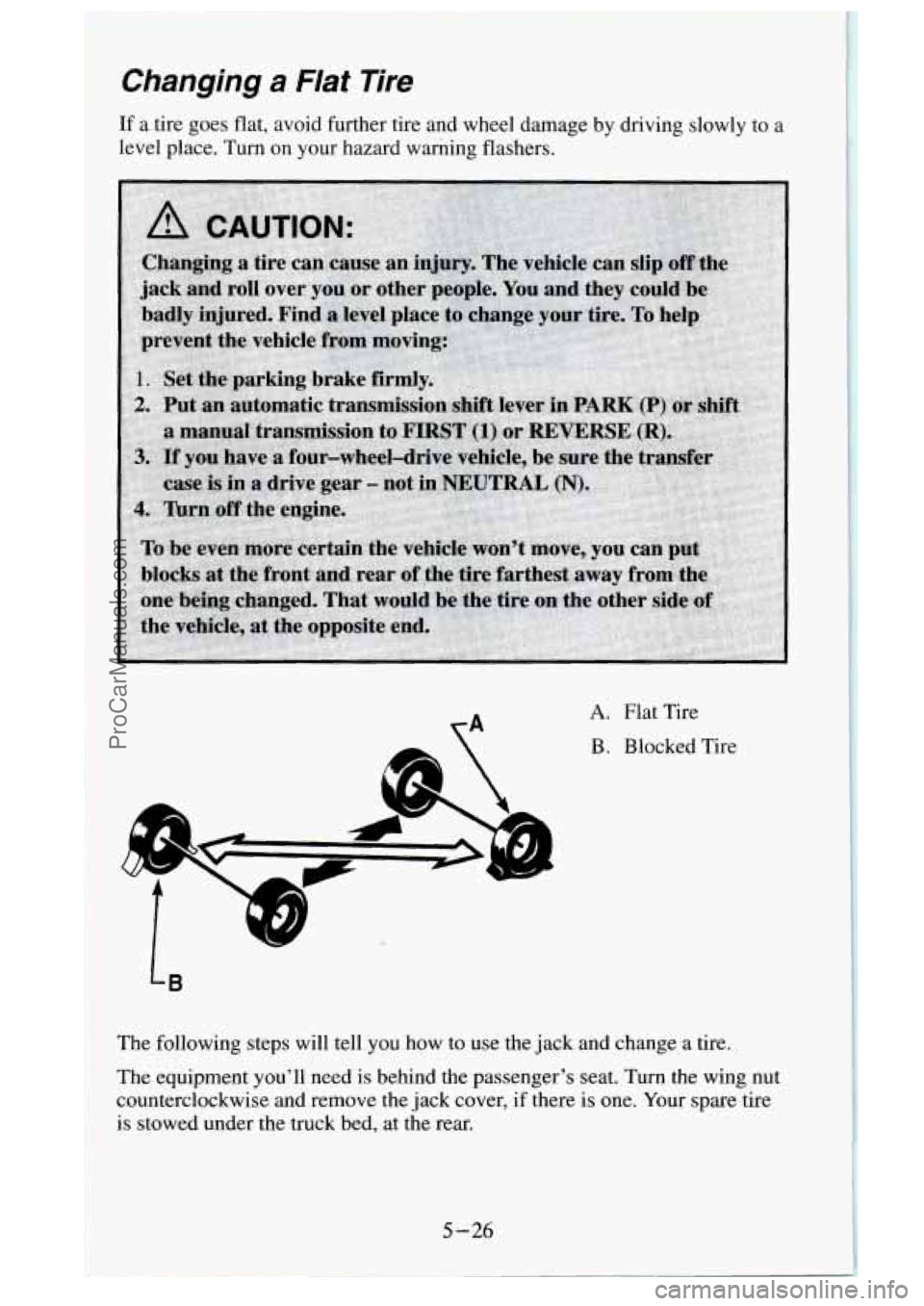
A. Flat Tire
B. Blocked Tire
The following steps will tell
you how to use the jack and change a tire.
The equipment you’ll need
is behind the passenger’s seat. Turn the wing nut
counterclockwise and remove the jack cover, if there is one.
Your spare tire
is stowed under the truck bed, at the
rear.
5-26
ProCarManuals.com
Page 255 of 488
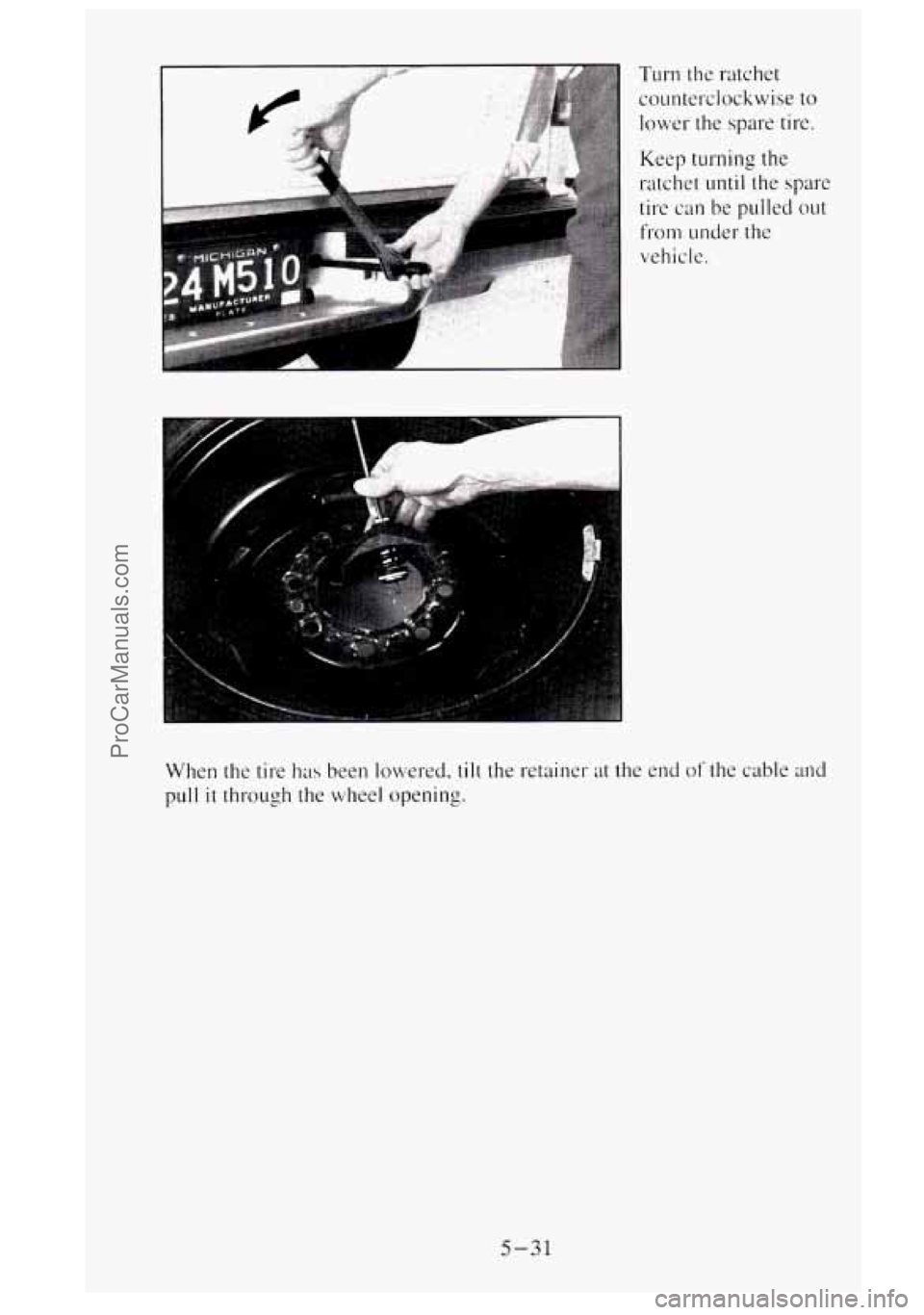
Turn the ratchet
counterclockwise to
lower- the spare tire.
Keep turning the
ratchet
until the spare
tire
can be pulled out
from under the
vehicle.
When the tire
has been lowered. till the retainer at the end of the cable and
pull it through the wheel opening.
5-31
ProCarManuals.com
Page 256 of 488
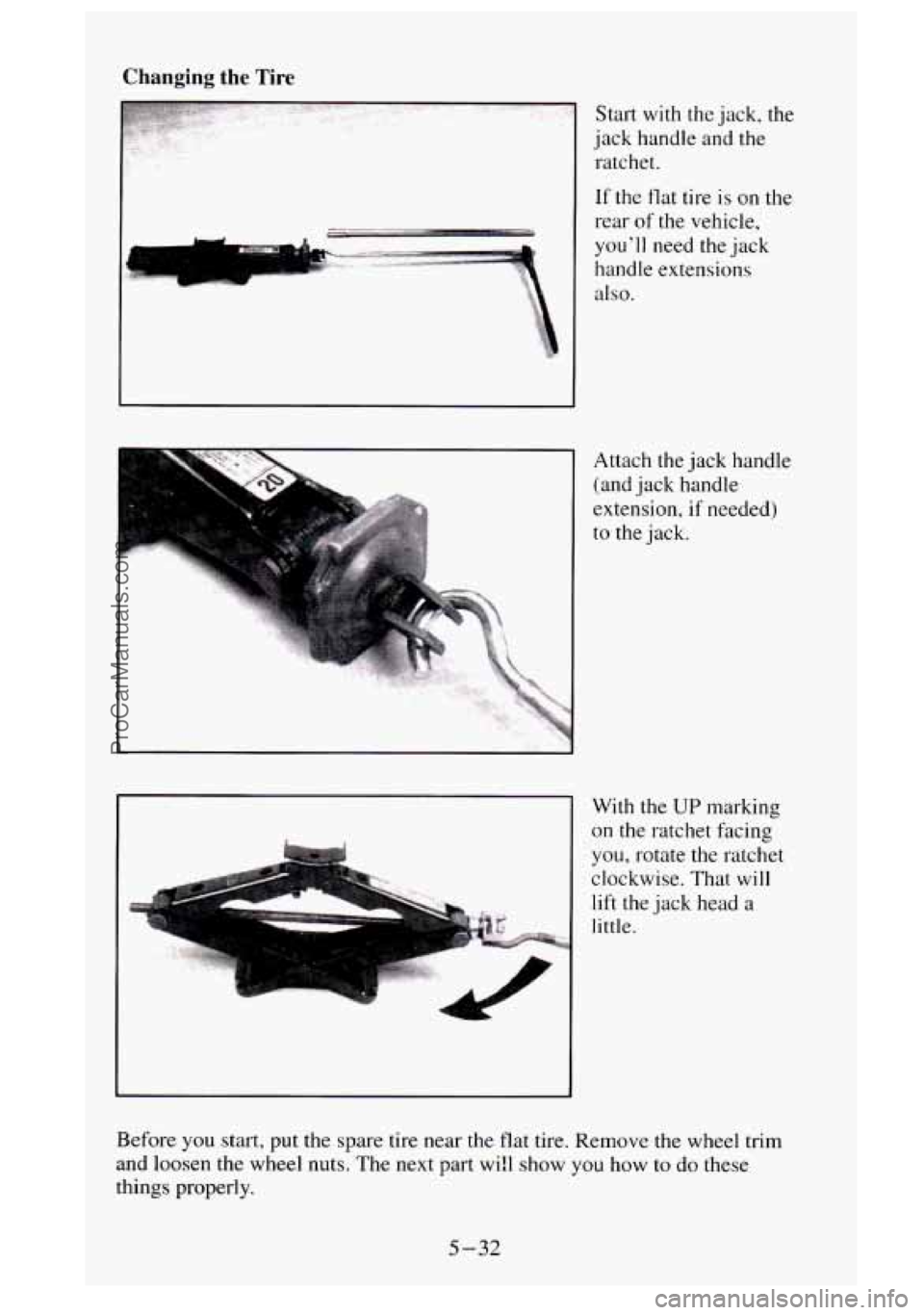
Changing the Tire
.
Start with the jack, the
jack handle and the
ratchet.
If
the flat tire is on the
rear of
the vehicle,
you’ll need the jack
handle extensions
also.
Attach the jack handle
(and jack handle
extension, if needed)
to the jack.
With the
Up marking
on the ratchet facing
you, rotate the ratchet
clockwise. That will
lift the jack head a
little.
Before
you start, put the spare tire near the flat tire. Remove the wheel trim
and loosen
the wheel nuts. The next part wi!l show you how to do these
things properly.
5-32
ProCarManuals.com
Page 257 of 488
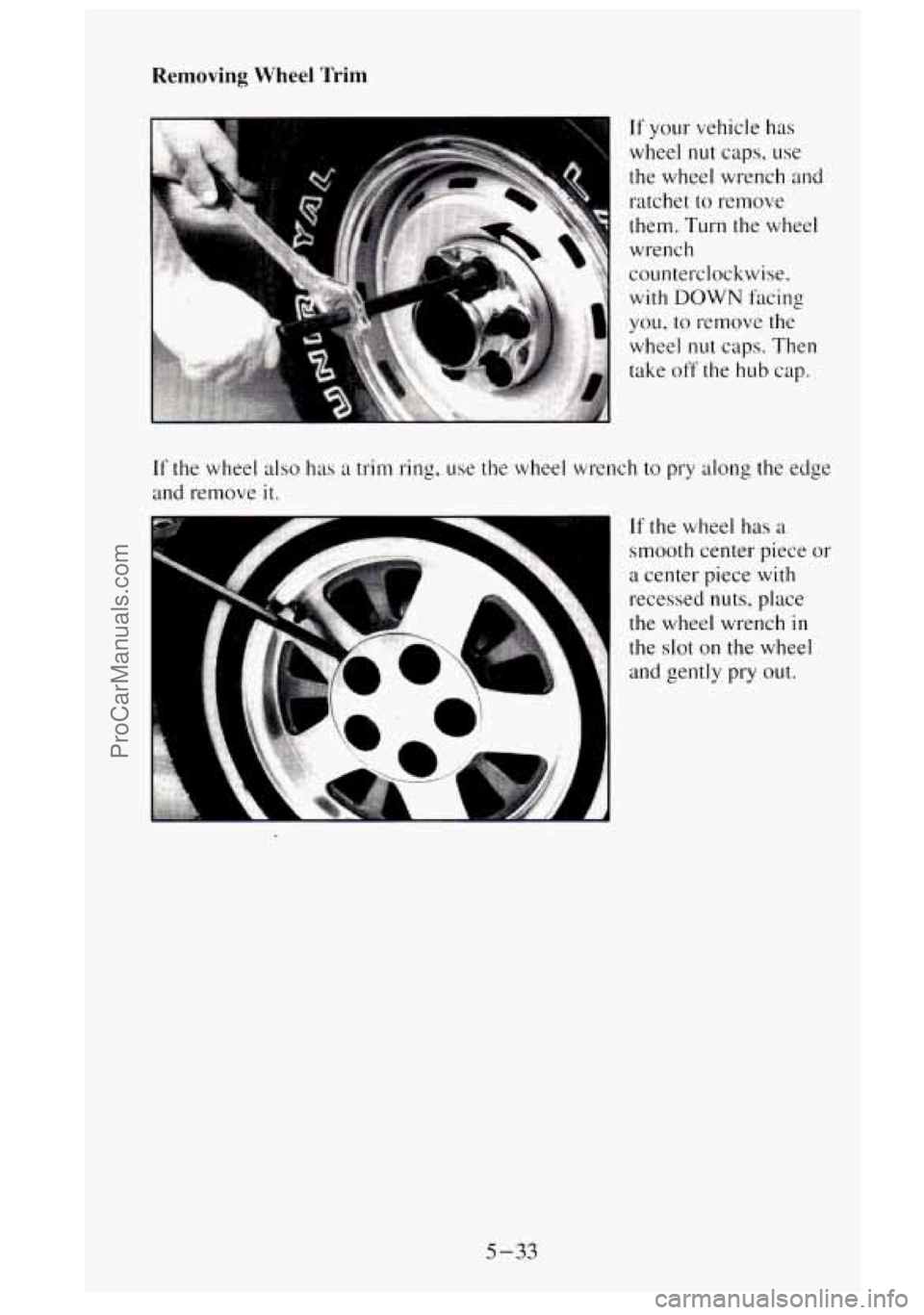
Kemoving Wheel Trim
If your vehicle has
wheel
nut caps, use
the wheel wrench and
ratchet
to remove
them. Turn the wheel
wrench
counterclockwise.
with DOWN facing
you, to remove the
wheel
nut caps. Then
take off the hub cap.
If the wheel also has a trim ring. use the wheel wrench to pry along the edge
and remove
it.
If the wheel has a
smooth center piece or
a center piece with
recessed nuts, place
the wheel wrench
in
the slot on the wheel
and gently
pry out.
5-33
ProCarManuals.com
Page 258 of 488
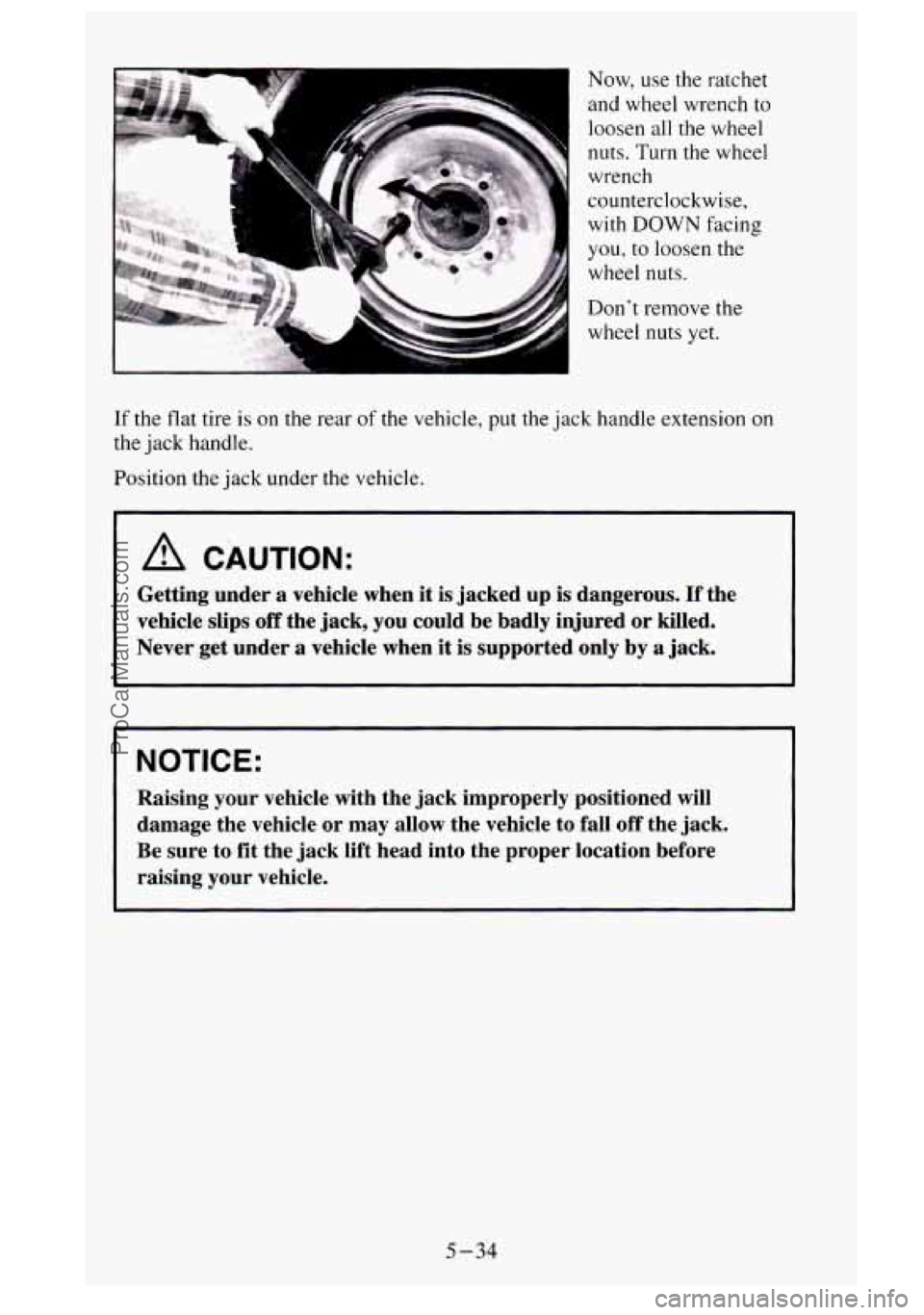
Now, use the ratchet
and wheel wrench to loosen all the wheel
nuts.
Turn the wheel
wrench
counterclockwise,
with DOWN facing
you, to loosen the
wheel nuts.
Don’t remove the
wheel nuts yet.
If the flat tire is on the rear of the vehicle, put the jack handle extension on
the jack handle.
Position the jack under the vehicle.
1 A CAUTION:
Getting under a vehicle when it is jacked up is dangerous. If the
vehicle slips
off the jack, you could be badly injured or killed.
Never get under a vehicle when
it is supported only by a jack.
NOTICE:
Raising your vehicle with the jack improperly positioned will
damage the vehicle or may allow the vehicle to fall
off the jack.
Be sure to
fit the jack lift head into the proper location before
raising your vehicle.
5-34
ProCarManuals.com
Page 259 of 488
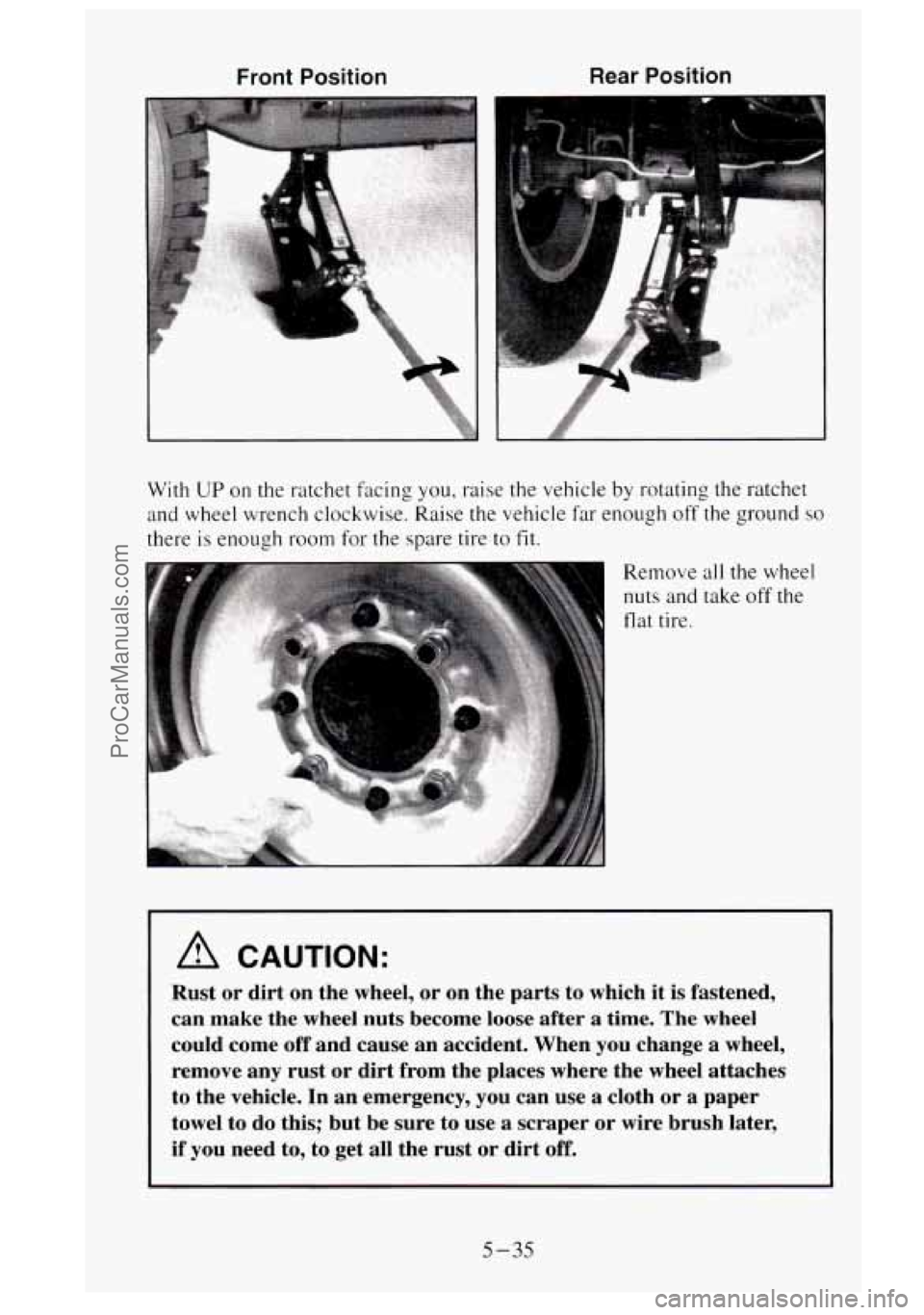
Front rosluon Rear Position
With UP on the ratchet facing you, raise the vehicle by rotating the ratchet
and wheel wrench clockwise. Raise the vehicle
far enough off the ground so
there is enough room for the spare tire to fit.
Remove
all the wheel
nuts and take
off the
flat tire,
A CAUTION:
Rust or dirt on the wheel, or on the parts to which it is fastened,
can make the wheel nuts become loose after a time. The wheel
could come
off and cause an accident. When you change a wheel,
remove any rust or dirt from the places where the wheel attaches
to the vehicle. In an emergency, you can use a cloth or a paper
towel
to do this; but be sure to use a scraper or wire brush later,
if you need to, to get all the rust or dirt off.
5-35
ProCarManuals.com
Page 260 of 488
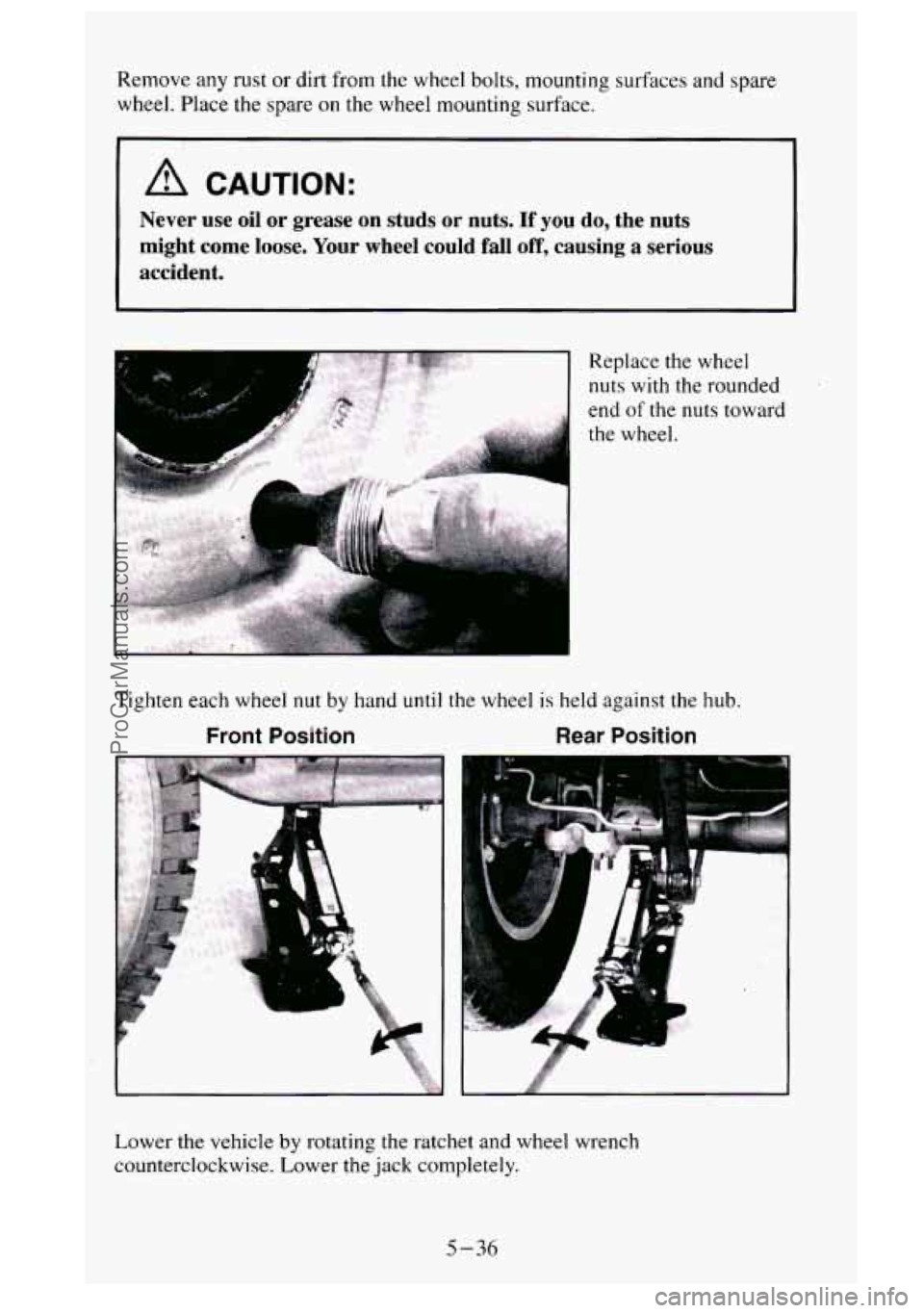
Remove any rust or dirt from the wheel bolts, mounting surfaces and spare
wheel. Place the spare
on the wheel mounting surface.
A CAUTION:
Never use oil or grease on studs or nuts. If you do, the nuts
might come loose. Your wheel could fall
off, causing a serious
accident.
Replace the wheel
nuts with the rounded
end
of the nuts toward
the wheel.
Tighten each wheel
nut by hand until the wheel is held against the hub.
Front Position Rear Position
Lower the vehicle by rotating the ratchet and wheel wrench
counterclockwise. Lower the jack completely.
5-36
ProCarManuals.com
Page 261 of 488
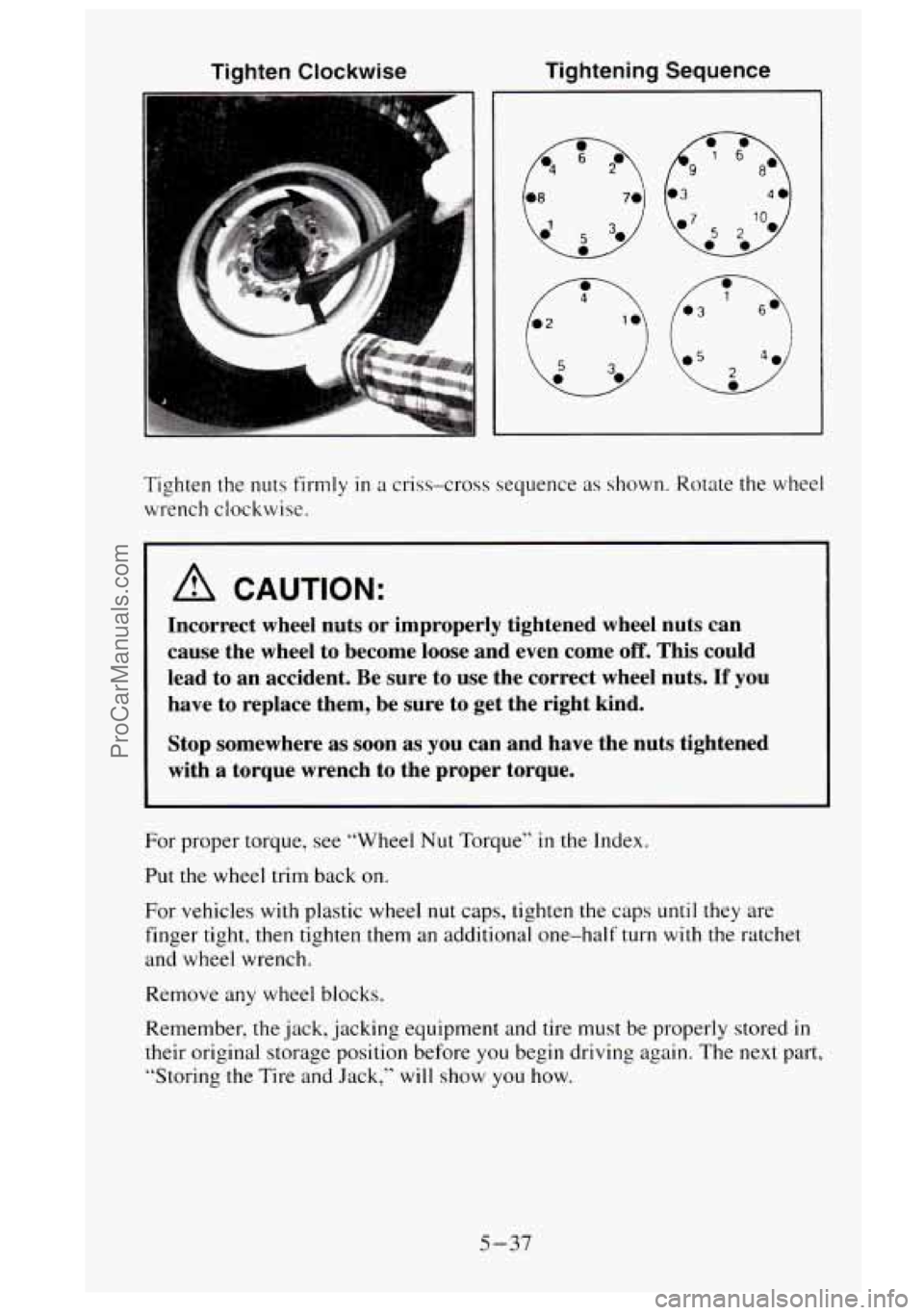
Tighten Clockwise Tightening Sequence
t
40
Tighten the
nuts firmly in a criss-cross sequence as shown. Rotate the wheel
wrench clockwise.
A CAUTION:
Incorrect wheel nuts or improperly tightened wheel nuts can
cause the wheel to become loose and even come
off. This could
lead to an accident. Be sure to use the correct wheel nuts.
If you
have to replace them, be sure to get the right kind.
Stop somewhere
as soon as you can and have the nuts tightened
with
a torque wrench to the proper torque.
For proper torque, see “Wheel Nut Torque” in the Index.
Put the wheel trim back on.
For vehicles with plastic wheel
nut caps, tighten the caps until they are
finger tight, then tighten them an additional one-half turn
with the ratchet
and wheel wrench.
Remove any wheel blocks.
Remember, the jack, jacking equipment and tire must be properly stored
in
their original storage position before you begin driving again. The next part,
“Storing the Tire and Jack,”
will show you how.
5-37
ProCarManuals.com