oil GMC SIERRA 1995 User Guide
[x] Cancel search | Manufacturer: GMC, Model Year: 1995, Model line: SIERRA, Model: GMC SIERRA 1995Pages: 488, PDF Size: 26.01 MB
Page 223 of 488
When You Are Ready to Leave After Parking on a Hill
1. Apply your regular brakes and hold the pedal down while you:
Start your engine:
Shift into a gear; and
Release the parking brake.
2. Let up on the brake pedal.
3. Drive slowly until the trailer is clear of the chocks.
4. Stop and have someone pick up and store the chocks.
Maintenance When Trailer Towing
Your vehicle will need service more often when you’re pulling a trailer. See
the Maintenance Schedule
for more on this. Things that are especially
important
in trailer operation are automatic transmission fluid (don’t
overfill), engine oil, axle lubricant, belt, cooling system, and brake
adjustment. Each of these is covered
in this manual, and the Index will help
you find them quickly. If you’re trailering, it’s
a good idea to review these
sections before you start your trip.
Check periodically to see that all hitch
nuts and bolts are tight.
Trailer Lighting Systems Wiring
See “Trailer Wiring Harness” in the Index.
4-49
ProCarManuals.com
Page 236 of 488
Cooling System - Gasoline Engines
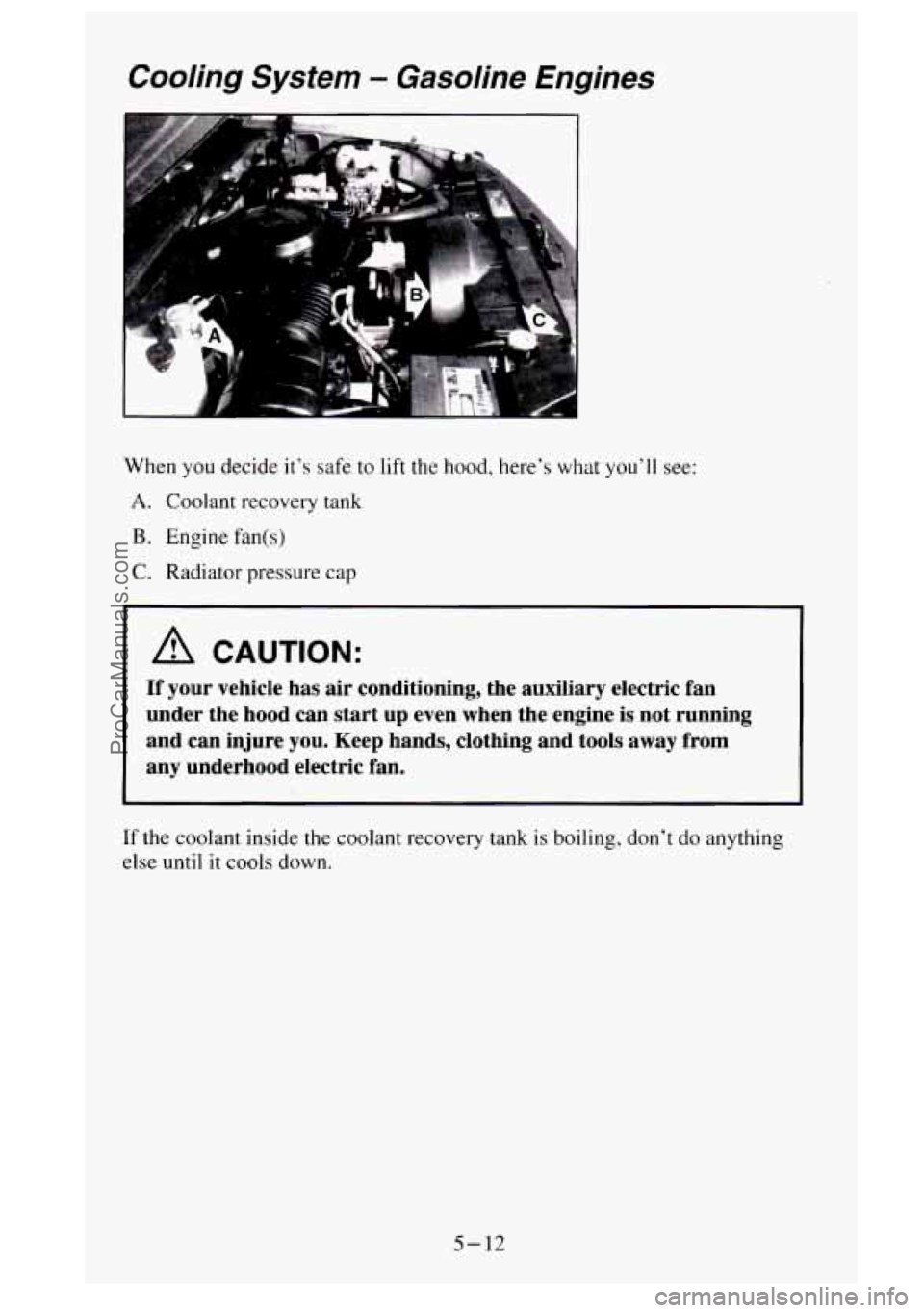
When you decide it’s safe to lift the hood, here’s what you’ll see:
A. Coolant recovery tank
B. Engine fan(s)
C. Radiator pressure cap
I A CAUTION:
If your vehicle has air conditioning, the auxiliary electric fan
under the hood can start up even when the engine is not runn\
ing
and can injure you. Keep hands, clothing and tools away from any underhood electric fan.
If the coolant inside the coolant recovery tank is boiling, don’t do anything
else
until it cools down.
5-12
ProCarManuals.com
Page 243 of 488
Cooling System - Diesel Engines
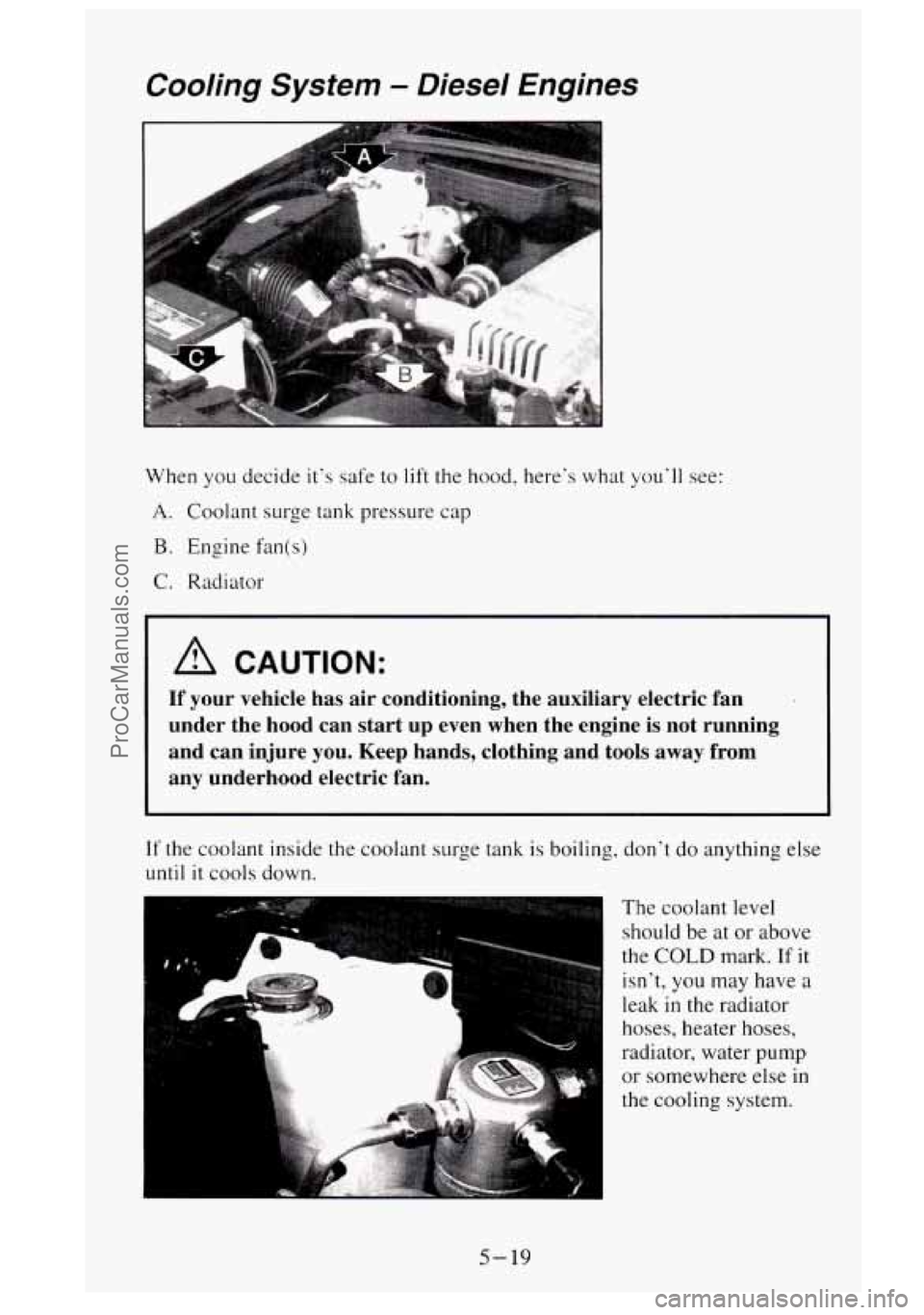
When you decide it‘s safe to lift the hood, here’s what you’ll see:
A. Coolant surge tank pressure cap
B. Engine fan(s)
C. Radiator
A CAUTION:
If your vehicle has air conditioning, the auxiliary electric fan
under the hood can start up even when the engine is not running
and can injure you. Keep hands, clothing and tools away from
any underhood electric fan.
If the coolant inside the coolant surge tank is boiling, don’t do anything else
until it cools down.
The coolant level
should be
at or above
the
COLD mark. If it
isn’t,
you may have a
leak in the radiator
hoses, heater hoses,
radiator, water pump
or somewhere else in
the cooling system.
5-19
ProCarManuals.com
Page 245 of 488
A CAUTION:
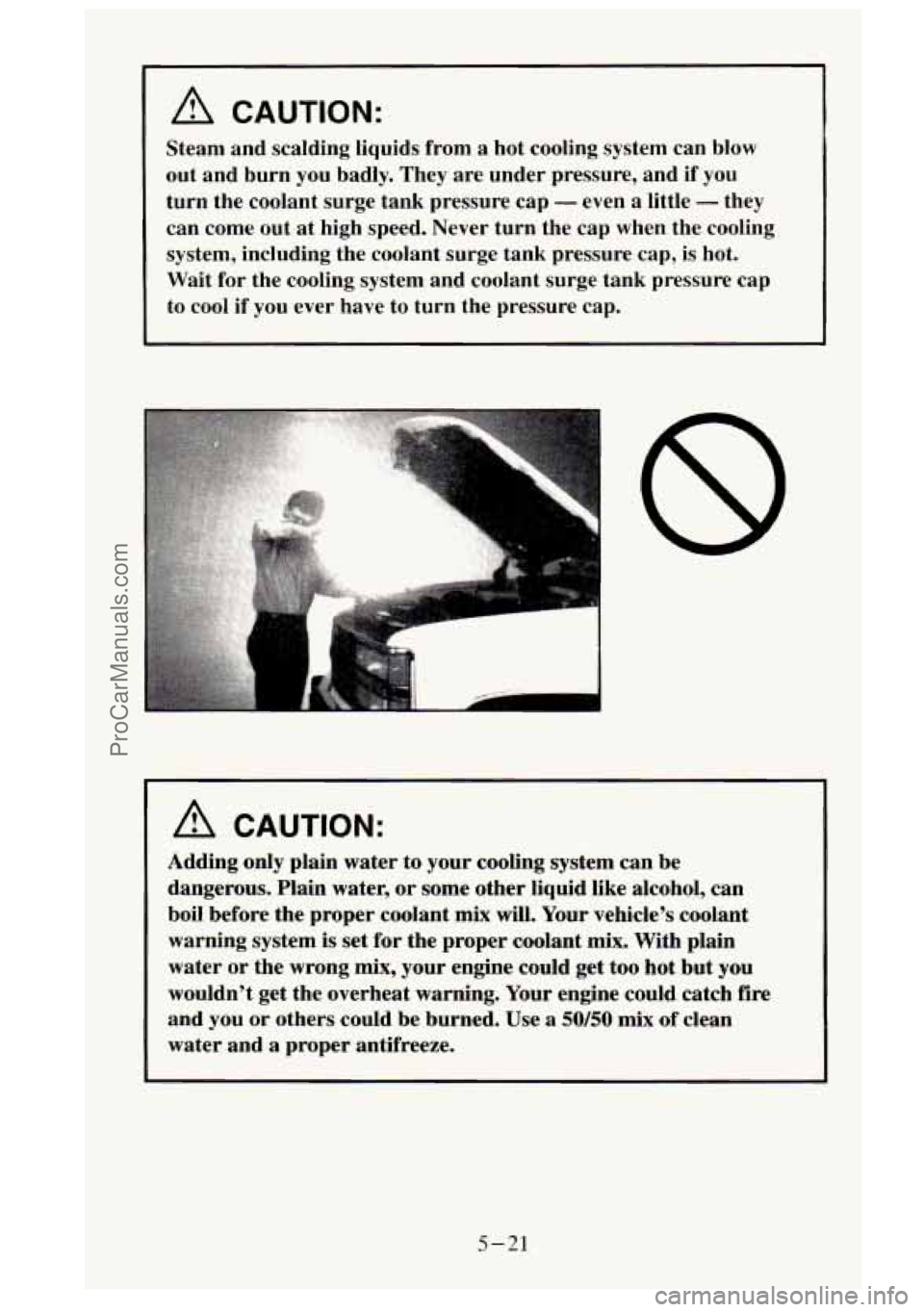
Steam and scalding liquids from a hot cooling system can blow
out and burn you badly. They are under pressure, and
if you
turn the coolant surge tank pressure cap
- even a little - they
can come out at high speed. Never turn the cap when the cooling
system, including the coolant surge tank pressure cap,
is hot.
’ Wait for the cooling system and coolant surge tank pressure cap
to cool
if you ever have to turn the pressure cap.
A CAUTION:
Adding only plain water to your cooling system can be
dangerous. Plain water, or some other liquid like alcohol, can
boil before the proper coolant mix
will. Your vehicle’s coolant
warning system is set for the proper coolant mix. With plain
water
or the wrong mix, your engine could get too hot but you
wouldn’t get the overheat warning. Your engine could catch fire
and you or others could be burned. Use
a 50/50 mix of clean
water and a proper antifreeze.
5-21
ProCarManuals.com
Page 260 of 488
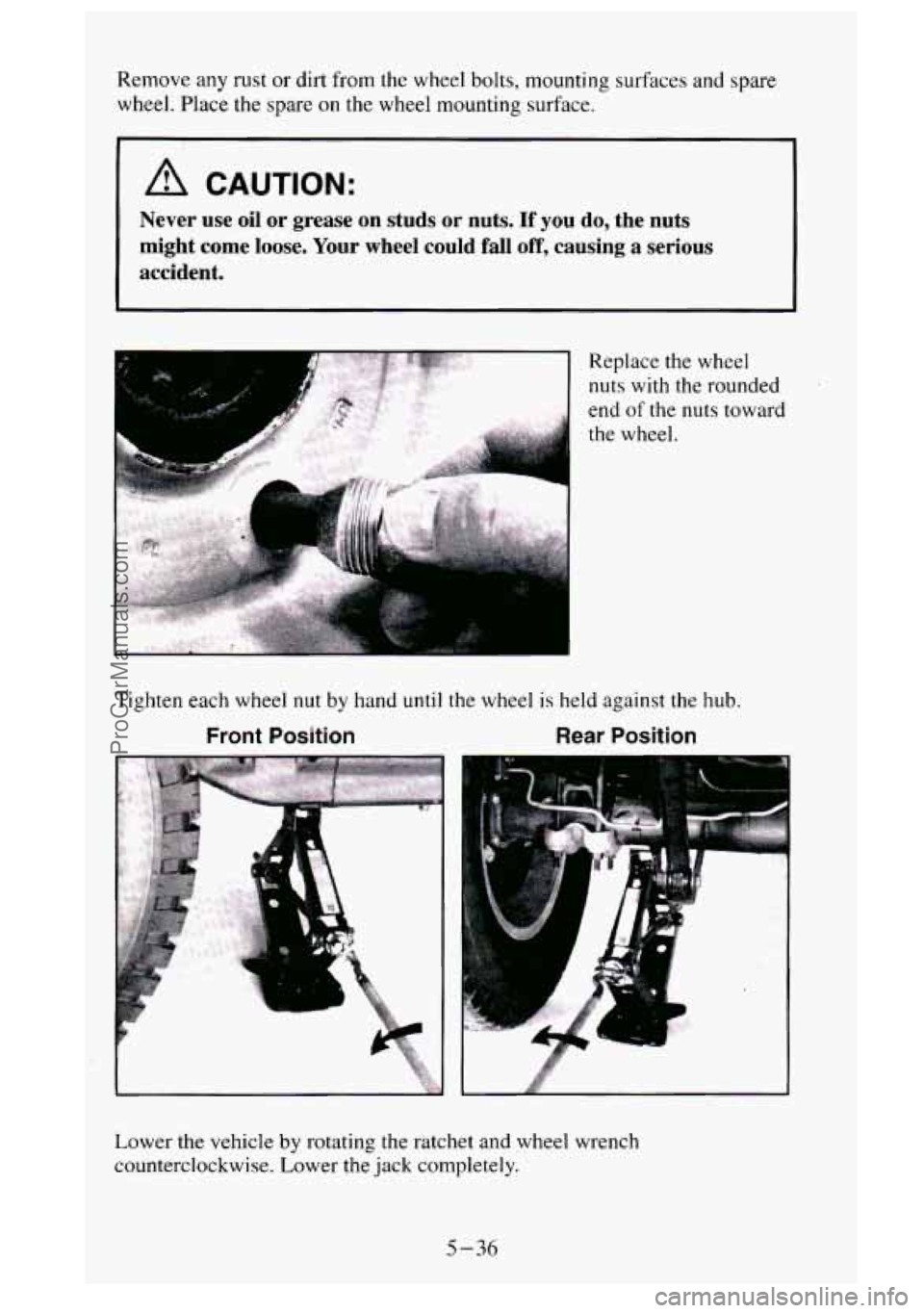
Remove any rust or dirt from the wheel bolts, mounting surfaces and spare
wheel. Place the spare
on the wheel mounting surface.
A CAUTION:
Never use oil or grease on studs or nuts. If you do, the nuts
might come loose. Your wheel could fall
off, causing a serious
accident.
Replace the wheel
nuts with the rounded
end
of the nuts toward
the wheel.
Tighten each wheel
nut by hand until the wheel is held against the hub.
Front Position Rear Position
Lower the vehicle by rotating the ratchet and wheel wrench
counterclockwise. Lower the jack completely.
5-36
ProCarManuals.com
Page 270 of 488
Fuel Requirements
NOTICE:
Diesel fuel or fuel additives not recommended in this manual
could damage your fuel system and engine. Your warranty
wouldn’t cover this damage. And:
Diesel fuel that has been mixed with engine oil could damage
your engine and emission controls. Always check with your
service station operator to make sure his diesel fuel has not \
been mixed with engine oil.
If you ever run out of diesel fuel, it can be difficult to restart
your engine. “Running Out of Fuel,” later in this section, tells
you how to get it started again.
To avoid all this, try never to
let your tank get empty.
What Fuel to Use
For best results, use Number 2-D diesel fuel year-round (above and below
freezing conditionsj as oil companies blend Number
2-D fuel to address
climate differences. Number
1-D diesel fuel may be used in very cold
temperatures (when
it stays below 0°F or -18°C); however, it will produce
a power and fuel economy loss. The use of Number I-D diesel fuel in warm
or hot climates may result in stalling, poor starting when the engine is hot
and
may damage the fuel injection system.
Diesel fuel may foam when you
fill your tank. This can cause the automatic
pump nozzle to shut off, even though your tank isn’t
full. If this happens,
just wait for the foaming to stop and then continue to
fill your tank.
A CAUTION:
Heat coming from the engine may cause the fuel to expand and \
force the fuel out of your tank.
If something ignites the fuel, a
fire could start and people could be burned. To help avoid this,
fill your fuel tank only until the automatic nozzle shuts
off.
Don’t try to “top it off.”
6-4
ProCarManuals.com
Page 271 of 488
Canadian Fuels
Diesel-powered trucks are now equipped with emission control systems that
require the use of diesel fuel with low-sulfur
(.05% by weight) content.
Both low- and higher-sulfur fuels will be available
in Canada. Only
low-sulfur diesel fuels are available
in the United States. It is important that
diesel-powered trucks are refueled with low-sulfur fuel. Use of fuels with
higher-sulfur content will affect
the function of the emission components
and may cause reduced performance, excessive smoke and unpleasant odor.
Cold Weather Operation
Follow the instructions listed previously under the heading “What Fuel to
Use.”
If you’re driving
in very toold temperatures and can’t get a “winterized”
Number
2-D that has been adapted to cold weather or a Number 1-D, you
can
use one gallon of kerosene for every two gallons of diesel fuel. Once
you add the kerosene, run your engine for several minutes
so the fuels will
mix. Add kerosene only when the temperature falls below 0°F (-1 S”C),
because the fuel economy of kerosene isn’t as good as that of diesel fuel.
NOTICE:
Never use home heating oil or gasoline in your diesel engine. \
They can cause engine damage.
In cold weather, your fuel filter may become clogged (waxed). To unclog it,
warm the filter to between
32°F and 50°F (OOC to 10°C). You won’t need
to replace
it.
Water in Fuel
Sometimes, water can be pumped into your fuel tank along with your diesel
fuel. This can happen
if a service station doesn’t regularly inspect and clean
its fuel tanks, or
if it gets contaminated fuel from its suppliers.
If this happens, a WATER
IN FUEL light will come on. If it does, the excess
water must be drained. Your dealer can show
you how to do this.
6-5
ProCarManuals.com
Page 273 of 488

Hesitation or “flat” performance at high speed or during \
hard acceleration
may be an indication of premature fuel filter plugging due to dirty or
contaminated fuel. The fidter element may need to be changed
if this
happens. See your dealer for assistance.
To drain water:
1. Stop and park the vehicle in a safe place. Turn off the engine and apply
2. Remove the fuel tank cap.
the parking brake.
3. Place a
fuel-resistant container under the filter drain hose.
5.
6.
7.
8.
4. With the engine
off, open the
water drain valve
2 to 3 turns.
When standing in
front of the
vehicle, the valve
is located on the
right side of the
thermostat
housing.
Start the engine and allow it to idle until clear fuel is ob\
served.
Stop the engine and close the water drain valve.
Remove the fuel-resistant container and properly dispose of the
contaminated fuel.
To find out how to properly dispose of contaminated
diesel fuel see “What to Do with Used Oil” in the “E\
ngine Oil (Diesel
Engines)” part, later in this section.
Install the fuel tank cap.
If the WATER IN FUEL light comes on again after driving a short distance
or the engine runs rough or stalls-a large amount of water has probably
been pumped into the
fuel tank. The fuel tank should be purged.
6-7
ProCarManuals.com
Page 277 of 488
Fuels in Foreign Countries (Gasoline Engines)
If you plan on driving in another country outside the U.S. or Canada,
unleaded fuel may be hard to find.
Do not use leaded gasoline. If you use
even one tankful, your emission controls won’t work well or at all. With
continuous use, spark plugs can get fouled, the exhaust system can corrode,
and your engine
oil can deteriorate quickly. Your vehicle’s oxygen sensor
will be damaged.
All of that means costly repairs that wouldn’t be covered
by your warranty.
To check on fuel availability, ask an auto club, or contact a major oil
company that does business in the country where you’ll be driving.
You can also write
us at the following address for advice. Just tell us where
you’re going and give your Vehicle Identification Number
(VIN).
General Motors Overseas Distribution Corporation,
North American Export Sales (NAES)
1908 Colonel Sam Drive
Oshawa, Ontario
LlH 8P7
Filling Your Tank
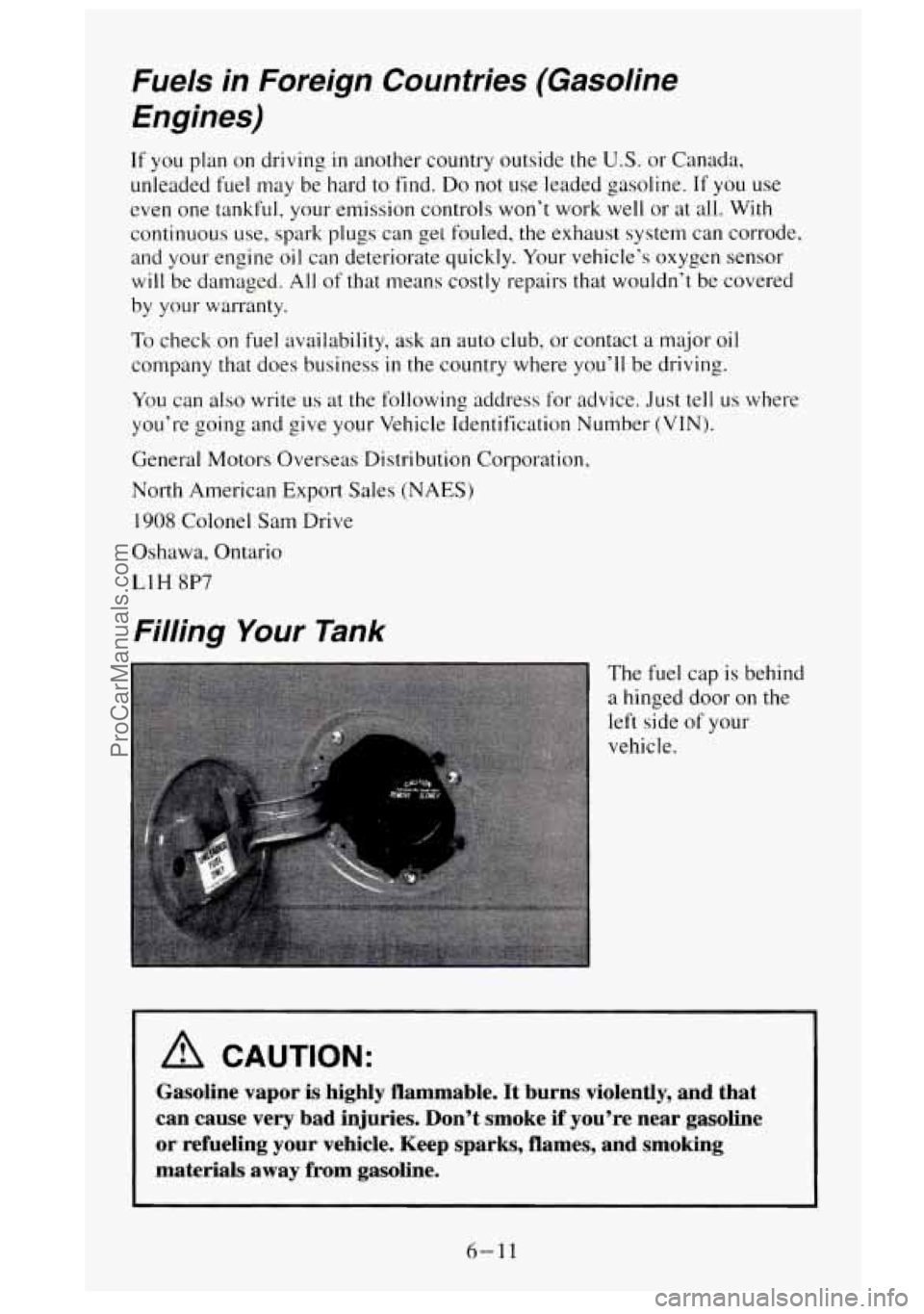
The fuel cap is behind
a hinged door on
the
left side of your
vehicle.
A CAUTION:
Gasoline vapor is highly flammable. It burns violently, and that
can cause very bad injuries. Don’t smoke
if you’re near gasoline
or refueling your vehicle. Keep sparks, flames, and smoking
materials away from gasoline.
6-11
ProCarManuals.com
Page 280 of 488
A CAUTION:
If your vehicle has air conditioning, the auxiliary engine fan
under the hood can start up and injure you even when the
engine is not running. Keep hands, clothing and tools
away from
any underhood electric fan.
A CAUTION:
Things that burn can get on hot engine parts and start a fire.
These include liquids like gasoline or diesel fuel, oil, coolant,
brake fluid, windshield washer and other fluids, and plastic
or
rubber. You or others could be burned. Be careful not to drop or
spill things that
will burn onto a hot engine.
Before closing the hood, be sure
all filler caps are on properly. Pull down
the
hood and close it firmly.
Cleaning Your Diesel Engine
I NOTICE:
If you spray or pour water or any other liquid on your engine
when it is warm or hot, or when it
is running, you could cause
serious damage to it.
If you ever clean the engine, clean it only
when it is cold.
Noise Control System
The following information relates to compliance with Federal noise
emission standards for vehicles with a Gross Vehicle Weight Rating
(GVWR)
of more than 10,000 pounds (4 536 kilograms). The Maintenance
Schedule booklet provides information on maintaining
the noise control
system to minimize degradation of the noise emission control system during
the life of your vehicle. The noise control system warranty is given in your
Warranty booklet.
These standards apply only
to vehicles sold in the United States.
6-14
ProCarManuals.com