change time GMC SIERRA 1995 Owner's Manual
[x] Cancel search | Manufacturer: GMC, Model Year: 1995, Model line: SIERRA, Model: GMC SIERRA 1995Pages: 488, PDF Size: 26.01 MB
Page 287 of 488
Engine Coolant Heater
An engine coolant heater can be a big help if you have to park outside in
very cold weather, 0°F (-1 8OC) or colder. If your vehicle has this option,
see “Engine Coolant Heater’’ in the Index.
What to Do with Used Oil
Did you know that used engine oil contains certain elements that may be
unhealthy for your skin and could even cause cancer? Don’t let used oil stay
on your skin for very long. Clean your skin and nails with soap and water,
or a good hand cleaner. Wash or properly throw away clothing or rags
containing used engine oil. (See the manufacturer‘s warnings about the use
and disposal of
oil products.)
Used oil can be a real threat to
the environment. If you change your own oil,
be sure to drain all free-flowing oil from the filter before disposal. Don’t
ever dispose
of oil by putting it in the trash, pouring it on the ground, into
sewers, or into streams or bodies
of water. Instead. recycle it by taking it to
a place that collects used oil. If you have a problem properly disposing of
your used oil, ask your dealer, a service station or a local recycling center
for help.
Engine Oil (Diesel Engines)
It’s a good idea to check your engine oil level every time you get fuel. In
order to get an accurate reading, the oil must be warm and
the vehicle must
be on level ground.
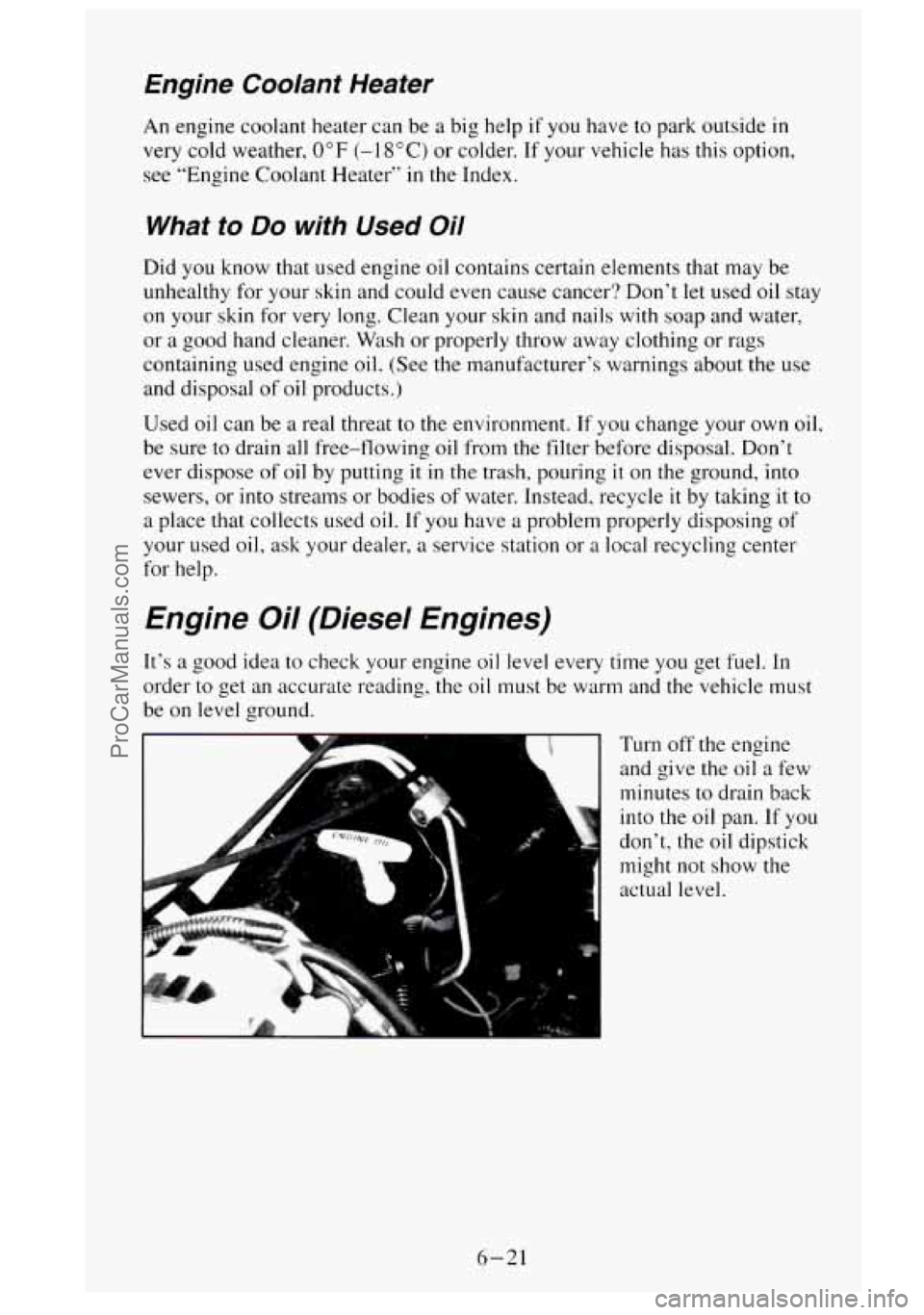
Turn off the engine
and give the oil
a few
minutes
to drain back
into the
oil pan. If you
don’t, the oil dipstick
might not show the
actual level.
6-21
ProCarManuals.com
Page 293 of 488
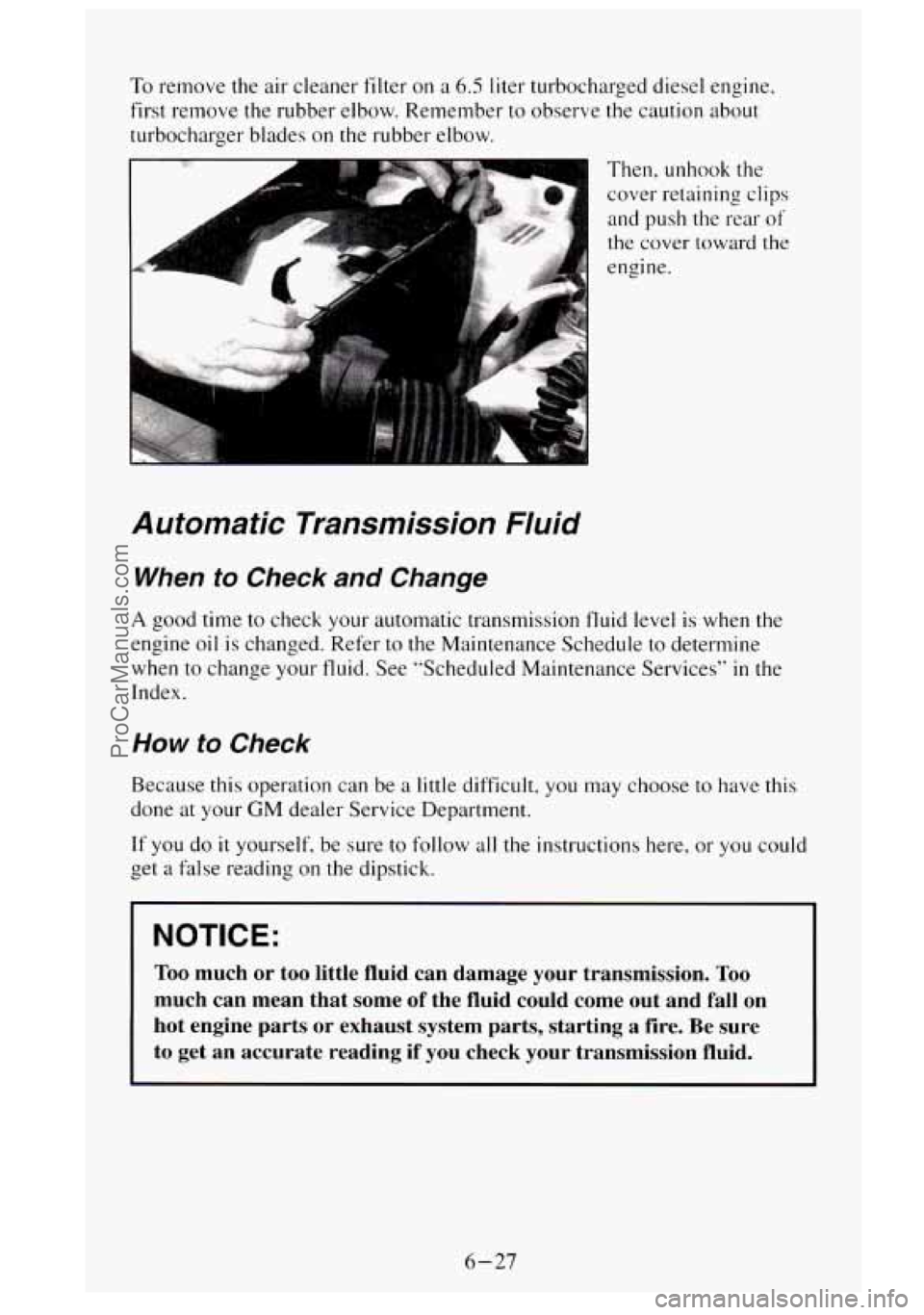
To remove the air cleaner filter on a 6.5 liter turbocharged diesel engine,
first remove the rubber elbow. Remember to observe the caution about
turbocharger blades on the rubber elbow.
Then, unhook the
cover retaining clips
and push the rear
of
the cover toward the
engine.
Automatic Transmission Fluid
When to Check and Change
A good time to check your automatic transmission fluid level is when the
engine
oil is changed. Refer to the Maintenance Schedule to determine
when to change your fluid. See "Scheduled Maintenance Services''
in the
Index.
How to Check
Because this operation can be a little difficult, you may choose to have this
done at your
GM dealer Service Department.
If you do
it yourself, be sure to follow all the instructions here, or you could
get
a false reading on the dipstick.
NOTICE:
Too much or too little fluid can damage your transmission. Too
much can mean that some of the fluid could come out and fall on
hot engine parts or exhaust system parts, starting a fire. Be \
sure
to get an accurate reading if you check your transmission fluid.
6-27
ProCarManuals.com
Page 296 of 488
How to Add Fluid
Refer to the Maintenance Schedule to determine what kind of transmission
fluid
to use. See “Recommended Fluids and Lubricants” in the Index.
Add fluid only after checking the transmission fluid
HOT. (A COLD check
is used
only as a reference.) If the fluid level is low, add only enough of the
proper fluid to bring the level up
to the HOT area for a hot check. It doesn’t
take much fluid, generally less than a
int. Don ’t overfill. We recommend
you use only fluid labeled DEXRON
-111, because fluid with that label is
made especially for your automatic transmission. Damage caused by fluid
other than DEXRON@-I11 is not covered by your
new vehicle warranty.
8
0 After adding fluid, recheck the fluid level as described under “How to
Check.”
0 When the correct fluid level is obtained, push the dipstick back in all
the way; then flip the handle down
to lock the dipstick in place.
Manual Transmission Fluid
When to Check
A good time to have it checked is when the engine oil is changed. However,
the fluid
in your manual transmission doesn’t require changing.
How to Check
Because this operation can be a little difficult, you may choose to have this.
done at your
GM dealer Service Department.
If you do it yourself, be sure to follow all the instructions here, or you could
get a false reading.
NOTICE:
Too much or too little fluid can damage your transmission. Too
much can mean that some of the fluid could come out and fall on
hot engine parts or exhaust system parts, starting a fire.
Be sure
to get an accurate reading if you check your transmission fluid.
Check the fluid level only when your engine is off, the vehicle is parked on
a level place and the transmission is cool enough for you to rest your fingers
on the transmission case.
6-30
ProCarManuals.com
Page 299 of 488
What to Use
Refer to the Maintenance Schedule to determine what kind of lubricant to
use. See “Recommended Fluids and Lubricants”
in the Index.
C3 (3500 H.D.) Trucks Equipped with Dana Rear Axle
Additional rear axle scheduled maintenance is required on 3500 H.D.
models equipped with Dana rear axles when they are driven under the
following conditions:
0 Extreme loading (at or near GVWR) or trailer towing, and:
Operation above 45 mph for extended periods of time
Vehicles used
in any of these conditions require the rear axle lubricant (SAE
8OW-90 - GL-5) be changed every 3 months or 3,000 miles, whichever
comes first.
To reduce required maintenance, SAE 75W-140 synthetic gear lubricant
may be used. With the use of synthetic
SAE 75W-140 lubricant, the fluid
change intervals may be increased to 30,000 miles. Before using SAE
75W-140, it is important to drain and flush the axle with clean mineral
based (non-synthetic) axle lubricant. Fluid capacity is 4.12 qts. (3.9L).
Four- Wheel Drive
Most lubricant checks in this section also apply to four-wheel-drive
vehicles. However, they have two additional systems that need lubrication.
Transfer Case
When to Check Lubricant
Refer to the Maintenance Schedule to determine how often to check the
lubricant. See “Periodic Maintenance Inspections”
in the Index.
6-33
ProCarManuals.com
Page 311 of 488
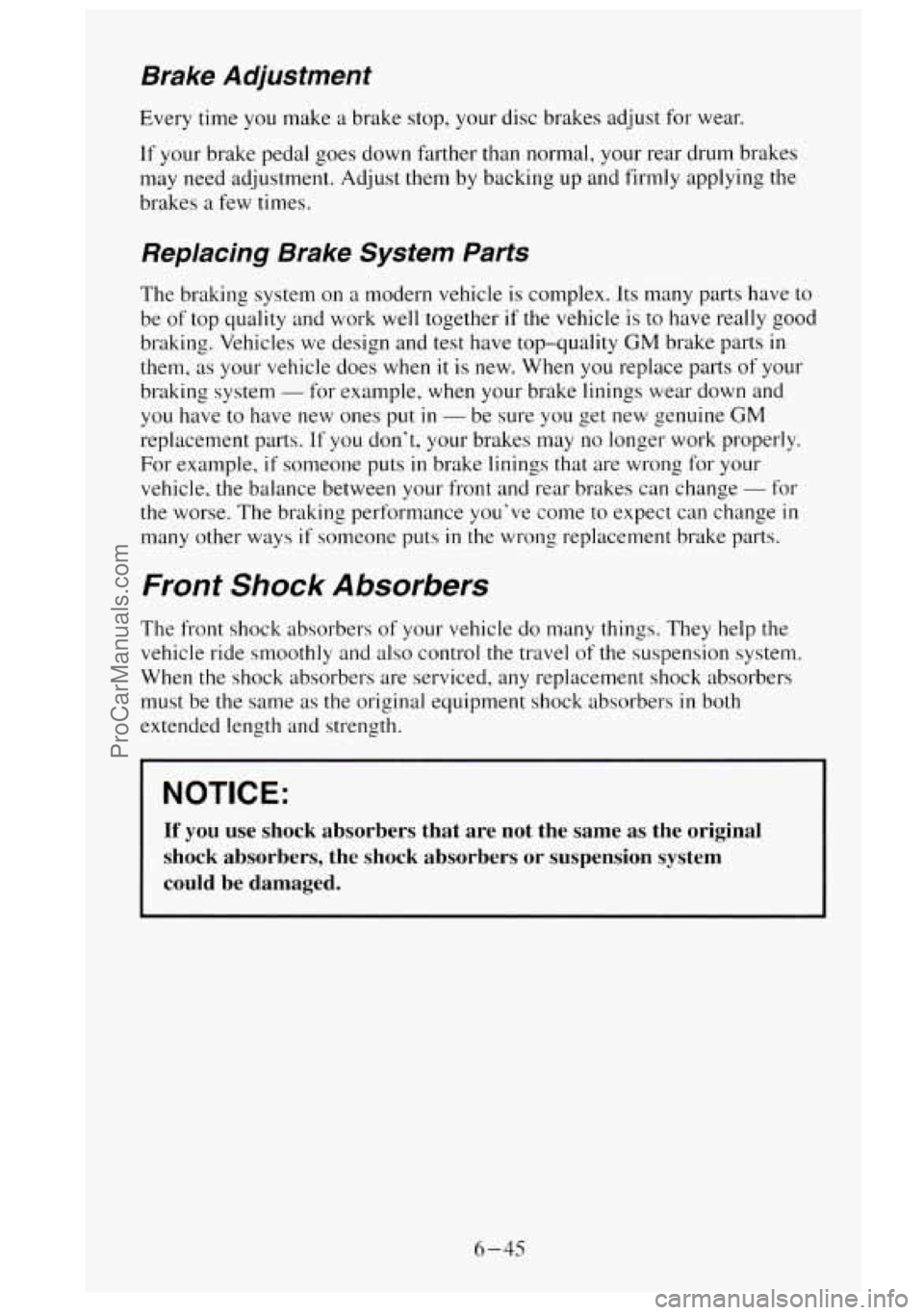
Brake Adjustment
Every time you make a brake stop, your disc brakes adjust for wear.
If your brake pedal goes down farther than normal, your rear drum brakes
may need adjustment. Adjust them by backing
up and firmly applying the
brakes
a few times.
Replacing Brake System Parts
The braking system on a modeffl VEShicle is complex. Its many parts have to
be of top quality and work well together if the vehicle
is to have really good
braking. Vehicles we design and test have top-quality
GM brake parts in
them, as your vehicle does when it is new. When you replace parts of your
braking system
- for example, when your brake linings wear down and
you have to have new ones put
in - be sure you get new genuine GM
replacement parts. If you don't, your brakes may no longer work properly.
For example, if someone puts in brake linings that are wrong for your
vehicle, the balance between your front and rear brakes can change
- for
the worse. The braking performance you've come to expect can change
in
many other ways if someone puts in the wrong replacement brake parts.
Front Shock Absorbers
The front shock absorbers of your vehicle do many things. They help the
vehicle ride smoothly and
also control the travel of the suspension system.
When the shock absorbers are serviced, any replacement shock absorbers
must be the same as the original equipment shock absorbers
in both
extended length and strength.
I NOTICE:
If you use shock absorbers that are not the same as the original
shock absorbers, the shock absorbers
or suspension system
could be damaged.
6-45
ProCarManuals.com
Page 346 of 488
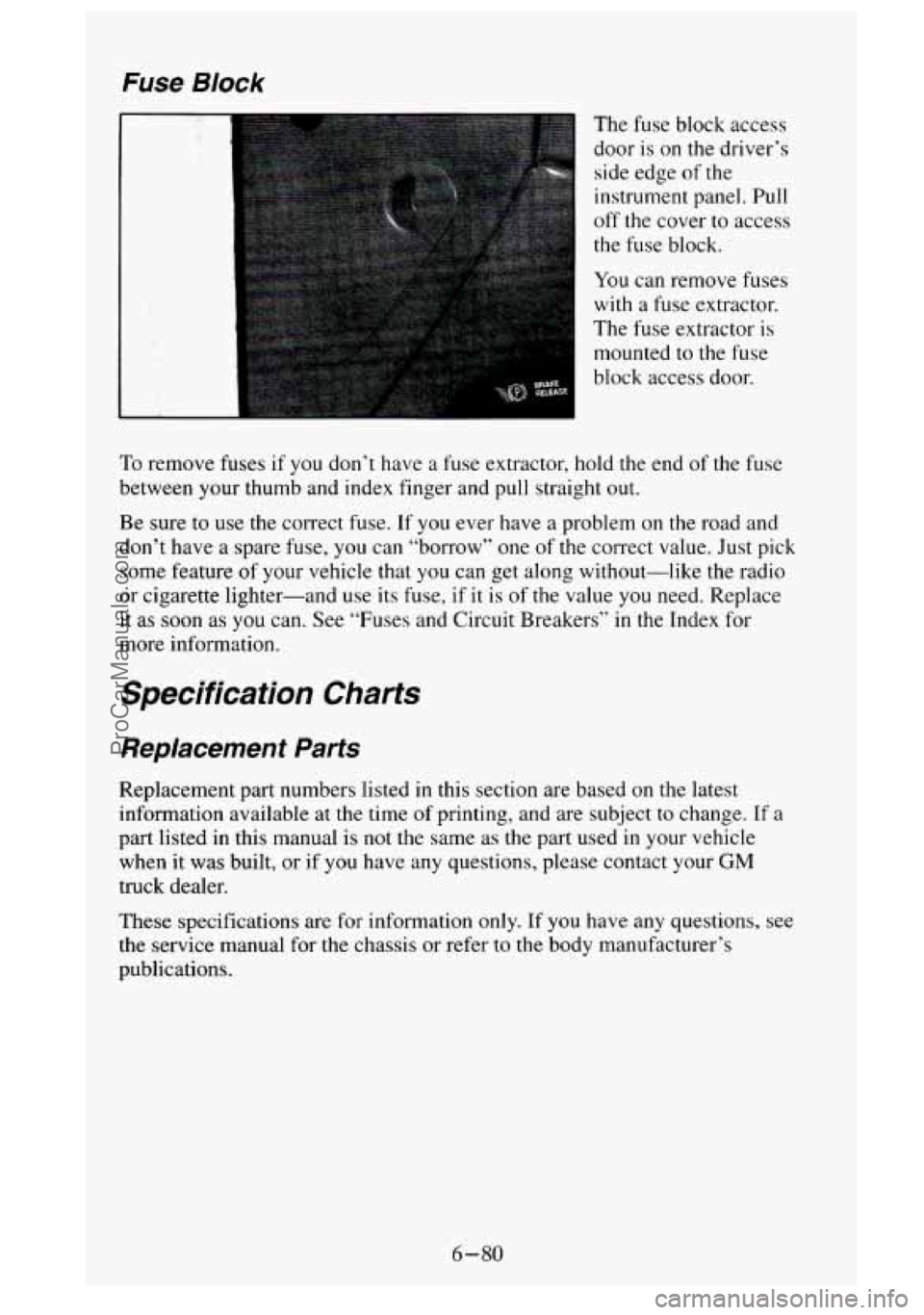
Fuse Block
The fuse block access
door is on the driver’s
side edge
of the
instrument panel.
Pull
off the cover to access
the fuse block.
You can remove fuses
with a fuse extractor.
The fuse extractor is
mounted to the fuse
block access door.
To remove fuses if you don’t have a fuse extractor, hold the end of the fuse
between your thumb and index finger and pull straight out.
Be sure to use the correct fuse. If you ever have a problem
on the road and
don’t have a spare fuse, you can “borrow” one
of the correct value. Just pick
some feature of your vehicle that
you can get along without-like the radio
or cigarette lighter-and use its fuse, if
it is of the value you need. Replace
it as soon as you can. See “Fuses and Circuit Breakers” in the Tndex for
more information.
Specification Charts
Replacement Parts
Replacement part numbers listed in this section are based on the latest
information available at the time
of printing, and are subject to change. If a
part listed in this manual is not the same as the part used in your vehicle
when it was built,
or if you have any questions, please contact your GM
truck dealer.
These specifications are for information
only. If you have any questions, see
the service manual for the chassis or refer
to the body manufacturer’s
publications.
6-80
ProCarManuals.com
Page 368 of 488
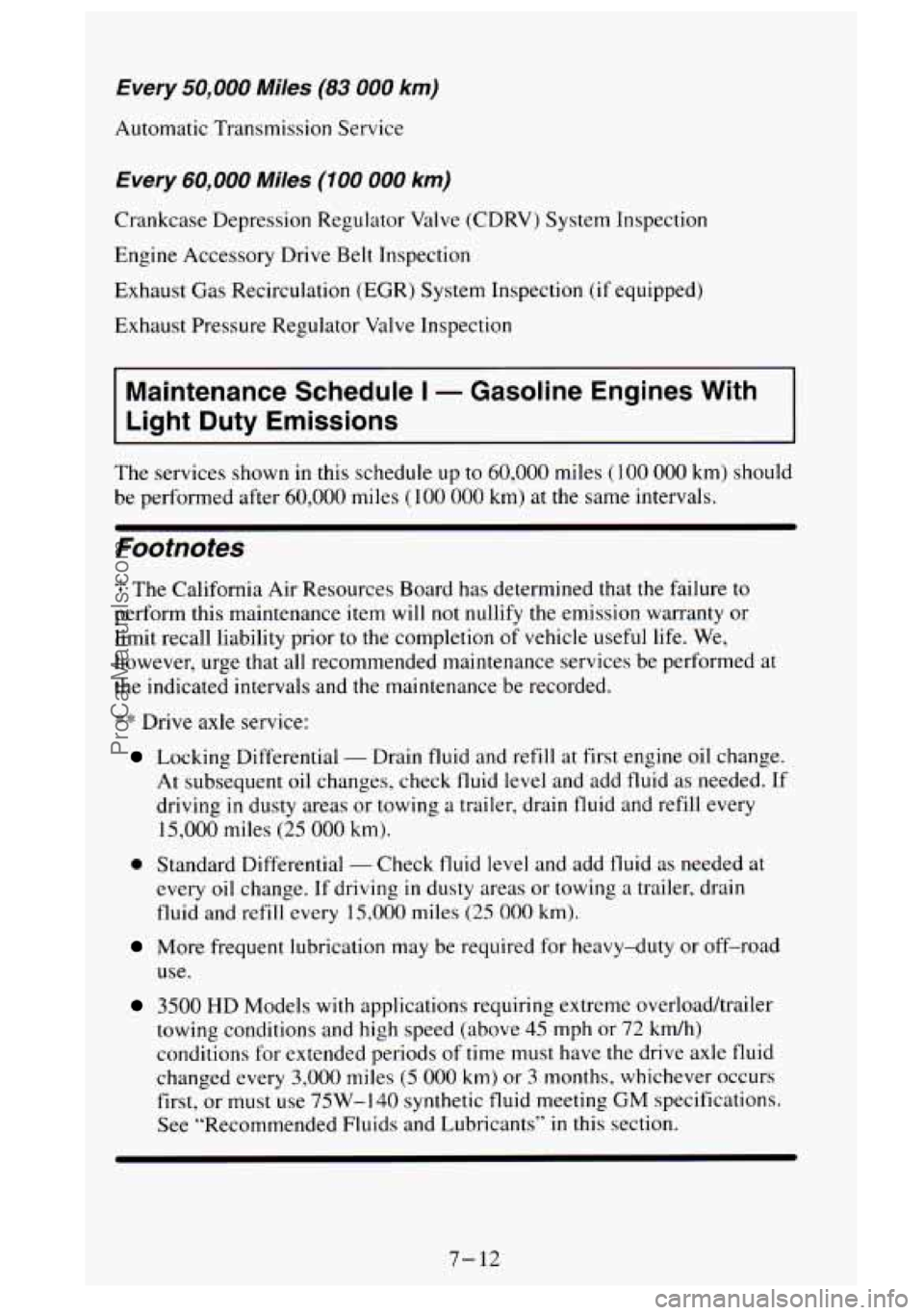
Every 50,000 Miles (83 000 km)
Automatic Transmission Service
Every 60,000 Miles (100 000 km)
Crankcase Depression Regulator Valve (CDRV) System Inspection
Engine Accessory Drive Belt Inspection
Exhaust Gas Recirculation (EGR) System Inspection
(if equipped)
Exhaust Pressure Regulator Valve Inspection
Maintenance Schedule I - Gasoline Engines With
Light
Duty Emissions
The services shown in this schedule up to 60,000 miles (1 00 000 km) should
be performed after
60,000 miles (100 000 km) at the same intervals.
Footnotes
3 The California Air Resources Board has determined that the failure to
perform this maintenance item will not nullify the emission warranty or
limit recall liability prior to the completion of vehicle useful life. We,
however, urge that all recommended maintenance services be performed at
the indicated intervals and the maintenance be recorded.
:$* Drive axle service:
Locking Differential - Drain fluid and refill at first engine oil change.
At subsequent oil changes, check fluid level and add fluid
as needed. If
driving in dusty areas or towing a trailer, drain fluid and refill every
15,000 miles (25 000 km).
0 Standard Differential - Check fluid level and add fluid as needed at
every oil change.
If driving in dusty areas or towing a trailer, drain
fluid and refill every 15,000 miles (25 000 km).
More frequent lubrication may be required for heavy-duty or off-road
use.
3500 HD Models with applications requiring extreme overload/trailer
towing conditions and high speed (above
45 mph or 72 kmh)
conditions for extended periods of time must have the drive axle fluid
changed every
3,000 miles (5 000 km) or 3 months, whichever occurs
first, or must use
75W-140 synthetic fluid meeting GM specifications.
See “Recommended Fluids and Lubricants”
in this section.
7-12
ProCarManuals.com
Page 374 of 488
Maintenance Schedule I - Gasoline Engines With
Light Duty Emissions
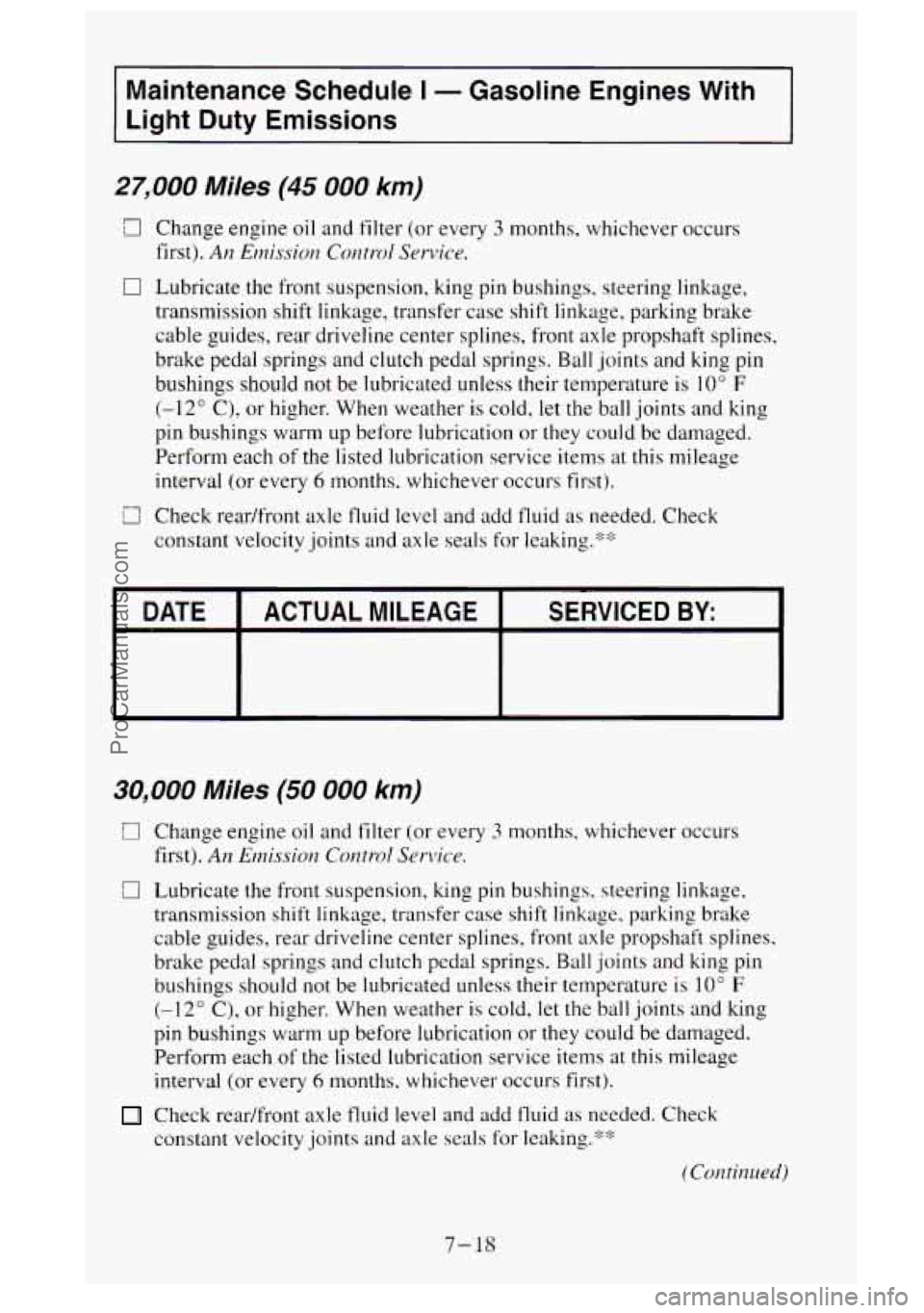
27,000 Miles (45 000 km)
a Change engine oil and filter (or every 3 months. whichever occurs
first).
Arz Enzissiorz Control Service.
0 Lubricate the front suspension, king pin bushings, steering linkage,
transmission shift linkage, transfer case shift linkage. parking brake
cable guides, rear driveline center splines, front axle propshaft splines.
brake pedal springs and clutch pe,dal springs.
Ball joints and king pin
bushings should not be lubricated unless their temperature is
10" F
(-12" C), or higher. When weather is cold, let the ball joints and king
pin bushings warm up before lubrication or they could be damaged.
Perform each of the listed lubrication service items at this mileage
interval (,or every
6 months. whichever occurs first).
Ll Check readfront axle fluid level and add fluid as needed. Check
constant velocity joints and axle seals for leaking.:!::':
30,000 Miles (50 000 km)
CI Change engine oil and filter (or every 3 months, whichever occurs
first).
An Euzission Corltrol Service.
0 Lubricate the front suspension, king pin bushings, steering linkage,
transmission shift linkage, transfer case shift linkage, parking brake
cable guides, rear driveline center splines, front axle propshaft splines,
brake pedal springs and clutch pedal springs. Ball joints and king pin
bushings should not be lubricated unless their temperature is
10" F
(-12" C), or higher. When weather is cold, let the ball joints and king
pin bushings warm
up before lubrication or they could be damaged.
Perform each
of the listed lubrication service items at this mileage
interval (or every
4 months. whichever occurs first).
Check readfront axle fluid level and add fluid as needed. Check
constant velocity joints and axle seals for leaking.'+:+
(Contimed)
7-18
ProCarManuals.com
Page 375 of 488
LI
c
Maintenance Schedule I - Gasoline Engines With
Light Duty Emissions
(Contimed)
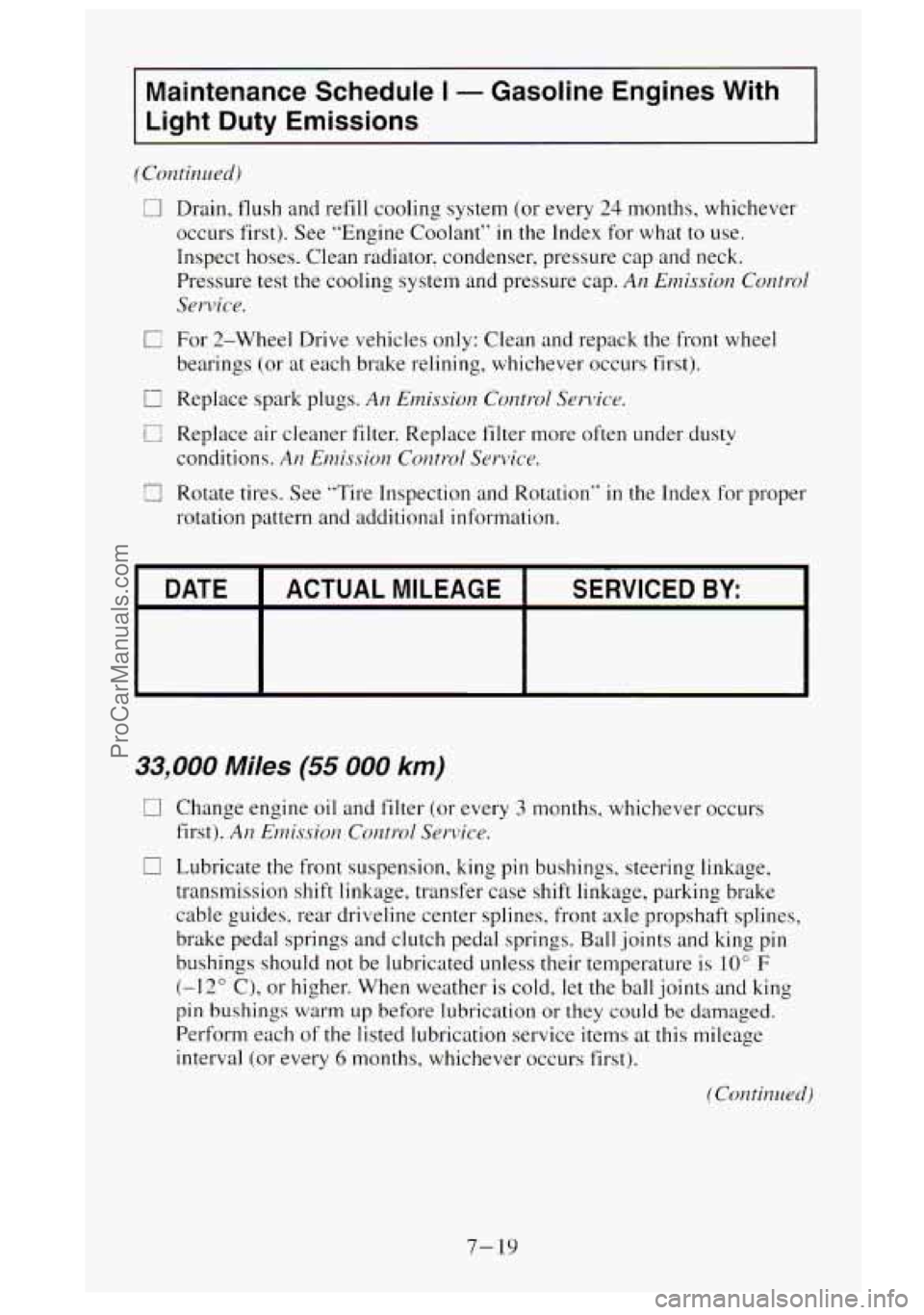
Drain, flush and refill cooling system (or every 24 months, whichever
occurs first). See "Engine Coolant''
in the lndex for what to use.
Inspect hoses. Clean radiator. condenser. pressure cap and neck.
Pressure test
the cooling system and pressure cap. An Emission Control
Service.
For 2-Wheel Drive vehicles only: Clean and repack the front wheel
bearings (or at each brake relining, whichever occurs first).
Replace spark plugs.
An E~~zissior~ Corztrol Ser-vice.
Replace air cleaner filter. Replace filter more often under dusty
conditions.
An Emission Cor~tr-01 Service.
Rotate tires. See "Tire Inspection and Rotation" in the lndex for proper
rotation pattern and additional information.
I DATE I ACTUAL MILEAGE I SERVICED BY:
33,000 Miles (55 000 km)
0 Change engine oil and filter (or every 3 months, whichever occurs
first).
An Er7rissiou Contmi Service.
0 Lubricate the front suspension, king pin bushings, steering linkage,
transmission shift linkage, transfer case shift linkage, parking brake
cable guides, rear driveline center splines, front axle propshaft splines,
brake pedal springs and clutch pedal springs.
Ball joints and king pin
bushings should not be lubricated unless their temperature is
10" F
(-I 2" C), or higher. When weather is cold, let the ball joints and king
pin bushings warm up before lubrication or they could be damaged.
Perform
each of the listed lubrication service items at this mileage
interval (or every
6 months, whichever occurs first).
ProCarManuals.com
Page 383 of 488
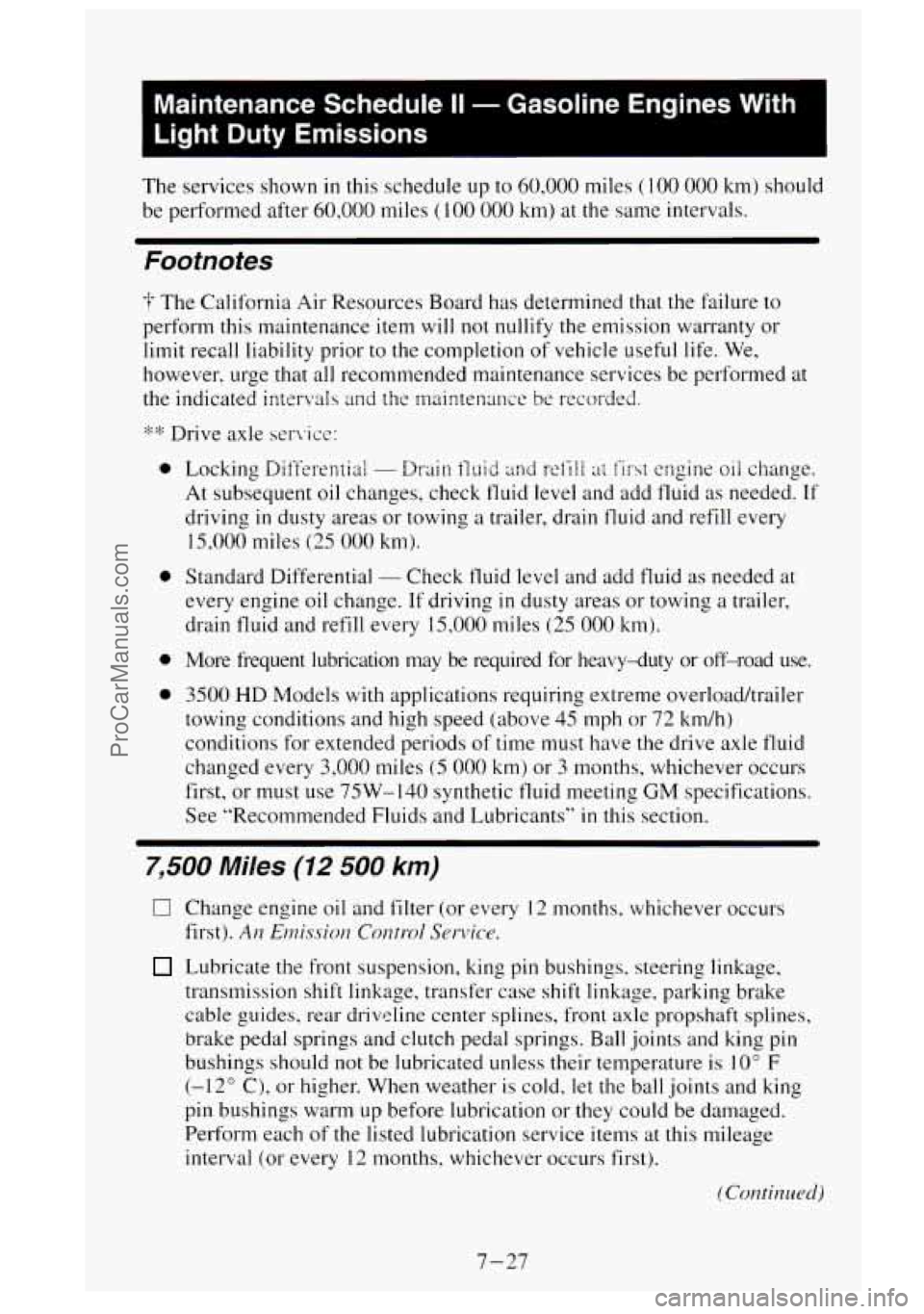
Maintenance Schedule II - Gasoline Engines With
Light Duty Emissions
The services shown in this schedule up to 60.000 miles ( 100 000 km) should
be performed after
60.000 miles ( 100 000 km) at the same intervals.
Footnotes
-i- The California Air Resources Board has determined that the Failure to
perform this maintenance item will
not nullify the emission warranty or
limit recall liability prior
to the completion of vehicle useful life. We,
however. urge that all recommended maintenance services be performed at
the indicated intsrkrds
and t!w rnlrinlcn;nnx be recor-ded.
0
0
0
0
Locking Differential - Drain iluid mci wi.il! :ii !.iI-st cngine oii change.
At subsequent oil changes, check fluid level and add fluid as needed. If
driving in dusty areas or towing a trailer. drain fluid and refill every
15,000 miles
(25 000 km).
Standard Differential - Check tluid level and add fluid as needed at
every engine
oil change. If--driving in dusty areas or towing a trailer.
drain fluid and refill every
15,000 miles (25 000 km).
More frequent lubrication may be required for heavy-duty or off\
-road use.
3500 HD Models with applications requiring extreme overload/trailer
towing conditions and high speed (above
45 mph or 72 km/h)
conditions for extended periods
of time must have the drive axle fluid
changed every
3,000 miles (5 000 km) or 3 months, whichever occurs
first, or must use 7SW-140 synthetic tluid meeting
GM specifications.
See "Recommended Fluids and Lubricants"
in this section.
7,500 Miles (12 500 km)
0 Change engine oil and filter (or every 12 months. whichever occurs
first).
A11 E1?7iLs.~io1I Corlti-ol Serl7ic-e.
Lubricate the front suspension, king pin bushings. steering linkage,
transmission shift linkage, transfer case shift linkage. parking brake
cable guides.
rear driveline center splines, front axle propshaft splines,
brake pedal springs and clutch pedal springs.
Ball joints and king pin
bushings should
not be lubricated unless their temperature is 10" F
(-12" C). or higher. When weather is cold, let the ball joints and king
pin bushings warm up before lubrication or they could be damaged.
Perform each of the listed lubrication service items at this mileage
interval (or every
12 months. whichever occurs first).
(ColltillltL'd)
7-27
ProCarManuals.com