fuel GMC SIERRA 1995 Owner's Manual
[x] Cancel search | Manufacturer: GMC, Model Year: 1995, Model line: SIERRA, Model: GMC SIERRA 1995Pages: 488, PDF Size: 26.01 MB
Page 197 of 488
After Off-Road Driving
Remove any brush or debris that has collected on the underbody, chassis or
under the hood. These accumulations can be
a fire hazard.
After operation
in mud or sand, have the brake linings cleaned and checked.
These substances can cause glazing and uneven braking. Check the body
structure, steering, suspension. wheels, tires, and exhaust system for
damage.
Also, check the fuel lines and cooling system for any leakage.
Your vehicle
will require more frequent service due to off-road use. Refer
to the Maintenance Schedule for additional information.
Driving at Night
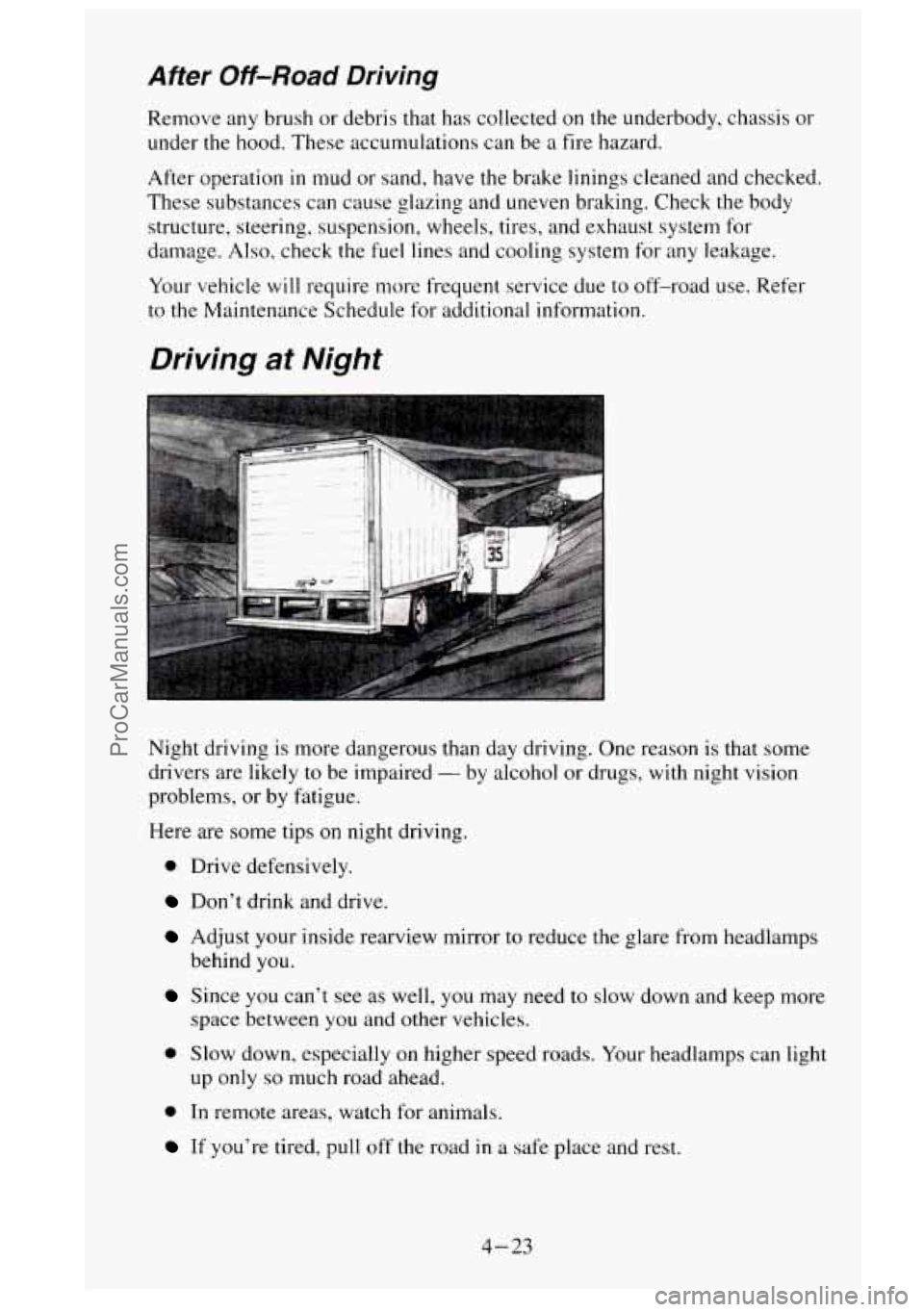
Night driving is more dangerous than day driving. One reason is that some
drivers are likely
to be impaired - by alcohol or drugs, with night vision
problems,
or by fatigue.
Here are some tips on night driving.
0 Drive defensively.
Don’t drink and drive.
Adjust your inside rearview mirror to reduce the glare from headlamps
Since you can’t see as well, you may need to slow down and keep more
behind
you.
space
between you and other vehicles.
a Slow down, especially on higher speed roads. Your headlamps can light
up only
so much road ahead.
0 In remote areas, watch for animals.
If you’re tired, pull off the road in a safe place and rest.
4-23
ProCarManuals.com
Page 208 of 488
c
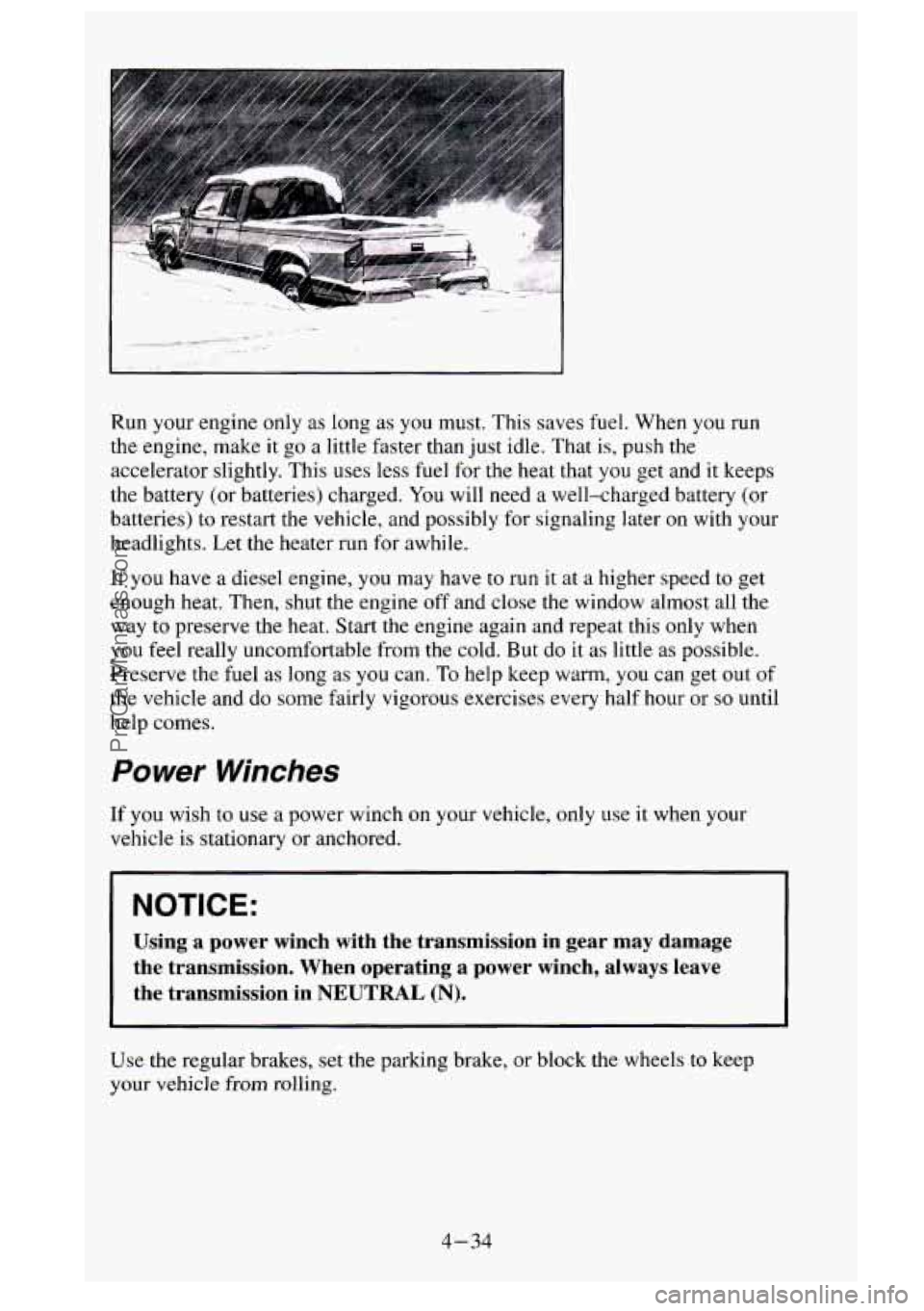
Run your engine only as long as you must. This saves fuel. When you run
the engine, make
it go a little faster than just idle. That is, push the
accelerator slightly. This uses less fuel for the heat that
you get and it keeps
the battery (or batteries) charged. You will need a well-charged battery (or
batteries) to restart the vehicle, and possibly for signaling later on with your
headlights. Let the heater run for awhile.
If you have a diesel engine, you may have to run it at a higher speed to get
enough heat. Then, shut the engine off and close the window almost all the
way
to preserve the heat. Start the engine again and repeat this only when
you feel really uncomfortable from the cold. But do it as little as possible.
Preserve the fuel as long
as you can. To help keep warm, you can get out of
the vehicle and do some fairly vigorous exercises every half hour or so until
help comes.
Power Winches
If you wish to use a power winch on your vehicle, only use it when your
vehicle
is stationary or anchored.
NOTICE:
Using a power winch with the transmission in gear may damage
the transmission. When operating a power winch, always leave
the transmission in NEUTRAL
(N).
Use the regular brakes, set the parking brake, or block the wheels to keep
your vehicle
from rolling.
4-34
ProCarManuals.com
Page 211 of 488
Loading Your Vehicle
-
DSI/KPA (COL3)
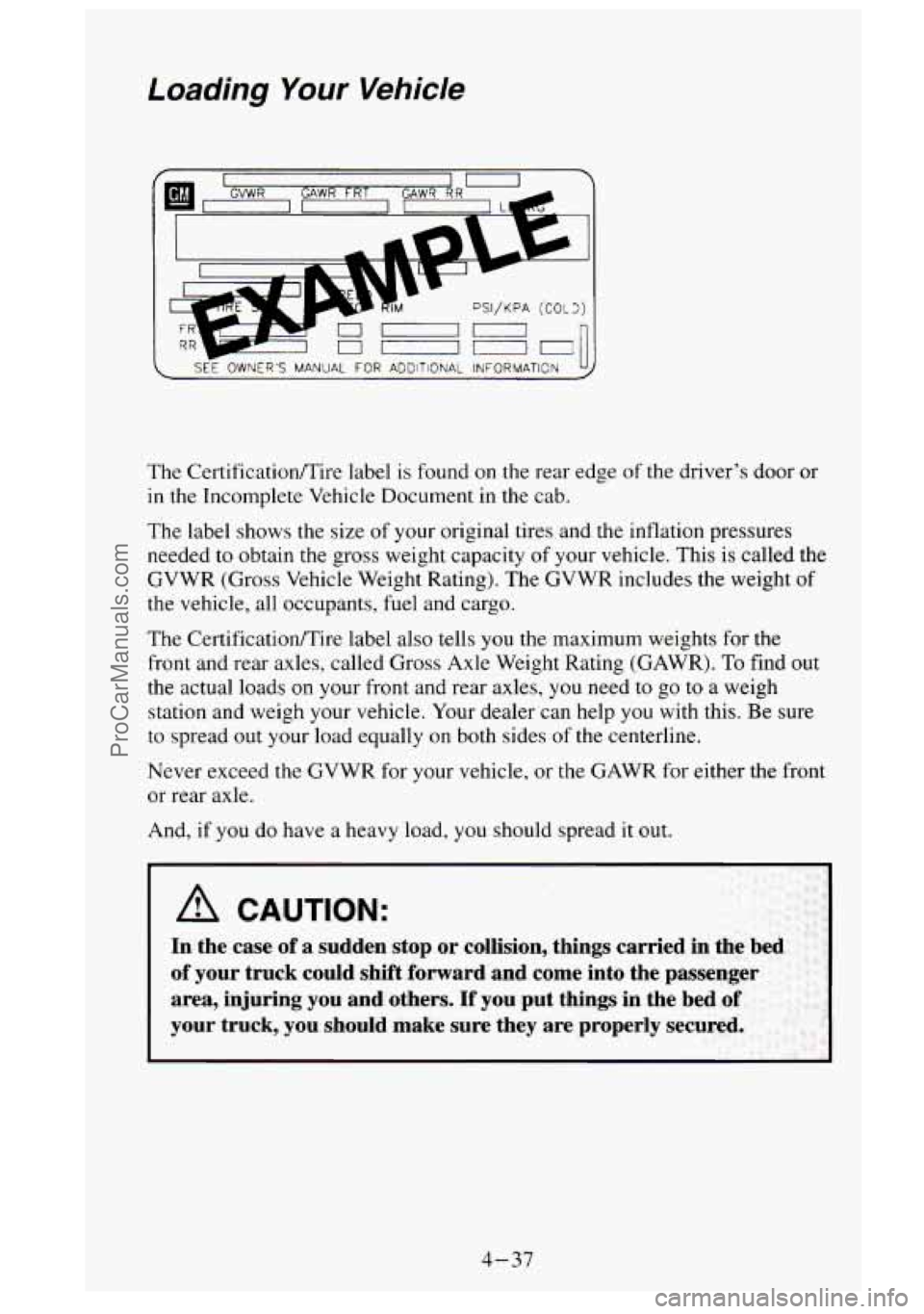
The Certification/Tire label is found on the rear edge of the driver’s door or
in the Incomplete Vehicle Document in the cab.
The label shows the size of your original tires and the inflation pressures
needed to obtain
the gross weight capacity of your vehicle. This is called the
GVWR (Gross Vehicle Weight Rating). The
GVWR includes the weight of
the vehicle, all occupants, fuel and cargo.
The CertificatiodTire label also tells you the maximum weights for the
front and rear axles, called Gross Axle Weight Rating (GAWR).
To find out
the actual loads
on your front and rear axles, you need to go to a weigh
station and weigh your vehicle. Your dealer can help
you with this. Be sure
to spread out your load equally on both sides of the centerline.
Never exceed the GVWR for your vehicle, or the GAWR for either the front
or rear axle.
And,
if you do have a heavy load, you should spread it out.
A CAUTION-:
In the case of a sudden stop or collision, things carried in the bed
of your truck could shift forward and come into the passenger \
area, injuring you and
others. If you put things in the bed of
your truck, you
should make sure they are properly secured.
4-37
ProCarManuals.com
Page 217 of 488
Most vehicles are ready for some trailer towing. If yours was built with
trailering options,
as many are, it’s ready for heavier trailers. But trailering
is different than just driving your vehicle by itself. Trailering means changes
in handling, durability, and fuel economy. Successful, safe trailering takes
correct equipment, and
it has to be used properly.
That’s the reason for this part.
In it are many time-tested, important
trailering tips and safety rules. Many of these are important for your safety
and that of your passengers.
So please read this section carefully before you
pull a trailer.
If You Do Decide To Pull A Trailer
If you do, here are some important points.
e
e
a
0
a
There are many different laws, including speed limit restrictions,
having to do with trailering. Make sure your rig will be legal, not only
where you live but also where you’ll be driving.
A good source for this
information can be state or provincial police.
Consider using
a sway control if your trailer will weigh 4,000 pounds
(I 800 kg) or less. You should always use a sway control if your trailer
will weigh more than
4,000 pounds (1 800 kg). You can ask a hitch
dealer about sway controls.
Don’t tow
a trailer at all during the first 500 miles (800 km) your new
vehicle
is driven. Your engine, axle or other parts could be damaged.
Then, during the first
500 miles (800 km) that you tow a trailer, don‘t
drive over
50 mph (80 kdh) and don’t make starts at full throttle. This
helps your engine and other parts of your vehicle wear
in at the heavier
loads.
If you have an automatic transmission, you should use DRIVE (3) (or,
as you need to, a lower gear) when towing a trailer. Operating your
vehicle in DRIVE
(3) when towing a trailer will minimize heat
build-up and extend the life
of your transmission. If you have a manual
transmission and you are towing
a trailer, it’s better not to use FIFTH
(5) gear. Just drive in FOURTH (4) gear (or, as you need to, a lower
gear).
Three important considerations have
to do with weight:
Weight of the Trailer
How heavy can a trailer safely be?
It depends on how you plan to use your rig. For example, speed, altitude,
road grades, outside temperature and how much your vehicle is used
to pull
a trailer are all important. And, it can
also depend on any special equipment
that you have on your vehicle.
4-43
ProCarManuals.com
Page 249 of 488
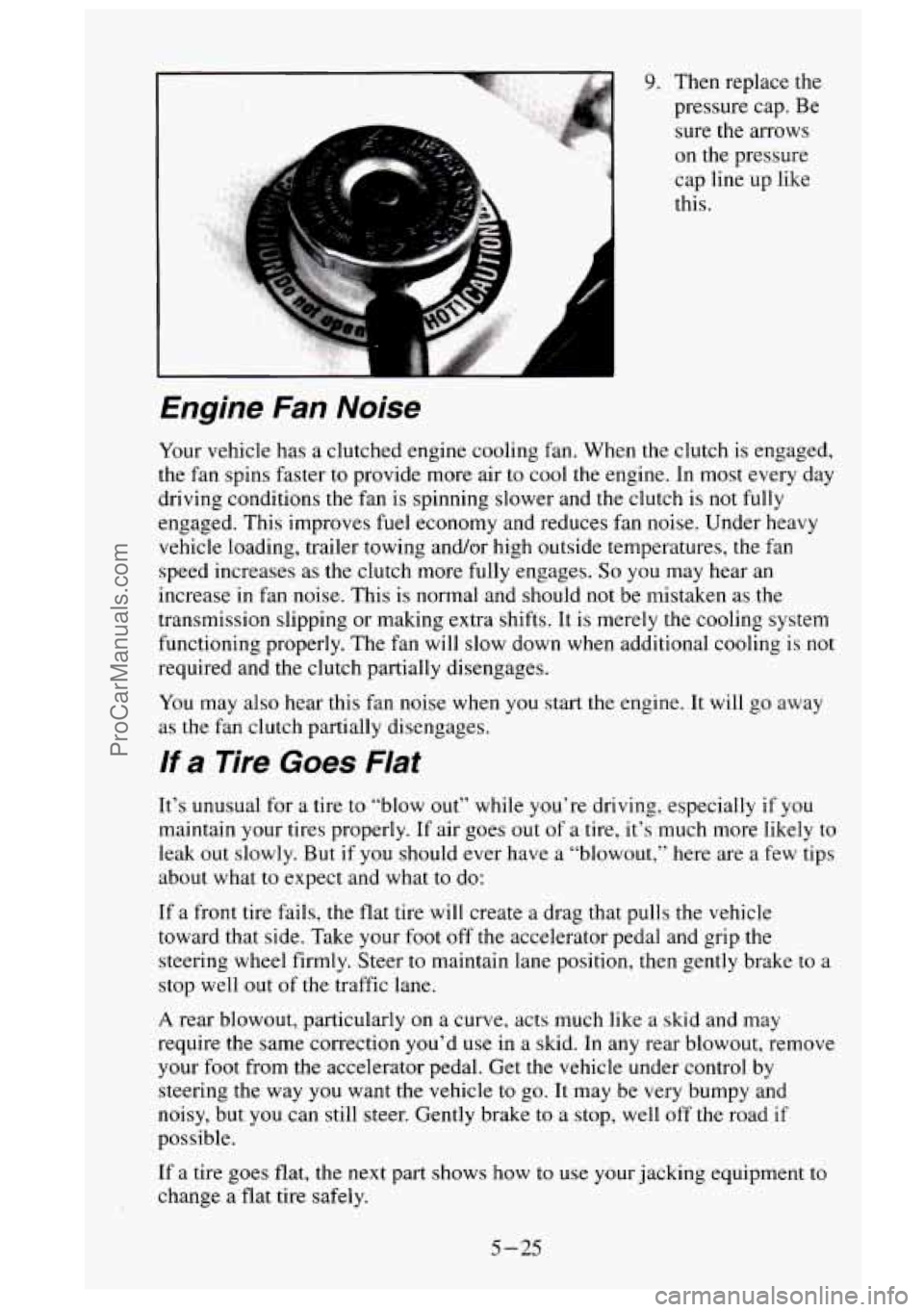
Engine Fan Noise
Your vehicle has a clutched engine cooling fan. When the clutch is engaged,
the fan spins faster
to provide more air to cool the engine. In most every day
driving conditions the fan is spinning slower and the clutch is
not fully
engaged. This improves fuel economy and reduces fan noise. Under heavy
vehicle loading, trailer towing and/or high outside temperatures, the fan
speed increases as the clutch more fully engages.
So you may hear an
increase
in fan noise. This is normal and should not be mistaken as the
transmission slipping or making extra shifts.
It is merely the cooling system
functioning properly. The fan will slow down when additional cooling is not
required and the clutch partially disengages.
You may also hear this fan noise when you start the engine. It will go away
as the
fan clutch partially disengages.
If a Tire Goes Flat
It’s unusual for a tire to “blow out” while you’re driving, especially if you
maintain your tires properly. If air goes out
of a tire, it’s much more likely to
leak out slowly. But if you should ever have a “blowout,” here are a few tips
about what to expect and what to do:
If a front tire fails, the flat tire will create a drag that pulls the vehicle
toward that side. Take your foot
off the accelerator pedal and grip the
steering wheel firmly, Steer
to maintain lane position, then gently brake to a
stop well out of
the traffic lane.
A rear blowout, particularly on a curve, acts much like a skid and may
require the same correction you’d use in a skid. In any rear blowout, remove
your
foot from the accelerator pedal. Get the vehicle under control by
steering the way
you want the vehicle to go. It may be very bumpy and
noisy, but you can still steer. Gently brake to a stop, well
off the road if
possible.
If a tire goes flat, the next part shows how to use your jacking equipment to
change a flat tire safely.
5-25
ProCarManuals.com
Page 267 of 488
Service & Appearance Care
Section
Here you will find information about the care of your vehicle. This section
begins with service and fuel information, and then it shows how to check
important fluid and lubricant levels. There is also technical information
about your vehicle, and
a part devoted to its appearance care.
Service
Your GM dealer knows your vehicle best and wants you to be happy with it.
We hope you’ll go to your dealer for all your service needs.
You’ll get
genuine GM parts and GM-trained and supported service people.
We hope you‘ll want
to keep your GM vehicle all GM. Genuine GM parts
have one
of these marks:
Doing Your Own Service Work
If you want to do some of your own service work, you’ll want to get the
proper
GM Service Manual. It tells you much more about how to service
your vehicle than this manual can.
To order the proper service manual, see
“Service Publications”
in the Index.
6-1
ProCarManuals.com
Page 268 of 488
You should keep a record with all parts receipts and list the mileage and the
date
of any service work you perform. See “Maintenance Record” in the
Index.
A CAUTION:
You can be injured if you try to do service work on a vehicle
without knowing enough about it,
Be sure you have sufficient knowledge, experience, and the
proper replacement parts and tools before you attempt
any
vehicle maintenance task.
Be sure to use the proper nuts, bolts and other fasteners,
“English” and “metric” fasteners can be easily confused. If
you use the wrong fasteners, parts can later break or fall
off.
You could be hurt.
NOTICE:
If you try to do your own service work without knowing enough
about it, your vehicle could be damaged.
Fuel (Gasoline Engine)
If your vehicle has a diesel engine, see “Diesel Fuel Requirements and Fuel
System”
in this Section. For vehicles with gasoline engines, please read this.
Use regular unleaded gasoline rated at 87 octane or higher. It should meet
specifications ASTM D48
14 in the United States and CGSB 3.5-92 in
Canada. These fuels should have the proper additives, so you should not
have to add anything
to the fuel.
In the United States and Canada, it’s easy to be sure
you get the right kind
of gasoline (unleaded). You’ll see UNLEADED right on the pump. And
only unleaded nozzles will
fit into your vehicle’s filler neck.
Be sure the posted octane is at least
87. If the octane is less than 87, you
may get a heavy knocking noise when you drive. If it’s bad enough,
it can
damage your engine.
If you’re using fuel rated at 87 octane or higher and you still hear heavy
knocking, your engine needs service. But don’t worry
if you hear a little
pinging noise when you’re accelerating or driving up a hill. That’s normal
and you don’t have to buy a higher octane fuel to get rid
of pinging. It’s the
heavy, constant knock that means you have a problem.
6-2
ProCarManuals.com
Page 269 of 488
What about gasoline with blending materials that contain oxygen
(oxygenates), such
as MTBE or alcohol?
MTBE is “methyl tertiary-butyl ether.” Fuel that is no more than 15%
MTBE is fine for your vehicle.
Ethanol is ethyl or grain alcohol. Properly-blended fuel that is no more than
10% ethanol is fine for your vehicle.
Methanol is methyl or wood alcohol.
NOTICE:
Fuel that is more than 5% methanol is bad for your vehicle.
Don’t use it. It can corrode metal parts in your fuel system and
also damage plastic and rubber parts. That damage wouldn’t be
covered under your warranty. And even at
5% or less, there
must be “cosolvents” and corrosion preventers in this fuel
to
help avoid these problems.
Gasolines for Cleaner Air
Your use of gasoline with deposit control additives will help prevent
deposits from forming
in your engine and fuel system. That helps keep your
engine
in tune and your emission control system working properly. It’s good
for your vehicle, and you’ll be doing your part for cleaner air.
Many gasolines are now blended with oxygenates. General Motors
recommends that
you use gasolines with these blending materials, such as
MTBE and ethanol. By doing
so, you can help clean the air, especially in
those parts of the country that have high carbon monoxide levels.
In addition, some gasoline suppliers are now producing reformulated
gasolines. These gasolines are specially designed to reduce vehicle
emissions. General Motors recommends that
you use reformulated gasoline.
By doing
so, you can help clean the air, especially in those parts of the
country that have high ozone levels.
You should ask your service station operators if their gasolines contain
deposit control additives and oxygenates, and if they have been
reformulated
to reduce vehicle emissions.
Diesel Fuel Requirements and Fuel Sysrem
Some states and provinces have restrictions on the purchase of diesel fuel
for light-duty vehicles and require you to buy permits or pay special taxes.
Some
of these restrictions apply only to residents, and others apply to both
residents and visitors. These restrictions can change.
To learn the current
restrictions in any state or province, contact your auto club, the police or
other officials.
6-3
ProCarManuals.com
Page 270 of 488
Fuel Requirements
NOTICE:
Diesel fuel or fuel additives not recommended in this manual
could damage your fuel system and engine. Your warranty
wouldn’t cover this damage. And:
Diesel fuel that has been mixed with engine oil could damage
your engine and emission controls. Always check with your
service station operator to make sure his diesel fuel has not \
been mixed with engine oil.
If you ever run out of diesel fuel, it can be difficult to restart
your engine. “Running Out of Fuel,” later in this section, tells
you how to get it started again.
To avoid all this, try never to
let your tank get empty.
What Fuel to Use
For best results, use Number 2-D diesel fuel year-round (above and below
freezing conditionsj as oil companies blend Number
2-D fuel to address
climate differences. Number
1-D diesel fuel may be used in very cold
temperatures (when
it stays below 0°F or -18°C); however, it will produce
a power and fuel economy loss. The use of Number I-D diesel fuel in warm
or hot climates may result in stalling, poor starting when the engine is hot
and
may damage the fuel injection system.
Diesel fuel may foam when you
fill your tank. This can cause the automatic
pump nozzle to shut off, even though your tank isn’t
full. If this happens,
just wait for the foaming to stop and then continue to
fill your tank.
A CAUTION:
Heat coming from the engine may cause the fuel to expand and \
force the fuel out of your tank.
If something ignites the fuel, a
fire could start and people could be burned. To help avoid this,
fill your fuel tank only until the automatic nozzle shuts
off.
Don’t try to “top it off.”
6-4
ProCarManuals.com
Page 271 of 488
Canadian Fuels
Diesel-powered trucks are now equipped with emission control systems that
require the use of diesel fuel with low-sulfur
(.05% by weight) content.
Both low- and higher-sulfur fuels will be available
in Canada. Only
low-sulfur diesel fuels are available
in the United States. It is important that
diesel-powered trucks are refueled with low-sulfur fuel. Use of fuels with
higher-sulfur content will affect
the function of the emission components
and may cause reduced performance, excessive smoke and unpleasant odor.
Cold Weather Operation
Follow the instructions listed previously under the heading “What Fuel to
Use.”
If you’re driving
in very toold temperatures and can’t get a “winterized”
Number
2-D that has been adapted to cold weather or a Number 1-D, you
can
use one gallon of kerosene for every two gallons of diesel fuel. Once
you add the kerosene, run your engine for several minutes
so the fuels will
mix. Add kerosene only when the temperature falls below 0°F (-1 S”C),
because the fuel economy of kerosene isn’t as good as that of diesel fuel.
NOTICE:
Never use home heating oil or gasoline in your diesel engine. \
They can cause engine damage.
In cold weather, your fuel filter may become clogged (waxed). To unclog it,
warm the filter to between
32°F and 50°F (OOC to 10°C). You won’t need
to replace
it.
Water in Fuel
Sometimes, water can be pumped into your fuel tank along with your diesel
fuel. This can happen
if a service station doesn’t regularly inspect and clean
its fuel tanks, or
if it gets contaminated fuel from its suppliers.
If this happens, a WATER
IN FUEL light will come on. If it does, the excess
water must be drained. Your dealer can show
you how to do this.
6-5
ProCarManuals.com