tires GMC SIERRA 1995 Owner's Manual
[x] Cancel search | Manufacturer: GMC, Model Year: 1995, Model line: SIERRA, Model: GMC SIERRA 1995Pages: 488, PDF Size: 26.01 MB
Page 220 of 488
Will the trailer brake parts take 3,000 psi (20 650 Wa) of Ijressure? If
not, the trailer brake system must not be used with your vehicle.
Driving with a Trailer
Towing a trailer requires a certain amount of experience. Before setting out
for the open road, you’ll want to get to know your rig. Acquaint yourself
with the feel of handling and braking with the added weight of the trailer.
And always keep in mind that the vehicle you
are driving is now a good
deal longer and not nearly as responsive as your vehicle is by itself.
Before you start, check the trailer hitch and platform (and attachments),
safety chains, electrical connector, lamps, tires and mirror adjustment. If the
trailer has electric brakes, start your vehicle and trailer moving and then
apply the trailer brake controller by hand to be sure the brakes
are working.
‘This lets you check your electrical connection at the same \
time.
During your trip, check occasionally to be sure that the load is secure, and
that the lamps and any trailer brakes
are still working.
Following Distance
Stay at least twice as far behind the vehicle ahead as you would when
driving your vehicle without a trailer.
This can help you avoid situations that
require heavy braking and sudden turns.
Passing
You’ll need more passing distance up ahead when you’re towing a trailer.
And, because you’re a good deal longer, you’ll need to go much farther
beyond the passed vehicle before you can return to your lane.
.
Backing Up
Hold the bottom of the steering wheel with one hand. Then, to move the
trailer to the left, just move that hand to the left.
To move the trailer to the
right, move your hand to the right. Always back
up slowly and, if possible,
have someone guide you.
4-46
ProCarManuals.com
Page 231 of 488
To wing Your Vehicle
Try to have your GM dealer or a professional towing service tow your
vehicle. They can provide the right equipment and know how to tow
it
without damage.
If your vehicle has been changed since
it was factory-new. by adding such
things like fog lamps, aero skirting,
or special tires and wheels, these things
could be damaged during towing.
Before you do anything,
turn on the hazard warning flashers.
When you call, tell the towing service:
0 That your vehicle has rear-wheel drive, or that it has the four-wheel
drive option.
The make, model, and year of your vehicle.
0 Whether you can move the shift lever for the transmission and transfer
case,
if you have one.
If there was an accident. what was damaged.
A CAUTION:
To help avoid injury to you or others:
Never let passengers ride in a vehicle that is being towed.
0 Never tow faster than safe or posted speeds.
0 Never tow with damaged parts not fuIly secured.
0 Never get under your vehicle after it has been lifted by the
tow truck.
0 Always use separate safety chains on each side when towing a
vehicle.
0 For pickups (except cab chassis models), use T-hooks on front
. of vehicle, J-hooks on rear.
For cab chassis models, use J-hooks on front and rear of
vehicle.
When your vehicle is being towed, have the ignition key off. The steering
wheel should be clamped
in a straight-ahead position, with a clamping
device designed for towing, service.
Do not use the vehicle’s steering
column lock for this. The transmission and transfer case, if
you have one,
should be
in NEUTRAL (N) and the parking brake released.
5-7
ProCarManuals.com
Page 249 of 488
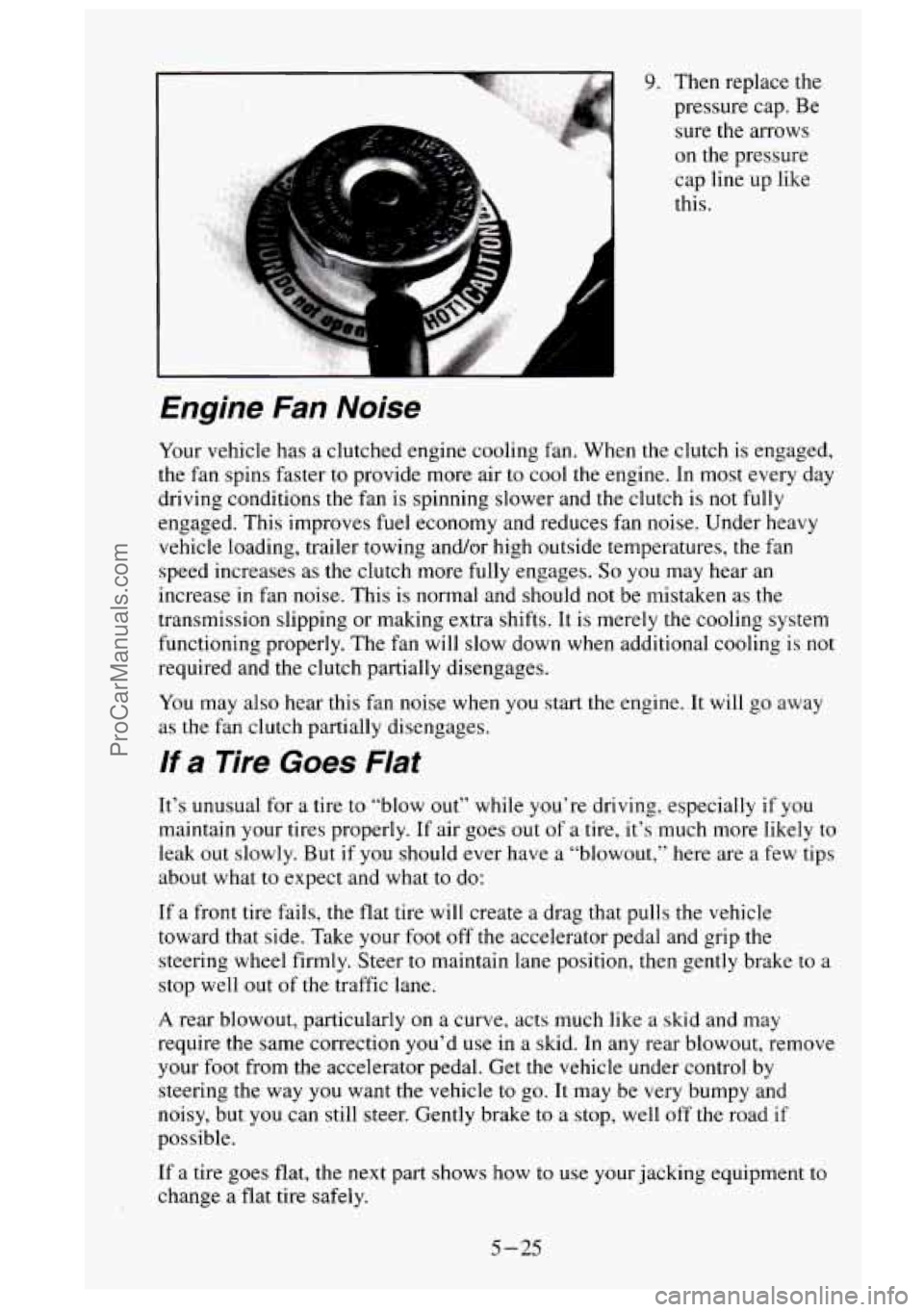
Engine Fan Noise
Your vehicle has a clutched engine cooling fan. When the clutch is engaged,
the fan spins faster
to provide more air to cool the engine. In most every day
driving conditions the fan is spinning slower and the clutch is
not fully
engaged. This improves fuel economy and reduces fan noise. Under heavy
vehicle loading, trailer towing and/or high outside temperatures, the fan
speed increases as the clutch more fully engages.
So you may hear an
increase
in fan noise. This is normal and should not be mistaken as the
transmission slipping or making extra shifts.
It is merely the cooling system
functioning properly. The fan will slow down when additional cooling is not
required and the clutch partially disengages.
You may also hear this fan noise when you start the engine. It will go away
as the
fan clutch partially disengages.
If a Tire Goes Flat
It’s unusual for a tire to “blow out” while you’re driving, especially if you
maintain your tires properly. If air goes out
of a tire, it’s much more likely to
leak out slowly. But if you should ever have a “blowout,” here are a few tips
about what to expect and what to do:
If a front tire fails, the flat tire will create a drag that pulls the vehicle
toward that side. Take your foot
off the accelerator pedal and grip the
steering wheel firmly, Steer
to maintain lane position, then gently brake to a
stop well out of
the traffic lane.
A rear blowout, particularly on a curve, acts much like a skid and may
require the same correction you’d use in a skid. In any rear blowout, remove
your
foot from the accelerator pedal. Get the vehicle under control by
steering the way
you want the vehicle to go. It may be very bumpy and
noisy, but you can still steer. Gently brake to a stop, well
off the road if
possible.
If a tire goes flat, the next part shows how to use your jacking equipment to
change a flat tire safely.
5-25
ProCarManuals.com
Page 252 of 488
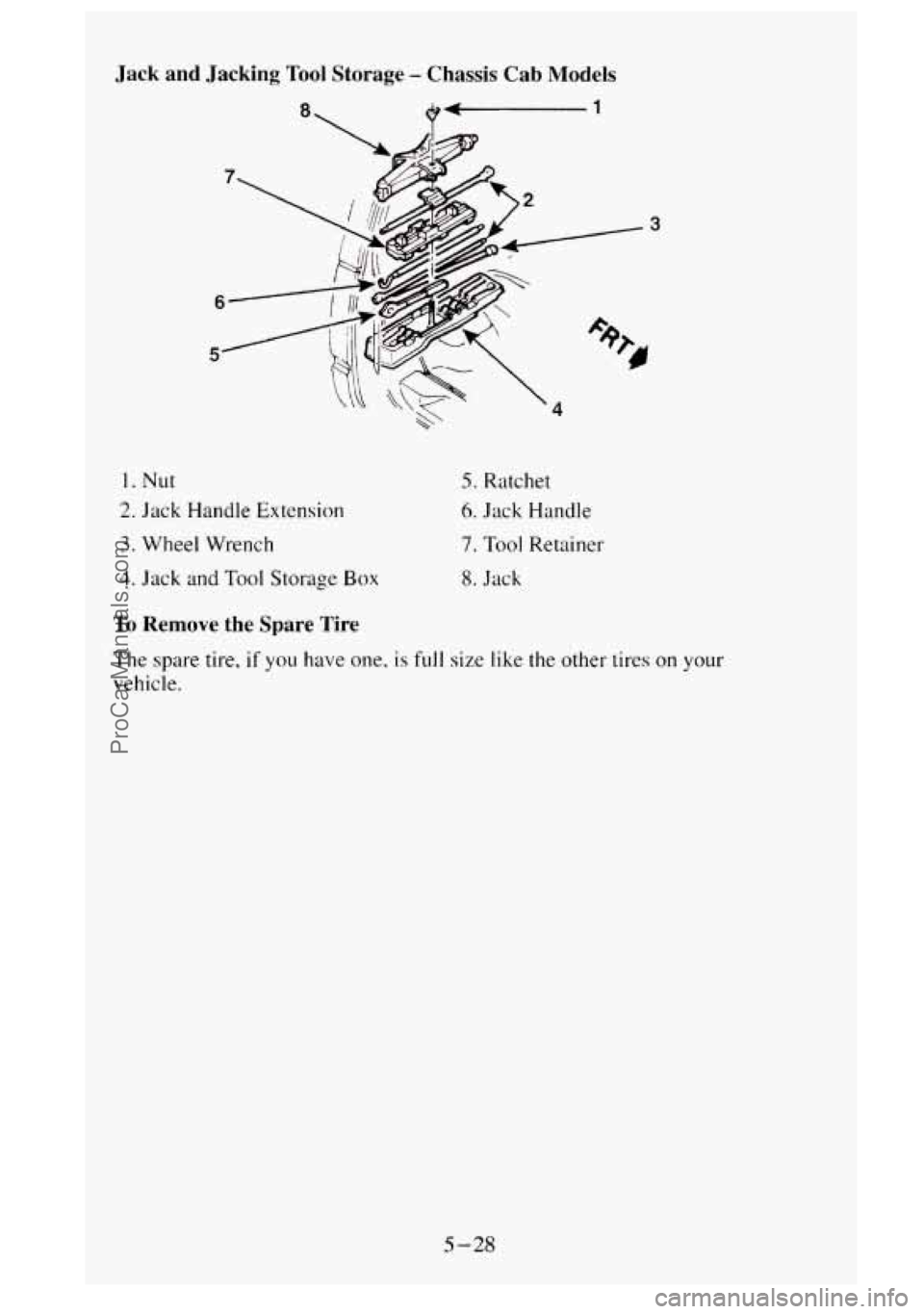
Jack and Jacking Tool Storage - Chassis Cab Models
a -1
Jacking Tool Storage - Chassis Cab Models
a -1
3
3
1. Nut
2. Jack Handle Extension
3. Wheel Wrench
4. Jack and Tool Storage Box
5. Ratchet
6. Jack Handle
7. Tool Retainer
8, Jack
To Remove the Spare Tire
The spare tire, if you have one, is full size like the other tires on your
vehicle.
5-28
ProCarManuals.com
Page 263 of 488
If You’re Stuck: In Sand, Mud, Ice or Snow
What you don’t want to do when your vehicle is stuck is to spin your wheels
too fast. The method known as ”rocking” can help you get out when you’re
stuck, but you nlust use caution.
A CAUTION:
If you let your tires spin at high speed, they can explode and you
or others could be injured. And, the transmission or other par\
ts
of the vehicle can overheat. That could cause an engine
compartment fire or other damage. When you’re stuck, spin th\
e wheels
as little as possible. Don’t spin the wheels above 35 mph
(55 km/h) as shown on the speedometer.
I NOTICE:
Spinning your wheels can destroy parts of your vehicle as well as
the tires. If you spin the wheels too fast while shifting your
transmission back and forth, you can destroy your transmission.
For information about using tire chains on your vehicle, see “Tire Chains”
in the Index.
Rocking
your vehicle to get it out:
First. turn your steering wheel left and right. That will clear the area around
your front wheels. Then shift back and forth between REVERSE
(R) and a
forward gear (or
with a manual transmission, between FIRST (1 ) or
SECOND (2) gear and REVERSE), spinning the wheels as little as possible.
Release
the accelerator pedal while you shift, and press lightly on the
accelerator pedal when the transmission
is in gear. If that doesn’t get you
out after a few tries, you may need
to be towed out. Or, you can use your
recovery hooks,
if your vehicle has them. If you do need to be towed out.
see “Towing Your Vehicle”
in the Index.
5-39
ProCarManuals.com
Page 310 of 488
Brake Wear
Your vehicle has front disc brakes and rear drum brakes. If you have a C
3500 HD model, it has four-wheel disc brakes.
Disc brake pads have built-in wear indicators that make
a high-pitched
warning sound when the brake pads are worn and new pads are needed. The
sound may come and
go or be heard all the time your vehicle is moving
(except when you are pushing on the brake pedal firmly).
I A CAUTION:
The brake wear warning sound means that sooner or later your
brakes won’t work well. That could lead to an accident. Whe\
n
you hear the brake wear warning sound, have your vehicle
serviced.
NOTICE:
Continuing to drive with worn-out brake pads could result in
costly brake repair.
Some driving conditions or climates may cause a brake squeal when the
brakes are first applied or lightly applied. This does not mean something is
wrong with your brakes.
If you have rear drum brakes, they don’t have wear indicators, but if you
ever hear
a rear brake rubbing noise, have the rear brake linings inspected.
Also, the rear brake drum should be removed and inspected each time the
tires are removed for rotation
or changing. When you have the front brakes
replaced, have the rear brakes inspected, too.
Brake linings should always be replaced as complete axle sets.
Brake Pedal Travel
See your dealer if the brake pedal does not return to normal height, or if
there is a rapid increase in pedal travel. This could be a sign of brake
trouble.
6-44
ProCarManuals.com
Page 324 of 488
Tires
We don’t make tires. Your new vehicle comes with high-quality tires made
by a leading tire manufacturer. These tires are warranted by the tire
manufacturers, and their warranties are delivered
with every new vehicle. If
your spare tire is a different brand than your road tires, you will have
a tire
warranty folder from each
of these manufacturers.
A CAUTION:
Poorly maintained and improperly used tires are dangerous.
Overloading your tires can cause overheating as a result of too
much friction. You could have an air-out and a serious
accident. See “Loading Your Vehicle” in the Index.
Underinflated tires pose the same danger as overloaded tires.
The resulting accident could cause serious injury. Check all
tires frequently to maintain the recommended pressure. Tire
pressure should be checked when your tires are cold.
Overinflated tires are more likely to be cut, punctured, or
broken by
a sudden impact, such as when you hit a pothole.
Keep tires
at the recommended pressure.
Worn, old tires can cause accidents. If your tread is badly
worn, or if your tires have been damaged, replace them.
Inflation - Tire Pressure
The Certification/Tire label which is on the rear edge of the driver‘s door, or
on the incomplete vehicle document in the cab, shows the correct inflation
pressures for your tires, when they’re cold. “Cold“ tneans your vehicle
has
been sitting for at least three hours or driven no more than a mile.
You can operate some vehicles at reduced inflation pressures only when
you’ll be carrying reduced loads. On those vehicles, the minimum cold
inflation pressures for
a typical reduced load are printed on the “Improved
Ride Tire Pressure” label located on the driver’s door. Weigh the vehicle to
find the load on each tire and see the label for the minimum cold inflation
pressures for that load.
6-58
ProCarManuals.com
Page 325 of 488
NOTICE:
Don’t let anyone tell you that underinflation or overinflation is
all right. It’s not.
If’ your tires don’t have enough air
(underinflation)
you can get:
0 Too much flexing
Too much heat
0 Tire overloading
Bad wear
Bad handling
0 Bad fuel economy.
If your tires have too much air (overinflation), you can get:
Unusual wear
Bad handling
Rough ride
Needless damage from road hazards.
When to Check
Check your tires once a month or more. Also, check the tire pressure of the
spare tire.
How to Check
Use a good quality pocket-type gage to check tire pressure. Simply looking
at the tires will not tell you the pressure, especially
if you have radial tires
- which may look properly inflated even if they’re underinflated.
If your tires have valve caps, be sure to put them back on. They help prevent
leaks by keeping out dirt and moisture.
Tire Inspection and Rotation
Tires should be inspected every 6,000 to 8,000 miles (10 000 to 13 000 km)
for any signs of unusual wear. If unusual wear is present, rotate your tires as
soon as possible and check wheel alignment. Also check for damaged tires
or wheels. See “When it’s Time for New Tires” and “Wheel Replacement”
later in this section for more information.
If your vehicle has dual rear
wheels, also see
“Dual Tire Operation” later in this section.
6-59
ProCarManuals.com
Page 326 of 488
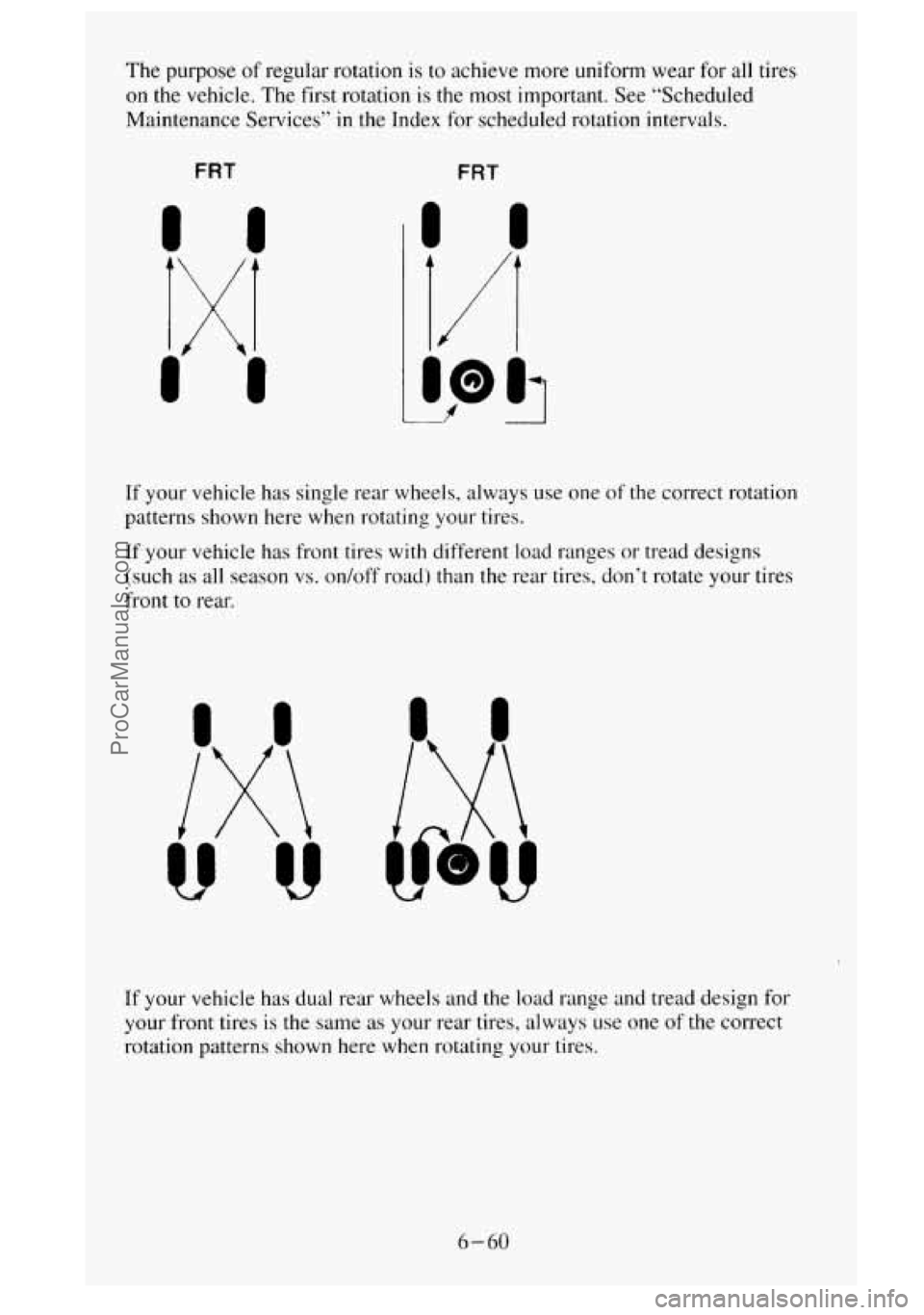
The purpose of regular rotation is to achieve more uniform wear for all tires
on the vehicle. The first rotation is the most important. See “Scheduled
Maintenance Services”
in the Index for scheduled rotation intervals.
FRT
I
II
FRT
If your vehicle has single rear wheels, always use one of the correct rotation
patterns shown here when rotating your tires.
If your vehicle has front tires with different load ranges
or tread designs
(such as all season vs. on/off road) than the rear tires. don‘t rotate your tires
front
to rear.
W v
If your vehicle has dual rear wheels and the load range and tread design for
your front tires
is the same as your rear tires, always use one of the correct
rotation patterns shown here when rotating your tires.
6-60
ProCarManuals.com
Page 327 of 488
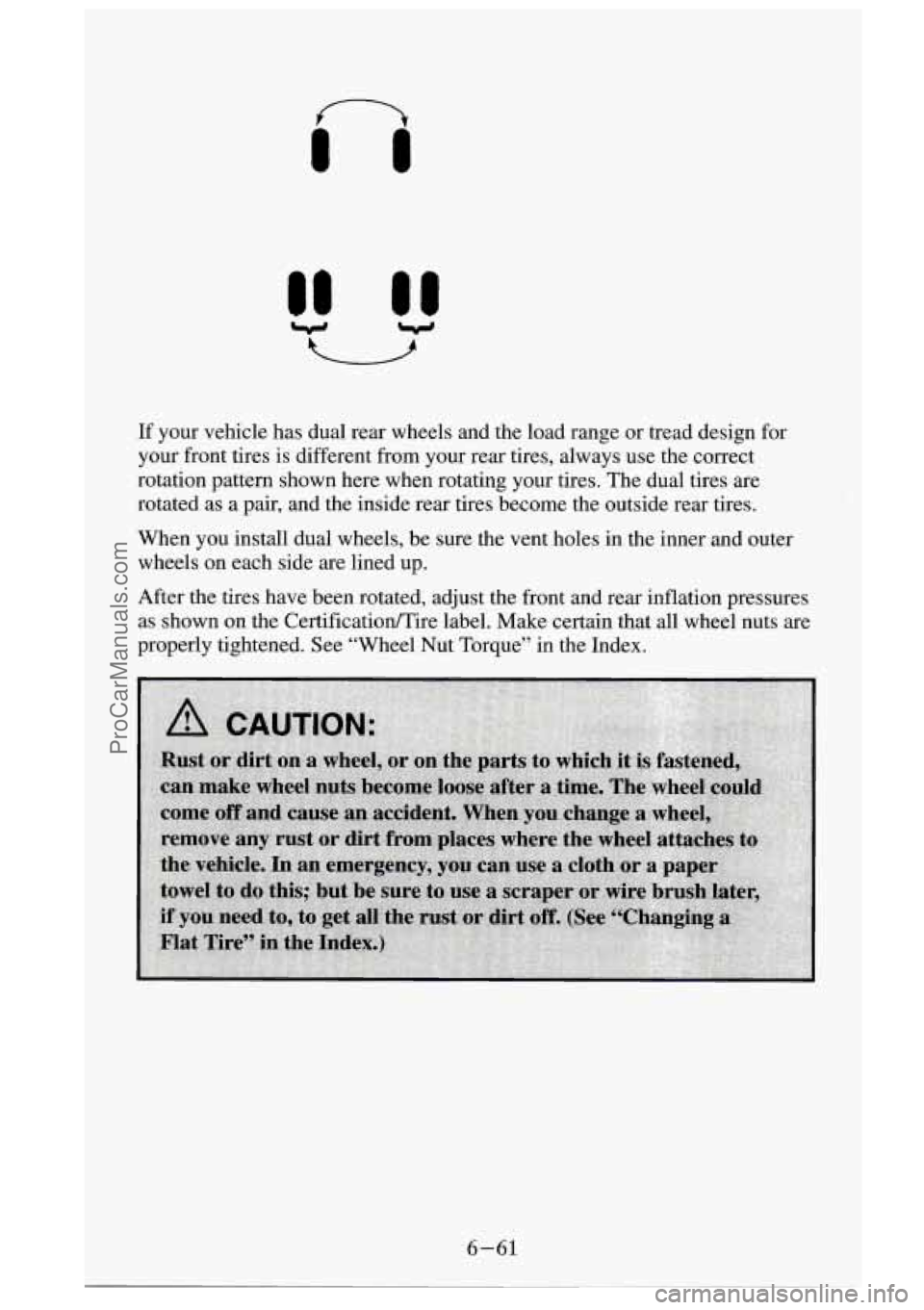
If your vehicle has dual rear wheels and the load range or tread design for
your front tires is different from your rear tires, always use the correct
rotation pattern shown here when rotating your tires. The dual tires are
rotated as a pair, and the inside rear tires become the outside rear tires.
When you install dual wheels, be sure the vent holes in the inner and outer
wheels
on each side are lined up.
After the tires have been rotated, adjust the front and rear inflation pressures
as shown on the Certificatioflire label. Make certain that all wheel nuts are
properly tightened. See “Wheel Nut Torque” in the Index.
6-61
ProCarManuals.com