ECU GMC SIERRA 1995 Owner's Guide
[x] Cancel search | Manufacturer: GMC, Model Year: 1995, Model line: SIERRA, Model: GMC SIERRA 1995Pages: 488, PDF Size: 26.01 MB
Page 262 of 488
I
A ,CAUTION:
Storing a jack, a tire or other equipment in the passenger
compartment
of the vehicle could cause injury. In a sudden stop
or collision, loose equipment could strike someone. Store all
these
in the proper place.
Stowing the
Tire - Under-Body Carrier
Stow the flat tire under the rwr of the vehicle in spare tire carrier. To stow
the flat tire:
1.
AI 3
3.
4.
5.
Put the tire on the ground at the rear of the vehicle with the valve stern
pointed down.
Pull the wheel retainer through thc wheel opening.
Attach the ratchet
to the urheel n'rench with the UP marking Facing
you.
Put the other end of the whcel wrench through the rcar bumper access
hole, located at the passenger side edge
of the license plate. Be sure the
wheel wrench connects into the hoist
shaft.
Turn the ratchet clockwise to raise the tire. Keep turning the ratchet
until the tire is all the way up. You will hear two "clicks" when the tire
is secure. Pull on the tire to nuke sure it is tightly secured.
Stowing the Jack and Jacking Tools
Return the jack, ratchet, wheel wrench and jack extensions to their location
behind the passenger's
seat. Stow thc jack and jacking tools as shown in the
illustrations earlier
in this part. Secure the items and replace the jack cover,
if there is one.
5-38
ProCarManuals.com
Page 312 of 488
Windshield Wiper Blade Inserts
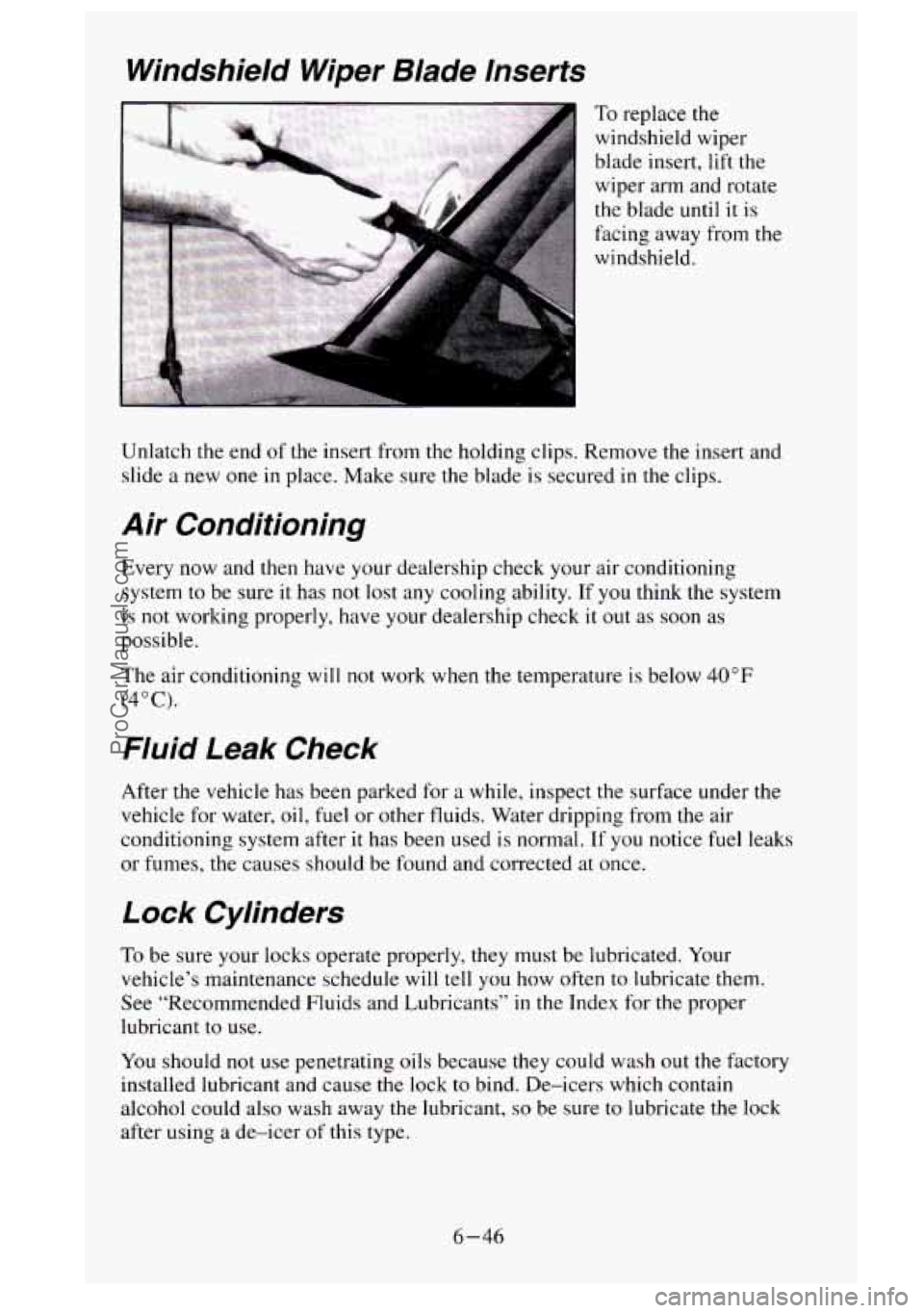
To replace the
windshield wiper
blade insert, lift
the
wiper arm and rotate
the blade until
it is
facing away from the
windshield.
Unlatch the end
of the insert from the holding clips. Remove the insert and
slide
a new one in place. Make sure the blade is secured in the clips.
Air Conditioning
Every now and then have your dealership check your air conditioning
system to be sure it
has not lost any cooling ability. If you think the system
is not working properly, have your dealership check it out as soon as
possi bleb
The air conditioning will
not work when the temperature is below 40°F
(4°C).
Fluid Leak Check
After the vehicle has been parked for a while, inspect the surface under the
vehicle for water, oil, fuel
or other fluids. Water dripping from the air
conditioning system after it has been used is normal.
If you notice fuel leaks
or fumes, the causes should be found and corrected at once.
Lock Cylinders
To be sure your locks operate properly, they must be lubricated. Your
vehicle’s maintenance schedule will tell you how often to lubricate them.
See “Recommended Fluids and Lubricants” in the Index for
the proper
lubricant to use.
You should
not use penetrating oils because they could wash out the factory
installed lubricant and cause
the lock to bind. De-icers which contain
alcohol could also
wash away the lubricant, so be sure to lubricate the lock
after using
a de-icer of this type.
6-46
ProCarManuals.com
Page 332 of 488
Whenever a wheel, wheel bolt or wheel nut is replaced on a dual wheel
setup, check the wheel nut torque after 100, 1,000 and 6,000 miles ( 160,
1 600 and 10 000 km) of driving. For proper torque, see “Wheel Nut
Torque” in the Index.
Used Replacement Wheels
A CAUTION:
Putting a used wheel on your vehicle is dangerous. You can’t
know
how it’s been used or how many miles it’s been driven. It
could fail suddenly and cause an accident. If you have to replace
a wheel use a new GM original equipment wheel.
7
c
‘ire Chains
NOTICE:
If your vehicle has dual wheels or LT265/75R16 size tires, don’t
use tire chains; they can damage your vehicle.
If you don’t have dual wheels or if you have a tire size other
than
LT26975R16, use tire chains only where legal and only
when you must. Use chains that are the proper size for your
tires. Install them on the tires of the rear axle.
Don’t use chains on the tires
of the front axle.
Tighten them
as tightly as possible with the ends securely
fastened. Drive slowly and follow the chain manufacturer’s
instructions. If you can hear the chains contacting your vehicle,
stop and retighten them. If the contact continues, slow down
until it stops. Driving too fast
or spinning the wheels with chains
on
will damage your vehicle.
6-66
ProCarManuals.com