inflation pressure GMC SIERRA 1995 Owners Manual
[x] Cancel search | Manufacturer: GMC, Model Year: 1995, Model line: SIERRA, Model: GMC SIERRA 1995Pages: 488, PDF Size: 26.01 MB
Page 211 of 488
Loading Your Vehicle
-
DSI/KPA (COL3)
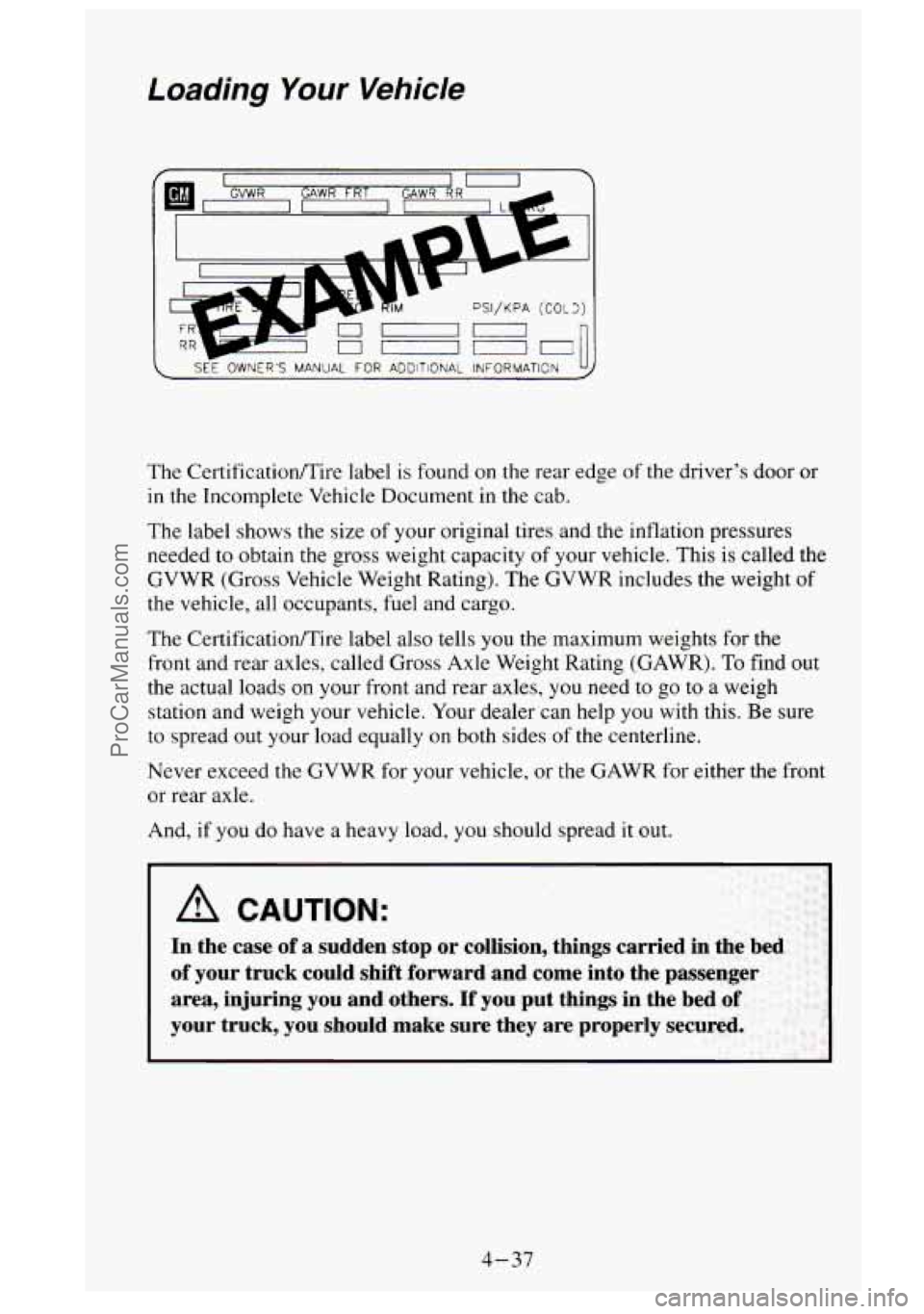
The Certification/Tire label is found on the rear edge of the driver’s door or
in the Incomplete Vehicle Document in the cab.
The label shows the size of your original tires and the inflation pressures
needed to obtain
the gross weight capacity of your vehicle. This is called the
GVWR (Gross Vehicle Weight Rating). The
GVWR includes the weight of
the vehicle, all occupants, fuel and cargo.
The CertificatiodTire label also tells you the maximum weights for the
front and rear axles, called Gross Axle Weight Rating (GAWR).
To find out
the actual loads
on your front and rear axles, you need to go to a weigh
station and weigh your vehicle. Your dealer can help
you with this. Be sure
to spread out your load equally on both sides of the centerline.
Never exceed the GVWR for your vehicle, or the GAWR for either the front
or rear axle.
And,
if you do have a heavy load, you should spread it out.
A CAUTION-:
In the case of a sudden stop or collision, things carried in the bed
of your truck could shift forward and come into the passenger \
area, injuring you and
others. If you put things in the bed of
your truck, you
should make sure they are properly secured.
4-37
ProCarManuals.com
Page 324 of 488
Tires
We don’t make tires. Your new vehicle comes with high-quality tires made
by a leading tire manufacturer. These tires are warranted by the tire
manufacturers, and their warranties are delivered
with every new vehicle. If
your spare tire is a different brand than your road tires, you will have
a tire
warranty folder from each
of these manufacturers.
A CAUTION:
Poorly maintained and improperly used tires are dangerous.
Overloading your tires can cause overheating as a result of too
much friction. You could have an air-out and a serious
accident. See “Loading Your Vehicle” in the Index.
Underinflated tires pose the same danger as overloaded tires.
The resulting accident could cause serious injury. Check all
tires frequently to maintain the recommended pressure. Tire
pressure should be checked when your tires are cold.
Overinflated tires are more likely to be cut, punctured, or
broken by
a sudden impact, such as when you hit a pothole.
Keep tires
at the recommended pressure.
Worn, old tires can cause accidents. If your tread is badly
worn, or if your tires have been damaged, replace them.
Inflation - Tire Pressure
The Certification/Tire label which is on the rear edge of the driver‘s door, or
on the incomplete vehicle document in the cab, shows the correct inflation
pressures for your tires, when they’re cold. “Cold“ tneans your vehicle
has
been sitting for at least three hours or driven no more than a mile.
You can operate some vehicles at reduced inflation pressures only when
you’ll be carrying reduced loads. On those vehicles, the minimum cold
inflation pressures for
a typical reduced load are printed on the “Improved
Ride Tire Pressure” label located on the driver’s door. Weigh the vehicle to
find the load on each tire and see the label for the minimum cold inflation
pressures for that load.
6-58
ProCarManuals.com
Page 325 of 488
NOTICE:
Don’t let anyone tell you that underinflation or overinflation is
all right. It’s not.
If’ your tires don’t have enough air
(underinflation)
you can get:
0 Too much flexing
Too much heat
0 Tire overloading
Bad wear
Bad handling
0 Bad fuel economy.
If your tires have too much air (overinflation), you can get:
Unusual wear
Bad handling
Rough ride
Needless damage from road hazards.
When to Check
Check your tires once a month or more. Also, check the tire pressure of the
spare tire.
How to Check
Use a good quality pocket-type gage to check tire pressure. Simply looking
at the tires will not tell you the pressure, especially
if you have radial tires
- which may look properly inflated even if they’re underinflated.
If your tires have valve caps, be sure to put them back on. They help prevent
leaks by keeping out dirt and moisture.
Tire Inspection and Rotation
Tires should be inspected every 6,000 to 8,000 miles (10 000 to 13 000 km)
for any signs of unusual wear. If unusual wear is present, rotate your tires as
soon as possible and check wheel alignment. Also check for damaged tires
or wheels. See “When it’s Time for New Tires” and “Wheel Replacement”
later in this section for more information.
If your vehicle has dual rear
wheels, also see
“Dual Tire Operation” later in this section.
6-59
ProCarManuals.com
Page 327 of 488
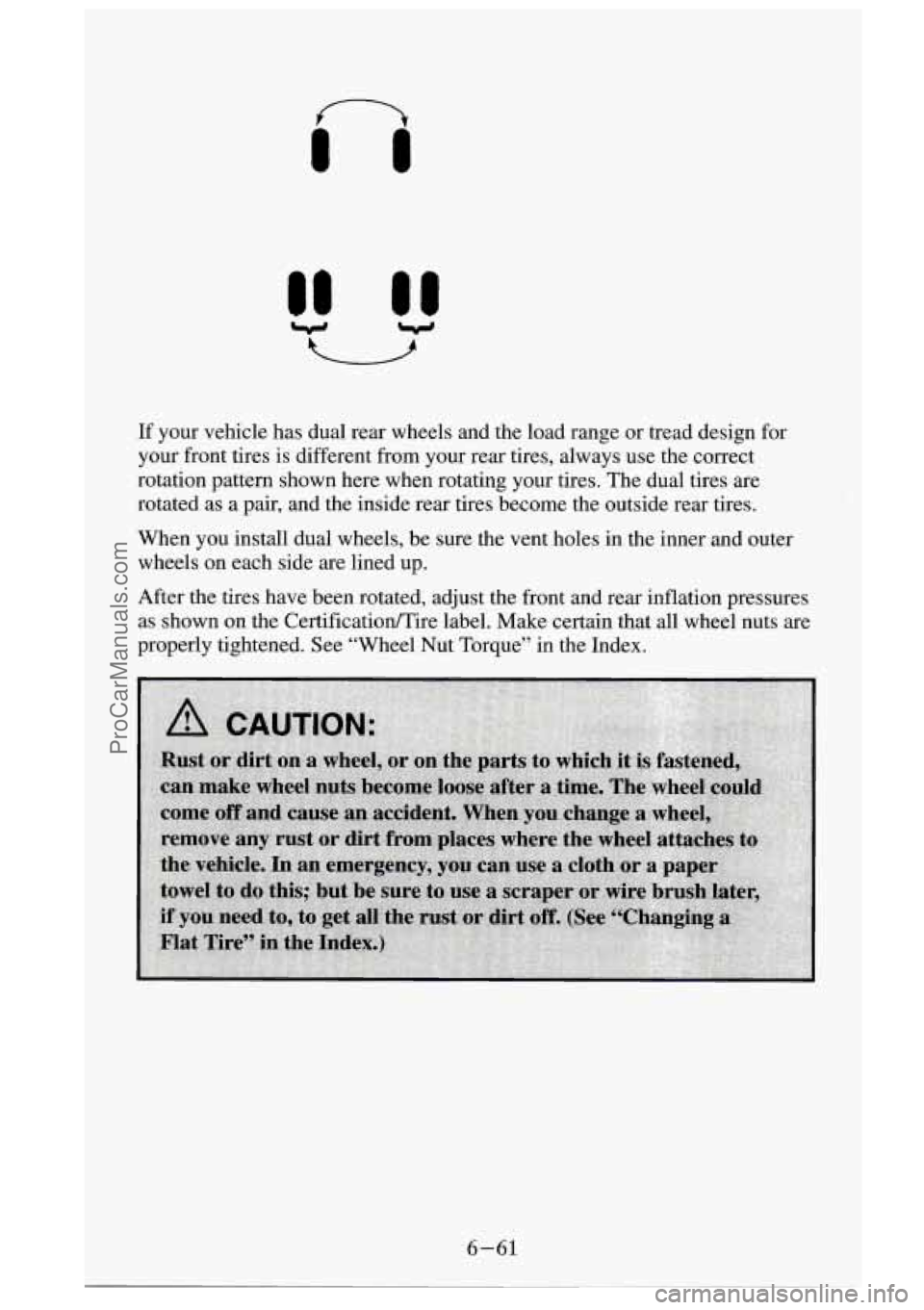
If your vehicle has dual rear wheels and the load range or tread design for
your front tires is different from your rear tires, always use the correct
rotation pattern shown here when rotating your tires. The dual tires are
rotated as a pair, and the inside rear tires become the outside rear tires.
When you install dual wheels, be sure the vent holes in the inner and outer
wheels
on each side are lined up.
After the tires have been rotated, adjust the front and rear inflation pressures
as shown on the Certificatioflire label. Make certain that all wheel nuts are
properly tightened. See “Wheel Nut Torque” in the Index.
6-61
ProCarManuals.com
Page 449 of 488
Part B: Owner Checks and Services
Listed below are owner checks and services which should be performed at
the intervals specified to help ensure the safety, dependability and emission
control performance of your vehicle.
Be sure any necessary repairs are completed at once. Whenever any fluids
or lubricants are added to your vehicle, make sure they are the proper ones,
as shown in Part D.
At the First 100, 1,000 and 6,000 Miles (160, I 600 and
IO 000 km)
For vehicles with dual wheels, check dual wheel nut torque. For proper
torque, see “Wheel
Nut Torque’’ in the Index.
At Each Fuel Fill
Engine Oil Level
Check the engine oil level and add the proper oil if necessary. See “Engine
Oil”
in the Index for further details.
Engine Coolant Level
Check the engine coolant level and add the proper coolant mix if necessary.
See ”Coolant”
in the Index for further details.
Windshield Washer Fluid Level
Check the windshield washer fluid level in the windshield washer tank and
add the proper fluid if necessary. See ”Windshield Washer Fluid” in the
Index for further details.
At Least Once a Month
Tire Inflation
Check tire inflation. Make sure tires are inflated to the pressures specified
on the Certification/Tire label which is located on the rear edge of the
driver’s door or on the incomplete vehicle document in the cab. See “Tires”
in the Index for further details.
7-93
ProCarManuals.com