oil additives GMC SIERRA 1995 Owners Manual
[x] Cancel search | Manufacturer: GMC, Model Year: 1995, Model line: SIERRA, Model: GMC SIERRA 1995Pages: 488, PDF Size: 26.01 MB
Page 270 of 488
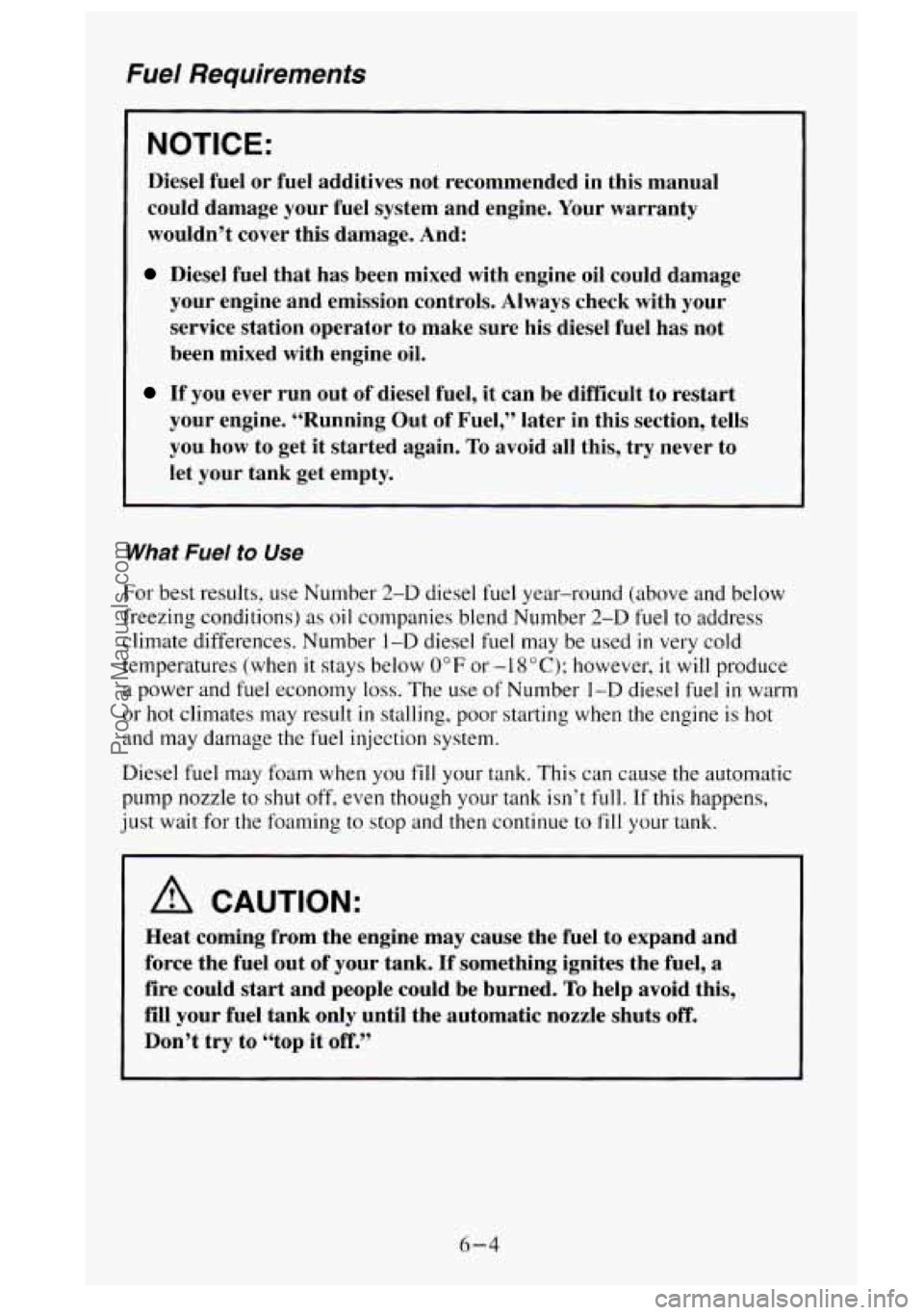
Fuel Requirements
NOTICE:
Diesel fuel or fuel additives not recommended in this manual
could damage your fuel system and engine. Your warranty
wouldn’t cover this damage. And:
Diesel fuel that has been mixed with engine oil could damage
your engine and emission controls. Always check with your
service station operator to make sure his diesel fuel has not \
been mixed with engine oil.
If you ever run out of diesel fuel, it can be difficult to restart
your engine. “Running Out of Fuel,” later in this section, tells
you how to get it started again.
To avoid all this, try never to
let your tank get empty.
What Fuel to Use
For best results, use Number 2-D diesel fuel year-round (above and below
freezing conditionsj as oil companies blend Number
2-D fuel to address
climate differences. Number
1-D diesel fuel may be used in very cold
temperatures (when
it stays below 0°F or -18°C); however, it will produce
a power and fuel economy loss. The use of Number I-D diesel fuel in warm
or hot climates may result in stalling, poor starting when the engine is hot
and
may damage the fuel injection system.
Diesel fuel may foam when you
fill your tank. This can cause the automatic
pump nozzle to shut off, even though your tank isn’t
full. If this happens,
just wait for the foaming to stop and then continue to
fill your tank.
A CAUTION:
Heat coming from the engine may cause the fuel to expand and \
force the fuel out of your tank.
If something ignites the fuel, a
fire could start and people could be burned. To help avoid this,
fill your fuel tank only until the automatic nozzle shuts
off.
Don’t try to “top it off.”
6-4
ProCarManuals.com
Page 286 of 488

NOTICE:
Use only engine oil with the American Petroleum Institute
Certified For Gasoline Engines “Starburst” symbol. Failure \
to
use the proper oil can result in engine damage not covered
by
your warranty.
GM Goodwrench@ oil (in Canada, GM Engine Oil) meets all the
requirements for your vehicle.
Engine Oil Additives
Don’t add anything to your oil. Your GM dealer is ready to advise if you
think something should be added.
When to Change Engine Oil
See if any one of these is true for you:
Most trips are less than 5 to 10 miles (8 to 16 km). This is particularly
important when outside temperatures are below freezing.
Most trips include extensive idling (such as frequent driving in stop and
go traffic).
Most trips are through dusty areas.
You operate your vehicle in dusty areas or off-road frequently.
You frequently tow a trailer.
If any one
of these is true for your vehicle, then you need to change your oil
and filter every
3,000 miles (5 000 km) or 3 months - whichever comes
first.
Light Duty Emissions:
If none of them is true, change the oil and filter every 7,500 miles (12 500
km) or 12 months - whichever comes first.
Heavy Duty Emissions:
If none of them is true, change the oil and filter every 6,000 miles (10 000
km) or 12 months - whichever comes first.
6-20
ProCarManuals.com
Page 291 of 488
This doughnut-shaped logo (symbol) is used on most oil containers to help
you select the correct oil.
You should look for this
on the oil container, and use only those oils that
display the logo.
GM Goodwrench‘ oil (in Canada, GM Engine Oil) meets all the
requirements for your vehicle.
Engine Oil Additives
Don’t add anything to your oil. Your GM dealer is ready to advise if you
think something should be added.
When to Change Engine Oil
See if any one of these is true for you:
0 Most trips are less than 5 to IO miles (8 to 16 km). This is particularly
important when outside temperatures are below freezing.
0 Most trips include extensive idling (such as frequent driving in stop and
e 00 traffic).
0 You operate your vehicle in dusty areas or off-road frequently.
0 You frequently tow a trailer or use a carrier on top of your vehicle.
If any of these is true for your vehicle, then you need to change your oil and
filter every
2,500 miles (4 000 km) or 3 months - whichever comes first.
If none of them is true, change the oil and filter every
5,000 miles (8 000
km) or 12 months - whichever comes first.
What to Do with Used Oil
Did you know that used engine oil contains certain elements that may be
unhealthy for your skin and could even cause cancer? Don‘t let used oil stay
on your skin for very long. Clean your skin and nails with soap and water,
or
a good hand cleaner. Wash or properly throw away clothing or rags
containing used engine oil. (See the manufacturer’s warnings about the use
and disposal
of oil products.)
Used oil can be a real threat
to the environment. If you change your own oil,
be sure
to drain all free-flowing oil from the filter before disposal. Don’t
ever dispose of oil by putting it
in the trash, pouring it on the ground, into
sewers, or into streams or bodies of water. Instead, recycle
it by taking it to
a place that collects used oil. If you have a problem properly disposing of
your used oil, ask your dealer, a service station or a local recycling center
for help.
6-25
ProCarManuals.com
Page 479 of 488
Oil DieselEngines
............................................... 6-21
Additives
................................................. 6-25
Pressure Gage (See “Gages”
j
ToCheck ................................................. 6-22
WhatKindtoUse
.......................................... 6-23
WhentoAdd
.............................................. 6-22
WhentoChange
............................................ 6-25
What to Do with Used Oil
.................................... 6-25
Gasoline Engines
............................................. 6-16
Additives
................................................. 6-20
Pressure Gage (See “Gages”)
ToCheck
................................................. 6-16
WhatKindtoUse
.......................................... 6-17
WhentoAdd .............................................. 6-17
When to Change ............................................ 6-20
What to Do with Used
Oil .................................... 6-21
Owner Checks and Services
........................................ 7-93
Parking Brake (See “Brakes-Parking”)
On Hills (See “Towing-Parking on Hills’*j
Over Things That Burn
........................................
Passing (See “Drivin~-Passing”)
Periodic Maintenance Inspections (See “Scheduled Maintenance Services”)
Power
Door Locks (See “Dood’j 2-31
Steering
...................................................... 4-7
Steering Fluid
................................................ 640
Take-Off
.................................................... 4-35
Winches
..................................................... 4-34
Radiator Pressure Cap
............................................ 6-39
Radio (See “Audio Systems”)
Rear Axle (See ”Axle”)
Recommended Fluids and Lubricants (See “Scheduled Maintenance Services“)
Recovery Hooks
................................................. 5-40
Replacement Parts ............................................... 6-80
Reporting Safety Defects To The United States Government (See “Safety Defects”)
Roadside Assistance
............................................... 8-5
Rocking Your Vehicle ............................................ 5-39
Rear Window Defogger
............................................ 3-4
Safety Belts ..................................................... 1-9
Adults ...................................................... 1-12
Center Passenger Position ....................................... 1-25
Checking Restraint System ...................................... 1-44
7
ProCarManuals.com